Movies
“I, Robot”
Will Smith has one hot bod, but is that enough to overcome this futuristic flick's edifice complex?
“I, Robot” is set in Chicago circa 2035, a land of silver-and-granite skyscrapers that stare coldly at the world through monster-size safety-glass eyes. The movie itself is a cold, blank stare, and it’s skyscraperish itself, always aware of its massive size and its state-of-the-art sleekness — it has an edifice complex. Part whodunit, part action film, part chilly cautionary tale (don’t think you’re going to escape from its clutches without the obligatory “We must save humanity from itself” scene), “I, Robot” strives to be so many things that it ultimately falls away to nothing, a heap of expensive metal parts.
Through occasional sections of the movie, those parts hang together well enough to make you think they actually serve a useful, entertaining purpose: In places I found myself drawn in by “I, Robot,” but usually with the sharp clang of magnet to metal. If I responded to the picture in any remotely organic way, that had to do mostly, I think, with Will Smith.
Smith plays Detective Del Spooner with his usual affable touch, and we’re eased into this dry, metallic movie with an early scene, set in his laid-back, ’90s-style apartment, in which he awakens, rises seminude from his bed like a magnificent dolphin god, and steps into the shower, where the water flows off his torso in a rushing S-curve. For human beings of all genders and persuasions who are inclined to enjoy looking at the human body, this vision is both potently erotic and lyrically earthbound — it’s everything in the movie that’s really worth looking at, and after the first 10 minutes of the picture, it’s over.
Spooner lives in a world of robots — they walk among humans, mechanical servants built only to serve and never to harm — but he deeply distrusts them, in part because of a guilty secret he harbors. And we grasp early on that Spooner, whose body looks like a Michelangelo sketch conceived in muscular inverted triangles, bears a notable resemblance to the robots around him: They, too, sport slender hips and chests that flare out like pilsner glasses — although unlike Spooner, who has a loose, easy gait, they strut elegantly, if stiffly, on their pegged-together legs.
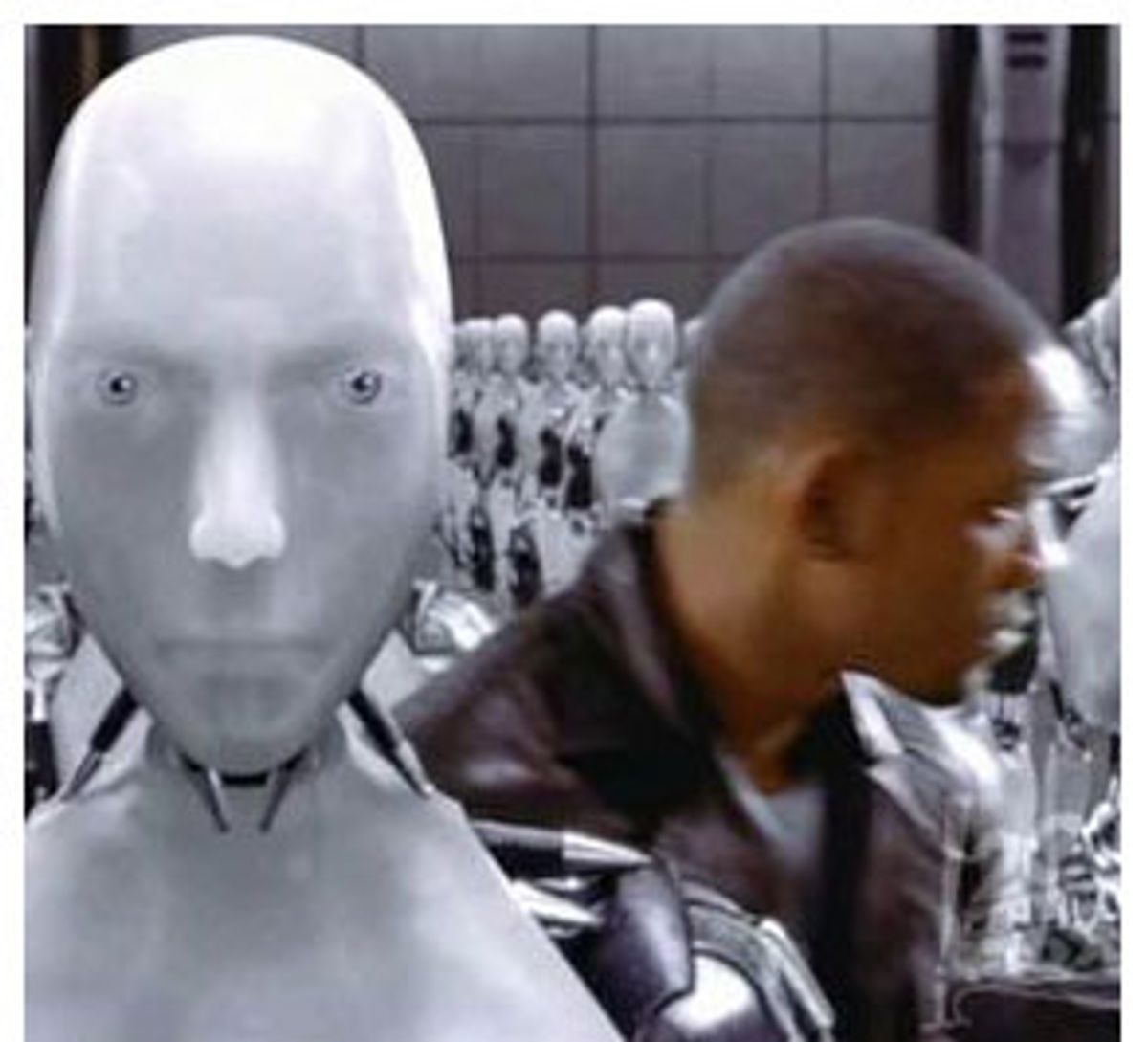
But those are the old-fangled, pre-2035 robots we’re talking about. The fellow who got the whole robot biz started in the first place, Dr. Alfred Lanning (James Cromwell), is about to introduce a far more advanced and somewhat more human type of robot, the NS-5 (and in vast, armylike quantities to boot). On the eve of the big robot launch, he mysteriously commits suicide; Spooner is assigned to the case, and immediately smells something fishy in robotland. The sylphlike Dr. Susan Calvin (Bridget Moynahan), a specialist in robot pyschology, reassures him that the new, improved robots, as the old ones were, are programmed to strictly follow orders and would never harm a human. But one NS-5 in particular, the very special Sonny (a computer-generated character whose movements and mannerisms were adapted from those of actor Alan Tudyk, Gollum-style), suggests to both Dr. Calvin and Spooner that these new mechanical creatures may be more dangerous than anyone realizes.
You can hear the gears groan mightily as director Alex Proyas (“The Crow,” “Dark City”) manipulates the man-vs.-machine theme with giant mechanical fingers. In between, there’s the requisite amount of action, including a car-chase scene (it’s actually more of a car-vs.-robot scene) that takes place in a tunnel, with loads of clanging bangs and crashes and lots of metal-against-metal sparks.
And so what? Even with its grand “Oh, the humanity!” themes ringing so loudly throughout, “I, Robot” feels cavernously empty. Its production values are high, if height is what you’re after, and the eerie expressiveness of the NS-5s is weirdly riveting, at least at first. (The “flesh” that covers their faces and parts of their smoothly mechanized bodies has a pearly, rubbery glow, like the protective pliable cases made for iPods.)
But once you’ve been wowed by the production values and computer imagery of “I, Robot,” there’s not much to gawk at. And the hint of romance that’s stirred up between Spooner and Dr. Calvin never amounts to anything (apparently, that weary old “fear of interracial romance” thing once again rears its tired head). The script, by Jeff Vintar and Avika Goldsman, borrows daintily here and there from the classic Isaac Asimov stories from which the movie takes its title. It just doesn’t feel like Asimov — not even like an incredible simulation of Asimov. It is, like the NS-5 itself, remarkably lifelike. But aside from Smith, there’s just too little life to like.
Stephanie Zacharek is a senior writer for Salon Arts & Entertainment. More Stephanie Zacharek.
“Snow White and the Huntsman”: A would-be fantasy classic
Charlize Theron blows Kristen Stewart off the screen in "Snow White and the Huntsman," an unexpected summer delight
Charlize Theron in "Snow White and the Huntsman" There’s plenty of ambition and imagination on display from the first seconds of “Snow White and the Huntsman,” along with an enthusiasm for the material that can’t be faked and which makes up for at least some of the film’s missteps. I resisted this derivative mishmash of classic fairytale and modern epic fantasy for as long as I could, but ultimately it swept me up into its geeky but manly embrace and carried me away on a white charger. English commercial director Rupert Sanders makes his feature debut with a splash, launching a fantasy-adventure franchise that probably isn’t as good as any of the things it references — the classic Walt Disney film, of course, but also “The Lord of the Rings,” the Narnia series, “Game of Thrones,” “Star Wars,” Shakespeare and countless other works besides — but comes close enough, I’d guess, to carve out its own niche and create its own fan base.
Continue Reading CloseBlockbuster fatigue? A summer alt-movie guide
Summer movies beyond Batman, from male strippers to a Depression neo-noir to Matthew McConaughey's big comeback
From top: stills from "Beasts of the Southern Wild," "Take This Waltz" and "Lawless" It may feel to you as if the summer moviegoing season has only just begun and many months of popcorn-munching delight lie ahead. That’s both true and not true. There’s a degree of pseudo-Calvinist predestination about the whole thing this year that’s unusual even by the standards of Hollywood, where conventional wisdom and guesswork-in-advance count for actual knowledge.
I mean, nobody knows for sure how much money the 1980s big-hair musical “Rock of Ages” will gross or whether “The Dark Knight Rises” will beat out “The Avengers” as the top box-office hit of the year. (My answers: Not enough to be a huge hit, and no.) But pretty much any idiot with a computer — me, for instance — can look at the calendar and figure out what the biggest hits of the summer will be. As I just mentioned, the summer’s No. 1 movie, in all probability, has already been released. (I’ll save the trollery about how it wasn’t really all that great for some other time.) After we get through “Prometheus” and “Abraham Lincoln: Vampire Hunter” in June, followed by “The Amazing Spider-Man” and “The Dark Knight Rises” in July, well, that’s pretty much it. I exaggerate, but only a little — these days, blockbuster season commences in early May and is over by the end of July, with August reserved as usual for offbeat genre movies, the fourth chapters of trilogies, and the continuing careers of Sylvester Stallone and Jackie Chan. (In other words, the good stuff.)
Continue Reading CloseThe kids are all wrong
Nightmare children populate the dark, dreary and near-perfect "The Bad Seed" and "We Need to Talk About Kevin"
The best movies act as a kind of amber, trapping the life of their times. Sometimes, you get jewels, other times you get, well, amber.
It was hard to read anything about “We Need to Talk About Kevin” without some reference to its distinguished antecedents in the “there’s something about that boy, June” school of demon child cinema. “The Omen,” “Rosemary’s Baby” and “Problem Child” all got their time on deck, but one film in particular gets mentioned, for it invented this entire genre. And that film is Mervyn LeRoy’s 1956 epic “The Bad Seed.” This is one of those movies embedded in our consciousness that perhaps should stay embedded and not actually be pried loose.
Continue Reading ClosePick of the week: Haunting, gorgeous “Oslo, August 31st”
Pick of the week: "Oslo, August 31st" is a wrenching voyage of discovery in Norway's suddenly trendy capital
“Oslo, August 31st” is, as the title suggests, an evocation of one day in the Norwegian capital, as experienced by a troubled young man who’s facing the end of summer and the end of his youth. It’s a marvelously constructed personal journey, both wrenching and bittersweet, whose emotional ripple effects stay with you for days and weeks afterward. While much of international art cinema can seem overly talky or conceptually alien to American viewers, this second feature film from Norwegian director Joachim Trier is a dynamic, even breathtaking visual experience without much dialogue or any philosophical heavy lifting, following the bony, handsome, exceedingly vulnerable Anders (Anders Danielsen Lie) through coffee shops, nightclubs and bodies of water, en route to an ambiguous final destination.
Continue Reading Close“Moonrise Kingdom”: Wes Anderson’s mid-’60s love story
Bruce Willis and Ed Norton are at their best in the rapturous summer fantasy "Moonrise Kingdom"
Tilda Swinton, Bruce Willis and Edward Norton in "Moonrise Kingdom" All the details of Wes Anderson’s rapturous and hilarious mid-1960s New England summer romance “Moonrise Kingdom,” taken one at a time, are plausible. Indeed they are more than plausible; they’re perfect, from the fitted uniforms and yellow canvas tents of the troop of “Khaki Scouts” headed by cigarette-smoking Edward Norton to the achingly picturesque island home where the brood of children belonging to Bill Murray and Frances McDormand sit around listening to the Leonard Bernstein recording of “A Young Person’s Guide to the Orchestra.” (I’m not going to bother questioning whether that record existed in 1965; some production intern probably spent half a day tracking down its history.)
Continue Reading ClosePage 1 of 709 in Movies