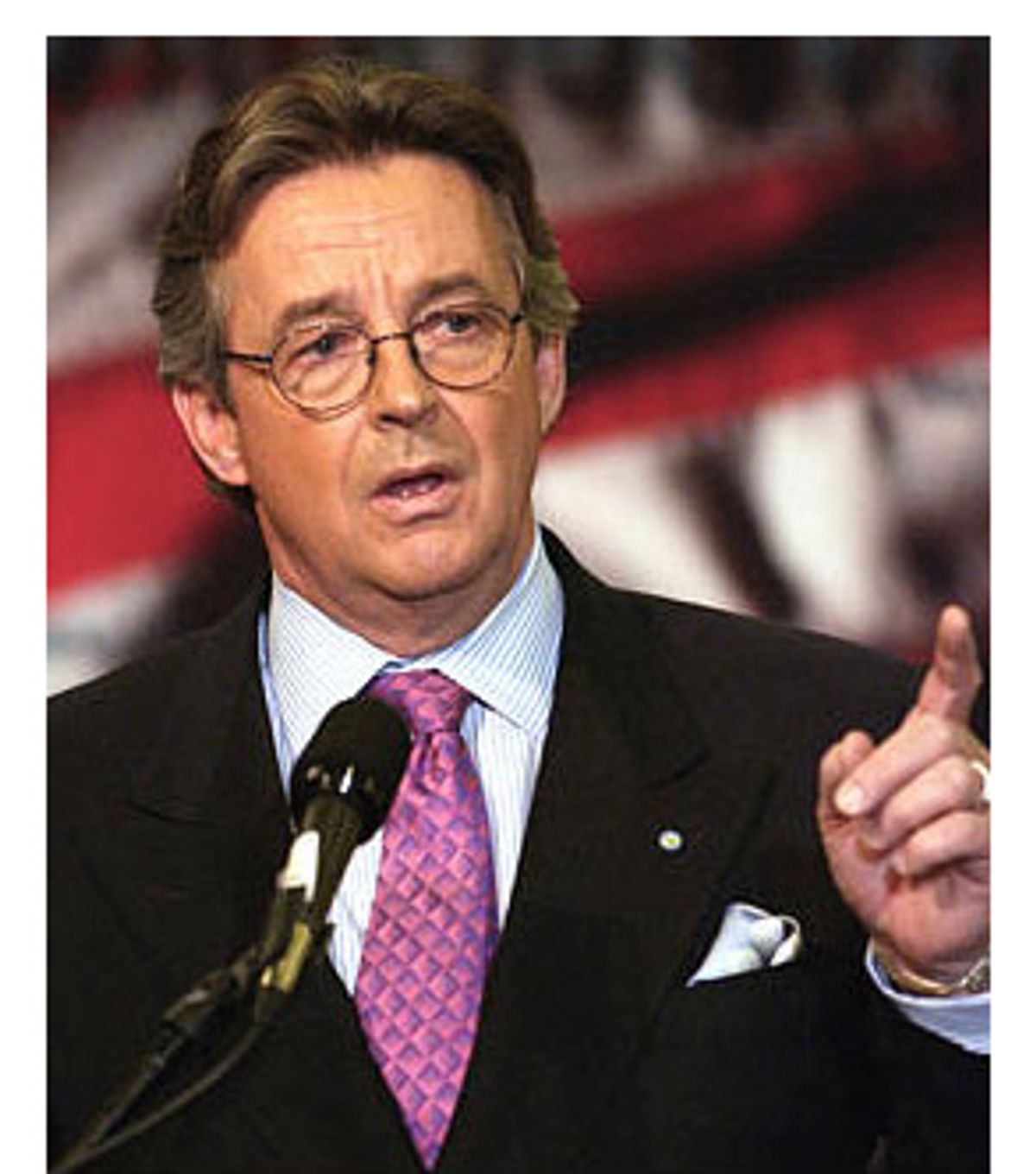
Editor's note: Last week, the Senate Intelligence Committee released its report on the U.S. intelligence community's prewar assessments on Iraq. An appendix discusses the role taken by former ambassador Joseph C. Wilson in determining whether Iraq had obtained uranium from Niger. The following is Wilson's letter to the Senate Intelligence Committee pointing to errors in the Republican senators' additional comments to the report and demanding corrections.
- - - - - - - - - - - -
July 15, 2004
The Hon. Pat Roberts, Chairman, Senate Select Committee on Intelligence
The Hon. Jay Rockefeller, Vice Chairman, Senate Select Committee on Intelligence
Dear Sen. Roberts and Sen. Rockefeller,
I read with great surprise and consternation the Niger portion of Sens. Roberts, Bond and Hatch's additional comments to the Senate Select Intelligence Committee's Report on the U.S. Intelligence Community's Prewar Assessment on Iraq. I am taking this opportunity to clarify some of the issues raised in these comments.
First conclusion: "The plan to send the former ambassador to Niger was suggested by the former ambassador's wife, a CIA employee."
That is not true. The conclusion is apparently based on one anodyne quote from a memo Valerie Plame, my wife, sent to her superiors that says, "My husband has good relations with the PM [prime minister] and the former Minister of Mines (not to mention lots of French contacts), both of whom could possibly shed light on this sort of activity." There is no suggestion or recommendation in that statement that I be sent on the trip. Indeed it is little more than a recitation of my contacts and bona fides. The conclusion is reinforced by comments in the body of the report that a CPD [Counterproliferation Division] reports officer stated that "the former ambassador's wife 'offered up his name'" (page 39) and a State Department intelligence and research officer stated that the "meeting was 'apparently convened by [the former ambassador's] wife who had the idea to dispatch him to use his contacts to sort out the Iraq-Niger uranium issue."
In fact, Valerie was not in the meeting at which the subject of my trip was raised. Neither was the CPD reports officer. After having escorted me into the room, she [Valerie] departed the meeting to avoid even the appearance of conflict of interest. It was at that meeting where the question of my traveling to Niger was broached with me for the first time and came only after a thorough discussion of what the participants did and did not know about the subject. My bona fides justifying the invitation to the meeting were the trip I had previously taken to Niger to look at other uranium-related questions as well as 20 years living and working in Africa, and personal contacts throughout the Niger government. Neither the CPD reports officer nor the State analyst were in the chain of command to know who, or how, the decision was made. The interpretations attributed to them are not the full story. In fact, it is my understanding that the reports officer has a different conclusion about Valerie's role than the one offered in the "additional comments." I urge the committee to reinterview the officer and publicly publish his statement.
It is unfortunate that the report failed to include the CIA's position on this matter. If the staff had done so it would undoubtedly have been given the same evidence as provided to Newsday reporters Tim Phelps and Knut Royce in July 2003. They reported on July 22 that:
"A senior intelligence officer confirmed that Plame was a Directorate of Operations undercover officer who worked 'alongside' the operations officers who asked her husband to travel to Niger. But he said she did not recommend her husband to undertake the Niger assignment. 'They [the officers who did ask Wilson to check the uranium story] were aware of who she was married to, which is not surprising,' he said. 'There are people elsewhere in government who are trying to make her look like she was the one who was cooking this up, for some reason,' he said. 'I can't figure out what it could be.' 'We paid his [Wilson's] airfare. But to go to Niger is not exactly a benefit. Most people you'd have to pay big bucks to go there,' the senior intelligence official said. Wilson said he was reimbursed only for expenses." (Newsday article "Columnist Blows CIA Agent's Cover," dated July 22, 2003).
In fact, on July 13 of this year, David Ensor, the CNN correspondent, did call the CIA for a statement of its position and reported that a senior CIA official confirmed my account that Valerie did not propose me for the trip:
"'She did not propose me,' he [Wilson] said -- others at the CIA did so. A senior CIA official said that is his understanding too."
Second conclusion: "Rather than speaking publicly about his actual experiences during his inquiry of the Niger issue, the former ambassador seems to have included information he learned from press accounts and from his beliefs about how the Intelligence Community would have or should have handled the information he provided."
This conclusion states that I told the committee staff that I "may have become confused about my own recollection after the International Atomic Energy Agency (IAEA) reported that the names and dates on the documents were not correct." At the time that I was asked that question, I was not afforded the opportunity to review the articles to which the staff was referring. I have now done so.
On March 7, 2003, the director general of the IAEA reported to the U.N. Security Council that the documents that had been given to him were "not authentic." His deputy, Jacques Baute, was even more direct, pointing out that the forgeries were so obvious that a quick Google search would have exposed their flaws. A State Department spokesman was quoted the next day as saying about the forgeries, "We fell for it." From that time on the details surrounding the documents became public knowledge and were widely reported. I was not the source of information regarding the forensic analysis of the documents in question; the IAEA was.
The first time I spoke publicly about the Niger issue was in response to the State Department's disclaimer. On CNN a few days later, in response to a question, I replied that I believed the U.S. government knew more about the issue than the State Department spokesman had let on and that he had misspoken. I did not speak of my trip.
My first public statement was in my article of July 6 published in the New York Times, written only after it became apparent that the administration was not going to deal with the Niger question unless it was forced to. I wrote the article because I believed then, and I believe now, that it was important to correct the record on the statement in the president's State of the Union address which lent credence to the charge that Iraq was actively reconstituting its nuclear weapons program. I believed that the record should reflect the facts as the U.S. government had known them for over a year. The contents of my article do not appear in the body of the report and it is not quoted in the "additional comments." In that article, I state clearly that "as for the actual memorandum, I never saw it. But news accounts have pointed out that the documents had glaring errors -- they were signed, for example, by officials who were no longer in government -- and were probably forged. (And then there's the fact that Niger formally denied the charges.)"
The first time I actually saw what were represented as the documents was when Andrea Mitchell, the NBC correspondent, handed them to me in an interview on July 21. I was not wearing my glasses and could not read them. I have to this day not read them. I would have absolutely no reason to claim to have done so. My mission was to look into whether such a transaction took place or could take place. It had not and could not. By definition that makes the documents bogus.
The text of the "additional comments" also asserts that "during Mr. Wilson's media blitz, he appeared on more than thirty television shows including entertainment venues. Time and again, Joe Wilson told anyone who would listen that the President had lied to the American people, that the Vice President had lied, and that he had 'debunked' the claim that Iraq was seeking uranium from Africa."
My article in the New York Times makes clear that I attributed to myself "a small role in the effort to verify information about Africa's suspected link to Iraq's nonconventional weapons programs." After it became public that there were then-Ambassador to Niger Barbro Owens-Kirkpatrick's report and the report from a four-star Marine Corps general, Carleton Fulford, in the files of the U.S. government, I went to great lengths to point out that mine was but one of three reports on the subject. I never claimed to have "debunked" the allegation that Iraq was seeking uranium from Africa. I claimed only that the transaction described in the documents that turned out to be forgeries could not have occurred and did not occur. I did not speak out on the subject until several months after it became evident that what underpinned the assertion in the State of the Union address were those documents, reports of which had sparked Vice President Cheney's original question that led to my trip. The White House must have agreed. The day after my article appeared in the Times a spokesman for the president told the Washington Post that "the sixteen words did not rise to the level of inclusion in the State of the Union."
I have been very careful to say that while I believe that the use of the 16 words in the State of the Union address was a deliberate attempt to deceive the Congress of the United States, I do not know what role the president may have had other than he has accepted responsibility for the words he spoke. I have also said on many occasions that I believe the president has proven to be far more protective of his senior staff than they have been to him.
The "additional comments" also assert: "The Committee found that, for most analysts, the former ambassador's report lent more credibility, not less, to the reported Niger-Iraq uranium deal." In fact, the body of the Senate report suggests the exact opposite:
In August 2002, a CIA NESA [Office of Near Eastern and South Asian Analysis] report on Iraq's weapons of mass destruction capabilities did not include the alleged Iraq-Niger uranium information. (page 48)
In September 2002, during coordination of a speech with an NSC staff member, the CIA analyst suggested the reference to Iraqi attempts to acquire uranium from Africa be removed. The CIA analyst said the NSC staff member said that would leave the British "flapping in the wind." (page 50)
The uranium text was included in the body of the NIE [National Intelligence Estimate] but not in the key judgments. When someone suggested that the uranium information be included as another sign of reconstitution, the INR [State Department's Bureau of Intelligence and Research] Iraq nuclear analyst spoke up and said the he did not agree with the uranium reporting and that INR would be including text indicating their disagreement in their footnote on nuclear reconstitution. The NIO [national intelligence officer] said he did not recall anyone really supporting including the uranium issue as part of the judgment that Iraq was reconstituting its nuclear program, so he suggested that the uranium information did not need to be part of the key judgments. He told committee staff that he suggested, "We'll leave it in the paper for completeness. Nobody can say we didn't connect the dots. But we don't have to put that dot in the key judgments." (page 53)
On Oct. 2, 2002, the Deputy DCI [director of central intelligence] testified before the SSCI [Senate Select Committee on Intelligence]. Sen. Jon Kyl asked the Deputy DCI whether he had read the British White Paper and whether he disagreed with anything in the report. The Deputy DCI testified that "the one thing where I think they stretched a little bit beyond where we would stretch is on the points about Iraq seeking uranium from various African locations." (page 54)
On Oct. 4, 2002, the NIO for Strategic and Nuclear Programs testified that "there is some information on attempts ... there's a question about those attempts because of the control of the material in those countries ... For us it's more the concern that they [Iraq] have uranium in-country now." (page 54)
On Oct. 5, 2002, the ADDI [associate deputy director for intelligence] said an Iraqi nuclear analyst -- he could not remember who -- raised concerns about the sourcing and some of the facts of the Niger reporting, specifically that the control of the mines in Niger would have made it very difficult to get yellowcake to Iraq. (page 55)
Based on the analyst's comments, the ADDI faxed a memo to the deputy national security advisor that said, "Remove the sentence because the amount is in dispute and it is debatable whether it can be acquired from this source. We told Congress that the Brits have exaggerated this issue. Finally, the Iraqis already have 550 metric tons of uranium oxide in their inventory." (page 56)
On Oct. 6, 2002, the DCI called the deputy national security advisor directly to outline the CIA's concerns. The DCI testified to the SSCI on July 16, 2003, that he told the deputy national security advisor that the "President should not be a fact witness on this issue," because his analysts had told him the "reporting was weak." (page 56)
On Oct. 6, 2002, the CIA sent a second fax to the White House that said, "More on why we recommend removing the sentence about procuring uranium oxide from Africa: Three points (1) The evidence is weak. One of the two mines cited by the source as the location of the uranium oxide is flooded. The other mine cited by the source is under the control of the French authorities. (2) The procurement is not particularly significant to Iraq's nuclear ambitions because the Iraqis already have a large stock of uranium oxide in their inventory. And (3) we have shared points one and two with Congress, telling them that the Africa story is overblown and telling them this is one of the two issues where we differed with the British." (page 56)
On March 8, 2003, the intelligence report on my trip was disseminated within the U.S. government, according to the Senate report (page 43). Further, the Senate report states that "in early March, the Vice President asked his morning briefer for an update on the Niger uranium issue." That update from the CIA "also noted that the CIA would be debriefing a source who may have information related to the alleged sale on March 5." The report then states the "DO officials also said they alerted WINPAC [Center for Weapons Intelligence, Nonproliferation and Arms Control] analysts when the report was being disseminated because they knew the high priority of the issue." The report notes that the CIA briefer did not brief the vice president on the report. (page 46)
It is clear from the body of the Senate report that the intelligence community, including the DCI himself, made several attempts to ensure that the president did not become a "fact witness" on an allegation that was so weak. A thorough reading of the report substantiates the claim made in my opinion piece in the New York Times and in subsequent interviews I have given on the subject. The 16 words should never have been in the State of the Union address, as the White House now acknowledges.
I undertook this mission at the request of my government in response to a legitimate concern that Saddam Hussein was attempting to reconstitute his nuclear weapons program. This was a national security issue that has concerned me since I was the deputy chief of mission in the U.S. Embassy in Iraq before and during the first Gulf War.
At the time of my trip I was in private business and had not offered my views publicly on the policy we should adopt toward Iraq. Indeed, throughout the debate in the run-up to the war, I took the position that the U.S. be firm with Saddam Hussein on the question of weapons of mass destruction programs, including backing tough diplomacy with the credible threat of force. In that debate I never mentioned my trip to Niger. I did not share the details of my trip until May 2003, after the war was over, and then only when it became clear that the administration was not going to address the issue of the State of the Union statement.
It is essential that the errors and distortions in the additional comments be corrected for the public record. Nothing could be more important for the American people than to have an accurate picture of the events that led to the decision to bring the United States into war in Iraq. The Senate Intelligence Committee has an obligation to present to the American people the factual basis of that process. I hope that this letter is helpful in that effort. I look forward to your further "additional comments."
Sincerely,
Joseph C. Wilson IV, Washington, D.C.
Shares