Air Travel

The hysterical skies

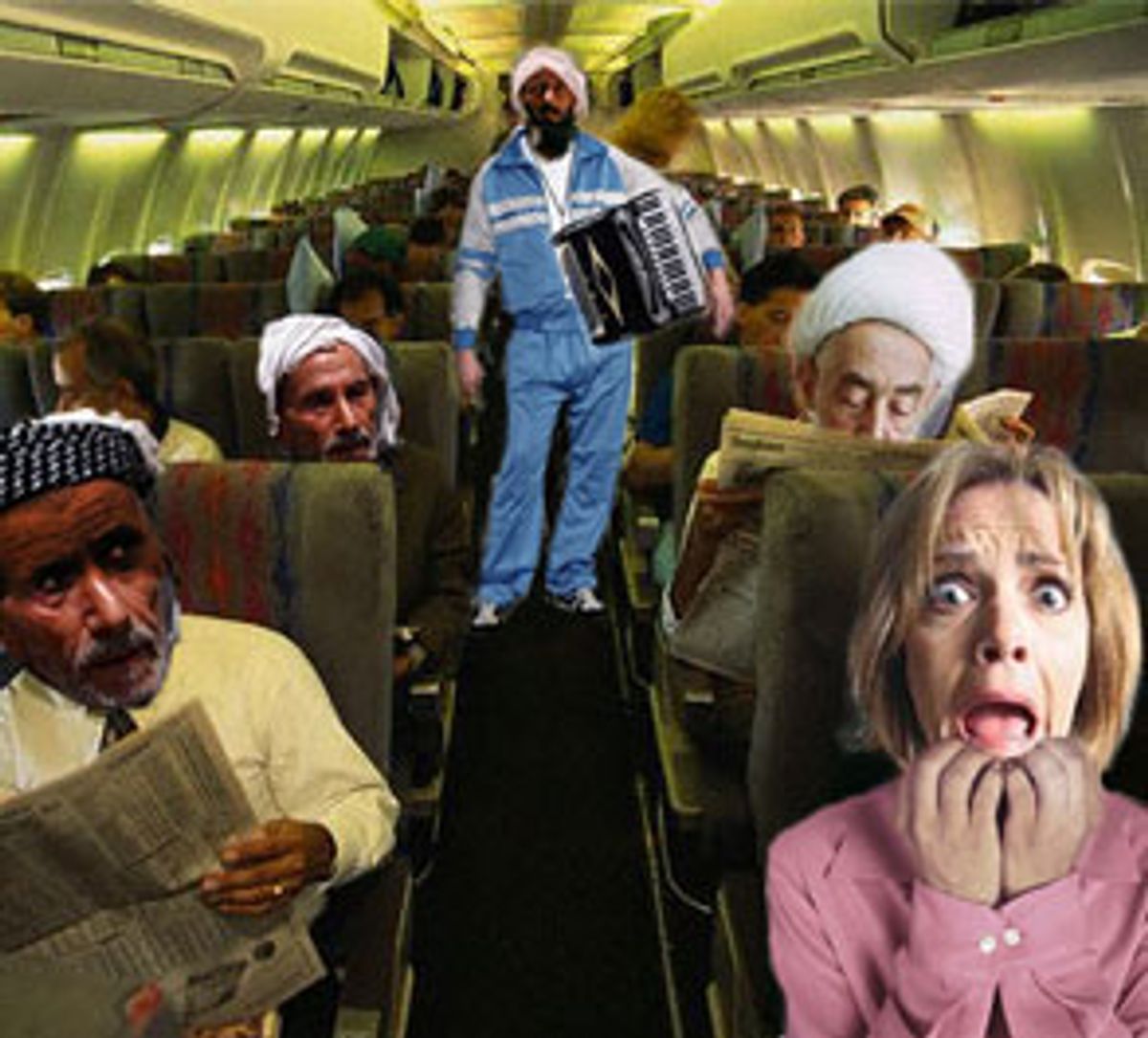
She survived a flight with 14 harmless Syrian musicians -- then spread 3,000 bigoted and paranoid words across the Internet. As a pilot and an American, I'm appalled.

  • more
    • All Share Services

The hysterical skies

In this space was supposed to be installment No. 6 of my multiweek dissertation on airports and terminals. The topic is being usurped by one of those nagging, Web-borne issues of the moment, in this case a reactionary scare story making the cyber-rounds during the past week.

The piece in question, “Terror in the Skies, Again?” is the work of Annie Jacobsen, a writer for WomensWallStreet.com. Jacobsen shares the account of the emotional meltdown she and her fellow passengers experienced when, aboard a Northwest Airlines flight from Detroit to Los Angeles, a group of Middle Eastern passengers proceeded to act “suspiciously.” I’ll invite you to experience “Terror” yourself, but be warned it’s quite long. It needs to be, I suppose, since ultimately it’s a story about nothing, puffed and aggrandized to appear important.

The editors get the drama cooking with some foreboding music: “You are about to read an account of what happened,” counsels a 70-word preamble. “The WWS Editorial Team debated long and hard about how to handle this information and ultimately we decided it was something that should be shared … Here is Annie’s story” [insert lower-octave piano chord here].

What follows are six pages of the worst grade-school prose, spring-loaded with mindless hysterics and bigoted provocation.

Fourteen dark-skinned men from Syria board Northwest’s flight 327, seated in two separate groups. Some are carrying oddly shaped bags and wearing track suits with Arabic script across the back. During the flight the men socialize, gesture to one another, move about the cabin with pieces of their luggage, and, most ominous of all, repeatedly make trips to the bathroom. The author links the men’s apparently irritable bladders to a report published in the Observer (U.K.) warning of terrorist plots to smuggle bomb components onto airplanes one piece at a time, to be secretly assembled in lavatories.

“What I experienced during that flight,” breathes Jacobsen, “has caused me to question whether the United States of America can realistically uphold the civil liberties of every individual, even non-citizens, and protect its citizens from terrorist threats.”

Intriguing, no? I, for one, fully admit that certain acts of airborne crime and treachery may indeed open the channels to a debate on civil liberties. Pray tell, what happened? Gunfight at 37,000 feet? Valiant passengers wrestle a grenade from a suicidal operative? Hero pilots beat back a cockpit takeover?

Well, no. As a matter of fact, nothing happened. Turns out the Syrians are part of a musical ensemble hired to play at a hotel. The men talk to one another. They glance around. They pee.

That’s it?

That’s it.

Now, in fairness to Jacobsen, I’ll admit that in-flight jitters over the conspicuous presence of a group of young Arabs is neither unexpected nor, necessarily, irrational. She speaks of seven of the men standing in unison, a moment that, if unembellished, would have even the most culturally open-minded of us wide-eyed and grabbing our armrest. As everybody knows, it was not a gaggle of Canadian potato farmers who commandeered those jetliners on Sept. 11. See also the legacy of air crimes over the past several decades, from Pan Am 103 to the UTA bombing to the failed schemings of Ramzi Yousef, the culprits each time being young Arab males.

Air crews and passengers alike are thus prone to jumpiness should a certain template of race and behavior be filled. Jacobsen’s folly is in not being able to step back from that jumpiness — neither during the flight itself, at which point her worry and behavior are at least excusable, nor well after touching down safely. Speaking as a pilot, air travel columnist, and American, I find Jacobsen’s 3,000-word ghost story of Arab boogeymen among the most overwrought and inflammatory tracts I’ve encountered in some time.

Most disturbing of all has been the pickup from Internet bloggers and news sources, including ABC, CNN, MSNBC and the New York Times. The writer hops a flight to California on which absolutely nothing of danger occurs, and the following are among the citations:

“Harrowing piece”
“The frightening true story”
“Disturbing account”
“Riveting article”
“An absolute must-read”

“Read all about the breaking Northwest airlines scare,” advertises TheLosAngelesNews.com, suggesting perhaps a narrowly averted crash, a bomb defused during flight or a thwarted skyjacking. Click on over to hear instead about the toilet habits of a group of Syrian minstrels and one middle-aged woman’s alarmist reaction to them. No matter; over the past week or so Jacobsen has found herself linked and excerpted in every last crevice of the Web. Those of you not convinced of just how paranoid and xenophobic Americans can be, look no further than the following online posts, which, along with thousands like them, have emerged in direct response to this story:

“You will never, ever, catch me on an airplane again!”

“My advice would be to de-plane as soon as I counted 14 Arabs as passengers. ”

“Soon after 9/11 we were in a local McDonald’s and a group of Middle Eastern men came in and got carry-out. They sat in their van for a while then headed North. I felt scared out of my wits. I wrote down a description of the vehicle and license, but never did anything with it. Guess next time I won’t be so stupid.”

Jacobsen spins her experience into a not-so-veiled call for racial profiling of airline passengers. Help me out with this one: If only those musicians had been interrogated prior to boarding, it would have been revealed they were, in fact … musicians. (They had, of course, endured the same concourse X-ray and metal detector rigmarole as everyone else, and were in possession of valid passports and visas.)

My own feelings on passenger profiling are mixed, and I’m not as liberal on the issue as you might expect. However, I do think singling out a specific ethnicity for extra screening is less a racist idea than a wasteful and ineffective one. Does it not occur to people that Muslim radicals come in all complexions and from many nations — from the heart of black Africa to the archipelagoes of Southeast Asia? (Many Syrians, no less, are fair-haired and light-skinned.) Does it not occur to people that terrorists are clever, resourceful and, in the end, bound to outwit such obvious snares? The notion that 14 saboteurs, replete with silk-screened track suits effectively advertising themselves as such, would obviously and boisterously proceed in and out of an airplane lavatory, taking turns to construct a bomb, is so over-the-top ludicrous it deserves its own comedy sketch. Indeed, Jacobsen is trying to portray a scene of angst and fear, but she inadvertently scripts out a parody. I half-expected her to tell me that one of the men wore a cardboard sign labeled “TERRORIST.”

On Tuesday morning I appeared as a guest on a conservative, drive-time radio show in Philadelphia, and Jacobsen was the hot issue. The host, without much else to go on, proposed the Syrians had choreographed a “dry run” for a future attack. (At one point he referred to the involved carrier, Northwest Airlines, as “Northeastern.”) When I dared express doubt, and noted that investigators from the Transportation Security Administration and the FBI had confirmed the men’s identities and motives, I was mocked, ridiculed and eventually hung up on. The very suggestion that the men could have been innocent musicians seemed, in the eyes of the host and callers, preposterous. They had to be terrorists. Disagreeing got me called “a frickin’ idiot,” and a caller demanded to know which airline I worked for so he could be certain never to ride on a plane with a traitor like me at the controls.

Stop the presses: A sequel to “Terror in the Skies, Again?” has now been posted on WomensWallStreet.com, in which Jacobsen reinfects the conversation with a fresh dose of mongering. “And I now have another important question,” she writes. “Is there a link between my experience … and the arrest of Ali Mohamed Almosaleh by Customs agents at the Minneapolis Airport on July 7?” Almosaleh, a Syrian, was allegedly carrying a suicide note and “anti-American material.”

Jacobsen’s hint at conspiracy, however, is based exclusively on the coincidence that Almosaleh and the musicians happen to all be Syrian citizens. I see. That a supposition this groundless and stupid can make it into print and entice the likes of major news networks should outrage any clear-thinking American. How about we seek out all Syrians and put their names on airline blacklists?

Jacobsen’s sequel is peppered with incendiary quotes from industry sources. Says an airline pilot: “The terrorists are probing us all the time.” Another confides a maddeningly baseless belief that Jacobsen had been “likely on a dry run,” while another states, “The incident you wrote about, and incidents like it, occur more than you like to think. It is a ‘dirty little secret’ that all of us, as crew members, have known about for quite some time.”

Which dirty little secret, exactly, are we talking about? That foreigners ride on airplanes?

In a moment of truly ghastly philosophizing, Jacobsen includes a manipulative passage in which she is smitten with anguish as she recollects a photograph taken during the Sept. 11 attacks. She gives us this: “Political correctness has become a major road block for airline safety … I think about the meaning of ‘dry run.’ And then I think about what it means to be politically correct. And I keep coming up blank.”

So do I.

Aside from matters of politics and general opinion, is Jacobsen playing fast and loose with the facts? There appear to be embellishments in her original tale.

Aboard flight 327, as she, her husband and several passengers and crew are having their nervous breakdowns, comes this instance of B-movie tension: “[The flight attendant] leaned over and quietly told my husband there were federal air marshals sitting all around us. She asked him not to tell anyone and explained that she could be in trouble for giving out that information. She then continued serving drinks.”

Are we to believe not only that an airline professional was unwise enough to reveal such a thing, but that a group of marshals — not one, not two, but several — having gotten word that a covey of Arabs were flying to LAX, were on hand to trail and observe them? That’s some tight logistical planning. Are we following Middle Easterners through airports now? If so, how does that work at Kennedy International, I wonder, where foreign airliners carrying thousands of passengers arrive daily from Pakistan, Saudi Arabia, Jordan, Egypt, Morocco, the UAE and elsewhere? That’s a lot of dry runs, and there’s no love lost, after all, between Muslim radicals and the governments who own and operate these airlines — Pakistan International, Saudi Arabian, EgyptAir, Royal Jordanian, etc. Such subtleties are lost on that segment of the public who’d prefer a more digestible cock-and-bull yarn from high above the American heartland. As for those wacky airlines from abroad, why not simply ban them from American airspace?

Clearly I’m in a fit of envy over Jacobsen’s cheap grab at notoriety. I’ve got a book out and could use some publicity. Here, let me give it a try.

Late last summer I boarded a nonstop flight from Dubai, United Arab Emirates, to Newark, N.J. After taking my seat, I noticed that well over a hundred of my fellow passengers looked to be Muslims! Yes, that’s the same faith adhered to by those dastardly perpetrators who knocked down our Trade Center and demolished part of the Pentagon. Not only that, but our aircraft, a Malaysia Airlines Boeing 777, was registered and maintained by a company headquartered in a predominantly Muslim nation! What if the cargo holds had been stuffed full of anthrax or TNT by unscrupulous terrorists back in Kuala Lumpur!

Several passengers wore conservative Islamic dress — men in white dishdashas; women concealed in full black burqa. Our plane contained a Muslim prayer enclave (for possible use by terrorists preparing for the throes of martydrom), and the seatback video displayed a graphic of the qibla, showing real-time distance and heading to Mecca. En route toward New York, dozens of Muslim passengers were seen socializing and using the lavatories, in some cases blatantly ignoring the illuminated seat-belt sign!

To my relief and utter astonishment, we landed safely (and on time).

Jacobsen simmers her own account in gratuitous detail and melodrama. It plays like a Hollywood disaster film — the young child, the would-be villain who smiles innocently in a moment of spooky foreshadowing. We’re waiting for the gunshots, the fireball from the lavatory, the marshals jumping up to yell, “Hit the floor!”

That her story concludes in such a painfully boring anticlimax ought to be the very point, and in the final few pages she still has time for a constructive moral, the clear lesson being not the potentials of global terror, but the dangers of our own preconceptions and imagination. Instead, she pulls a vile U-turn and chooses to bait us with racist innuendo and fearmongering. Nothing happened, but something might have happened, and so it serves us to remain frightened and draconian at all costs, furthering our nation’s pathetic embrace of maximum paranoia.

Jacobsen’s kicker: “So the question is … Do I think these men were musicians? I’ll let you decide. But I wonder, if 19 terrorists can learn to fly airplanes into buildings, couldn’t 14 terrorists learn to play instruments?”

Excuse me? She concludes, as did the radio host Tuesday morning, by insinuating that the men were terrorists, despite every shred of evidence, not to mention common sense, arguing to the contrary. And with that her article, and her credibility with it, plummets from merely sensationalist to inexcusably offensive.

- – - – - – - – - – - -

Do you have questions for Salon’s aviation expert? Send them to AskThePilot and look for answers in a future column.

Behind the underwear bomb

The latest airplane terror plot wouldn't have been foiled without airport security -- but not the kind we all know

  • more
    • All Share Services

Behind the underwear bombTravelers line up at a TSA checkpoint at Los Angeles International Airport. (Credit: Reuters/Danny Moloshok)

Another deadly plot taken down in the planning stages. This time, thanks to the work of a CIA double agent, officials were able to infiltrate a Yemen-based al-Qaida plot to destroy a U.S.-bound jetliner using a nearly undetectable underwear bomb.The moral of the story: Airport security works!Am I being facetious?  Not necessarily.  It depends on your definition of airport security.

In my mind, the key to keeping airplanes safe is, and always has been, stopping acts of sabotage while they are still in the planning stages. Here in the age of the TSA checkpoint, with its toothpaste confiscations and obsession with pointy objects, we tend not to think this way, preoccupied instead with a kind of airport Kabuki — the tedious, fanatical screening of passengers and their carry-ons. Real airport security takes place offstage, as it were. It is the job of the folks at the CIA and the FBI, working together with foreign authorities. And while TSA has an important role here too, we can do without the spectacle of airport guards rifling through innocent people’s bags in a pathological hunt for what are effectively harmless items.

The concourse checkpoint needs to be there.  Just the same, chances are good that once an adversary has made it to the airport, he or she has engineered a way to outwit the system.  And spend as we might, there will always be a way to outwit the system.  ”Even if our technology is good enough to spot it,” said California Rep. Adam Schiff, commenting on the news of the latest underwear plot, “technology is still in human hands and we are inherently fallible.”

That’s one of the smartest things I’ve heard a politician utter in some time.

Getting a handle on this takes us all the way back to Sept. 11, 2001, the day that everything, and yet really nothing, changed.  I’ve said this before, but it bears repeating: Conventional wisdom holds that the 19 hijackers exploited a weakness in airport security by smuggling box cutters onto four Boeing jetliners. But conventional wisdom is wrong. What the men actually exploited was a weakness in our mind-set — a set of presumptions based on the decades-long track record of hijackings and how they were expected to unfold. (In prior years, a hijacking meant a diversion, perhaps to Havana or Beirut, with hostage negotiations and standoffs; crews were accordingly trained in the concept of “passive resistance.”) The presence of box cutters on 9/11 was merely incidental. The men could have used almost anything — a deadly sharp can be fashioned from a broken first-class dinner plate or a ballpoint pen — particularly when coupled with the bluff of having a bomb. The success of their plan relied not on hardware but on the element of surprise. It wasn’t a failure of airport security that allowed those men to hatch their takeover scheme. It was a failure of national security — a breakdown of communication and oversight at the FBI and CIA level.

To put it succinctly: The success of the 9/11 attacks had almost nothing to do with airport security at all — a great and painful irony, of course, to any passenger forced to endure the checkpoint rigmarole in 2012.

Not that frontline guards don’t play a deterrent role.  And, in the opinions of some, the plot uncovered in Yemen underscores the value of full-body scanners — those controversial walk-through machines that allow guards to look beneath a passenger’s clothing. It’s a compelling argument, but the way in which these scanners have — and have not — been deployed is apt to make some of us cynical. For instance, the vast majority of body scanners are found at U.S. domestic airports. Overseas, where a bomb is far likelier to originate, they are rare. Is this really about safety, we wonder, or is it about billions of dollars going into the coffers of the companies contracted to build these machines?

And although the scanners are effective, where does the arms race end?  Not long ago, the idea that passengers would be marched through body scanners and photographed naked before being allowed to board an airplane, would have seemed outrageous. Yet here we are. What might be next?  The stubborn truth is, we can turn airports into fortresses if we want (in some respects we’re well along that path), yet we’ll never be entirely safe. Airport screening alone, no matter how thorough, how expensive, and how technologically advanced, will never defeat a relentless enough, resourceful enough adversary intent on downing a plane.

That isn’t capitulation, it’s reality.  And acknowledging this reality would go a long way toward warding off panic and overreaction when the next successful attack occurs.

Regrettably, too, we often forget that commercial air travel has long been a target of terrorist extremists.  The 1970s and 1980s in particular were, as I like to describe them, a Golden Age of Air Crimes, comparatively rife with bombings, hijackings and other deadly assaults against airplanes and airports. Over one five-year span between 1985 and 1989 we can count at least six high-profile terrorist attacks, including the horrific bombings of Pan Am 103 and UTA 772; the bombing of an Air India 747 over the North Atlantic that killed 329 people; and the incredible saga of TWA Flight 847.  And let’s not forget what might have been, such as the so-called “Project Bojinka,” the 1994 scheme masterminded by Ramzi Yousef (nephew of Kalid Sheikh Mohammad), in which impossible-to-detect (at the time) liquid explosives were to be used to simultaneously destroy a dozen U.S. airliners over the Pacific Ocean. Fortunately the plot unraveled and Yousef was arrested.

While we can argue, quite persuasively, that many of the current-day security measures have done little if anything to make us safer, we’ve nevertheless introduced measures that have been useful and effective, from explosives screening of checked luggage to the sorts of trans-border partnerships that broke up the most recent plot from Yemen. Whether in spite of, or because of, the attention we’ve lavished on All Things Terrorism, the past decade has seen fewer attacks against commercial air travel than any since the 1950s.What we need to remember, though, is that our success has had more to do with the security measures we don’t see than those taking place in plain view. And if our luck is to hold, we need to better rationalize and streamline our entire approach to airport security. For instance, if we’re going to have those body scanners, let’s put them where they’re needed. If this requires negotiating with foreign authorities whose airports are beyond TSA’s jurisdiction, so be it. Meanwhile, here at home, TSA’s one-size-fits-all approach, in which every single person who flies is seen as a potential threat, is simply unsustainable in a country where close to 2 million people fly daily. Things like taking snow globes from children, haggling over tiny container sizes, or confiscating a dessert fork from a uniformed, on-duty airline pilot (it happened to me) serve no useful purpose whatsoever. On the contrary, they divert valuable time and resources away from the things that could make us safer.  Let’s scale back that concourse Kabuki and retrain guards in the finer points of a more sensible, risk-based assessment of passengers and their belongings.

And lastly, if only as an aside, let’s behold for a moment the term “underwear bomb.”  That was the operative phrase in literally hundreds of articles and broadcasts over the past several days, and nowhere did it raise a snicker.  What does it say about our country, I wonder, that such a preposterous expression is instantly understood and effectively taken for granted?

Strange times indeed.

Continue Reading Close

How the rich took over airport security

Security checks were one of America's most democratic places -- until rich passengers got their own speedy lines

  • more
    • All Share Services

How the rich took over airport security (Credit: Reuters/Salon)

The other day at Bergstrom Airport in Austin, Texas, I witnessed a striking manifestation of the new American plutocracy. Along with getting a photo at the Department of Motor Vehicles and sitting in a jury pool, standing in line at airport security with a mob of other people, miserable though it is, remains one of the few examples of civic equality in our increasingly oligarchic republic. Much airport security, of course, is theater, designed to provide alibis for bureaucrats and politicians in the event of a terrorist attack. But while we can debate what a rational airport security system would look like, no rational system would discriminate among passengers on the basis of ability to pay.

That is what makes the policy of Delta Airlines so shockingly un-American.  In Austin, Delta had not one but two lines that fed into the Transportation Security Administration checkpoint area. One line was mixed race, mixed class and mixed age. The other line was usually empty. Now and then a white, middle-aged man would appear in the second line and the first line would be halted as he went directly into the TSA checkpoint.

“Who are those guys?” I asked a TSA officer, when I reached the front of the second-class citizen line.

“Delta has total control over the passenger line all the way up to here,” the officer answered. “They’ve decided to let priority passengers as well as pilots and steward staff go through ahead of others.”

“So that’s the rich white guy line?” I asked.

The TSA officer laughed. “On our side of the line, everybody is equal.”

Now I would be the first to concede that what Delta and other airlines do beyond the government security checkpoint at the gates that lead to airplanes is their business. At the moment, the model of America’s pathetic, predatory, deteriorating airline industry seems to be eking out nickels and dimes by playing crudely on the snobbery of their customers, with the use of two separate lines at the terminal gates, one for priority passengers — labelled, by various airlines, Gold, Platinum, Elite and so on.

The priority line, needless to say, goes to exactly the same door and entry ramp and does not get the “elite” to its destination one second earlier. Neither de Toqueville, who commented on the contrast between the status obsessions of Americans and their professed democratic egalitarianism, nor Veblen, who coined the term “conspicuous consumption,” would have been surprised by this method of showing off. Such silliness is a matter for satire, not lawsuits or protest marches.

But going through airline security is different. It is not a choice, like belonging to an airline’s frequent flier points club. Security screening is an onerous civic duty. Like other civic duties, it should be shared equally by rich and poor alike. Remember the motto of Jacksonian populism? “Equal rights for all, special privileges for none.”

Nearly all the airlines now allow well-heeled passengers to pay for the privilege of cutting ahead of the rest of us at the TSA checkpoint. At many airline checkpoints there are two lines. The long line looks like America; the short line is made up mostly of affluent white men.

Is this the future we Americans want: two lines at all airline security checkpoints, one for the privileged 1 percent and the other for the 99 percent, who have to stand aside to let the people with lots of money pass?  Alas, it appears that making economic apartheid formal in U.S. civil aviation is a bad idea whose time has come. The TSA is experimenting with a “precheck” program with built-in class discrimination, including the government’s crony-capitalist invitation of frequent fliers from private U.S. airline programs, but not other American citizens, to participate:

If you are a United States citizen and are currently a member of CBP’s eligible Trusted Traveler programs (Global Entry, SENTRI, NEXUS), you are automatically qualified to participate in the TSA Pre ™ pilot as long as you are flying on a participating airline at a participating airport. (If you’re a more frequent flyer with Delta or American, you must opt in to the program by responding to the communication sent to you, which is why it’s important to find that email and follow the directions in it.)

In other words, if you do not fly frequently — and most low-income and middle-income Americans cannot afford to — you would not be allowed to take part in this public government program.  In true crony capitalist fashion, the precheck program blurs the line between the government’s security function and the airlines’ purely commercial frequent flier programs.

The precheck program is advertised as an experimental program, holding out the possibility that after a period in which they are subject to more scrutiny than affluent business travelers, low-income grandmothers traveling to visit their grandchildren at last will be able to take part.  More likely, the precheck program would never be extended to the masses rather than the classes.  It would simply become another permanent perk of the elite, whose members would have no incentive to lobby for democratizing the program — rather the contrary.

But wouldn’t it help an overburdened airport security system to reduce the number of people to be rigorously screened by TSA?  Not if it means more screening for low-income grandmothers and less for frequent business travelers.  Indeed, as anti-terrorist measures, trusted traveler programs allowing affluent people who are frequent international travelers to be subjected to fewer security procedures might well backfire. Osama bin Laden and Mohamad Atta were members of the affluent social and educational elites in their countries who lived abroad and traveled frequently.

These “trusted traveler” systems will not make America safer. Their unacknowledged purpose is to create yet another area of American society that is privatized and segregated by class, to the benefit of the mostly white economic overclass.

Very well then. Why don’t we just make the new class-based discrimination official? Instead of leaving it to airlines and other corporations to construct the new apartheid piecemeal and informally, let the government issue a Premium Elite Citizen Card, valid for multiple purposes. For the right price, a price carefully calculated to be unaffordable by the majority of Americans, those willing and able to pay would be allowed to cut in line, not only at airports, but everywhere: at taxi stands, movie theaters, restaurants. All they would have to do is flash their Premium Elite Citizen Card to force the rabble to step aside and make way.  The degeneration of America’s democracy into a banana republic would be complete, once the Land of the Free became the Land of the Free Points With Membership.

Continue Reading Close

Michael Lind’s new book, "Land of Promise: An Economic History of the United States", will be published in April and can be pre-ordered at Amazon.com.

When parents drug their kids

Antihistamines can knock out even the loudest child on a plane. Is it safe -- or just bad parenting?

  • more
    • All Share Services

When parents drug their kids (Credit: Ilya Andriyanov and KAMONRAT via Shutterstock)

When I wrote last week about the 2-year-old girl who, along with her whole family, was kicked off a JetBlue flight for having a tantrum, I expected an outpouring of responses. What I hadn’t imagined was how much of it would be in favor of sedating kids as a practical means of getting them from point A to point B. “You know how I traveled with toddlers?” the stay-at-home mother of two tweeted to me. “Benadryl. Works like a charm.”

I’ll admit that I was initially stunned to see how apparently commonplace the practice is. I’d never given my two daughters Benadryl or anything else to calm them down when they were young travelers, and the thought of doing so seemed wrong to me. It would have felt like a violation of their trust, a willful introduction of something unnecessary into their bodies for my own convenience.

In fairness, though, my kids have barely ever flown, and when they have, they’ve been reasonably chill. And after getting an earful from other parents both on Twitter and via email, I began to wonder if doing something that could make a child comfortable — and one’s fellow travelers considerably less inconvenienced – was such a big deal.

“I’ve totally given Benadryl as a way to get the kids to go to sleep when they were littler,” says my friend Collette, whose sons are now tweens like mine. “I think I did it about a month ago even. I would do it on a flight if I thought it would make them less freaked out.” But, she admits, “I’ve never made it a habit.”

And my friend Ted, who has two school-age daughters, regaled me with the story of flying to Florida a few years ago, “crouched down behind the row of seats in the departure lounge, feeding my perfectly healthy kids cough syrup so they will sleep, and looking guiltily around to see if I am going to be caught. Down at the other end of the long row of benches, I catch the eye of another parent doing the same thing to her daughter. All our kids rack out and we sit and laugh about it — and other kid realities — for the whole flight.”

It’s not as if this generation’s parents invented the idea of taking the edge off for our kids. We learned from the masters – our own parents. Ted says, “My parents did the same to us when we were on long road trips. We had a VW van with the back seat removed and a platform put in covered with mattresses and sleeping bags and we drove everywhere — out to the Midwest, down to Florida, New Mexico. My mother fed the three of us cough meds as we left a few times and after that it was Pavlovian — we’d all get in the car and immediately crash. I still fall asleep if I’m not driving.” Collette says that her mother used to give her whiskey in hot milk. And Monica, a mom in the Bay Area, recalls a cross-country trip with her brothers in the ’70s, when the kids “made little beds in the back of my parent’s Buick LaSabre and slept constantly.”

“It was strange to wake up and two states had gone by, or it was afternoon and suddenly it was midnight and we were checking into a hotel,” she says. “My mom was always giving us ‘vitamins’ from a tincture. I remember us all standing in the entry of our hotel room while she gave us little drops — like little birds getting a worm. Years later my mom told me what she did. She had gone to the doctor before the trip and gotten some kind of sleep aid/tranquilizer for us.”

But nothing in life, not even relaxing, over-the-counter allergy medication, is a sure thing, recalls Melissa, a mom who learned that the hard way. “We gave our newly adopted 14-month-old a dose on a flight home from China. She wound up climbing the walls, hyper-awake and restless. Never touched the stuff again.”

And Darshak Sanghavi, a pediatrician and author of “A Map of the Child: A Pediatrician’s Tour of the Body,” says, “According to a good randomized trial of Benadryl to promote sleep in infants, the drug didn’t really work any better than a placebo. So I first tell parents that it’s not really clear that Benadryl really works like many parents might think. Second, there are occasional case reports of Benadryl poisoning. Granted, those are highly unlikely, but my opinion is that parents traveling with infants should generally stay away from trying to sedate them with Benadryl, and instead focus on comforting them with feeding during takeoff and landing (may improve ear pressure equalization). Flying with infants is almost always torture,” he admits, “and unfortunately, medicating an infant isn’t going to change that.”

Yet when you’re facing a cross-country flight and a cranky kid, sometimes you’re willing to try anything. My own former pediatrician, Brooklyn’s Dr. Philippa Gordon, advises parents to be guided by equal measures of caution and instinct. “It’s a question that toggles between the pragmatic and what we find uncomfortable,” she says. “Is it a kid who has a known disorder or you know is going to have a terrible time on a flight? Or is it really more for the control of their symptoms than the comfort of other passengers? Are you medicating them for behaving like normal, developmentally appropriate children? We shouldn’t use medications just for the comfort of adults. Remember that Benadryl is an antihistamine. I try not to use over-the-counter drugs for children and toddlers, and certainly not for unintended results.” But she adds that it’s “a judgment call,” and ultimately “a relatively benign intervention.”

But my friend Helen, an advanced practice nurse specializing in maternal addiction in Philadelphia, sees it differently. “I think putting a chemical into your child’s brain in lieu of substituting appropriate comforting parenting behaviors is shameful,” she says. “Whatever happened to games, singing, soothing? I work with addicts for a living and this is the disease to its core: Can’t cope? Head for the dope! If other people on the plane get annoyed at a fussy child, then dose THEM.”

Even those of us who’ve never sedated our kids can cop to moments when we’ve considering it. I’ve certainly enjoyed a few of my children’s drowsier afternoons after they’ve had vaccinations or medication. And my friend Ava recalls a pediatrician handing her two bottles of medicine, “with instructions to be careful to give the one at night, as it would make my 8-month-old baby sleepy,” and wondering, “Just at night? When I’ve considered the tension and fighting and probable bad mothering that took place in a carful of kids on a 12-hour road trip, I’ve wondered more than once just how bad it would have been if I’d given them that night-time cold medicine. I didn’t, but I wouldn’t judge a mother who did.”

I’m still glad I got out of my children’s meltdown years without dosing them – because that feels like the right and consistent approach for our family. I still shudder at the automatic “Haven’t you ever heard of Benadryl?” response from callous adults who think any child out in public should be silent and sleepy. There’s also a world of difference when you’re dealing with a colicky baby, a tantrum-tossing toddler or a bored kindergartner, and you need to consider your options in age-appropriate ways. But in the past few days, I’ve been reminded that parenting is very much a make-it-up-as-we-go-along adventure, and that most of us really are endeavoring to do right by our children and the innocent bystanders who have to put up with them. As my writer-friend Stella says, “There are so many things you say you’ll never do/say to your kids. But any parent will tell you that raising children is all about doing the best you can with what’s at hand. Excepting actual physical injury or emotional trauma, I would never deign to judge the parental decisions someone else makes. Parenting is hard. Full stop. And you do what you can.”

Continue Reading Close
Mary Elizabeth Williams

Mary Elizabeth Williams is a staff writer for Salon and the author of "Gimme Shelter: My Three Years Searching for the American Dream." Follow her on Twitter: @embeedub.

When a flight becomes “pre-schoolers gone wild”

A family with toddlers is ejected from a JetBlue plane -- and kicks up a storm about kids and travel

  • more
    • All Share Services

When a flight becomes (Credit: Kenneth Man via Shutterstock)

Very few venues in this world — especially ones that invlove confined spaces — are thrilled to welcome a 2-year-old. Unless you’re at a Wiggles reunion show, the most common response is a lot of rolled eyes, anticipatory grimacing and the question “Can we change our seats?” So when JetBlue staff noticed young Natalie Vieau boarding a flight from Turks and Caicos with her parents and her 3-year-old sister last month, it’s possible they were already steeling themselves for Natalie to behave exactly like, well, a 2-year-old. When young Miss Vieau complied, pitching a fit that would have made Chris Brown proud, the crew kicked her and her family off the plane. Discuss.

The problem, the family says, arose when Natalie – and apparently her sister as well — didn’t appreciate the notion of sitting still and being buckled in. Natalie wanted to fly on her mother’s lap, but federal regulations require children over the age of 2 to fly in their own seats. “We were holding them down with all of our might, seat belt on,” their mother, Dr. Colette Vieau, told a Rhode Island TV station this week. “And I said, ‘We have them seated. Can we go now?’” Instead, the pilot made the decision to ground the  family and have them escorted off the flight. They wound up having to book a hotel for the night and then find another flight home, to the tune of $2,000.

The very fact that Dr. Vieau describes the scene with the phrase having to use “all of our might” certainly suggests that little Natalie might be a handful. And her squirmtastic appearance on the “Today” show Monday doesn’t do much to suggest she’d have settled down for a peaceful ride back to Boston. So it’s unsurprising that when “Today” polled its viewers, “71 percent of more than 60,000 voters” agreed with the airline’s decision to kick the family off the flight.

Modern flying is horrible enough – on top of all the usual indignities, nobody wants to be trapped in the air with a pair of freaked-out toddlers. This mortified family, however, just wanted to get home, and they remain confused about just how quickly the incident escalated. As Dr. Vieau says, “We did what we were asked to do. We weren’t belligerent, drunk, angry or screaming. We were just having a hard time struggling with our children. Just some consideration, a little bit of humanity in the situation was really all I was looking for.”

What stories like this illustrate is how often that “little bit of humanity” goes wanting. And the predictably vocal response shows how badly we’ve all been burned by other people’s senses of entitlement. For their part, the Vieaus — with their Caribbean vacation, their plea that they’ve flown with their very young brood an impressive 15 times before, and their sob story of having to lay out two grand for an extra night on a tropical island — come off sounding exactly like the kind of spoiled, swaggering parents who make you avoid the playground. They may be lovely people whose kid had an off day – and if you’re a parent, you’ve likely seen plenty of those – but their story can’t engender too much sympathy. Too many of us have endured the nightmare of the family that just does not understand why little Finnegan’s meltdown is not what everyone in earshot signed up for. We’ve all seen preschoolers gone wild and parents who blithely stood by. When we hear a story about a toddler freaking out, we immediately think, fairly or not, “Spoiled parents, spoiled kids.”

That’s why the story is hard from the other side, too. Sometimes all a family has to do is go somewhere other than a Chuck E. Cheese to rile up a whole lot of tantrums – and not from the 2-year olds. You need only look as far as the frothing comments about “yuppie larvae” with “unbearable brats,” and observations that “kids just suck up oxygen and subway space anyways” to see that there’s a whole mess of preemptive rage toward children and families. And even if a child is tantruming up a storm, it’s still a stretch for an airline to claim, as the Vieaus assert, that she was “a risk to the safety and security of the aircraft in general.”

We all have to navigate a pretty crowded planet together. As Dr. Vieau herself admits, “I don’t know that I could blame JetBlue, to be totally fair. I just feel like it’s airplane travel today in general.” Kids don’t make it easy – they are volatile, difficult and often really annoying beings, it’s true. But they can’t stay home until they learn not to scream and poop in their pants. Sometimes they have to travel for family reasons, and frankly, they’re entitled to for recreational ones. They’re people, and as such, they can be jerks just like everybody else. A parent doesn’t always know, on the morning of a flight, whether she’s going to get Quiet Little Napping Girl or Hellspawn Baby for the day. The best all of us can do with other people’s kids is not be hostile just because they’re kids. And the best we can do as parents is to know when to exit gracefully.

Continue Reading Close
Mary Elizabeth Williams

Mary Elizabeth Williams is a staff writer for Salon and the author of "Gimme Shelter: My Three Years Searching for the American Dream." Follow her on Twitter: @embeedub.

The things I carry

All those gadgets, chargers, adapters and cords are supposed to make my life easier. I'm not so sure

  • more
    • All Share Services

The things I carry (Credit: Patrick Smith)

The scourges of modern-day air travel.

I can think of a few: TSA, delayed flights, garbage in your seat pocket. Screaming kids and misdirected luggage. “CNN Airport News.”

Or, how about the blizzard of cardboard placards that hotel chains insist on littering their rooms with? I spend a quarter of my life in hotel rooms, and I resent having to spend the first five minutes of every stay gathering up an armful of this diabolical detritus and heaving it into a corner where it belongs. Attention, innkeepers: This is fundamentally bad business. One’s first moments in a hotel room should be relaxing. The room itself should impart a sense of welcome. It shouldn’t put you to work.

And here’s another one: the ever-expanding collection of electronic cords, adapters, chargers and gadgets I’m obliged to haul around with me. You know what I’m talking about. Anybody who travels regularly knows what I’m talking about. All of this, supposedly, to keep us “connected.” To make our lives easier and more productive.

Does it?

Don’t get me wrong. Riding the subway out to Logan, I love being able to pop in my earbuds and catch a few cuts from the Wedding Present, the Jazz Butcher or the Velvet Underground. And my MacBook Air is as essential for travel as a change of socks. But there is, or was, something to be said for that unplugged, disconnected age of not so long ago. If nothing else, our carry-ons were lighter, with more room for clothes.

The photo above shows the assortment of electronic gadget and gizmos I take with me pretty much every time I hit the road, be it for work or pleasure. As recently as a decade ago I owned none of this. I didn’t even have a cellphone until 2006.

Clockwise-ish, from upper left:

– That black case contains the camera that I used to take this picture. I currently use a Panasonic DMC-LX3. It’s a decent point-and-shoot with a Leica lens and super-long battery life. (The more recent pictures in my Flickr archives were taken with this camera.) I bring it with me on most, though not all, of my layovers and holidays.

– Earbuds. I recently upgraded to a pair of Klipsch and retired this Apple set.

– 32GB flash drive. For my backup files, and for transferring to and from my “master” computer at home.

– USB connector for camera (optional).

– Ethernet cord. Useful in those (too many) hotels where Wi-Fi is weak and a wired connection runs more robustly. Hotel-supplied Ethernet cords are often broken.

– Power adapter for laptop.

– AC adapter set. Essential when traveling overseas. One problem is, if I’m assigned to reserve status I often don’t know if I’ll be heading overseas until the last minute, so I’ve always got this with me.

– iPhone 4. Product unplug: Am I the only person who despises — and I mean really despises — the iPhone’s messaging keypad? Because the special function keys — caps, space bar, backspace and return — are so close to the normal character keys, I’m constantly capitalizing, spacing and backspacing when I don’t mean to. This happens in either the vertical or horizontal layout, and it’s especially annoying for those of us with fat fingers. It takes me five attempts to complete the simplest sentence.

– USB charger for iPhone.

– USB-to-AC connector thing for iPhone (optional, but a good thing to have).

– USB-to-Ethernet adapter (see Ethernet cord above).

And, in the middle of it all, my beloved MacBook Air.

All together, we’re looking at roughly five pounds of technology that, for all intents and purposes, is mandatory carry-on. Sometimes it’s slightly less, other times slightly more. Not shown, for instance, is my Flip video camera, which I bring on longer trips. ( Flip brought you this, among other works of directorial art.)

Thus the real must-have gadget is a decent case or container in which to consolidate all of this crap. For me, most of the more wiry components above fit nicely into an old business class amenities kit, which keeps them out of the way and avoids tangles. (How frustrating is it, meanwhile, that so many electronic devices require their own proprietary charging cord or adapter? Imagine if every lamp took a different kind of light bulb.)

The amenities case, together with the laptop, camera and phone, fit snugly into either of my larger carry-ons. Now that my flight case has been retired — a milestone previously detailed here — I typically go to work with two pieces of luggage:

The first is a custom crew roll-aboard from Luggage Works. At the moment I use the 26-inch LW with the plastic frame, which is much lighter than the more popular metal frame version. To make it even lighter, I’ve retrofitted the stainless steel retractable handle with an aluminum one.

I don’t know what “custom crew” means. I just thought it sounded cool. Over 95 percent of LW users are airline crew members, but anybody can order one.

A number of my colleagues use Travelpro bags (I’ve owned a couple of Travelpros over the years), but on the whole that brand is more popular with flight attendants than with pilots.

For a long time pilots resisted using roll-aboards at all. The thinking was that rolling your belongings was, like, too effeminate for the macho pilot (take me, for example). And so pilots would hand-haul their 40-odd pounds of personal luggage and pilot gear through the airport, toning their tough-guy biceps and making many a chiropractor happy.

By the way, have you ever heard somebody refer to roll-aboard bags as “roller board” bags? I was on a plane a few weeks ago and the flight attendant made an announcement reminding people to stow their “roller boards” handle-first into the bins.

My smaller bag, hung from my roller board using a hook that I designed myself, is a $300 Tumi briefcase that I bought about six months ago and quickly learned to hate, with its useless, miniature exterior pockets that I can barely squeeze my fingers into.

I’m something of a pro when it comes to short-notice, multi-climate packing. Here’s a tip: Go with lightweight clothing. What a concept, I know, but I’m amazed by how many people travel with heavy cotton jeans — even to hot climates. I own a lot of fast-dry synthetics. They’re not stylish, but when have I ever been? On the other hand I can launder a pair of pants in the hotel room bathtub and they’re dry before morning.

- – - – - – - – - – - -

GO-AROUNDS

Re: The Funniest Thing Ever Written

Several readers emailed demanding that I immediately scan and post copies of the 1988 “Guide to Harvard University Dining Services” booklet that I wrote about last week. A great idea, but the thing is 38 double-sided pages long. Tell you what: I’ll do it, but not for free. My price is $5, sent to my PayPal account. I figure if 20 people are interested, that’s $100, which makes it worth my trouble. Once I hit a hundred bucks I’ll send scans of every page to anybody who wants to see them, or else I’ll post them somewhere on my home site. If I don’t hit the $100 mark within the next 10 days I’ll refund your donations. (I really don’t expect to bring in much beyond that, as people will be waiting for the early birds to cover the cost.)

- – - – - – - – - – - -

Join the Ask the Pilot mailing list. Keep abreast of changes, the newest articles and other info. To sign up, send a message to patricksmith@askthepilot.com with the word “subscribe” in the title.

Continue Reading Close

Page 1 of 122 in Air Travel