9/11

“I never want to forget 9/11″

Alice Hoglan's son Mark Bingham died on Flight 93, in a final struggle captured on cockpit tapes heard only by family members. With pride, grief and anger, she tells what happened.

  • more
    • All Share Services

Alice Hoglan doesn’t read the news like you and I do. The final report of the National Commission on Terrorist Attacks, made public in its entirety Thursday, exposes the incompetence of America’s intelligence agencies. It whisks open the White House doors to reveal an administration asleep to the imminent threat of Osama bin Laden, even with alarm bells about al-Qaida going off all around it.

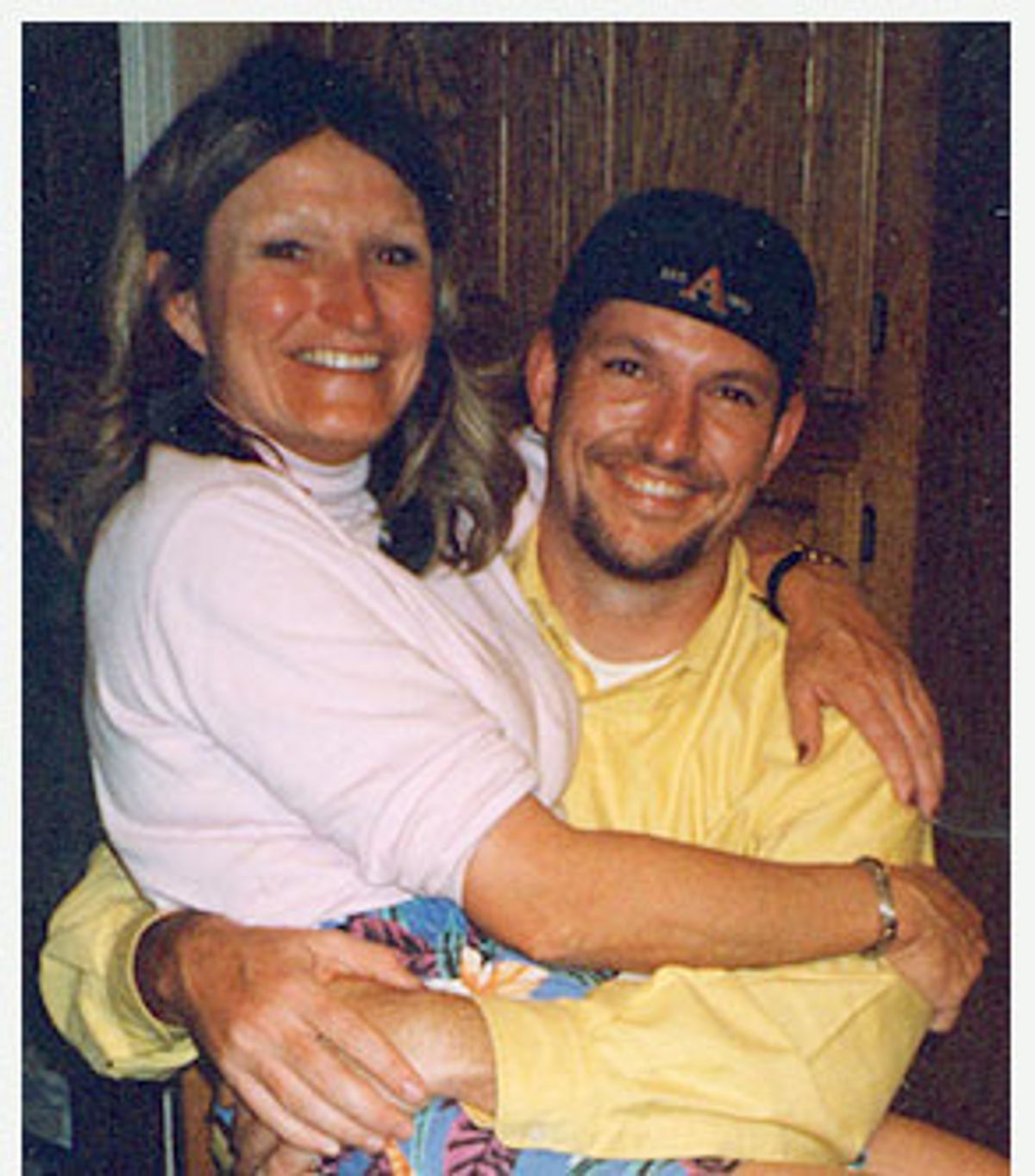
But at first glance, Hoglan doesn’t see policy failures in the report, the government’s definitive word on events surrounding Sept. 11. Hoglan sees her only son, Mark Bingham. She sees the magnanimous, crazy, irrepressible guy she raised alone flying home to San Francisco to act as an usher in the wedding of his Egyptian college buddy, Joe Salama. As she has for nearly every day of the past two and a half years, Hoglan imagines the desperate last moments of Mark’s life, when his plane, United Flight 93, crashed into a dry field in Shanksville, Pa.

Only later does Hoglan allow the report, rough drafts of which have been available online for the past year, to flood her consciousness. There they are, the CIA, FBI, State Department and Department of Defense bumbling around overseas like a hapless group of private detectives, each unaware of what the other was uncovering, incapable of sharing what they found. Hoglan can only sigh when she reads the testimony of former CIA director George Tenet, who summarized the mangled communication by confessing, “The victims and the families of 9/11 deserve better.”

Really, what more can she say about what’s in the report? “It’s very discouraging,” she says. “It’s horrible, just horrible. For good reason, a lot of Sept. 11 families are up in arms about it.” Up in arms is an understatement. For many family members, the pain of losing their loved ones on Sept. 11 remains as raw as ever. You feel it when you talk to them; your heart, like theirs, still breaks.

Hoglan has spent the past two years summoning all her strength to prevent her anger from swallowing her. “And it’s a whole other kind of strength and internal fortitude,” says Todd Sarner, 33, a therapist and one of Mark Bingham’s best friends since high school. “Alice is a survivor. Not just an ‘I’m-getting-by survivor.’ But, ‘I’m absolutely not going to be a victim, I’m going to do whatever I can with my life.’ She’s like a soldier: Let’s move on and do positive things.”

Indeed, in the “wreckage of her life,” as Hoglan says, she has found the voice of an activist. A flight attendant for 18 years with, of all airlines, United, Hoglan now canvasses the country, arguing that the greedy airlines need to get off their bottom lines and invest in more rigorous security. Bingham was gay and so Hoglan often appears at public rallies to undercut stereotypes about sexual preference. One wry comment is pretty much all it takes. “I don’t think sexual orientation was discussed in the pitching aircraft that was Flight 93,” she says. As passengers and crew banded together to charge the hijackers, “I’m pretty sure there was no screening.”

Given her activism, Hoglan has become that peculiar American phenomenon, a minor celebrity for all the wrong reasons. “Some people think she has done too many interviews,” says Sarner. “But her point has always been that talking about Mark helps her. She is partly dealing with her grief by telling the world about her son.”

It’s true. You never get the feeling while talking to Hoglan, 54 — whom you might call your basic hippie mom from the Santa Cruz Mountains, where she still lives — that she’s exploiting Sept. 11 for any personal gain or profit. You sense a genuine selflessness in her goals, a warmness in her levity and soft laughter. After all, at age 51 Hoglan acted as a surrogate mother for her sister-in-law and gave birth to triplets. “Just lending out the womb,” she says with a grin. At times, though, you are stopped short by her unknowable despair.

It’s a despair shared by all the 9/11 families. Coincidentally, just minutes before he picks up the phone in his New Jersey home, Jerry Guadagno and his wife, Beatrice, have returned from visiting the cemetery where the ashes of their son, Richard, are entombed. A dedicated naturalist, unswervingly serious about law enforcement, Richard Guadagno had recently been appointed manager of the Humboldt Bay National Wildlife Refuge, when he perished on Flight 93, surely in revolt with all the other passengers and crew. Jerry Guadagno, 79, speaks haltingly but intently about his son. He hasn’t studied the National Commission report and is not sure he will. The stress of reliving his son’s death is getting, simply, too much to bear. “When you lose a son, there’s nothing worse than that,” he offers. “Nothing comes close to losing a child. It’s been devastating to our family. Life is just not the same.”

But Guadagno is grateful for the final report — if for no other reason than what has made him angrier than anything over the past two years is how President Bush and a truculent administration consistently stifled a full-scale investigation, refusing to release White House files and documents. In fact, if it weren’t for the zealous lobbying of outraged family members of Sept. 11 victims, the National Commission report would never have seen the light of day.

“When the investigation was first met with stonewalling by the administration, I was terribly hurt,” Guadagno says. “My son was murdered, and all I was doing was looking for some answers. For the administration to stonewall like that is unforgivable.”

Hoglan and I saw “Fahrenheit 9/11″ together. You could hear people in the theater catch their breath as Lila Lipscomb, the working-class mother from Flint, Mich., recounted the moment that she heard her son, Sgt. Michael Pederson, had been killed in Iraq: “The grief grabbed me so hard that I even fell on the floor. … Why is it my son that you had to take? He didn’t do anything. He wasn’t a bad guy. He was a good guy. Why did you have to take my son?” You could only imagine what Hoglan was thinking. She was staring into her lap, crying.

Still, more often that not, you are infected by Hoglan’s desire to set the record straight, to stave off the creep of historical amnesia. “I never want to grow complacent about that day,” she says. “I never want the world to forget it.” That often means stealing past the official remarks encompassing Sept. 11 and detailing her own agonizing experiences of events surrounding the infamous day.

Always, she remembers her son. A fit and muscular 6’4″, the 31-year-old Bingham was a fearless athlete who had attended UC Berkeley on a rugby scholarship. Head of his own San Francisco public relations firm, hyping ambitious dot-coms, Bingham boomed down city streets with a huge spirit, lighting up everybody in his wake. He was also the crazy man, the guy who dove off the highest cliff in Maui, who ran with the bulls in Pamplona — and wasn’t happy until he got gored — who grabbed a gun from a mugger one night in San Francisco’s Castro District. Hoglan smiles with chagrin as she relates the time that Mark, three sheets to the wind during a Cal-Stanford football game, ran onto the field and tackled the Stanford mascot, a massively tall and awkward tree. He was handcuffed and carted off to a Berkeley jail.

The harrowing final half-hour of Flight 93 has often been recreated by journalists, dramatists, and surely, screenwriters by the score. Hoglan, however, describes the fatal descent with details missing from past accounts — minute facts that have been sealed in her mind from listening to the plane’s cockpit voice recorder twice. (Family members of Flight 93 are the only Americans, except for national security personnel, to have heard the tapes.) The story rushes out of her on a wave of pride for her son, her excited voice often cracking under the strain of her memory. Be assured, though, she says, she is only offering her own faithful interpretation of the facts, based on “examining all the documents and listening to every piece of testimony.”

The cockpit voice recording lasts 31 minutes. In the first few minutes, says Hoglan, you hear one of one the United pilots yelling to a hijacker, “Get out of here, get out of here.” Next comes a struggle and “this breathy, rapid conversation in Arabic, and someone laboring to breathe, gurgling. I guess I don’t have to explain why that would indicate that he had received a bad throat wound.” (When the FBI played the cockpit tapes for the family members of Flight 93, they flashed English subtitles on a screen for the Arabic dialogue.)

Two hijackers then drag the slain pilots out of the cabin, return to the cockpit and close the door. Following scuffling and fiddling around in the cockpit, Hoglan says, you hear one man telling the other in Arabic, “Sit, sit, sit.” A third hijacker stands guard outside the cockpit door and a fourth herds the passengers into the back of the plane. The next 20 minutes of the cockpit tape, says Hoglan, “are consumed in a lot of sounds of automatic pilot being turned on and off, and occasionally you hear one of the other guys in the cockpit, chanting prayers, ‘There is no God but God.’”

Around this time, Hoglan’s son called home. “Mom, this is Mark Bingham,” he said with a strange formality, suggesting, Hoglan says, his grace under pressure. “I just want to tell you that I love you. I’m on a flight from Newark to San Francisco and there are three guys on board who have taken over the plane. They say they have a bomb. You believe me, don’t you, mom?”

“Oh, Mark, I believe you,” Hoglan responded.

Hoglan now surmises that passengers in the back of the plane were beginning to advance toward the cabin. On the cockpit recorder, Hoglan says, comes the sound of one of the terrorists knocking at the cockpit door. “Let the fellows in now,” a hijacker in the cabin says.

“I remember this well,” she says. “You hear one terrorist saying to the other what sounds like ‘iraq,’ which means ‘fighting.’ In other words, ‘Are passengers fighting in the back?’ Then you hear this frantic knocking on the door. ‘Let him in, let him in.’ Then, ‘Hold it up to the door so they will see it and be afraid.’”

The “it” is a fire ax mounted on the back of the cockpit. The hijackers believed that by brandishing the ax through the cockpit’s peephole, the passengers would turn back. But the hijackers didn’t know how a peephole works, Hoglan explains, they didn’t know that passengers couldn’t see through it from outside the door.

The last five minutes of cockpit tape, Hoglan says, are bone-chilling. “You hear the excruciating sound of the wind going over the wings because the airplane is flying at such a low altitude.” You also hear a lot of muffled yelling, she adds, as if the passengers in the back of the plane had psyched themselves up like football players and were now ready to bolt madly down the field.

It was impossible to distinguish voices on the tape, or who was playing what position. But Hoglan knew Bingham had to be in the middle of the charge.

At this point, Hoglan says, a struggle mounts in the rear of the plane. It’s the moment when Todd Beamer, an account manager for Oracle, utters the now famous line, “Let’s roll.” A few seconds later, Hoglan says, “you hear somebody being killed, probably strangled. And then you hear Todd Beamer saying something like, ‘God help us.’

“That’s when they run forward and you hear this ‘rrrraaahhh’ getting closer to the cockpit. You visualize guys running forward and yelling, trying to get their blood up. They’re unarmed and they’re going after these guys they know have killed people and have knives. You hear them say, ‘In the cockpit, in the cockpit, in the cockpit!’ Then you hear this terrible bloodscream. I know it’s silly, but it sounds like somebody who is a non-native speaker, probably the terrorist by the door. Next you hear this terrible crashing of a food cart, and I’m a flight attendant, so I’ve heard crashing carts before.

“They ram the door with the cart and all of a sudden you hear these voices in English getting louder. Remember, the terrorists are at the controls, and the plane is heaving back and forth at very low altitudes. If you’ve ever tried to walk in turbulence, you know how tough that is. I think the hijackers are now in this terrible struggle and know they are going to be subdued by the passengers, so they start thrashing the airplane around, more than ever.”

Hoglan says that an Arabic voice inside the cockpit then asks, “Finish her now?” The answer comes back, “No, not yet.” Then, she adds, “maybe a minute later, with more scuffling and struggling in the background, the very last thing you hear is a low voice spoken in English: “Pull it up, pull it up.” It probably signals the last struggle, they are probably trying to get control of the airplane. Maybe their hands are on the controls when the plane goes into the ground.”

Reams have been written about the heroes on Flight 93, and heroes they most definitely are. But in passing years a stem of resentment has risen from the hallowed ground around Flight 93, with some family members claiming exhaustion at the story of only a handful of passengers, led by Bingham and Beamer, leading the revolt. Hoglan herself is careful not to promulgate the myth of a hardy few. Sincerely, she says, “everyone on the flight was a hero to me. I can recite the names of all 40 of the passengers and crew on Flight 93.”

She knows she has been criticized for bragging about Bingham to the press, but, she says, can you blame her? “Mark was everything to me. He set me on the spiritual quest that I’ve been on for most of my life. It was really my son who forced me to deal with most of the issues in my life. It was my son who has grown me up.”

When the subject turns back to why their loved ones had to die on Flight 93, Hoglan and many of the family members remain distraught. Even now, there are unanswered questions. The National Commission report contains scads of important insights, but it remains sketchy on just what happened inside the hijacked planes, despite all the evidence amassed from phone calls made by passengers and crew members to friends and airline headquarters.

Most distressing to Hoglan and other family members are phone calls made by flight attendants on American Flight 11, the first jet to hit the World Trade Center. The calls by Madeline (Amy) Sweeney, who identified the hijackers as Middle Eastern men with a bomb, and Betty Ong, to American’s flight center, came at least 20 minutes before Flight 93 took off. Immediately after the valiant women’s calls, shouldn’t the airlines or FAA have acted to ground all planes, including Flight 93?

One of the ten commissioners, former Sen. Bob Kerrey, suggested as much during the hearings. Of all the facts presented, Kerrey said, the one that “caused scales to fall from my eyes was listening to Betty Ong … talk to the ground and hear the ground surprised by a hijacking. I mean, not only were we not at a high state of alert in our airports, we were at ease.” He went on: “And it’s baffling to me why some alert wasn’t given to the airlines to alter their preparedness to go to a much higher state of alert. It seems to me a lot of things would have changed if that would have happened.”

Does Hoglan, who has more than 20 years in the airline business, and who has studied the minute-by-minute actions of all four jets that were hijacked on Sept. 11, believe that Flight 93 could have been prevented from taking off? “Yes, I do,” she says. “Clearly, there was an awful lot of blame before that, and I doubt that any quick action or well-intended action on the part of these people at American would have prevented what happened. But it might have. They might have been able to get word to the FBI and get the planes grounded.”

More adamant is Bonnie Greene Le Var, 56, director of a New York nonprofit group, Corporate Angel Network, that arranges for children with cancer to fly on private jets to clinics; her brother, Donald Greene, was on Flight 93. Yes, Greene admits, her conviction that the plane could have been grounded is fed by the pain of her loss. But at the same, she knows a thing or two about the airline business. Her and Donald’s father, Leonard, invented safety flight instruments — stall warning indicators, to be exact — now installed on virtually every commercial airliner. Donald was executive vice president of the family company, Safe Flight, when Flight 93 crashed.

Transportation authorities “could have grounded my brother’s plane,” Le Var says, her brusque New York accent underscoring her anger. “They knew who was hijacking those planes that hit the World Trade Center. They knew exactly what was going on. But they wasted time grounding all the planes. Remember that scene in “Fahrenheit 9/11″ with Bush sitting in the school for seven minutes? You might say seven minutes isn’t much — but it’s a lot. You know how many planes take off in seven minutes every single day? I don’t know. Maybe Albert Einstein wouldn’t have known how to react, known to immediately ground all the planes. But somebody should have. Somebody should have had the smarts to figure that out.”

The commission report fails to deliver a conclusive answer to whether Flight 93 could have been grounded; rather, it states that personnel at the FAA and North American Aerospace Defense Command were unprepared and “struggled under difficult circumstances to improvise a homeland defense against an unprecedented challenge they had never before encountered and had never trained to meet.” The report does conclusively state, though, that “We are sure that the nation owes a debt to the passengers of United 93. Their actions saved the lives of countless others, and may have saved either the Capitol or the White House from destruction.”

You will get no argument from Hoglan or any of the family members associated with Flight 93 on that point. But praise in the long run will get you nowhere with people you’ve betrayed. Especially newborn activists like Hoglan. “People ask me, ‘Don’t you want closure?’” she says. “And the truth is, I’d like to go to my death tortured by the events of Sept. 11. I want to be angry about it.”

Continue Reading Close

Kevin Berger is the former features editor at Salon.

Hiding 9/11′s last secrets

The military tribunal for Khalid Sheikh Mohammed means the American people will never know what drove him to terror

  • more
    • All Share Services

Hiding 9/11's last secrets (Credit: Reuters//Brennan Linsley)

After a Navy SEAL team killed Osama bin Laden at his Pakistan hideout a year ago this week, it flew his body to the Arabian Sea, weighted it down, and slid it silently off an aircraft carrier into the watery depths.

For many Americans, the secret raid provided a measure of revenge and catharsis for the strikes of Sept. 11, 2001. But it didn’t provide the kind of justice and official reckoning that the country needs to gain real closure. Now the government has a chance to achieve that through a full, fair and open trial of Khalid Sheikh Mohammed and four co-defendants, so the world can finally see the evidence against him as the true architect of the attacks on New York and Washington. The trial kickoff — an arraignment for the men — is scheduled for this Saturday at the U.S.-run detention facility in Guantanamo Bay, Cuba.

This should be our Nuremburg, the defining trial of the 9/11 era and a fitting coda to it.

Unfortunately, the U.S. government appears to be on the verge of squandering this opportunity, and with it, the best, and perhaps only, chance for the public to understand not only how the attacks came to be, but why Mohammed waged a relentless war against America and how we might stop the next would-be terrorist mastermind.

The problems lie within the reformed military-tribunal system that the Obama administration put in place after losing its fight for a civilian trial in New York. Political compromises have resulted in a flawed military commissions process that from outward appearances is not only rigged against the defense, but hyper-choreographed, censored and hermetically sealed.

“The process is designed to achieve a conviction, and to do it with as little revelation as humanly possible, but with the veneer of due process and justice,’’ said one participant who said restrictive gag orders prohibited him from talking publicly. “You’re talking about the most heinous crime ever, and we’re going to afford them less due process, less discovery, less of everything than we would the guy who shoplifted a pack of gum from CVS.’’

Obama administration officials say their reformed military commissions system is a vast improvement over the Bush administration’s version, which Obama moved to shut down on his first day in office in 2009.

Defense lawyers disagree, and insist they have been hamstrung in their efforts to mount the kind of aggressive defense needed to do their jobs including full and unfettered access to evidence, witnesses and even the accused themselves.

Four of the five legal teams had so few of their key players in place in recent months that they did not file the “mitigation submissions’’ that the government said it needed to decide which of the five men should face the death penalty and other key issues, such as whether to try them together or individually. They recently filed motions asking that the charges be thrown out because of fatal flaws in the system, which they say make it impossible for them to defend their clients.

“It’s window dressing,’’ Mohammed’s defense lawyer, David Nevin, said of the government’s improvements. “I am not all satisfied that it is a fair process. In fact, it is not a fair process.’’

Many of the defense lawyers have quit out of frustration or for other personal reasons stemming from the many delays in the process. Only a few have been there long enough to even begin to understand their clients’ case, not to mention the convoluted military commission process.

And they say they will be unable to effectively challenge confessions obtained when their clients were coercively interrogated in the CIA’s black site prisons, if they can broach the subject at all. This is important for the four men accused of helping Mohammed with the logistics of the plot. Several claim they have been wrongly accused, tortured into confessing, or both.

It is also important with regard to Mohammed, who confessed to dozens of plots while being waterboarded 183 times, and has said he may plead guilty even before the trial begins. Few U.S. counterterrorism officials believe all of his often boastful confessions, and it is important for the public to hear what, exactly, evidence the government has with regard to what he did and didn’t do, and whom he might have been protecting.

The team of Defense and Justice Department officials overseeing the military commission process, and the presiding judge, should quickly address the defense lawyers’ complaints, or a proceeding that some call “The Trial of the Century’’ will be delayed further by legal wrangling — and forever tainted by accusations of being unfair.

A full, fair and transparent trial, above all, will benefit the public. There is much the public doesn’t know about Mohammed, including the details of how he devised the plot, convinced bin Laden to let him do it and then orchestrated it “from A to Z,’’ to use his own words. It was Mohammed who masterminded dozens of other plots and attacks, some while staying a step ahead of the largest-ever criminal manhunt.

Mohammed, not bin Laden, was the one who traveled the world as a kind of “Johnny Appleseed’’ of terrorism, establishing alliances and creating a network of cells and lieutenants that in some cases remains today. And it was Mohammed who personally recruited young jihadist prospects much like a baseball scout, many of them Westerners, tapping into their grievances to turn them to his cause.

The U.S. government has kept the details of what Mohammed did — and how and why he did it — hidden in its most classified files since his capture in Pakistan nine years ago. The government should set the record straight on that, because there is an important lesson to be learned from the largely untold tale of Khalid Sheikh Mohammed: It isn’t some monolithic group like al-Qaida that poses a continuing threat, it’s the one intelligent and energetic person who can emerge from nowhere and orchestrate a 9/11 while the world focuses elsewhere.

To that end, the government should declassify as much evidence as possible, and explain how it obtained it. It should call numerous witnesses to testify, especially since the one who has been publicly identified, Majid Khan, claims he was tortured while in CIA custody overseas.

Instead of limiting access to a few closed-circuit TVs, it should consider televising the proceedings. It should ensure that censorship is minimized, and used only to protect intelligence sources and methods, not to save the government from embarrassment. And it should let Mohammed and the others testify at length on their behalf if they so desire.

By doing so, the Obama administration will be able to say it did its best to put on the kind of civilian trial it has wanted all along, and one with a similar outcome to that of the al Qaida members charged with blowing up two U.S. embassies in Africa in 1998.

Those of us who witnessed that trial in Manhattan in 2001 saw the defendants squirm in their chairs as prosecutors introduced mountains of evidence against them. We saw eyewitnesses point the finger at the accused, and surviving victims glare at them from the pews.

We heard from the terrorists themselves, and learned a lot about why they did it, about how terrorist networks operate and about what might be done to stop people like them. And when the jury convicted them, there was no question that justice was done.

Continue Reading Close

Josh Meyer is the author, with Terry McDermott, of the new book, "The Hunt for KSM: Inside the Pursuit and Takedown of the Real 9/11 Mastermind, Khalid Sheikh Mohammed.’’

Marky Mark saves the universe!

The "Contraband" star suggests he could have stopped 9/11 -- and inspires a genius viral art explosion online SLIDE SHOW

  • more
    • All Share Services

Marky Mark saves the universe! (Credit: quickmeme.com)

View the slide show

Mark Wahlberg’s insensitive comments about 9/11 have sparked incredulity everywhere from Twitter to the cover of the New York Post. Earlier this week, in an interview with Men’s Journal, the actor seemed to confuse himself with Chuck Norris:

If I was on that plane with my kids, it wouldn’t have went down like it did. There would have been a lot of blood in that first-class cabin and then me saying, ‘OK, we’re going to land somewhere safely, don’t worry.’

Wahlberg has apologized profusely for his lightning-rod remarks — but the pocket pundits of Tumblr and other meme machines have already had their say. Check out the following slide show for some of the most notable examples of Wahlberg-inspired Internet art.

View the slide show

Continue Reading Close

Emma Mustich is a Salon contributor. Follow her on Twitter: @emustich.

An “incredibly close” screening

A preview of “Extremely Loud and Incredibly Close” turns into group therapy for post-9/11 New Yorkers

  • more
    • All Share Services

An A movie that asks are we ready to talk about 9/11?

I knew all those years of sitting in darkened theaters on sunny afternoons, awash in movies new and old, stale popcorn and gallons of diet soda, would pay off some day. For one, there was the woman I met in 1975 at the late, lamented Carnegie Hall Cinema during a Mel Brooks double feature. She came and sat next to me when a guy kept bothering her during “Blazing Saddles” and we wound up dating — until she lit out for a career in the hinterlands, acting in summer stock.

But as lovely as she was, that’s not the payoff I mean. All that time reading about and watching movies didn’t just prepare me for romance, or Jeopardy and Trivial Pursuit, if it comes to that. (Quick—the address of Charles Foster Kane’s love nest with Susan Alexander? 185 West 74th Street.)

What it did ready me for is one of my favorite things, interviewing screenwriters about their work. In my various capacities at the Writers Guild of America, East, I’ve had the opportunity over the last decade and a half to talk with many of them, in private for articles or video archives, and in public, in front of an audience, at screenings of their films. Sometimes the director and one or two of the actors come, too.

This has led to some odd experiences: like dealing with the emotionally fragile starlet who recently had gone through a very public break-up. I had to gently coax her out of her limo and into the screening because she was afraid of the paparazzi, who were covering a premiere at the theater next door. They didn’t notice.

Or the time the writer knelt next to me during his film and frantically whispered that an entire reel had been skipped, the next to last one. We let everyone see it when the movie was over but discovered that the hapless projectionist had been showing it that way – to critics – for weeks.  The film opened and closed very quickly.

There was the incomprehensible interview with Jean-Luc Godard, which was not because my French was worse than his English, or vice versa, but simply because he’s Jean-Luc Godard; and the Q & A with British writer and director Mike Leigh – my first question triggered a rapid-fire, twenty-minute monologue that was impossible to interrupt. Because he covered virtually every one of my prepared questions, it wasn’t so bad. By the time he had worn himself out, we were ready for questions from the audience.

But one of the most unusual interviews took place just last month, a week or so before Christmas. I was scheduled to introduce a screening of “Extremely Loud & Incredibly Close” and talk afterwards with the author of its screenplay, Eric Roth, whose other credits include “Forrest Gump” and “The Curious Case of Benjamin Button.”

When I arrived at the theater, a representative from Warner Brothers let me know that the film’s director, Stephen Daldry, would be joining us as well. I had to pretty much toss the interview I’d prepared – most of my questions were about Eric’s work and screenwriting in general – but it would be okay. Stephen and I had met several years ago when he was promoting his movie “The Hours” and I was interviewing its screenwriter, David Hare.

If you haven’t heard by now, “Extremely Loud & Incredibly Close,” adapted from the novel by Jonathan Safran Foer, is a tough movie to watch, especially if you’re a New Yorker who was here on 9/11. But in my opinion, it’s well worth it; the engaging, entertaining and powerful story of an emotionally troubled Asperger’s kid who seeks to reconnect with the father he lost at the World Trade Center. The boy travels across the city trying to solve the riddle of a mysterious key he finds in his father’s closet a year after the attacks.

The film ended and there was applause, which doesn’t always happen at these things; we are, after all, jaded, Manhattan media sophisticates. The lights came up, I introduced Eric and Stephen and started to ask my first question.

Stephen interrupted (he’s a director). “I’d like to know what people think about the film. We’ve only just finished it and only shown it to a handful of audiences, so I’d like to know what you think.”

Silence.

I think we’re all experiencing a bit of shellshock, I said. Most of us were here on 9/11. Ten years later, it’s still kind of raw. Stephen repeated his question – what did you think?

Slowly, people began to respond, positively for the most part but in each of us the film triggered memories. People had friends in the buildings. A man who worked as an extra in the film – you see a split-second shot of him in a Batman costume – had a job in wire transfers at Bank of America. He worked the night shift at the Trade Center and left just minutes before American Airlines Flight 11 hit the North Tower. He’s still suffering from survivor guilt.

For me, it was a moment toward the end of the film when the boy, Oskar (an incredible performance by young, first-time actor Thomas Horn), visits an office downtown in the middle of the night. Security takes his photo and prints out a building ID. That would seem innocuous to most, but I remembered an evening about a week and a half after what Oskar calls “the worst day.” George Bush was addressing a joint session of Congress.

My then wife and I were burning candles to cover the smell from Ground Zero, which had shifted that rainy night from an odor of burning electrical cables and melted metal to something more feral and decaying. As we listened to Bush and I made dinner, she sat and sorted through a basket of odds and ends, then handed me something: a security ID with my picture — like Oskar’s — but taken the last time I had gone to the World Trade Center for a meeting.

The rest of my interview with Stephen and Eric went like that. I got a couple of my original questions in, but the evening had turned into a group therapy session, and that was fine. As Daldry recently said in the Los Angeles Times, “It’s a loss that’s very public and one that everyone has very rich stories about. One has to be responsible to the original author’s book … and you have to be aware of the truth of the reality of what happened to thousands of people who lost loved ones.

I heard a new ad for ”Extremely Loud & Incredibly Close” on the radio this morning, its pitch apparently readjusted, aimed at those averse to a movie about the Trade Center calamity. It’s “not about 9/11,” the spot’s announcer declared, “but every day after.”

Nice try. The question is, as Stephen told the Times, “Is it time? Can we start to tell these stories yet or is it too early?” The film opens nationally on January 20. Spend a couple of hours in a darkened movie theater and find out what you think.

Continue Reading Close

Michael Winship is senior writing fellow at Demos and a senior writer of the new series, Moyers & Company, airing on public television.

How the feds fueled the militarization of police

Billions in post-9/11 taxpayer dollars have paid for combat-style gear on display in the Occupy crackdowns

  • more
    • All Share Services

How the feds fueled the militarization of policePolice in riot gear move to a location at the port facilities in Longview, Wash., Wednesday, Sept. 21, 2011. (Credit: AP/Don Ryan)

The militarization of America’s metropolitan police forces was on full display in recent months as police from Los Angeles to New York cracked down on Occupy protests, decked out in full SWAT gear and occasionally using strange pieces of military hardware.

Less well known is that police forces in small towns and far-flung cities have also been stocking up on heavy equipment in the years since Sept. 11, 2001.

In spite of strained city and state budgets in local years, the trend has continued thanks to generous federal grants. According to a new story by the Center for Investigative Reporting, $34 billion in federal grant money has financed the past decade’s shopping spree.

To learn more about the trend, I spoke with G.W. Schultz, who co-authored the story with Andrew Becker. (Also worth a look is the slide show accompanying the story.)

You start your piece with Fargo, N.D., where the police have a “$256,643 armored truck, complete with a rotating turret,” kevlar helmets and assault rifles in their squad cars. What did they say when you asked why they need this kind of heavy equipment?

Their view is that they need to be as prepared as a city like New York. We’ve been studying the grant programs for a while. You see this in city after city. Everyone has got an explanation for why they need more and not less grant money. I grew up in Tulsa; there’s still a lot of sensitivity around the Oklahoma City bombing. So the attitude is, “Look, we could have a similar attack and we need to be ready for it.” Now I live in Austin. The attitude here is, we could have an incident like the one in which a guy smashed his plane into the IRS building a few years ago, or the one in which a guy started shooting people from a tower at the Uniersity of Texas a few decades ago. Every city has an answer like that. The approach to security spending is based on speculation about what could happen, however remote. That attitude enables you to buy everything without limit because you can never attain 100 percent security.

What is the federal grant program that is handing out all this money?

What we learned over time is that it’s not just one grant program, it’s grant programs. There is a dizzying array of grants that local communities are eligible for from the Department of Homeland Security and sometimes the Justice Department. A few grants existed prior to 9/11. After DHS was created, Congress kept creating new programs to meet perceived needs around security. For example, “We need a bulletproof vehicle to send in our SWAT unit if a Mumbai-style attack occurs.” That led to a spree of spending on bulletproof vehicles. Each round of purchases is fueled by a what-if scenario.

You write in your piece that there’s a lot of information still lacking about this spending. What don’t we know? 

We’ve been working on this Homeland Security research for a few years. The feds have never had a listing of everything the local police and other local government agencies bought with the grant money. You literally can’t go to Washington and find a listing of how the $34 billion was spent; you have to go state by state. We set out to do that; after a period of many months, we still only have records from 41 states, and they are wildly inconsistent. We wanted to build a nationwide database of how the money was spent, but there turned out to be just no way to do it because of the lack of information. But we spent so much time with grant records, we were able to identify trends; we knew many communities were buying SWAT-style trucks, combat-style protective gear, and so on.

Has most of this equipment — assault rifles and armored vehicles and so on — just not been used? 

It’s hard to tell. We can say from available audits that a lot of the equipment purchased with grant funds is not used. As the years pass by, you see more people in government concede that particularly during the early years after 9/11, a lot of the stuff that was bought was never used, and a lot of money was wasted. I was recently at a small public safety summit in Austin and the chief of police here rhetorically asked the audience, “All the protective attire that you bought after 9/11 for a chemical attack, have you used any of that?” And the room kind of giggled a little bit. In the end there’s still an attitude in law enforcement and the government that it could be used and we need to be prepared.

Who is making money off of all this?

Well, defense contractors are not manufacturing F-35s or big ships for local cops. But these companies and Wall Street in general think in terms of diversity. They want small profit margins and large profit margins. Companies like Northrop Grumman have sold a lot of bomb-dismantling robots to local police. Some traditional defense contractors like Raytheon have also gotten into the intelligence side, selling things like information-sharing tools and radio equipment. I went to a conference a few weeks ago where Raytheon had a big presence, offering expensive communications equipment for dispatchers and so on.

It’s important to point out you can’t buy guns with Homeland Security grants — but it’s about the only thing you can’t buy. That’s a restriction the feds decided to place early on. But if a local police department can take care of some of the capabilities they believe they need to have with grants, that leaves money to buy things like AR-15s. In the 10 years since 9/11, they’ve done both — both combat-style SWAT attire and assault rifles. That’s partly why you see images now of SWAT police looking very much like combat troops in Baghdad or Kabul.

Are there any dissenting voices within the police community about all this militarization? 

There are even folks in the SWAT community — some of the older folks who have observed the evolution of SWAT — who are concerned about this. They’re concerned about whether or not the training is going to meet all the equipment that’s being bought. Part of the reason for that is the training is not as sexy as the equipment. The image and romance of battling bad guys with lots of tough-looking equipment and guns maybe isn’t as exciting as investing in training. There’s also concern among some police about deploying tactical units too often — for low-risk warrant executions and things like that. But, the counter-voice in law enforcement is, “Look, this enhances safety for officers.” They look back at a couple of really bad shootings and say, “We’re never going to let that happen again. We’re going to get whatever equipment or training we need.” But that comes at a cost.

Does it make police look more intimidating to be wielding AR-15s with all kinds of devices attached to them? Especially in a country that’s been working for years to implement community policing strategies. In a place like Los Angeles, there were years of work done to soften the image of law enforcement and improve the department’s relationship with minority communities. Is that threatened by the wider adoption of combat stye equipment and training?

Continue Reading Close
Justin Elliott

Justin Elliott is a reporter for ProPublica. You can follow him on Twitter @ElliottJustin

“Extremely Loud & Incredibly Close”: Post-9/11 trauma, made cute and dull

The sentimental bestseller "Extremely Loud & Incredibly Close" becomes a dreary Tom Hanks-Sandra Bullock weeper

  • more
    • All Share Services

Thomas Horn and Tom Hanks in "Extremely Loud and Incredibly Close"

A few weeks ago I wrote a largely negative review of Kenneth Lonergan’s long-delayed “Margaret,” a sprawling and ambitious attempt at weaving a multi-character cinematic tapestry about life in post-9/11 New York. I stand by every word, but I also understand why a group of critics and cinephiles have campaigned to get “Margaret” on the awards-season radar screen, in the face of Fox Searchlight’s evident decision to abandon it on the curb like a stillborn hamster. “Margaret” is coming back to New York’s Cinema Village this weekend, and if you’re in the neighborhood and want to see a flawed, big-hearted, intermittently marvelous and maddening epic about the legacy of 9/11, go check it out. You certainly won’t find any such grand emotions in “Extremely Loud & Incredibly Close,” which renders Jonathan Safran Foer’s best-selling 2005 novel into unconvincing Hollywood mush.

“Extremely Loud & Incredibly Close” is pretty much the last of this year’s supposedly major holiday movies to be unveiled for the press and public, and if I were director Stephen Daldry (he of “The Hours” and “Billy Elliot”), I might’ve wanted to sit on it a bit longer. It’s not a terrible film, exactly, but something worse, an irritating and enervating one. A longtime theater director who made the switch to film in the early 2000s, Daldry has a propensity for pretty, almost vampiric movies that are elegantly staged but drain the life out of their source material — and Foer’s novel didn’t have too much of that to begin with. A whimsical fable about an overly precious and eccentric 9-year-old, loaded down with Asperger-ish tics and phobias, who goes on a self-appointed citywide treasure hunt after his father dies in the twin towers, “Extremely Loud” always struck me as a sentimental contrivance. (I started the book and couldn’t finish it.)

Daldry and screenwriter Eric Roth remove some of the book’s more maddening byways and curlicues (such as the epistolary back story of the main character’s German grandparents) but can’t evade its biggest problems. What they wind up with is something like an especially slow-moving and unnaturally grave Wes Anderson movie, with a hero you constantly want to smack, mixed with an after-school special about grief and healing. Throw in a bunch of awkward, still-life supporting performances — Sandra Bullock, Max von Sydow, Viola Davis and Jeffrey Wright, all sitting around looking sad — skillful cinematography by British vet Chris Menges and a Minimalist orchestral score by Alexandre Desplat, and it all adds up to something that looks and feels classy yet is really minor-league schmaltz.

Nine-year-old Oskar Schell (played by one-time “Teen Jeopardy” contestant Thomas Horn, in his acting debut) feels like a literary creation all the way, a precocious and painfully odd city kid who’s afraid of almost everything and way too dependent on his dad, a Manhattan jeweler named Thomas. (You know, I like Tom Hanks, and he’s perfectly OK in this role, but he’s almost the last guy I would consider to play a New York shopkeeper of German and/or Jewish extraction.) Thomas has constructed a long-running scavenger hunt designed to draw Oskar out of his shell, and purportedly to solve the mystery of the missing “sixth borough” of New York City, which was dragged away at some point by secretive authorities for unknown reasons. This quest is interrupted after Thomas is vaporized in the World Trade Center, and the traumatized Oskar conceals his father’s last phone messages from his mother (Bullock). But when Oskar finds a key hidden inside a vase in his dad’s closet, he thinks it’s a clue from beyond the grave, and sets out on a mission to interview all 800-odd New Yorkers who share the surname Black (which was written on the envelope that held the key).

I get that you either have to suspend your disbelief and travel with the tambourine-jingling, subway-phobic Oskar from Fort Greene to Hamilton Heights to Astoria to Broad Channel — enjoying the journey and not fixating on the destination, etc. — or simply bail out, but I was supposed to write this review and couldn’t do the latter. In a larger sense, the problem with Daldry’s film is that it’s much too polite and pretty and classed-up, and lacks the nebbishy intensity and conviction that Foer’s mock-Salinger universe at least pretends to possess. “Extremely Loud & Incredibly Close” demanded the real Wes Anderson or, better still, Michel Gondry — someone who would treat Oskar’s filing systems and maps and sets of regulations and French Foreign Legion-style accessories with the utmost seriousness, and even make them the point of the whole enterprise.

What we get instead is frankly a drag, a slow-moving tale of healing and redemption with a low-wattage resolution you’ll glimpse miles away and a whole bunch of trailing loose ends. (Two of the major questions you’re asking yourself after reading my plot synopsis are never answered.) Oh, it’s enjoyable enough when von Sydow’s on hand as Oskar’s mysterious European grandfather, mostly because the titanic Swede is always terrific even when absolutely silent (as here). I did hear a little sniffling around me in the darkness, so if you’re an easy mark you may need a hankie. But, for the love of God, a movie that’s about 9/11 and autism and growing up without a dad should leave you crying buckets, and this one is too restrained and arty and highfalutin — I believe the correct expression in Daldry’s homeland would be “piss-elegant” — even to accomplish that.

Continue Reading Close

Page 1 of 54 in 9/11