
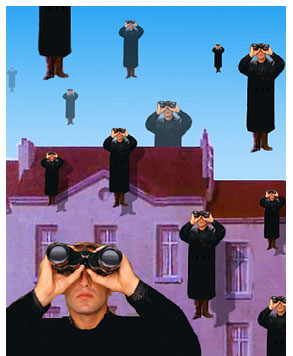

Ten centuries ago, at the previous millennium, a Viking lord commanded the rising tide to retreat. No deluded fool, King Canute aimed in this way to teach flatterers a lesson — that even sovereign rulers cannot halt inexorable change.
A thousand years later, we face tides of technology-driven transformation that seem bound only to accelerate. Waves of innovation may liberate human civilization, or disrupt it, more than anything since glass lenses and movable type. Critical decisions during the next few years — about research, investment, law and lifestyle — may determine what kind of civilization our children inherit. Especially problematic are many information-related technologies that loom on the near horizon — technologies that may foster tyranny, or else empower citizenship in a true global village.
Typically we are told, often and passionately, that Big Brother may abuse these new powers. Or else our privacy and rights will be violated by some other group. Perhaps a commercial, aristocratic, bureaucratic, intellectual, foreign, criminal or technological elite. (Pick your favorite bogeyman.)
Because one or more of these centers of power might use the new tools to see better, we’re told that we should all be very afraid. Indeed, our only hope may be to squelch or fiercely control the onslaught of change. For the sake of safety and liberty, we are offered one prescription: We must limit the power of others to see.
Half a century ago, amid an era of despair, George Orwell created one of the most oppressive metaphors in literature with the telescreen system used to surveil and control the people in his novel “1984.” We have been raised to a high degree of sensitivity by Orwell’s self-preventing prophecy, and others like it. Attuned to wariness, today’s activists preach that any growth in the state’s ability to see will take us down a path of no return, toward the endless hell of Big Brother.
But consider. The worst aspect of Orwell’s telescreen — the trait guaranteeing tyranny — was not that agents of the state could use it to see. The one thing that despots truly need is to avoid accountability. In “1984,” this is achieved by keeping the telescreen aimed in just one direction! By preventing the people from looking back.
While a flood of new discoveries may seem daunting, they should not undermine the core values of a calm and knowledgeable citizenry. Quite the opposite: While privacy may have to be redefined, the new technologies of surveillance should and will be the primary countervailing force against tyranny.
In any event, none of those who denounce the new technologies have shown how it will be possible to stop this rising tide.
– – – – – – – – – – – –
Consider a few examples:
Radio frequency identification (RFID) technology will soon replace the simple, passive bar codes on packaged goods, substituting inexpensive chips that respond to microwave interrogation, making every box of toothpaste or razor blades part of a vast, automatic inventory accounting system. Wal-Mart announced in 2003 that it will require its top 100 suppliers to use RFID on all large cartons, for purposes of warehouse inventory keeping. But that is only the beginning. Inevitably as prices fall, RFID chips will be incorporated into most products and packaging.
Supermarket checkout will become a breeze, when you simply push your cart past a scanner and grab a printout receipt, with every purchase automatically debited from your account.
Does that sound simultaneously creepy and useful? Well, it goes much further. Under development are smart washers that will read the tags on clothing and adjust their cycles accordingly, and smart medicine cabinets that track tagged prescriptions, in order to warn which ones have expired or need refilling. Cars and desks and computers will adjust to your preferred settings as you approach. Paramedics may download your health status — including allergies and dangerous drug-conflicts — even if you are unconscious or unable to speak.
There’s a downside. A wonderful 1960s paranoia satire, “The President’s Analyst,” offered prophetic warning against implanted devices, inserted into people, that would allow them to be tracked by big business and government. But who needs implantation when your clothing and innocuous possessions will carry cheap tags of their own that can be associated with their owners? Already some schools — especially in Asia — are experimenting with RFID systems that will locate all students, at all times.
Oh, there will be fun to be had, for a while, in fooling these systems with minor acts of irreverent rebellion. Picture kids swapping clothes and possessions, furtively, in order to leave muddled trails. Still, such measures will not accomplish much over extended periods. Tracking on vast scales, national and worldwide, will emerge in rapid order. And if we try to stop it with legislation, the chief effect will only be to drive the surveillance into secret networks that are just as pervasive. Only they will operate at levels we cannot supervise, study, discuss or understand.
Wait, there’s more. For example, a new Internet protocol (IPv6) will vastly expand available address space in the virtual world.
The present IP, offering 32-bit data labels, can now offer every living human a unique online address, limiting direct access to something like 10 billion Web pages or specific computers. In contrast, IPv6 will use 128 bits. This will allow the virtual tagging of every cubic centimeter of the earth’s surface, from sea level to mountaintop, spreading a multidimensional data overlay across the planet. Every tagged or manmade object may participate, from your wristwatch to a nearby lamppost, vending machine or trash can — even most of the discarded contents of the trash can.
Every interest group will find some kind of opportunity in this new world. Want to protect forests? Each and every tree on earth might have a chip fired into its bark from the air, alerting a network if furtive loggers start transporting stolen hardwoods. Or the same method could track whoever steals your morning paper. Not long after this, teens and children will purchase rolls of ultra-cheap digital eyes and casually stick them onto walls. Millions of those “penny cams” will join in the fun, contributing to the vast IPv6 datasphere.
Oh, this new Internet protocol will offer many benefits — for example, embedded systems for data tracking and verification. In the short term, expanded powers of vision may embolden tyrants. But over the long run, these systems could help to empower citizens and enhance mutual trust.
– – – – – – – – – – – –
In the mid-’90s, when I began writing “The Transparent Society,” it seemed dismaying to note that Great Britain had almost 150,000 CCD police cameras scanning public streets. Today, they number in the millions.
In the United States, a similar proliferation, though just as rapid, has been somewhat masked by a different national tradition — that of dispersed ownership. As pointed out by UC-San Diego researcher Mohan Trivedi, American constabularies have few cameras of their own. Instead, they rely on vast numbers of security monitors operated by small and large companies, banks, markets and private individuals, who scan ever larger swaths of urban landscape. Nearly all of the footage that helped solve the Oklahoma City bombing and the D.C. sniper episode — as well as documenting the events of 9/11 — came from unofficial sources.
This unique system can be both effective and inexpensive for state agencies, especially when the public is inclined to cooperate, as in searches for missing children. Still, there are many irksome drawbacks to officials who may want more pervasive and direct surveillance. For one thing, the present method relies upon high levels of mutual trust and goodwill between authorities and the owners of those cameras — whether they be convenience-store corporations or videocam-equipped private citizens. Moreover, while many crimes are solved with help from private cameras, more police are also held accountable for well-documented lapses in professional behavior.
This tattletale trend began with the infamous beating of Rodney King, more than a decade ago, and has continued at an accelerating pace. Among recently exposed events were those that aroused disgust (the tormenting of live birds in the Pilgrim’s Pride slaughterhouse) and shook America’s stature in the world (the prisoner abuse by jailers at Abu Ghraib prison in Iraq). Each time the lesson is the same one: that professionals should attend to their professionalism, or else the citizens and consumers who pay their wages will find out and — eventually — hold them accountable.
(Those wishing to promote the trend might look into Project Witness which supplies cameras to underdogs around the world.)
Will American authorities decide to abandon this quaint social bargain of shared access to sensors under dispersed ownership? As the price of electronic gear plummets, it will become easy and cheap for our professional protectors to purchase their own dedicated systems of surveillance, like those already operating in Britain, Singapore and elsewhere. Systems that “look down from above” (surveillance) without any irksome public involvement.
Or might authorities simply use our networks without asking? A decade ago, the U.S. government fought activist groups such as the Electronic Frontier Foundation, claiming a need to unlock commercial-level encryption codes at will, for the sake of law enforcement and national defense. Both sides won apparent victories. High-level commercial encryption became widely available. And the government came to realize that it doesn’t matter. It never did.
Shall I go on?
Driven partly by security demands, a multitude of biometric technologies will identify individuals by scanning physical attributes, from fingerprints, iris patterns, faces and voices to brainwaves and possibly unique chemical signatures. Starting with those now entering and leaving the United States, whole classes of people will grow accustomed to routine identification in this way. Indeed, citizens may start to demand more extensive use of biometric identification, as a safety measure against identity theft. When your car recognizes your face, and all the stores can verify your fingerprint, what need will you have for keys or a credit card?
Naturally, this is yet another trend that has put privacy activists in a lather. They worry — with some justification — about civil liberties implications when the police or FBI might scan multitudes (say, at a sporting event) in search of fugitives or suspects. Automatic software agents will recognize individuals who pass through one camera view, then perform a smooth handoff to the next camera, and the next, planting a “tail” on dozens, hundreds, or tens of thousands of people at a time.
And yes, without a doubt this method could become a potent tool for some future Big Brother.
So? Should that legitimate and plausible fear be addressed by reflexively blaming technology and seeking ways to restrict its use? Or by finding ways that technology may work for us, instead of against us?
Suppose you could ban or limit a particular identification technique. (Mind you, I’ve seen no evidence that it can be done.) The sheer number of different, overlapping biometric approaches will make that whole approach fruitless. In fact, human beings fizz and froth with unique traits that can be spotted at a glance, even with our old-fashioned senses. Our ancestors relied on this fact, building and correlating lists of people who merited trust or worry, from among the few thousands that they met in person. In a global village of 10 billion souls, machines will do the same thing for us by prosthetically amplifying vision and augmenting memory.
With so many identification methodologies working independently and in parallel, our children may find the word “anonymous” impossibly quaint, perhaps even incomprehensible. But that needn’t mean an end to freedom — or even privacy. Although it will undoubtedly mean a redefinition of what we think privacy means.
– – – – – – – – – – – –
But onward with our scan of panopticonic technologies. Beyond RFID, IPv6 and biometrics there are smart cards, smart highways, smart airports, smart automobiles, smart televisions, smart homes and so on.
The shared adjective may be premature. These systems will provide improved service long before anything like actual “artificial intelligence” comes online. Yet machinery needn’t be strictly intelligent in order to transform our lives. Moreover, distributed “smart” units will also gather information, joining together in cross-correlating networks that recognize travelers, perform security checks, negotiate micro-transactions, detect criminal activity, warn of potential danger and anticipate desires. When these parts fully interlink, the emerging entity may not be self-aware, but it will certainly know the whereabouts of its myriad parts.
Location awareness will pervade the electronic world, thanks to ever more sophisticated radio transceivers, GPS chips, and government-backed emergency location initiatives like Enhanced-911 in the United States and Enhanced-112 in Europe. Cellphones, computers and cars will report position and unique identity in real time, with (or possibly without) owner consent. Lives will be saved, property recovered, and missing children found. But these benefits aren’t the real reason that location awareness and reporting will spread to nearly every device. As described by science fiction author Vernor Vinge, it is going to happen because the capability will cost next to nothing as an integrated part of wireless technology. In the future, you can assume that almost any electronic device will be trackable, though citizens still have time to debate who may do the tracking.
The flood of information has to go someplace. Already databases fill with information about private individuals, from tax and medical records to credit ratings; from travel habits and retail purchases to which movies they recently downloaded on their TiVo personal video recorder. Yahoo’s HotJobs recently began selling “self” background checks, offering job seekers a chance to vet their own personal, financial and legal data — the same information that companies might use to judge them. (True, a dating service that already screens for felons, recently expanded its partnership with database provider Rapsheets to review public records and verify a user’s single status.) Data aggregators like Acxiom Corp., of Arkansas, or ChoicePoint, of Georgia, go even further, listing your car loans, outstanding liens and judgments, any professional or pilot or gun licenses, credit checks, and real estate you might own — all of it gathered from legal and open sources.
On the plus side, you’ll be able to find and counter those rumors and slanderous untruths that can slash from the dark. The ability of others to harm you with lies may decline drastically. On the other hand, it will be simple for almost anybody using these methods to appraise the background of anyone else, including all sorts of unpleasant things that are inconveniently true. In other words, the rest of us will be able to do what elites (define them as you wish, from government to aristocrats to criminal masterminds) already can.
Some perceive this trend as ultimately empowering, while others see it as inherently oppressive. For example, activist groups from the ACLU to the Electronic Privacy Information Center call for European-style legislation aiming to seal the data behind perfect firewalls into separate, isolated clusters that cannot cross-link or overlap. And in the short term, such efforts may prove beneficial. New database filters may help users find information they legitimately need while protecting personal privacy … for a while, buying us time to innovate for the long term.
But we mustn’t fool ourselves. No firewall, program or machine has ever been perfect, or perfectly implemented by fallible human beings. Whether the law officially allows it or not, can any effort by mere mortals prevent data from leaking? (And just one brief leak can spill a giant database into public knowledge, forever.) Cross-correlation will swiftly draw conclusions that are far more significant than the mere sum of the parts, adding up to a profoundly detailed picture of every citizen, down to details of personal taste.
– – – – – – – – – – – –
Here’s a related tidbit from the Washington Post: Minnesota entrepreneur Larry Colson has developed WebVoter, a program that lets Republican activists in the state report their neighbors’ political views into a central database that the Bush-Cheney campaign can use to send them targeted campaign literature. The Bush campaign has a similar program on its Web site. And here’s Colson’s response to anyone who feels a privacy qualm or two about this program: “[It’s] not as if we’re asking for Social Security number and make and model and serial number of car. We’re asking for party preference … Party preference is not something that is such a personal piece of data.”
That statement may be somewhat true in today’s America. We tend to shrug over each other’s harmless or opinionated eccentricities. But can that trait last very long when powerful groups scrutinize us, without being scrutinized back? In the long run, tolerance depends on the ability of any tolerated minority to enforce its right to be left alone. This is achieved assertively, not by hiding. And assertiveness is empowered by knowledge.
The picture so far may seem daunting enough. Only now add a flood of new sensors. We have already seen the swift and inexpensive transformation of mere cellphones into a much more general, portable, electronic tool by adding the capabilities of a digital camera, audio recorder and PDA. But have we fully grasped the implications, when any well-equipped pedestrian might swiftly transform into an ad hoc photojournalist — or peeping Tom — depending on opportunity or inclination?
On the near horizon are wearable multimedia devices, with displays that blend into your sunglasses, along with computational, data-storage and communications capabilities woven into the very clothes you wear. The term “augmented reality” will apply when these tools overlay your subjective view of the world with digitally supplied facts, directions or commentary. You will expect — and rely on — rapid answers to queries about any person or object in sight. In essence, this will be no different than querying your neuron-based memories about people in the village where you grew up. Only we had a million years to get used to tracking reputations that way. The new prosthetics that expand memory will prove awkward at first.
Today we worry about drivers who use cellphones at the wheel. Tomorrow will it be distracted pedestrians, muttering to no one as they walk? Will we grunt and babble while strolling along, like village idiots of yore?
Maybe not. Having detected nerve signals near the larynx that are preparatory to forming words, scientists at NASA Ames Research Center lately proposed subvocal speech systems — like those forecast in my 1989 novel “Earth” — that will accept commands without audible sounds. They would be potentially useful in spacesuits, noisy environments and to reduce the inevitable babble when we are all linked by wireless all the time.
Taking this trend in more general terms, volition sensing may pick up an even wider variety of cues, empowering you to converse, give commands, or participate in faraway events without speaking aloud or showing superficial signs.
Is this the pre-dawn of tech-mediated telepathy? It may be closer than you think. Advertising agencies are already funding research groups that use PET scans and fMRI to study the immediate reactions of test subjects to marketing techniques and images. “We are crossing the chasm” said Adam Koval, chief operating officer of Thought Sciences, a division of Bright House, an Atlanta advertising and consulting firm whose clients include Home Depot, Delta Airlines and Coca-Cola, “and bringing a new paradigm in analytic rigor to the world of marketing and advertising.” Those who decry such studies face a tough burden, since all of the test subjects are paid volunteers. But how about when these methods leave the laboratory and hit the street? It is eerie to imagine a future when sensitive devices might scan your very thoughts when you pass by. Clearly there must be limits, only how? Will you be better able to protect yourself if these technologies are banned (and thus driven underground) or regulated, with a free market that might offer us all pocket detectors, to catch scanners in the act?
Microsoft recently unveiled Sensecam, a camera disguisable as jewelry that automatically records scores of images per hour from the wearer’s point of view, digitally documenting an ongoing daily photo-diary. Such “Boswell machinery” may go far beyond egomania. For example, what good will your wallet do to a mugger when images of the crime are automatically broadcast across the Web? Soon, cyber-witnessing of public events, business deals, crimes and accidents will be routine. In movie parlance, you will have to assume that everybody you meet is carrying a “wire.”
Meanwhile, you can be sure that military technologies will continue spinning off civilian versions, as happened with infrared night vision. Take “sniffers” designed to warn of environmental or chemical dangers on the battlefield. Soon, cheap and plentiful sensors will find their way into neighborhood storm drains, onto lampposts, or even your home faucet, giving rapid warnings of local pollution. Neighborhood or activist groups that create detector networks will have autonomous access to data rivaling that of local governments. Of course, a better-informed citizenry is sure to be more effective…
…and far more noisy.
The same spinoff effect has emerged from military development of inexpensive UAV battlefield reconnaissance drones. Some of the “toys” offered by Draganfly Innovations can cruise independently for more than an hour along a GPS-guided path, transmit 2.4 GHz digital video, then return automatically to the hobbyist owner. In other companies and laboratories, the aim is toward miniaturization, developing micro-flyers that can assist an infantry squad in an urban skirmish or carry eavesdropping equipment into the lair of a suspected terrorist. Again, civilian models are already starting to emerge. There may already be some in your neighborhood.
Cheap, innumerable eyes in the sky. One might envision dozens of potentially harmful uses … hundreds of beneficial ones … and millions of others in between ranging from irksome to innocuous … all leading toward a fundamental change in the way each of us relates to the horizon that so cruelly constrained the imagination of our ancestors. Just as baby boomers grew accustomed to viewing faraway places through the magical — though professionally mediated — channel of network television, so the next generation will simply assume that there is always another independent way to glimpse real-time events, either far away or just above the streets where they live.
Should we push for yet another unenforceable law to guard our backyards against peeping Toms and their drone planes? Or perhaps we’d be better off simply insisting that the companies that make the little robot spies give us the means to trace them back to their nosy pilots. In other words, looking back may be a more effective way to protect privacy.
One might aim for reciprocal transparency using new technology. For example, Swiss researcher Marc Langheinrich’s personal digital assistant application detects nearby sensors and then lists what kind of information they’re collecting. At a more radical and polemical level, there is the sousveillance movement, led by University of Toronto professor Steve Mann. Playing off “surveillance” (overlooking from above), Mann’s coined term suggests that we should all get in the habit of looking from below, proving that we are sovereign and alert citizens down here, not helpless sheep. Mann contends that private individuals will be empowered to do this by new senses, dramatically augmented by wearable electronic devices.
– – – – – – – – – – – –
We have skimmed over a wide range of new technologies, from RFID chips and stick-on penny cameras to new Internet address protocols and numerous means of biometric identification. From database mining and aggregation to sensors that detect chemical pollution or the volition to speak or act before your muscles get a chance to move. From omni-surveillance to universal localization. From eyes in the sky to those that may invade your personal space.
Note a common theme. Every device or function that’s been described here serves to enhance some human sensory capability, from sight and hearing to memory. And while some may fret and fume, there is no historical precedent for a civilization refusing such prosthetics when they become available.
Such trends cannot be boiled down to a simple matter of good news or bad. While technologies of distributed vision may soon empower common folk in dramatic ways, giving a boost to participatory democracy by highly informed citizens, you will not hear that side of the message from most pundits, who habitually portray the very same technologies in a darker light, predicting that machines are about to destroy privacy, undermine values and ultimately enslave us.
In fact, the next century will be much too demanding for fixed perspectives. (Or rigid us-vs.-them ideologies.) Agility will be far more useful, plus a little healthy contrariness.
When in the company of reflexive pessimists — or knee-jerk optimists — the wise among us will be those saying … “Yes, but…”
– – – – – – – – – – – –
Which way will the pendulum of good and bad news finally swing?
We are frequently told that there is a fundamental choice to be made in a tragic trade-off between safety and freedom. While agents of the state, like Attorney General John Ashcroft, demand new powers of surveillance — purportedly the better to protect us — champions of civil liberties such as the ACLU warn against surrendering traditional constraints upon what the government is allowed to see. For example, they decry provisions of the PATRIOT Act that open broader channels of inspection, detection, search and data collection, predicting that such steps take us on the road toward Big Brother.
While they are right to fear such an outcome, they could not be more wrong about the specifics. As I discuss in greater detail elsewhere, the very idea of a trade-off between security and freedom is one of the most insidious and dismal notions I have ever heard — a perfect example of a devil’s dichotomy. We modern citizens are living proof that people can and should have both. Freedom and safety, in fact, work together, not in opposition. Furthermore, I refuse to let anybody tell me that I must choose between liberty for my children and their safety! I refuse, and so should you.
As we’ve seen throughout this article, and a myriad other possible examples, there is no way that we will ever succeed in limiting the power of the elites to see and know. If our freedom depends on blinding the mighty, then we haven’t a prayer.
Fortunately, that isn’t what really matters after all. Moreover, John Ashcroft clearly knows it. By far the most worrisome and dangerous parts of the PATRIOT Act are those that remove the tools of supervision, allowing agents of the state to act secretly, without checks or accountability. (Ironically, these are the very portions that the ACLU and other groups have most neglected.)
In comparison, a few controversial alterations of procedure for search warrants are pretty minor. After all, appropriate levels of surveillance may shift as society and technology experience changes in a new century. (The Founders never heard of a wiretap, for example.)
But our need to watch the watchers will only grow.
It is a monopoly of vision that we need to fear above all else. So long as most of the eyes are owned by the citizens themselves, there will remain a chance for us to keep arguing knowledgeably among ourselves, debating and bickering, as sovereign, educated citizens should.
It will not be a convenient or anonymous world. Privacy may have to be redefined much closer to home. There will be a lot of noise.
But we will not drown under a rising tide of overwhelming technology. Keeping our heads, we will remain free to guide our ships across these rising waters — to choose a destiny of our own.
– – – – – – – – – – – –
This article is condensed from a longer work under construction. Inquire c/o David Brin.
