Michael Moore

The passion of the Rudy

The GOP's Monday night moderates try to fire up the convention's far-right true believers. But Michael Moore is more successful.

  • more
    • All Share Services

The passion of the Rudy

It was quiet at ground zero Monday afternoon. A few dozen tourists approached the big hole with the slow respect they might show an open casket. Here and there, people held their cameras up to the fence and clicked photos to show the folks back home. A fat man in shorts and a Harley-Davidson T-shirt pulled his sunglasses from his face and wiped away a tear. Across the street at St. Paul’s Chapel, banners preserved from the days after Sept. 11 spoke of light and hope, gratitude and a connection to one other.

There was a moment then, a moment when Americans felt connected to one another — and the world felt more connected to us — when Le Monde proclaimed for the world, “We are all Americans.”

Inside Madison Square Garden Monday night, the Republicans tried mightily to bring that moment back, even as they ignored the reasons it was lost in the first place. On the strangely flat opening night of the Republican National Convention, speaker after speaker reminded delegates of Bush’s bravura performance at a ground zero photo opportunity in 2001 — the one where he grabbed a bullhorn and vowed that the terrorists would soon “hear from” the United States — and then papered over the president’s unpopular war in Iraq.

Recalling the days after Sept. 11, Arizona Sen. John McCain told delegates: “We were united, first in sorrow and anger, then in recognition we were attacked not for a wrong we had done, but for who we are — a people united in a kinship of ideals, committed to the notion that the people are sovereign.”

Turning to Iraq, McCain argued that the war was necessary and inevitable. He dismissed criticism of the decision to invade Iraq as the naive and misguided rantings of Michael Moore. In the only real show of enthusiasm of the night, the crowd roared its approval, at least in part because Moore himself was in the hall to hear it, chuckling at the Republican fusillade directed at him from his seat in the press gallery, where he is filing a column for USA Today. But Moore wasn’t the only war critic in the house Monday night; McCain himself has taken the administration to task for sending too few troops to Iraq and for failing to plan for the postwar period, and he has led the questioning about the abuses at Abu Ghraib prison. He didn’t mention any of that Monday night.

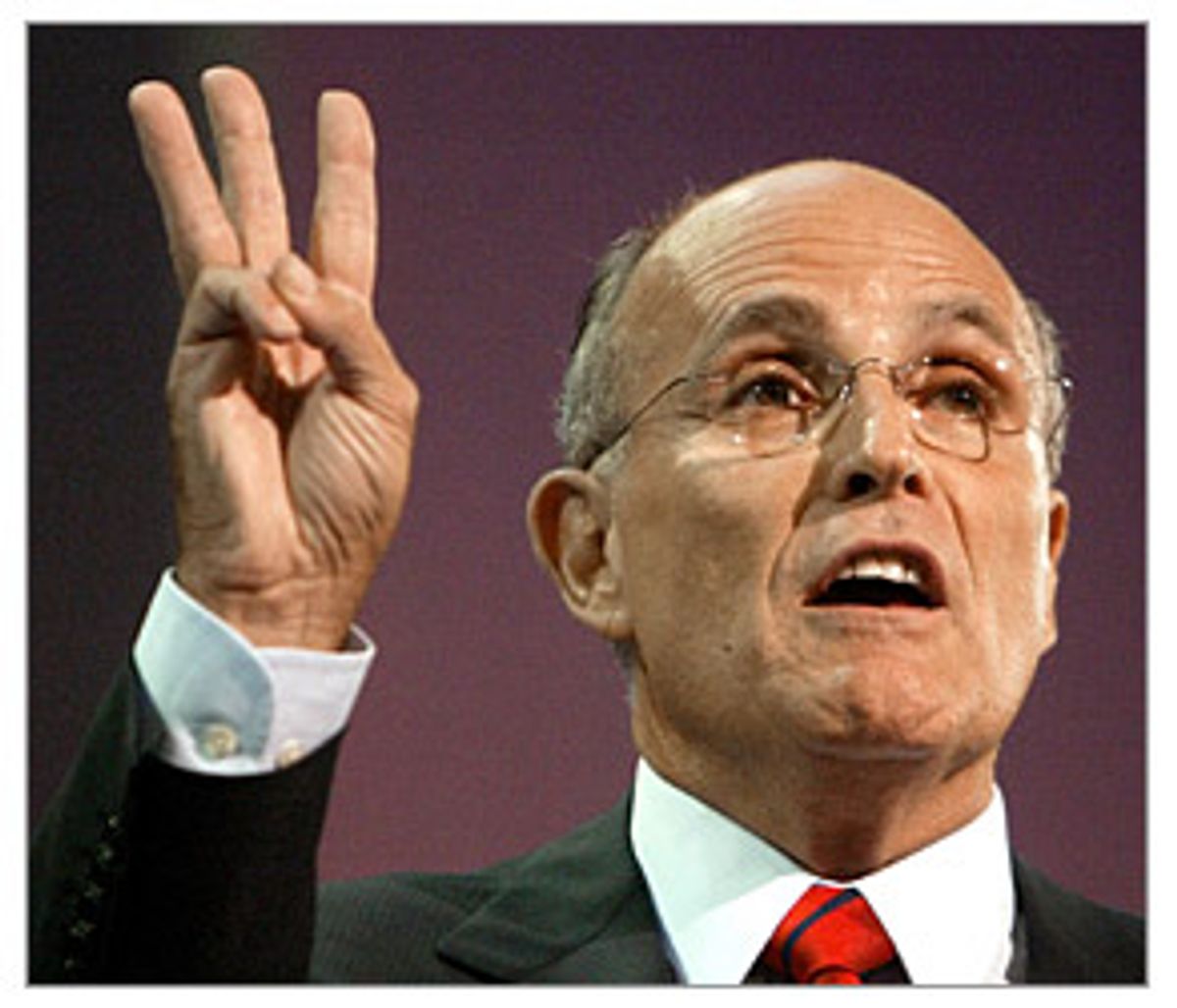
If McCain buried his criticism of the war, former New York Mayor Rudolph Giuliani took his support for it to new heights. He resuscitated the administration’s seemingly abandoned rationale that Saddam Hussein had something to do with the attacks of Sept. 11, invoking — as at least three previous speakers had — that ground zero photo op. Giuliani said that Bush “stood amid the fallen towers of the World Trade Center and said to the barbaric terrorists who attacked us, ‘They will hear from us.’ They have heard from us! They heard from us in Afghanistan and we removed the Taliban. They heard from us in Iraq and we ended Saddam Hussein’s reign of terror.”

In putting the country on the offensive in Afghanistan and Iraq, Giuliani said that Bush had succeeded in “keeping us unified” and in “holding us together.”

Giuliani’s words were belied by events in his city — where hundreds of thousands of protesters filled the streets over the weekend — and around the country, where polls show that Americans are sharply divided over the president and the war he chose to fight.

For Republicans, George W. Bush is still a resolute hero, and the days after Sept. 11 were his finest moments. Robyn Rutledge, a delegate from North Carolina, said she looks back at those days, and the words “leadership” and “courage” come to mind.

For many Democrats, of course, memories of Bush’s reaction to Sept. 11 come in a wave of very different images. There’s Bush, sitting in that Sarasota classroom while the schoolkids read “The Pet Goat.” There’s Bush, flying aimlessly around the country on Sept. 11 to avoid a threat to Air Force One — a threat that Karl Rove and Ari Fleischer trumpeted and the White House later quietly disavowed. And there’s Bush, invoking the attacks of Sept. 11 to launch a war against a different enemy in a different place.

But if the country is divided today, it is not Bush’s doing — at least according to some Republican delegates. “The Democrats have polarized our country,” Rutledge said as she waited for the night’s speeches to begin. “Our president has been attacked so much over the last year, it’s ridiculous.”

McCain called for some sort of end to those attacks Monday night. He didn’t mention the Swift boat flap or the Bush smears he faced in 2000. Instead, he reminded delegates that Democrats are Americans, too, and he said that neither party should question the other’s sincerity. But that didn’t stop speaker after speaker from questioning Kerry’s sincerity Monday night, suggesting again and again that he has no firm convictions and waffles on important issues. One delegate, Dianne Alexander from California, showed up at the convention in a sweater embroidered with flip-flops. “My issue is national security,” she said, “and I don’t think John Kerry has ever addressed our safety. I don’t think he’s serious about it. I know our president is.”

Paul Rieckhoff isn’t as sure. A New Yorker who helped with search and rescue operations at ground zero and then led an Army Reserve platoon in Operation Iraqi Freedom, Rieckhoff said the focus on Sept. 11 is just a way to avoid talking about the war abroad or safety at home. “I’ll tell you, I was at 9/11, I was at ground zero digging bodies out,” said Rieckhoff, who now leads a veterans’ organization called Operation Truth, and came to Madison Square Garden to see if the Republicans were living up to its standards. “This is an insult to me and to everyone else who was there. If they’re trying to take advantage of 9/11 for political reasons, I think it’s more of the political posturing crap we’ve heard from both sides. I want to hear issues. I want to hear what they’re going to do to stop 9/11 from happening again.”

On the first night of the Republican National Convention, there were a lot of things that nobody heard. In almost four hours of speeches — speeches devoted almost exclusively to the attacks of Sept. 11 — Osama bin Laden wasn’t mentioned once. The protests in the streets were ignored; a phony convention “floor reporter” said that New York had “rolled out the red carpet” for the Republicans, and delegates universally claimed that they hadn’t seen any protesters.

There was also no hint of any discord in the party. The pro-gay Log Cabin Republicans launched a TV ad earlier in the day warning that the religious right was hijacking the party, but the moderates who dominated the prime-time lineup Monday said nothing at all about the party’s internal tensions. Although the Log Cabin Republicans view McCain and Giuliani as friends to their cause, those friends did nothing at all Monday to move delegates toward a more moderate view on social issues.

Earlier in the day, delegates ratified platform language that gave the party’s right wing just about everything it wanted — a call for constitutional amendments banning abortion and gay marriage, opposition to any form of legal recognition of same-sex relationships, and tight limits on stem-cell research. The proponents of such hard-right policies weren’t on display during prime time Monday, as the Republicans chose to kick off their convention with two of the party’s most popular moderates.

Democrats dubbed it a “bait and switch” operation. Democratic National Committee chairman Terry McAuliffe said anyone who wanted to see just how extremist the GOP really is should “turn down the volume and read the platform.”

“They’re trying to present one view and one face on the party to the people, and they’re trying to keep the focus on those who, frankly, have no influence in Washington, with all due respect,” Sen. Hillary Clinton said Sunday. “They’re not running the House — Tom DeLay is. They’re not running the Senate — the Republican Senate caucus largely driven by the most extreme members are unfortunately calling the shots.”

Republicans brushed off the charge, saying that the party would be foolish to ignore its most popular politicians during election season. “A party that wasn’t smart enough to ask Gov. Schwarzenegger to come and speak would be unworthy of trying to occupy the White House,” former House Speaker Newt Gingrich said Monday at a panel sponsored by the moderate Main Street Republicans.

Christine Todd Whitman, the former New Jersey governor and EPA administrator, said during the panel discussion that she thinks too much is being made of the convention’s moderate cast. “I have been somewhat amused as I have gotten questioned at this convention, ‘Well, isn’t it somewhat hypocritical that you have all of these Republican officeholders who are moderate and are speaking?’” she said. “Well, to think about it, no, they’re Republican officeholders, and they’re speaking and they’re moderate. That’s who we are.”

Republican Sen. Mitch McConnell said that the parties — both parties — have to put on a moderate show to appeal to a country split down the middle. “The Democrats painted a much more moderate image with their speeches and speakers than the Democratic delegates,” he told a radio interviewer Monday. “We are putting our moderate stars front and center for the very same reason. The voters that are undecided are in the middle, and both sides are doing exactly the same thing.”

Not exactly. In Boston, liberal Democrats like Howard Dean, Ted Kennedy, Dennis Kucinich and Al Sharpton all had prominent speaking spots, and sometimes they used them to speak passionately about their causes. Moreover, the speakers who played most prominently on the Democratic stage in Boston represented — for better or for worse — the current power structure of the party.

McCain and Giuliani don’t represent the reality of today’s Republican Party, and Monday night they didn’t even do a particularly good job of representing themselves. McCain tarnished his reputation as a “straight talker” by sucking up entirely to a president he has often opposed. Giuliani, meanwhile, lost some of his good-guy luster by engaging in the kind of fact-challenged smearing favored by the Bush campaign. He fudged facts to make the case that Kerry is a flip-flopper who can’t be trusted. He said that Kerry had declared himself an antiwar candidate and then a “pro-war candidate” — a statement that was half misleading and half untrue — and he claimed that Kerry had suggested he was supported by some foreign leaders — true — who opposed the war in Iraq — false.

And neither McCain nor Giuliani distinguished himself as a speaker. On the Democrats’ first night in Boston, Jimmy Carter, Al Gore and Bill Clinton electrified the Fleet Center crowd. Although Giuliani fired off a few anti-Kerry zingers, the overall tone of the night was flat. Maybe it was because, unlike the Democratic stars, the Republican keynote speakers on Monday night were not the red-meat GOP delegates’ favorite sons. Giuliani’s speech went on forever, but then it ended abruptly. Within seconds, delegates were filing out of the hall and back to their buses, where through the darkened windows they might catch a glimpse of a very different world outside.

Continue Reading Close

Tim Grieve is a senior writer and the author of Salon's War Room blog.

Michael Moore and the Oscars get it right

The Academy's documentary category has been a horrible mess for years. The controversial new rules can only help

  • more
    • All Share Services

Michael Moore and the Oscars get it right Stills from "The Interrupters" and "Senna"

As multiple media sources have reported over the last two days, under proposed new Academy rules, only films that have been reviewed by the New York Times or the Los Angeles Times will be eligible for the best documentary Oscar. But that’s not the real story, and it’s not nearly as dumb as it sounds.

“Everybody’s getting excited about something that’s not the real headline,” explains filmmaker and blogger AJ Schnack, a co-founder of the documentary-centric Cinema Eye Honors awards. “The headline is that the Academy is making big changes to the way it selects and nominates documentary films, and based on what I know so far, those changes are overwhelmingly positive.”

Perhaps the first thing to understand is that the new docu-Oscar rules, which go much further than eligibility issues, were largely pushed through by Michael Moore, who sits on the Academy’s governing board. The intention behind the changes, including the bizarre-sounding NYT/LAT requirement, is to streamline a notoriously clunky and cliquey nominating process, and to ensure that the Oscar-winning documentary is “truly a theatrical motion picture, because that’s what these awards are for,” as Moore told indieWIRE.

Furthermore, the new rules are meant to minimize the possibility that major, well-reviewed documentaries will be shut out of the Oscar nominations for mysterious reasons, as has happened repeatedly in the past. As Roger Ebert wrote more than 15 years ago, the list of non-nominated documentaries is like an honor roll of classics, from Errol Morris’ “The Thin Blue Line” to Moore’s “Roger & Me,” from Michael Apted’s “28 Up” to Steve James’ “Hoop Dreams.” In recent years, you could add “Fahrenheit 9/11,” “Grizzly Man” and “Waiting for ‘Superman’” to that list. Two of 2011′s best-reviewed docs, James’ “The Interrupters” and Asif Kapadia’s “Senna,” have already been eliminated from consideration this year.

Under the current system, secret committees of 10 or fewer volunteers from the Academy’s documentary branch view groups of films and vote on them, creating the possibility that some tiny knot of dissenters — perhaps one or two voters — can sabotage a film’s Oscar hopes by giving it low marks. “That first round of voting, to go through all the eligible films and get to the short list, just seems really weird,” says Schnack. “You have small groups of people, each of which only views a small portion of the films. Instead of voting for their passions, they can end up voting against what they dislike. I think it’s pretty much true that one person can sabotage a film.”

Under Moore’s proposed new rules — at least as summarized in an admirable explainer by Dana Harris of indieWIRE — the documentary “shortlist,” and later the list of five nominees, will be selected in a vote by the Academy’s entire documentary branch, which reportedly has 157 members. “That restructuring, where the entire branch gets to vote and not just a small committee, strikes me as an incredibly good thing,” says Schnack. “That might be the single biggest change.”

Veteran documentary producer and programmer Thom Powers, who runs the prestigious Stranger Than Fiction series in New York, notes that there are legitimate concerns about exactly who’s in the documentary branch and how they will vote. “That membership remains secret, although if you’ve been paying attention over the years, you can figure out a few dozen of the names,” he says. “It’s valid to wonder whether all 157 members will really dive into the 100-plus films that will qualify. Is this system going to favor the top 15 films that are most talked about and most prominent? One unfortunate thing about that secrecy is that it does favor filmmakers with deeper pockets or more powerful distributors.”

In another major departure from established procedure, the five nominees will then be submitted to the entire Academy membership of 6,000 or so Hollywood professionals for final voting, not just to the specialists of the documentary branch. Under the current system, as Michael Moore puts it, “When people get the award for best documentary and they go on stage and thank the Academy, it’s not really the Academy, is it? It’s 5 percent of the Academy.”

While the decision to use the stodgy warhorses of print journalism as an Oscar-eligibility filter may seem arbitrary and retrograde, it’s an attempt to restore some order to an unwieldy system. The New York Times’ editorial policy is to review every film that plays at least a one-week engagement at a theater in New York City, which nearly matches the current Oscar eligibility rules requiring a New York or Los Angeles theatrical run. (If the Times revises that policy, then the Academy promises to revisit the new rule.) Those films likely to be eliminated under the new rule, like this year’s acclaimed Marine Corps documentary “Semper Fi,” are those that lack commercial distribution or are bound for TV, and play as part of the International Documentary Association’s DocuWeeks festival.

“I’m not that concerned with the eligibility rules,” says Schnack. “They’ve tinkered with those six or seven times in the last 10 years, and somehow roughly the same number of films manage to become eligible.” He points out that while a film like “Semper Fi” would indeed be ineligible for 2011 under the new rules, if it were to find theatrical distribution in 2012 it would receive the required Times review and become eligible next time around. Exactly the same thing applies to another shortlisted film for 2011, the Harry Belafonte documentary “Sing Your Song.” It has played to enthusiastic audiences at film festivals, and will open commercially in New York this week, so it would certainly have become eligible for 2012 under the new rules.

There’s a long tradition of films that are primarily or exclusively intended for television getting Oscar nominations, after meeting the letter but perhaps not the spirit of the eligibility rules. That may well change; I’m not sure, for instance, that Marshall Curry’s “Street Fight,” an Oscar-nominated 2005 film about an infamously dirty Newark, N.J., mayoral election, would meet the new requirements. But that’s an issue in a much broader debate, and the Academy has clearly decided that it wants to honor theatrical films, not TV films. After all, as Michael Moore observes, the television industry gives out its own awards, and if they don’t quite carry the cachet of an Oscar, so be it.

Some voices on the Internet, including respected indie-film blogger Anthony Kaufman, have suggested that letting all Academy members — actors, costume designers, cinematographers and so on — vote for the best documentary will push the awards in an ever more tepid and mainstream direction. Neither Powers nor Schnack sees it in those terms. “It’s called the Academy Awards,” says Powers. “Academy members should get to vote.”

“Look, we love the Oscars because it’s a big, glitzy ceremony with a big gold statue,” says Schnack. “It’s part of Hollywood history and part of documentary film history. Over the years, the winners [in the documentary category] have included Walt Disney and Jacques Cousteau and the Department of the Navy. It’s a crazy, big award, and if we want to be part of it our movies should be judged as movies, by the same standards that apply to narrative films.”

Continue Reading Close

Michael Moore: “America is not broke”

The documentary filmmaker was in Wisconsin yesterday, slamming Republicans for cutting union benefits

  • more
    • All Share Services

Michael Moore:

Michael Moore has a message for Wisconsinites:

Contrary to what those in power would like you to believe — so that you’ll give up your pension, cut your wages, and settle for the life your great-grandparents had — America is not broke.

The claim came at the beginning of a speech delivered by the documentary filmmaker and liberal firebrand at the Wisconsin State Captiol yesterday. Over the course of 30 minutes, Moore railed against Republicans, who he accused of misleading the American public when they claim that government can’t afford to spend money on expenditures like pensions and union wages. You can watch the entire speech below.

Continue Reading Close

Directors of the decade: No. 6: Michael Moore

Whether you love him or want to punch him in the mouth, he is rallying the troops in the rhetorical civil war

  • more
    • All Share Services

Directors of the decade: No. 6: Michael MooreMichael Moore (at right) and former President George W. Bush in a still from "Farenheit 911"

Michael Moore is the only documentary filmmaker besides Ken Burns the average American has heard of, and he’s more of an active presence in American life than Burns, because even when he’s not making or promoting a new film, he’s on TV and the Internet beating the drum for a cause or tormenting the foes of all he deems good and decent. He is a media-age phenomenon as well as a filmmaker, his presence on the pop culture radar screen a life-as-mass-media-performance-art-project in the vein of previous practitioners, some important, others merely shameless: Andy Warhol, Muhammad Ali, Madonna, Norman Mailer, Gore Vidal, Tiny Tim.

And whether you think Moore is a brave soul fighting the power or a self-aggrandizing blowhard who’s mainly selling himself, it’s clear he has a knack for insinuating himself into the head space of all sorts of people — those who have no opinion on him, those who are glad he’s alive, and those who fantasize about pouring a vat of beef stew over his head and tossing him into a pit full of wolverines. I suspect Moore’s highly subjective, emotion-driven filmmaking and his career-long interweaving of self-promotion and self-expression (which started back in 1989 with his anti-General Motors jeremiad “Roger & Me”) will one day be seen as epitomizing aspects of life in this grim, weird decade, just as Hunter S. Thompson’s song-of-myself political writing helped future generations understand the ’70s.

When artists construct such a compelling public face, the art and the artist fuse, even loop back on themselves so that it’s tough to tell where one begins and the other ends. It’s a conundrum the modern artist can’t escape, and maybe shouldn’t; when an artist resists becoming the story, the media and the public tend to decide there isn’t one. Moore knows vastly fewer people would talk about his movies, or even bother to see them, if he weren’t out there on talk shows and in front of his own documentary lens raising hell, cracking wise, taunting the powerful, comforting the powerless and otherwise carrying on like the bastard spawn of Will Rogers and Amy Goodman.

In any event, Moore the director has been politically and artistically (and on the Internet, technologically) vital — not to mention adept at identifying subjects of mass dread and getting films about them into the marketplace right around the time said dread achieves critical mass. In the last 10 years, Moore has addressed the self-perpetuating cycle of fear and violence in America (“Bowling for Columbine“), the Bush administration’s conduct of the war on terror (“Fahrenheit 9/11”) and the arguments in favor of state-run, or at least state-assisted, healthcare (“Sicko”).

Moore’s latest, “Capitalism: A Love Story,” might be the key Moore film, its title serving as an umbrella that shades every other subject he’s tackled. The answer to every “Why?” in a Moore film can be answered, “Because of money.” Its arguments are too fuzzy and its thesis too broad to achieve the level of popular relevance to which Moore has become accustomed; Americans prefer ideas they can hold in their hands. But whatever “Capitalism’s” reception, the fact remains that nobody else is making political films on such basic and important subjects and getting them so widely distributed and discussed.

None of Moore’s films this decade were as prominent as “Fahrenheit 9/11,” because none had a main character as charismatic and polarizing as President George W. Bush. It was the first feature that Moore tried to stay out of, to the extent that Moore can stay out of anything, and I wouldn’t be surprised if his decision was motivated both by a desire to foreground the message rather than the messenger and an entertainer’s understanding that you can’t steal the spotlight from a child, a pet — or W. himself. (Add to that the fact that Moore, who positions himself as the good guy in his own mythic narratives, hadn’t had a truly intimidating adversary since GM boss Roger Smith.)

The prospect of making the president lose reelection, or at least lose sleep, formalized the (often contrived) underdog mantle that Moore has always wrapped around himself like a cape. And it encouraged Moore to spotlight his insult comic’s vicious wit, setting one of the movie’s expository passages about the president’s youth to Eric Clapton’s “Cocaine” and letting Bush’s paralysis in that classroom on the morning of 9/11 play out at length. One rarely sees a documentary whose whole purpose is to tear down another person, and that dubious distinction made “Fahrenheit 9/11″ electrifying — if only to liberals who felt helpless in the face of the president’s political, military and media machines and prayed that somebody somewhere would stand up, say something, do something.

Bush’s brazenness post-Iraq seemed to crank up Moore’s urgency and grandiosity. Around the time “Fahrenheit 9/11″ came out, Moore declared that his goal was nothing less than the electoral defeat — or re-defeat, as the bumper stickers said — of the president (whether the film ultimately hurt or helped the president is an important, but unanswerable question). To achieve that end, Moore paints Bush’s definitive negative caricature, presenting him as a hateful fraud, an ignorant brat playing with mass-murdering toys, a fake macho man whose cornball swagger was purchased with daddy’s money and America’s military might, and a bumpkin prince of darkness whose descent upon the Capitol following the electoral shenanigans of 2000 was a metaphysical as well as political catastrophe. And the film’s opening credits are one of the decade’s most powerful sequences: Bush and his Cabinet being made up for TV appearances while mournful, minor-key acoustic guitar plays in the background is a devastating marriage of image and sound, one that conjures sadness, rage and fear. The sequence is a liberal’s dirge. Democracy is dead, and here are its murderers putting on their war paint and getting ready to finish off the rest of us. (Facing down the president ennobled Moore’s asshole tendencies. His adversary was so powerful and so smug about his power that Moore couldn’t go too far in attacking him – at least not as he did in “Bowling for Columbine,” in which he trespassed on the property of the elderly, unprepared and clearly baffled NRA spokesman Charlton Heston and answered his gentlemanly incredulity with snotty contempt.)

“Fahrenheit 9/11″ was arguably the documentary of the decade, a work that tried to change history as well as describe it and, if not a classic of logical argument, then surely a masterpiece of outrage, propaganda as formally skillful as it was emotionally opportunistic. (Moore’s use of war veterans and their loved ones was the liberal flip side of W. treating uniformed soldiers as TV props to burnish his warrior bona fides.) And it was everywhere in 2004 — in theaters, on TV, on the Web. Even if you hated Moore’s guts and wouldn’t see the movie if your life depended on it, you still ended up reading about it, hearing the film’s merits argued and its errors and distortions catalogued. Moore shows the world what American liberal anger looks like — a furious but ephemeral force that rarely stays roused for long, liberals being notoriously inclined to bitch rather than act unless it’s a presidential election year. Elsewhere this decade he prided himself not just on participating in the national argument, but also on setting its terms. His films supplied liberals with talking points on gun violence, 9/11, the war on terror, healthcare and financial chicanery. His Web site, public speeches and coordinated e-mail campaigns endorse or oppose presidential decisions, political candidates and propose new laws. (Moore’s “Letter From Mike” feature is written, quite effectively, in the jes’ folks style of his movie narration. “It’s not your job to do what the generals tell you to do,” Moore writes, in an “open letter” to President Barack Obama urging him not to add more troops in Afghanistan, adding, “With our economic collapse still in full swing and our precious young men and women being sacrificed on the altar of arrogance and greed, the breakdown of this great civilization we call America will head, full throttle, into oblivion if you become the ‘war president.’” For better or worse, Moore is one of a few filmmakers who could publish such a letter and rest assured that a president (or his people) might even read it.

He’s the enemy the right deserves and probably craves. He is his own self-caricature, and craftier and more gifted than detractors care to admit. He’s a standard-bearer in the rhetorical civil war that Mailer, in 1963′s “The Presidential Papers,” foretold as inevitable fallout from the end of the Cold War — “the war which has meaning, that great and mortal debate between rebel and conservative where each would argue the other is an agent of the Devil.” 

Continue Reading Close

Moore a sign of things to come for Obama?

A prominent liberal breaks, in a big way, with the president over his Afghanistan policy

  • more
    • All Share Services

Moore a sign of things to come for Obama?Filmmaker Michael Moore speaks at a news conference "to challenge President Obama and the Democrats to stand strong on healthcare reform that includes a public option", in Washington September 29, 2009. REUTERS/Molly Riley (UNITED STATES ENTERTAINMENT POLITICS HEALTH)(Credit: Reuters)

On Tuesday night, President Obama is set to announce that he’s sending additional U.S. troops to Afghanistan — about 30,000 of them. Indeed, White House Press Secretary Robert Gibbs said Monday that the president has already given the order, though for now Gibbs wouldn’t say what the actual order was.

Michael Moore, however, wants to stop him. In an open letter published on his Web site Monday, Moore decried Obama’s decision, saying he’ll now be known as “the new war president.” The director wrote:

Do you really want to be the new “war president”? If you go to West Point tomorrow night (Tuesday, 8pm) and announce that you are increasing, rather than withdrawing, the troops in Afghanistan, you are the new war president. Pure and simple. And with that you will do the worst possible thing you could do — destroy the hopes and dreams so many millions have placed in you. With just one speech tomorrow night you will turn a multitude of young people who were the backbone of your campaign into disillusioned cynics. You will teach them what they’ve always heard is true — that all politicians are alike. I simply can’t believe you’re about to do what they say you are going to do. Please say it isn’t so.

It is not your job to do what the generals tell you to do. We are a civilian-run government. WE tell the Joint Chiefs what to do, not the other way around. That’s the way General Washington insisted it must be. That’s what President Truman told General MacArthur when MacArthur wanted to invade China. “You’re fired!,” said Truman, and that was that. And you should have fired Gen. McChrystal when he went to the press to preempt you, telling the press what YOU had to do. Let me be blunt: We love our kids in the armed services, but we f*#&in’ hate these generals, from Westmoreland in Vietnam to, yes, even Colin Powell for lying to the UN with his made-up drawings of WMD (he has since sought redemption).

Here’s the thing, though: Obama wasn’t exactly hiding his position on Afghanistan during the presidential campaign. The war there was often thought of as the “good war” on the left, at least in comparison to the one the Bush administration started when it invaded Iraq. And that meant refocusing resources on Afghanistan.

Still, while it’s pretty clear that Moore’s open letter won’t change Obama’s mind, and that Obama is likely to win a fight with Moore right now, it also appears that the floodgates are opening. With former President George W. Bush out of office, liberals are coming forward to oppose escalation in Afghanistan, and Moore won’t be the last prominent figure from the left to slam Obama over it.

Continue Reading Close

Alex Koppelman is a staff writer for Salon.

Michael Moore and the evils of free enterprise

In "Capitalism: A Love Story," the filmmaker takes to the bullhorn to decry corporate greed -- and promote himself

  • more
    • All Share Services

Michael Moore and the evils of free enterpriseMichael Moore

Michael Moore’s ostensible subject has always been his fury at the injustices wrought against hardworking American citizens. And it’s possible that, in his early days as a filmmaker, that was his true motivation. But 20 years after “Roger & Me,” “Capitalism: A Love Story” proves that Michael Moore’s greatest subject is himself. This is a love story, all right, but it has less to do with the flaws of capitalism than it does with Moore’s unwavering fondness for the sound of his own voice, and for what he perceives as his own vast cleverness.

As with all Michael Moore’s films, that’s not to say he doesn’t have a point, buried in there somewhere amid all the Silly Putty-stretched facts and cartoony music. It’s possible to agree with Moore in theory and still find his tactics sloppy and ineffective (though his zombie-like followers don’t like to allow for the existence of any potential gray areas, maybe because gray areas tend to demand actual thought). In the 2007 “Sicko,” he highlighted some very real, and very dangerous, problems with the U.S. healthcare system. In the 2004 “Fahrenheit 9/11,” he asserted that our then-president was bad for America, and that the Iraq war was wrong. If you’re reading this right now, it’s 99 percent likely that you agree, as I do, with Moore’s basic take on those subjects.

The problem with Moore’s approach is that he reveals these injustices as if he’s just discovered them himself. Similarly, “Capitalism: A Love Story” will be revelatory and helpful to those Rip Van Winkles who slept through the fall of 2008 and the early part of 2009, who didn’t realize that hardworking American people are being pushed out of their homes in record numbers as a direct result of corporate greed. It’s not Moore’s core beliefs that are grating: It’s his consistently wide-eyed approach, his presupposition that you need to adopt an aura of innocence in order to be outraged. In Michael Moore’s world, to be enlightened and outraged makes you one of the elite — better to be an underinformed Everyman, so he can spoon-feed the facts to you and therefore reinforce his own reason for existing.

Moore’s aim here is to prove that capitalism, at least as big business currently defines it, is bad. It wasn’t always thus: Moore includes footage from his own family’s home movies, showing a smiling young Mike enjoying the pleasures of life in Flint, Mich., circa the 1950s. (Moore’s father, who appears in the film, was a longtime G.M. employee.) Moore explains in voice-over that his family wasn’t rich by any means, but they were definitely comfortable: The house in which he grew up had been fully paid for by the time he was in kindergarten; his parents could buy a new car every three years. This is Moore’s way of explaining — and he’s not wrong — that many working people could take part in the capitalism of the ’50s, but capitalism as it’s practiced today is another story.

In his usual hopscotching fashion, Moore goes on to explore numerous instances of corporate greed and its effects on working people: He interviews several young pilots, working for regional airlines, who are trained and entrusted to operate aircraft and yet who barely make enough money to get by. (One of them explains that he had to go on food stamps.) He interviews Peter Zalewski, a scarily slick type who works for a Florida real-estate concern called, in a stroke of brazen forthrightness, “Condo Vultures,” which specializes in matching foreclosed properties with buyers, who resell them for a profit. He decries last fall’s banking-industry bailout, and bemoans the way the recipients squandered the money they received instead of using it to either save endangered jobs or create new ones.

But Moore doesn’t shed any new light on this kind of greed, and his attempts to grab his audience are so strained that they detract from his essential argument. His tactics here include conducting on-camera interviews with families who have just been pushed out of their homes. For understandable reasons, these people are often brought to tears as they vent their outrage and sadness, their sense of loss. In case we’re not getting the point, Moore puts gloppy, sentimental string music on the soundtrack, as if he believes viewers can’t be trusted to grasp the basic horror of the situation on their own. At another point, he marches up to AIG headquarters on Wall Street (it appears to be on a Sunday morning, when no one’s around — Wall Street is bustling on any weekday), declaring to the security guards that he’s there to make a citizen’s arrest of the CEO. The security guards rebuff Moore firmly but politely, as if he were a crazy but harmless old auntie — they’d serve Moore’s purposes better if they were angry or bullying.

Moore does hit a number of crucial points, making note, for example, of the large number of former Goldman Sachs executives who figure prominently in both the current and previous administrations. But he can’t let 10 minutes pass without injecting himself into the conversation: Moore can’t mention the sad collapse of Detroit without taking credit for foreseeing these kinds of problems in “Roger & Me,” as if he’d offered some kind of viable advice that simply hadn’t been taken. He tells us how, when he was a lad, his dream was to enter the priesthood, because he so admired the work of Catholic priests who became involved in the fight for civil rights. This is his way of reminding us how noble his goals are — that all he ever really wanted to do was fight for the little people.

But his respect for the priesthood does make sense in terms of his misguided sense of pageantry. In “Capitalism: A Love Story,” he can’t resist showing himself outside the hallowed halls of Citibank (and Chase, and AIG), trying to gain access and, of course, being refused. Those scenes have become tired staples of every Moore film, a recycled vaudeville act that’s supposed to be funny, surprising or outrageous each time we see it. Scenes like that are necessary to reinforce Moore’s status as an outsider, and his loyal fans, it seems, never get tired of seeing them. At this point, Moore appears to be making movies specifically for those fans — he’s no longer even pretending to try to win over the general populace. With “Capitalism: A Love Story,” he’s preaching to people who have already been converted, 20 times over. As for the others, no matter how loudly he shouts through his bullhorn, he’s not going to get their attention.

Continue Reading Close

Stephanie Zacharek is a senior writer for Salon Arts & Entertainment.

Page 1 of 9 in Michael Moore