Rebecca Clarren

Baked Alaska

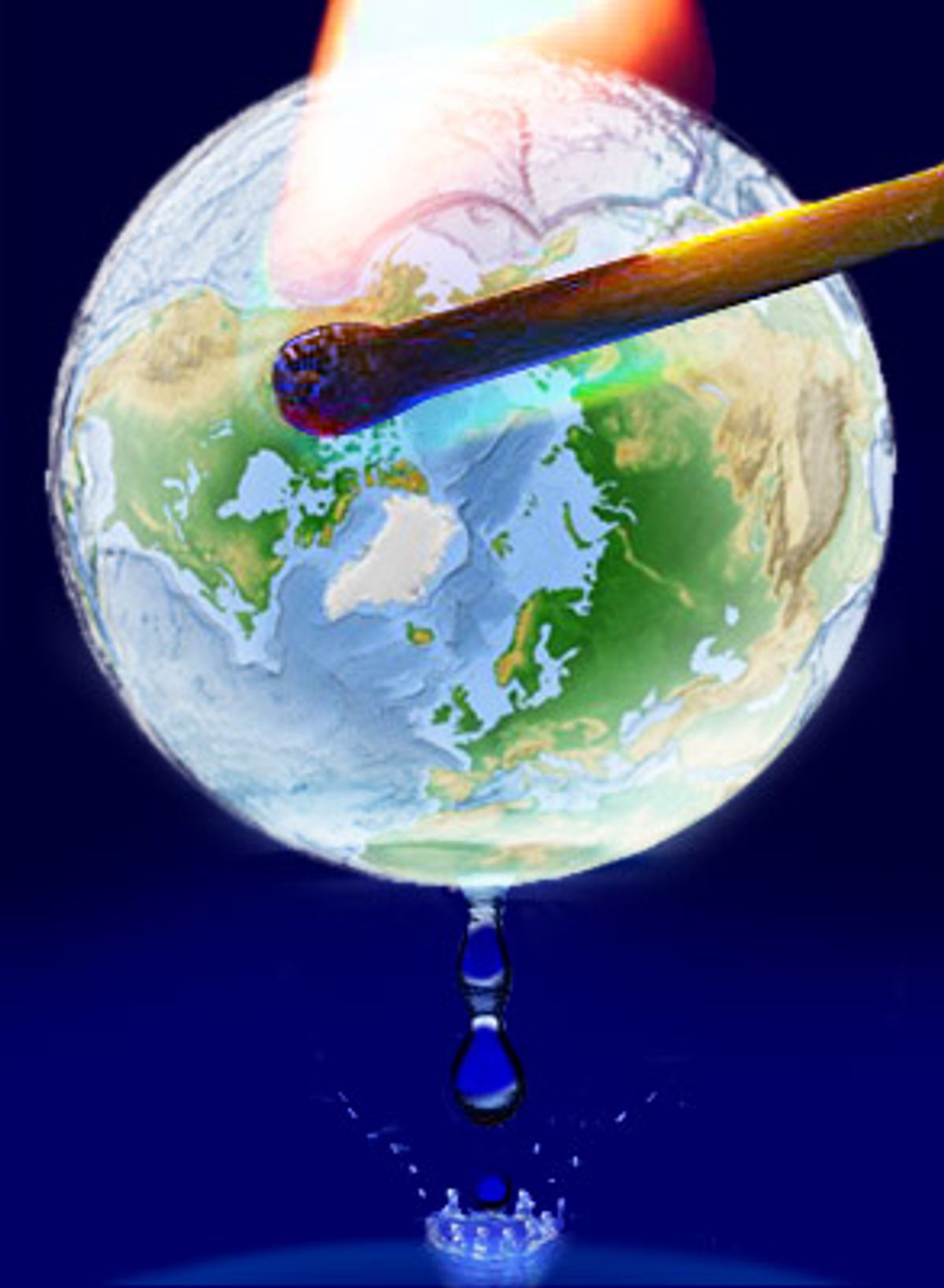
In the Arctic, where flowers are madly blooming, trees are growing to mutant sizes and the snowpack is thinning, researchers are getting an incontrovertible view of global warming.

  • more
    • All Share Services

Baked Alaska

Thin bright light stretches taut across the late afternoon sky. At an Arctic biology research site, 135 miles south of the Arctic Ocean, an expanse of golden tundra rolls unhindered toward the craggy mountains of the Brooks Range. Silver rivers and lakes, blueberries and umber hills grace the landscape.

At the moment, University of Alaska Fairbanks ecologist Syndonia “Donie” Bret-Harte is not enjoying the view. As she stares at the tundra carpet with concern, her husband, Peter Ray, a retired Stanford professor of plant physiology, yells from up the hill. “Hey, Donie, you’ve got to come look at this. The eriophorum are efflorescing again.” Translation from science speak: The flowers are blooming.

It’s the second time they’ve blossomed this year. Given an atypically long season of warm weather, the flowers are confused, thinking spring is here again.

“It’s a bad strategy for them because they’ll lose their seeds to the frost,” says Bret-Harte, looking worried behind large gold-rimmed glasses. Flowers only make one set of buds each year so if they spend next year’s buds now, they’ll be out of luck next spring. If the warming trend continues, the flowers may go extinct.

Lean and tall with a long black braid down her back, an intellectual Olive Oyl, Bret-Harte has spent the past 10 summers studying Arctic plants at this research site in Toolik Lake, Alaska. While it’s too soon to prove statistically, she and Ray suspect that these confused flowers are just one more example of the phenomenon threatening the entire planet: global warming.

Over the past century, Bret-Harte explains, due to the increase in oil and gas consumption, carbon dioxide and methane emissions have skyrocketed. Such gases hover above the earth, trap the sun’s heat, and cause the planet to warm up. In just the past three decades, this warming has heated the Arctic by nearly 5 degrees Fahrenheit. Since the mid-1950s, Alaska’s glaciers have lost about 3,300 cubic kilometers of melted ice and snow — enough to submerge the entire state of Texas in 15 feet of water. Due in part to this influx of fresh water combined with warmer temperature, computer models predict that the Arctic Ocean’s sea ice could completely disappear within 70 years.

While it’s unlikely the four horsemen of the apocalypse are saddled up and ready to ride, global warming will likely have an enormous and dire impact on human populations in the Arctic and beyond. Already, native communities that dot Alaskan shorelines are seeing villages crumble. Waves, unhindered by large ice chunks, now swell and break against the shore with a ferocity never seen before. Banks are eroding and high water has consumed so many homes and buildings that two villages have been forced to move inland.

Alaska is not alone. In his alarming book “Boiling Point,” Ross Gelbspan writes that global warming is disrupting “the normal flow of deep-water currents that determine climactic conditions in much of the world.” For instance, Gelbspan reports, extreme effects of the weather phenomenon, El Niño, have caused China’s Yangtze River to overflow, killing more than 3,000 people, leaving 230 million people homeless, and generating $30 billion in damages. Worldwide, warmer weather means more extreme floods and drought, which creates breeding grounds for countless disease-carrying insects.

“There’s strong consensus now in the scientific community that global climate change is caused by human activities,” says Bret-Harte in her kind, matter-of-fact manner. “There are always a few folks that disagree. But mostly they work for the oil and gas industry.”

And apparently for the Bush administration. Claiming the jury is still out on what causes global warming, the president has written a climate change policy that is about as aggressive as a tortoise. Loath to enact measures that would reduce our addiction to oil and gas — and income to his friends and campaign supporters — the Bush administration has spent the past several years misrepresenting the science on climate change in order to justify a path of inaction. For the Arctic researchers who are watching a landscape in flux, this is beyond infuriating.

“We see the possible consequences of no action and the consequences are looking graver and graver and more and more imminent,” says John Hobbie, the tough co-founder of the Institute of Arctic Biology Toolik Field Station and director of the Ecosystems Center at the Marine Biological Lab. “We scientists realize that climate change is more than just vague words and models.”

A funky hodgepodge of old military trailers, canvas tents and a helicopter (to transport scientists to remote lakes and streams), the Toolik Field Station looks like some sort of 21st century “MASH” set. Established by the National Science Foundation in 1975 as a long-term ecological research facility, the site, nestled on the edge of Toolik Lake, has since attracted an annual crew of up to 100 scientists, graduate students and technicians from universities and institutions throughout the country. Each year they spend weeks at a stretch analyzing the changing landscape, isolated by the empty terrain from what they fondly call “their real lives.”

Because the Alaskan Arctic is warming faster than any other place in the world, it offers an ideal natural laboratory to study climate change. Unlike the rest of the world, which has warmed about 1 degree over the past century, the Arctic’s unique landscape of mostly ice and snow magnifies temperature changes because as ice and snow melt, the terrain stops reflecting sunshine and starts absorbing heat. With this trend in a dizzying rate of motion, computer models predict that during the next century the Arctic will warm an additional 7 to 12 degrees Fahrenheit. Considering that the last ice age was spurred by a temperature difference of 13 degrees, such climate change means that the flowers aren’t alone in their strange behavior.

The tundra that Bret-Harte and Ray study is a patchwork of ancient grasses, berries, moss and woody shrubs. Due to the intense cold and the limitations of a two-month-long growing season, the plants are miniature — 400-year-old tussocks are no bigger than a pie tin. Yet as the climate has warmed, the woody species like birch, willow and alder shrubs are not quite so shrublike these days. Compared with aerial photographs taken on oil exploration missions in the mid-1950s, the woody plants have taken off like a case of bad acne. In each of the 200 comparison photos, not only did individual shrubs increase in size, but the patches of alder and birch have spread into areas that weren’t shrubby before. This trend is likely to continue, says Bret-Harte.

To further predict the outcome of future warming, in 1988 Bret-Harte’s former postdoctoral advisor, Gaius Shaver, perched greenhouses directly atop the tundra. Inside the enclosed plot, the plastic structure increased the temperature by 3.5 degrees Celsius, the predicted regional warming for the next century. In less than 20 years, the birch has squeezed out the mosses and berries, growing from an average height of 8 inches to almost 4 feet.

“They’re trying to become trees,” says Bret-Harte, balancing on a boardwalk beside the crowded plastic greenhouse. While currently the birch lie down beneath the snow’s weight, if and when the shrubs stay standing throughout the winter, they will trap snow. While it’s hard to think of snow as bikini weather, for the soil in the north, snow actually acts as a thick blanket, creating a layer of insulation from the frigid wind and air. With more snow, soils could warm, releasing more carbon and other nutrients into the atmosphere and, that’s right, contribute to more global warming.

A shrubbier landscape devoid of moss and grass could spell hard times for wildlife such as caribou, which feast on ground willow and cotton grass. Already caribou are feeling the proverbial heat: With warmer springs, plants are blooming earlier and then drying up earlier — by as much as 10 to 20 days. That means less food in the fall, the critical time when caribou fatten up for the winter.

“Without ample forage, caribou aren’t as able to conceive offspring or survive the long, cold winter,” says Brad Griffith, an associate professor of wildlife ecology at the University of Alaska Fairbanks. Griffith suspects this shift in seasons is why the Porcupine caribou herd, the wildlife poster child in the fight over the Arctic National Wildlife Refuge, has dropped from 178,000 to 123,000 in the past decade.

Across the dusty Dalton Highway, in another watershed near Toolik, the landscape offers one more sign that global warming may already be having an impact. A wide hole, large enough to consume a helicopter, gapes from the tundra. Climb down into the pit and an underground world is exposed. A dense layer of rich soil and roots rests atop a slab of what looks like brown concrete. Called permafrost, this soil layer froze thousands of years ago, but as temperatures have warmed, it’s melting. As these ancient slabs of ice dissolve, the spongy tundra tears off in large chunks and sinks a good 10 feet into the crater left by former permafrost. At the hole’s lip, a small stream forms a waterfall, carving a new path, dense with soil and sediment under the landscape above.

“We’ve been walking around out here for 20 years and have never seen one of these things, and all of a sudden we’ve got four in our backyard,” says William “Breck” Bowden, a professor of watershed science and planning at the University of Vermont, who has logged countless hours slogging across the tundra to study Arctic streams. For Bowden, these new formations are the biggest news of the summer — the influx of mud is enough to smother the moss, algae and insects for up to 60 miles of river. While scientists aren’t exactly a rash group, he makes a prediction: “This may be a tangible indication of the warming of the Arctic environment.”

Not all permafrost melting results in such mud pits but, says Jon Benstead, a postdoctoral scientist from the Marine Biological Lab, the thawed soil is dumping additional nutrients into lakes and streams throughout the region. Benstead stands by the Kuparuk River in boots held together with duct tape.

As a heavy rain falls, he explains that to measure the impact of permafrost thaw, Toolik scientists have, for 20 years, been adding phosphorus to this river to mimic the nutrients that melting soil releases into the ecosystem. So far, the results have shown that with additional phosphorus, the river’s algae flourish like an athlete on steroids. More plants translate into insect habitat and more food for fish. In this case, the changes of climate warming are beneficial for the plants and animals in the ecosystem.

Still, there’s not a lot to throw a party over. Benstead adds that they’re also seeing a trend: The Arctic grayling, one of only a handful of fish species sturdy enough to withstand the frigid winters, don’t do well in warmer summers. He and his colleagues predict that if and when streams heat up to a measurable amount, the Arctic grayling may become extinct.

“There is no doubt that climate change is rewriting the rules that have governed these ecosystems for millennia,” says Stan Senner, executive director of Alaska Audubon.

About 150 miles north of Toolik Lake, the impact of oil and gas dependence translates into more than just an abstract notion of global warming: Here lies the unappealing landscape that accompanies energy development. Welcome to Prudhoe Bay, Alaska, home to one of the largest oil and gas reserves in North America.

Clinging to the edge of the Arctic Ocean, the small town of temporary employees is an industrial wasteland of oil wells, semis and high security clearance areas. Every day, nearly 1 million barrels of oil flow out of here; that’s less than 10 percent of U.S. consumption. The Bush administration and the state of Alaska are hoping to significantly increase production within the next 10 years.

“I can’t say specific numbers, but I know we want a whole lot more [oil and gas development],” says Harry Bader, northern regional manager of Alaska’s Department of Natural Resources.

Environmental standards mandate that massive seismic trucks, which search for new oil deposits, can cross the fragile tundra only when there is a thick layer of ice and snow. Over the past 30 years, rising temperatures have cut the frozen season in half, from 208 days down to 98. Now the state is reassessing the standard and hoping it can rewrite it to allow more days on the ice hunting for oil.

In addition, Alaska is pushing for state ownership of federal land that abuts massive swaths of natural gas. If the state of Alaska gets its way, and it’s looking pretty good that it will, such energy development could be headed toward Toolik Lake. With a state dependent on oil and gas for 90 percent of its budget, the state is paving the Dalton Highway, which slices through the 55 million acre North Slope, and roll out a natural gas pipeline. The irony of locating such a massive extraction project in the fastest-warming region of the globe doesn’t faze Bader.

“I don’t think anyone doubts that global warming is happening — at least not up here — but the question is whether it’s anthropogenic or not, and that’s not my job to figure out,” says Bader with a grin. “My job is to maximize the amount of oil and gas drilling on the North Slope while protecting the Arctic tundra.”

Industrial activities here will not only produce more global warming; they also threaten to destroy the very studies of global climate change. New roads and gas wells could scar the currently empty watershed and tundra where the Toolik researchers conduct their research.

“Oh my God, this will have a huge impact,” says Bret-Harte, shaking her head. “I’m hopeful the station will be able to survive, but all the reserves of gas are here in the foothills.” With a wry laugh, she adds: “At least we’ll have the chance to study the impacts of oil and gas development up close.”

Continue Reading Close

The EPA’s Stalin era

"It's absolutely shocking what's going on," say insiders. Secretive changes have diluted science and jeopardized public health. Will Obama overcome Bush's toxic legacy?

  • more
    • All Share Services

This may sound like just another Erin Brockovich-style tear-jerker. Enter stage right: Poor people exposed to toxic chemicals who worry that the government is ignoring their plight.

But the story of the hundreds of sick people who live near the former Kelly Air Force Base illuminates an entirely new manner in which the Bush administration has diluted science and put public health at risk. This year, largely in obeisance to the Pentagon, the nation’s biggest polluter, the White House diminished a little-known but critical process at the Environmental Protection Agency for assessing toxic chemicals that impacts thousands of Americans.

As a coalition of more than 40 national and local environmental organizations put it in a letter to EPA administrators this past April: “EPA, under pressure from the Bush White House, has given the foxes the keys to the environmental protection henhouse.”

So meet lifelong San Antonio residents Robert and Lupe Alvarado. For decades, the Alvarados, whose modest home sits around two miles from Kelly, have lived with toxic chemicals underfoot. This is the poor part of town, adorned with chain-link fences and black metal bars concealing the windows. Many houses lack a proper foundation and rest on simple concrete slabs.

Beneath the Alvarados’ house and those of their neighbors are shallow pools of groundwater that are polluted with tetrachloroethylene, or PCE, a chemical associated with cancer, liver and kidney disease. Before the Kelly base closed in 2001, mechanics used PCE to degrease parts on airplanes and fighter jets. For decades, they chronically dumped the solvent into poorly sealed or unsealed waste pits on the base, where it seeped underground, forming a plume that sprawls over four square miles under 23,000 homes and businesses. Locals refer to the area as “the toxic triangle.”

On cool or rainy days, when the Alvarados close the windows and shut off the air conditioning, a sweet chemical smell floods the house. When they eat dinner during these times, says Robert, 66, it’s like tasting something acrid. “We drink bottled water but there’s nothing we can do about the air except go outside and wait,” says Lupe, 64.

Robert, a handsome man with almond skin, limps across his cramped living room with a black metal cane. He shows me a letter that recently arrived from the local hospital, congratulating him; he’d qualified for a kidney transplant. A few years ago he suffered a brain aneurysm, causing him to become nearly blind. His wife and one of his daughters both have battled thyroid cancer. “We know at least 15 people on this street alone who have some sort of cancer,” says Robert, a former labor relations employee at Delta Air Lines. “We call ourselves the living dead.”

In the Alvarados’ front yard, a purple cross sticks out of a cluster of banana trees. The crosses, distributed by a local community group, punctuate front yards throughout the neighborhood. They mark homes where people are battling cancer or other illnesses, an estimated 25 percent of households, according to local activists.

Surveys conducted by the federal Agency for Toxic Substances and Disease Registry have found elevated levels of kidney, liver and cervical cancer, leukemia and low birth weights in the neighborhoods that surround Kelly Air Force Base. A survey by the University of Texas found that 91 percent of adults in the area experienced multiple illnesses, including chronic sinus infections, nausea, heart and lung disease. Based on these studies, the area qualifies as a cancer cluster (with a higher rate of terminal illness, per capita, than areas of a similar size), says Wilma Subra, a chemist and environmental health activist based in Louisiana, who has consulted with Kelly community activists.

Although it has conducted limited testing, the EPA acknowledges that it’s possible for PCE vapor to rise from groundwater into people’s living rooms and kitchens. Yet it says the Alvarados and their neighbors have nothing to fear. Based on EPA air quality tests inside five area homes, the nation’s environmental guardian claims that it’s safe for residents to live above the plume for the next 40 to 100 years, or the amount of time it will take for the chemicals to naturally dissipate.

The fact is, EPA scientists haven’t completed an updated scientific assessment of PCE, including its health risks, for a decade. Worse, a comprehensive review of the carcinogenic chemical may never be coming. Anti-regulatory crusaders inside the Bush White House have peopled the EPA with top officials apparently more concerned with limiting government spending than public health. According to critics within and outside the EPA, the agency has stifled independent research and compromised scientific assessments of all manner of toxins and carcinogens that Americans breathe, drink and touch.

“It feels like Stalin-era Russia, like the administration set themselves up to decide what’s allowable science and what isn’t,” says a high-ranking staff scientist at the EPA, who spoke on condition of anonymity. “Until the recent economic crash, this has been such an anti-regulatory administration. One of the ways to undermine regulations is to undermine the science behind them. It’s absolutely shocking what’s going on.”

Public health officials say this attempt to derail the scientific evaluation of toxins is one of the most damning legacies of the Bush administration. In late September, the Government Accountability Office issued a scathing critique of the EPA’s new toxic-assessment procedures. It concluded that the secretive procedures compromise scientific credibility and sacrifice the public’s trust in government. Despite such hefty criticism, public officials fear that because the new procedures have been instituted at the EPA so far below the public radar, their harmful impact will survive long after Bush leaves office. It will take a bold and expedient move by Barack Obama or the next Congress to curtail the influence of the Pentagon and other government agencies on the EPA.


It sounds like just another mind-numbing acronym: IRIS. Although not widely known, the Integrated Risk Information System is a database that houses the scientific analyses of toxic chemicals. It’s the foundation for most environmental regulations in the U.S. and beyond. Created in 1985 to be the final word on how specific chemicals impact human health, IRIS assessments are subject to review by both EPA scientists and independent experts. EPA regional offices, states and governments worldwide use this data to set standards for drinking water, air emissions and cleanup of chemical spills by both industry and agencies such as the Department of Defense, the National Air and Space Administration and the Department of Energy.

At least that’s how the process used to work before Bush administration appointees arrived in Washington, determined to snap shut the government’s wallet. Chief among them was John Graham, appointed in 2001 as administrator of the Office of Information and Regulatory Affairs, a powerful but little-known division within the Office of Management and Budget, an agency that controls the White House purse strings.

Before arriving at OMB, Graham headed the industry-funded Harvard Center for Risk Analysis, a conservative think tank known for proposing legislative reforms to limit government. Upon arrival in Washington, Graham demanded that agencies make greater use of cost-benefit analyses in formulating regulations. In his first six months on the job, Graham rejected 17 proposed rules submitted to OMB for review, due to the overriding costs of such regulation to industry and the economy.

Graham’s anti-regulatory sentiment found an ally at the EPA. George Gray, a former director of the Harvard Center, became assistant administrator for the Office of Research and Development, a position that gave him direct management power over the EPA’s chemical assessment program, in 2006. Inside the bags he packed for his new job was a staunch determination to expose uncertainty in scientific studies. At the top of his agenda, Gray told the journal Environmental Science & Technology in 2006, was an overhaul of IRIS assessments.

Historically, EPA scientists would apply a single number to the toxicity of a compound. That number reflected how much exposure a person could take before getting sick. But, explained Gray, because the human population is so diverse, there’s always an inherent uncertainty of how one person may react to low levels of exposure versus his neighbor. “I think recognizing uncertainty is sort of a sign of this kind of humility,” Gray told the journal.

Instead, he added, the agency would categorize the toxicity of a compound in a range. “We are going to recognize that the levels of exposure that we are [expecting] in the environment are usually hundreds to thousands of times lower than what we know about now.”

This line of thinking is not humble but concerning, says Adam Finkel, a professor of public health at the University of Medicine and Dentistry of New Jersey, and an expert in the field of risk assessment. “The problem with creating a range is that you can home in on the middle of the range or the low end of the range — that’s been George’s hobbyhorse for a long time,” says Finkel. “But why would you want to be only in the middle range? The reason for the range is that people are diverse. Homing in on the middle only protects half the people and leaves the other half unprotected.”

Not incidentally, under Gray’s tenure at the EPA, the agency has lowered the economic value of human life by nearly $1 million, or 11 percent. A human life is now worth just under $7 million. Such calculations are critical when government determines whether a proposed regulation is financially cost-effective to enforce.

For the Pentagon, the arrival of Gray and Graham couldn’t have been better timed. Since the early 1990s, the EPA has been conducting a toxic assessment of perchlorate, a major component in rocket fuel, used by the military and its contractors in bases throughout the country.

The chemical is incredibly widespread. It shows up in the groundwater of 35 states from New England to California; it has contaminated 153 public water systems in 26 states. Between 17 million and 40 million Americans are exposed to perchlorate at a level many scientists consider unsafe. According to a 2006 CDC study, 36 percent of American women are iodine deficient, putting them at risk for perchlorate-related thyroid problems. Due in part to perchlorate-contaminated irrigation water, most Americans who eat lettuce in the winter ingest the chemical. It has also appeared in melons, spinach and milk, according to 2005 and 2006 studies by the Food and Drug Administration.

A 2002 IRIS assessment led the EPA to call for a safe exposure dose of one part per billion — roughly the equivalent of a drop of water in a home swimming pool. That finding was expected to propel a stringent cleanup policy, one that could cost the Department of Defense billions of dollars.

But when the Pentagon and OMB saw the IRIS assessment, they were furious, says Kevin Mayer, a California-based EPA Superfund manager, who had been involved with the perchlorate review. “The Defense Department was openly upset, not only with the conclusions the scientists at EPA had drawn, but with the external peer review,” says Mayer. “I don’t think the Defense Department was hiding any motives. Anyone can see they have a lot at stake. They’re already spending millions of dollars a year on Superfund sites in California, and groundwater is really hard to clean.”

Concurrently, a preliminary EPA review of trichloroethylene (TCE), used by the military to degrease jets and metal parts, found that the chemical was up to 40 times more likely to cause cancer than was previously believed. Military activities have contaminated some 1,400 sites nationwide with TCE. Again, the Pentagon was staring down a hefty price tag for cleanup.


Fortunately for the Pentagon, it had a sympathetic ear in Graham and Gray. In 2005, the EPA distributed a proposal to revise the chemical assessment process; officials at the Office of Management and Budget sat down with the IRIS blueprint and pulled out a red pen.

The plan that emerged calls for expanding the role of other federal agencies in determining which chemicals are assessed each year. It allows agencies like the Pentagon, Department of Energy and NASA to identify “mission critical” chemicals to the agency’s operations.

Significantly, the new process affords OMB more oversight and involvement in what critics say should be a purely scientific assessment. Now OMB and other non-health agencies have three additional opportunities to comment. Such comments are off-limits to public scrutiny and not available to congressional review unless subpoenaed. If OMB doesn’t agree with certain scientific findings, it can effectively block EPA from moving forward with the assessment.

Longtime EPA officials were astounded by OMB’s audacity. Implementing such a plan is “like industry selecting its own cleanup standards,” an EPA scientist told Inside OSHA in August 2005.

Regardless, this spring, EPA officials and OMB adopted the Pentagon’s suggestions for the new IRIS process. The new plan, says Gray, results in higher-quality risk assessments. This sets up a process that “allows others to bring in scientific information and expertise,” Gray writes in an e-mail. “We’ve heard the criticisms that this is somehow allowing a backdoor, but it should be noted that all draft IRIS assessments are peer reviewed by outside experts. If it doesn’t pass scientific muster, we won’t accept it, and all final decisions on IRIS content remain with EPA.”

Paul Yaroschak, an official with the Department of Defense’s Emerging Contaminants initiative, says it’s important for the Pentagon to be involved. “We wouldn’t be serving the public very well if we didn’t bring studies to bear on this,” he says. He and others within the Office of Management and Budget underscore that they are not interfering with the EPA’s assessment but providing valuable information.

“All we do is provide them with written comments and scientific studies,” says Yaroschak. “We have no influence on the decisions that the EPA makes. EPA makes the judgment, EPA controls the process.” Graham, now dean of the Indiana University School of Public and Environmental Affairs, says that participation by other federal agencies is crucial to ensuring that the IRIS process has “scientific quality and credibility.”

However, even after peer reviews, the OMB and other federal agencies have one last opportunity to review the document. If the agencies don’t like the scientific findings, they can convene with the EPA, again in private, and reject the findings. These secretive meetings undercut the scientific credibility of IRIS assessments, says Lynn Goldman, an EPA administrator under Clinton, who now teaches environmental health at Johns Hopkins University.

“The new process is an open invitation for interested parties to meddle with IRIS in secret,” Goldman told members of the Senate Committee on Environment and Public Works last spring. “Their involvement in the IRIS interagency process gives the appearance — if not the reality — of providing a back door through which industry groups can exert pressure to modify EPA’s conclusions or to subject the process to endless delays.”

Such manipulation and delays aren’t a possibility, they’re already happening, says an EPA staff scientist who agreed to speak on a condition of anonymity. “OMB has created de facto vetoes all over the place,” the scientist says. “If we don’t make the changes they want, the assessment doesn’t go any further. They’re trying to take our assessments and change the science so that a chemical looks much less risky.”

The EPA scientist asserts that the OMB modifies language in EPA reports to put qualifiers on the science. “Every time there’s a dispute with OMB, the debate comes to the desk of George Gray, and he of course always agrees with OMB, so we end up doing a lot of things we feel are incorrect, but that George Gray directed us to do.”

Already, say critics, it’s possible to determine how the influence of the Pentagon and other agencies will play out. In the past two years, since Gray has been at the agency, the EPA has produced more than 40 chemical assessments. Yet only four evaluations met OMB approval and were finalized. The EPA, which should be completing 50 per year to stay current, faces a backlog of 70 chemical assessments in need of updating.

TCE, the solvent used to degrease airplanes, still lacks a finalized assessment, despite the conclusions of a 2006 National Academy of Sciences review of EPA’s assessment, which found a strong connection between the chemical and cancer, and urged the EPA to finalize the analysis so that comprehensive exposure standards could be complete.

In the case of perchlorate, after six years of political thrashing back and forth between the EPA and OMB, the environmental agency announced in early October that it wouldn’t regulate perchlorate in the drinking water. Instead, the agency issued a “health advisory,” which is non-mandatory, due to be finalized by Dec. 1. The advisory is 15 times less strict than the agency’s original proposal in 2002.

OMB heavily edited the perchlorate proposal, eliminated key passages and requested that the EPA use a computer modeling approach to calculate the chemicals risks, rather than the broad scientific data available, reported Juliet Eilperin of the Washington Post. Among the studies deleted by OMB officials was one conducted by the CDC, which describes the impact of the chemical on infants, the most sensitive population.

“If you look at the body of literature [about perchlorate], it would lead to a different conclusion than EPA is making,” says Tom Zoeller, a University of Massachusetts endocrinologist, specializing in thyroid hormone and brain development. “They’re not using all of the information that they have available to them to derive a number. The effect of it is to set a standard that isn’t as strict.”

The Alvarados and their neighbors in San Antonio, who want to know whether the PCE in their groundwater is making them sick, must wait several years for an answer from the EPA. The IRIS database currently contains PCE data that’s 20 years old. Although the EPA completed an updated assessment three years ago that found that low doses could cause cancer, Gray directed his staff to reanalyze the cancer risk, using an unvetted risk analysis computer model, which staff scientists say would lead to a less-protective assessment. According to the GAO, since 2006, EPA staff have gone back and forth with Gray; the assessment remains unfinalized.

With a flick of a pen, Obama could reinstate the old IRIS process. Whether this will happen remains to be seen. His transition office didn’t return calls and e-mails asking if it would be likely to reverse the Bush administration changes to the IRIS process.

“If the Obama administration is serious about protecting poisoned communities, fixing the IRIS program is the place to start,” says Jennifer Sass, a toxicologist at Natural Resources Defense Council. “This should be the top priority at EPA. It’s really fundamental.”

Rep. Brad Miller, D-N.C., chairman of the Subcommittee on Investigations and Oversight of the House Committee on Science and Technology, has taken matters into his own hands. In September, he introduced legislation that would make EPA solely responsible for the IRIS process. The agency would be barred from consulting with any agency, including OMB, that had a conflict of interest in the scientific review.

“This bill gets the process back on track and in the sole hands of EPA where it belongs, so scientists can make important decisions for public health and ultimately help save lives,” says Miller. “The current system is fundamentally broken and cried out for this reform.”

Yet because IRIS is so obscure, it’s doubtful there will be a national clamor demanding restoration of EPA control. And that makes it easy for politicians to maintain the status quo, says David Michaels, a professor at the George Washington University School of Public Health, and author of “Doubt Is Their Product: How Industry’s Assault on Science Threatens Your Health.”

“Power usually wants to hold on to power,” says Michaels. “The Defense Department will fight like crazy to maintain their ability to influence EPA’s deliberations. I believe these changes were made to limit EPA’s independence long after the defense industry-friendly Bush administration leaves office.”

In the meantime, the Alvarados continue to sit in their living room, breathing contaminated air. “How many more people are going to die because they don’t want to release this information?” asks Lupe Alvarado, referring to the EPA. Several of her friends have died recently of cancer. She struggles to stop crying as she talks, but it’s a losing battle. The brown napkin she presses to her eyes darkens with tears. “We’re all casualties of war,” she says. “We’re dying out here, one by one.”


Thanks to David Armstrong, bureau chief of the National Security News Service in Washington, D.C.

Continue Reading Close

Should biotech piggy go to market?

Consumer advocates worry that the FDA is throwing open the barn door to genetically engineered animals too quickly.

  • more
    • All Share Services

Should biotech piggy go to market?

Behind locked doors, past a shower, where humans are required to rinse, more than 25 pink pigs crowd into hay-covered pens at the University of Guelph in Ontario, Canada. They look like regular Yorkshire pigs: Their eyes gleam like black marbles, they snort, and they scarf dinner from a trough. “These pigs behave like pigs; they do everything a pig would do,” says John Kelley of Mars Landing, a Canadian agricultural development program. Except for one thing.

These pigs have been modified to carry a gene from an innocuous strain of E. coli that has been spliced with a protein from a mouse. This doesn’t give the pigs a newfound affinity for cheese. Rather, the added gene enables the animals to produce the enzyme phytase in their saliva. This enzyme, say Guelph researchers, could solve one of the major environmental problems associated with industrial pig farms.

Normal pigs can’t break down phytate, a phosphorus-rich compound in their gut. When manure lagoons on hog factories overflow or breach into nearby rivers or seep into groundwater, the high phosphorus content creates algae blooms, killing fish and other marine life. Trademarked the Enviropig, these genetically modified pigs produce 60 percent less phosphorus in their manure than their conventional cousins.

Although they’ve been raised at Guelph for seven years, the miracle pigs haven’t made it out of the lab. They have been hogtied by American and Canadian regulatory agencies, which have not written regulations for genetically engineered animals’ entrance into the marketplace. But thanks to a landmark law recently passed by the U.S. Food and Drug Administration, these little piggies may soon be headed to market.

In January, when the FDA declared that cloned animals and their progeny are safe to eat, it opened the door to genetic engineering, a prospect that hasn’t been widely reported, but one that has plenty of consumer advocates concerned. “In my opinion, the FDA approved animal cloning only to open the door to genetic engineering of animals,” says Jaydee Hanson of the Center for Food Safety, a Washington, D.C., group.

The U.S. agency reached the decision after reviewing hundreds of scientific studies that found no significant nutritional or toxicological differences in the composition of the meat or milk of cloned cows, pigs and goats from those of their more traditional brethren. In the short term, that means that breeders of cows, pigs and goats can now genetically copy their most prized animals as a way to take the guesswork out of breeding. Within an undisclosed period of time, food from clones and their descendants can be sold at grocery stores and restaurants without any special labels. In the long term, the decision is the first step to the regulation and commercialization of genetically engineered animals.

For livestock professionals like Kelley, the FDA’s decision, and a meeting the U.S. Department of Agriculture held in late November to seek guidance on how to work with transgenic animals, signal that the U.S. is primed to consider the public’s appetite for G.E. animals. They say it is a sign that the agency is beginning to take more seriously the job of creating regulations for G.E. animals. And that’s a necessary assurance for potential investors, says Barb Glenn of Biotechnology Industry Organization, an international trade organization. “This is huge,” says Glenn. “Without cloning, we wouldn’t be able to advance genetic engineering research. It allows us to better study G.E. animals and really helps us get the benefits from G.E. research. This contributes to the long stewardship we have in the agricultural industry to improve the animal.”

To clone an animal, a cell nucleus is taken from an “elite” animal, implanted into an egg whose nucleus has been removed, cultivated into an embryo in a lab, and then implanted in the womb of a surrogate “mother” of the same species. To genetically engineer an animal, scientists splice foreign genes, generally from some other type of animal, into a nucleus, and then implant the modified embryo into a host mother.

Creating a transgenic animal is incredibly difficult and expensive, prone to mistakes that can cause the premature death of animals. “Genetic engineering doesn’t work all that well,” says Hanson. He points out that once genetic farmers produce the perfect animal through trial and error, they will save a tremendous amount of money by cloning its genotype — which is why they welcome the FDA ruling. “When they find it works in an animal, they want to copy it with cloning,” Hanson says. “Cloning is how you Xerox your success.”

Hanson and other watchdog groups, including the Union of Concerned Scientists and Consumers Union, have been critical of the FDA’s research review that led to its approval of cloning, claiming that the agency dismissed studies that raised questions about safety. “It was a pathetic risk assessment,” says Michael Hansen of Consumers Union. “There were small sample sizes and the studies weren’t designed properly. For controls, they used cows in other fields, not raised under the same husbandry conditions.”

Despite the criticism, labs throughout North America are betting that genetic engineering will be the norm in the future. They include Revivicor in Blacksburg, Va., working on animal tissue transplants for humans. Remember the 1993 movie “Untamed Heart”? As you recall, human biology prevents the acceptance of animal organs and tissue. (Quick reminder: Christian Slater dies because his body rejects his transplanted monkey heart.) Human blood circulates high levels of an antibody to a particular sugar that rests on the surface of all pig cells and tissues, spurring people to reject pig hearts or livers.

At Revivicor, researchers have deleted the gene in pigs that causes the placement of this sugar on pig tissues. In tests, they are transplanting these genetically engineered pig hearts, kidneys, livers and pancreas cells (to treat diabetes) into non-human primates, mostly baboons. Within three years, the company plans to begin human trials. Aside from bridging the gap between human demand for transplants and available organs, Revivicor chief executive officer Dave Ayares says such G.E. pig organs and cells would also be safer than human organ transplants, since they would be free of HIV or hepatitis.

Near the golden cornfields of Sioux Falls, S.D., another experiment in genetic modification is abloom. Hematech, a decade-old biotechnology company, has genetically manipulated cows that produce disease-fighting human antibodies in the plasma of their blood. The clones of these transgenic cows, born with human antibodies in their systems, are “hyper-vaccinated” against specific diseases, explains chief operating officer Eddie Sullivan, so that the plasma from their blood can become human drugs.

“It’s exactly the same way you get vaccinated; we give them a little shot in the hind end,” says Sullivan. “Their plasma has extremely high concentrations of the antibody, so the cows become plasma donors two or three times a month, using the same machines we humans use to donate plasma to people.”

Such antibodies could be used to develop drugs that combat infectious and neurotoxin disease, and even bioterrorism; Hematech has received federal funding to develop antibodies to counteract the toxicity of anthrax. Hematech now has more than 300 head of modified cattle and hopes to begin clinical drug testing by 2010.

Enviropigs aren’t the only transgenic animals being developed as a way to eliminate the problems associated with large-scale industrial farms. Scientists at Virginia Tech are trying to clone cattle that would be genetically incapable of developing mad cow disease, a deadly brain-wasting illness spread by feeding cows, normally herbivores, the meat and bone meal of infected cattle. Researchers in Virginia would protect cattle from the fatal disease by producing animals that lack prions, a naturally occurring protein that appears to be the main conductor of the pathogens.

The subtext of any discussion about the science of G.E. animals is whether this is something the public wants or is ready for. Regulation, if done well, would increase consumer confidence in the efficacy and safety of the animals. But the ways government has proposed regulating such new “products” raises concerns from consumer and environmental groups, and a 2002 National Academy of Sciences Commission.

A policy paper issued by the White House in 2001 implied the FDA would regulate transgenic animals the same way the agency considers new animal drugs. Such an approach would entail a rigorous review of each individual G.E. animal or product to assess food safety and animal welfare, and would require pre-market approval from the FDA before being available for commercial use.

However, under this law, the process by which the government would approve one of these transgenic animals as fit for the market would happen in secret to protect the proprietary interests of companies from their competitors. There would be no opportunity for the public to provide comments or be involved in a discussion until after the G.E. animal was given the stamp of approval.

Moreover, the FDA has almost no experience regulating environmental impacts that could be associated with transgenic animals. That includes the ecological impact of a transgenic animal getting loose in the environment and breeding with native or conventional populations.

“The FDA’s in a tough spot on cloning and transgenic animals,” says Michael Taylor, a former FDA and USDA official, who now teaches public health at George Washington University. “All the heat is on FDA but it’s not empowered to deal with all the questions being raised. The FDA is put in a position of making a decision, but it’s not empowered to address the broader societal issues.”

The FDA issued a boilerplate response that it’s “working closely with producers of genetically engineered animals to ensure that they do not enter the food supply unless they have been shown to be safe.”

In reality, even the three locked doors of the Enviropig research facility haven’t always succeeded in preventing the pigs from getting to market. In early 2002, the carcasses of 11 stillborn Enviropiglets were accidentally taken from a freezer where they were waiting to be incinerated, as is required by law, and shipped to a rendering plant. While there, they were turned into palletized food and fed to chickens and turkeys on Ontario farms. The government didn’t destroy any of the eggs or birds because it believed there were no human health concerns.

The week after the FDA decision in January, the Guelph researchers who developed the Enviropig flew to meet with regulators in Washington. There’s no timeline at this point for when their green pigs might arrive on our dinner plates as pork chops.

Continue Reading Close

Put a stake in it

Cut up to 10 percent of your electric bill simply by turning off "vampire" appliances that run all night.

  • more
    • All Share Services

Put a stake in it

There are insomniacs in our homes that work late at night and run up the electricity bill. They are not the classically overworked American who pops melatonin or Tylenol PM. They are microwave ovens, computers and TVs. They are half of our appliances, electronic equipment and associated chargers that suck down power even when they’re turned off, in sleep or standby mode. A typical house hosts around 50 such insomniacs, and though individual devices use minuscule amounts of electricity, in the aggregate they’re an astonishing and pricey burden.

This “vampire energy loss” represents between 5 and 8 percent of a single family home’s total electricity use per year, according to the Department of Energy. On average, that’s the equivalent of one month’s electricity bill. Taken across the United States, this adds up to at least 68 billion kilowatt-hours of electricity annually; that’s the equivalent output of 37 typical electricity-generating power plants, costing consumers more than $7 billion. This wasted energy sends more than 97 billion pounds of carbon dioxide into the atmosphere; on a global scale, standby energy accounts for 1 percent of the world’s carbon emissions, according to Alan Meier of the Lawrence Berkeley National Laboratory, based in California.

“When a consumer thinks the device is off, it should be using as little power as possible,” says Meier. “But in their haste to get products onto the market, manufacturers don’t make those modest design improvements, and we, the consumers, pay the price in unnecessarily high standby power use.”

Luckily, there are a number of new gadgets that make it easy to thwart vampire energy loads. For places with clusters of cords like a home office or entertainment center, use a Smart Strip. By monitoring power consumption, the strip detects when computers or stereos are off and powers down, eliminating energy usage in all peripheral devices such as printers. Another option is the Isolé power strip, which uses a motion sensor to turn off six of its eight outlets if it hasn’t detected anyone in the room for up to 30 minutes.

To ascertain what appliances are sucking the most power, you can buy a Kill a Watt power meter, a nifty gadget with a wall outlet that measures the watts, volts, amps and kilowatt-hours of a given device when off or on. I bought one and spent a fun-filled few days discovering the power my appliances were wasting. While my electric toothbrush and cellphone charger suck less than a kWh per day (around $5 a year), my VCR, which I seldom use, takes three times that much. I don’t have a plasma TV, but if you do, it’s likely using over 1,400 kWh per year (the equivalent of about $160) if plugged in but not technically “on,” according to a 2005 Department of Energy report. A Federal Energy Management Program Web site supplies information about the standby power wattage of office equipment such as computers, fax machines and printers.

To measure whole-house electricity consumption, try a monitor called Energy Detective. It costs around $190 and provides cost estimates of energy use and greenhouse gas emissions. Like a scale, it doesn’t help you lose weight or cut back on power. But by providing immediate feedback of how much money you are spending each day on energy, and how much you are likely to spend next month, it’s a solid motivator to unplug appliances and turn off lights. Consumers who used such monitors cut back their energy use by around 5 percent, according to a July 2007 report by the American Council for an Energy-Efficient Economy.

Currently, there are no simple devices to thwart the biggest users of phantom energy in our homes — the appliances that we unknowingly never turn off. The biggest such offenders are TV set-top boxes with a digital video recorder such as TiVo. Made without a standby mode, most models remain on even when you’re not watching or recording a show, consuming up to 400 kWh per year, according to the Natural Resources Defense Council. That’s enough energy to emit 0.05 tons of carbon dioxide per year (roughly the total emissions of an average citizen of Burundi), reported the New Scientist in November. While energy-efficiency advocates have been trying to get cable and satellite companies to reduce the energy use of these boxes, they’ve had limited success so far.

“A family with several such cable boxes may use more energy per year than to power their new refrigerator,” says Noah Horowitz, a senior scientist with NRDC, based in San Francisco. “The cable or satellite company provides the box, but they don’t pay the electric bill, you do. People should be calling their service provider in anger, saying there’s no reason these things need to be at full power all the time.”

Computer-game consoles are also often left on. Microsoft’s Xbox 360 and Sony’s PlayStation 3, for example, use only less than 1 watt of power when turned off, but when left on (in order to not quit an unfinished game before dinner or bedtime, for example), they use roughly 150 watts. Although the Xbox 360 does have an automatic power-down feature, it arrives disabled. Users need to dig into the menu to enable the “auto off” feature.

Finally, an easy fix for saving additional power from your TVs and computers is to reduce the brightness of your screen by half, and watch power consumption of the entire machine drop by about 30 percent. And by using computer screen savers, you’re wasting as much as $100 per year. These constant displays don’t save energy or prevent the display disfigurement for which they were created 15 years ago; new technology fixed that problem long ago.

A major solution to vampire energy, say experts like Meier, will arrive when manufacturers design more efficient appliances. Even so, by using power strips and maintaining vigilance about unplugging the TV and devices that get little use, we can help those insomniacs get some rest.

Continue Reading Close

Not-so-green jeans

Organic cotton is a leap ahead for the garment industry -- not so the toxic dyes and finishing agents used in trendy eco-jeans.

  • more
    • All Share Services

Not-so-green jeans

More than any other article of clothing, bluejeans connect us to the storied myth of America. Created for ranchers and loggers in the 19th century, bluejeans still symbolize hard work and freedom, even if we don’t wear them for anything that resembles physical labor. Popularized by icons like James Dean and Bruce Springsteen, jean styles, from bell-bottomed to acid-washed, reflect the zeitgeist of our times. Today, there’s a new jean in town — organic.

Just over a year ago, Levi Strauss & Co., the top jeans retailer in America, launched Eco jeans, made with 100 percent organic cotton, in a variety of styles. Jeans in the company’s Red Tab line sell for $68 (only about $20 more than typical Red Tabs), aiming to fulfill a mission to “democratize organic,” according to E.J. Bernacki of Levi’s. Gap is considering its own line of organic jeans, and Patagonia and a number of high-end fashionista brands, such as James Jeans, Del Forte and Seven, also make jeans from organic cotton. Levi’s, for its part, explains that the move to organic was a simple response to consumer demand. Retail sales of organic cotton increased 238 percent between 2005 and 2007, and sales are expected to reach more than $2 billion by the end of this year, according to Organic Exchange, a nonprofit trade association.

While certified organic cotton makes up only an estimated 1 percent of the total cotton grown worldwide, the demand for organic cotton is so great that suppliers report escalating prices across the world. Grown primarily in Turkey and India, organic cotton must adhere to the same USDA standards as organic fruits and vegetables. It must be produced without synthetic pesticides on fields that have been managed organically for at least three years and certified by an accredited third-party certifier.

The drive toward organic jeans and other organic clothes is good news for dyed-in-the-wool greens. The U.S. Environmental Protection Agency classifies eight of the pesticides used in nonorganic U.S. cotton as possible carcinogens. While cotton represents only a fraction of all crops in production, it uses 25 percent of the world’s insecticides, according to nonprofit Pesticide Action Network North America. In California alone, nearly 6 million pounds of pesticides were sprayed on cotton fields in 2005. In India, 91 percent of men who work in cotton fields get sick, reports Stephen Yafa, author of “Big Cotton,” a comprehensive look at the plant.

However, organic bluejeans aren’t exactly saving the planet one pant leg at a time. Organic textiles aren’t like organic apples; they don’t roll off the farm ready to wear. There are no laws that regulate how a garment made from organic fiber must be processed — that is, dyed, washed and sewed. The Fair Trade Commission regulates textiles but has no specific laws for organic labeling; manufacturers are expected to make truthful claims. But “truthful” can lead to some surprising omissions.

The USDA sprays all raw fiber (which hasn’t been spun into yarn or fabric) brought into the U.S. with fumigants such as methyl bromide and aluminum phosphide to ensure that foreign bugs don’t sneak into the country. Such chemically laden cotton could be sold as “organically grown cotton,” according to Terry Young at Organic Exchange, since it technically was grown without pesticides. Another misleading aspect of the lack of product standards is that a garment labeled “made with organic cotton” could contain minuscule amounts, say 3 percent, of organic cotton.

On average, nearly a pound of chemicals goes into every pair of jeans, according to Yafa. Regular denim is dyed with petroleum-based dyes that don’t easily break down in wastewater-treatment facilities. To finish jeans, making them look worn and soft, as if they’ve been worn by people who work in mines or ride motorcycles, requires a number of toxic bleaches. And rinsing these “finishers” from the garment uses on average 10.5 gallons of water per garment, says Tony Rodriguez, owner of Blue River Denim Laundry, a finishing house based in Los Angeles that works with Levi’s and Banana Republic. Most troubling, says Rodriquez, are the gluelike resins used to seal color in place. Because these products contain formaldehyde, the Occupational Health and Safety Administration regulates them as carcinogens. Jeans marketed as eco and organic might use any of these processes.

Recently, the textile industry has developed a number of voluntary standards to ensure a green manufacturing footprint. Launched in late 2006, the Global Organic Textile Standard has emerged as what industry experts call the most comprehensive certification. GOTS requires companies to create safe working conditions for workers, restricts the amount of heavy-metal dyes and bleaches allowed in production, expects companies to meet certain water- and air-quality standards for factory emissions and tests final products for toxic residues. So far, however, there’s no label to identify the standard or a Web site to list companies that adopt it.

According to major certifiers, no American jeans company employs a voluntary organic manufacturing standard for all aspects of production, although some report that they are “environmentally sensitive.” For its fancy Capital E 501 jeans, which retail for around $250, Levi’s insists it uses nonpetroleum, plant-based dye and few or no finishing agents. Patagonia claims that it uses minimal finishers in its organic cotton jeans. Del Forte reports that it reduces the use of chemicals by hand-sanding its denim for that weathered look.

For now, until textile processing gets an organic certification standard, those concerned with their environmental impact should buy darker jeans, which generally are made with many fewer chemicals. Just one more reason to stay far, far away from those unattractive acid-washed jeans.

Continue Reading Close

Go green this holiday season

Amazing kid swings, handbags, local food deliveries and more -- all organic or handcrafted from recycled materials.

  • more
    • All Share Services

Go green this holiday season

We all know people who love to complain the holidays are no more than a display of idol worship at the altar of consumerism. Yet most of us like to give gifts — it’s the giving that fills us with love and cheer. And I bet even the grinches among your family and friends won’t mind a thoughtful present made in the U.S. from recycled goods or sustainable materials. Here’s an offering of Earth-friendly gifts.

Messenger bags

Alchemy Goods turns old bike tire tubes and seat belt straps into hip messenger bags. Eli Reich, a former mechanical engineer, started the company in 2003 after his messenger bag was stolen and he noticed a bunch of old bike tubes collecting dust in his apartment. He now collects old tire tubes from bike shops along the West Coast. Waterproof and stylish, his bags come in three sizes. The Messenger ($148) is good for bike commuting or trips to the gym, the Urban ($138), a bit smaller, is better for carrying laptops, and the Haversack ($88) is a good unisex purse, big enough for a book and your lunch, and it has a handy front-zippered pocket for a wallet or iPod. (Memo to my friends and family: I really want one.) Look for a new line of men’s wallets ($32), made from recycled billboard banners and, of course, old bike tires.

Kid swings

When I was young, my dad followed instructions from Sunset magazine and turned old car tires into bucket swings. Don’t get me wrong, they were the best; but, sorry, Dad, these handcrafted tire swings, made from recycled tires, are the Porsches of the playground. Works of art, they’re crafted in the shape of a horse with a mane or a longhorn steer or even a motorcycle. If I had one of these — even now — I’d never come inside for dinner. Compatible with swing sets, they can also be hung inside on a ceiling beam or from a strong tree limb; they hold up to 200 pounds. The swings, made by the Palumbo family in Kunkletown, Penn., are constructed without glue, and every nut and bolt is covered with a smooth, spoon-shaped surface so they’re safe for kids. Lab tested, they follow home playground equipment safety standards. Prices range from $90 to $200.

Wool mittens

From the base of the West Elk Mountains in tiny Paonia, Colo., Elisabeth Delehaunty turns vintage wool sweaters into unique and colorful mittens. Washed in hot water to felt the wool and make the materials denser, these mittens don’t unravel like most handmade knitwear. No two pair are alike, making them great for those who likes their clothes to convey their individual and arty nature. Delahaunty and her four employees sew everything themselves at their studio, a former livery stable built in the early 1900s. The mittens ($56) come in one size that fits men with average hands and most women.

Local food deliveries

For foodies, Michael Pollan fans and people committed to buying local, a regular delivery from a nearby farm is a fantastic present. An increasing number of farms throughout the country offer weekly or monthly subscriptions where members receive baskets of vegetables, flowers, fruit, eggs or milk. Community Supported Agriculture keeps farms local, decreasing the distance food travels from the field to your plate. It also sustains small family farms instead of the agribusiness giants that stock most grocery stores. To find a local farm near you that delivers, visit Local Harvest.

Bamboo skateboards

Ever been in a bamboo stand during a fierce storm? The woody grass doesn’t easily snap — it bends with the wind. This flexibility and strength make it a great material for skateboards. Loaded Boards from Los Angeles transitioned its entire line of long boards to bamboo in January of 2007. Loaded gets its bamboo from China, but manufactures its boards in Southern California, using a glue that has doesn’t emit formaldehyde and an epoxy that emits no volatile organic compounds. Their five models all come in different flexes, meaning they have boards for lighter riders like women and kids. Expect to spend between $250 and $300.

Women’s purses and wallets

Ever wonder who’s wearing that Michael Jackson-style red leather jacket you used to sport in the early ’80s? If Ashley Watson’s found it, that old coat may now be one of the hippest new handbags on the market. Watson, 28, scours charity thrift stores for leather jackets — the more pleats and zippers, the better — from which she makes purses of all sizes, wallets and daily planners. Her bags, named after birds like the thrush or plover, are one-of-a-kind, with varying dimensions, details and colors. Steeped in a do-it-yourself mentality, Watson, a former art student, and her two seamstresses make every bag themselves from her apartment. Available at Beklina.com, Shopfatal.com or in 30 stores throughout the U.S. Check out Watson’s Web site. Wallets and clutches cost around $100; purses start at $280.

Organic textiles

Twin sisters Dawn Oliveira and Deborah Olson have great eyes for pattern and color. Their debut line of textiles, the Ocean Collection, is made from a blend of organic cotton and hemp, which makes the fabric incredibly strong, says Oliveira, a former designer for Ralph Lauren and Emanuel Ungaro. The sisters import the hemp from China and Romania because American drug laws prohibit it from being grown here. The mill where they print their fabric is based near their home in Bristol, R.I. Great for upholstery, pillows or draperies, these textiles are gorgeous but not cheap. Prices start at $120 per yard.

Chain bracelets

These tough-looking bracelets ($12), made from old bike chains, appeal to urban hipsters and bike enthusiasts. Made by the guys at Resource Revival, based in rural Oregon, the bracelets come in both men’s and women’s sizes. The chains are cleaned with mild detergents, so you don’t have to worry about hurting the environment or greasy wrists.

Eco-groovy wrapping paper

For some greens, wrapping paper is a call to arms. (What a waste! Why didn’t you use newsprint?) But if you enjoy the aesthetic of a well-packaged gift, check out Fish Lips Paper Designs. Made from a coated 100 percent post-consumer recycled content, Fish Lips prints its luxurious papers in Southern California with soy-based inks, which it claims emit vastly less volatile organic compounds than petroleum-based inks during the drying process. The $4 oversize sheets come in a collection of groovy holiday prints and can be shipped to your door within two or three days.

Continue Reading Close

Page 1 of 4 in Rebecca Clarren