John F. Kerry, D-Mass.

“President Bush thwarted our attempts at every turn”

The widows known as the "Jersey Girls" changed history by demanding an independent 9/11 investigation. Now they want to change who's president -- though some voted for Bush four years ago.

Over the last three years, the group of 9/11 widows turned activists dubbed the “Jersey Girls” have become a fixture on the Washington political scene. Some of them are Republicans, others Democrats or independents. But they are all determined to hold official Washington accountable for the attacks that killed their husbands and nearly 3,000 others. They have held news conferences, lobbied members of Congress, pored over documents, and forced the White House to accept an independent commission to investigate the Sept. 11, 2001, attacks. Along the way, the women have learned about coverups, obfuscation, political cowardice, deceptions and the dangers of eschewing international alliances for a go-it-alone foreign policy.

And their conclusion: For the sake of the country’s future, John Kerry must replace George W. Bush.

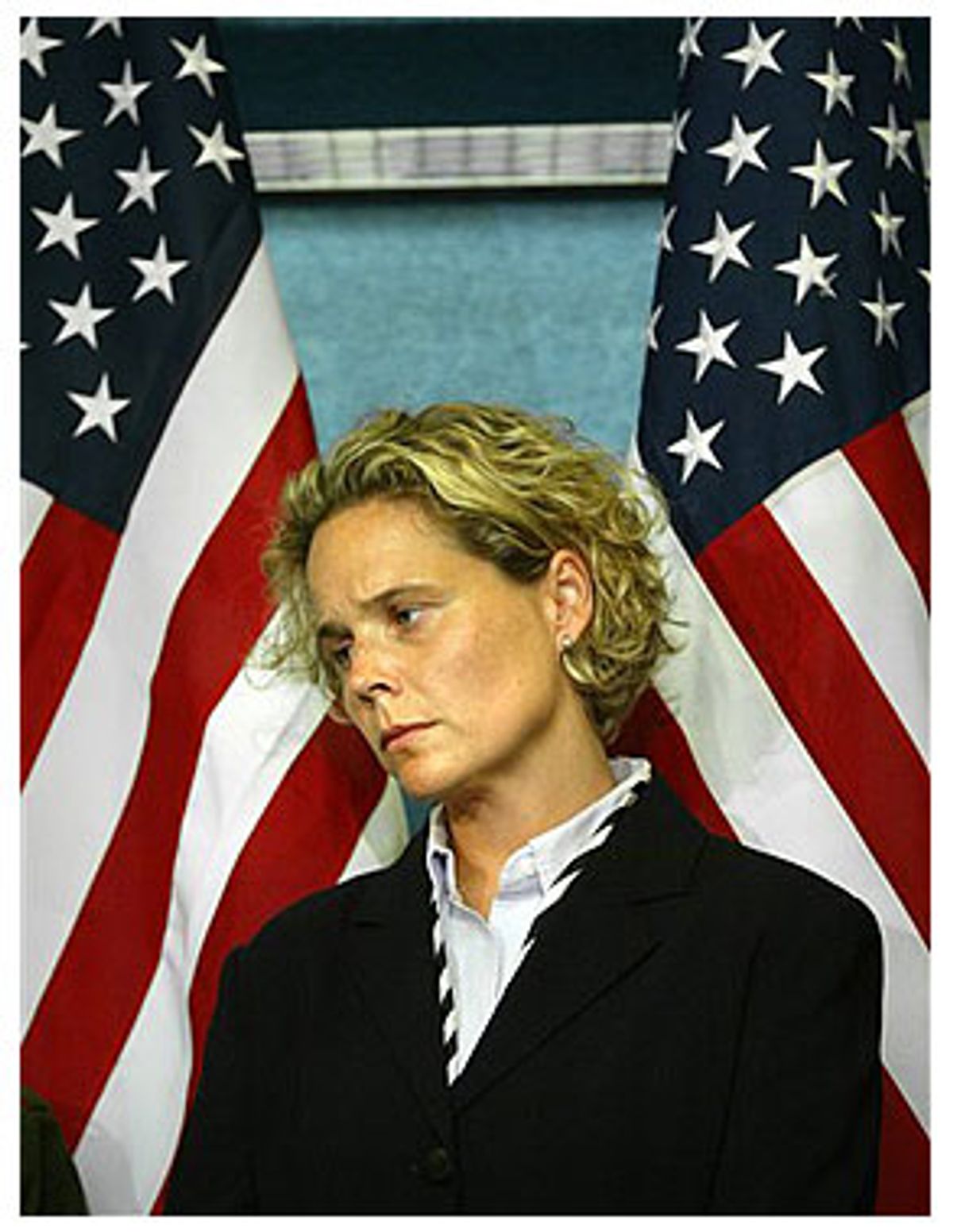
Gathering at the National Press Club in Washington on Tuesday, the widows announced their endorsement of the Massachusetts Democrat for president, a move made “in good conscience and from our hearts,” as former Bush supporter Kristen Breitweiser told the news cameras. “In the three years since 9/11, I could never have imagined I would be here today, disappointed in the person I voted for, for president,” she said. Added fellow Jersey Girl Patty Casazza: “It was President Bush who thwarted our attempts at every turn.”

The widows said they endorsed Kerry because three years of studying the facts has convinced them he will do a better job than Bush at protecting the nation. “This was not an easy decision to make. We agonized over this,” said Monica Gabrielle of West Haven, Conn., an honorary Jersey Girl. “We have always been very careful about not being partisan. We have always attempted to uncover the truth. We have always looked for the greater good.” Still, the women said they expect to be trashed as partisan hacks.

“We were joking amongst ourselves yesterday that we should come down here geared up in football pads and helmets, because we were anticipating personal attacks,” Breitweiser said. “Some other 9/11 family members have supported President Bush, and I think we have always been respectful of anyone’s points of view. And I hope that going forward, the debate and dialogue will be about the issues and it will be respectful and lively. But most important, respectful.”

The endorsement was a sword clanging against Bush’s political armor. Polls show that voters rate Bush high on his handling of 9/11 and its aftermath, and Republicans have been quick to exploit that approval with television ads and their recent convention, held in Manhattan around the theme of Bush’s leadership against terrorism. Meantime, the families of 9/11 victims are split on whom to support for president, with many for Bush.

The Jersey Girls’ political foil is Deena Burnett, widow of Thomas Burnett, one of the passengers on United Airlines Flight 93, which crashed in Pennsylvania. Burnett, who lives in Arkansas, spoke to the Republican National Convention two weeks ago, giving an emotional account of her last conversations with her husband from the plane. “The heroes of 9/11 weren’t created that day,” Burnett told the convention. “Their actions were the result of virtues practiced over a lifetime.” Delegates wiped away tears.

Watching the convention on television, Breitweiser felt not teary-eyed, she said, but frightened. She found the speakers angry and bellicose, and she worried that the Bush administration seemed to revel in war. “I am scared [by] the mentality that my daughter, who is 5 years old, is being handed a tomorrow that will be a war for a lifetime. My husband was killed on 9/11. I do not want to lose my daughter 18 years from now when she’s walking or living in a large city, and it’s payback for our actions in Iraq,” Breitweiser said. Later she told me in an interview that she voted for Bush in 2000 because, well, she’s a Republican. “I’m not a Democrat!” she said, when I asked if her endorsement of Kerry meant that she had switched parties.

On Tuesday I was unable to reach Deena Burnett, whose name is not listed in the phone directory, for comment about the Jersey Girls’ endorsement of Kerry. But a telephone interview I conducted with her two years ago was revealing for her lack of knowledge about the origins and funding sources of al-Qaida. Burnett is a lead plaintiff in a massive lawsuit against wealthy members of the Saudi royal family and Saudi establishment filed by South Carolina trial lawyer Ron Motley, who is trying to prove that the 9/11 attacks were financed out of the kingdom. Interestingly, many people who share those suspicions about the Saudi role in 9/11 also tend to question the Bush family’s close ties to the House of Saud, but not Burnett. When I spoke with her for the profile, I expected to talk with her about the substance of the case. Instead, she directed me back to the lawyers, pleading ignorance of such details as which Saudi prince made which overtures to the Taliban. She clearly wasn’t a document hound.

The Jersey Girls are. They have read seemingly every scrap of information about 9/11 and al-Qaida, from news articles to affidavits to footnotes in obscure government reports. And their command of the facts is what has made them so effective. On Sept. 18, 2002, when much of the public was still sympathetic to the Bush administration position that the attacks could not have been foreseen or prevented, Breitweiser gave a statement before the joint House-Senate investigation into intelligence lapses; it may have changed the course of history.

In a concise, straightforward manner, she laid out the facts far more effectively than had any senator or representative on the panel. She asked how, for example, the CIA could fail to locate hijackers Nawaf Alhazmi and Khalid al-Midhar, who had entered the United States despite being on a terrorist watch list, when one was listed in the San Diego phone book and both roomed with an undercover FBI informant. The day after her presentation, the White House — once firmly against an independent commission — reversed itself and endorsed the idea. And it was the 9/11 commission that would later find no operational ties between Saddam Hussein and al-Qaida, one of the key reasons Bush gave for invading Iraq.

On Tuesday, the widows cited the invasion of Iraq as one of their top reasons for supporting Kerry. “Unfortunately, before the work in Afghanistan was complete … this administration moved our most precious resources, America’s sons and daughters, into Iraq, without the support of our allies. Iraq had nothing to do with 9/11, and that is what we learned from the 9/11 commission’s final report,” said Lorie Van Auken of East Brunswick, N.J. “Sept. 11 was an enormous intelligence failure, and yet nothing was done to fix our intelligence after 9/11, and that same intelligence apparatus took us into Iraq. So it’s doubly frustrating to learn that Iraq had nothing to do with 9/11.” Van Auken said she is also worried that with military forces stretched thin, her 17-year-old son and 15-year-old daughter could be called up in a draft.

The women said they approached Kerry about the endorsement, not the other way around. Their requests to meet with Bush were rejected. Breitweiser and Gabrielle plan to campaign actively. In Breitweiser’s case, it will be difficult, because she hasn’t traveled in an airplane since her husband died. “I have serious anxiety about getting on a plane,” she said. “But that’s how committed I feel.”

Mary Jacoby is Salon's Washington correspondent.

Kerry says relations with Pakistan at crossroads

The senator spoke Tuesday after returning from a trip to Afghanistan and Pakistan

U.S. Senator John Kerry speaks during a press conference at the U.S. embassy in Kabul, Afghanistan, Sunday, May 15, 2011. U.S. Sen. John Kerry says the U.S. relationship with Pakistan is at a "critical moment" because of the killing of Osama bin Laden. But he also said that bin Laden's death may present a new opportunity for reconciliation with the Taliban in Afghanistan. (AP Photo/Musadeq Sadeq)(Credit: AP)

The chairman of the Senate Foreign Relations Committee says the US-Pakistan relationship is at a critical juncture and both countries need to get it right.

Sen. John Kerry, D-Mass., spoke Tuesday after returning from a trip to Afghanistan and Pakistan. He said the United States has vital national security interests in the region.

The discovery of terrorist leader Osama bin Laden inside Pakistan angered American lawmakers who have suggested cutting American aid to Islamabad.

Kerry says the U.S. has to get the policy right with Pakistan in the aftermath of the raid May 2 in which U.S. SEALS apprehended and killed bin Laden on an estate near a Pakistani military training academy. On Afghanistan, Kerry says he sees no purely military solution but he is optimistic about the overall outlook.

Will things finally, really work out for John Kerry?

The Massachusetts senator may have his eye on a big promotion -- not at all for the first time

John Kerry

It’s hard to feel sorry for John Kerry. He wasn’t exactly born into the American aristocracy, but his childhood wasn’t marked by hardship, either. He spent summers in France at an estate owned by his mother’s family (the Forbes), attended all the right schools, and even hung out on a yacht with President John F. Kennedy when he was just 18. But while he’s risen high in American politics, it’s also true that Kerry’s four-decade public career has never quite amounted to what he hoped it would.

This is the context in which Kerry seems to be launching his latest — and very possibly final — push for a big career promotion. The five-term Massachusetts senator, who has chaired the Foreign Relations Committee since 2009, has been highly visible as anti-government protests have swept Egypt in the past two weeks. There was a well-received Op-Ed in the New York Times on Jan. 31, a “Meet the Press” appearance on Sunday and “a lot of headlines in between. Given that no one expects Hillary Clinton to stay on even if there’s a second Obama term, the Boston Globe’s Joan Vennochi wrote that Kerry “is running an unofficial campaign to become the next secretary of state.” And, she added, “for once, he looks artful, as well as ambitious.”

Kerry, of course, had hoped to head up the State Department two years ago, when Obama passed him over in favor of Clinton. Instead, he settled for the Foreign Relations gavel, which came free when Joe Biden handed it in to become vice president. It was hardly a bad gig, but it still amounted to a consolation prize. This has been a steady theme in Kerry’s political career.

There was, for instance, his first bid for office, back in 1972. He’d been readying himself for a life in politics since (at least) his prep schools days, and the time seemed right. He’d done his service in Vietnam, then returned and earned a national reputation for his opposition to the war. And if any state seemed suited to an antiwar campaign from a principled, young veteran, it was Massachusetts. Kerry was 29 and on his way to Congress, destined, it seemed, to play an outsize role in American life in the 1970s — and beyond. Except he picked a terrible district to run in. Massachusetts’ 5th District, centered in blue-collar Lowell, was a haven for culturally conservative “white ethnics” (it’s the setting for the new movie “The Fighter“), folks who resented ambitious young war opponents. Even as George McGovern carried Massachusetts, the 5th District snubbed Kerry and chose instead a Republican named Paul Cronin (who would serve just one term, the last time to this day that a Republican has represented the 5th).

Kerry’s dreams of a rapid rise in politics were thwarted. Instead of spending the next decade on the national stage, he went to law school at Boston College, then took a low-profile gig with Middlesex County District Attorney John Droney (who had suffered his own political disaster in 1972, losing by 30 points to U.S. Sen. Ed Brooke). It wasn’t until the year he turned 40, in 1982, that Kerry was finally positioned to take another shot at office, one not nearly as glamorous as Congress: lieutenant governor of Massachusetts. It was supposed to be a doomed mission, but some odd circumstances — ’82 was the year Michael Dukakis, unseated by Ed King in a 1978 primary, won back the Democratic nomination and the governorship — landed him in the winner’s circle on primary night (and from there, the general election was a cruise). A decade earlier, he might have sniffed at the idea of being lieutenant governor, but at least now he was back in the game.

And, it turned out, he picked just the right time to become lieutenant governor. Less than a year later, Paul Tsongas, who’d unseated Brooke in 1978, announced that he’d been diagnosed with lymphoma and would leave the Senate in 1984. The seat was wide open. Kerry jumped at the chance to run. So did several other Democrats. The initial favorite was James Shannon, who had eclipsed Kerry as the state’s designated Democratic up-and-comer when he was elected to the House in 1978 at the age of 26. A favorite of Speaker Tip O’Neill, Shannon won broad establishment support and led in early polling. Somehow, Kerry edged him out in the September primary (and caught another break that same day when Ray Shamie, a conservative activist, upset the liberal Watergate hero Elliot Richardson in the Republican primary). Kerry was elected in November. Suddenly, his 1970s detour was an ancient memory; he had worked his way back to the national stage, and his future was again bright.

But being in the Senate, Kerry soon discovered, didn’t automatically mean standing out on the national stage — or even in Massachusetts. This was partly a function of his lack of seniority. It also didn’t help that his Bay State colleague, Ted Kennedy, was a global political celebrity and a major force in the Senate. Or, for that matter, that Dukakis ran for president in 1988. At best, Kerry was the third most visible Democrat from his home state — fourth, if you throw in O’Neill, who stayed on as House speaker until January 1987.

Nor was Kerry that interested in playing the “Senator Pothole” role in Massachusetts. Foreign policy fascinated him, not ribbon cuttings for transportation projects back home. The stories of Kerry’s indifference to local politicians in Massachusetts — and their indifference toward him — are legendary. In his early years in Washington, Kerry’s bachelor status — he and his first wife divorced in 1988, after a four-year separation — did make news, and not always in a good way. By 1990, with economic anxiety running high in Massachusetts, Kerry found himself facing dangerously low poll numbers and a self-funding multimillionaire GOP opponent, James Rappaport. The race was ugly, but Kerry prevailed. The experience, though, was humbling. He harbored White House ambitions, as everyone knew, but they’d have to wait. There’d be no quick jump from the Senate to a presidential race. (Tsongas, back on the scene following a seemingly successful 1986 bone marrow transplant, ended up being the Massachusetts Democrat who ran for president in 1992.)

He sensed his moment had arrived after his next reelection, in 1996. Opposed by William Weld just two years after Weld had been reelected governor with an astonishing 71 percent of the vote, Kerry had defied initial expectations and survived — by 7 points. The 2000 Democratic nomination would be open; Kerry prepared himself for a national race, building his national profile and making several high-profile breaks with liberal orthodoxy (notably on education). He was ready to run, and he would have … if a single big-name Massachusetts Democrat had been willing to stand in his corner. Instead, one by one, they lined up behind Vice President Al Gore. It was a humiliating blow for Kerry, who soon announced that he’d sit out an ’00 race that he badly wanted to contest. It got worse in the summer of 2000, when Kerry made Gore’s running-mate short list, along with Evan Bayh, John Edwards and Joe Lieberman. Kerry was the logical pick, but Lieberman was Gore’s choice. With reporters camped outside his Beacon Hill home, Kerry put on a good face — something he was getting good at.

Then came 2004, and the near-miss against George W. Bush. The exit polls forecast a Kerry landslide; the actual returns handed Bush a second term. Kerry had missed his dream by 19 electoral votes. He wanted to try again in 2008, and set out in 2005 and 2006 to position himself for the nomination, striking a far more strident tone. The knock was that he’d been unfocused in ’04 and had let Bush walk all over him. Desperately, Kerry tried to prove that he could be a “fighter.” He never got to the starting line. A “botched joke” just before the 2006 midterms gave Democrats an opportunity to bluntly deliver the message to Kerry that they’d been too polite to spell out before then: No way would they nominate him again in ’08.

So he backed out of the ’08 race, watched Obama maneuver his way into contention for the nomination, and then — just two days after Obama suffered a New Hampshire primary loss that seemed crushing at the time — provided an endorsement. Ten months later, President-Elect Obama was in position to return the favor. Kerry wanted to be secretary of state and his qualifications were impeccable. So, of course, the job went to Hillary Clinton. Kerry took it in stride and stressed all of the important work he’d still get to do with the Foreign Relations Committee.

He’s 67 now. There will be no more campaigns for president. The Democrats’ Senate majority, reduced to 53 in the last election, may be slipping away as we speak. A Republican takeover in 2012, which would strip Kerry of his chairmanship, is quite possible. 2012 is also when Clinton figures to leave Foggy Bottom. For Kerry, it may be one final, fateful moment: Will he get the job he truly covets, or spend the rest of his career as a minority party senator, painfully aware of just how close he came to being so much more?

Continue Reading Close
Steve Kornacki

Steve Kornacki writes about politics for Salon. Reach him by email at SKornacki@salon.com and follow him on Twitter @SteveKornacki

John Kerry is right: Americans are ignorant

But that doesn't make it smart politics for him to say so -- in an election year, no less!

John Kerry isn’t usually someone many people get that riled up about, so I was shocked to discover that the right wing has decided this week to claim to take offense at his statement during a tour of the Boston Medical Center that the electorate “doesn’t always pay that much attention to what’s going on so people are influenced by a simple slogan.”

A quick check turned up citations of the senator’s remark by Michelle Malkin, NewsBusters, Tucker Carlson’s The Daily Caller, and the right-wing blog Legal Insurrection, which apparently started the ruckus.

Are the conservatives that desperate? It occurred to me that if there really is no better target than Kerry for their angry arrows their quiver must be close to empty. Happy thought: Maybe the Democrats have a chance in November, after all.

Alas, I fear not. Kerry was merely the innocent victim of a classic conservative drive-by shooting. It wasn’t Kerry they were aiming at. It was the Democrats’ presumed elitist pretenses. He was merely a convenient target of opportunity.

In Kerry’s defense it should be noted that nothing he said was actually the least bit controversial — if one takes into account the facts, something admittedly that is not terribly popular in American politics. Studies since the 1940s have consistently shown that Americans by and large don’t pay much attention to politics, and when they do it is apt to be because somebody has nicely captured their feelings about the times in a reductionist bumper sticker slogan.

Just how ignorant are Americans? Three facts. Only one out of two know the Constitution was drafted in Philadelphia. Only one in five know there are a hundred U.S. senators. Only two in five can name the three branches of government. Please note that in each case the part of the electorate that has been found to be knowledgeable about our history and our government is in the minority.

Poor John Kerry. He has the facts on his side and thinks that matters. Does the man not understand how politics is played these days? How it has been played for going on 40 years, ever since George Wallace denounced pointy-headed intellectuals and Richard Nixon discovered the virtues of the Silent Majority?

Does he not remember being demonized as an effete, wine-swilling, French-speaking, surfer boy-man who hunts in clean clothes and resides in a mansion?

I have some news for Mr. Kerry. Nothing’s changed since 2004. We are the same country we were then, Barack Obama’s election notwithstanding. Even Obama had to sing about hope and change and Yes, we can as if those were more than empty slogans. (His biographer tells us Obama was embarrassed by the latter slogan. Good for him.)

If the senator wants to join the nascent movement to restore civics to the school curricula — a movement I heartily embrace — by all means let him do so by giving a serious address on the subject from the floor of the Senate and then rallying his fellow solons to provide the necessary funding. But he should not be tossing off bons mots in passing about ignorant voters. That plays right into the hands of the Republicans, who are all too ready to rally voters by appealing to faux cultural populist motifs.

John — may I call you John? Voters don’t like being told they are ignorant. Telling them they are in the middle of an election inspires, well, a negative reaction. This comment I found on a conservative blog in response to your statement is representative: “Halp us, Jon Carry, were to stoopid! Pleeze tell us the facks!” Or as the Boston Herald put it in a caption to the story the paper ran, you seem to believe “clueless voters are to blame for Democrats’ uphill fight against Republicans.” Am I getting through, John? This is no way to win votes.

As for Republicans. Please! Just because you can play the populist card to great effect doesn’t mean you should. Let me pretend to be Jon Stewart for a moment. Aside. Camera two … Can’t we agree that it’s cheeky to claim to be on the side of the little guy while favoring tax breaks for the wealthy, as you guys keep doing? Isn’t that a bit rich? You can’t play the race card anymore because racism is now politically incorrect, but it’s OK to play the populist card? Shouldn’t that be politically incorrect, too?

Back to camera one. Folks of both left and right: We can do better, can’t we? Don’t we have to? If only we put as much effort into arming voters with the facts as we do manipulating them, might we not have smarter politics? Don’t smarter voters equal smarter politics? Hey, it’s just a thought. But don’t we want to live in a country with smart voters?

Maybe some of us don’t.

Continue Reading Close

Rick Shenkman is the author of "Just How Stupid Are We? Facing the Truth About the American Voter" (Basic Books), and vice president of VoteiQ More Rick Shenkman.

Climate bill dead

The Senate won't take up even a tiny, stripped-down bill addressing carbon emissions this summer

Sorry, Earth! Maybe we’ll do something about not destroying you next year? Harry Reid has officially given up on passing climate legislation this summer.

Reid was originally going to maybe put some Earth-helping stuff in a bill responding to the Gulf oil spill, with the idea that Republicans would be embarrassed to vote against a bill addressing the oil spill, but Republicans are shameless, and so Harry Reid gave up.

John Kerry — who made headlines for incessantly bugging his peers to pass a climate bill despite the fact that no one wanted too — promises this won’t take as long as health care did, which is probably good, because if it takes as long as health care did, there won’t be much the Senate can do.

Meanwhile:

Sea levels are rising faster than scientists predicted just a few years ago. Himalayan glaciers are melting. In the American West, pine beetles (which struggle to survive the cold) are multiplying and killing trees.

According to NASA, 2010 is on course to be the planet’s hottest year since records started in 1880. The current top 10, in descending order, are: 2005, 2007, 2009, 1998, 2002, 2003, 2006, 2004, 2001 and 2008.

On the other hand, it definitely snowed last winter.

Continue Reading Close
Alex Pareene

Alex Pareene writes about politics for Salon and is the author of "The Rude Guide to Mitt." Email him at apareene@salon.com and follow him on Twitter @pareene

Cap-and-trade and energy politics: A Salon debate

Steve Everley made the case against putting a price on carbon this morning. Now David Roberts responds

Over the next three days, Salon will be featuring a dialogue between two very different voices on the subject of climate change legislation. Steve Everley is manager of policy research at American Solutions and a contributing author to “To Save America: Stopping Obama’s Secular-Socialist Machine,” by Newt Gingrich, and David Roberts writes about energy politics for Grist.

Everley led off with his thoughts this morning, and a response from Roberts followed a few hours later (it appears below Everley’s post).

Steve Everley: With the unemployment rate near 10 percent, creating jobs should be the first consideration of our elected leaders, but instead President Obama and his liberal allies in Congress are insisting on enacting a national energy tax that will kill jobs and drive American businesses overseas.

The vehicle for imposing this vast new energy tax system is cap-and-trade, a scheme where the government arbitrarily determines how much carbon each company can emit, chooses which companies get free permits to emit carbon and which companies have to pay for them, and then puts unelected bureaucrats in charge of regulating the whole system.

The result is higher energy costs, which virtually every economist will tell you are necessary for cap-and-trade to be effective – higher prices are necessary to prevent consumers from using what the left considers too much energy. President Obama even bragged that under his ideal cap-and-trade plan, electricity prices would “necessarily skyrocket.”

President Obama has also listed Spain as the model for his energy policy, noting last year that the Spanish government’s investments in green energy “are paying off in good, high-wage jobs – jobs they won’t lose to other countries.”

But a study from economics professor Gabriel Calzada of King Juan Carlos University in Spain shows that his country’s push for “green jobs” has been a disaster for the economy: Calzada found that each green job created not only costs on average 2.2 jobs in the private sector, but also upward of $800,000 each in government subsidies. Two months ago, Spain’s unemployment rate topped 20 percent.

If Spain is the model that President Obama and the left wish to emulate, then America’s unemployment rate will also “necessarily skyrocket.”

Many other studies have shown, including those from the Brookings Institution and the Congressional Budget Office, that higher energy costs lead directly to fewer American jobs. The CBO adds that the shift toward so-called green technologies, President Obama’s biggest selling point for this new cap-and-trade energy tax, would actually reduce economic productivity as each worker in the energy industry would now spend the same amount of time producing less energy.

The European Union sold cap-and-trade to its member countries in 2005 on the basis that it would create jobs and boost their economies. The opposite happened. Since 2005, this policy has cost the EU economy over $7 billion, and the U.S. Government Accountability Office found last year that the EU system did not significantly advance investment in new technologies, which President Obama and his liberal allies in Congress keep pointing to as the source of new jobs that cap-and-trade energy taxes are supposed to deliver.

With that kind of record, what rational policymaker would seek to impose this new energy tax system on his or her own constituents as a way to create net new jobs and net new economic wealth, and not just a massive redistribution of wealth?

Last fall Sen. Kerry tried to sell his cap-and-trade energy tax plan by pointing out that America had effectively reduced its emissions in the past year “because of the downturn in the economy.” In order to get to where we need to be, Kerry concluded, we just need to go “another 14 percent.”

It was an illuminating admission from the Senate’s staunchest defender of the energy tax. Kerry articulated a direct relationship between economic stagnation and cap-and-trade, proof that an energy tax is a strategy that will kill more American jobs and make the recession permanent.

- – - – - – - – - – - -

David Roberts: I confess to being uncertain how to respond to Mr. Everley’s opening salvo. Like his boss Mr. Gingrich, one of the original masters, he seems to be stringing together words and phrases poll-tested to inspire fear. The presence of the term “unelected bureaucrats” does not generally signal good faith and seriousness.

So let’s back up a bit. Why would we want a mandatory cap on greenhouse gas emissions? Because we have a large and pressing problem to solve, namely climate change, a phenomenon that Everley astonishingly fails to even mention. The best science indicates that the developed world needs to reduce its emissions over 80 percent by 2050. That is a truly Herculean task, and I’d be quite curious to hear how Everley proposes to accomplish it without a mandatory cap on carbon pollution — or if he thinks it’s a real problem at all.

By emitting greenhouse gases, industries are imposing costs on the public, but they are not paying those costs. Carbon pollution is a classic economic “externality” that distorts the proper functioning of the market. One way or another, those costs need to be internalized, incorporated into the market price of fossil fuel-intensive goods and services. It’s important to note that such a move would not raise net costs — it would simply move those costs to their rightful owners. It would force the market to tell the truth.

So how to go about it? In the late 1980s, a group of market-inclined environmentalists, recognizing the limits of “command-and-control” air pollution regulations, developed a new model: rather than plant-by-plant mandates, set a declining upper limit on the total pollution emitted across the U.S. economy, issue tradable pollution permits, and allow private capital to flow to the best (read: cheapest) means of meeting the cap. Thus you harness environmental goals to market forces. This essentially conservative idea impressed the administration of George Bush Sr., who signed into law the 1990 Clean Air Act amendments, which implemented such a system for acid rain pollutants. It was a resounding success, reducing pollution much more cheaply than expected, with massive social and health benefits. (For a compact history of cap-and-trade, I recommend this article in Smithsonian.)

Market-based pollution limits have been so effective that a bipartisan group of senators led by Sens. Carper. D-Del., and Alexander, R-Tenn., is now pushing a similar trading system for SO2, NOx, and mercury — so-called multipollutant legislation. Leading lights on the right used to feel the same way about using market-based systems to reduce greenhouse gases. For instance, a wise man once said:

“I think if you have mandatory carbon caps combined with a trading system, much like we did with sulfur, and if you have a tax-incentive program for investing in the solutions, that there’s a package there that’s very, very good. And frankly, it’s something I would strongly support.”

That was Newt Gingrich in 2007, before he was angling for a presidential nomination from a party dominated by its Tea Party fringe. Similarly, in 2008 California Senate candidate Carly Fiorina said that a cap-and-trade system would “both create jobs and lower the cost of energy.” Now that she’s seeking votes from the Tea Party, she’s allying with the Senate’s premier flat-earther, James Inhofe, R-Okla.

In short, conservative politicians are turning away from — and grotesquely mischaracterizing — a market-based pollution control system for primarily self-interested electoral reasons. This has made clear dialogue on the subject extraordinarily difficult.

Anyway, I don’t want to bore people, but a couple more quick notes. First, the Spanish study Everley cites has been debunked up one side and down the other, most recently by the DOE’s National Renewable Energy Laboratory. No one but conservative ideologues takes it seriously anymore. Recent studies of cap-and-trade bills, like the one a couple weeks ago from the Peterson Institute for International Economics, show that they would be net job creators, if modest ones. Other studies, from, for example, the EPA and CBO, show that the bills would reduce the deficit, which you’d think would be attractive to conservatives.

On the costs of a cap-and-trade system, the economic consensus is that it would cost American households about a postage stamp a day — a far, far smaller price than would be imposed by the damages from climate change. For more on that consensus, see this discussion paper (PDF) from journalist Eric Pooley.

To conclude: virtually everyone agrees that the U.S. needs to invest in new clean energy industries and solutions. That’s the easy part. The politically more difficult part is how to pay for those investments. A cap-and-trade system offers a twofer: It discourages carbon pollution by raising its price, and it uses that revenue to fund clean energy solutions. Conservatives want to spend the money, but they don’t want to raise it. It’s fiscally and morally irresponsible.

Continue Reading Close

Page 1 of 53 in John F. Kerry, D-Mass.