Nonfiction

Kinky sex secrets of the lobster

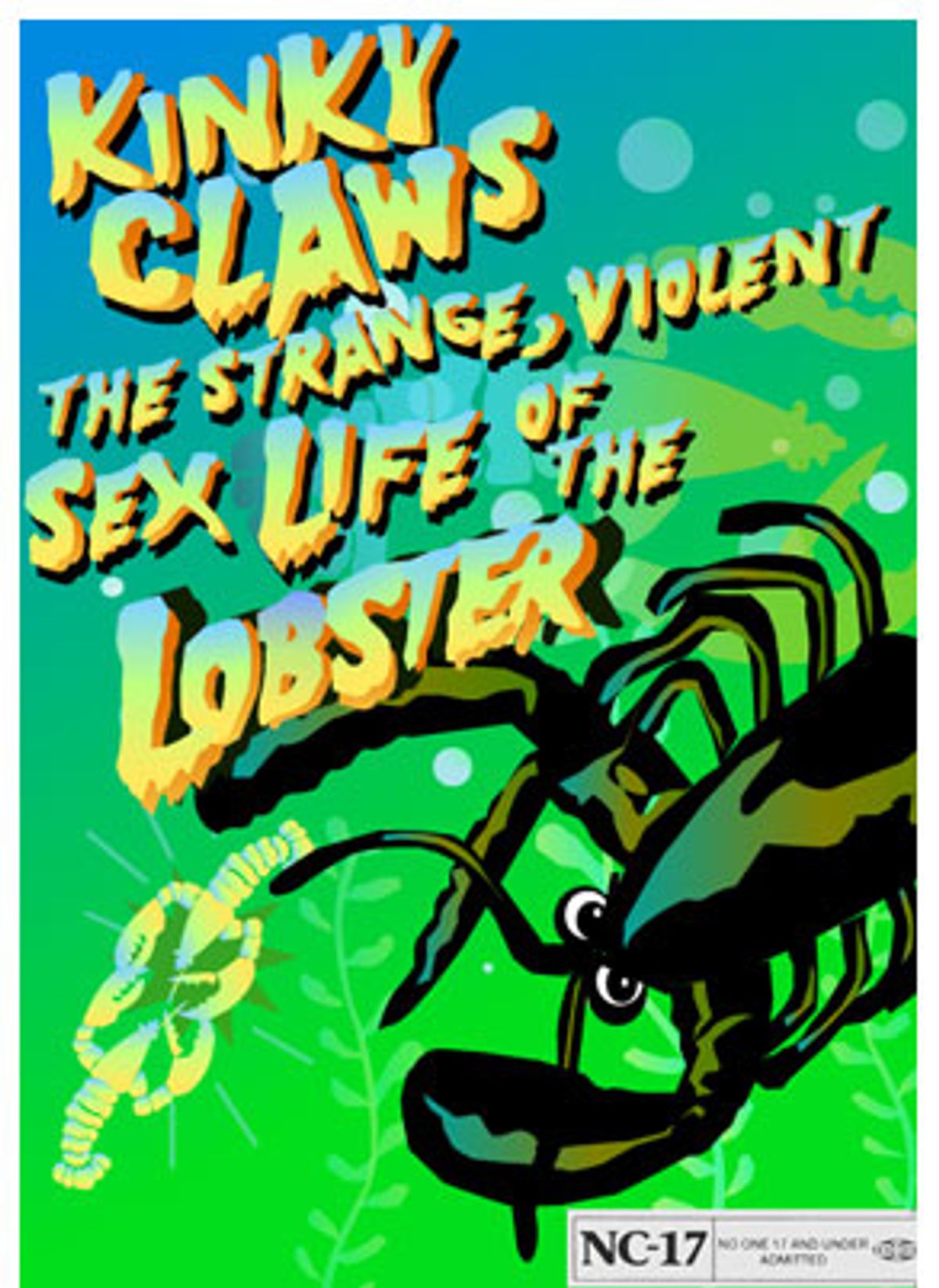
They're stupid, hyper-aggressive, and they turn each other on by urinating out of bladders in their heads. And David Foster Wallace got everything about them wrong.

  • more
    • All Share Services

Kinky sex secrets of the lobster

It might be tough to imagine this, but centuries ago American Indians along the New England coast used the masses of lobsters they found on their shores for field fertilizer. As recently as the early part of the 20th century, lobster remained a meal that people in Maine ate reluctantly, if there was nothing else around. But over the past 75 years, the Homarus americanus has gotten an extreme makeover.

During the fishing season that culminates in the fall, more than 60 million pounds of lobster are pulled out of Maine waters. It’s a catch that supports hundreds of lobstering communities and thousands of boats all over the Gulf of Maine. Maine lobster is known around the world and has become one the most distinct delicacies in our national cuisine. During the Christmas season, thousands of lobsters are stuffed into 747s and flown to France, where the crustacean is a popular holiday meal.

Lobster is unique in our cuisine for another reason. It is pretty much the only remaining animal we kill in the kitchen before eating. Many people are understandably squeamish about plunging a live fellow creature into a pot of boiling water — even if it looks like a giant bug — and the ethics of this practice have been disputed for decades.

You might feel pity for the clawed creatures when you see them floating somnolent in restaurant tanks, a claustrophobic’s worst nightmare. But then again, after reading Trevor Corson’s “The Secret Life of Lobsters,” you might not. Corson describes lobster life as an endless round of ruthless, ritualized violence and kinky, territorial sex practices that would make a porn star blush. Real lobsters, he maintains, bear no similarity to the friendly animated creatures seen in movies and on TV, or to the caricature presented by activists like People for the Ethical Treatment of Animals (PETA). Lobster existence is like an underwater version of the movie “Boogie Nights,” combined with a never-ending Ultimate Fighting Championship.

Corson’s book is more than just a litany of crustacean factoids — he has lived the lobsterman’s life. After spending five years studying Asian culture in China and Japan, Corson came back to the small Maine island where his family vacationed when he was a child. He became a lobsterman for the next two years and then spent a year interviewing lobster scientists about the complicated, brutal conduct of lobsters at love and war. His book also addresses a crucial ecological quandary, the question of what accounts for the recent boom in Maine lobster fishing, whether the industry is as healthy as it appears to be, and whether lobstermen and scientists can make the age of gourmet plenty last.

How did a Princeton graduate with a specialty in Asian subjects get into lobstering?

Lobsters do seem like an unlikely obsession, and it’s not something that I would have predicted for myself. I was a summer kid in Maine, on Little Cranberry Island, which is described in the book. Of course, being a summer kid in Maine doesn’t confer any sort of status at all. The relationship between the locals and the summer people is often fraught at best. But I used to go down to the wharf and watch the fishermen come in and unload their catch and that was very exciting. These guys were like superheroes, with these big beautiful boats coming in from the distant ocean, battling nature and everything.

At the age of 5 I built my own cardboard lobster boat that I could stand inside. I painted it red and I would drive it around the island. I even got my cousin to dress up as a lobster and covered him with cardboard body armor. I thought a lobster should be painted red, but my parents convinced me that live lobsters are really brownish green, so I painted him green. We didn’t want him to be dead, because then it wouldn’t be any fun to catch him.

Isn’t the lobster depicted in PETA’s literature red? So it looks like he’s dead already?

Their logo was red. It may have been a strategic decision to attract attention, because generally lobsters aren’t depicted as red, but I thought it was an interesting choice for them.

Maybe someone screwed up.

Yeah, it’s really kind of dumb. In the past they’ve said some completely ridiculous and untrue things about lobsters, like that they mate for life and they walk hand in hand along the bottom of the ocean and that they raise their young. All of that is completely absurd and gives the impression that lobsters are kind and nurturing to each other. Lobsters despise each other. They socialize a lot but in a hateful way. They do in fact walk hand in hand along the bottom of the ocean, but that’s a deadly game of chicken called “claw lock.” When other forms of pushing and shoving haven’t settled a fight, the two lobsters reach across like they’re shaking hands and put their two crusher claws together to see who chickens out first. That’s the one time they hold hands, and it’s a very dangerous, aggressive situation.

What’s the misconception about lobsters you hear most?

A lot of people think they mate for life, which couldn’t be further from the truth. When people hear these mythical factoids, they’re often taken as a reason not to eat lobsters. After studying them, what I realized is that they’re really primitive and their reactions are automated responses to chemical stimuli to achieve certain outcomes. It’s not as though lobsters are doing a lot of thinking down there.

What distinguishes the Maine lobster from other crustaceans?

Stupidity and claws. The only close cousin is the European lobster, which is almost identical but is bluish in color. They catch those in Ireland but in much smaller numbers. There’s another small Norwegian lobster that’s also related, but that’s about it. There are other clawed lobsters around the world, but not in very big numbers. Caribbean lobsters, the Australian and New Zealand lobster, and the Hawaiian lobster are all spiny, or rock, lobsters. And none of those have claws. In terms of evolution, they’re much more sophisticated. They migrate in clans, they’re much more cooperative in social situations.

Maine lobsters have this complex, interesting social life, but they’re very predictable. It’s hard-wired behavior. Scientists built these little neighborhoods for lobsters and if they spaced the habitats too close together, the lobsters wouldn’t stop fighting. Even if there were little lobsters that posed no threat, the bigger lobsters were hard-wired to just keep fighting and couldn’t stop. Another example is what happened during a mating experiment that increased the ratio of females to males in a tank. The males become unbelievably belligerent and keep on fighting because they can’t let it go, they have to decide who is dominant. In a tank they’re stuck together and there’s nowhere to hide, so it can get brutal. In one case there was a male who was dragging himself around by his lips because he’d lost all his other appendages in fights. Clearly he was losing, but he couldn’t figure that out because he was hard-wired to keep going. It’s not like lobsters are sophisticated enough to say, “Geez, the circumstances aren’t in my favor, I’m going to back down.”

Actually, there’s a third distinguishing thing: incredible population density. There is no lobster density like on the Maine coast, especially right now.

How did lobster become a delicacy?

It’s really changed since the time they were considered junk food that Mainers would try to avoid if they could. In the early 20th century, Mainers would only eat lobsters because the fish they caught was too valuable to eat themselves. At the turn of the century wealthy people like the Rockefellers started going to New England in search of the calm, quiet, rural life. They were called “rusticators.” They had an elitist appreciation for the simple rural coast of Maine, the unspoiled land that wasn’t filled with all those annoying immigrants in the city. So culturally the simple boiled lobster dinner achieved its status during that period. Those people popularized it as a luxury.

People in Maine should be thanking them for that.

Yes and no. The rest of the world thinks of lobster as a symbol of Maine, but for people in Maine it’s a very fraught item. For a lot of people, especially those who don’t live on the coast, they can’t afford to eat lobster. At one point the state decided to make lobster the official license plate symbol, and one Maine writer pointed out: “If you wanted to pick something representative of Maine, how about macaroni and cheese?” So for many Mainers it’s an annoying example of how wealthy outsiders have turned the state into their personal playground and made it inaccessible to them. Most people in Maine can’t afford waterfront property anymore, the lobstermen can’t afford the space for their equipment on shore because coastal property has become so expensive. A lot of lobstermen live significantly inland from where their boats are.

Is there any corporate lobstering? Or is it all individual fishermen?

That’s the really neat and interesting thing about the Maine lobster industry. One of the reasons it’s been so exemplary is that it remains almost completely uncorporatized. A lot of that has to do with the fact that 80 percent of the fishing takes place within 3 miles of land. It’s a seasonal fishery that’s based on catching the lobsters when they come into shallow waters. So it’s very territorial and there are lobstering communities that control certain territories. It’s an informal system that developed over decades. Over the past 20 years the state and even the federal government have imposed more regulations, so the struggle has been to figure out how to codify these informal regulations. In the past it was an open frontier where the lobstermen were the law and they’d police their own boundaries. If someone was pushing into their territory they would launch a defense. There are all sorts of tricks to discourage someone from setting traps in your area.

Like what?

Usually it starts out fairly innocently, like you would take an unfamiliar buoy and tie the rope about it so that the buoy’s backwards. It’s called “back tying.” That’s just a warning and next time the encroacher hauls up his traps he’s going to see that the locals have taken note and that they don’t want him there. And he faces escalation if he doesn’t leave. The next step is usually to haul up the traps and take out the bait bag and any lobsters and put it back, so he’ll know the traps have been tampered with. Now, none of this is legal and I’m not saying anyone has done it.

These are tough guys, aren’t they? Do they start punching each other at some point?

They are very tough guys and there are definitely stories of guns on boats and whatnot. They’re very tough and the communities are very tight and they really look out for one another. It’s partly for safety, because it’s a dangerous job. There were two guys at Little Cranberry Island who were killed in a storm at sea and one of my fellow stern men was dragged overboard while I was working there, though fortunately nothing happened. Almost all these guys have a story of getting a foot tangled in a rope and nearly being dragged overboard.

There’s a variety of lobstering subcultures along the coast. Different areas have different mentalities and practices, but what really impressed me about the guys on Little Cranberry Island is that they were serious about basic conservation, such as V-notching, which is a peculiar practice. It came about because you can’t sell a lobster with eggs; it’s illegal. But there’s a terrible history during the 19th century of lobstermen scraping the eggs off female lobsters and selling them. So at one point the state started offering to buy those egg lobsters and release them in order to protect them, which was a good idea, but then the lobstermen would just catch the same ones and keep getting paid for them, so the state said, “Hey, wait a minute.”

So they came up with the idea of notching the flipper. Then in the 1920s there was kind of a bust, probably due to overfishing and the Depression, and something like a third of the fishermen left the business. When the next generation came back after World War II they were aware of this bust and realized that they needed to do more to protect the industry and decided to do self-imposed notching. Especially the previous generation, they were very serious about it. And the current generation, at least on Little Cranberry Island, was inculcated into those practices and they’re very serious about it.

What did you do on the boat as a stern man? I went out with a friend once who used to lobster on the weekends, though I wasn’t able to help much. I couldn’t get over the smell and the rocking boat. So assuming someone isn’t useless like I was, what do you actually do?

When you become a stern man you’re under the wing of the captain, but economically you are also technically self-employed. You get paid a share of the catch at the captain’s discretion. So if you go out for the day and you don’t catch anything, you don’t get paid. There were slow days where if I computed my hourly wage it would have been a dollar an hour or something abysmal.

Most lobster boats function with two people. The captain runs the boat and owns everything and figures out where to put traps and when. He’s the brains of the operation, and there are a lot of brains involved. These guys are very aware of the weather and the tides and how the boat interacts with the ocean. They also know where the lobsters are going to be at what time of year, what they’re doing, how they’re running. It’s a family thing. Bruce Fernald, the guy who hired me, is a fifth-generation fisherman on this little island.

The stern man is mostly in charge of the bait, which is crucial and totally disgusting. My job was to stuff these little mesh bags the size of a grapefruit with bait and I have only a few seconds between traps to do that. Some lobstermen claim to like the smell, but it’s certainly nasty. I spent 8 to 10 hours a day hunched over a bin the size of a kitchen table full of rotting herring. It’s not intended to be ripe — people have a misconception that rotten fish attracts lobsters — it’s just the nature of storing raw fish. You throw it in a barrel with a bunch of salt and make do.

Meanwhile the boat is constantly swinging and bucking. The height of fish season is the fall and the weather sucks in fall because it’s kind of windy. When the sun’s up people on land are happy, but on the ocean you don’t care about the sun at all, the wind is your nemesis. An overcast rainy day with no wind is far preferable to a sunny day with a breeze. So if there’s any breeze at all, and there usually is in the fall when you’re fishing really hard, the spray is flying, the deck is constantly heaving. It’s totally draining and exhausting.

The other part of my job is to help the captain sort through whatever comes up with the trap. When he throws open the top, and it’s full of gunk, there are tons of things in there. Sea urchins, which ended up cutting through my gloves a few times, and a piece of embedded spine landed me in the emergency room with blood poisoning. These nasty, nasty spiny fish called skultons, which we kill and then slice open and use as additional bait. There are snails and little crabs, and hopefully some lobsters.

How much of the catch can you keep?

The majority of the catch actually goes back overboard. You have undersize lobsters and oversize lobsters and females with eggs that have to be thrown back, so you’re sorting through all these and measuring and putting rubber bands on their claws with little pliers. The borderline lobsters you throw in a bin to sort later on and the obvious ones you throw back overboard. The minimum size is 3-1/4 inches on the body shell and you can’t keep any with a body shell larger than 5 inches. The maximum is because if they’ve avoided the lobstermen and managed to make it through the gauntlet, they deserve their retirement. It’s also so there will be more mating lobsters. So it’s like populating a big sex club for retirees.

What did you and the other lobstermen do to blow off steam?

Well, there are a lot of practical jokes. People were always putting stuff in each other’s traps. A can of Spam, stuff like that. There was one guy who had little kids and he kept tripping over his kids’ toys in the morning when it was dark. So he started taking whatever toy he tripped over and later put it in one of his friends’ traps, so one day someone would haul up a little frog in his trap or a stuffed bear. One fellow tied a small fridge onto a trap so when his friend pulled up the trap he pulled up a refrigerator. Silly stuff like that.

One time, my friend was looking for a practical joke to play. He went to a Barbie doll outlet on the mainland and he got a skirt, blouse and high-heeled shoes on one of the V-notch lobsters and stuck it in this guy’s trap. When he hauled it up it was very funny and it was a big joke and everyone was talking about it on the marine radio. But then the guy throws her back into the water to see if she would show up in any other traps, because these females migrate in and offshore during the season. She showed up in trap after trap. Bruce caught her at one point; one of his brothers caught her. She was walking several miles in high heels between each trapping and gradually losing pieces of clothing along the way until she finally lost it all and returned to her unclothed dignity.

How much money is there in lobstering? Do these guys get paid well for all this hard work?

In the past 15 years the lobster catch in Maine has tripled, so lobstermen have been doing extremely well lately.

What caused that kind of increase? Most of the other fisheries I’ve read about have had the exact opposite dynamic.

Nobody is really quite certain and this is one of the scientific mysteries of the book. Of course, for the management folks in government, this is a disaster. Basically they’re seeing a replay of the cod fisheries where the size of the catch increased exponentially and then the whole industry crashed. So they’ve had an almost knee-jerk reaction, which is totally understandable, by saying, “Oh, my god, we have to get this under control before something disastrous happens.” But the situation is more complicated because while the number of traps has increased dramatically, a big increase occurred a number of years before the catch went up. So there’s no evidence that just putting more traps in the water means you’ll catch more lobsters.

One of the key things the scientists in the book try to figure out is the relationship between the size of the lobster population and their habitat. They’re beginning to think that the size of the lobster population is actually controlled by environmental factors. What appears to have happened is that environmental conditions and other favorable factors, such as other types of predatory fish like the cod being caught up, caused the lobster population to expand, which is totally the opposite of what happened in the cod fisheries. The cod population was diminishing and technology was improving so they were catching more and more until it was gone.

With lobsters, at some point in the mid-’80s the population started to expand, but it didn’t show up in the catch until the early ’90s. So the ’90s was a story of lobstermen ratcheting up their efforts with an increasing supply of lobsters. That’s what the evidence suggests, and that is totally contrary to every other commercial fishery story out there. So in a sense, the lobster fishery is a great success story and lobstermen in Maine take a lot of credit for it. They say, “Well, we’ve been protecting the little lobsters, the egg lobsters, the big lobsters, so the resource is doing well.”

But the problem is, if environmental factors change again, we now have more lobstermen, more traps, and they’ve all been doing really well. For the previous generation, they didn’t make a lot of money, but they had a good life and they made enough to get by and they didn’t have a lot of expenses. Bruce’s father took out one loan his entire life and paid it back in six months, but now people are taking out $200,000 and $300,000 loans just for new boats, so there’s a big problem with overcapitalization in the industry and banks loaning way too much money.

You got the complete view of the Maine lobster, first from two years on a lobster boat, then you spent a year interviewing lobster scientists in their laboratories on the Maine coast and at Woods Hole, Mass. You even went on a research ship where they were using submarines and underwater robots. Did you find out more from the scientists than you expected?

After two years of working on a lobster boat I thought I knew a lot about lobsters, but when I started researching the book and talking to the scientists who study lobsters for a living, I had no idea.

The most amazing thing is how the lobsters socialize, communicate, and their mating ritual. It turns out that lobsters do most of their interpretation of the world and their socializing through their sense of smell. Their nose is actually a pair of little flickable antennules, or mini-antennae. They’re packed with chemo receptors and they flick them in the water to detect odors, like sniffing, and if they’re in a good current they can hold them up like rabbit ears and pick up all the chemicals in the water.

They also have this little interesting feature of their anatomy where they have a big bladder in their head and they piss out the front of their head. So they’re constantly pissing in each other’s faces. When a female wants to seduce a male, she comes by the door of his apartment and he sits inside and pisses out the door at her. If she likes the smell she comes by and sticks her head inside his apartment and pisses back at him.

Um, when you say apartment …?

They live inside little rock hollows, basically, and they’re very attached to their homes. That’s not to say that they don’t move from one to the next, but they’re very defensive creatures despite all the armor. They really like to hunker down and they have a strong preference for backing into tight places with their claws out and ready so they can defend themselves.

So when scientists started studying the mating habits, there was very little information about crustacean mating and how it worked. The anatomy had been investigated for a long time. At first the scientists couldn’t figure out how lobsters mated and no one was sure if the male lobster had a penis at all, and then it turned out that it had two.

That’s real vindication.

Yeah, so they knew the anatomy, but they still couldn’t figure out how the social part worked. Normally lobsters hate each other. If you put a male and female lobster in a tank with each other they start fighting right away and try to kill each other. In nature they have a pretty complicated set of procedures for interacting with each other that are designed to actually avoid real injury, so that a smaller lobster can immediately tell that a bigger lobster is dominant and get out of the way. But if the lobsters are evenly matched in a tank they just continue fighting and the whole thing escalates.

So one of the scientists I write about, Jella Atema, thought the female lobster might be emitting a pheromone to attract the male but it turns out to be exactly the opposite. They did these experiments where they set up a social situation in a 20-foot tank. The males would fight with each other to figure out who the dominant male was, and once he was proven dominant he would go around and beat up all the other lobsters every night. All the lobsters in the neighborhood would be dealt a daily dose of humiliation, both males and females. He’d kick them around and then go back and hang around his shelter, which was the best shelter in the tank, of course.

What happened then is that the females started to take up residence nearby and they would come by his shelter. Then one of them began an elaborate social ritual where she’d come calling to the door every day and eventually he would let her inside the shelter. Then she actually moved in, and it turns out she was ready to shed her shell at that time. So within 15 or 30 minutes of her molting the male approaches and turns her over and they copulate while she’s soft. Then after about a week, once her shell has hardened up again, she leaves without a backward glance. So they’ve pair-bonded for about two weeks. And then? The next female lobster shows up and moves in with the dominant male. And this goes on in sequence. The female lobsters are keeping tabs on each other to figure out who’s mating with the dominant male, and they wait until one of their sisters has done her business and then the next moves in. So they all take turns. It’s called serial monogamy.

It’s funny, sometimes people use specific mating habits of animals to prove a certain point about human sexuality, though I can’t imagine what group would claim lobsters as their example.

The Mormons might like it. But it’s not all at once. It’s in sequence, you wouldn’t be able to keep a harem going. The male just waits at home once he’s proven his dominance by beating up everyone every night, which really arouses the females. And it turns out they’re recognizing his smell, because he’s pissing in their faces all the time while they’re fighting.

They’re violent little creatures. What’s with all the aggression? And the pissing? They look so passive and harmless floating in those restaurant tanks.

Jella Atema set up a boxing ring in order to study lobster fights, and when he staged rematches on consecutive nights, the loser immediately recognized his former opponent and backed down, forfeiting the fight. It wasn’t that lobsters had become cowards — if the loser was paired with another lobster he would fight aggressively again. So something was going on and the lobsters were recognizing individual opponents that had beaten them before. Blindfolding the lobsters didn’t make any difference. So the scientists catheterized some lobsters, put these little tubes over their urine slots on their face and made a little urine bottle and measured outflow.

It turns out that the lobsters were accompanying their most punishing blows with intense squirts of piss in each other’s faces. The scientists actually charted the results, so clearly the smell is what they pick up on. The funny thing is that the winner was almost always the lobster that pissed first, the first one off the draw, like down at the OK Corral, but in this case whoever pissed first wins.

They realized that this pissing was going on in the bedroom, too. When the male lobster was fighting with everyone in the tank he was pissing in everyone’s face and when the females would come by they would piss in his face. The scientists think that the females were also pissing a drug at the male when they’re getting ready to molt. So after the females are satisfied that he’s the toughest one they would drug him to tone down his aggression, which puts him in the mood for courtship and then the females convince him to mate. So the males are out there fighting, but the females really choose which one they mate with. They’re in charge and they have this sisterhood deal where they’re basically cooperating so they all get to nail this one lobster who they’ve chosen.

In terms of simple outright aggression, lobsters are brutal. One guy in New Hampshire did an experiment to see if lobsters preyed on each other. He tethered a juvenile lobster to the bottom of the shallows so he couldn’t get away. Very quickly big lobsters showed up, and when they figured out that he was helpless, they attacked the young lobster, crushed him, and then ate him.

That’s not exactly the “Finding Nemo” version of lobster life. Talk about the arguments that organizations like PETA have put forth against killing and eating lobster.

PETA protests lobster fishing at various times, it’s one of their favorite little sideline things. I think a lot of what PETA does is worthwhile, because they’re opposed to the industrialized slaughter of animals. I also think there’s a coherent case to be made for vegetarianism. But if you’re going to eat meat, protesting against eating lobster is the last thing you should be doing. I mean, put it in perspective. If people could see how cows were being produced and dying for those burgers at McDonald’s, the lobster going in the pot would be a glorious example of humanely and appropriately prepared food.

Lobster is the perfect example of how meat should be produced and eaten. It’s the ultimate free-range, sustainably harvested and locally produced meat. And it’s healthier, as long as you don’t eat it with too much melted butter.

There’s been a lot of lobster writing this past summer. I didn’t see the piece, but apparently the novelist David Foster Wallace wrote a long feature about lobsters in the August issue of Gourmet magazine. Some of the quotes I saw indicated that he might not agree with your assessment.

I have to say, having read that piece, it made me wonder where his reputation for brilliance comes from. As far as I could tell, he got almost everything wrong he could about lobsters and lobstering. And he misses very interesting points, sometimes stumbling over them. He also just comes across as an arrogant snob. I guess he has a reputation as being a smart aleck, but I was just appalled.

He was assigned to write about the Maine lobster festival and most of the article is a big put-down. I mean, it’s true, the festival is kind of tacky. I’ve been there a few times. There are silly carnival rides and people eat fried dough and buy trinkets, but I mean it’s a festival. Lighten up! There are also fun things, like eating fresh lobster down by the sea, which your average tourist might not have another opportunity to do. There are cooking demonstrations; they have this cute parade down Main Street. Local people work hard to build floats for the parade. But David Foster Wallace is so busy being snooty, he writes, “These homemade floats in the parade are cheesy and boring.” Those are his exact words. I mean, of course they’re cheesy. They’re homemade!

And a lot of his facts are completely wrong. Like he says that lobstering is a warm-weather business — excuse me while I laugh very hard with a touch of bitterness in my voice while I remember the fact that half our catch was caught in nasty fall weather starting in October and November and the many days I spent in December and January and March in freezing cold conditions. Most Canadian lobstermen and a few Maine lobstermen only fish in winter. So he has no idea what he’s talking about. He basically can’t be bothered to find anything out, which is really kind of annoying.

But most of all he’s trying to earn all these big moral points by taking this stance about cruelty to lobsters. That view represents a misallocation of moral concern. People put all this worry on lobsters because they see them going in the pot. But these other meats we don’t see are treated much, much worse. He’s got this big spread in Gourmet magazine and he picks lobsters to write about and he’s capitalizing on our squeamishness and he doesn’t take the next step and say let’s consider what that means, which is that all animals that we eat die. He doesn’t consider that there is a spectrum of morality in the issue. It seems like a lazy and cowardly thing to do as a writer.

It’s the boiling alive part that gets a lot of people upset.

Well, there’s the ethics of actually killing the lobster, which is a separate issue. But scientists have studied lobsters pretty extensively and we know that lobsters don’t have the sort of pain receptors that mammals have, so we don’t even know if lobsters feel pain. If you’ve seen lobsters engaged in combat, they don’t exhibit pain behavior at times that you’d expect them to, like after losing a limb. And the movement of the lobster while in a pot of boiling water could be a standard stress response, the sort of escape reaction that occurs when they’re approached by a predator or see something above them in the water. They sense something’s wrong, and they try to get out of there. The movement itself is no proof whatsoever of pain, let’s put it that way.

Now, none of this is to say that there aren’t other neurological receptors that cause something akin to pain in lobsters. But even if they do feel pain, their nervous system is the equivalent of a mosquito or a housefly. And any meat you eat — especially most of the kinds of meat we eat — the question is not whether they feel pain or not, because you’re not going to find an animal that doesn’t have a self-protective neurological mechanism, so you’ve got to face this with everything.

The funny thing is that PETA often quotes Jella Atema saying, “I believe lobsters probably do feel pain.” But the rest of that quote, the quote in full, is “When we kill them for food we should do so quickly, but we should also honor them with thoughtful appreciation for what they have done for us. We should strive for this in all corners of our lives.” He eats lobster, he loves to eat lobster. PETA never points out that the man they’re quoting in defense of lobster liberation loves to eat lobster. Almost without exception the scientists I write about in the book, who spend hours and hours with lobsters, love to eat lobsters.

I think there’s a spiritual dimension in there about cooking lobster, believe it or not. To me, it’s an opportunity for us to reconnect with the web of life that sustains us, not that everyone’s going to want to take that opportunity. But that puts it into a different perspective than the way we usually think about cooking lobster.

How about ending up with a little practical advice? What’s the most humane way to kill a lobster?

You turn it upside down on a cutting board and take the largest kitchen knife you can find and plunge it straight into the bottom of its head and then quickly slap the knife down so it cuts through the middle of the head, through the nose and between the eyes. That’s the way Julia Child killed her lobsters and that’s how professional chefs kill their lobsters. It seems more gruesome but it’s very quick.

For people who don’t want to do that, there’s a more humane way to boil. You put the lobster in the freezer for 10 to 15 minutes before you boil them. It slows their metabolism way down and their reaction to being in the pot is much shorter. So that’s a good way for people who are a bit squeamish.

Christopher Dreher is a writer living in Plymouth, Massachusetts.

“Why won’t you answer me?”

Kids' questions may be annoying -- but they're more crucial to learning than we've ever thought. An expert explains

  • more
    • All Share Services

(Credit: Bonita R. Cheshier via Shutterstock)

Children can ask a lot of very annoying questions. Starting at about 2 years of age, they begin barraging their parents with endless queries, from “Are we there yet?” to “Why is the moon round?” — questions that often seem more like desperate ploys for parental attention than anything else. And, to make things worse, cooperative parents are often treated to a relentless barrage of follow-up questions, many of which involve one word: “Why?” Is this process infuriating? Yes. But is it crucial to their development? Far more than most of us think. And furthermore, the frequency and form of those questions can tell us a lot, not only about how children learn but also about cultural and class differences in America.

In his new book, “Trusting What You’re Told,” Paul L. Harris, a Victor S. Thomas Professor of Education at Harvard, argues that much of what we’ve assumed about our kids’ early learning may be misguided. Although many parents and teachers think of children as primarily independent “scientific” learners who best absorb knowledge by physically interacting with the world — an idea that informs everything from Montessori education to museum planning —  Harris believes it woefully underestimates the importance of dialogue in young kids’ lives. Conversation — and question asking — allows young children to grasp highly abstract concepts, from religion to history, at an earlier age. However, as Harris points out, the way young children learn can vary surprisingly between working-class and middle-class children, and people from different ethnic backgrounds.

Salon spoke to Harris over the phone about Montessori’s mistakes, Asian-American kids’ deference levels, and why working-class kids ask fewer questions.

Why is it so important to determine where young children actually get their information? 

A lot of research on cognitive development has argued that children do best when they’re exploring the world for themselves in a scientific fashion. That idea has a long pedigree. If you read someone like Rousseau, that’s what he’s basically advocating — along with more recent researchers or educators like Paget or Montessori. Even in the last decade or so there have been a lot of titles within the popular science mode that have focused on the “scientist in the crib” or the “child as a scientist.” But I think it dramatically underestimates children.

Where is this, as you argue, misguided approach to early education reflected?

If you go into a Montessori classroom, which is the archetype of this, the child is given materials to play with — be they rods or cones or things to assemble — and the assumption is that the child learns best about numbers and space from interacting with those concrete materials. I’m not quarreling with this as an educational device; I just don’t think it’s the whole story. You also see this philosophy in progressive science museums for children that pride themselves on being hands-on experiences: The child is not necessarily told very much, and he or she is encouraged to try things out for themselves.

You argue that, rather than allowing children simply to figure things out for themselves, it’s incredibly important that children learn things by interacting with adults from a young age. When does that form of learning start?

Probably before the child learns how to talk. There was a nice set of experiments where toddlers who were barely able to walk were given a slope to go down. The slope was made a little bit too steep for them to be confident on, and they’d often turn toward a parent of caregiver looking for advice. The evidence showed that if the parent looked anxious and apprehensive, the toddler would probably hesitate to tackle the slope, and if the caregiver looked encouraging and optimistic, the toddler would go ahead and try to negotiate it.

But this process of learning from others really comes into its own when the child is starting to talk, from 18 to 24 months upward. If, for example, the child puts a toy in a box in a room, and the child comes back into the room, and you tell the child that you’ve moved the toy to a different box, by around two and a half, children are very good at listening to you and will go search in the new place. This is a very early illustration of the way human children realize that the world may not be as they saw it, or as they see it, and that their best bet is to listen and trust other people for guidance.

At a certain point in their childhood, kids start asking lots and lots of inane question where they don’t even seem to be interested in the answer. It can be insanely annoying, and a lot of parents dismiss this as a way to get attention, but you argue that it’s actually incredibly important.

It’s true that children ask a lot of questions, but if you look more closely at the kinds of questions they ask, about 70 percent of them are seeking information as opposed to things like, for example, asking permission. And then when you look at those questions, 20 to 25 percent of them go beyond asking for bare facts like “Where are my socks?” Children ask for explanations, like “Why is my brother crying?” If a child spends one hour a day between the ages of 2 and 5 with a caregiver who is talking to them and interacting with them, they will ask 40,000 questions in which they are asking for some kind of explanation. That’s an enormous number of questions.

And it’s not just attention seeking. When children ask questions and you answer them, that is actually a setting for a sustained dialogue, and they’re trying to get clear in their minds about a particular issue that’s confusing to them or bothering them.

One disturbing finding you highlight in the book is that children in less wealthy families are far less likely to ask these kinds of inquisitive questions.

The most critical variable is the education of the mother. The more educated the mother, the greater the richness of the vocabulary and sentences they use with their children, and to some extent the greater the amount of time they talk to their children. One study was done in the U.K. with a group of working-class 4-year-olds and middle-class 4-year-olds, and the middle-class 4-year-olds were more likely to ask questions than the working-class 4-year-olds. This was also true not just of the single one-off questions but more persistent series of questions. That study also showed that children asked many more questions at home than at preschool, so when we send kids to preschool we’re giving them opportunities to play with other children and pretend play or whatever, but in terms of one-to-one dialogue where these kinds of sustained explorations can take place, we may be limiting the opportunities.

Children also seem to trust answers that come from parents more than other people they don’t know as well.

We’ve done a variety of experiments, and children seem to have a variety of biases that steer them more toward some informants than others. One of the most basic is that they’ll often turn to familiar people rather than strangers. Though by the time the child is 5, if a familiar person starts saying things that from the child’s point of view are incorrect or implausible, the child will become less receptive to that person.

There’s a surprising finding in the book that Asian-American children are more deferential in their early learning than others. What does that mean?

There is data comparing American children who are European-American and children from Asian-American families, and to cut a long story short, it looks as if the first-generation Asian-Americans children are more likely to scan the social horizon, more likely to listen to other people. I don’t think we should automatically jump to the conclusion that’s an intellectually inferior strategy; it’s actually an intellectually sophisticated strategy. We don’t know exactly what brings this cultural difference about, but our best guess is that it goes back to the dialogue between caregiver and children — that mothers differ in the extent to which they encourage children to voice their own opinions or record a child’s opinion as worthy of attention.

But the willingness to provide and act on what you’re told is not something that’s peculiar to any particular culture. Deference has been an important tool for the transmission of culture. Human technology becomes more elaborate, more complicated, from one generation to the next, and deference allows information to be picked up and acted upon. Chimpanzees, for example, deprive themselves of the ability to learn culturally inherited wisdom passed on from generation to generation. If we look at chimpanzee tool use, it tends to be unsophisticated; it doesn’t accumulate over generations.

You draw parallels and contrasts between childhood beliefs in  religion, in the sense of the existence of God, and in more scientific things, like germs. What are the conclusions you can draw from that?

This is another illustration of how the traditional portrait of the child as a little scientist doesn’t work. A 4- or 5-year-old child isn’t in a position to observe germs, but talk to one, and they are pretty convinced they exist. It’s perfectly routine for children to believe in things that they can’t observe, and they do that presumably by listening to what other people say and looking at the presuppositions in what people say. This is as much true of germs and oxygen as it is of special beings such as God or Santa Claus or the tooth fairy. From the perspective of the child the primary evidence they have is what other people tell them about these entities.

The making of that distinction between scientifically established and more religious or supernatural entities is far from straightforward. There’s a sense that children are a little bit like psephologists: They look at what people say around them, and they do a head count, and they see that there’s nobody who’s a skeptic about germs. But on the other hand there are very subtle signs that God has a different status. Then of course when it  comes to Santa Claus and the tooth fairy — and eventually in the schoolyard — they’re going to meet a skeptic if not several, so their belief in those entities is going to suffer a heavy blow at some point.

What do findings tell us about how children first learn about death and understand it?

They start by understanding that the body has a life cycle, and that people have these internal organs that have to be working for them to live — and that at a certain point in time the life cycle comes to an end. These internal organs cease to function. The biological account of death implies that once you’re dead, that’s it. Life has ceased. By contrast the religious conception of death typically carries with it the implication of some sort of afterlife. But it takes them a longer time to start accepting the claims that a particular community will make about the afterlife. The other interesting finding is that it’s not as if those two accounts are in competition with one another. So when children subscribe in the end to a Christian notion of the afterlife, it doesn’t lead them to abandon the biological conception. Both coexist in the child’s mind — and get recruited in different contexts.

Given your findings, how should we be changing the way we educate and parent our children?

One thing that it calls attention to is how much children can learn just by talking to people and engaging in dialogue with someone they’re familiar with. Even at a fairly young age, children can be guided to think about episodes, places, periods in history which are fairly remote from their own immediate experience. Part of the human experience is the capacity to leave behind the here and now and to think about very different times and times and places. I suppose the other aspect of the book that I didn’t dwell on, though it’s increasingly on our mind, is the fact that thanks to technology, children’s access to information is now amplified. At an early age children have these spontaneous filters. They’re trusting some people more than others; navigating the Internet, which is tricky; and many of them are left to their own devices in figuring out how to do that. It’s not as if we have educational programs which encourage children to think more carefully about where they gather information from. What we tend to do is try to guarantee that children’s access to certain misleading sources or difficult sources is blocked rather than giving them the tools to make assessments for themselves. In the future we’ll have to address that question more systematically than we do and at an earlier age.

Continue Reading Close
Thomas Rogers

Thomas Rogers is Salon's Arts Editor.

“Farther Away”: Franzen on Wallace

In a new essay collection, "Freedom's" author reflects on his best friend's suicide with betrayal, anger and sorrow

  • more
    • All Share Services

This article appears courtesy of The Barnes & Noble Review.

Jonathan Franzen wants you to like him. In “Mr. Difficult,” a 2002 New Yorker essay, Franzen identifies two types of authorship: the Status model, devoted to the pursuit of difficult art at the expense of commercial gain, and the Contract model, which privileges the enjoyment and connectedness of the reader. Franzen is, in his own estimation, “a Contract kind of person.” His novels don’t ask more of the reader than she is willing to give in turn. “[T]o build the reader an uncomfortable house you wouldn’t want to live in: this violates what seems to me the categorical imperative for any fiction writer.”

Barnes & Noble Review
But if Franzen the fiction writer diligently abides by this Kantian fiat, Franzen the essayist is not in the business of building comfortable houses. In his nonfiction, Franzen violates the writerly contract he so vaunts, not by high-art subversion but simply by being a grouch. “How to Be Alone,” which appeared in 2003 two years after the breakout success of “The Corrections,” collected his essays of the previous decade into an angry bundle. Anchored by his famous Harper’s essay on the plight of the modern novelist, the book lambasted our national preference for cultural pablum and lamented the demise of a virtuous solitude. “Farther Away,” coming nearly two years on the heels of “Freedom,” follows much the same pattern. Like its predecessor, this assemblage of essays finds Franzen in a curmudgeonly mood — ranting against the encroachments of social media and other people’s cellphone “I love yous” — and like its predecessor, it contains one long essay that has already proved a lightning rod.

“Farther Away,” the essay that lends the book its title, arrived with the force of a gathering storm, an electric anticipation (literally: the New Yorker used it to bait new fans on Facebook, never mind Franzen’s public denunciation of the Like button) giving way to a blustery fracas. Here was a major novelist, possibly even the novelist of his generation, prepared to issue a public verdict on the life and work of another literary titan, his late friend and friendly rival, David Foster Wallace. And what a mournful, vengeful, bitter, sad, ambivalent verdict it was.

“Farther Away” has a deliberately inorganic quality: Franzen, having deferred the emotional work of making sense of his friend’s suicide to deal with the professional work of finishing and promoting “Freedom,” decides to isolate himself on the same remote Chilean island where Defoe set “Robinson Crusoe,” in order to contemplate the origins of the novel and work through his feelings about Wallace’s death. In Franzen’s mind, these subjects are not unrelated. The modern novel, whose genealogy begins with “Robinson Crusoe,” was born of a need to fill the leisure hours of a newly emergent bourgeoisie in 18th-century England; Wallace “in one interpretation of his suicide … had died of boredom and in despair about his future novels.” The novel was meant to be a solution to boredom, and Wallace, in taking boredom as his subject in the work eventually published as “The Pale King,” had plunged into a fatal nihilism.

While Franzen never admits subscribing to this interpretation, he has elsewhere described his and Wallace’s shared understanding of fiction as “a particularly effective way for strangers to connect across time and distance” — a conclusion that Wallace, by his suicide, would seem to have abandoned. And yet what makes Franzen angriest, and where his sense of injury over Wallace’s death begins to show through most fully, isn’t Wallace’s implicit rejection of the redemptive possibilities of fiction. It’s the way in which Wallace’s suicide has itself transmogrified into an unlikely act of connection:

But if you happened to know that his actual character was more complex and dubious than he was getting credit for, and if you also know that he was more lovable — funnier, sillier, needier, more poignantly at war with his demons, more lost, more childishly transparent in his lies and inconsistencies — than the benignant and morally clairvoyant artist/saint that had been made of him, it was still hard not to feel wounded by the part of him that had chosen the adulation of strangers over the love of the people closest to him.

The story of their friendship is the story of two great writers caught in a dialectic of mutual admiration and resentment, each finding in the other a counterpart against whom to define his own relationship both to his art and to his public. As Franzen said in his interview for the Paris Review’s “Art of Fiction” series, “I perceived, rightly or wrongly, that our friendship was haunted by a competition between the writer who was pursuing art for art’s sake and the writer who was trying to be out in the world. The art-for-art’s-sake writer gets a certain kind of cult credibility, gets books written about him or his work, whereas the writer out in the world gets public attention and money.” Some of Franzen’s bitterness in “Farther Away” seems to be directed at the ways in which Wallace’s inexplicable act thwarts the narrative he had constructed around their respective relationships to the Contract and the Status models:

[W]e who loved him were left feeling betrayed. Betrayed not merely by the failure of our investment of love but by the way in which his suicide took him away from us and made him a very public legend. People who had never read his fiction, or had never even heard of him, read his Kenyon College commencement address in The Wall Street Journal and mourned the loss of a great and gentle soul. A literary establishment that had never so much as short-listed one of his books for a national prize now united to declare him a lost national treasure.

Wallace dies not only with his cult credibility intact; he also gets public attention and money.

The fact that “Farther Away” (the collection, not the essay) opens with Franzen’s own commencement address at Kenyon makes for an instructive irony: Was Franzen ever really the populist of the two? Certainly, when we enter the terrain of nonfiction, the dichotomy begins to break down. Franzen’s essays hold his reader at arm’s length, whereas Wallace’s are more readily welcoming than his fiction. Both Kenyon speeches — Wallace’s from 2005, Franzen’s from last spring — warn against the lure of narcissism. Wallace asks the graduating class to do the hard work of consciousness, of keeping their brains from flying on autopilot; Franzen rails against the techno-consumerist threats of Facebook and the iPhone. For a talk so concerned with the importance of connecting with other people, Franzen comes across as willfully obtuse: “Very probably you’re sick to death of hearing social media dissed by cranky 51-year-olds. My aim here is mainly to set up a contrast between the narcissistic tendencies of technology and the problem of actual love.”

There are, it is worth noting, other essays in this collection: “Farther Away” is one of 22 pieces assembled from Franzen’s extra-fictional writing career since 1998. There are his environmental writings from the New Yorker, born of a midlife love affair with birdwatching; assorted literary criticism; and a handful of essays in which he uses his pedestal to plead the case of deserving, overlooked authors: Christina Stead, Donald Antrim, Alice Munro. In this last category, Franzen is at his best, shedding his perennial irritation to treat them with a nuance he fails to bring to his readings of the 21st-century cultural landscape. But it’s “Farther Away” — a document of one great writer tangling with the ghost of another — that we’re going to be reading 30 years from now. It’s the only essay Franzen has written that directs the current of anger that runs through all of his nonfiction at a subject actually worthy of it: the suicide of his best friend. His willingness to say the unsayable, to let all his ugly feelings show through, may not make him likable, but in finally writing for himself instead of for his reader, he’s given us a fitting tribute to Wallace — a confrontation with the problem of actual love.

Continue Reading Close

“When women were birds”: Reading blank journals

A writer makes sense of the rows of empty cloth-bound diaries her mother left her

  • more
    • All Share Services

This article appears courtesy of The Barnes & Noble Review.

If you are a reader who cares about nature, wilderness, our place in nature, writing and nature, how to choose a course of action when something you care about is threatened, the lifelong search for voice, and what it means to be a woman in this world, you will have crossed paths with the work of Terry Tempest Williams. Perhaps you grew up reading Aldo Leopold, John Muir, Edward Abbey, Gary Snyder and Bill McKibben and, loving their work, still felt something missing — that your relationship with these issues was not fully rendered. Then you discovered Williams, and, not unlike Alfred Stieglitz’s famous response when he first saw Georgia O’Keeffe’s paintings, you might have breathed: “At last! A woman on paper!”

A woman on paper.

Barnes & Noble ReviewWhen Williams was 22 her beloved mother, then 54, died of cancer. She left her only daughter all of her journals, rows of cloth-covered books. When Williams opened them, the pages were blank. Disappointed, she used some of them for her own; others were put away and forgotten. Quite simply, she was too young to know what to make of them. Decades later, at fifty-four, Williams seeks an explanation for these white, white pages. The result is “When Women Were Birds: Fifty-four Variations on Voice.” “My mother was a great reader,” she writes. “She left me her journals, and all her journals were blank. I believe she wanted them read. How do I read them now?”

If you’re like many readers, your first introduction to Williams’s work was her fourth book, “Refuge: An Unnatural History of Family and Place,” published in 1991, when the author, who hails from a large Mormon clan in northern Utah, was 36. This was a memoir in which Williams tried to understand how 10 women in her family, living downwind from the atomic bomb testing grounds in Utah, had died from or been diagnosed with breast cancer. She struggled at the same time to capture a world in which the rising of the Great Salt Lake was flooding the Bear River Migratory Bird Refuge, a much-beloved ecosystem. She knew that somehow, in the deep aquifer that contains the American, the western, the feminine, and the human subconscious, these events were connected.

Williams went on to create 13 more books: essays, poetry, edited volumes. She protested nuclear testing in the Nevada Desert in the late eighties and early nineties, testified in Congress on women’s health and environmental links to cancer, opposed the war in Iraq and joined the Wilderness Society in support of the Redrock Wilderness Act, which would limit the ravaging of 5.7 million acres in that state. She has served on the Governing Council of the Wilderness Society and was a member of the western team for the President’s Council for Sustainable Development. She is currently on the advisory board of the National Parks and Conservation Association, the Nature Conservancy, and the Southern Utah Wilderness Alliance.

You might say she found her voice.

With each new book, the reader feels she knows a little more about the writer; each book is autobiographical but finds a different angle of repose. Threads run through the books like rivers — a love of birds, revelations inspired by paintings, silence and sound, a lifelong conversation with the Mormon Church in which Williams challenges, confronts, encourages, illuminates the dark corners and keeps her fingers crossed that she will not be excommunicated. Women in the Mormon Church are expected to keep a journal and to bear children (“The only things I’ve done religiously are keep a journal and use birth control.”) Williams has thought a great deal about motherhood. In “When Women Were Birds,” she writes that the first voice she heard was her mother’s. She writes about the many ways that mothers withhold their voices to allow their children to develop their own. “She spoke through gestures,” she writes of her mother, Diane Dixon Tempest, “largely quiet and graceful. A letter. A meal. A walk together. Her touch.”

Williams traces the evolution of her own voice. She remembers long hours as a child listening to Prokofiev’s “Peter and the Wolf” and memorizing the music and the voices of the animals and birds. She remembers a kind teacher who helped her to overcome a speech impediment, and some of her fear of speaking out loud, by reciting poems about birds. Her new husband, Brooke, also a lover of wilderness and wildness, understood “when I threw back my head and howled.”

And then there were the silencers: a terrifying man in Idaho’s Sawtooth wilderness who tried to kill her with an axe when she was doing fieldwork in college — the story was too terrifying to tell anyone except Brooke. Or the headmistress at the ultra-conservative school where Williams taught biology, who told her environmentalism was the work of the Devil. Or Congressman Jim Hansen, who looked over his glasses at Williams when she testified to preserve Utah’s wilderness against extractive and other industries and said: “I’m sorry Ms. Williams, there is something about your voice I cannot hear.”

And then in 2010, Williams receives a diagnosis with the power to silence: a cavernous hemangioma, “located in what doctors call the ‘eloquent’ part of my brain, or Wernicke’s brain, the home of language comprehension, where metaphor and the patterned mind live.” She is given two possible treatments: brain surgery or waiting. “How well do you live with uncertainty?” the neurosurgeon asks. “What else is there?” Williams responds. This is not my story, she thinks. This is not my story.

“When Women Were Birds” is in many ways a thank-you letter to a mother who gave her daughter the gift of words, the gift of locating herself in the world with words and the gift of recognizing, describing, and protecting beauty in the world, using words. But there is more. Diane Dixon Tempest’s blank journals gave her daughter the great gift of peace with a terrible fact: words are often inadequate. “I will never be able to say what is in my heart,” Williams realizes, “because words fail us, because it is in our nature to protect, because there are times when what is public and what is private must be discerned.” Looking at a photograph of her mother, she remembers this poem by Wallace Stevens, called “The Bird Listener”:

I do not know which to prefer,
The beauty of inflections
Or the beauty of innuendos,
The blackbird whistling
Or just after.

My mother’s journals,” Williams writes, are ‘just after.’ ”

Continue Reading Close

“Drop Dead Healthy”: A failed addition to “shtick lit”

In a book about one man's "quest for bodily perfection," the author doesn't even bother to try

  • more
    • All Share Services

This article appears courtesy of The Barnes & Noble Review.

In “Memoir: A History,” Ben Yagoda defines “shtick lit” as “[b]ooks perpetrated by people who undertook an unusual project with the express purpose of writing about it.” He identifies “Walden” as the earliest example of the genre, which would seem to establish a respectable pedigree, but the word perpetrated leaves little doubt as to Yagoda’s opinion of more recent efforts. He can’t be alone in casting a skeptical eye on shtick-lit superstar A. J. Jacobs, the Esquire writer responsible for “The Know-It-All” (shtick: reading the “Encyclopaedia Britannica” in its entirety), “The Year of Living Biblically” (shtick: following every biblical injunction to the letter for 12 lushly bearded, annoying months), and now “Drop Dead Healthy,” evidently a reboot of Remar Sutton’s out-of-print “Body Worry.”

Barnes & Noble ReviewFull disclosure: I undertook the project of reading an A. J. Jacobs’ book with the express purpose of writing about it. My plan was to acknowledge, with a touch of self-deprecating humor, the unlikeliness of my enterprise: I know this seems like a crazy waste of time, guys, but just hear me out…. I’d suffer a few well-timed setbacks, and — this is de rigueur — get chastised by my wife for neglecting her, the kids or my household chores. (I’m not married, but if memoir can massage the truth, why can’t reviews of memoir?) I thought about failing to finish the book. In the end, I may not have made it to my goal of 375 pages, but I did learn a whole lot about the value of shtick lit. Would I do it all again? Probably not, but I’m still glad I made the effort

Well, I did finish the book, and I did learn a lot about the value of shtick lit. The truth is, despite the warnings of Yagoda and others whose opinions I trust, I was never reluctant to read Jacobs. I find autodidacticism and self-improvement fascinating, and greatly to be encouraged. When I took up Jacobs, my hope was to defend him and his beleaguered genre from the cynics, the ones who can’t believe that anyone acts in a spirit of genuine curiosity or enthusiasm. I’d point out, too, that nobody is forcing them to buy shtick lit; if they have a philosophical objection to bogus projects undertaken expressly to be written about, they should make themselves useful and campaign to abolish the college essay.

The cover photo of Jacobs mock-struggling to do a pull-up is a clue to the fatal flaw of this book. It is not going to be, as advertised, a “quest for bodily perfection.” It is going to be a litany of shortcomings, a chronicle of thwartings and chastenings. It will consist of Jacobs dipping his toes in a thousand different dietary and fitness fads and will read like a novelization of every health-scare story and dubious medical study that ever beckoned from a website sidebar or nagged you from your Facebook feed. And because Jacobs will flit from topic to topic, body part to body part, anxiety to anxiety, the reader will almost but not quite fail to notice that Jacobs isn’t accomplishing very much at all.

It’s not that I wasn’t expecting this. I’m familiar with the conventions of the genre. It just took seeing them at their most conventional to realize that they’re dragging the genre down. Paradoxically, Jacobs expended an astonishing amount of hard work to produce a book this lazy. In just two years, he learned to eat better, to lift weights, to reduce his exposure to environmental toxins, to run correctly, and so on. He shed 16 pounds, or eight pounds per year — a little more impressive than it sounds when you consider that he must have gained muscle weight in the process. He cut his fat in half. He wrote his entire book on a treadmill, walking over a thousand miles in the process.

His labors culminate in conclusions any fool could have seen coming: “I’ll incorporate much of what I learned” and “I’ll follow fitness expert Oscar Wilde’s advice: Be moderate in all things, including moderation.” It’s not even really fair to call these conclusions, since they probably appeared verbatim in his book proposal. You aren’t supposed to criticize an author for not having written a different book, but what if the book he’s written doesn’t need to exist? What if everyone already knows that health fads are zany and that moderation is good? A book trading on such modest insights had better be mind-bendingly funny. A quick test: Jacobs is sold on skin care when he sees two guys — “leather jackets, Harley tattoos” — at Penn Station, talking moisturizers. Do you find this a) funny, b) funny but implausible, or c) so Shoebox Greetings unfunny that it doesn’t matter if it happened or not?

Most of Jacobs’ humor is of the self-deprecating or auto-emasculating variety. “[A]s an experiment,” Jacobs writes, “I’ve been wearing my blue bike helmet as I run my errands.” Have you been, man? Is anyone laughing at this? Hack comedy is one thing, but what irks me is that someone gave Jacobs a great deal of money — he mentions his advance repeatedly — to challenge himself, and instead of doing that he’s screwing around with stuff like wearing a bike helmet in public. “Bodily perfection” implies that your 44-year-old carcass is going to scale Half Dome or complete Marine Corps boot camp. I don’t care that you ate a bushel of vegetables, tried on a CPAP, or submitted to the indignity of wearing Vibram FiveFingers sneakers. I’d like to see some results. As it stands, we don’t even get an “after” photo.

Jacobs’ crowning achievement is a modest triathlon: 11 minutes of swimming, 33 minutes of bicycling, and an unspecified amount of jogging, probably 3.1 miles. Here lies the problem with shtick lit: the pedestrian nature of its goals. When men get old and retire — when they become the target market for books making light of their Jacobs-like ineptitude — they tend to read a lot of biography. Why? Perhaps it’s because age, regret and self-criticism conspire to produce a craving for real achievement, or at least for stories about real achievement. Most of us have been half-assing it since the day we were born. Self-deprecation has become a reflex, a preemptive excuse — which is why books like Jacobs’ will climb the bestseller lists and, let’s be fair, actually entertain the average reader. Yet if shtick lit is ever to live up to its promise, it’ll have to abandon its jokesy “points for trying” mentality and start attempting the impossible in earnest.

Continue Reading Close

“A Slave in the White House”: James Madison and his slaves

A new biography focuses on an overlooked part of the president's life: His perplexing relationship with slavery

  • more
    • All Share Services

This article appears courtesy of The Barnes & Noble Review.

When James Madison died, he still owned about 100 slaves. He freed none of them, not even Paul Jennings, his valet. Jennings could read and write, and in fact published the first White House memoir, declaring that Madison was “one of the best men who ever lived.” Modern biographers of Madison, such as Richard Brookhiser and Jeff Broadwater, have frankly acknowledged the shocking truth that such a politically astute and sensitive founding father utterly failed to address the problem of slavery seriously. But most, including not only Mr. Brookhiser and Mr. Broadwater, but also Kevin R. C. Gutzman, Andrew Burstein, and Nancy Isenberg, treat the issue of slavery as a thing apart, in separate chapters, instead dealing with the place of the “peculiar institution” in Madison’s life in the years after he left the presidency.

Barnes & Noble ReviewAnd yet there never was a time when James Madison (1751 – 1836), a third-generation slave owner, did not believe slavery was evil — or a time when he did not recognize the capabilities of African-Americans. In 1791, Madison wrote admiringly about the “industry & good management” of a free African-American landowner who could read, keep accounts and supervise six white hired men on a 2,500-acre farm. In April 1800, Madison dined with Christopher McPherson, a confident and free African-American, who came as a guest to Madison’s plantation home, Montpelier, to deliver books and letters that Madison and Jefferson sent to each other. During Madison’s terms as president, he often heard out his private secretary, Edward Coles, who objected to slavery as a violation of the natural rights doctrine that Jefferson and Madison espoused. In 1816, Jesse Torrey, a zealous abolitionist, visited Montpelier and treated Madison to a tirade against slavery, afterward sending a letter of apology — only to receive, in reply, a letter from Madison saying no apology was necessary. In 1824, Madison endured with good grace the disapproval of Lafayette, then on a triumphal tour of the United States, who visited Montpelier and told off the retired president, expressing disgust that both Jefferson and Madison, such champions of liberty, should still own slaves and support such a vile institution. In 1835, Harriet Martineau, an outspoken abolitionist and an old friend of Madison’s, visited him for the last time, afterward reporting that her host “talked more on the subject of slavery than on any other, acknowledging, without limitations or hesitation, all the evils with which it has ever been charged.”

Like Madison himself, his biographers treat slavery as a kind of dirge, faintly heard offstage and nearly drowned out by the stirring music of the freedom fighters making an American Revolution and the framers of the Constitution going about the glorious work of creating a democratic republic. Elizabeth Dowling Taylor, however, wants us to listen to that more troubled theme, and the result is a revelation. In “A Slave in the White House: Paul Jennings and the Madisons,” we’re asked to consider Madison as a “garden-variety slaveholder”: “He followed the basic patterns and norms for slaves’ living conditions and treatment that had long been established on Virginia plantations and like most owners respected the customary “rights” — such as Sundays off — that enslaved people had come to consider their due.” If it is not oxymoronic to say so, Madison was a humane slaveholder. He was also not very enterprising, in that his human holdings constituted — as they did for Jefferson — a losing economic proposition. As soon as her husband died, Dolley Madison, whose Quaker father had freed his slaves, sold off batches of her slaves in order to pay off debts.

Ms. Dowling crafts a narrative in which African-Americans are virtually never out of sight. And that makes a great deal of sense: It is unlikely that Madison ever spent a day without relying on the services of a slave. He took at least one of them with him when he traveled. And Paul Jennings was the last one out the door, clutching some of Dolley Madison’s treasures, as the British advanced during the War of 1812 and set fire to the White House.

Harriet Martineau observed with some surprise how Madison could discourse on the evils of slavery, even as slaves served him at table. It is that Madison we see in Ms. Dowling’s narrative. Here is a sample sentence: “The Virginia Resolutions [1799] was yet another appeal against tyranny that Madison drafted at the place where he lived with scores of slaves.” When Lafayette comes to Montpelier, Jennings is there beside Madison, listening, although we do not know what the slave thought. And this silence forces Ms. Dowling, all too often, to resort to what “must have been” going through Jennings’ mind. It is no wonder, then, that most historians and biographers are much more comfortable dealing with Madison’s well-documented mind. Thus Kevin R. C. Gutzman writes a stirring narrative, showing his subject’s dexterity as politician and statesman, while Andrew Burstein and Nancy Isenberg portray how well the tag-team of Madison and Jefferson served their country.

The concluding pages of Richard Brookhiser’s concise biography seem to come closest to revealing why the mild-mannered Madison both deplored slavery and supported it; started the War of 1812, even as he was trying to negotiate peace with the British; and fought stoutly for maintaining the Union, even as he remained very much a son of the South. Mr. Brookhiser sees Madison as the epitome of the legislative mind. Madison was the man of principles who made deals, making sure the words “slave” and “slavery” did not appear in the Constitution, but also paying off his Southern vote-counting brethren with the three-fifths compromise. Slaves were partial “persons” for purposes of exerting political power. This political accommodation jibed with Madison’s statement that slaves were part of his family, but only a “degraded” part.

The legislative mind, Mr. Brookhiser suggests, has trouble with the idea of exerting executive power. Since Madison believed that he could secure no agreement among slaveholders to abolish slavery — let alone arrange some kind of compact with the North — then nothing could be done short of shipping African-Americans off to Liberia. But that strategy would work only if African-Americans themselves consented, Madison argued, and most did not. And the cost of reimbursing slaveholders proved a problem too large for Madison’s limited capacity as an economist.

But there is an even more important factor to consider in exploring why Madison, a mover and shaker of public opinion when it came to engineering such triumphs as the “Federalist Papers” to support the Constitution, never mounted a credible campaign to abolish or even attenuate the institution of slavery. From 1780 to 1784, William Gardner, Madison’s slave, resided in Philadelphia with his master, who attended meetings there of the Continental Congress. Upon Madison’s return to Virginia, Madison left Gardner behind, writing that his factotum’s mind had been “tainted” with ideas — the “contagion of liberty,” as Elizabeth Dowling Taylor puts it. This episode is reminiscent of that scene in Frederick Douglass’s autobiography when his white mistress is advised not to teach him to read, because doing so will only give him “notions” that do not befit a slave.

Madison’s idea of the American polity had no place for educated black men and women, let alone the masses of freed slaves that he believed had trouble governing themselves. No matter which biography you read, all of them eventually disclose this fundamental fact: Madison did not believe that white and black Americans could live side by side on terms of equality and amity. His failure to imagine a world more capacious and tolerant than his own helps explain a good deal of subsequent history, and America’s resistance to the very practice of equality that Madison otherwise did so much to foster.

Continue Reading Close

Page 1 of 81 in Nonfiction