Business

The summit of Mount Stephenson

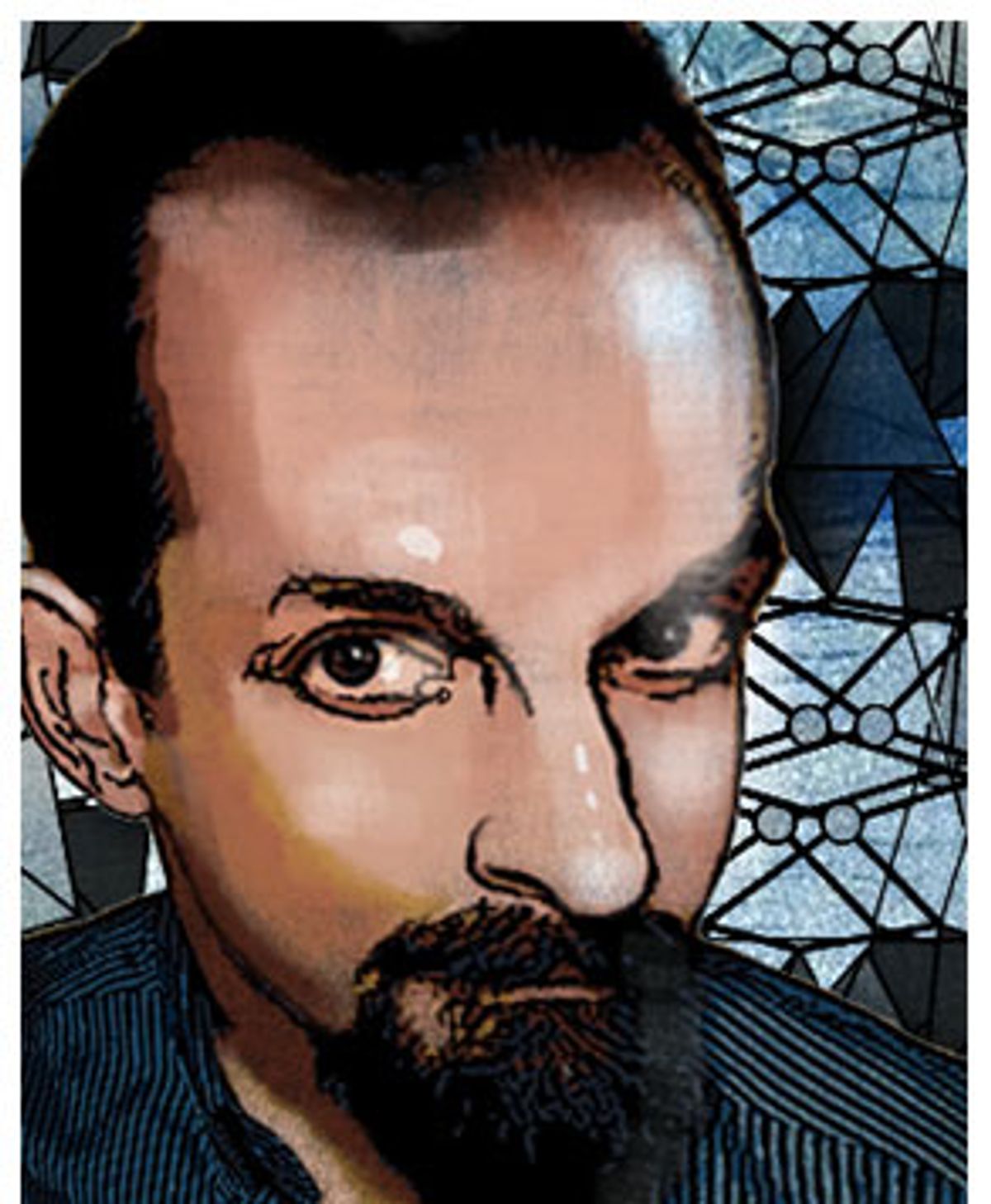
Neal Stephenson's sprawling, intricate "System of the World" caps a vast trilogy of historical and philosophical splendors.

  • more
    • All Share Services

The summit of Mount Stephenson

Mount Stephenson is casting a shadow on my computer monitor: four giant works of fiction stacked on each other like the layers in a Titan’s wedding cake. At the base, two imposing hardcovers, resplendent in their silver and tan jackets: “Quicksilver” and “The Confusion,” Volumes 1 and 2 of “The Baroque Cycle.” Then, up past the tree line, where the air begins to thin, one dog-eared galley, Volume 3, “The System of the World.” Finally, at the summit, scraping the roof of heaven, a morbidly obese paperback, “Cryptonomicon.”

I have weighed them: 11 pounds. I have added up the pages: 3,775. I have estimated, taking into consideration the different average number of words per page of hardcover, galley and paperback, a total word count just shy of 2 million.

I’ve read every one of those words, some of them more than once. As a Neal Stephenson fanboy dating back to the publication of 1988′s “Zodiac” I have considered this my solemn duty and obligation. I have even, like the dot-com start-up execs in “Cryptonomicon,” exercised careful due diligence. After completing “The Baroque Cycle’s” three volumes of late 17th century adventure, intrigue and philosophy, I returned to 1999′s “Cryptonomicon,” to which the Cycle is a mighty prequel, just to make sure I hadn’t missed anything.

This places me in possession of some hard-won, rare and very odd motes of Stephensonian trivia.

For instance, I am now cognizant that in both “Cryptonomicon” and “The System of the World,” Stephenson devotes perhaps more attention than is proper to a sordid Greek mythological tryst in which Hephaestos attempts to rape Athena but succeeds only in ejaculating on her leg. Athena, we are told, wipes the semen off with a rag and squeezes it into Mother Earth, who then gives birth to Erichthonius, an early king of Athens, said to have introduced the world to the use of silver money.

If I was as clever as the author, I would use this recurring Erichthonian interlude as an opportunity to introduce several themes of Stephenson’s recent work. Most obvious is his obsession with money, in all forms, whether as substantial as gold or as newfangled and wafty as credit. “The Baroque Cycle” lovingly details the birth of modern capitalism — it is one of the many new “systems” featured in “The System of the World.”

Less central to the plot, but equally inescapable, we see in Hephaestos’ failed coitus evidence of Stephenson’s mildly discombobulating passion for human bodily fluids. “The Baroque Cycle” does not devote as much space to male masturbation as does “Cryptonomicon,” but this is more than made up for by frequent references to shit and piss and stinking sewers. Stephenson enjoys flinging turds — and apparently, during the Enlightenment, there was plenty of ammunition at hand.

Finally, we must consider Athena, goddess of wisdom, and according to Enoch Root, the one recurring character in all four volumes, the muse of technology. Ever since his breakthrough novel, 1991′s “Snow Crash,” Stephenson has staked out a convincing role for himself as one of technology’s most ardent poets, or propagandists, or prophets — take your pick. It is no accident that “The System of the World” begins and ends with the invention of the steam engine, or that even in the early days of the 18th century, one of his characters is trying to build a computer. For Stephenson, technology has a clear spiritual force. If, as another of his characters declares, understanding how the world works brings us closer to God, then so too does making the world work for us, because that smoothly operating machine is the ultimate proof of our comprehension, of the world, and of God.

But really, I’m not that clever. Staring at my 11 pounds, 3,775 pages, roughly 2 million words of Stephensonia, I feel the queasiness of a boa constrictor who has rashly swallowed not one, not two, not three, but four water buffalo. This act of digestive hubris has paralyzed me. How is all this to be reduced to manageable size? Where does one begin? Stephenson doesn’t just care about technology and money and excrement — he cares about the intersection of God and science, the emergence of democracy, the rethinking of religion, the birth of the digital computer, and the abolition of slavery. All are mixed in with a love story, an action thriller, the search for Solomon’s gold, an intellectual duel to the death between Gottfried Leibniz and Isaac Newton, and the rise and fall of kings and nations.

As I look back on my previous attempts to wrestle this herd of buffalo to a standstill, “clever” is not the word that springs to mind to characterize their sagacity. In my review of Volume 1, I said Stephenson didn’t seem to care about plot. I was wrong. Plot abounds, and Volume 3 delivers a multilayered payoff that would not have been possible without the avid and thorough preparation wrought in Volumes 1 and 2. Villains get their comeuppance, true love perseveres, mysteries (well, most of them, anyway) are explained, a new world order is birthed, and the ending of it all is most satisfactory.

Furthermore, I implied in my review of Volume 2 that its focus on the exploits of Jack the Vagabond King and Eliza, the former harem slave turned Duchess of Qwghlm, made it more satisfying than Volume 1 because fewer pages were devoted to the natural philosopher Daniel Waterhouse, who, in Volume 1, was always mooning about, obsessed with free will and heresy and the architectural reimagining of London.

But Volume 3 is Waterhouse’s revenge, and it is a triumph. If Jack is the ultimate man of action, then Daniel Waterhouse is the paradigmatic man of reason, the moral and technological core of “The Baroque Cycle,” its true hero. Let us pause for a moment and let Stephenson do the writing. Listen to Waterhouse, the scion of royalty-beheading Puritans, account for himself to a courtier of the Princess of Hanover, who is about to ascend to the English throne.

“Listen to me. I did not wish to be summoned by your Princess. Summoned, I did not wish to come. But having been summoned, and having come, I mean to give a good account of myself. That’s how I was taught by my father, and the men of his age who slew Kings and swept away not merely governments but whole Systems of Thought, like Khans of the mind.”

Like Khans of the mind! A mere five words out of nearly 2 million, and yet they are minted of the purest gold. I stare at Mount Stephenson threatening to tumble down upon my keyboard, and my only wish is that it was higher still.

Neal Stephenson occupies a unique place in the pantheon of speculative fiction-writing demigods, because he possesses both unlimited ambition and a colossal capacity for silliness. One needs only to recall the extended treatment of the Captain Crunch-consuming ritual of “Cryptonomicon” protagonist (and Daniel Waterhouse descendent) Randy Waterhouse, to appreciate Stephenson’s ability to take an absurd premise and articulate it beyond all sane restraint. I hold no brief for cereal, personally, but the loving, obsessive-compulsive detail with which Stephenson depicts Waterhouse’s efforts to combine milk and Crunch nuggets in the most efficient and delicious manner possible is a definitive example of his sui generis stock in trade.

There is a danger in cultivating wacky excess — self-indulgence on such a grand scale can obscure the greater narrative and runs the risk of coming off as wanking just for wanking’s sake. There are occasions in “The Baroque Cycle” where Stephenson bogs down, where so much time is spent drilling down to the last extraneous molecule that the effort of reading becomes tiresome, rather than an exhilarating flight of fancy. (Or as Stephenson spells it, “phant’sy.”)

But, and this is one of the joys of reaching the finish line of the Cycle, there is more method to Stephenson’s madness in these tomes than in any of his previous works. By the end, one realizes that in many cases what once seemed a foray into insubstantial irrelevance was a carefully placed foundation stone.

In “Quicksilver,” the first installment of the Cycle, Daniel Waterhouse and Isaac Newton, two students at Cambridge, visit a local fair. Newton attempts to purchase some prisms. Instead, he gets a “lesson in the unbelievable shabbiness of the English coinage.” In the ensuing pages, we are offered a quick and dirty introduction to the difference between shillings coined during the reign of James I, those that were minted during the Cromwell interregnum (and have since been “demonetized”) and the new, perfectly circular guineas of Charles II (so named because they were made from gold that the Duke of York had mined in Africa). We are also introduced to the problems that ensue when such coins are clipped and worn down or otherwise debased.

It all seems a great lark, Stephenson riffing along about the bizarre variety of coins that Isaac Newton might have in his pocket. Isn’t 17th century money just so cute! But there’s more going on here than is immediately apparent. Newton and the prism seller aren’t just arguing over price; they are arguing over how to evaluate the merits of the individual coins that are the very basis for exchange. They have to define their money before it can be spent.

Fast-forward to Volume 3. Newton — who is, in the Cycle, as compelling a character as any Stephenson has ever brought to life — is now the master of the Royal Mint, a position he held for 30 years, long after he made his name with his theories of gravity and optics. His life’s goal is to bring order, sense and accuracy to the English coinage. (There’s another purpose, as well, but since it involves the central fantastical mystery of the Cycle, I’ll leave that for readers to discover for themselves.) Meanwhile, Jack the Vagabond King, whose exploits provide much of the drama in Volumes 1 and 2, has transmuted into Jack the Coiner, a counterfeiter who is Newton’s bête noire.

The struggle between Jack and Newton is the struggle between old order and new — one of the many birth pangs in the extended labor that results in the Enlightenment. Newton (whose third volume of “Principia Mathematica,” incidentally, is named “The System of the World”) wants to bring reason into full effect, monetarily speaking and otherwise. No more doubt and imprecision! No more need to weigh or bite or otherwise determine the provenance of a coin before making a purchase. And while he is adjusting the coinage of the realm, elsewhere — on the London Exchange or in Amsterdam or a score of other innovative entrepôts — stock markets and credit schemes and other financial strategies are ushering in even vaster changes.

This system of money is not without its detractors, reactionaries who see in the new Cult of Finance abomination and anathema. The chief villain of the Cycle is Edouard de Gex, a French Jesuit priest who hounds Jack and his life-love Eliza. Why does he despise them so? In Volume 3, with Eliza finally within his dastardly grasp, he proclaims (with a desperation that is clearly the last gasp of an expiring age) his hatred for all things numismatic.

“‘Money, and all that comes with it, disgusts me,’ said Father Edouard de Gex, ‘within living memory, men and women of noble birth did not even have to think about it. Oh there were rich nobles and poor, just as there were tall and short, beautiful and ugly. But it would never have entered the mind of even a peasant to phant’sy that a penniless duke was any less a duke, or that a rich whore ought to be made a duchess. Nobles did not handle money, or speak of it; if they were guilty of caring about it, they took pains to hide it, as with any other vice. Men of the cloth did not need money, or use it, except for a few whose distasteful duty it was to take in the tithes from the poor-box. And ordinary honest peasants lived a life blessedly free of money. To nobles, clerics, and peasants — the only people needed or wanted in a decent Christian Realm — coins were as alien, eldritch, inexplicable as communion wafers to a Hindoo … The makers, users, and hoarders of money were a cult, a cabal, a parasitical infestation, enduring through many ages, no more Christian than the Jews — indeed, many were Jews … This was repugnant but endurable. But what has happened of late is monstrous. The money-cult has spread faster across what used to be Christendom than the faith of Mahomet did across Araby. I did not grasp the enormity of it until you came to Versailles as an infamous Dutch whore, a plaything of diseased bankers, and shortly were ennobled — made into a countess, complete with a fabricated pedigree — and why? Because you had noble qualities? No. Only because you were Good With Money…’”

The great marvel of the Enlightenment is that the introduction of a new system of money was being matched simultaneously by new systems of science and religion and government. In every aspect of civilization, bold thinkers dared to reorder the cosmos, to sweep away the confounding murk of the past and replace it with a new and better way of doing things.

The ferment is extraordinary. But one could understand if such changes might trigger a crisis of faith.

How do men of science explain God? Or, conversely, how do men of faith come to terms with science? Is the miraculous complexity unveiled by modern biology and chemistry and physics proof of an awesome creator, or the opposite?

“The Baroque Cycle” contains many things, some of which, like the extended analysis of the blueprint of the Tower of London that drags on forever in “The System of the World,” are less interesting than others. But like a compass whose needle continually swings back to point to north, no matter how many times it is jostled, Stephenson’s trilogy keeps returning to an awesome preoccupation: the truth about God and the universe.

Smart people often disagree on this topic; really smart people are often obsessed with it. If we are to trust Stephenson, and I see no reason not to, Gottfried Leibniz and Isaac Newton were two of the smartest people ever. Both were men of profound faith, and yet they were responsible for scientific and philosophical discoveries that, in the centuries after them, fundamentally shook Western civilization’s faith in that omnipotent deity on high.

Newton and Leibniz have issues. There is, for one thing, the question of who invented “the calculus” first. The evidence leans Leibniz’s way, but Newton will kowtow to no man. Oh, and then there’s that trifling dispute as to how the universe works.

The quest for understanding the underlying principles of everything runs through each volume of “The Baroque Cycle,” a kind of meta-umbrella encompassing all the other sub-themes (to recap: birth of modern finance, biology and chemistry; transition from monarchy to representative government; alchemical search for eternal life, et cetera). But in “The System of the World” this search becomes most explicit.

In Volume 3, the philosophical becomes personal when Waterhouse arranges a debate between Leibniz and Newton in the presence of the perspicacious Princess Caroline of Hanover (wife of George I, the first Hanoverian king of England).

The chapter, titled “Philosophick Showdown at Leicester House,” delivers a scene that action fans might find paralyzing, literary critics might sneer at, and only a very small subset of geekily arrogant writers would even attempt (Thomas Pynchon and Richard Powers come to mind). Two of history’s greatest geniuses put their unified-theories-of-existence cards on the table. The sniping is fast and furious. At stake is not just truth itself, but as Leibniz accuses Newton, the potential crime of “spreading doctrines that incline others toward Atheistical views.” (The slur, Newton says, more properly should be aimed at Leibniz.)

A typical exchange goes something like this:

“By no means,” said Leibniz. “I say only that, though the machine of the body obeys deterministic laws, it does so in accordance with the desires and dictates of the soul, because of the pre-established harmony.”

“Of that, we must needs hear more, for it is very difficult to understand,” said the Princess.

“Chiefly because it is wrong!” said Sir Isaac.

Caroline now had to literally step between the two philosophers.

Much as the image of Leibniz and Newton as WWF wrestlers body-slamming each other amuses, the terms of this debate are challenging to comprehend. Does the soul have a mechanical, deterministic basis, or doesn’t it? What does this have to do with Leibniz’s theory of monads and Newton’s theory of gravitation? It hardly seems worth mentioning that the two philosophers do not come to agreement.

And what of that cutting accusation, that one or the other philosopher’s discoveries are turning people away from God? If the Enlightenment, which these two men are partial architects of, is a process that unlocked humanity from a state of blind faith into knowing doubt, then aren’t both men guilty?

My own feeble grounding in natural philosophy, not to mention advanced mathematics and physics, does not equip me to evaluate the debate between Leibniz and Newton from a position of authority. The only thing I can discern for sure is that two very smart men utterly disagree with each other.

Could that be the point — that there is no consensus? This is not to say that Stephenson is some kind of postmodern relativist who believes everything is a social construct. Far from it. In the past, Stephenson has saved some of his most cutting scorn for such types — like all good engineers, Stephenson has always conveyed the sense that you can figure out how things work, and indeed, the whole point of “The Baroque Cycle” is to wallow as thoroughly as possible in the sights, smells and sounds of a period in history where people were figuring out how things really worked.

But that doesn’t mean that they got the final answer, or even that any such answer is possible, or that any new system is perfect.

At the very end of his epic, Waterhouse reflects that even a “flawed and doomed” system is better than no system at all. Here, and elsewhere in this final volume, there is some ominous foreshadowing of just where men of reason may end up leading the world: the horrors of 20th century fascism and totalitarianism, the manifest failures of democracy and capitalism, the heightening tension between science and faith that plagues us to this day.

Surely, if the natural philosophers of the Enlightenment were so smart, they could have done better? Or could have declined to chomp at the forbidden apple?

But that’s not how science works. It’s not how engineers or programmers work, either. There is no perfect system — you just keep tinkering until you get something that works well enough, and when that breaks down you come up with a new improved model. The effort of improvement is its own reward. In “Cryptonomicon,” Avi Halaby, Randy Waterhouse’s partner, is trying to come up with a scheme using computers, networks and cryptography that will prevent future Holocausts. It’s not clear that it will have any real chance of success, but still, one must try.

That effort at understanding, at tinkering with the system, of looking through the microscope, of striving for first principles even though full knowledge may never be attained, is the preoccupation of Stephenson’s characters in “The Baroque Cycle.” One senses his admiration on every page, and his challenge: to follow their example, to tinker some more, to reform the coinage, figure out a unified theory, end slavery, build cool computers and, above all, go for the gold.

Andrew Leonard

Andrew Leonard is a staff writer at Salon. On Twitter, @koxinga21.

States shush corporate critics

From factory farms to home foreclosures, state governments are helping hide corporate wrongdoing

  • more
    • All Share Services

States shush corporate criticsWorkers at the Perdue Farms Inc. processing plant prepare cleaned and gutted chickens for packaging at the plant in Accomac, Va. (Credit: AP/J. Scott Applewhite)

You can’t be outraged by — or fight back against — what you don’t know. At least that seems to be the theory behind a spate of new government-backed efforts to help corporations prevent inconvenient information from ever reaching the public domain. In states across the country, as in Washington, D.C., lawmakers are helping companies keep secrets in everything from factory farming to fossil fuel exploration to home foreclosures.

In five states, for instance, so-called Ag Gag laws are now on the books. Iowa just passed legislation that “criminalizes investigative journalists and animal protection advocates who take entry-level jobs at factory farms in order to document the rampant food safety and animal welfare abuses within,” according to the Atlantic’s Cody Carlson.

The impetus for such laws is obvious: After a series of damning videos of factory farms abusing animals, Big Ag faced a consumer backlash. But rather than make its facilities more humane, it has opted to spend its cash on lobbyists and court cases aimed at preventing the public from ever seeing the atrocities in the first place. Accomplishing that means pioneering new legal theories that threaten to set dangerous new precedents curtailing some of the most basic First Amendment freedoms we take for granted.

Over in the world of energy, it’s much the same thing. Last month in Pennsylvania, the oil and gas industry successfully lobbied state legislators to ban physicians from telling patients what toxic fracking chemicals they may have been exposed to. As Mother Jones’ Kate Sheppard reports, “While companies must disclose the identity and amount of any chemicals used in fracking fluids to any health professional that requests that information … the new bill requires those health professionals to sign a confidentiality agreement stating that they will not disclose that information to anyone else — not even the person they’re trying to treat.”

At least doctors in Pennsylvania get to see some basic information about the industry’s toxic brew, which is more than health professionals in other states have been able to say in recent years. Indeed, in 2008, an emergency room nurse nearly died after being exposed to a company’s fracking chemicals and, according to High Country News, the company cited a trade secrets law in “refus(ing) to provide more specific information (about the chemicals) to the hospital once she fell ill.” That left her “intensive-care doctor to guess what to do as he tried to keep her alive.” This possibility still exists in states that still do not fully mandate disclosure of fracking chemicals.

In the housing sector, you probably assume you at least have a right to see relevant documents related to your imminent home foreclosure. After all, with that basic information, you might stand a chance of going to court and preventing a bank from illegally throwing you out of your home. Yet, if you live in Colorado, your assumption about being able to see such information would be wrong.

With details of the financial industry’s document shredding and robo-signing scandals still leaking out, the Denver Post reports that Republicans in the Legislature there voted down a bill simply “requiring that lenders prove their right to foreclose on a home.” That means Colorado remains the only state to “allow for a foreclosure without the lender first proving” it has the legal right to repossess a person’s domicile. With the GOP so successfully defeating the reform proposal in the face of public outrage at bank fraud, look for the financial industry to try to get state governments to set the same “no doc foreclosure” precedent all over the country.

Then there are corporate taxes, perhaps the most egregious area in which the government uses its power to shield politically significant information. As the Institute on Taxation and Economic Policy reports, “neither the SEC nor most state governments require corporations to release detailed information on their state corporate tax payments” — which deliberately makes it “hard to identify which corporations are not paying their fair share at the state level.” At the federal level, after corporate tax disclosure laws made it onto the books in the 19th and early 20th centuries, they were removed. Bloomberg News notes that the Financial Accounting Standards Board has the power to “make the income-tax returns of all companies with shares traded on U.S. stock markets available to the public,” but that it has refused — even in the wake of reports proving that many of the most profitable corporations are now paying no tax at all in America’s loophole-ridden tax system. The result is that the government empowers corporate management to prevent both companies’ shareholder-owners and the public at large from ever evaluating a firm’s tax compliance — or lack thereof.

Each of these examples — and the many others like them — are closely related to the concurrent corporate efforts to prevent labeling mandates. And as disparate as such examples may seem, they each prove that 21st-century capitalism and old-school Orwellian control are not polar opposites, as they are often portrayed. On the contrary, those two political forces now often coexist in a symbiotic relationship — one that uses state power to keep politically charged information hidden. The theory beneath the calculation is simple: Public ignorance equals corporate bliss.

With protest movements rising and the possibility of widespread social unrest a real possibility, we should expect that calculation to be more prevalent in our politics than ever.

Continue Reading Close
David Sirota

David Sirota is a best-selling author of the new book "Back to Our Future: How the 1980s Explain the World We Live In Now." He hosts the morning show on AM760 in Colorado. E-mail him at ds@davidsirota.com, follow him on Twitter @davidsirota or visit his website at www.davidsirota.com.

AT&T agrees to drop bid for T-Mobile

Government objections put an end to planned $39 billion acquisition

  • more
    • All Share Services

LOS ANGELES (AP) — AT&T Inc. said Monday that it is ending its $39 billion bid to buy T-Mobile USA after facing fierce government objections.

The cellphone giant said that the actions of the government to block the deal do not change the challenges of the wireless phone industry, which it says requires more airwaves, known as spectrum, to expand.

The deal would have solved that problem for a time, and without it, “customers will be harmed and needed investment will be stifled,” AT&T said in a statement.

It called on the government to quickly approve its purchase of unused spectrum from Qualcomm Inc. and come up with legislation to meet the nation’s long-term needs.

AT&T, the nation’s second-largest wireless carrier behind Verizon Wireless, faces paying Deutsche Telekom $3 billion in cash and may have to enter into a roaming agreement with Deutsche Telekom, while transferring it the rights to spectrum it doesn’t need for the rollout of its planned, next-generation “4G” network.

AT&T’s purchase of T-Mobile from Deutsche Telekom of Germany would have made it the largest cellphone company in the U.S. T-Mobile is currently the fourth-largest.

The Justice Department sued to block the merger on Aug. 31, saying it would reduce competition and lead to higher prices.

Last month, the companies withdrew their application to the Federal Communications Commission after its chairman also opposed the deal.

Continue Reading Close

I hired the wrong person and she turned on me

She's gone now, thank God, but I can't get her out of my head

  • more
    • All Share Services

I hired the wrong person and she turned on me (Credit: Zach Trenholm/Salon)

Dear Cary,

Three years ago, I hired what I thought to be a talented, kind and honest second in command at the magazine where I work. It turns out, I was only one-third right. While “Sally” was great at many parts of her job, she wasn’t honest and she wasn’t nice. She began sleeping with another person in my department (my work equal), and was dishonest about it, and would often say, “The art department feels this would work better this way,” when our entire organization knew these people were a couple. She’d undermine me at meetings with higher-ups, criticizing my ideas and interrupting me, and in meetings with me one-on-one, she’d burst into tears at the slightest disagreement or say, with a stern little look, “We’ll just agree to disagree.” It made any sort of discussion darn near impossible.

She also puffed herself up constantly — “I was mistaken for a model yesterday!” and made digs at me and other people at work, “Well, that’s not MY taste. But, interesting!”

I was trying to figure out how to fire her when she took another, more lucrative job in another field. The guy at my office dumped her shortly before this happened. But sadly, even though it’s been a year, I’m still haunted by the experience. I feel like I let myself be steamrolled by an “All About Eve” clone, and I dread running into her at events in my relatively small professional circle.

I honestly believe she’s a pretty lousy person, and I wish her ill. But I check her Twitter feed, and, honestly, am a little obsessed with hating her. How can I move beyond this, or, better yet, make sure other people in my industry know she is evil?

The Bad Boss

Dear Bad Boss,

I know how hard these things can be. I am a champion grudge-carrier myself.

I could go into business carrying grudges. I could get a truck with a magnetic sign: No Grudge Too Small. Bulk Rates. Tired of carrying that grudge? Call 1-800-GRUDGE-KING.

Would it make you the most miserable man on earth, carrying all those grudges for others? Or would it be liberating, knowing that not one of them is yours?

Anyway, some of us are champion grudge-carriers and we need a way to let go of a grudge. If we don’t deal with it, it can last for years.

So what we do in the 12 steps, we do inventories. You could look that up. We work with a sponsor. We’ll say, I can’t stop thinking about this person who screwed me over. And the sponsor will say, Well, let’s do the steps on this. Or, have you done the steps on this? Or, what step are you on?

Doing the steps gets you focused on you, not the person you’re obsessing about.

In doing the steps, we write things down. We answer questions like, what happened, and who was involved, and what sort of injury or threat did we perceive? What area of life was affected? Was it our sex relations, our self-esteem, our status?

We just more or less dispassionately look at what happened. We break it down. We also ask what role we played. This is not done in a blaming way. We just, for instance, say, well, the role we played was, we made the decision to hire her. OK. The great part about that is it puts us in the mix and gives us a sense of agency. We’re not a victim, we’re a participant. We see, OK, we did have a decision and we did play a part. We might have made a different decision. Likewise with the other events, we just identify what part we played. It may be that all we did was choose to go to a party. But we realize then, though it may have seemed like we  had to do what we did, we see  that maybe we could have avoided the upset. Not that it’s our fault, but that we were present and played a part in it.

It reminds me a little bit of how one proceeds in cognitive therapy. What I like about cognitive therapy and the 12 steps is that they lead us increasingly toward reality. We are always asking what is real, what is concrete, what can we see?

Then we often find that our response had something to do with fear. We see that we were trying to prevent something from harming us.

As we continue in this way, dissecting the event, we begin to see that in an existential sense we can’t protect ourselves anyway. We are vulnerable. We may be disliked or disrespected by co-workers or family members. We may be cheated on or deceived. There are no guarantees. We cannot control other people. Meditating on this returns us to the real world; it restores a correct relationship to the awesome powers of life and death that surround us; it fills us with appropriate awe for nature and fate; it unites us with other creatures living and dead; it humbles us and returns us to the bosom of humanity.

This notion of letting go of control is a sticky one, because it involves beginning to trust in something outside ourselves, and often we have been adamantly self-sufficient. But to get out of our awful predicament we focus on something beyond ourselves. We place trust in something larger than us.

It’s not like we get converted or saved or ascend to a higher state of consciousness. It’s more subtle. We entertain the notion of something bigger than us, and it shifts our focus away from ourselves, away from our vexing, all-consuming fear. We see that the world is awesomely powerful and if it wanted to strike us down it would have done so already. So we relax a little. If it’s coming, it’s coming. Don’t sweat the small stuff.

Once you entertain that notion that maybe you are not the one in control, then you do not need to respond to every possible threat with a flanking maneuver and a public relations campaign. Some things you can just let go of.

You are able to entertain the notion that maybe it’s not about the other person. Maybe it’s about you.

So you work with a sponsor and the sponsor suggests you do a fourth step, or a tenth step, or maybe the sponsor just talks with you about this obsession you have. But somehow you work through it by working through it. You have a method. That’s the point. The 12 steps offer a method, a simple, concrete method of purging ourselves of worry, doubt and fear.

If you’re not an alcoholic or drug addict and don’t have an eating disorder or a sex addiction you can always go to Al-Anon.

It’s just helpful to have a group. The Al-Anon group is all about how we deal with problems associated with other people — how the behavior of other people affects us, and how we learn to separate our problems from other people’s problems.

Really, I suggest you check out Al-Anon. You can get some grounding in the 12 steps, and you can hear personal stories from people who are coping with similar situations.

Plus it’s sort of fun. Really. Once you get over the initial novelty of it it becomes fun.

If you don’t want to do the steps, you can certainly get into therapy. I’m all for therapy. But therapy costs money and its efficacy depends on the intelligence and talent of the therapist. The 12 steps are pretty much free, and they work.

So that’s my approach to dealing with grudges.

But I still like the idea of the grudge-carrying truck.

I bet I could make some money.

Continue Reading Close
Cary Tennis

Cary Tennis writes Salon's advice column, leads writing workshops and creative getaways, publishes books, writes an occasional newsletter and tweets as @carytennis.

Join Cary's Online Writing Workshops

Fox Business Network exec: Channel has too much Fox, not enough “business”

Rupert Murdoch's would-be CNBC-killer suffers in the ratings as it imitates its ultra-conservative sister network

  • more
    • All Share Services

Fox Business Network exec: Channel has too much Fox, not enough (Credit: Salon)

In 2007, Rupert Murdoch started the Fox Business Network to crush CNBC using the same tactics that Fox News used to surpass CNN: Make a louder, sexier, angrier, more right-wing populist product, and the old people who watch TV during the day will tune in. Except it didn’t really work with Fox Business.

CNBC averages 263,000 viewers during the workday, according to Nielsen. Fox Business tops off at 85,000 from 4:30 to 8 p.m., and that period includes daily shows hosted by Fox stars Lou Dobbs and Neil Cavuto. Fox Business executive vice president Kevin Magee had a great idea to finally turn things around, according to a memo Reuters obtained: Maybe focus more on business news?

“I’ve been asked to remind you all again that they are separate channels and the more we make FBN look like FNC the more of a disservice we do to ourselves,” Magee said in the memo dated October 5, carrying the subject line “Fox News and Fox Business.”

“I understand the temptation to imitate our sibling network in hopes of imitating its success, but we cannot,” Magee went on to say in the memo. “If we give the audience a choice between FNC and the almost-FNC, they will choose FNC every time. Earnings, taxes, jobs etc give us PLENTY to chew on.”

As Media Matters ably documents here, Fox Business is right now just a sort of weird alternate-Fox News, with slightly different personalities who are still fixated on the exact same right-wing causes and phony outrages. (Plus cantankerous Connecticut cowboy Don Imus in the mornings, which is an odd choice for a “business” channel.) It’s Fox’s ESPN 2, except without extreme sports.

Why would an investor or trader want to watch Eric Bolling interview Pam Geller about the “ground zero mosque”? Who turns on a “business news” channel hoping to see former Wall Street Journal editorial writer David Asman promote birtherism and interview an ex-NFLer about the dangers of gay marriage?

The problem with Fox Business is baked right into the channel’s founding: It serves a market that is totally satisfied with preexisting offerings. People who want conservative-slanted market news all day already had a channel: CNBC. Just about everything Fox Business has ever done is either a retread (sexy ladies talk about stocks, just like on CNBC!) or just stupid (a five p.m. show set in a weird fake Irish pub!). While CNBC flatters its viewers’ senses of sophistication and superiority, Fox Business assumes its audience would rather watch an interview with Tila Tequila than hear about the SEC’s decision to charge Goldman Sachs with fraud.

The Fox model doesn’t work with business news, where the pro-corporatist mind-set is already baked into the majority of “objective” coverage and there isn’t a need to spice up the mundane business of promoting the interests of the wealthy with culture war material. Fox Business should be targeting the conservative elites who find Muslim-bashing and birtherism a bit distasteful (if necessary). But those elites may never find a reason to tune in. News Corp’s own Wall Street Journal has an exclusive deal with CNBC, and WSJ reporters are just as turned off by the Fox Business brand as everyone else.

Continue Reading Close
Alex Pareene

Alex Pareene writes about politics for Salon and is the author of "The Rude Guide to Mitt." Email him at apareene@salon.com and follow him on Twitter @pareene

No, I can’t edit your manuscript for free

I write about books for a living, so people think I'd love to critique their prose

  • more
    • All Share Services

No, I can't edit your manuscript for free (Credit: Zach Trenholm/Salon)

Dear Cary,

I’m writing to you because you’re very nice and have a great deal of empathy, and I’m hoping you can tell me how to respond with empathy in a situation that’s causing me distress.

I write about books for a living. I have been working with, around and in books for over a decade. Hooray for my job; I feel very lucky. In the last six months, four people I know have approached me and asked for help with books they are writing. They want me to read and evaluate and edit their manuscripts. They want me to tell them where to send their manuscripts after I have made them publishable.

To which I say: No way! First of all, I have two jobs and am often so busy I feel breathless. Second, I write about books; I’m not a literary agent or an acquisitions editor at a major publishing house. I haven’t even published a book of my own (though I hope to, someday).

But, even if I had the knowledge they seek, why should I use it to benefit them? Reading and editing a manuscript would take a helluva long time. What’s more, it’s work, work that other people get paid for.

All these requests have come from men. None of these men are professional writers. I am not in regular contact with any of them; they are once-removed from my daily life: the brother of a friend, the husband of a friend, and  the father of a friend. They don’t ask how I am. They don’t stop to consider if I’m busy. They don’t seem to read my (published!) writing, since their manuscripts are in genres I don’t write about.

When I get these requests, I feel incredibly stingy. I get angry and anxious and think uncharitable thoughts about them.  It seems to me that they are all entitled jerks who have no respect for me or my career. Sure, they might think I can steer them on a path toward publication, but also seem to think I have nothing better than sit around and read their stupid manuscripts. They’re so out of line I can hardly think straight.

I blew off the first request. I flat-out refused the second two. I still haven’t responded to the fourth one, which I received this morning. This last request seems very problematic, since it comes from someone I’ve known since childhood and who’s sick.

So, Cary, what do I do? Am I right in refusing these people? If so, what’s the best way to tell them that I can’t do it? And how do channel some generosity of spirit toward them? How do I stop getting so upset? Right now, I feel like a mean-spirited jerk.

Sincerely,

Angry Books Writer

Dear Angry Books Writer,

You are absolutely right that such work is not to be expected casually or for free. It is very demanding work.

So here is what I suggest: Think of an hourly rate that would make you happy. Don’t think of the “correct” rate or the “going” rate. Think of a number that makes you smile. Think of a number that is high enough to discourage most casual requests.

This is what a person — whom I was paying to advise me — advised me to do when I received such requests. It seemed weird at first. I thought, well, I should just charge what is the correct rate. She said no, forget correct. How much do you want? What would make you happy? And what would discourage casual requests? You don’t really want to do this work all that much anyway, right? So, OK, a number came to me. It seemed high. It seemed almost silly it was so high. But it felt good to me! So I said it out loud. And the person advising me said, OK, when people ask you for this kind of work, quote that number. And I did.

I ended up accepting some work at that price. Surprisingly, I enjoyed doing the work. The person desiring my services was happy to pay that rate. Neither one of us felt cheated. We were both pleased.

It turns out that stuff is worth exactly what someone is willing to pay for it. It turns out — surprise, surprise! — that you can make an agreement with one individual based on what each of you wants and it will work out fine. Amazing.

That one piece of advice was worth all the money I paid this person for her advice, and more. It solved the problem. It made me happy. I’m grateful to the person who gave me that advice. And now I am giving that advice to you. It makes me happy to be able to give it to you. Really, it does. Because I have benefited greatly from it.

As to your desire to respond with empathy, how can you not have empathy for someone who wants to publish a manuscript? Poor bastard. How can you not have empathy for the person? That doesn’t mean you have to become their servant.

When somebody asks you if you would do this kind of work for them, tell the person that you do occasionally take on such projects, in a selective way, and here is your hourly rate. And see what happens.

Continue Reading Close
Cary Tennis

Cary Tennis writes Salon's advice column, leads writing workshops and creative getaways, publishes books, writes an occasional newsletter and tweets as @carytennis.

Join Cary's Online Writing Workshops

Page 1 of 139 in Business