Stephanie Zacharek

“House of Flying Daggers”

The director of "Hero" comes out with a follow-up so heroically seductive you may just faint into its arms.

  • more
    • All Share Services

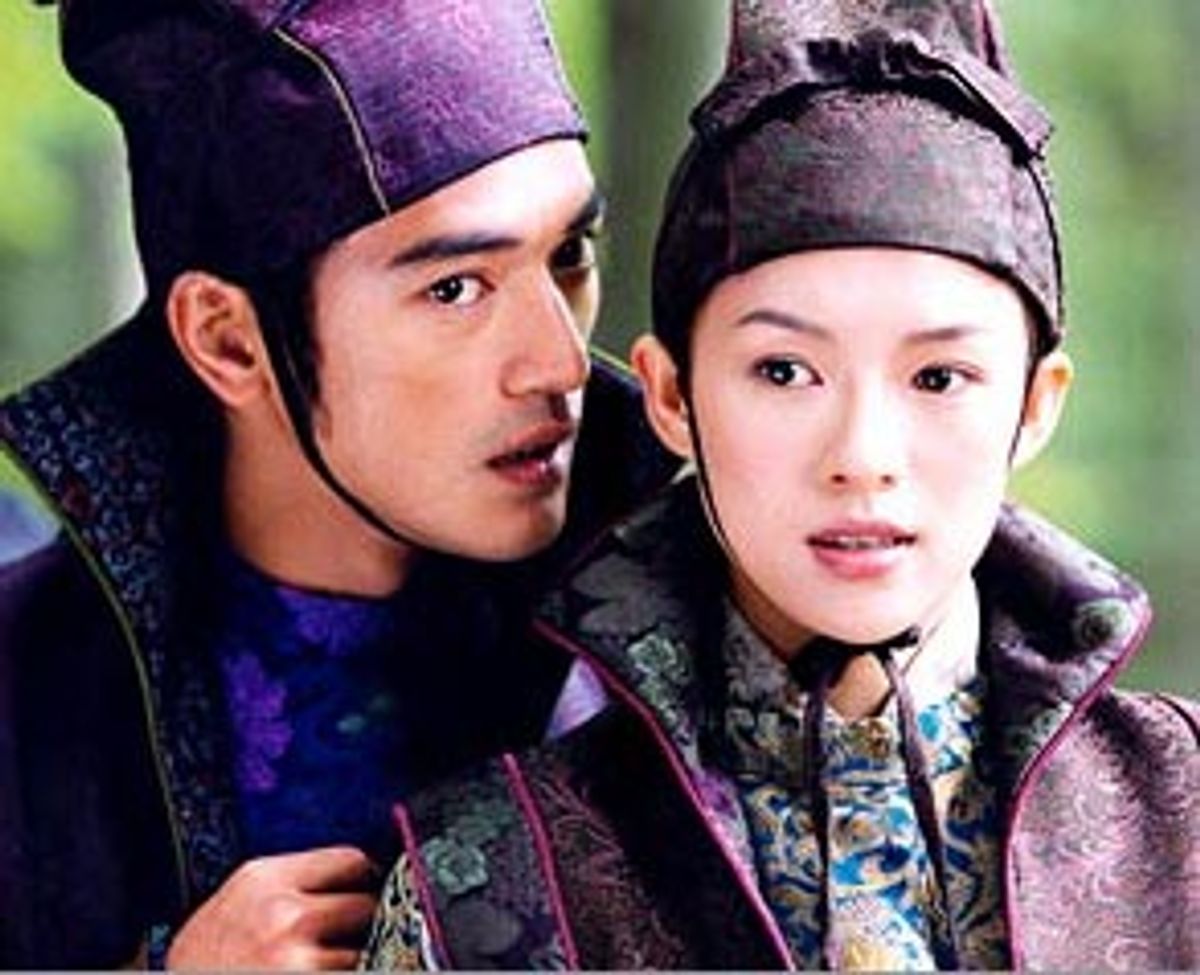
When Ziyi Zhang glides into her first scene in Zhang Yimou’s optically and operatically intense Tang Dynasty romance “House of Flying Daggers” — in her rustling brocade robe and breezily tinkling golden headdress, she doesn’t do anything so mortal as walk — the movie stops, momentarily, almost before it has really begun.

Ziyi Zhang’s character is Mei, a blind warrior girl masqerading as a dancer in a brothel. She’s about to perform for Jin (Takeshi Kaneshiro), a local deputy who has come, undercover, to arrest her. Jin, lounging against a floor cushion like a bored frat boy, beckons Mei closer so he can scrutinize her, as well as intimidate her. He asks why her name is so simple, when all the other ladies in the establishment go by elaborate flower names. Mei fixes him in her sightless gaze — her face is a bisque oval whose very contours suggest the unmappable shape of intelligence — and tells him, neither haughtily nor modestly but in a tone that confirms the absurdity of the question, “I don’t want to compete with those ordinary girls.”

With that line, Ziyi Zhang throws down the challenge that “House of Flying Daggers,” a martial-arts movie that owes more to Bizet or Puccini than to Bruce Lee, meets with supple and spectacular grace: This is a plush, enveloping blanket of a picture that nonetheless feels essential, boiled down to to its barest emotional elements. It’s an epic of the heart.

“House of Flying Daggers” fits nicely into the slipcases of both romance and action-adventure, if you feel the need to categorize it. But as a piece of filmmaking, it’s as crisp and as slithery as a piece of silk, weaving its way around and through multiple genres as it blurs and softens any hard divisions between them. As “House of Flying Daggers” unfolds, you’re barely aware of the story’s dramatic boning, the corsetry that keeps it in shape. To seduce us, it uses the most basic tools — color, sound, movement — often all at once. Its color palette alone — from candy reds and yellows, to autumnal russets and golds to, finally, the muted shimmer of icy whites and grays — demands complete surrender to its sensual vocabulary.

But the picture isn’t an empty spectacle. The beauty of “House of Flying Daggers” is so lulling that by its climax, we’re barely aware of the way its dramatic texture has become denser, more intense. The finale of “House of Flying Daggers” has the emotional potency of silent film. Everything around the actors — the sound, the colors, the lush scenery — is still firmly in place, yet it may as well have dropped away. The actors, and the web of feeling that connects them, are all that matter. Their faces become the only reason for the screen to exist.

Ziyi Zhang’s Mei can’t be called the anchor of “House of Flying Daggers” — that’s too clumsy and clanking a word for what she does, and it undermines both her delicate beauty and her lithe strength. It’s more accurate to say she’s the stem around which “House of Flying Daggers” wraps and twines. Mei is hiding out at that brothel — it has the sugared-nipple name of Peony Pavilion — because she’s really a member of the House of Flying Daggers, a secret, Robin Hood-like outfit that roams the countryside defending the poor and disenfranchised and thus enraging the local power structure.

The leader of the House of Flying Daggers has recently been killed by the local deputies, but the organization continues to thrive. One of the deputies’ senior officers, Leo (Andy Lau), has sent Kaneshiro’s Jin, an unreasonably handsome soldier whose sex appeal is far more lethal than any sword he carries, to the brothel to ensnare Mei. Leo and Jin hope she’ll lead them to the House of Flying Daggers’ lair so they can vanquish the group once and for all.

Jin botches the capture, and Leo steps in to complete it. Mei nearly defeats him in a spiraling, whirling duel: Though she’s unable to see, she’s a masterful, agile fighter. But Leo subdues and captures her, bringing her back to headquarters, where he threatens her with torture unless she reveals the secrets of the House of Flying Daggers.

And then, suddenly, a stranger swathed in black rescues her from her cell. It’s Jin in disguise — his motives become clearer as the story winds through its numerous interlocking twists and turns — and the two of them escape through the forest. Although they both resist it, they fall deeply in love.

Ziyi Zhang, Kaneshiro and Lau all have the charisma of old-fashioned movie stars. (Ziyi Zhang, formerly known as Zhang Ziyi, played Jen in “Crouching Tiger, Hidden Dragon,” and although she wasn’t the star, she lingers — in my mind, at least — as its most memorable character. Kaneshiro was the pineapple-eating cop in Wong Kar Wai’s “Chungking Express.” Lau, a huge star in Asia, may be best known to Americans as the star of “Infernal Affairs,” which was recently released here.) Ziyi Zhang and Kaneshiro, in their early, prickly, falling-in-love scenes and their later, wrenchingly tender ones, use the screen space around them as if it were a canvas — the air around them vibrates with muted erotic tension. And Lau, his stern demeanor giving way to peeled-naked vulnerability during the course of the picture, gives a performance that thrums beneath the surface of his skin. The secrets revealed in the last quarter of the film completely change the shadowy light around the character of Leo as we see him in the first half.

“House of Flying Daggers” is one of those pictures in which every frame has been lavished with care. Yet it never looks overworked. Zhang’s last picture, the exhilarating and equally gorgeous adventure epic “Hero,” did well with American audiences. Before that, Zhang, who lives and works in China, was best known (in the States, at least) for art-house pictures like “Ju Dou” and “Raise the Red Lantern.”

“Hero” was Zhang’s first foray into wuxia, or martial-arts movies. And he has said that “Hero” was just a rehearsal for “House of Flying Daggers,” a way of mastering the genre’s conventions. Here, Zhang is clearly in complete control — and still, the picture has a relaxed, fluid feel to it. He takes the staples of wuxia films — bamboo-forest fight sequences, for instance, like the one seen in Ang Lee’s pale-by-comparison “Crouching Tiger, Hidden Dragon” — and recasts them with subtle twists. In the “House of Flying Daggers” bamboo-forest sequence, Jin and Mei flee from a group of soldiers (the baddies slide down their individual bamboo stalks face-forward, with a silently deafening “whoosh”), only to hit a trip-wire that causes hundreds of bamboo spikes to pop up through the forest soil like giant pencil points.

The sound design of “House of Flying Daggers” is so vivid it’s practically part of the cinematography. (The director of photography here is Xiaoding Zhao; the picture was filmed in Ukraine.) Mei and Jin trek through forests that shift from flame-orange tones to velvety moss-green ones; they take a breather in a vast wheat-gold field, where Jin picks flowers for Mei. (If that sounds corny, I should note that Jin harvests massive bunches of posies without ever dismounting his horse.) The wind — which Jin considers his alter ego — travels with Jin and Mei like a discreet but always present accomplice; we hear it, and other forest sounds, as Mei does, quietly intensified.

Every sight and sound has resonance: The shivery whisper of flying arrows, the way Mei’s delicate feet bounce off a group of soldier’s upturned shields as if she were bouncing off giant piano keys. Zhang speaks to us through the details, in the way a flying dagger pierces a single droplet of blood suspended in air, or the way a fight sequence begins in autumn and continues well into winter, the weary warriors lunging through drifts of snow to get at one another — it’s as if they’ve been at each other’s throats not just for minutes but for months or even years.

As a director, Zhang spoils us, offering us visual and aural luxuries as if they were delicacies on a tray. For example, the first half hour of “House of Flying Daggers” features not one but two dance sequences, the second even more spectacular than the first. The details of the second — an elaborate performance called the “Echo Game” — are so remarkable they have to be seen to be believed. So I’ll describe only the first: The performance takes place in a grand, meticulously decorated room, its floor a tiled mosaic of pastel butterflies and peonies. Mei, whom Jin has commanded to dance, stands in the center of the room, waiting for her cue. Assorted temptresses, draped lavishly yet modestly in gowns of orange, blue and gold, flutter at the sidelines. The music starts — it’s supplied by a band of beauties in blue robes, who sit in a row with their legs daintily crossed, plucking their stringed instruments — and Mei reacts, cocking her head slightly as if she were responding more to the vibrations of the colors around her than to the music.

The song — about a woman so beautiful she can destroy whole cities with a glance — at first seems too somber to suit this diminutive, if self-possessed, beauty. But as Mei begins to dance, her arms elongated by ribbonlike sleeves of pink chiffon that swirl and snake around her, we realize she has taken possession of the whole room. Everyone, including the cocky young deputy who has come to arrest her, belongs to her, and from that moment, “House of Flying Daggers” takes possession of its audience, too. It reminds us that there’s no greater moviegoing pleasure than to give ourselves wholly and willingly to the picture in front of us. “House of Flying Daggers” is heroically seductive; there’s no recourse but to faint into its arms.

A movie critic bids farewell

After 11 years, I'm leaving Salon. Thank you for being such a passionate, engaged, challenging audience

  • more
    • All Share Services

A movie critic bids farewell

This is the hardest piece I’ve ever had to write for Salon: my last.

When Joyce Millman — at the time just an acquaintance, but more than that a pop-music and television critic I’d long admired — contacted me sometime in early 1996 about the possibility of writing for a new publication she and a bunch of other San Francisco Examiner exiles were starting, I was intrigued. Until I found out the publication was online only. At the time, I was a full-time magazine copy editor by day and a freelance writer by night: If it wasn’t in print, it wasn’t real.

At that point, we didn’t yet know just how old Old Media really was. But the idea of transferring the skills and principles of Old Media onto the Web intrigued me. And even if Salon, as an online-only magazine, wasn’t “real,” the money its founder, David Talbot, was willing to pay its writers, was — the fees weren’t princely, but definitely fair, particularly for a start-up. So I made one tiny leap as a freelancer in 1996 that turned into a bigger one three years later, when I was hired at Salon full-time. My friends at the business magazine, in Boston, where I was working at the time — a job I loved but was ready to leave — urged me to rethink my decision. Salon was a start-up; it wasn’t stable. I might move to New York, where David was assembling an East Coast staff, and it could all fall apart the next day.

It didn’t, and it hasn’t, though no publication — online or in print — has had an easy time of it these past few years. When I was a journalism student in the 1980s, if you had told me that by 2010 it would be nearly impossible for a smart, experienced professional to make a living wage as a journalist or editor, I’d have accepted it only if you’d told me that by that time, we’d also be zooming around in flying cars, like the Jetsons. Journalism, as a profession, is in danger of dying; I’m still waiting for that flying car. And lest you think I’m going to hijack this space for a speech about the death of film criticism, I need to say that, realistically, the world could survive without full-time movie critics. But if dedicated, disciplined, paid journalists disappear, we’re headed for some very dark times.

Over the years Salon has strived to make a place for serious writers, editors and journalists, and it continues to do so. I’m astounded when I stop to think about the number of superb, conscientious editors with whom I’ve had the pleasure to work, and the many, many terrific, challenging writers with whom I’ve been honored to share space. They’ve humbled me and, I hope, made me better. Salon has also, I must note, always made a place for film criticism, even in times when other outlets were scaling back. In granting me this space — and in allowing me the pleasure of working with the kindest, grooviest and most generous colleague imaginable, Andrew O’Hehir — Salon has made me the most fortunate of movie critics, and even as I move on to a new adventure elsewhere on the Web, my gratitude won’t diminish.

What I’ve written so far is largely about me. But here’s where it becomes all about you. People who are paid to write can gas on all they want about the decline of their profession, but even then we sometimes forget that we’re only half of the equation. We’re nothing without readers, and at Salon I’ve found a truly passionate, engaged, challenging audience. You have often inspired me, and I hope I’ve done you justice.

So this is where, with wholly inadequate words, I say thank you: To those who have read me faithfully or even just casually; to those who have written to me personally over the years, widening my world more than you can even imagine; to those who’ve taken the time and care to leave thoughtful, well-reasoned comments instead of just doing the asshole drive-by; to those who have stolen from me (theft is the sincerest form of flattery); and most of all, to those of you who have disagreed with me, often passionately. Because as I’ve said more times than I can count, criticism isn’t about consensus, it’s about engagement. And so bravo, and brava, to you all.

Continue Reading Close

“Clash of the Titans” could make the gods weep

It's a mythological extravaganza with a messy story, a lame monster and no magic. Release me, Kraken!

  • more
    • All Share Services

Sam Worthington in "Clash of the Titans."(Credit: Jay Maidment)

Many of us who fancied ourselves sophisticated in 1981 freely mocked “Clash of the Titans” at the time of its theatrical release: A hokey-looking fantasy that plays fast and loose with Greek mythology, starring a well-oiled Harry Hamlin as brave warrior Perseus and Laurence Olivier as his top-god father, Zeus? No thanks. We were too busy oohing and ahhing over the prim aesthetics of “Chariots of Fire” to fall for anything so obviously fake as a flying white horse.

Since then, many of us have seen the error of our ways, and we now know what little kids who were dazzled by watching “Clash of the Titans” on TV (it was a staple of HBO in the early days) have always known. Directed by Desmond Davis and with stop-motion special effects by the great Ray Harryhausen, the first “Clash of the Titans” is an unself-conscious treasure of fantasy filmmaking. Harryhausen’s creatures — from his feathery-winged Pegasus to his fearsome yet sympathetic sea beast the Kraken — are low-tech by today’s standards. Yet within their specially created universe, they’re wholly alive, not disposable. Their fantastically unreal qualities demand a measure of engagement from the viewer, and it’s that engagement — not the amount of money or time spent on their creation — that gives them life.

Say goodbye to all that with the new 3-D “Clash of the Titans,” in which Sam Worthington’s Perseus struts around importantly in a Utilikilt, Pegasus is something of an afterthought (and is black instead of white), and Zeus and Hades are played by the Tweedledum-and-Tweedledee versions of Olivier, Liam Neeson and Ralph Fiennes. And unlike the original — which, in a crazy stroke of genius, allowed Shakespearean thespians like Claire Bloom and Maggie Smith, plus Bond babe Ursula Andress, to mix it up as jealous goddesses — the new “Clash of the Titans” is frightfully low on babes. Gemma Arterton and Alexa Davalos — as, respectively, Io and Andromeda, the two beauties who vie for Perseus’ stolid soldier’s heart — are comely enough, but there’s no sensuous glow about them. They’re eye candy, not enchantresses.

Of course, lamenting that the old “Clash” is so much better than the new one will take us only so far. Any remake has to stand on its own merits. That said, “Clash of the Titans” still sucks. The story — the script is by Travis Beacham, Phil Hay and Matt Manfredi — is unruly and unnecessarily complicated: Perseus may be the son of Zeus, but he’s been raised by human parents (played all too briefly in the movie’s early scenes by Pete Postlethwaite and Elizabeth McGovern). When they’re killed by Hades, god of the underworld, he stomps around for a bit, looking angry. Then he decides to lead a mission, with the help of some hotshot soldiers from Argos (the hottest of these is played by Mads Mikkelson; less hot is gangly, confused-looking Nicholas Hoult), to defeat the god who killed his family. Meanwhile, Neeson’s Zeus (clad in a sizzling-white, headache-inducing suit of armor) and Fiennes’ Hades (scowling as he sports the ever-popular bald head with long fringe look) duke it out over something or other. And Perseus and his crew get on with the business of fending off giant scorpions, beheading the serpent-tressed Medusa (a CGI creature modeled from the face and form of fashion model Natalia Vodianova) and, ultimately, sending the Kraken packin’.

The Kraken is big all right, and his design — a small, turtlish head perched on a gargantuan body — owes a debt, as so many modern movie creatures do, to H.R. Giger’s design for “Alien.” But this Kraken is disappointing; there’s no glamour or mystery to him. He’s overscaled and underwhelming, and even in 3-D, he lacks dimension. The director of “Clash of the Titans” is kooky Frenchman Louis Leterrier, and based on some of the intentionally over-the-top pictures he’s made in the past (including the gorgeously melodramatic “Danny the Dog”), he isn’t necessarily a bad choice to breathe new life into an old favorite. But the picture is loaded with dimwitted proving-your-manhood dialogue — “This isn’t your fight!” one of Perseus’ girlies exclaims, to which he responds, with all the expressiveness of a green-plastic army man, “Someone has to take a stand!” — and not even the picture’s aggressive special effects are enough to distract us from it. “Clash of the Titans” was converted to 3-D after it was completed, and I wonder if it wouldn’t be more enjoyable as a straightforward 2-D feature: The use of 3-D renders the action muddier and more indistinct than it might otherwise be, and the movie’s fantasy vistas, of seaside cliffs and rugged desertlike terrain, don’t look particularly distinctive in the retrofitted format.

The fact that some genius at Warner Bros. decided that a 2-D “Clash of the Titans” just wouldn’t be good enough for movie audiences — or, more likely, recognized that the extra dough moviegoers have to fork over for 3-D glasses would dramatically pad the grosses — suggests that Hollywood thinks it’s got us just where it wants us. We want spectacle at the movies, as we always have; we want action and drama and escape.

But what about everything Hollywood, with movies like this “Clash of the Titans,” is failing to give us? The movie is big all right. But where’s the magic? And where, dare I ask, is the eroticism? We barely get a kiss between Worthington and Arterton, not that I particularly wanted one. On the other hand, in the original, we see the spirit of Andromeda (played by Judy Bowker) being carried off in a golden cage by a winged beastie, as her left-behind body sleeps behind a sheer, sparkly curtain. The image is lush, unsettling, dreamily evocative. The new “Clash of the Titans” is supposed to stand for progress, and the promise of huge profits, as we purportedly stand at the forefront of a 3-D revolution. Instead it’s a symbol of everything we’ve lost. But at least it reminds us that our 2-D dreams can’t be so easily replaced.

Continue Reading Close

Miley Cyrus: Finally old enough to hate

The teen star is all grown up in "The Last Song" -- and it's time to admit she cannot act

  • more
    • All Share Services

Miley Cyrus: Finally old enough to hateMiley Cyrus in "The Last Song."

Movies based on Nicholas Sparks’ novels have gotten a bad name, and unfairly so: As source material they’ve at least helped prolong the life of an endangered movie species, the romantic melodrama. Pictures like “Nights in Rodanthe,” “Dear John” and “The Notebook” may have their flaws, but in cineplexes crowded with carelessly made action pictures and, increasingly, flashy-but-empty 3-D features, they at least cling to some tatters of a movie tradition forged by Douglas Sirk and Max Ophuls.

But not all Sparks adaptations are created equal, and the latest, “The Last Song,” is less equal than most. There are a few decent performances here, most notably that of Greg Kinnear as Steve, a grizzled, beleaguered, divorced dad. But “The Last Song” — which was directed by Julie Ann Robinson, from a screenplay by Sparks and Jeff van Wie — doesn’t even work as passable, tear-loosening melodrama, and the predictable plot mechanics aren’t what make it insufferable. The big problem is Miley Cyrus.

It wasn’t so long ago that Cyrus, as normal preteen/pop star Hannah Montana, became a megastar among the sparkly purse set. And even though plenty of us may have rolled our eyes at Cyrus and her alter-ego character, there’s only so much criticism you can level at a child performer: Cyrus was a cute enough kid, and the reasons for Hannah Montana’s popularity were understandable. Young singers and actresses are by their nature unformed: It’s OK to be somewhat critical of their abilities, but part of their appeal is the idea that they’re still on their way to becoming something more.

But Cyrus is now 17, playing in the tougher arena of grown-ups, and her performance in “The Last Song” suggests she has two expressions at her disposal: Pouty and scowly. Three, if you count squinty. Cyrus plays grumpy high school graduate Ronnie (Miley Cyrus), who spends the summer at her dad’s beach house in Georgia sulking, grumbling and generally making her poor father’s life miserable. And for this she’ll be rewarded by meeting a nice, hunky blond boy, Will (Liam Hemsworth), who genuinely likes her and also happens to be rich. Conflicts will of course ensue.

When I wrote about “Hannah Montana: The Movie” last year, I couldn’t help noticing Cyrus’ vaguely blowsy quality — she seemed to have bypassed dewy, carefree teenage youth and was instead hurtling toward three-kids-and-a-McMansion matronliness. Still, she could just about pass as a kid, in a movie aimed at a pretty young audience. It seemed prudent to give her the benefit of the doubt.

But the suffering she causes in “The Last Song” is just too much. Cyrus’ speaking voice is deep instead of squeaky, which is usually a plus. But this isn’t a throaty purr we’re talking about; it’s more like a three-packs-a-day growl, and it’s gratingly unpleasant. Her diction is a slurry mess, and she speaks every line with an implicit sneer, as if everything, even the script of the movie she’s starring in, is beneath her consideration. Her expression is perpetually bored and restless, as if the only thing she’s got on her mind is getting back to her walk-in closet to assess her vast kingdom of tank tops. This is a performance with all the elegance of a bitten fingernail.

Maybe I’m expecting too much of Cyrus. But “The Last Song” rests heavily on her alleged appeal, and I can’t remember the last time I came across such a singularly charmless teenage performer. I hesitate to even use the word “actress,” because what Cyrus projects here is an unvarnished haughtiness that’s wholly disconnected from the troubled-but-feisty character she’s supposed to be playing. Even as poor pops Kinnear suffers nobly for the camera, Cyrus barrels through the movie as if she were the only person in it. She’s all ego and no alter, although we should probably be grateful we’re not dealing with a split personality here. Please, one is enough.

Continue Reading Close

“How to Train Your Dragon”: Triumph of the beast

The real success of DreamWorks' painless animated fantasy is a creature who seems thrillingly real

  • more
    • All Share Services

Hiccup and Toothless the dragon

Despite the outlandish success of the “Shrek” movies, there’s often a sad, also-ran vibe to DreamWorks’ animated movies. “A Shark’s Tale,” “Bee Movie,” Monsters vs. Aliens”: These movies aren’t terrible, and they’re probably reasonably enjoyable for kids. But they’re also, as the English would say, just a little too keen. With their pop-culture references stacked sky-high, their too-cute yet not cute enough characters, they’re tap-dancing as hard as they can to dazzle us with their wit and sophistication, as if to distract us from noticing that they’re so low on charm.

With “How to Train Your Dragon” — which was directed by Dean DeBlois and Chris Sanders and adapted from the book by Cressida Cowell — DreamWorks has managed to loosen the screws, at least a little. The writers — a team including DeBlois, Adam F. Goldberg, Chris Sanders, Peter Tolan — have focused more on the story than on loading it with hyper gags, and as a result the movie is both more relaxed and more focused than, for instance, DreamWorks Animation’s last picture, the cluttered and scattershot “Monsters vs. Aliens.” Hiccup (the voice of Jay Baruchel) is a brainy young Viking lad, living in a Viking village that must always be on the lookout for dangerous dragons. Hiccup’s father, the burly, bushy-bearded Stoick the Vast (Gerard Butler), is a brave dragon hunter, and the expectation is that Hiccup will follow in his footsteps. But Hiccup isn’t very good at slaying dragons. And when, one day, he encounters a wounded beastie who’s easy prey, he just can’t bring himself to do the deed. This is a good thing, because the young dragon — whom he names Toothless — becomes a loyal companion who teaches Hiccup that dragons aren’t to be feared and conquered but understood: There are benefits to sharing the world with them, instead of trying to wipe them from the face of the earth.

The picture has a tidy moral, for those who look for such things. It shows, gently enough, that received wisdom should always be questioned, and creatures (or, by extension, people) we might think of as foreign and scary are really much like us. “Everything we know about you guys is wrong,” Hiccup marvels as he comes to learn that Toothless has some very generous food-sharing impulses (he regurgitates a half-eaten fish and nudges it in Hiccup’s direction) and will fall asleep instantly if he’s scratched in a certain way.

“I looked at him, and I saw myself,” Hiccup says of Toothless in a particularly revelatory moment, though I’d hesitate to put too strict a geopolitical reading on “How to Train Your Dragon”: The formerly misunderstood dragons end up as Viking pets — beloved ones, but pets just the same. Beyond its easy-on-the-psyche message, the picture is reasonably pretty to look at. It was designed to be seen in 3-D, which means we often see Hiccup on Toothless’ back, swooping through the air above cloud-laced mountains and through artfully chiseled valleys. In one striking scene the two find themselves part of an air-traffic clog of fellow dragons of all shapes, sizes and varieties, all on their way to a mysterious somewhere.

“How to Train Your Dragon” is low on belabored gags, which makes sitting through it relatively painless (although you’ll have to suspend disbelief enough to reconcile all those Scottish accents tumbling out of Viking mouths — in addition to Butler’s voice, we also hear Craig Ferguson’s). The movie also has a strange, grim twist at the end that’s treated a little too blithely. And it reaffirms a recurring DreamWorks weakness: With one exception, the character design is uninspired. When you’ve seen one scrappy little Viking ragamuffin with a bulbous nose and half-moon smile, you’ve seen them all.

But then there’s Toothless: He may be a dragon, but with his rounded paws and panther-shaped head, there’s also something of the house cat in him — he has the same proportions of civilized dignity and wildness, as well as a tendency to express his affection in offhanded ways. (Remember that regurgitated fish?) Toothless has black Naugahyde skin that makes you want to reach out and touch it; his glowing green eyes are mischievous and appraising but not wholly unfriendly. And he doesn’t speak, which means that Hiccup — and we — must read his expression, the tilt of his ears, the way he swishes his tail, to know what he’s thinking, and even then we can’t be 100 percent sure. Toothless has the one precious ingredient that’s missing from so many of Hollywood’s contemporary animated characters: an air of mystery. For once, instead of spelling everything out for us with constant chatter, DreamWorks has gotten the knack of leaving something unsaid.

Continue Reading Close

“The Runaways” is the (cherry) bomb

There's plenty of sex, drugs and groupies, but this film is really about the transformative power of rock 'n' roll

  • more
    • All Share Services

Kristen Stewart and Dakota Fanning star in The Runaways, a Sundance Films production.

It was entirely possible to be a teenage girl in 1975 and have no idea who the Runaways were. But even if you’d never heard them, you wouldn’t have had any trouble understanding what the Runaways were about: This was a bunch of tough-looking Los Angeles girls who may have been brought together by a sleazy, exploitative impresario named Kim Fowley. Nonetheless, their raggedly sensuous sound was a “no” rather than an acquiescent “yes,” the sound of not waiting around for life to happen. They were neither the first nor the last all-girl outfit to refuse to wait around — the Shangri-Las had gotten there before, and Sleater-Kinney would come later, to name just two. But the Runaways’ brash charisma was specific to its era: With their jagged feathered hair and satin jumpsuits, they were girls you wanted to be, less sugar and spice than glamour and sweat.

Floria Sigismondi’s “The Runaways” tells a somewhat fictionalized version of the band’s story. But even though there’s always some rock ‘n’ roll wanker — usually a guy — on hand to volunteer, “I was on the scene, and that’s not how it went down,” the best rock ‘n’ roll movies are less about strict authenticity than about capturing a vibe. And “The Runaways” gets the vibe just right, from its opening shot: As the girl who will become the Runaways’ lead singer, a superfoxy, Bowie-loving 15-year-old sunshine-blonde named Cherie Currie (Dakota Fanning), sneaks around with her twin sister, Marie (Riley Keough), to meet up with some boys, a drop of her menstrual blood hits the pavement. Shortly thereafter, the girls change from their schoolgirl knee-socks and wedgie sandals into glittery, neck-breaking platform shoes they’ve “borrowed” from their mom. These are girls who, to borrow a line Paul Westerberg put into a song many years later, are aching to be.

From there, Sigismondi — who also wrote the screenplay, partly adapted from Currie’s candid and entertaining memoir “Neon Angel” — traces the band’s rise and inevitable implosion, including a scene in which the young Joan Jett (Kristen Stewart) totes her guitar to see the school music teacher (played by Robert Romanus, Damone in “Fast Times at Ridgemont High”). After unsuccessfully trying to get her to strum a few chords of “On Top of Old Smokey,” he informs her that girls don’t play electric guitar, and you can imagine how well that goes over. Jett, obviously, persists, but the members of the band — including lead guitarist Lita Ford (Scout Taylor-Compton) and Sandy West (Stella Maeve); a fifth character named Robin (Alia Shawkat) was invented for the movie, as a way around legal restrictions surrounding the portrayal of the band’s real-life bassist, Jackie Fox — find their way to one another only with the help of skeezeball genius Fowley. As Michael Shannon plays him — almost too well — Fowley is a greasy, lizardlike operator whose single facial expression is a half-sneer, half-scowl. He rules the band by abuse: He calls the girls his “dogs” and sends them out on grueling tours without giving them enough money for food, let alone paying them an actual wage.

But even though Sigismondi doesn’t exactly gloss over Fowley’s creepitude — and even though it goes without saying that in real life, the Runaways made far too little money off their brief but blazing run, which included a deal with Mercury Records — she recognizes that focusing too much on Fowley’s exploitation of the girls would turn the movie into his story instead of theirs, focusing on their victimhood rather than their triumph. “The Runaways” is, as you’d expect, a portrait of excess, including lots of sex, drugs and rampaging groupies. But its bigger focus is on the transformative powers of rock ‘n’ roll. When Fowley strides up to Cherie in a L.A. club and croons, “I like your style,” he’s picking up on the exact out-of-sight radio signal she’s striving to send: Cherie looks great in her satiny outfit and homemade shag haircut, but it’s her attitude — her half-bored, half-expectant pout — that pushes the look into the stratosphere. Fanning’s Cherie has a “don’t mess with me” aura, but with a great deal of softness around the edges. Sigismondi is extremely conscious of the line between dewy teenage innocence and the hard-edged, used-up look that can take its place seemingly overnight.

Sigismondi — who has directed music videos for the White Stripes and Marilyn Manson — elides some parts of the band’s story and compresses others, but she keeps deft control of the picture’s overall tone: She doesn’t downplay young Cherie’s suffering, caused partly by family problems and partly by just growing up too fast, but she doesn’t waste time playing junior shrink, either. Benoît Debie’s cinematography is L.A.-tawdry when it needs to be and exuberantly glossy when the story calls for it. It is also, in places, beautifully moody and tender, particularly in the affectionate sex scene between Currie and Jett. In her book, Currie writes very simply, and with great protectiveness, about her relationship with Jett: “It ran deep, and at times she was the only one that kept me sane … How do I explain about a person that was my best friend, someone I would confide in like a sister, someone who to me became a strong, sexual attraction? Well, it’s easy … I can leave it by saying that I had moments with a friend that quake me to this day.” In the film, there’s no explicit seduction scene, not even a muted one: Sigismondi instead shows Jett and Currie almost literally drifting toward each other, bathed in low light. The sequence is brushed with tenderness and a druggy, blissed-out eroticism. Sigismondi doesn’t infantilize her subjects by making it look as if they’re merely cuddling, like coy schoolgirls. And the fact that Currie is wearing roller skates makes the moment even more touching: They’re one last vestige of little-girl innocence.

My hunch is that a lot of viewers who have watched Fanning grow up in the movies — many, but probably not all, of them men — are going to feel uncomfortable seeing her in a role that eroticizes her so frankly. But I think that discomfort speaks to the noisy shout of freedom that the Runaways sounded themselves: At what point is a little girl allowed to be not just a young woman, but her own person? Someday she’s going to demand the keys to the car, and not just literally.

That unspoken restlessness is everywhere in “The Runaways,” in the way Stewart captures Jett’s slightly hunched, long-legged stride, and in the way Fanning’s Cherie takes the stage during a show in Japan, wearing a creamy satin bustier and stockings, to sing the band’s jailbait-heartbreaker anthem “Cherry Bomb.” As the real Cherie Currie did, Fanning (who does her own singing in the film) wraps the microphone cord around her leg, only to unwrap it and whip it around again, a snake-charmer routine that’s also an obvious challenge: You think you want this, but can you handle it? That challenge isn’t just a sexual come-on: It’s a basic question about how to move forward the business of living. Teenagers aren’t ready for life, which is exactly why they want to jump in and get on with things. “The Runaways” is all about taking that leap — and being OK with the bruises after the inevitable fall.

Continue Reading Close

Page 1 of 223 in Stephanie Zacharek