
Heather Havrilesky

Puppet masters

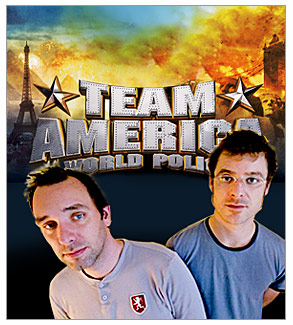
"South Park" creators Trey Parker and Matt Stone talk about "Team America," their new foe Sean Penn, and whether it requires much effort to be this offensive.

  • more
    • All Share Services

Puppet masters

Forget “Fahrenheit 9/11.” “Team America: World Police” is easily the most riveting political satire of the year, if not the most entertaining, the silliest and the dirtiest.

This unhinged parody of ’80s action movies focuses on a gung-ho team of American special agents, played by marionettes, who are hell-bent on ridding the world of terrorists, even if it means toppling the Eiffel Tower and mowing down innocent civilians in the process. Featuring terrorists who mumble “Jihad” and “Mohammed” and puppets engaging in sexual positions never before seen at the Cineplex, “Team America” constitutes a generational litmus test like none before it. At the screening I attended, younger viewers laughed hysterically and emerged with huge grins on their faces, older viewers sat in silence and walked slowly from their seats, scowling. But your ultimate reaction to this film will no doubt depend entirely on 1) how many bad formulaic action movies you sat through in the ’80s; 2) whether the word “fuck” makes you uncomfortable; and 3) how excited you are to see miniature replicas of self-righteous celebrities get their heads blown to smithereens.

Trey Parker and Matt Stone, the creators of “South Park,” have created a visually stunning, wildly goofy but undeniably incisive critique of American culture and our role as global cops. Wall-to-wall absurdity from the first shot, it doesn’t pull any punches, and even its Scooby Doo-like ending will have you laughing louder than you have at any of the limp comic offerings of the last few years.

Unless, of course, you hate it.

I met up with Parker and Stone in Beverly Hills, Calif., where our interview was the first in a two-day whirlwind of movie junkets for “Team America.” A day after Sean Penn attacked them publicly in a letter, and shortly after the movie finally received an R rating by the MPAA after making some required cuts (including, reportedly, a “golden shower” scene between marionettes), the two seemed slightly shellshocked, but were extremely easygoing and eager to talk about what’s arguably their funniest, most ambitious work to date.

I saw “Team America” last night and, my God, I’ve never seen anything so obnoxious in my life.

Parker: [Laughs] My family’s in town — my aunts and uncles — and I really don’t even want them to see it.

Really?

Parker: Not out of embarrassment, I just know they’re gonna be confused.

I’ve never heard more hysterical laughter at a screening before in my life, but when I was walking out I saw a few older people with extremely grim looks on their faces.

Stone: Right. I don’t think it’s for older people.

And it’s probably hard to translate it for them.

Stone: I did an interview the other day with this college kid who was like, “I think this movie will span generations! What would you say to an 85-year-old about the movie?” I was like, “Don’t go see this movie. Because you’ll be bummed out. It is not for you.”

Are there ever people who say, “Oh, I usually hate humor like this, but you guys do it so well.” Or do people who hate this kind of humor just hate your stuff?

Parker: Yeah, they hate our stuff. And they hate us.

Stone: They hate us. But we haven’t really had that many reactions to the movie yet. It’s only been shown [in screenings] for the first three or four days, so we don’t really know.

Parker: We got some hatred yesterday from some of the foreign press people, who were like, “This movie is so hateful!” and “How dare you?” They basically wanted to use all their time to just try to slam us. And then I was thinking about it, and I thought, I guess if I didn’t offend an uptight old German woman — I mean, if we can’t offend her, we haven’t done anything.

Stone: At least we offended somebody.

Still, do you ever feel like you cover your asses too much by taking on targets on opposing sides?

Parker: I don’t think so, because we do take somewhat of a stand at the end. I mean, I believe we do make a point at the end of the movie. Some people consider that point to be fairly right-wing, and some people consider it to be fairly left-wing …

What do you think that point is?

Parker: [Laughs] The thing is, obviously, we’re not setting out to make a movie going, Look, America, this is how you should run things, this is how it should be. Because then we’d be no better than the fucking actors we hate. But the only thing that we assert is that there’s a difference between dicks and assholes. That’s the biggest thing that we assert.

Stone: That’s such a strong political statement.

Parker: And it really kinda is! Because that’s the thing that we realized when we were making the movie. It was always the hardest thing. We wanted to deal with this emotion of being hated as an American. That was the thing that was intriguing to us, and having Gary (the main character) deal with that emotion. And so, him becoming ashamed to be a part of Team America and being ashamed of himself, he comes to realize that, just as he got his brother killed by gorillas — he didn’t kill his brother; he was a dick, he wasn’t an asshole — so too does America have this role in the world as a dick. Cops are dicks, you fucking hate cops, but you need ‘em.

Thanks to all the assholes — or criminals. Or in the case of the movie, terrorists.

Parker: Right. Because there are assholes — terrorists — you gotta have dicks — people who hunt down terrorists. And I think that that is a pretty strong thing to assert, actually … at least the pussies think so.

The pussies being the whiny liberals. But you obviously make fun of dicks — or ugly Americans — for the first half of the movie.

Stone: Well, it’s just Gary coming to terms with the fact that it’s an imperfect world, basically. And this is Gary going, “This is as much sense as I can make of it.”

Parker: Dicks are bad, and it sucks to be a dick, but it’s way worse to be an asshole, and because there are assholes, we need dicks. So shut the fuck up, all you pussies!

Stone: That does seem like a funny way to put it.

What question are you dreading the most?

Parker: Why marionettes?

Stone: Why puppets? That’s what everyone always says first thing. “Why puppets, guys?”

Better cross that one off the list …

Parker: Well, you always have the one question that you answer in every interview, to the point where we know that one of us is going to start the answer, and we know exactly what the other one is going to say …

So it ends up feeling rehearsed.

Parker: It’s the only thing that does, because we try to stay really conversational. Because there is a fascinating story behind it, which we won’t tell you now.

Stone: Since you’re not going to ask that.

Parker: But because there is a specific story behind it, it gets told and retold.

OK, I shot myself in the foot. I’ll just have to link to the story. I’m wondering, do you ever take a break and eat some lunch and come back and say, “Man, I’m not so sure about that part that goes ‘Lick my butt and suck my balls’”?

Stone: No. Those are always the parts we’re most sure about.

Although I did notice that, when you do the touching ballad-reprise of [the movie's theme song] “America! Fuck, Yeah!” you didn’t include the lyric “lick my butt.”

Parker: [Laughs] Oh yeah! That’s true.

Do you feel that you seek to offend people, or do you find that insinuation offensive?

Parker: No, in fact, it’s funny, I was talking to my parents about this …

Stone: No, we’re just offensive.

Parker: Yeah. I was all nervous last night because the movie was playing … Like, we’ve never seen the whole movie.

Stone: No one had ever seen it until last night.

Because you were cutting it to get the R rating?

Stone: Because of the schedule we were on, no one had ever sat down and actually watched the entire movie on film, with the sound mix, start to finish, until it played in however many theaters.

Parker: I was really nervous, and my dad said, “I don’t understand why you’re all nervous,” and I said, “I’m just really scared that people are getting really pissed off right now.” Not scared, but just bummed out. And I realize that I really do — and I think Matt’s the same way — if someone does really get offended by our movie, we don’t feel good about it. We want people to love the movie, you know what I mean? Even psycho German lady the other day kinda bummed us out, you know? Because it was like, Come on, you didn’t like it? Deep down, we want everyone to laugh and have a good time. We don’t go, Oh, let’s piss these people off.

Stone: We just are offensive people. I mean, I offend people all the time in everyday life and I wish I didn’t; I just fucking say the wrong thing.

What do you think creates a person who naturally offends by accident?

Stone: When that person is just really charismatic and cool!

Parker: No, I think we just deal with everything with humor. Everything. We say all the time, “I know that if one of us got cancer tomorrow, we would be joking about it.” It’s just the way we deal with stuff. A lot of people with no sense of humor think that that means that you just basically don’t care about anyone or anything, and it’s not true.

Ultimately, I think we’re both pretty optimistic people, too. A lot of this movie came out of, you’re laughing at people because you’re sort of saying, “Dude, relax.” You have the Michael Moores of the world and all these people telling you, “These people are evil and America’s going to be destroyed in a matter of five years!” And it’s just, to us, not that dire. It’s like, you know what? Our lives are pretty fucking great. And a lot of the lives we see around us are pretty fucking great, and everything’s gonna be OK. That’s just our basic philosophy.

What about the people who’d say, Well, you’ve got to get out of your bubble and check out the world and see how fucked up things are for everyone else.

Stone: It’s about optimism, though. That’s the big thing about the movie; that end message is about American optimism. And that’s the difference between America and the rest of the world, because if you go to Europe, people are not optimistic about the future there. And Americans do have a naive optimism about that — it’s not just us, and the fact that we live in this L.A. bubble — I think all Americans have this naive optimism and have for a long time. And a lot of times it’s naive, and it’s unfounded, and it’s even wrong, but it’s somehow that optimism that keeps America looking forward and trying to make the world better. And I really do think that’s something that’s unique to America that doesn’t exist in a lot of the world.

And it can be a self-fulfilling prophecy.

Stone: Exactly. A lot of times it fuels the good things. Sure, it’s stupid, and a lot of times it’s a big smile while eating a big shit sandwich, but you just keep going, you know?

Parker: But another thing that goes along with the optimism part of it is basically the idea of, well, if I’m not going to have a fucking great time and I’m not going to really appreciate and enjoy and say life is great, then there really is no hope. Because all of the hope for the world is that there can be a great life, and to me, I’m proof of that, that there can be a great life. And yes, it’s all about trying to dole that out to as many people as possible, but it’s also about, when you have a great country, and it all works, and your life is awesome, then be able to say so! But for some reason, it’s almost taboo to say, My fucking life is awesome, and I have a great time, and I have a sweet house and a nice car. People are like [using a scolding voice], “Hey, hey, hey, hey!”

Stone: Especially the richest people in the world, which we know some of in this town, you know? [Angry voice] “The world is fucked up!”

Parker: Look, we were below middle class growing up, and I had a dream that someday things were gonna be better, and I assume that’s the way it is in Third World countries. So, if you’re not going to enjoy the dream, then there’s no hope for anything.

Stone: I think that when Trey wrote “America! Fuck, Yeah!” — that song? That, to me, encapsulates it. We could talk for hours about America’s overzealous stance overseas, but there’s also, you know, “America! Fuck, Yeah!” too. And somehow that song encapsulates an hourlong conversation. When people ask me, “What’s your attitude about America?” I think of Trey’s song. That’s the perfect way to put it. It’s awesome, and you have to admit it’s also a little cheesily testosterone-driven at the same time …

A little cheesily testosterone-driven?

Stone: Yeah. But. It’s awesome.

After the movie’s first scene, I really wondered if you could keep up that level of really sharp satire. Did you ever think, “Ah, maybe we shouldn’t put in the dick and asshole stuff, because we could make a piece of art that anyone could see and appreciate”?

Stone: [Laughs.] Nope. I wish that would’ve occurred to us earlier.

Parker: Although the tone of the movie did change completely after shooting that scene, because we shot that scene first. The script was written … a bit more like “South Park,” but even a little more jokey than “South Park,” and I think it’s good that we wrote it that way, because Paramount had to say, “OK, comedy? Oh, this is a funny script.” Whereas, this movie, as a script, there are so many times where, if you were reading the script, you’d say, “Where’s the joke?” Because so much of the joke is coming off of [the marionettes] trying to do drama. So we had way more jokey-jokes in the script, more like fucking Adam Sandler jokes — I mean, not that bad, but …

Stone: But joke jokes.

Parker: And after shooting that first scene, we were like, Dude, we’ve gotta take all the jokes out of this movie.

Stone: Then we did a pass where there was not a single joke or laugh in the whole movie, it was kind of just a fucked-up, serious, weird satire. But that was no fun to watch, and we’re no good at doing that kind of thing.

Parker: So then we started putting all the pussy and dick stuff in.

Stone: But then it became, saying that kind of stuff, but with the serious music, and the collision of the music and the tone? That became what the movie was about. I think that most people will get that, but there will be people that don’t get that. And if you don’t get that central conceit of the movie, you’ll just hate the movie more and more and more.

Yeah, but screw those people, right?

Stone: Well, I agree, but that’s what people have to get, or they’re gonna be like, “What the fuck is this crap?” And that’s generational.

Not spelling it all out clearly, though, makes it so much better than it would be if you connected all the dots.

Parker: Oh, yeah. For sure.

Stone: But I also think that’s generational, because 85-year-olds didn’t grow up watching “Top Gun” and all the other movies that have that kind of stupid structure seared into them.

I have to ask you quickly about the letter from Sean Penn (who, along with other Hollywood political activists like Tim Robbins and Susan Sarandon, is satirized in the film), which was posted on Matt Drudge …

Parker: We got it the day before, actually. He was nice enough to send it to us before he sent it to the world.

Stone: I remember when I got it, thinking that it read like a fucking open letter. It doesn’t really read like it’s really to us. That was my first thing; I was like, This doesn’t read like a private letter.

And then the next day it was an open letter.

Stone: Yeah! The next day it was open.

Parker: I mean, I just don’t understand. If he really is pissed, why would he do us that huge of a favor? I mean, seriously, there is nothing he could’ve done to help this movie more.

Stone: He just proved that we nailed him so perfectly in the movie. Because if you read the letter what he says in the movie is exactly like what he would say in the movie.

It was actually the marionette that wrote you that letter! I like how he sets you two up in the letter as such losers. I remember seeing you at a party. I remember how you dropped my name to appear witty …

Parker: By the way, we’ve never met him. You do meet a lot of people. We’ve met a lot, and maybe we’ve even forgotten some, but I would remember Sean Penn. We never met Sean Penn, either one of us.

Stone: But when you read it, the letter comes from such a high place of arrogance, you know, [deep, serious voice] “You guys are young guys! If you don’t have children, you can’t say anything about anything!” And the whole voting thing. All we ever said was that we thought that uninformed people should not vote — on either side of the political spectrum. It doesn’t matter who you’re gonna vote for. If you really don’t know who you’re gonna vote for, or are uninformed, or haven’t really thought about it? Just stay home. Don’t let people fucking shame you into going to the polls.

Parker: If you have absolutely no idea, fuck it.

Stone: If you really don’t know or you’re just going to vote for George Bush because he’s already in office, or you’re gonna vote for John Kerry because he’s on the cover of Rolling Stone, don’t do that. That’s lame. Just stay home. That’s all we ever said.

Publicist: We really have to wrap up now.

Well, in parting, do you have a special message for all those undecided voters out there?

Stone: Stay home.

Parker: Don’t vote!

Stone: And it’s no big deal. If you don’t want to vote, you don’t have to. Fuck that vote or die shit. I hate that.

Havrilesky says goodbye to Salon

A thank you to Salon's readers

  • more
    • All Share Services

After seven years as Salon’s TV critic, I’m leaving. I’ve thoroughly enjoyed writing for Salon all these years: My very supportive editors let me cover everything and anything, from the seething boozehounds of Drunk Asshole Hotel to the seething boozehounds of “Mad Men.” And whether I was tackling dying undertakerswhoring sea donkeysambivalent mobsters or aging boomers, I was given an alarming amount of creative freedom — alarming to readers, most of all — and took full advantage of it. I indulged in caffeine-fueled digressions and rambling parodies, created TV-themed puppet shows, and crafted not one but two “Deadwood”-speak columns that made ample use of the word “cocksucker.”

To all of Salon’s readers: You’re some of the most engaged and outspoken readers on the Web, and my writing has benefited from both your criticism and your encouragement. I genuinely appreciate your support over the years. Please feel free to drop me a line via Twitter, keep up with my latest work through my website, the rabbit blog, and look for my memoir, “Disaster Preparedness,” on Dec. 30 from Riverhead Books.

Few writers ever get the chance to enjoy a job that’s as creatively fulfilling as this one, or to write for an audience as smart and as insightful as Salon’s. Although it’s time for me to move on to new challenges, I will look back fondly on my years at Salon and feel grateful for them.


Continue Reading Close

The best TV shows of 2010

Slide show: Killer zombies, glorious "Mad Men," Zach Galifianakis -- the shows that blew our minds this year

  • more
    • All Share Services

The best TV shows of 2010

View the slide show

If you think 2010 was a bad year for TV, well, you need to reacquaint yourself with that big appliance in your living room. Although very few new series became giant hits, the best established shows got even better this year. Yes, the world fell in love with “Mad Men” like never before (and with good reason), but it was the comedies that really surprised us this year. Remember when nothing on TV made you laugh out loud? These days you have 10 to 15 flavors of laughter to choose from, so many that it’s pretty challenging to narrow them down to just a handful.

From disturbing zombie parables to madcap stoner nostalgia, from grumbling middle-aged men to grandstanding TV executives, the cream of the crop this year transcended their earlier peaks to bring us great entertainment in the comfort of our soft pants. Notable for their sharpness, originality and ability to make us feel uncomfortably human emotions, here are the 10 best TV shows of 2010.

View the slide show

Why you should be watching Jimmy Kimmel

In the wake of the late-night wars, one host emerges victorious -- and his name isn't Jay or Conan or Dave

  • more
    • All Share Services

Why you should be watching Jimmy KimmelClockwise from lower left: Jimmy Fallon, David Letterman, Jimmy Kimmel, Jay Leno, Conan O'Brien and Jimmy Kimmel

Shots were fired, angry accusations flew, risky stands were taken, and gigantic egos were bruised — but did anyone really win the late night wars? Since waging a valiant crusade against NBC and Jay Leno, Conan O’Brien finally retreated to TBS, comforted by the rabid devotion of Team Coco members nationwide. But even as his ratings remain impressive, he’s faced with one recurring question: How many self-deprecating basic cable jokes does it take to mask the defeat inherent in trading in a lifelong dream of hosting “The Tonight Show” for a spot in television’s hinterlands? Meanwhile, Jay Leno continues to play the clueless country uncle who came home from the state fair with a shiny new Corvette he won at the ring toss, gamely telling his ultra-sophisticated fat jokes and terrorist jokes and ugly-sister jokes on a set about as stylish and edgy as the lobby of the Cheesecake Factory. Snickering on the sidelines, as always, is David Letterman, who delighted at playing the bemused onlooker in this bloody conflict, but still never emerged as the clear ratings winner of the lot. Although he must’ve taken some real satisfaction in demonstrating just how much pain and anguish NBC could’ve spared itself by awarding him “The Tonight Show” gig almost two decades ago, Letterman has been doing the same incredulous snark routine for so long now (without many variations or imaginative twists), that not even an awkward admission of infidelity could shake us out of our indifference.

While the old familiar faces of late night don’t do much more than make us chuckle ourselves to sleep at night, one man has been calmly and quietly upping his game: Jimmy Kimmel. Despite his distance from the action, it was Kimmel who took some of the most direct shots at Leno during the late night wars. In addition to imitating Leno on “Jimmy Kimmel Live!” and then appearing on Leno’s show and insulting him to his face, Kimmel has been more outspoken than Conan himself about Leno’s sneaky strategy to take back “The Tonight Show” (although Bill Carter’s new book, “The War for Late Night,” seems to suggest that Leno wasn’t quite so calculating as Kimmel and others seem to assume). When asked in an interview with GQ this month what he learned from the late night dust-up, Kimmel replied: “The lesson is, it pays to be sneaky. I think that’s the main thing I learned. That, and don’t trust Jay Leno.”

It’s this frank talk that sets Jimmy Kimmel apart from his peers. Throw in the sharpest and funniest opening monologue on late night, an incredible knack for improv, and liberal use of off-kilter gimmicks and skits, and it’s no wonder that Kimmel has risen to the rank of late night king. Whether he’s launching a multitiered attack on Facebook idiocy with his National Unfriend Day, finding creative new ways to insult Matt Damon, or shooting an entire episode during a power outage using only his webcam, Kimmel has always had that combination of swagger and imagination that separates the good talk show hosts from the great ones. Like Johnny Carson and Letterman in his heyday, Kimmel has the bluster and the quick wit to make every moment watching him on the air feel dynamic and exciting.

That’s no small feat, of course, but it’s what real late night heroism demands. Kimmel tackles pop culture with more sharp wit and weirdo flair than any of the other late night hosts, whether he’s addressing the new Spider-Man musical (“I’ve been working on a superhero show myself, it’s called ‘Aquaman on Ice.’ Aquaman on skates, trying desperately to speak to his friends who are trapped under the layer of ice. That’s a musical!”), rumors that Snoop Dogg will play at Prince William’s bachelor party (“I’m excited for His Highness, and by His Highness, I mean both of them”), airline security pat-downs (“We freak out if a TSA agent touches us on the outside of our pants, but Black Friday, we will hump each other’s heads to get at Walmart to save 8 bucks on a PSP”), or even the plans to have Lindsay Lohan appear on “Dancing With the Stars” (“I would love to see her vomit on Len Goodman”).

When he’s interviewing guests, Kimmel is arguably better on his feet and more ready with unexpected quips than any other host. On a recent episode when Ben Affleck waxed sympathetic about hard economic times in America, Kimmel soon hinted that no one wants to hear a megastar fake emotion for the little people.

Affleck: I don’t think there’s anybody in the United States that hasn’t been affected (by the recession) in some way or another.

Kimmel: Oprah hasn’t been affected at all.

On another recent episode, Kimmel took an otherwise bland interview with Kate Bosworth and livened it up. (And let’s face it, the real test of good late-night hosting lies in finding some way to spice up interviews with dull, self-involved young actors and actresses. In addition to Kimmel, only Letterman and Craig Ferguson manage it with any regularity.)

Bosworth: (on her Korean co-star) He literally is the Brad Pitt of Korea. It’s pretty wild.

Kimmel: Really? ‘Cause I was told I was the Brad Pitt of Korea. That’s disappointing. I feel like I was lied to. (pause) He’s the Brad Pitt of Korea. And so does that mean he adopts a whole bunch of white kids, or how does that work?

He even managed to save an interview with Paris Hilton from the bowels of hell:

Hilton: (on her current boyfriend) Right now, I’m just so happy. He’s my best friend.

Kimmel: Wait a minute, now. I saw a television show in which you picked a best friend and he wasn’t it. Are you telling me that was not your real BFF?

Later, when Hilton called her new perfume “my tenth fragrance,” Kimmel countered, “That seems like too many fragrances to me.”

This is where the fans of Jimmy Fallon, who have been rallying lately to crown their contagiously giddy leader the supreme ruler of late night, really must admit defeat. While Fallon’s antics try our patience in all the right ways (Zach Galifianakis’ recent appearance, followed by a skit the very finest flavor of stupid, marked a recent high point), Fallon is a pretty bland interviewer, sometimes resembling Chris Farley’s guffawing yes-man talk show host of “SNL” legend. Nonetheless, Fallon is undoubtedly in the groove lately, with such sure-footed oddball gimmicks and quirky enthusiasm that it makes you wonder if “The Chris Farley Show” itself wouldn’t have morphed into something deliciously strange, if given enough time. And let’s face it, anyone who makes Helen Mirren play beer pong deserves at least an honorable mention, if not an Emmy.

While he might be the best Neil Young impersonator on late night (or anywhere else), Fallon has none of the subtle snideness that made Carson, Letterman and now Kimmel masters of the craft. Sure, the kind folks down at the local elementary school’s bake sale might find such a tone distasteful, but the rest of us, who’ve been marinating in a toxic mix of “The Love Boat,” People magazine and celebreality shows for years now, need a healthy dollop of scorn to make the celebrity promotional appearance go down a little more smoothly.

Fans of Craig Ferguson will point out that he shares the requisite doubting tone in his interviews, and also scores very high for sheer courage of conviction. And it’s true that to watch half a second of Ferguson’s show is to love him, from his googly-eyed knowing looks to his perverse but genius rambling asides. His self-effacing charms make his perhaps the most unpredictable and unruly of the late night shows. However enchantingly strange Ferguson’s monologues and interviews may be, they just don’t stack up to Kimmel’s.

And like Letterman, Kimmel carries the torch of bemoaning his network overlords, lamenting the dumb stuff ABC makes him promote. The imbedded advertising — Bud Light signs on the stage, Old Navy promotions at the start of the show, constant appearances by “Dancing With the Stars” contestants — isn’t all that easy to ignore, but Kimmel makes the best of it. He’s taken to calling himself “the three-headed dog the stars must pass on their way to no-dancing hell,” and after that show’s big finale, he told his audience, “I tell you something, I had a good morning. I woke up this morning, and for about three minutes, couldn’t remember who won “Dancing With the Stars” this year. It felt great, it really did.”

But Kimmel should wake up feeling great every morning. After all, who would’ve thought that this guy would be the big winner of the late night debacle of 2010? When you flip from Conan to Leno to Letterman, or stay up for Carson Daly or Fallon or Ferguson, even though you might appreciate Ferguson’s bizarro self-deprecating digressions or Fallon’s raw enthusiasm, Kimmel is the only host who will make you laugh out loud more than a few times per episode. He’s got the sharpest monologue, the most interesting digressions and skits, and the best interviewing skills. Now that the dust has cleared, “The Tonight Show” doesn’t look like a prize worth squabbling over, because, with or without the Cheesecake Factory backdrop, Jimmy Kimmel is the new Johnny Carson.

Continue Reading Close

“Men of a Certain Age”: Cool is overrated

TNT's moving, understated drama focuses on the disappointments and the sweetness of growing old among old friends

  • more
    • All Share Services

Scott Bakula, Andre Braugher and Ray Romano in "Men of a Certain Age"

The older you get, the less cool you are. The less cool you are, the nicer you are. This is why old people are so nice to each other.

When we’re young, we think old people are nice to each other because they’re fake. I was walking the dogs with my 14-year-old stepson yesterday and we passed a couple on the sidewalk. “Hi, how are you?” the man said. “Great, how are you?” I replied.

“That was weird,” my stepson said. “It’s like he says the same thing to everyone.”

“OK, have a great weekend!” I replied.

Old people are a little checked out, it’s true. But we’re amiably comatose. This friendly state of autopilot is the only way we’ve found to manage our dashed dreams, our growing contempt for the culture, our creeping disappointments, our fibromyalgia. We grind our teeth at night and have vivid dreams about screwing cheerleaders. We resent the unflattering shape of matchstick jeans and daydream about gigantic claw-foot bathtubs we can’t afford. Our elbows hurt and our hair always looks bad and we secretly think all electropop sounds like Kraftwerk.

Recognizing the defeat in each other’s eyes, we smile warmly and say things like, “Of course! We’d love to,” and “Fantastic! I can’t wait!” because we recognize that everyone is flawed and just barely able to accept their own mediocrity or tolerate the frustrations of advancing age. The least we can do is be nice about it.

Youngish (under 35) skeptics will tell you that the men of “Men of a Certain Age” (premieres Dec. 6 on TNT) don’t talk like men at all, they talk like post-menopausal book club members. This show isn’t made for those youngish people, though. It’s made for the oldish (over 35) among us, who recognize the self-doubting, second-guessing, pot-bellied guys on their TV screen as a painfully palpable embodiments of the humiliations and tiny little ego victories of middle age.

The charms of “Men of a Certain Age,” like the charms of growing old, are lost on the common whippersnapper. While youngish people tend to reevaluate and reappraise their oldest friendships constantly, questioning whether this or that old friend is up to speed with just how advanced and mature and evolved the new “me” is, old people recognize that they haven’t actually advanced or matured or evolved much over the years. Thus do they humbly turn to each other, all rumpled feathers and matted fur, and sigh deeply. Less important than how far you’ve come, to old friends, is how far you haven’t come — and also, where you were before you got old. The fundamental importance of old friendships, plus that peculiar flavor of shared, comfy nastiness that bounces around between old friends — these make up the soft center of “Men of a Certain Age.” We grow old, we fail, we reproach the gods and grimace in pain, and then we meet to eat pie and complain at the same diner each week.

“Everybody’s like, ‘Oh, don’t give up on your dream, Terry!’” Terry (Scott Bakula) tells lifelong friends Joe (Ray Romano) and Owen (Andre Braugher) of his acting career. “What would’ve been so bad if I had, huh? We’re at this place in our lives, we’ve come all this way, and I’ve got nothing to show for it. You’ve got something — families, careers …”

“Families suck,” Joe replies. This harshness, which of course we don’t expect and don’t believe entirely (even from a divorced guy with an anxious teen son and a moody teen daughter), is what balances out the vulnerability of “Men of a Certain Age.” As hand-holdy as the talk can get, these guys are still just guys.

And if you think their confessional, supportive tone with each other comes out of left field, tell that to the wood fence contractor who volunteered to me last week that he’d been “journaling a lot” about his dad’s death, or the plumber who, apropos of nothing, discussed the struggles of raising teenagers. Middle-aged strangers tell each other emotional stuff out of the blue, and middle-aged friends tell each other everything. (The only exception may be certain varieties of hipster intellectual, who could literally chat about Sufjan Stevens’ latest album on their deathbeds instead of confessing the hopes, fears and regrets of their final hours.)

But the utter lack of hipness of “Men of a Certain Age,” the total lack of concern for what’s deemed cool and what isn’t, the complete disregard for matching the breakneck pace, the action, the swooning romances, the spitty outbursts, the shiny thrills of other TV shows, is exactly what makes this drama so lovable. Where other dramas would pack in more zaniness and intrigue in every available second of airtime, “Men of a Certain Age” rolls out the familiar, the ordinary, and locates poetic folds and sweet pockets of emotion therein: Joe’s employees are two pure-intentioned teenagers who are genuinely confused by his old-guy ways, and one slow-moving old Spanish-speaking guy, Carlos, who sleeps on the job but Joe still can’t stand to fire him (he lays him off then hires him back at the end of the first season). Owen works at a car dealership owned by his dad, a thoroughly mundane job that Owen dislikes most of the time, but also occasionally excels at. When he breaks away to work for another dealership at the start of the second season, his father is angry, but his respect and investment in his son finally start to emerge out of the fog of his constant hectoring. Even Terry, with his acting career, has encounters with the film industry that will strike anyone who’s actually worked production as hauntingly authentic, less focused as they are on stars and perks and glamour than on a steady flow of deeply humiliating interactions with the most unsavory sorts of egomaniacs imaginable. The big promises and untrustworthy allegiances Terry forms with one director (who refers to him, tellingly, as “T-bag”), only to have the rug pulled out from under him on a whim, echo some essential Hollywood experience that’s rarely portrayed with quite as much clarity and empathy.

But the big impact of this drama comes in its quietest moments: Joe and his son, Albert (Braedon Lemasters), are driving home from the movie theater after Albert has had an anxiety attack and insists that they leave. Suddenly, Albert wants to know if Joe is embarrassed by him. “Embarrassed? No, man. Never,” Joe says, his eyes starting to well up a little. “You’re my hero. I mean that. You’re doing great, man. I’m proud of you.” It’s simple dialogue, nothing fancy, nothing too clever or provocative, but that’s what gets you in the throat sometimes.

Like the oldish and crumpled and vaguely resentful among us, “Men of a Certain Age” casts aside sophistication and witty banter for the comfort of what’s real — even when what’s real is disappointments, missed connections and inadequate attempts to reassure. In accepting our frailty, we locate our souls.

You’re doing great, “Men of a Certain Age.” We’re proud of you.

Oh, and have a great weekend! 

Continue Reading Close

“Public Speaking”: Scorsese’s Fran Lebowitz doc delights

Fran Lebowitz famously hasn't written a book in 20 years, but HBO makes the case she's as relevant as ever

  • more
    • All Share Services

Fran Lebowitz in "Public Speaking"

At the start of “Public Speaking,” Martin Scorsese’s documentary on Fran Lebowitz, you might find yourself wondering, “Just how much adoration does an author of exactly two books deserve?” After all, the woman hasn’t written a book for almost 20 years, yet she’s heralded as one of the singular wits of her generation.

But then, if you take the time to flip through the pages of “Metropolitan Life” or “Social Studies” yet again, you’ll find two truly great books that stand the test of time. And how many truly great books do most authors have in them?

The answer to that question, of course, is zero. Or as Lebowitz herself puts it when speaking to a roomful of young people, “There are too many books, the books are terrible, and it’s because you have been taught to have self-esteem.” This is Lebowitz’s distinct talent: making elitist contempt sound charming.

Toni Morrison, a friend of Lebowitz’s, puts it a little differently. “You seem to me almost always right,” she tells Lebowitz. “But never fair.”

“That’s why,” Lebowitz responds. “I’m always right because I’m never fair.”

Most of us secretly wish that we could be as right and as unfair as she is. But the world has changed a lot since “Metropolitan Life” was first published in 1974. Being unfair isn’t nearly as acceptable as it used to be. Today, people demand prose that is polite, respectful, nonjudgmental, and that never employs terms, phrases, suggestions or hints that could offend any segment of the population. People demand prose that isn’t prose, in other words.

Contrast that with almost any assertion made by Lebowitz in “Metropolitan Life” or “Social Studies”: Jews make good stand-up comedians. Sports are “dangerous and tiring activities performed by people with whom I share nothing except the right to trial by jury.” Communism is unpleasant because “I do not work well with others and I do not wish to learn to do so.” Children “tend to be sticky” and “respond inadequately to sardonic humor and veiled threats.”

“Public Speaking” (premieres 10 p.m. Monday, Nov. 22, on HBO) is also packed with Lebowitz’s clever observations, the most gratifying of which may be her reflections on the ways our culture has changed since her books were first published. “An audience with a high level of connoisseurship is as important to the culture as artists. That audience died in five minutes,” she says, referring to the AIDS epidemic. These days, Lebowitz says, “everything has to be broader, more blatant, more on the nose.” The problem? “Too much democracy in the culture, not enough democracy in the society.”

Lebowitz’s real strength, though, lies in explaining the different social classes to each other, either in her books or in Scorsese’s film. In “Social Studies” she includes a “Glossary of Words Used By Poorer People” including meatloaf (“A gloriously rough kind of pate”) and overworked (“an overwhelming feeling of fatigue, exhaustion, weariness. Similar to jet lag”), and outlines the trivializing effects of the international jet-setter (“What, after all, is London to a man who thinks of the whole Middle East as just another bad neighborhood and the coast of South Africa as simply the beach?”).

In “Public Speaking,” it’s clear that, although Lebowitz might mingle with elites, her underlying affections lie with the common man — as unsuitable as she might find his pants or his penchant for installing wall-to-wall carpeting in bathrooms. When the topic of how New York City has changed over the past two decades arises, Lebowitz says, “When a place is too expensive, only people with lots of money can live there. That’s the problem. You can like people with money, hate people with money. But you cannot say that an entire city with people with lots of money is fascinating. It isn’t.”

Even if her writers block continues for another three decades, Lebowitz herself remains undeniably fascinating. Scorsese’s documentary offers us a long overdue taste of her unique, queasily accurate perspectives on our culture — always right, never fair and never disappointing. 

Continue Reading Close

Page 1 of 126 in Heather Havrilesky