Andrew O'Hehir

“Saraband”

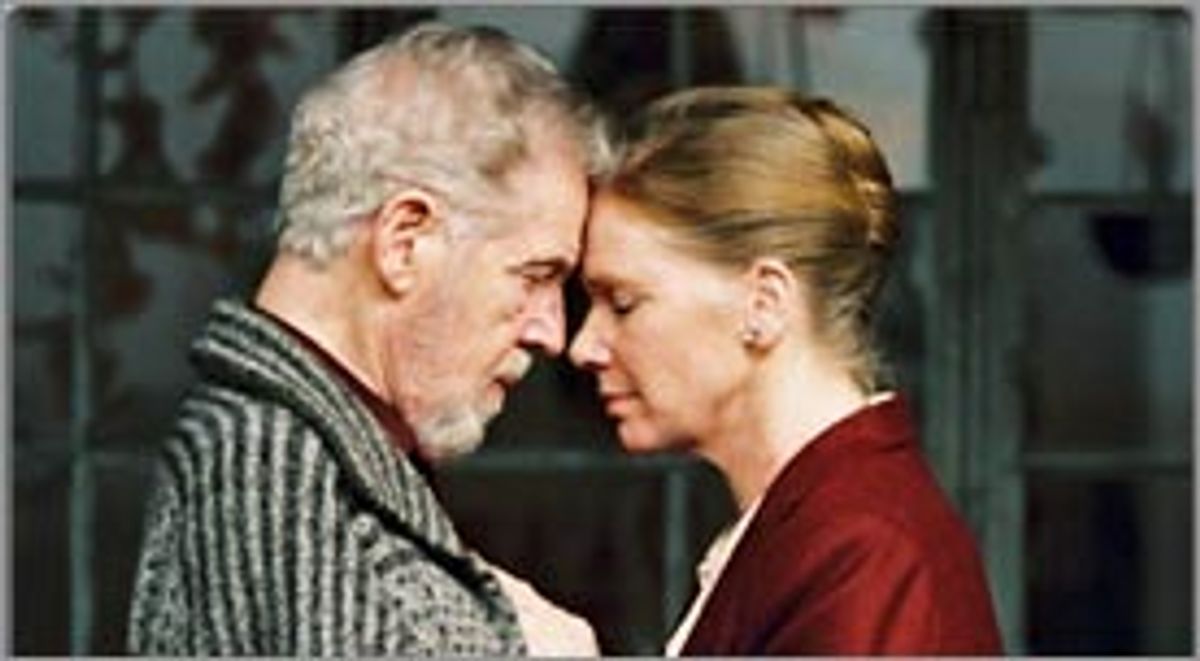
Is this really the 86-year-old Ingmar Bergman's last film? Maybe. More important: Is it among his finest?

  • more
    • All Share Services

I’m definitely not neutral when it comes to Ingmar Bergman, but the astonishing thing about “Saraband” is not that he’s made another film at age 86 — it’s how lean, sharp and vigorous it is. There is nothing here of the fuzzy sentimentality that clouded the lenses of his contemporaries like Kurosawa, Truffaut and Fellini as they drew near the ends of their lives (or, for that matter, that has inflected some of Bergman’s recent, mild-tempered work). Amid the over-stylized clutter of so much contemporary film, this movie’s combination of naked, almost ruthless family drama, visual intensity and narrative economy feels like a blast of cold Scandinavian air from a suddenly open window. If this doesn’t rank among Bergman’s very best works, that’s an impossibly high standard; “Saraband” still strikes me, on first viewing, as the best-crafted, least self-indulgent film I’ve seen in years.

This is meant to be Bergman’s last film, but as actress Liv Ullmann quipped at a press conference after the New York Film Festival screening I attended, he has said that before. Several times, in fact. (“Saraband” premieres in the festival on Friday.) “Fanny and Alexander,” the sweeping family chronicle that summarized much of his accomplishment, was Bergman’s first farewell. That was 22 years ago. Like any artist still in possession of his faculties, Bergman has been unable to stop working, but without quite reneging on his promise. Since the mid-1980s he has directed plays for the Royal Dramatic Theatre of Stockholm, written novels and memoirs, and even authored screenplays for other directors (including Bille August and Ullmann, his longtime collaborator). He announced his retirement from the theater in 1995, but hasn’t stuck to that either — I saw his production of Ibsen’s “Ghosts” last year at the Brooklyn Academy of Music. Over the years, he has also directed several modestly scaled television productions that began to seem, more and more, like new Ingmar Bergman films.

Now comes “Saraband,” which despite its fusty-sounding classical-music title is an intense emotional stew that reunites Johan (Erland Josephson) and Marianne (Ullmann), the feuding, neurotic couple from Bergman’s 1973 “Scenes From a Marriage.” Creaky, crotchety Johan is almost exactly the director’s age, and Bergman himself was once married to Ullmann, so it may be tempting to read the story of this marriage and its aftermath as autobiography. Ullmann explicitly denies this, and as usual with works of art, it’s probably more fruitful to assume that some act of psychological translation is occurring. Johan may reflect a certain aspect of Bergman’s personality, but if so it’s one he would like to ventilate or exorcise as much as possible.

When Marianne shows up at ex-husband Johan’s inherited summer home — longtime Bergman viewers will immediately recognize this house, or at least this kind of house, as an archetypal element in his work — they haven’t seen each other for 32 years. She’s a Stockholm lawyer, drawing near retirement age, reasonably content, perhaps a little lonely. His conclusions about himself are different: “My life has been shit,” he tells her, “a totally meaningless, idiotic life.” Nope, we’re nowhere near Golden Pond in this portrayal of old age.

Johan isn’t likely to make such a confession to anyone else in his life, but he may have a point. He has completely lost touch with his two daughters from his marriage to Marianne, one of whom lives in Australia and the other of whom is confined to an institution with an unexplained illness. He and his middle-aged son Henrik (Börje Ahlstedt) — from an earlier marriage, before Marianne — view each other with undisguised hatred; their relationship consists mostly of a not-so-cold war over Karin (Julia Dufvenius), Henrik’s beautiful 19-year-old daughter. A washed-up and impoverished music professor, Henrik clings a bit too closely to Karin, who is a promising cellist. He is tutoring her privately and refusing to let her leave home until she’s ready (in his eyes) for a conservatory. With his inherited wealth, Johan has grander plans for Karin, involving an antique Italian instrument, a prestigious Russian conductor and an exclusive music school in Helsinki. What only Marianne, as an outsider in the household, can see is that neither man seems ultimately concerned with Karin’s welfare and that both are haunted, at least figuratively if not literally, by the ghost of Karin’s mother, the beautiful Anna.

I don’t want to say too much about the role that Anna plays in “Saraband,” but it’s safe to describe this as another one of Bergman’s ghost stories, even if the dead woman never appears in any literal, Hamlet’s-father manner. (“Saraband” is dedicated to Bergman’s wife Ingrid, who died in 1995.) Over 10 numbered scenes with these four characters in the summer house (along with a mysterious epilogue that features a fifth person), this tense little saraband — which is in fact an erotic dance as well as a musical form — plays out. His great leonine head carved like a glacier and his eyes still burning with skeptical ferocity, Josephson plays Johan as a man essentially unbowed by age but almost eaten out from inside by his self-disgust. Ahlstedt nearly matches him; Henrik is a big, huggable walrus in a dingy undershirt, uneasily pitched partway between sympathetic and pathological. He tolerates terrible abuse from his father for Karin’s sake — but when you realize that he and Karin sleep in the same bed, well, you’d be right to wonder about how healthy this whole situation is.

I imagine “Saraband” will be a gripping experience even for viewers new to Bergman, but there’s no question that his fans will find in it countless echoes — ripples may be a better word — of his earlier work (even beyond the fact that this is a sequel of sorts). There are cuckoo clocks, doors that close without human agency, letters read by people to whom they’re not addressed (with fateful consequences), suicide attempts played as very dark humor, Spartan country churches, a young girl who cannot communicate with her father and escapes into the forest. (I would enumerate the references, but they’re almost too many to count.) This is also a story of an old man who knows that he has drawn very close to death, that it could come at any time. As Bergman viewers know, this is scarcely a new theme for him. If that awareness is more present for Bergman himself than ever before, it nonetheless does not dominate this film. For all the alleged darkness of his work, Bergman’s movies are more about how to survive and even how to love than they are about death or despair, and “Saraband” is no exception.

Bergman has been working with high-definition digital video (DV) for the last few years, and those who have doubted that DV could ever deliver the depth and loveliness of celluloid now, I think, have their answer. The simplicity and precision of the camerawork, from the subtly alarming zoom-ins on a character’s face to the elegant stillness of the two-character setups, is vintage Bergman. And some of the shots here — Ullmann listening to a Bach organ work in one of those rural Lutheran churches Bergman cannot resist, Dufvenius and Ullmann laughing and drinking wine, burnished with an almost Renaissance glow — are so beautiful you want to stop the movie and spend a day or two in them. If Bergman really is the first artist to make DV look great, there’s nothing especially ironic in that. Despite his reputation as a creator of talky darkness, he’s always had a painter’s eye for composition — and used the technology then available to break down the wall between narrative and experimental film in 1966, with “Persona.”

Whether or not “Saraband” is the final work of his extraordinary career (and as long as he’s still breathing, I remain unconvinced), Ingmar Bergman can never again be what he once was. From the late 1950s through the early ’70s, one could speak of him, utterly without irony, as the most important filmmaker in the world, and maybe the most important artist, period. But the movie universe, along with the universe in general, has shifted on its axis since then. The art-house audience that made “Smiles of a Summer Night” and “The Seventh Seal” and “Persona” famous around the world was essentially an extension of the high-culture market of symphony halls, art museums and modernist drama, and has withered away. The new art-house audience has been nurtured instead on a pop-culture smorgasbord of music videos, ’70s and ’80s sitcoms, horror movies and mock-serious cartoons. It belongs to either the big, sweeping gesture or the arched eyebrow (or to both at once) — to Scorsese and Tarantino, to Wes Anderson and the Coen brothers. Bergman’s demanding and often painful dramas — stemming, as they do, from Strindberg, Sartre and the A-bomb, from the 20th century’s existential and spiritual crisis — are now dreaded as much as respected.

But what goes around comes around, in movies as in anything else. Who would have predicted a generation ago that Luis Buñuel, the inscrutable surrealist and practical joker, would prove to be the defining influence on a new generation of European directors? Bergman’s influence is not now a dominant strain, but you can still see it all over the place, in younger Scandinavians from Lars von Trier to Thomas Vinterberg to Christoffer Boe (the entire Dogme movement could be described as a method for making imitation Bergman films), in American Cheerios-realism like “In the Bedroom” and “You Can Count on Me,” in the television universe of Alan Ball’s “Six Feet Under” (perhaps the best and most vital example). There’s no way to know what forms Bergman’s legacy will take in the future and where it will lead. As with any really important artist, though, the real thing is inimitable. “Saraband” is here now, and it’s prickly, electrical, alive.

Pick of the week: Haunting, gorgeous “Oslo, August 31st”

Pick of the week: "Oslo, August 31st" is a wrenching voyage of discovery in Norway's suddenly trendy capital

  • more
    • All Share Services

Pick of the week: Haunting, gorgeous

“Oslo, August 31st” is, as the title suggests, an evocation of one day in the Norwegian capital, as experienced by a troubled young man who’s facing the end of summer and the end of his youth. It’s a marvelously constructed personal journey, both wrenching and bittersweet, whose emotional ripple effects stay with you for days and weeks afterward. While much of international art cinema can seem overly talky or conceptually alien to American viewers, this second feature film from Norwegian director Joachim Trier is a dynamic, even breathtaking visual experience without much dialogue or any philosophical heavy lifting, following the bony, handsome, exceedingly vulnerable Anders (Anders Danielsen Lie) through coffee shops, nightclubs and bodies of water, en route to an ambiguous final destination.

I saw “Oslo, August 31st” last year at Cannes and found it powerfully affecting, but I never would have guessed that this small movie from a small country would have touched an international nerve the way it apparently has. In the wake of a breathless profile of doctor-turned-actor Lie and his supermodel wife, Iselin Steiro, in the New York Times’ style magazine — which made the film sound rather like a fashion accessory, or a handbook to Oslo architecture — I almost feel the need to dial back expectations a little. Yes, there are drugs and dance clubs and traveling shots but, honest to Pete, we’re not talking stylish, scenic, lovable hipster romp here, people. While “Oslo, August 31st” definitely has the dynamism and street-level energy of, say, an early Godard picture, and may indeed leave you eager to visit Norway, it’s first and foremost an intimate tragedy about a likable young man who has wandered off the path of life into some very dark woods, and isn’t necessarily finding his way back.

As in Trier’s equally wonderful first film, the 2006 “Reprise” — I’m pretty much the president of the cult on that one — the director is interested in exploring the existential dark side of Scandinavian social democracy, with its largely homogeneous character and devotion to equal opportunity. When I talked to Trier about that film, which featured Lie and Espen Klouman-Hoiner as a pair of arrogant, doomed aspiring novelists, he observed that in Norway “there are a lot of people with a lot of choices. It sounds wonderful but there’s a darker side to that. Lots of people are not dealing with those choices very well.” Anders in “Oslo, August 31st” is something like the worst-case outcome for Lie’s character in “Reprise”; he’s a guy from a loving, middle-class family who’s got looks, health, intelligence and education, but for unknowable reasons finds himself on the edge of middle age as a penniless, unemployable, supposedly recovering junkie.

Trier and co-writer Eskil Vogt adapted their central premise from “Le Feu Follet,” a 1930s novella about alcoholism by Pierre Drieu La Rochelle, but “Oslo, August 31st” could really be set anywhere at any time. It’s about the painful necessity of adapting to change, every single day that we’re alive, and if we identify with Anders even as we rage against his despair, it’s because every living human has at some point considered the possibility that it’s just too much and the struggle isn’t worth it. Anders is doing well in drug rehab, and has cautiously been granted a one-day leave to visit Oslo friends and apply for a job. But we can tell from the first moments of the film that his agenda is more complicated than that; Anders is in the position of a certain Danish prince, evaluating the reasons for being against the reasons for ceasing to be. (Trier, by the way, is cousin to another famous Dane, “Melancholia” director Lars von Trier, and one could argue their visions of the world are related as well.)

“Oslo, August 31st” runs a lean, mean 95 minutes, and not one second seems unimportant. Anders moves through the streets of Oslo looking for reasons to live and reasons to die, and even though we don’t know those streets as he does, we can tell that they’re haunted with memories and private agonies. The city is dotted with construction cranes and demolition sites, remorselessly regenerating itself while he appears to stand still. Indeed, Anders’ family home will soon be sold, and one of his personal missions is to pay a final visit. (The fluid, poetic cinematography is by Jakob Ihre.) He insults a prospective employer, refuses to make peace with his alienated sister, falls off the wagon — at first tentatively, and then enthusiastically — and leaves increasingly pathetic messages for his lost love, a woman who’s now in New York. (It’s the voice of Steiro, Lie’s real-life spouse.) On the other hand, he flirts with a younger girl who seems affectionate and charming, and who seems to open for him the promise of a new beginning. Their scene together at an Oslo swimming pool that has just closed for the season, so suggestive of both death and rebirth (and, literally, of baptism) is so gorgeous I wanted to cry. OK, I did cry, and that wasn’t the only time.

But none of that, not even the scenes where we feel that Anders is in imminent danger of taking his own life, are quite as painful as his visit with Thomas (Hans Olav Brenner), an old friend and veteran of long literary discussions and booze-and-drug sessions. Thomas has a wife and a kid now, and his vices involve an occasional bottle of beer. In the manner of one-time bohemians who’ve more or less grown up, he’s kind of an ostentatious jerk about it — but then admits to Anders, when they’re alone, that he’s desperately unhappy. Perhaps that’s the “ordinary unhappiness” Freud wrote about, the unhappiness we all have to accept to get from the last day of August into the first day of September, in Oslo or anywhere else. But is that enough? Is that ever enough, for anybody? And can we forgive those who decide that it isn’t?

“Oslo, August 31st” opens this week at the IFC Center in New York, and June 1 at Laemmle’s Playhouse 7 and Laemmle’s NoHo 7 in Los Angeles, with more cities and DVD release to follow.

Continue Reading Close

“Moonrise Kingdom”: Wes Anderson’s mid-’60s love story

Bruce Willis and Ed Norton are at their best in the rapturous summer fantasy "Moonrise Kingdom"

  • more
    • All Share Services

Tilda Swinton, Bruce Willis and Edward Norton in "Moonrise Kingdom"

All the details of Wes Anderson’s rapturous and hilarious mid-1960s New England summer romance “Moonrise Kingdom,” taken one at a time, are plausible. Indeed they are more than plausible; they’re perfect, from the fitted uniforms and yellow canvas tents of the troop of “Khaki Scouts” headed by cigarette-smoking Edward Norton to the achingly picturesque island home where the brood of children belonging to Bill Murray and Frances McDormand sit around listening to the Leonard Bernstein recording of “A Young Person’s Guide to the Orchestra.” (I’m not going to bother questioning whether that record existed in 1965; some production intern probably spent half a day tracking down its history.)

Yet, as usual with an Anderson movie, this meticulous and convincing detail does not add up to realism but — depending on your perspective — to something either much less or much more than that. Something that could be described, and has been, in all kinds of ways: As fantasy or fairytale; as a whimsical miniature under glass; as a diorama created by a brilliant, obsessive-compulsive child. All reasonable descriptions, at least up to a point — and I’m on board for all of it. I’ve pretty much been on Anderson’s wavelength from Day One — or at least from “Rushmore,” which isn’t quite Day One. That’s not the same thing as saying that I think all his movies work equally well, or that he doesn’t occasionally lapse into laziness or self-indulgence. (I’ll have to give “The Life Aquatic with Steve Zissou” another chance one of these days, but I feel pretty confident that was a misstep.)

I understand why Anderson’s films drive some viewers nuts, in fact, and I would simply respond that it should be clear by now that his vision of cinema and the world is idiosyncratic and not to everyone’s taste and that there’s no point sitting around hoping he’ll become more normal. But here’s what I reject completely: The idea that the artificiality or hyperrealism (a better word, I think) of Anderson’s worlds — which is admittedly cranked up pretty high here — is fundamentally pretentious and insincere, or that it reflects some kind of “kidult” refusal of grown-up emotion. Yes, Anderson’s principal subject, and arguably his only subject, is the collision between the emotional lives of adults and children and the paradoxical tragicomedy it can so often produce. But if Anderson’s adults yearn for the comparative simplicity of childhood while his children long for the big, important feelings they believe (wrongly) go with growing up, that in itself is a distinctly adult perspective.

“Moonrise Kingdom” takes place at the tail-end of summer — that season which is more charged with a rueful sense of passage than any other. Its preteen lovers, Sam and Suzy (played by newcomers Jared Gilman and Kara Hayward, respectively), most certainly aspire to the grand passions of Tristan and Isolde or Abelard and Heloise, and it’s entirely possible they’ve heard of them. They first met backstage during a performance of Britten’s “Noye’s Fludde” at the island of New Penzance’s only church, when Sam was in his Khaki Scout uniform and coonskin cap, and Suzy was wearing a bird costume. (The use of Britten, of all possible composers, as this film’s musical muse is wonderfully unlikely, and totally Andersonian.) After a hot and heavy epistolary romance, they conspire to run away together — as it happens (so we are told by on-screen narrator Bob Balaban), just three days before a major hurricane will hit New Penzance.

As irresistible as our young lovers are — Sam with his corncob pipe and camp-tested scouting skills, Suzy in her saddle shoes and with her dangerous pre-Lolita sexuality — this isn’t a movie about kids, and they are Potemkin protagonists. Against the certainty and clarity of the childhood world, we see the real heroes of New Penzance: Norton’s upright Scout Master Ward, who confesses his secret fears to a reel-to-reel tape recorder in the depths of the night; Bruce Willis’s Captain Sharp, the island’s only cop, who’s in love with Kara’s artsy, bespectacled mother, Laura (McDormand); Murray as the gentle, lawyerly Walt (Laura’s husband and Kara’s dad), who knows he is being cuckolded but can’t quite bring himself to do anything about it. All these lonely people are portrayed with wonderful delicacy and sensitivity, right in the middle of an artificial construction that contains plenty of shtick. I honestly don’t think I’ve ever seen Norton and Willis, in particular, be better than they are here.

Sam and Suzy’s tempestuous love affair, along with that looming act of God that’s boiling up out there in the Atlantic, will not merely bring all these people together but will give them an excuse to escape their everyday routine and their ingrained fears. In that sense, and in others too, “Moonrise Kingdom” is a deeply romantic film, perhaps the sweetest and most compassionate Anderson has ever made. What has evidently confused some viewers is the fact that it’s also an obsessively curated re-creation of an era that never quite existed, a meticulous storybook version of 1965 that’s more perfect than the original. In real life, Boy Scout tents of that era were made of canvas but were never yellow, and government social workers never wore Salvation Army-style uniforms, as Tilda Swinton’s officious character (whose only name appears to be “Social Services”) does here. And so on.

I suspect that people conflate the artificiality of Anderson’s movies with inauthenticity or insincerity (different things, to be sure) because his artificiality is obvious and worn on the surface, whereas the highly mannered films of, say, Martin Scorsese masquerade as realism. I’m not picking that example at random, by the way; Scorsese has identified Anderson as his favorite among younger American directors, I suspect because he sees a kindred spirit. The two men have very different aesthetics, but both are visionaries who see the world through a personal lens, and both are technical virtuosi concerned with managing every detail of their created universes. You’re free to prefer one director’s work to the other’s, of course, but “Raging Bull” and “Goodfellas” are every bit as obsessed with style and production design as any Anderson film. (The cinematography in “Moonrise Kingdom” is by Robert D. Yeoman, who has shot all of Anderson’s live-action films. The production designer is Adam Stockhausen, the art director is Gerald Sullivan and the spectacular costumes are by Kasia Walicka-Maimone.)

To the extent that “Moonrise Kingdom” can be described as nostalgia, it isn’t personal nostalgia, since Anderson himself was not born until 1969. Very likely it’s an attempt to create a fantasy version of the lost world of his own parents. I wonder whether Scout Master Ward, when the magical summer of ’65 fades into memory, will get married, move to Texas and have a son. The island cabin of Walt and Laura feels like a creation out of a classic children’s novel, but it is imbued with the sadness of a failing adult marriage. In the third act, it feels like Anderson and co-writer Roman Coppola get a little lost in plot shenanigans, and they introduce several extra characters (Jason Schwartzman, Harvey Keitel and Swinton all show up in small roles) to little effect. But all of “Moonrise Kingdom” — from Sam’s miniature stolen canoe to the Benjamin Britten excerpts to Captain Sharp’s heartbreaking bachelor trailer home — is a labor of love, as pure and sweet as the lovelorn letters of its young runaways. Wes Anderson can fool some people, maybe, but he’s not fooling me.

“Moonrise Kingdom” opens this week in New York and Los Angeles, with wider release to follow.

Continue Reading Close

“The Intouchables”: Racial comedy, French style

"The Intouchables" is the biggest foreign-language film of all time. Some critics say it's also racist

  • more
    • All Share Services

A still from "The Intouchables"

Here’s a startling news item: “The Intouchables,” a lively if largely predictable Parisian comedy about a wealthy quadriplegic and his ne’er-do-well immigrant caretaker, has become the biggest international success in the history of French cinema. Indeed, according to some sources — and these things are notoriously difficult to measure on a global and historical scale — “The Intouchables” is now the biggest non-Anglophone film of all time, with a worldwide gross approaching $300 million.

But beyond the business headlines, what’s really fascinating about “The Intouchables” is the way it exposes the gulf in racial attitudes between France and the United States, along with another gulf that’s just as wide, the one that has film critics and cinephiles on one side and popular audiences on the other. Viewers in numerous countries have eagerly devoured this feel-good fable about two men of different races and classes who forge an improbable friendship (dubbed by some wags “Driving Monsieur Daisy”). While the audience for foreign-language film is inherently limited in America, there’s no reason to believe it won’t do well here also. At the same time, heated transatlantic debate has erupted over whether “The Intouchables” traffics in offensive racial stereotypes, with Variety critic Jay Weissberg writing an uncharacteristically angry review that accused the film of “Uncle Tom racism” and compared the Senegalese caretaker character to a “performing monkey.”

When Harvey Weinstein first acquired “The Intouchables” in the wake of its smash success in France, he clearly imagined another dark-horse Oscar contender, in the wake of “The Artist.” The film has racked up audience awards at film festival after film festival, and currently stands at No. 93 on IMDb’s user-generated “Top 250″ list. Omar Sy, the charismatic Afro-French actor who plays Driss, the caretaker, won this year’s César award (the French Oscar equivalent) for best actor, beating out actual Oscar winner Jean Dujardin. But with the looming possibility that “The Intouchables” could spark a divisive, soul-searching racial debate — which was precisely what squelched the Oscar hopes of “The Help” — those expectations have been downplayed. (That isn’t why “The Intouchables” is being released this week, with Weinstein and most of the film-biz aristocracy in Cannes, but the coincidence is oddly useful.)

Let me come clean right now and tell you that I enjoyed “The Intouchables” quite a bit. If you’re looking for a lightweight summer change of pace, with just a smidgen of Continental flair, here it is. Both Sy and co-star François Cluzet (of the hit thriller “Tell No One”) are marvelous, the former playing a guy who’s constantly in motion, both physically and psychologically, and the latter playing a depressed and repressed guy who literally can’t move, but whose real imprisonment has more to do with his spirit than his spinal cord. Don’t go expecting serious French art cinema, please; those who have described this movie as something like a mid-’80s Eddie Murphy comedy dressed up with classy Parisian settings are correct. But here’s the question, and I can’t answer it for you: Is that such a bad thing, in itself?

Once is not enough for a movie that’s made this much money, of course, and Weinstein already has an American remake in the works, possibly to star Colin Firth as stick-up-butt wheelchair dude. The real Eddie Murphy has gotten too old to play the loosey-goosey, pot-smoking sidekick, but there’s no shortage of guys who could do it: Jamie Foxx is the default setting these days, but I’d go for the suddenly hot Kevin Hart from “Think Like a Man.” I’m not claiming it’s aesthetically or sociologically valid to remake a French movie that already feels like a reheated Hollywood throwback, by the way. I’m saying it’s a cruel reality, like Dutch elm disease or Adam Sandler, and there’s no way to stop it.

To get back to the case at hand, I do understand what the haters find so offensive about “The Intouchables.” (The infelicitous English title, by the way, reflects the fact that they couldn’t really get away with calling it “The Untouchables,” could they?) I was pretty taken aback by Weissberg’s vituperative review, and I tend to believe that “Uncle Tom” is one of those expressions that white people should pretty much never use. On the other hand, I can only applaud him for abandoning the balanced, analytical mode of trade-magazine criticism and saying exactly what he damn well thinks. (As for comparing a black man to a monkey — well, I understand what Weissberg was getting at, but it’s an error of rhetoric, the sort of comment that makes nuance and context disappear.) And I know for sure, from hearing friends and acquaintances in and around the movie business complain about this film, that Weissberg is not alone.

I believe that Olivier Nakache and Eric Toledano, the writing-directing duo who made “The Intouchables,” are innocent of any bad intentions. In fact, “innocent” isn’t a bad word overall, for this movie and the worldview it represents. The French may pride themselves on being the most worldly and sophisticated of all people, but the debate in France about race and immigration and multiculturalism — which ramped up sharply after the suburban riots of 2005 — can sometimes sound strikingly naive to American ears. Until very recently, mainstream French opinion has resisted thinking about the nation in anything except homogeneous terms, despite growing Arab and black minorities (both immigrant and native-born) and evident social problems with segregation and discrimination. (The French census, for instance, is prohibited from collecting data on race or religion, so no one really knows how many French people are black or Islamic.)

There can be no question that the characters in “The Intouchables” are stereotypes, in the broad sense. Cluzet’s character, Philippe, is an aristocratic zillionaire who lives in an astonishingly luxurious flat in central Paris. Since being injured in a paragliding accident, he’s lived inside a cocoon of money and privilege, surrounded by antiques and modern art and a bevy of assistants. Sy’s character, Driss, is easygoing, good-hearted, lustful and uncultured, and his passions run toward pretty girls, getting high and vintage American R&B. Philippe hires Driss specifically because Driss doesn’t particularly want the job — he only shows up to get a signature for his benefits card — and feels no pity for Philippe.

Which is actually a pretty good reason. You get where this is going, most likely: Driss is a pretty inept caretaker, at least at first, but is the only person Philippe knows who will relate to him man to man. There’s a bit of borderline-homophobic humor about their enforced intimacy; there are interludes with hookers and fast cars and late-night conversations fueled by booze and marijuana. Driss learns to like Mozart and modern art; Philippe learns to get down with Earth Wind & Fire and gets some valuable tips about chicks. It’s probably fair to summarize this movie as being the story of a paralyzed white man who needs the help of a younger, stronger, more virile black man to reconnect with his own masculinity, and if you want to say that narrative reflects an underlying latticework of racist attitudes, I won’t argue with you. Then there’s the complicating factor that in the real-life story on which “The Intouchables” is based, the caretaker was of Algerian origin, and hence Arab rather than black. (The filmmakers have said they wanted to cast Sy, and built the story around him, but it’s certainly possible to render other interpretations.)

But one can concede all of that while still agreeing with French historian and multicultural activist François Durpaire, who has responded to Weissberg by arguing that the huge success of “The Intouchables” is likely to have positive effects in Europe’s emerging discussion of race and culture, even if the movie relies on crude generalizations. (Durpaire adds that if “The Intouchables” is offensive, so were the “Beverly Hills Cop” movies.) Movies are not meant to be seminars in sociology, after all, and most viewers will receive “The Intouchables” as an upbeat story about two guys from vastly different circumstances who turn out to have a lot in common and help each other, etc., rather than a lesson in racial semiotics.

Perhaps the strongest endorsement for “The Intouchables” has come from aging French ultra-nationalist Jean-Marie Le Pen, who has described it as an allegory about how the future of his nation depends on disenfranchised young immigrants from the suburbs. He thinks that’s a “dreadful” vision, mind you — but, seriously, who knew that guy was so smart?

“The Intouchables” opens this week in New York and Los Angeles, with wider national release to follow.

Continue Reading Close

Male grooming: The movie

From beard contests to ball cream, Morgan Spurlock's "Mansome" goofs through modern-day male narcissism

  • more
    • All Share Services

Male grooming: The movieJack Passion in "Mansome"

American men are bewildered about their place in the cosmos, or so we have been told repeatedly over the last 20 years. They don’t know whether to thread their eyebrows or wield a welding torch, and end up trying to do both at once (which is inadvisable). As comedian Adam Carolla laments in a scene from Morgan Spurlock’s documentary “Mansome,” the old-time certainties of gender identity have melted away: Women are flying fighter jets and men work at the hair salon; there are no longer “chick jobs and guy jobs.”

I get that Carolla is just cracking wise, from inside the bubble of his own lame version of post-rockabilly guy-shtick — he is interviewed inside a garage, with what looks like an orange Camaro behind him in the middle distance — and that if you brought up the fact that those old-time “chick jobs” paid 40 to 80 percent less than “guy jobs,” he’d get all irritated with you for being a drag. He’s still an idiot, though, even if he’s an idiot in quotation marks. That’s kind of the problem with “Mansome,” which tries to tackle the enormous subject of contemporary male vanity as an assemblage of whimsical anecdotes, which are often entertaining in themselves but studiously avoid any semblance of intelligent analysis or historical understanding.

It’s pointless to come down too hard on a film like “Mansome,” because like all Spurlock’s work (including “Super Size Me” and “Where in the World Is Osama bin Laden?”) it’s driven by a good-hearted frat-boy humor that seems fundamentally sincere. It’s more first-person journal and travelogue than it is cultural archaeology, and as such it’s basically OK. Spurlock gets to interview some of his celebrity pals about their attitudes toward masculinity and grooming: Paul Rudd is slightly ill at ease, Judd Apatow is charming, and Zach Galifianiakis steals the show, of course. (When asked to rate his looks on a scale of 1 to 10, Galifianakis responds confidently that some people find him “a strong 2.”)

Spurlock documents his own decision to shave off his trademark porn-star ‘stache, thereby reducing his 5-year-old son to torrents of tears. (It was definitely a mistake, Morgan.) He meets various kooky characters who have some tangential relationship to his theme, including a California suburbanite named Jack Passion who describes himself as a professional “beardsman,” meaning he travels the world exhibiting his Hagar-the-Horrible facial thatch in competitions. (Anthrax rhythm guitarist Scott Ian responds: “Beard and mustache competitions, for want of a better word, are kind of gay.” I laughed, and I know that’s wrong.) Then there’s the elegantly coiffed and tailored Manhattan clothing buyer who describes himself as the “dictionary definition of a metrosexual,” perhaps making up for his teen years as a Sikh immigrant outcast in middle America. And the entrepreneur who has introduced a lotion-y product called Fresh Balls: The Solution for Men. (Yes, it is what you think it is.)

In fairness, Spurlock is at least half aware that all the jokes and episodes of “Mansome” never add up to anything, except perhaps the conclusion that neither male narcissism nor male grooming is anything new, but that they have been coded in different ways at different times. Masculinity is no less a troubled construction than is femininity, and it’s just as easily whipped about by the tides of commerce and fashion. The aristocratic dandies of the 18th century make Spurlock’s New York Sikh metrosexual look like a shoeless Dust Bowl farmhand, and every Important Man of the 19th century, regardless of background or affiliation — King Leopold II! Karl Marx! The pioneering Ambrose Burnside! — had his own tonsorial signature that required extensive maintenance.

Now, I’m not denying that there’s something specific and contemporary about the version of male narcissism wrought by consumer capitalism, with its tendency to turn things once seen as immutable, such as gender or sexual identity, into fluid and exchangeable commodities with no fixed meaning. (Speaking of Karl Marx, it was he who wrote that, under capitalism, “all fixed, fast frozen relations, with their train of ancient and venerable prejudices and opinions, are swept away … All that is solid melts into air, all that is holy is profaned.”) It was to address that question on a pop-sociological level that the term “metrosexual,” first introduced to America a decade ago in this Salon article by Mark Simpson, was originally invented. (Simpson’s coinage was instantly stolen by marketers, of course, and turned into a pretty-boy Frankenstein monster who was, in turn, burned by the resentful villagers.)

Some of that big-picture stuff comes up almost by accident in “Mansome,” but Spurlock doesn’t even pretend to pay attention. He’s just a guy! He’s confused like the rest of us! He makes his little boy cry and watches pro wrestler Shawn Daivari (a Minnesota native who plays the anti-American “heel” called Sheik Abdul Bashir) shave his back all the way down to his butt crack. He sticks for far too long with an embarrassing framing device in which Jason Bateman and Will Arnett go to a spa and engage in uneasy homoerotic banter. He chops up the movie into irrelevant chapters about beards, mustaches, hair and so on, as if those things were unrelated. When he goes to get his own hair cut, it’s at some pseudo-old-fashioned place in downtown Manhattan where the wood fixtures are way too polished and the barbers are conspicuously overdressed. It’s kind of endearing and kind of asinine.

“Mansome” is now playing in Atlanta, Boston, Chicago, Cincinnati, Dallas, Detroit, Houston, Los Angeles, Minneapolis, New York, Philadelphia, Portland, Ore., San Francisco, Seattle and Austin, Texas, with more cities to follow.

Continue Reading Close

Maggie Gyllenhaal on sexual liberation

The beloved indie star tells Salon about her "vibrator movie" and why she loves playing transgressive women

  • more
    • All Share Services

Maggie Gyllenhaal on sexual liberationMaggie Gyllenhaal (Credit: Reuters/Mark Blinch)

When I met Maggie Gyllenhaal about six weeks ago, she was enormously and gloriously pregnant, stretching out on a sofa with her shoes off and feet up in a Manhattan office building. (Since that time, Gyllenhaal and husband Peter Sarsgaard have welcomed their second daughter, Gloria Ray, to the world.) We were there to talk about “Hysteria,” the charming, lightweight feminist farce from director Tanya Wexler that explores a key event in the history of female sexuality: the invention of the vibrator by Mortimer Granville, a Victorian doctor who was seeking to cure the mysterious “female malady” that lends the movie its title.

While I wouldn’t assume there’s a vast amount of historical and social accuracy to “Hysteria,” it’s a lot of fun, and could definitely provide a viable moviegoing alternative for adult women eager to move on from “Iron Man” and “Captain America.” Gyllenhaal’s character, the crusading feminist and social worker Charlotte Dalrymple, who becomes the comic and romantic foil to Hugh Dancy’s stuffy, stammering Granville, might be described as a supporting character who takes over the movie. Charlotte effectively becomes the modern viewer’s window into the world of “Hysteria,” insisting as a matter of course that women indeed enjoy sexual pleasure (but are often plagued with partners who don’t know how to deliver it) and espousing then-outrageous views about women’s right to vote, go to college, work outside the home and so on.

Although still best known for her roles in independent films like the 2002 spanking-liberation manifesto “Secretary,” Spike Jonze’s “Adaptation” and the underappreciated “Sherrybaby” (not to mention her early role opposite real-life brother Jake Gyllenhaal in “Donnie Darko”), Gyllenhaal has also appeared in several major Hollywood productions, including “The Dark Knight,” “Crazy Heart” and the forthcoming “Won’t Back Down,” in which she stars with Viola Davis as parents trying to rescue a failing public school. Her prodigious on-screen charm is matched by a reputation as one of the most genuine and easygoing people in the movie business, and although I’d never met her before, this was one of the most relaxed interviews I’ve ever conducted.

We began our conversation, in fact, by talking about the Park Slope Food Coop, the legendary Brooklyn collective grocery store where we are both members. Unlike some celebrity members I could name, Gyllenhaal and Sarsgaard perform their assigned Coop work shifts personally. (She works in the basement, wearing a kerchief and packing nuts, teas, spices and cheeses, although like any other new mom she now has a one-year work exemption.) Is the Coop’s produce both better and cheaper than the pretty but nosebleed-expensive stuff for sale at Manhattan’s outdoor markets, we asked each other rhetorically? It is. Then we moved on to “Hysteria.”

So it seems like this must have been a fun character to play. You get to be the totally uninhibited character in a movie where everybody else has the 19th century hanging over them. You’re the liberated woman at a time when there almost weren’t any.

Right. Sometimes, a movie is set up where you’re meant to be winning, you know what I mean? I’ve certainly played a lot of characters who were really flawed and did horrible things, and where the challenge is to ask the audience if they can be compassionate enough to still have empathy for you. That’s really important to me, and I think that’s a really interesting thing to do with film — play a character who’s really flawed and ask the audience to practice being compassionate. Or who does things that are really outrageous that the audience might have judgments about, and make them question where their judgments come from.

This is completely different. This is like, you walk in and the movie doesn’t work if Charlotte isn’t winning. But the one thing I really did think — I mean, the script was so great, and so much of the tone of the movie was in place. I didn’t think it needed to be shifted almost at all. But one thing that I think comes from me is that I didn’t care at all about her being historically accurate. About her not having the 19th century over her, like you said. I think the movie is served better if she seems wild even now, if she seems so full of life that she could come from any time. Or any planet!

Because what she’s talking about in the movie — the actual politics — is very simple. The movie doesn’t have room for a complicated discussion of socialism. She says, “Socialism is a lot of people working together.” Well, you know, I mean — there’s a lot more to say about it! (Laughter.) Or, you know, women should have the right to vote, women should be able to go to college. We’re good with that here! So because her politics are so simple, and because the things that were so outrageous that she was saying do not sound outrageous now, she needs to be more outrageous in her spirit. So, yeah, it was fun to be able to just go, “You guys are constricted and constrained by all these things, and I just don’t feel them!”

I have to say the question of historical accuracy, or lack thereof, really never bothered me. It’s not that kind of movie.

Yeah. I think you’re on the wrong track if that’s what you’re worried about!

But one thing the writers really got right — or maybe this is your theatrical background and English-lit education at work — is that Charlotte feels like the heroine of a George Bernard Shaw play that Shaw never got around to writing.

Right! Right! She fits into a history of great wild women, you know? Even, like, ’40s women, screwball women, who you love even though they’re pissing you off. So, yeah, I agree with that. I liked that about it. I thought it would be fun!

You know, I probably can’t push this analysis of your career too far, but you do have a pattern of playing transgressive women, women who are defying social norms. Do you see it that way?

Well, I guess I think — and this might not be true either — but if you think about who might be interesting to watch, is it interesting to watch someone who’s absolutely following the norm and the pattern you’re used to watching? Sometimes people write those characters and they’re much more secondary characters meant to give you some exposition or whatever. Usually, the interesting character in a movie is either making a big change or transgressing somehow — making you think about how you live. So, yes, that is what appeals to me, but I also think it appeals to many people.

But no, I think maybe you’re right. When I think about Chekhov’s “Three Sisters,” for example — did you happen to see the production that we did last year?

No. I really, really wanted to. I love that play.

Well, so, of the three sisters, the transgressive one is Masha, and that’s who I played. But of course Olga is such an interesting character, and she’s not really transgressing at all. And in the movie I did after this, which is called “Won’t Back Down,” I’m also fighting against everything. It’s coming out in September, I think. I’m so pregnant! I’m all like, “It’s coming out sometime! I’ll talk to people about it!” Then there’s my character in “Crazy Heart” — she’s transgressive too, in a way. In her heart.

And of course everybody’s going to bring up “Secretary,” which, although it’s quite a different movie from “Hysteria,” is also about liberating female sexuality.

Well, yeah. That’s why people think about me that way. It’s always about what your first big movie is, that anybody knows about. And that movie is about transgression. I mean, that movie is overtly about what it means to transgress, and how it feels, and how you can live as a transgressor. But maybe it’s true: I am interested in people who are thinking — although the girl in “Crazy Heart” definitely isn’t thinking, or she wouldn’t do a lot of the things she does! I don’t know, you probably can’t tie them all together.

No, I wasn’t arguing that they all fit into that template. I’m always curious about the effect of having appeared in a really big movie. Do people see you on the street now and recognize you just because of “The Dark Knight”?

Some people do, yeah. It’s funny, because I’ve moved back and forth a lot. Even last year, I made “Hysteria” and then I made “Won’t Back Down,” which is a studio movie. There’s such a different feeling in terms of schedule, in terms of time, in terms of subject matter. I used to find it much easier to work on little movies: the pace and the way of working was just better for me. But I think I’m starting to change. I think I work the same way now on a smaller movie as I did on “Won’t Back Down.” It depends on the style of the movie. It’s harder when you’re in and out, like on “Dark Knight” or “World Trade Center.” I find that difficult. You’re not going to work and working for two months, going into the tunnel and just getting in your body who you are.

How has moving into your 30s changed your career? Don’t get me wrong, you’re still young! I was actually thinking it might have opened up some different possibilities.

Yeah, I actually feel like getting older has opened up a spectrum of roles to me. When I was younger, a lot of the roles that were coming to me were like, especially from a more Hollywood standpoint, the wacky girl. (Laughter.) Now I feel really drawn to playing grown-up women. I’m 34, and maybe it’s the way people age now or whatever, but I still feel like some roles I play are not grown-up women and some roles are. In “Won’t Back Down” she’s a child. In “Hysteria” she’s a woman, and in “Crazy Heart” she’s kind of half and half. You know, I have one foot in and one foot out. But thank God I’m done with, like, the wacky 25-year-old girl! That never worked that well for me. Plus, it’s so interesting to see a crop of really talented new actresses who are in a different generation.

Tell me who you especially like.

I love Rooney Mara. I was absolutely blown away by her performance in “Girl With the Dragon Tattoo.” Absolutely blown away. And to be honest, when you’re an actress, you go in and say, “All right — show me what you can do!” And every turn of that performance was excellent, and not just excellent in the way that some young actors are, where they’re just working on instinct and they have no craft. That was a crafted, excellent, beautiful performance. So to root for someone younger, that’s new for me. (Laughter.) You know, I’m sort of not in that young group anymore! I’m in another group now, but I like seeing talented young women come along. It’s exciting! What are they like? What I loved about Rooney Mara in that movie was that she wasn’t asking for anyone to love her. That’s hard to do!

“Hysteria” opens this week in New York and Los Angeles, with wider national release to follow.

Continue Reading Close

Page 1 of 233 in Andrew O'Hehir