Movies
“The Machinist”
Christian Bale lost 63 pounds and turned himself into a walking skeleton to star in this psychological horror thriller. Was it worth it?
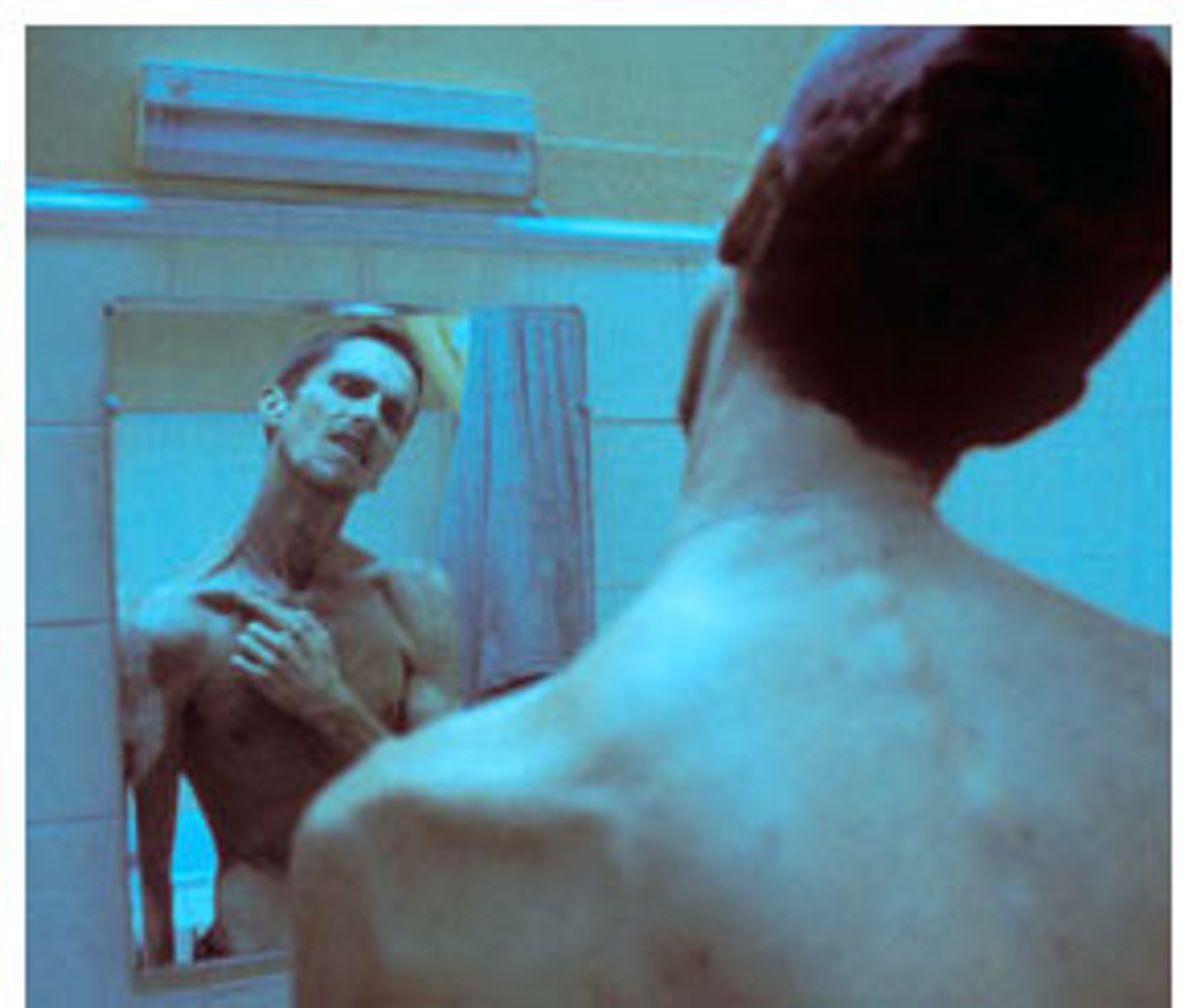
In Brad Anderson’s grim, unpleasant psychological horror thriller “The Machinist,” Christian Bale plays Trevor Reznik, a machine operator who hasn’t slept in a year. He sees things that he isn’t sure are real. He may be losing his mind. He’s also losing weight. At less than 120 pounds, it’s as if he’s being eaten alive from the inside, but until the end of the movie, we don’t know why.
“The Machinist,” which was written by Scott Kosar, is so skillfully put together that you think everything is going to fit together in the end much more significantly than it does. The picture is rendered in dull, vaguely metallic shades of gray, as if all the color had been blanched out of it — an arrestingly arty look, if you go for that sort of thing. (Its cinemtaographer is Xavi Giménez.)
But “The Machinist” isn’t your average somber, ominous exploration of insanity, guilt and paranoia. Anderson (“Next Stop, Wonderland,” “Session 9″) has made a movie that seems to be in love with its own artistry, possibly at the expense of one of its actors. Bale gives a remarkable performance in a movie I can recommend to no one, because the sight of him is more distressing than any of the allegedly deep themes of the picture.
Part of Bale’s appeal, when he’s at his normal weight, is his robust boyishness. Bale lost 63 pounds to play this role, and the first time we see him, he’s barely recognizable as the actor we know — even his skull seems to have been whittled into a new shape. When he turns his back to the camera in a semi-nude scene, he resembles photographs of concentration camp victims. The bones on his shoulders stick out in sharp pagoda points. His skin barely seems to cover his vertebrae — his back looks like the fossil of some long-dead animal.
Bale is a consistently fine and, I think, underrated actor. He’s soulful and open, and here, particularly in his scenes with Jennifer Jason Leigh, as a call girl who has fallen in love with him, and Aitana Sánchez-Gijón, as the lunch-counter waitress he has a crush on, he conveys a haunted desperation that’s very affecting. His eyes are almost invisible in his sockets — it’s as if they’re retreating into his skull.
But seeing him like this makes you wonder: Is the movie around him worth it? “The Machinist” has an intelligent aura about it — it’s not a thoughtlessly made picture. But watching it, I kept wondering: What, exactly, is the point? The movie sustains its ominous hum, but in the end, it doesn’t really give you all that much to think about.
And Anderson breaks faith with his audience repeatedly, particularly in a scene where we’re made to realize that one of Trevor’s fellow machinists is about to lose his arm as the result of Trevor’s carelessness. The man screams as he comes closer to being mangled; afterward, we hear a dull thumping sound, and see his severed arm, still spinning on the rotating machine part.
The scene is supposed to convey the weight, and the consequences, of Trevor’s actions, addled as he is by his sleeplessness. But ultimately, the picture feels like a cheap thriller dressed up for the art-house set. In the movie’s press notes, Bale explains how he lost the weight, dropping down to 120 pounds: “I didn’t eat; that was it.” While that was Bale’s decision to make — Anderson says that he would never expect, or ask, an actor to take that sort of risk — you have to wonder: Even for a serious and dedicated actor like Bale, does a relatively inconsequential movie like this one warrant that kind of sacrifice? Before you suffer for your art, you need to ask if your art is worth suffering for.
Stephanie Zacharek is a senior writer for Salon Arts & Entertainment. More Stephanie Zacharek.
Sacha Baron Cohen’s dark political farce
The "Borat" creator's nutty Arab "Dictator" moves to Brooklyn, falls in love -- and schools the West in democracy
Sacha Baron Cohen in "The Dictator" What exactly is Sacha Baron Cohen up to? This question, stupid as it may appear on the surface, has intrigued me ever since “Da Ali G Show” began airing in the United States. It’s a stupid question because Baron Cohen is a comedian; as “edgy” or “controversial” as his topics and material may sometimes be, his job is to make people laugh. But most comedians don’t try to get laughs by interviewing Pat Buchanan or Boutros Boutros-Ghali (“Boutros Boutros Boutros-Ghali,” as Ali G introduced him) under false pretenses, or by leading a group of unsuspecting Arizona nightclubbers in a rousing chorus of “Throw the Jew Down the Well.”
Continue Reading CloseAmerican influx at Cannes
American filmmakers dominate this year's line-up at France's annual glitzy celebration of cinema
Workers sets up a giant 65th Cannes Film Festival official poster featuring Marilyn Monroe on the Cannes Festival Palace, Monday, May 14, 2012. The Cannes Film Festival will start on Wednesday, May 16.(AP Photo/Lionel Cironneau)(Credit: AP) CANNES, France (AP) — Despite the mood in Europe, don’t expect any austerity at the Cannes Film Festival, the annual Cote d’Azur extravaganza where glamour is wrapped in world cinema fervor and gauzy Mediterranean sunshine.
Except for the Oscars, it’s the flashiest red carpet in the world, a ruby staircase flanked by tuxedoed photographers — and a world away from financial turmoil.
Yet Cannes, the 65th edition of which starts Wednesday, fetes its directors as much as it does its stars. This year, there are plenty of both: esteemed international filmmakers like Abbas Kiarostami and Michael Haneke to big-name talent like Brad Pitt and Nicole Kidman.
Continue Reading CloseWhitewashing, a history
From "Tiffany's" to "Khan," we look at Hollywood's illustrious tradition of casting white actors in non-white roles SLIDE SHOW
All I have to say is that whitewashing has been going on since as long as Hollywood has existed — it’s a tradition — and rather than non-white people complaining about it, they should embrace it. It will make going to the movies so much easier and more fun. But there are just a few things you need to understand.
First, stop watching movies as ethnic people and start watching them as white people. There’s nothing that white people like more than seeing other white people in movies and on television. When you go to the movies with your ethnic “judgment” eyes, you miss my point. Watch as a white person, and suddenly your outrage turns to understanding and laughter.
Continue Reading CloseAasif Mandvi is an actor and writer who appears as a correspondent on "The Daily Show with Jon Stewart." He also co wrote and stars in the film "Today's Special" and will be appearing this summer in the films "Premium Rush" and "Ruby Sparks." More Aasif Mandvi.
New Yorker profile? No, thanks
It's an honor to be the subject of a long, flattering, well-written New Yorker piece. It is also the kiss of death
(Credit: AP/Salon) Last year, The New Yorker ran a long, flattering profile of the director Andrew Stanton, the Pixar veteran who was engaged at the time in reshoots for the troubled “John Carter.” The article, by Tad Friend, noted some of the studio’s concerns about the initial cut of the film, which was Stanton’s debut in live action, but for the most part, its tone was highly positive, portraying Stanton as nothing less than Pixar’s resident storyteller: “Among all the top talent here,” an executive is quoted as saying, “Andrew is the one with a genius for story structure.”
Continue Reading CloseChild acting’s new golden age
From Chloe Grace Moretz to "Shameless," kids aren't just getting more roles -- they're actually good. What changed?
Chloë Moretz in "Hick" “Never work with children or animals” is an old W.C. Fields chestnut that, for a while in the ’90s and ’00s, everyone outside of children’s entertainment seemed to be holding sacred. Child actors were off on their own in a parallel entertainment universe created by Disney and Nickelodeon, while adults held down the fort in dramas and reality shows. There were some notable exceptions, like Haley Joel Osment and Christina Ricci, but by and large, children were almost entirely absent from grown-up entertainment.
Continue Reading CloseMichael Barthel is a PhD candidate in the communication department at the University of Washington. He has written about pop music for the Awl, Idolator, and the Village Voice. More Michael Barthel.
Page 1 of 707 in Movies