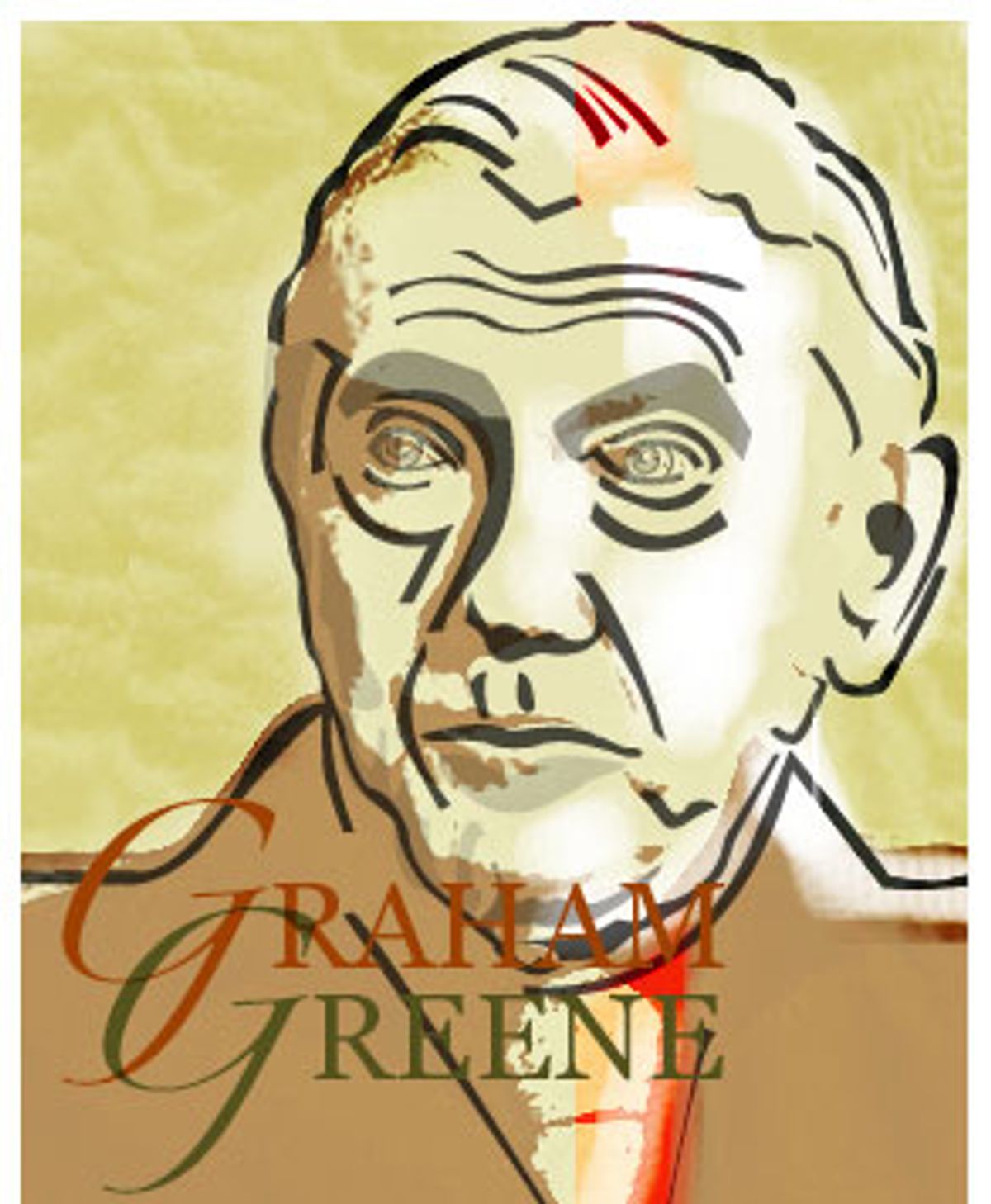
Graham Greene had a reputation for prophecy; as early as 1955 he published "The Quiet American," a book about the perils of American meddling in Vietnam. What seems like foresight actually came from his knack for cutting down to the heart of the matter -- to appropriate the title of another of his novels, this one about Sierra Leone. It was less that he saw things coming than that he recognized the same scenarios of human foolishness and venality unfolding over and over again. If anything, his was a gift for timing, and it's still in operation, even now, 13 years after his death. His centennial (Greene was born in 1904) arrives just as some of his most barbed political observations have acquired a brand new -- and simultaneously all too familiar -- relevance.
Greene wrote steadily (500 words a day, every day) and as a result produced a large body of work: journalism, travel writing, novels and stories, plays, memoir, criticism. There are several fat veins in his fiction alone: the "Catholic" novels ("The Power and the Glory," "The Heart of the Matter," "The End of the Affair," etc.); thrillers like "The Ministry of Fear" and "Gun for Hire"; comic fiction like "Travels With My Aunt" and "Our Man in Havana" (also a spy novel); and harder to categorize works like "The Quiet American," the book that more than any of his others has stamped itself upon the American imagination. For his centennial, Viking is publishing the third volume of Norman Sherry's mammoth biography and Penguin is reprinting six of his novels in paperback with new introductions by an impressive collection of contemporary writers (more titles will appear early next year).
"The Quiet American" is one of those six newly reprinted books, and, as the 2002 film version demonstrated to many who saw it, Greene's story of an idealistic young American fatally screwing up the lives of a British journalist and his Vietnamese mistress in the waning days of French colonial rule still provokes chills of recognition. But while Greene liked to set his novels in exotic places where daily life warps and splinters under the brute weight of politics, he wasn't in essence a political writer. His novels, unlike "Darkness at Noon" or "All the King's Men," don't concern themselves with how power gets parceled out and used. Rather, he's a moral writer interested in how people's deepest sense of themselves, and their integrity, responds to the terrible pressures that political situations impose.
It's this moral view that makes Greene particularly relevant now, because for the first time in many decades, American foreign policy has been driven by idealism of the kind that motivates Alden Pyle, Greene's quiet American. Pyle's grand, well-scrubbed, secondhand vision of how to remake Vietnam is disastrously incompatible with the place itself. The neoconservative component of the Bush administration that pushed the invasion of Iraq had a dream of democratizing the Middle East, too, a worthy goal however crackpot the plans to achieve it may have been (or how dicey some of their other motives). And that dream was, it turned out, also built on ignorance and air.
One reason it was so difficult to marshal an effective response to the neocon agenda is that it overthrew the prevailing notion of how the American political temperament was divided. Since the 1960s, the left has been cast as the faction of idealists, while the right has laid claim to skeptical realism. The left believed itself to be fighting against the odds to make the world a better place, while the right considered itself a bulwark against naive attempts at social engineering that failed to account for the incorrigible aspects of human nature.
But the scheme to "liberate" Iraq cast everyone against type, and in the scramble to construct a new rhetorical response to the fantasy of a forcibly democratized Iraq, the battle against going to war was lost. Even now, every time the president needles his opponents by stating that the world is a better place with Saddam Hussein out of power, a trippy sensation of Alice-in-Wonderland reversal sets in.
The role religion plays in Greene's moral universe also makes his fiction freshly pertinent, now that faith has become both a tacit and overt factor in foreign policy. Greene's private-label Catholicism saturates his politics, but it couldn't be further away from the triumphal Christian soldiering advocated by George W. Bush. The choice, Greene's fiction reminds us, isn't just between judicious secular internationalism and evangelical crusading, two approaches that barely speak each other's language. People of faith, Greene proved, can (and should) take a more self-questioning tack; God's most important battle takes place inside an individual soul.
Of course, Greene's Catholicism was unconventional. His own attitude might have been best expressed by the immortal Aunt Augusta in "Travels With My Aunt," when she was quizzed by her baffled and bedazzled nephew. "'Are you really a Roman Catholic?' I asked my aunt with interest. She replied promptly and seriously, 'Yes, my dear, only I just don't believe in all the things they believe in.'" (Sometimes one of the things Greene didn't quite believe in was God himself.)
Admittedly, it's hard for a secular reader to fully credit some of the more tortuous religious writhings in Greene's Catholic novels. For Scobie, the police official in "The Heart of the Matter," the nadir of his life comes when, in order to hide an adulterous affair from his wife, he must take communion without having been purged of the sin by confession. He can't successfully confess to the sin because he doesn't fully repent of it or intend to stop seeing his lover. Taking communion in this impure state is the ultimate catastrophe; he is eternally damned. His despair at this propels him to suicide, an even worse sin.
George Orwell, reviewing the novel, didn't think much of this spiritual psychodrama. He suspected Greene of glamorizing damnation and was far more interested in how Scobie reconciled his faith and much-vaunted reluctance to cause pain with his job as "an officer in a colonial police force." In truth, the bits of "The Heart of the Matter" that describe the complicated relationship between the colonial British and the West Africans they rule are far more interesting than the torments of Scobie's lugubrious and weirdly pleasureless love life. (The critic James Wood has remarked that it's curious that a man who so clearly relished and avidly pursued sex should write novels in which nobody seems to enjoy it very much.)
Nevertheless, even at its worst, the relentless self-examination that constitutes Greene's notion of a life in faith claims a limited number of victims. At its best, it leads to what used to be a mainstay of Christianity: the practice of good works and the sacrifice of self for others. The "whiskey priest" in "The Power and the Glory" lives like a miserable, hunted animal in order to serve believers in a Mexico where their faith has been outlawed. In today's America as embodied by George W. Bush, religion serves the private goal of personal redemption (God got Bush off the sauce), and provides a public justification for dictating everybody else's behavior. For Greene, Christianity is a matter of considering one's own sins; for too many American Christians, it's a license to police the sins of others.
Religion doesn't play a significant role in "The Quiet American," Greene's most scalding attack on American moral hubris. The narrator, Thomas Fowler, is an atheist who, unlike the spurned lover in "The End of the Affair," never gets nudged in the direction of faith. This is a canny choice on Greene's part, for whatever his personal beliefs, with pen in hand he was always a novelist first. Fowler's jadedness is a necessary counterpart to Pyle's idealism, and everything in a Greene novel serves the purpose of the whole. There's nothing strained or self-consciously "literary" about the book, which is one of its marvels. In Greene's fiction, craft is perfected to a level so high it's indistinguishable from art; "The Quiet American" is like a splendid racehorse, in which the beauty of the creature itself can't be divided from its efficiency in the production of speed.
Alden Pyle, Fowler's nemesis and would-be friend, ostensibly works for the American Economic Mission, an aid operation. He is actually (as Greene himself was) a spy, and also more than that. A CIA operative, he supplies arms to General Thé, a glorified bandit, having convinced himself that the general represents a nationalist "third force," or alternative to both the colonial French and the Communist Viet Minh. General Thé uses the explosives Pyle gives him to bomb a Saigon square, an attack that Pyle knows about in advance and that kills several innocent civilians.
Robert Stone, in his contentious introduction to the new Penguin edition, argues that Pyle is not an accurate representation of any American Greene might have met in Vietnam. Sherry, Greene's biographer, tends to agree, and points out that the elaborate code of honor Pyle adheres to in trying to win Fowler's mistress, Phuong, clearly belongs to the elite English boarding-school world in which Greene was educated. Pyle doesn't even talk like an American: "This isn't a bit suitable for her," he says at one point, with a very British fussiness.
But if Pyle isn't quite convincing as a flesh-and-blood American CIA agent running explosives in 1950s Vietnam, he does embody an aspect of the American national character that Greene rightly feared. With his "wide campus gaze" and an armful of books -- "The Challenge to Democracy," "The Role of the West" -- by the wonderfully named "expert" York Harding, Pyle could be a neocon acolyte, clutching his copy of Kenneth Pollack's "The Threatening Storm," and girded with prefabricated theories about how to solve "the Mideast problem."
"Greeneland," that collection of hinterland outposts where compromised men and women muddle through their seedy destinies, lies so close to the fictional province of Noir that the two territories share similar emotional climates and appeal to much the same people. There are scenes in "The Quiet American" that attain a kind of ecstasy of world-weariness: Confronted by Pyle about lies he's told in order to keep Phuong, Fowler says, "This is European duplicity, Pyle. We have to make up for our lack of supplies."
"The Quiet American," however, manages to exploit the pleasures of genre cynicism without cutting it any slack. Like "Casablanca," it's the story of a man with a policy of detachment who, when subjected to enough moral tension, is finally provoked to act. But Fowler's act, a homicidal betrayal whose motives are muddy to say the least, has none of the romantic unselfishness of Rick putting Ilsa on the plane with Victor Laszlo. It's a grubby intervention, one that might have been written to placate Orwell. As Zadie Smith puts it in the introduction to the British edition of the paperback (the Stone introduction appears only in the American edition), there is "no real way to be good in Greene, there are simply a million ways to be more or less bad."
But to be bad and to know it is Fowler's saving grace, because it means he's paying attention. "God save us always," he says, "from the innocent and the good." To be innocent and good is to remain impervious to the world, the way Pyle can't quite register the blood on his shoes after he walks through the freshly bombed square in Saigon. Greene, a great noticer of the specifics of a place, sees an implacable threat in those who refuse to see what lies around them. People still, after 50 years, read "The Quiet American" while visiting Vietnam, and still find it powerful. If Pyle isn't entirely plausible as a character, the country itself stands vividly on the pages.
As Smith puts it, Greene uses "details" to "fight the good fight against big, featureless, impersonal ideas like Pyle's." The novel itself is one long refutation of the neat, abstract theories that Pyle clings to in defiance of the concrete, chaotic realities of Vietnam. He is the reminder Greene left for us that we cannot, not even with the best of intentions, blindly and deafly impose our will on the world without doing unforgivable violence. And then, with blood on our shoes, we will fail.
Shares