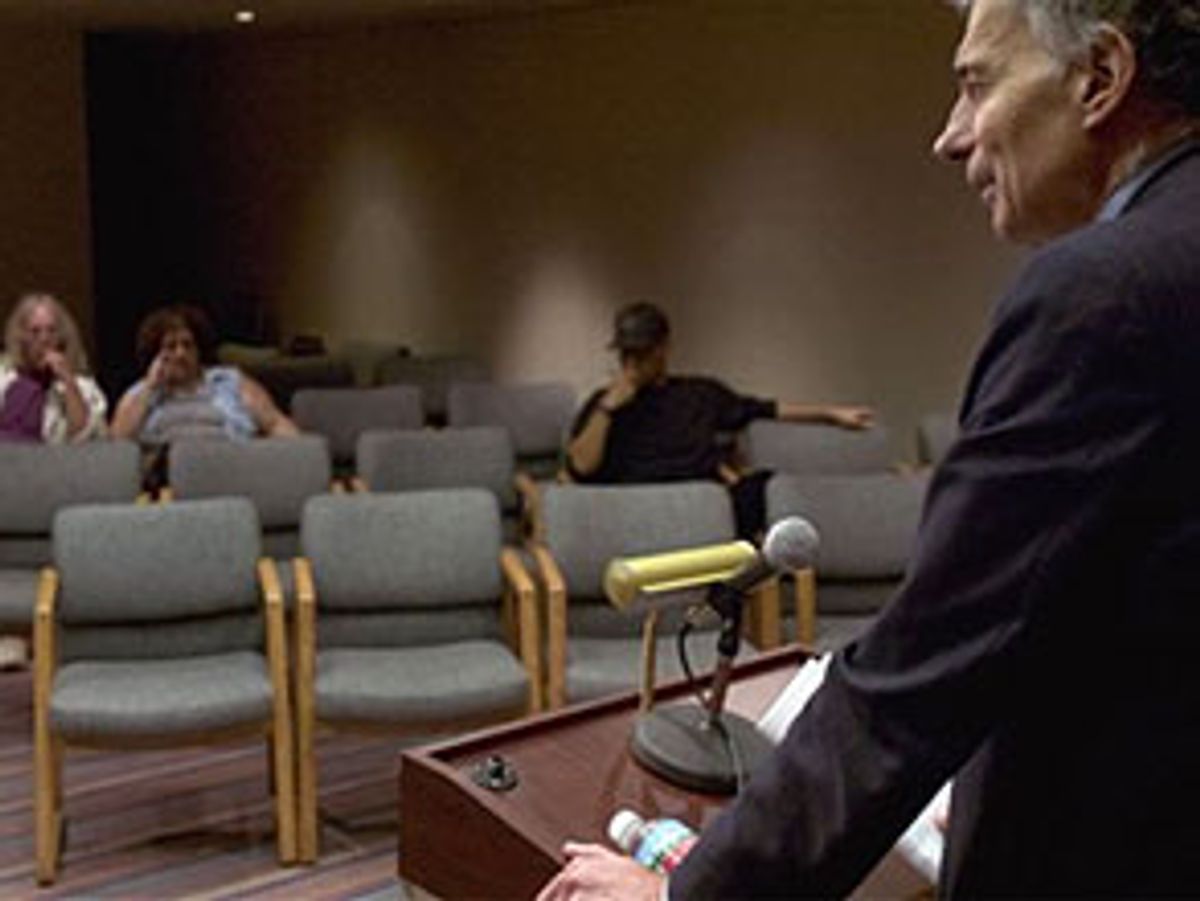
"You have to be willing to be humiliated," Ralph Nader told an audience recently. "I love it." The setting was the University of New Hampshire in Durham as Nader mused aloud on the trials facing leaders of alternative political movements in the United States. Like many things the perpetual candidate says these days, however, the statement rang hollow. Ralph Nader may or may not feel humiliated by finishing an increasingly distant third in presidential elections. But he certainly does not appear to love it.
Why should he? Nader's latest presidential effort -- No. 4 if you're counting -- is a sputtering campaign struggling to draw support. Yes, every vote counts. Yes, Nader could again be, as he was in 2000, one of the decisive factors in the outcome of the election. But if so, it will not be because his campaign is generating momentum down the stretch, or is a success on its own terms. It is not.
You might not realize this, given the recent spate of urgent appeals from former Nader supporters imploring progressive voters to abandon the Independent candidate. And you wouldn't know it from reading the recent front-page story in the New York Times ominously casting Nader as "just the kind of threat the Democrats feared." In reality, the Democrats would be far more afraid if Nader were campaigning strongly -- or if the antiwar movement had produced a more compelling third-party candidate than a notoriously thin-skinned consumer advocate whose career highlights occurred before today's college-age voters were born. As those of us who have seen Nader in person this month know, his campaign is a relatively low-energy, low-interest affair. Crowds are down. Campaign funds are minimal. The candidate who drew about 3 percent of the popular vote in 2000 is at 1 percent in this year's polls and could finish lower.
To see just how Nader is struggling, consider the trajectory of his campaign in 2000, and contrast it to his 2004 effort. On Aug. 25, 2000, Nader drew 10,579 supporters, who paid $7 each, to a "super rally" at the Portland Coliseum. There followed a string of "super rallies" with five-figure attendance numbers: 11,500 in Minneapolis, 12,000 at the Fleet Center in Boston, 10,000 in Chicago, and about 15,000 inside New York's Madison Square Garden, at $20 a ticket.
In 2004, Nader events are far smaller. On Oct. 5, for example, Nader spoke to about 65 supporters in Portland, Maine, before moving on to the University of New Hampshire event, where just over 100 supporters showed, and finishing the day speaking to an audience of about 500 at the University of Vermont. Nader's largest crowd of the month appears to have been about 800 in Berkeley, on Oct. 11, but I counted a more typical 225 in the audience last Saturday as Nader spoke on the Rutgers campus in Piscataway, N.J. Nader will end October having held over 30 campaign events, yet his total audience for the month could comfortably fit inside Madison Square Garden. At many events, anti-Nader groups protest outside; inside, former supporters often confront him during the question-and-answer sessions.
Meanwhile, the celebrity supporters who adorned Nader's campaign in 2000 -- including Tim Robbins, Susan Sarandon and, yes, Michael Moore -- have jumped ship. A long list of academics and public figures from Nader's 2000 "Citizens Committee" -- Noam Chomsky, Studs Terkel, Cornel West and dozens more -- now back John Kerry. Even Winona LaDuke, Nader's vice presidential candidate in 2000, endorsed the Democratic candidate this month, saying, "I'm voting my conscience on Nov. 2. I'm voting for John Kerry."
The news gets worse for Nader. His fundraising efforts have sagged, further lowering his campaign's profile. In 2000, according to Federal Election Commission filings, Nader's campaign raised $4.7 million in contributions. In 2004, he has raised $1.5 million, as of mid-October. In 2000, Nader launched a 30-state television advertising campaign in early November, showing spots based on Monster.com's popular ads. It was his second high-profile ad campaign that year, following earlier spots imitating MasterCard's "Priceless" ads. In 2004, Nader is not airing any commercials at all.
These days, a primary Nader campaign fundraising tactic involves an aide or supporter soliciting donations from the audience at a speech, even when the crowd is stocked with broke college students. Different speakers use the same stock line in their pitch -- "There is nothing more liberating than giving Ralph Nader more money than you can afford to give" -- and audience members who pledge $50 or more get a signed copy of Nader's 2002 book, "Crashing the Party." These pledge drives do not always produce their desired results, however.
In Durham, I watched as Greg Kafoury, a Portland, Ore., lawyer and longtime Nader backer, asked the students for money. The pitch unfolded this way:
Kafoury: "So let me ask: Is there anybody here who can contribute, anybody who is well off enough to contribute a thousand dollars to this campaign? Think about it. It's a lot. You can put it on your credit card. Pay for it over time. Is there one person who can do that much? I'll throw in a book." [Laughter.]
"Not just any book. This is 'Crashing the Party,' Ralph Nader's journal of the last campaign. And it is a, it's the best book about a campaign, a real insider's story. He talks about everything in it. He'll sign your name in it, and you'll read it and learn from it, and leave it in your will. Is there anybody who can do as much as that? How about $500? Think about it. Fifty dollars a month for 10 months. It's a lot of money. It's for a great cause. Is there one person who can do that much?" [Pause.]
"You know what, I got to tell you, from the bottom of my heart, there is nothing more liberating in this world than giving Ralph Nader more money than you can afford to give. Is there one person who can do that much? Tough crowd. $250? Who can do $250?"
Student: [Raises hand.] "I can give you $3. That's all I have in my wallet." [More laughter.]
Eventually Kafoury settled for two $100 contributions. It was hard to feel sympathy, though. Just before Nader's talk, as the candidate was entering the auditorium, I watched Kafoury stride over to five pro-Kerry students silently holding anti-Nader signs near the door and start pointing, yelling and unleashing what the University of New Hampshire student newspaper later called a "tirade of 'F-bombs'" at the undergraduates. Call it voter outreach, Nader 2004-style.
If Nader's support is diminishing in 2004, how low will it go? Some polls provide a solid indicator. In 2000, Nader polled as high as 5 percent in early October, but had fallen to 3 percent in the Washington Post tracking poll by the end of the month. That was an accurate forecast. Nader wound up with 2.7 percent of all votes cast in 2000, although he was not on the ballot in all states. In the 43 states where he was on the ballot, Nader received exactly 3.0 percent of the vote.
At the moment, the same Washington Post tracking poll has Nader at 1 percent nationally. But the more pressing issue for Democrats and Republicans is how Nader will fare in the key swing states. Using his 2000 average of 3.0 percent as a baseline, Nader drew above-average support in Colorado (5.3 percent), Minnesota (5.2), New Hampshire (3.9), New Mexico (3.6) and Wisconsin (3.6). Nader drew below-average support in Nevada (2.5 percent), Ohio (2.5), Iowa (2.2), Pennsylvania (2.1), West Virginia (1.7) and Florida (1.6). If the Post tracking poll is right, we might expect Nader to draw about one-third as much support in those states as he did in 2000.
That means Nader's decline in support this year could help contribute to John Kerry victories in Colorado, Florida, Nevada and New Hampshire -- all states George W. Bush won in 2000. (In Florida and New Hampshire, Nader's vote total exceeded the margin of victory.) On the other hand, Kerry will have to be concerned about Nader's continued impact in Iowa, Minnesota, New Mexico and Wisconsin -- all states Al Gore won narrowly, except for Minnesota, in 2000. Nader is least likely to be a factor in West Virginia and is not on the ballot in Ohio and Pennsylvania, the latter being the state where Nader's ballot-access petition had thousands of bogus signatures.
The level of Nader's support is just part of the equation of his potential 2004 impact, however. Another question is: Who supports Nader? All campaign long, Nader has been making the implausible claim that he will draw as much support from Republicans as from Democrats. But surveys show more of Nader's support coming from Democratic-leaning voters. A Nation Institute swing-state poll in October found 84 percent of Nader supporters saying they would still vote if he were not running; 49 percent favored Kerry and 17 percent favored Bush, with others undecided or preferring alternative candidates. An aggregation of Zogby International polls through September shows 41 percent of Nader supporters favoring Kerry and 15 percent favoring Bush. Exit polling on Election Day in 2000 found 47 percent of Nader's voters preferring Gore and 21 percent preferring Bush.
In short, a rule of thumb for Nader's support is that about 50 percent of his votes come from people who would otherwise choose John Kerry. Perhaps 20 percent come from those who would otherwise select Bush. And around a third come from people who would not support either.
To be sure, some people are choosing between Bush and Nader. While interviewing dozens of Nader supporters at several of his events this spring, however, I could not find a single person who voted for Bush in 2000 or would support Bush this year in lieu of a Nader candidacy. At the time, Nader himself had apparently encountered only a handful of these supporters. After all, they rarely exist in the places Nader actually campaigns: liberal strongholds, and the college campuses that provide progressive voters in swing states. After his Rutgers event on Saturday, Nader promptly headed off to an appearance aimed at African-American voters in Harlem -- which at last check was not home to many Republicans.
Many other signs show Nader knows he is primarily competing for votes with the Democrats. The typical Nader speech contains far more barbs directed at Kerry and other Democrats than at Bush. This month alone, Nader has also called John Edwards a "sniveling coward" and Howard Dean a "total and complete liar." As of Monday, the top item on the home page of Nader's campaign Web site was a testimonial from a New Mexico resident who "was definitely going to vote for John Kerry" but now supports Ralph.
Nader does call Bush a "messianic militarist" once per speech. But he lumps the two major candidates together on his main campaign themes: the harmful influence of corporations and the mess in Iraq. Nader links "the Kerry-Bush people" on domestic issues -- good government, healthcare, energy policy -- and repeatedly informs audiences, "John Kerry voted for the war." Tellingly, Nader frames Kerry's war vote the same way Bush does. Strictly speaking, Kerry did not vote for the war in October 2002, but for a resolution allowing the president to make a decision about it. Calculated though Kerry's vote may have been, both Nader and Bush are trying to obscure the larger question facing voters: If John Kerry had been president for the last four years, would we be in Iraq?
Ralph Nader has been saying at least since the 1980 election that the major candidates are identical. In 2004, however, this habit is why his campaign is circling the drain. Faced with an ideological chasm between major-party candidates, even most of Nader's former supporters are no longer buying his line. And Nader's claim to the progressive mantle is increasingly tenuous -- though he links his current campaign to the work of abolitionists, suffragists and Eugene Debs. "They fought and lost," Nader told the Rutgers crowd on Saturday. "They fought and lost. They fought and lost. Then they won."
They did. But if you cannot recall any fighting Nader has done for progressives since his last presidential campaign, you are not alone. Meanwhile, groups like MoveOn and ACT have grown, and Democrats have effectively used the Internet for grassroots fundraising and rapid-response activities such as recently pressuring the conservative Sinclair Broadcast Group into shifting plans for a one-sided anti-Kerry "news" program. The Democrats are more active at the grassroots level than Ralph Nader.
Indeed, Nader resembles a professional politician far more than an activist, tossing off sound bites -- "You can't have an election without selection" -- and brushing away inconvenient questions with non-answers. When asked about Republican Party support for his campaign's ballot-access efforts, Nader always changes the subject by saying he has received limited individual contributions from Republicans. It is interesting, though, to see the candidate occasionally brush up against a larger truth. In New Hampshire, Nader was riffing about how, say, Red Sox fans are better informed about baseball than politics. "They just care about performance," Nader said. "Performance. Performance. They evaluate their team defensively as well as offensively. Not only what they produce in terms of runs, but what they can stop the other team from scoring."
In 2004, Democrats thoroughly understand that playing defense is vital. That is why they are trying to end George W. Bush's turn at bat. With Ralph Nader's campaign fading, though, the Democrats should remember: They do not need him to record the third out.
Shares