2004 Elections

Stars try to shine the way in Ohio

Paul Newman, Steve Buscemi, Matt Dillon and a cast of dozens dazzle Cleveland with a door-to-door drive to get out the vote.

  • more
    • All Share Services

Topics:

Stars try to shine the way in Ohio

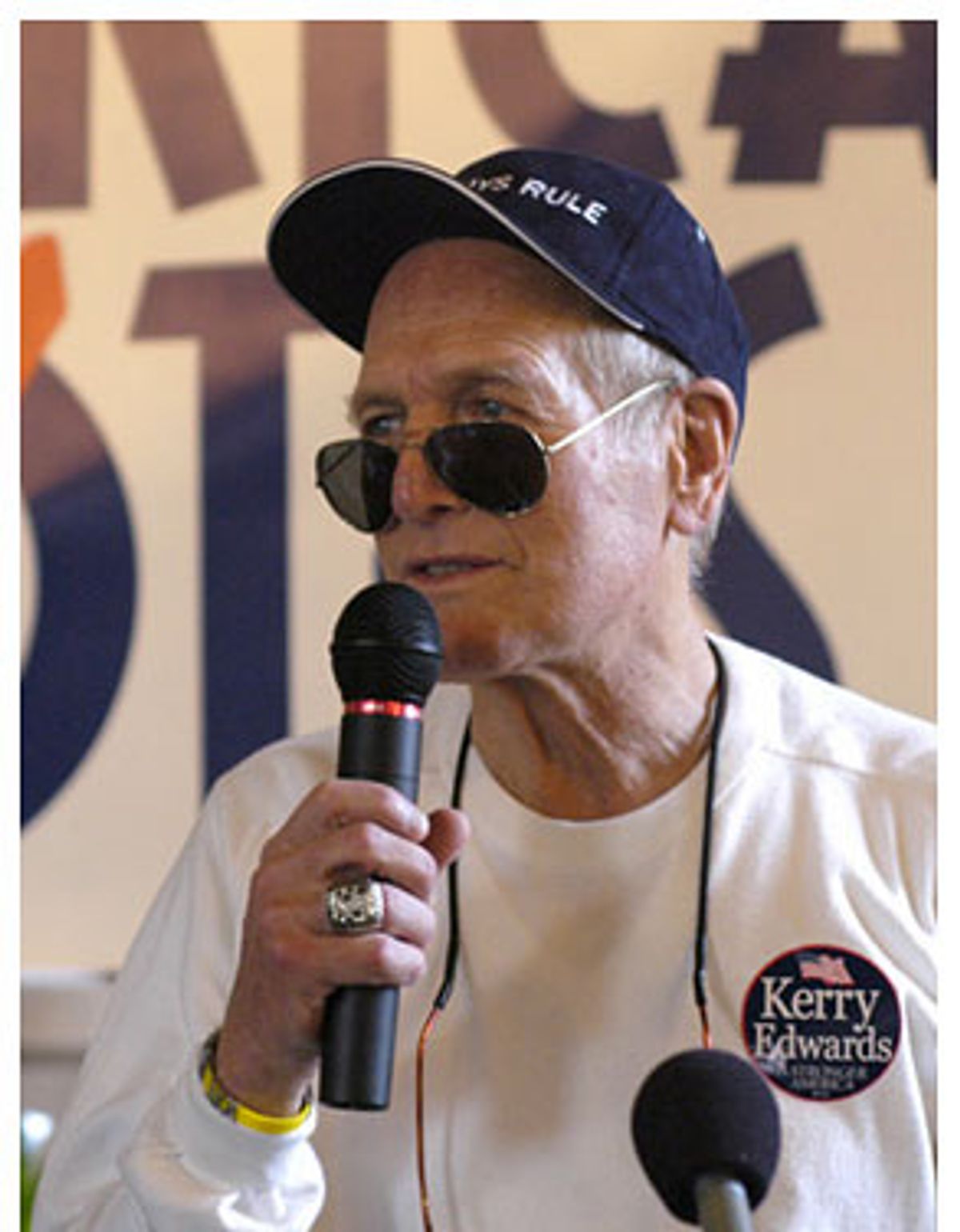
A silver-haired woman walked outside in her pink robe Saturday morning to find a cluster of actors on her driveway and TV cameramen everywhere. Actors Steve Buscemi and Chad Lowe, Rob Lowe’s less-famous brother, spoke to her while Timothy Hutton walked down the street knocking on doors, urging Democrats to get out and vote and Republicans to reconsider. Next door, Paul Newman, wearing a white sweater with a Kerry-Edwards sticker on his breast, stood on the front porch of a lovely Tudor house. It was his childhood home, a place he hadn’t been back to in decades, and he was there to canvass the new owners.

It was a spectacularly sunny day, and the leafy street in the affluent, liberal enclave of Shaker Heights was carpeted in auburn leaves. It all looked a bit like a movie set, a backdrop of archetypal fall suburban splendor. The trick was in figuring out whether the unfolding scene was inspiring drama or farce. Throughout the day on Saturday, as a busload of celebrities traveled through Ohio to rally Democrats to get out the vote, it was a little of both.

As the presidential campaign careens toward its world-altering climax, Ohio feels like the improbable center of the universe. Besides the candidates and their relatives and surrogates, hordes of political celebrities and Hollywood stars are descending on this resolutely unglamorous state. “The Lord of the Rings” star Viggo Mortensen campaigned along with Howard Dean on Saturday. Michael Moore gave several speeches. The right has less star power, but Arnold Schwarzenegger appeared with Bush on Friday, and Sean Hannity and Oliver North are in Akron today.

Meanwhile, battalions of progressive volunteers have come from all over the country, here to make sure that every Ohio voter is visited multiple times, often with literature specifically tailored to his or her particular concerns. Sometimes it feels like a circus, but sometimes it’s beautiful, a political moment when everyone wants only to do all they can.

The celebrities were touring the state as part of a campaign called Bring Ohio Back, which has been organizing celebrities to get out the vote in Ohio. They spent the weekend traveling by bus, visiting offices of America Coming Together, the country’s largest progressive get-out-the-vote operation, handing out pro-Kerry fliers at high school football games and supermarkets, and going door to door to talk about the election with voters somewhat dazed by the surreal spotlight shining on them.

The day began with a breakfast reception for ACT volunteers in Cleveland Heights, held in a lovely hall hung with chandeliers and Turkish carpets. Bagels and coffee were served in one corner, near a long table where new volunteers could sign up for duty. People wandered in and asked, “How do I get hooked up with a group?”

Many had taken time off from prestigious jobs to volunteer at the grass roots. Paul Spencer, a New York City advertising copywriter and Cleveland native who worked closely with Bill Clinton on his 1992 presidential campaign, was in town knocking on doors in the area where he grew up. “I called all my old high school friends,” he says, as well as a high school teacher from 30 years ago. They formed a team of 13. “I feel like I’ve gone from the officers’ club to leading a bunch of grunts through the trenches. I kind of like this better.”

Paul Newman spoke only briefly to the group. “You guys are doing all the heavy lifting and I get my picture taken,” he said. Someone in the crowd called out, “Bless you, your record speaks for itself.”

Afterward, Newman told a small scrum of reporters, “This is the most important election of my entire life.” Reports of voter disenfranchisement and harassment in the state had him especially worried. “If you can’t have free and fair elections in America, where can you have them?” he asked.

Then the Bring Ohio Back bus — along with lots of local reporters — headed out to Newman’s old neighborhood. At this stage of the campaign, the idea is to turn out Democratic voters, but while most of the actors went to homes with Kerry signs on their lawns, Timothy Hutton rang the bell of a house with four Bush signs. The man inside had printed up 50 photocopies of Osama bin Laden’s recent remarks, which he planned to hand out that day, apparently because he felt they demonstrated that the arch-terrorist wants a Kerry victory. Hutton talked to him for a while, and by the end of their conversation, the man said he hadn’t completely made up his mind who to vote for.

Perhaps he was simply cowed by being confronted with a movie star first thing in the morning. Still, Hutton said, “Why preach to the converted?”

Todd Stevens, a management consultant who grew up in the neighborhood but lives in Los Angeles, was walking his family’s dog and looking around quizzically at all the commotion. “This is very funny,” he said. “It’s comedy.” Politically Stevens is on the actors’ side — in fact, he was in Ohio for the weekend volunteering with the Kerry campaign. But the whole spectacle on Saturday struck him as preposterous. He pointed at Joe Pantoliano, who played Ralph Cifaretto on “The Sopranos,” and said, “You can’t wear what the Sopranos guy is wearing — his shoes cost more than most people’s mortgage! I can’t believe this is happening in my town.”

One Canadian reporter seemed to be thinking much the same thing when she asked Newman whether the stars’ efforts might backfire. “I don’t give up my citizenship just because I’m an actor,” he said.

Many Ohioans seemed fine with that. Before Saturday, I thought locals might react like Stevens, or worse. Would swing voters really appreciate Eliza Dushku — “Buffy the Vampire Slayer’s” Faith — or Hillary Swank trying to influence their choice? What would the parents at the high school football game in Massillon, Ohio, make of Julianna Margulies’ T-shirt, which juxtaposed a woman’s crotch and the president’s face and the words “Good Bush/Bad Bush”?

In fact, they loved it. Massillon, near Canton, is an area with lots of steel mills and union men, and it’s been hemorrhaging jobs. At a tailgate party before the Tigers game, a long line of people waited for the actors to serve them hot cider. A few of the locals wore Bush-Cheney stickers, but many more wore Kerry-Edwards buttons, or buttons that called the administration Asses of Evil. One girl’s T-shirt showed Bush in a tall cowboy hat, with the words, “Idiot Son of an Asshole.”

Fifty-year-old Carol Carpinelli said she was grateful that the celebrities were out campaigning for Kerry “when they’ve got movie star stuff to do.” She was there with her boyfriend, 50-year-old Pat Dieffenbaugher. Their own story had a touch of Hollywood to it. High school sweethearts, they went separate ways after graduation, married other people, and didn’t see each other for 27 years. Six years ago, when they were both single again, Carpinelli’s father died, Dieffenbaugher saw it in the paper and sent her flowers, and they’ve been together ever since.

But the threat of unemployment hangs over their happy ending. “Our plant could close any time,” said Dieffenbaugher. “I have two brothers who lost their jobs at Republic Steel.” His sister’s boyfriend, who works for Timken, another steel company, is now helping it set up a new plant in China. “It seems like we work better under Democrats,” he said.

Republican attempts to label Democrats as the party of coastal elites clash with their real-life experience. “I find the people we know who are better off than us want Bush,” says Carpinelli. “The working people are backing Kerry,” Dieffenbaugher adds. One need only look at Timken’s CEO, who’s raised $600,000 for Bush at the same time the company is making plans to eliminate 1,300 local jobs.

There were a few Republicans around, but even many of them seemed pleased with their celebrity visitors. One antiabortion activist muttered angrily, “I can’t believe they have to trot these actors out,” but other Bush supporters waited in line for autographs.

“I’ve been a fan of yours since way back!” 24-year-old Dan Studer, a beefy guy with a crew cut and a football jersey sporting a Bush-Cheney sticker, said to Steve Buscemi. Studer and his identically dressed friend threw their arms around the actor for a photograph, and then listened intently as he asked them, “Are you happy with the way things are going in this country?”

Speaking of Kerry, Studer said, “I just don’t like the way he won’t take a stand on anything. He flip-flops.”

In his famously wry voice, Buscemi replied, “You know what, it’s the media.” He proceeded to explain how Kerry’s words have been distorted. As they talked, Studer nodded a few times and said, “Yeah, that’s true.” Buscemi gave him a flier and said, “Anyway, just think about it.” Studer hugged him. “I’m a huge fan,” he said. “It’s great to meet you.”

As he walked away, Studer said he still believed in Bush, but Buscemi “had some valid points,” and said he thought some people who were undecided might be swayed by the celebs.

Meanwhile, a deputy sheriff was deep in conversation with Matt Dillon. “My wife and I went back and forth,” he said. “I’m afraid of the U.N. If it was any other time…”

Dillon gave him a flier and said, “Just take a look at this.” The sheriff said, “I don’t want to abandon what our kids have sacrificed for over there.” Then he looked at Dillon and said, “I respect what you guys are doing.”

Back on the bus, Dillon seemed fairly humble about what he was doing, and aware that it might seem absurd. “I don’t normally come out,” he said. “I don’t get that politically involved. I’ve not really been an activist.” He seemed genuinely worked up about the economy in Ohio, though. Bush voters there “are going to be voting against themselves,” he said. “I can’t stomach the low minimum wage — and now Bush wants to cut overtime! Personally, I feel strongly about John Kerry. This guy is great.”

“If I can make a difference,” he said, “I want to show up.”

Continue Reading Close

Michelle Goldberg is a frequent contributor to Salon and the author of "Kingdom Coming: The Rise of Christian Nationalism" (WW Norton).

Meet Patrick McHenry, the rudest, most shameless College Republican in Congress

Of course he was unfair to Elizabeth Warren: He was trained by the most cutthroat political organization around

  • more
    • All Share Services

Topics: , , , , , , ,

Meet Patrick McHenry, the rudest, most shameless College Republican in CongressPatrick McHenry

Rep. Patrick McHenry (R-Countrywide) called Elizabeth Warren a liar at the conclusion of a House Oversight subcommittee hearing that had already consisted mainly of Republican members of Congress getting very basic information about Warren’s Consumer Financial Protection Bureau completely wrong.

McHenry has been one of the most completely shameless of House Republicans since his arrival in Congress, in 2005, when he immediately and publicly endorsed Tom DeLay’s brilliant plan to exempt himself from ethics rules as his connections to Jack Abramoff began to end his career. But he was born to be cheerfully corrupt: He’s a product of the College Republicans, an organization that trains little Lee Atwaters, Karl Roves and Grover Norquists in the arts of scorched-earth campaigning and wholly irresponsible “governing” on behalf of the monied interests that bought you your job. The ethos is win by any means necessary, legal or quasi-legal (or worse, as long as you never get caught), and McHenry was very good at that, according to Benjamin Wallace-Wells’ memorable profile of the then-freshman in the Washington Monthly.

After the College Republicans, and a failed state legislature race, McHenry moved on to truly insidious conservative astroturfing/push-polling/communications firm DCI, then worked for Rove, then took a political appointment in the Bush administration, then moved to the district he now represents, where he started a real estate company that did not actually buy or sell any real estate, so that he could run for Congress as “a small businessman.”

Once in the United States House of Representatives, McHenry personally intervened in a wild and bloody College Republican National Committee chair election, on behalf of a personal friend of his who’d become slightly toxic after he sent fundraising letters attempting to trick “elderly people with dementia” into donating to the CRNC. And he was successful! The horrible kid won, against all odds:

In other phone calls, McHenry was more blunt: “He told me, and several of my friends that we were done in politics if we didn’t support him,” another College Republican chapter president told me. (McHenry has admitted that he and Deans made the calls but denied that they threatened anyone’s career). Over the course of two weeks, after a couple of a dozen calls, McHenry prevailed upon those in the North Carolina delegation to change their votes, removing three votes from Davidson’s column and putting them in Gourley’s. Gourley ended up winning by six votes; had North Carolina voted the other way, Davidson might have won.

Another of McHenry’s first acts in Congress, Wallace-Wells writes, was to champion a bill that was specifically written to rip off a large portion of his constituents, by making it “much harder for government to regulate or block the conversion of credit unions into banks …” He is a close ally of major consumer financial institutions with a plum assignment to the Committee on Financial Services, which is great for raising money.

It’s only natural that Elizabeth Warren, whose mission is to protect consumers from unethical and predatory practices by these institutions, is Patrick McHenry’s enemy. You can complain on his Facebook wall all you like, but the Republican from North Carolina is incapable of feeling embarrassment.

And his treatment of Warren will only make him a bigger conservative hero and an even more attractive investment opportunity for major banks.

Continue Reading Close
Alex Pareene

Alex Pareene writes about politics for Salon and is the author of "The Rude Guide to Mitt." Email him at apareene@salon.com and follow him on Twitter @pareene

What Osama’s death looked like at ground zero

I rode the subway in to experience the madness for myself -- the crowds, the tweeting and the conspiracy theories

  • more
    • All Share Services

Topics: , ,

What Osama's death looked like at ground zeroPerched on another's shoulders, Ryan Burtchell, of the Brooklyn borough of New York, center, waves an American flag over the crowd as they respond to the news of Osama Bin Laden's death early Monday morning May 2, 2011 by ground zero in New York. President Barack Obama announced Sunday night that Osama bin Laden was killed in an operation led by the United States. (AP Photo/Tina Fineberg)(Credit: AP)

“Today, at my direction, the United States launched a targeted operation against that compound in Abbottabad, Pakistan. A small team of Americans carried out the operation with extraordinary courage and capability. No Americans were harmed. They took care to avoid civilian casualties. After a firefight, they killed Osama bin Laden and took custody of his body.”

– President Barack Obama, May 1, 2011

1.

This is how history breaks in 2011. I was watching AMC’s “The Killing” last night when my daughter walked into the living room around 11 p.m. and said, “Osama bin Laden is dead.”

“What? Are you sure? Where did you hear this?”

“It’s online.”

The texts and calls and tweets and Facebook posts and cable news ticker feeds piled up from there, morphing into that familiar buzzing audiovisual din. Our other atmosphere.

At first there was no actual news, just rumor and speculation. Finally the Sunday night shows were interrupted by reports that Osama bin Laden, al-Qaida mastermind and America’s most wanted criminal, might finally be dead, nine-and-a-half years after the worst-ever terrorist attack on American soil.

On NBC’s East Coast affiliates, the announcement of an impending presidential address cut into the final moments of “Celebrity Apprentice,” starring would-be Republican presidential nominee Donald Trump. (Take that, you combed-over bigot.) Obama did not appear for another hour. After he spoke — confirming that bin Laden had been killed in Abbottabad, Pakistan, by Joint Special Operation Command forces working with the CIA — NBC and CBS returned to previously scheduled programming. ABC and the cable news channels stuck with the story. “The minute I heard that the president was doing an announcement at 10:30 and breaking into TV, I sort of guessed, I thought, ‘They got bin Laden,’” New York Sen. Chuck Schumer told New York’s WABC. “They wouldn’t break into TV for any other reason.”

Fox News Channel somehow managed to deliver comprehensible audio over the collective, bloody grinding of teeth, even when relaying a statement from ex-President George W. Bush congratulating Obama: “This momentous achievement marks a victory for America, for people who seek peace around the world, and for all those who lost loved ones on September 11, 2001.”

“This will probably prove to be one of the most significant, if not the most significant accomplishments of the president,” NBC News White House correspondent Chuck Todd told anchor Brian Williams, in a bloc of live MSNBC coverage that displaced a taped program titled “Sex Slaves UK.”

On ABC, Debra Burlingame, the sister of Charles Burlingame, pilot of the hijacked flight that struck the Pentagon, told anchor George Stephanopoulos, “This has been a long time coming. It’s been rough because it pretty much dominated my life, all of these national security issues. And we’re not out of the woods yet, George, but this is really big.”

Yes.

So big that after a certain point, a New York-based TV columnist can no longer sit in his living room, typing on a laptop while stealing glances at a TV. Next stop, ground zero.

2.

The Cortlandt Street R train stop deposits riders on the perimeter of ground zero, in front of the Century 21 department store on Church Street, meters away from a chain link fence festooned with banners detailing the splendors that will appear on the former World Trade Center site: Freedom Tower. Reflecting pool. High-end retail shops.

At first the street seemed unnervingly quiet. Yes, it was 1:30 Monday morning at the the start of a work week, but this was supposed to be V-E Day all over again, at least in theory. Where were all the people?

Two blocks away, as it turned out: Klieg lights. Waving flags. The distant roar of a crowd’s cheer building and cresting:

“HhhhhhhhhhRRaaaaaaAAAAAHHHHHHHHHHH!”

How many people were there? Thousands, I’m told. 

They’d stuck bunches of red and white roses into the fence and taped up signs: “Thanks, Barack!” “USA WINNING.” There was a scrawny young man in a red, white and blue top hat, and a tearful man with a hand-lettered sign that read, “He’s dead,” and a man holding an iPhone with a viewscreen spelling out, in huge letters, “OBAMA 1 OSAMA 0.” One woman came dressed in an Old Glory jumpsuit complete with hoodie.

“It feels like the world’s guiltiest criminal is now gone from this earth,” said Eric Brehm of Columbus, Ohio, who was visiting New York with his girlfriend, Megan Sander. “I’m happy for the people of New York and happy for the world.” Sander recalled watching the second plane hit on TV almost a decade ago. “My boss’ sister was a flight attendant on that plane,” she said.

A number of celebrants wore American flags as capes. “It’s an amazing night,” said one flag-caped celebrant, Juan Rodriguez of Cliffside Park, N.J. “I feel like I can breathe again.” He said the flag around his shoulders once belonged to his grandfather, who served in the Pacific during WWII.

Archie Archipolo, who grew up on the Lower East Side and has lived in lower Manhattan for over a decade, recalled the madness in this neighborhood nine-and-a-half years ago. “The Red Cross set up a station with bottles of water. There were tanks in the streets.”

Archipolo was wearing a VFW cap that belonged to his grandfather, who served in the 1st Division of the U.S. Army during World War II. He was there with his girlfriend, Danielle Cristiani, and her godson Max Sperling, a teenager who was 5 when the towers fell. “It was like a war zone down here,” Sperling recalled. “But it was so quiet that first night.”

“We lost friends, cousins that day,” Archipolo said. “Everyone did. Now I think we’re on the way back. But we have to be careful. It could happen again any time. It might not be as big as it was before. It could be some guys strapped with C-4.”

A young Navy officer in dress blues and a sailor in white joined a drunken civilian teenager atop a lamppost at the corner of Church and Vesey and led the crowd in reciting the Pledge of Allegiance. 

3.

What didn’t come through in the TV feeds and newspaper stories was the peculiar character of the crowd: half in-the-moment, half outside of it.

There were engaged, ecstatic — and over time, increasingly tipsy — revelers. There were news vans and trucks with broadcast-quality cameras and bright lights and rumbling generators. There were roving reporters with notepads and hand-held digital tape recorders. I saw people collecting video and audio with their iPhones. One woman circled the outer edge of the crowd, holding her iPad slightly above her head, getting a smooth tracking shot around the edges of the gathering and double-checking her framing by glancing up at the screen.

In some sectors of the designated celebration zone — a two-block area ringed by cops and barricades — witnesses to history appeared to outnumber participants.

Then again, the distinction between participants might be a false one. Nowadays just about everybody has the ability to record his or her life at any time, for any reason, via digital stills, video, audio. And there was a whole lot of recording going on last night. Three young men in kilts climbed on top of a bank of pay phones and gave an impromptu bagpipe concert; the strobe-flash illumination of shutterbugs was so intense that they might as well have been performing on the floor of a disco. There were people taking video and still photos of cops, construction workers, Marines, sailors and civilians wrapped in American flags or carrying signs. There were people taking pictures of the people taking pictures. And there were people taking pictures of the people taking pictures of the people taking pictures.

Clouds of pot smoke occasionally wafted through the scene, and as the celebration wore on, it became harder to move through the throng without accidentally kicking an empty beer bottle and sending it clattering down the street.

If you stood back and squinted at the crowd, hundreds of rectangles of electronic light seemed to bob like embers on a dark wave. People were showing each other their iPhones, sharing Twitter feeds, Facebook updates, uploaded and downloaded photos, YouTube clips, streaming video from CNN. They were discussing the coverage, repeating what they’d heard, saying what they did or didn’t believe.

“They should show pictures of the raid, pictures of the body, a picture, something,” a man holding a bottle of water told a man holding a tall can of Budweiser. “They have to show proof that he’s dead, that it’s him they shot, otherwise the tinfoil hats come out.”

And yet despite the anxiety and intense self-consciousness, there was a bustling energy to the gathering, with undertones of joy, relief and hope — plus a brute satisfaction than somebody finally tracked the son of a bitch down and put one in his brain. Songs and chants erupted and faded, some merely patriotic, others belligerent: “The Star-Spangled Banner.” “America the Beautiful.” “You ess AY! You ess AY” “Nah nah NAH nah!/Nah nah NAH nah!/Hey HEY-YYYYY/Good BYE!” One especially wasted young man lunged at a TV camera and yelled, “Iran is next! I don’t care what anybody says! Iran is next!”

Jonathan Jirack, formerly of Pittsburgh, left his apartment near ground zero around 2 a.m. bearing a hand-lettered sign that read, “We cheer for [PEACE SYMBOL], not death.” He walked through the crowd for hours holding it over his head. “I saw the gathering on TV and I thought, ‘I need to go down there and try to put an asterisk on the event,’” he said. “I understand the jubilation. I can feel it. But a lot of people are watching this thing on TV, and I’m afraid what we’re putting out there can be manipulated or misinterpreted.”

“That’s noble,” said Kevin Caslava, a San Diego-born writer who has lived in New York off and on for a decade, indicating Jirack’s sign. “But you’ve also got people here chanting, ‘Fuck Osama,’ so it’s not like what you’re describing is the only subtext out here.”

They argued politely about the sign — Jirack insisting that most of the people here were more relieved and happy than bloodthirsty, even though it might not come across that way on TV, and Caslava was taking a more skeptical view.

“Look, I get it,” Caslava said. “I feel a deep-rooted satisfaction, but also a sense of, ‘Should I be cheering because a man got shot?’ I’ve traveled a lot, and I’ve met people who argued for bin Laden as a freedom fighter, as somebody who had reasons for what he did. When you hear them talk, intellectually you understand the reasons, even though you have a visceral hatred of what happened in this country, right here on our own soil. Deep inside us, there’s a very strong voice for war. You try to be rational, but there’s that voice inside that says, ‘Fuck this.’ That’s the voice I’m hearing here, mostly.”

“And,” he added, “when you’re watching news from Middle Eastern countries and you see people holding up signs in Arabic, how do you know what they’re saying? If you can’t read Arabic, you can’t know. You might think what’s on that Arabic sign was a message of peace when it’s actually something like, ‘Fuck all y’all!’ How do you know that somebody in another country where they don’t speak English won’t look at your sign and just not understand it at all? Or misinterpret it?”

“That’s why I put the peace symbol on there,” Jirack said.

4.

Back in Brooklyn again after a brief subway ride in an R train car filled with mostly sleeping people and other awake persons — fellow pilgrims to ground zero who thought the timing of Obama’s announcement was a bit too convenient, that maybe the president delayed the raid, or delayed announcing the news, until tonight because it would put a lid on the celebrations.

“They were building up to this raid for weeks,” a man said. “He didn’t give the go-ahead last night. Why? Because if he’d done it last night, Saturday night, around the same time as tonight, the word would have gone out when half the people in America were already half-drunk, and then what would the TV have shown? It would have been insanity. So he waits until late Sunday night. Everybody’s happy, but they’re tired. They want to celebrate, but they also gotta go to work in the morning.”

“Not everything is a conspiracy,” another rider said.

“They’re very precise in how they manage the country,” the first rider said. “They got shaping P.R. down to an exact science.”

Home at last.  The kids were zonked out. On CNN, Steve Bernstein, whose brother Billy died on 9/11 when Cantor-Fitzgerald’s World Trade Center offices went up in smoke, said that when he heard about bin Laden, “I felt like my brother could finally rest in peace. I felt the same way.”

Then the newscast cut to correspondent Ted Rowlands reporting live from “a hookah lounge in Anaheim, California” at 2 a.m. Pacific. His topic: the reaction of Muslim-Americans. He sidled over to one side of the club and approached a couple of attractive young women. “Leila,” he said, extending his microphone to one of them, “as a Persian-American, give it to me: What is your reaction to Osama bin Laden being killed?”

“We’re elated that someone who is the biggest symbol of terrorism is finally gone now,” Leila said. “And I can’t wait to see his picture now, to be honest with you.”

Rowlands led the camera crew toward the back of the club, where the owner was waiting for him. Ninety minutes earlier, Rowlands explained, the owner — a U.S. armed forces veteran — had been the victim of a drive-by egging. There was still a splotch of yolk on his shirt.

“This is Mohammed, the establishment’s owner,” Rowlands explained. “He was actually hit in the neck by an egg.”

“Good job, U.S. Army, and Marines, everybody, Obama, we’re glad that’s over with,” Mohammed said. 

Rowlands followed up: ”Does it help? Do you think this is the beginning of the end of discrimination here in America, or no, is it an ongoing thing?”

“It’s gonna be an ongoing thing as long as we have a lot of the biased media and ignorant people out here,” Mohammed said. “Hopefully, this brings a little closure … We’re happy that he’s dead, we’re happy that he’s gone.”

I glanced down at my laptop. In my Twitter feed was a link to a wire story saying that Osama bin Laden’s corpse had already been buried at sea.

Continue Reading Close

Former Bush campaign manager Ken Mehlman finally comes out

The man who engineered Bush's reelection and then steered the RNC is now a gay activist for equality

  • more
    • All Share Services

Topics: , , , ,

Former Bush campaign manager Ken Mehlman finally comes outKen Mehlman

Former head of the Republican National Committee and Bush ’04 campaign manager Ken Mehlman has finally come out as a gay man. Mehlman broke the “news” to The Atlantic’s Mark Ambinder.

Everyone in politics basically suspected/”knew” this for years, but Mehlman says he only came to grips with it personally this year.

“Mehlman’s leadership positions in the GOP came at a time when the party was stepping up its anti-gay activities,” Ambinder writes, and boy howdy. But Mehlman has decided to become an open advocate for gay marriage, and the moderation of the GOP on gay issues. He participated in a fundraiser for the American Foundation for Equal Rights — a group supporting the legal challenge to Proposition 8 in California — last September, and he “has become a de facto strategist for the group,” attracting major Republican donors.

“It’s taken me 43 years to get comfortable with this part of my life,” Mehlman tells Ambinder. Plus he recently moved:

Mehlman said that his formal coming-out process began earlier this year. Over the past several weeks, he has notified former colleagues, including former President Bush. Once he realized that the news would probably leak, he assembled a team of former advisers to help him figure out the best way to harness the publicity generated by the disclosure for the cause of marriage rights. He is worried that some will see his decision to go public as opportunistic. Mehlman recently moved to Chelsea, a gay mecca in New York City.

Hm.

Well, welcome to being on the right side of one issue, Ken. (And this marks another one that Mike Rogers was right about.)

Continue Reading Close
Alex Pareene

Alex Pareene writes about politics for Salon and is the author of "The Rude Guide to Mitt." Email him at apareene@salon.com and follow him on Twitter @pareene

Michelle Obama, single mom

NYT mag shows how the first marriage stays strong: Hard work, yes, but huge sacrifice, from one spouse especially

  • more
    • All Share Services

Topics: , , ,

It’s hard to imagine another political couple, much less one residing in the White House, agreeing to sit down with a reporter from the New York Times Magazine to discuss the intimate particulars of their marriage as the Obamas did for a cover story in this Sunday’s magazine. Or perhaps the reverse is true: It’s hard to imagine that most reporters would find the particulars of a good political marriage a newsworthy topic. The Clintons’ marriage, portrayed as mercenary at best, was fodder for torrid speculation and political character assassination; the Bushes made everyone wonder how an elegant book-reading woman with seemingly moderate views put up with her smirking frat boy of a husband (a puzzle that inspired, among other things, Curtis Sittenfeld’s splendidly nuanced fictional take on their marriage, “An American Wife.”) But the Obamas are the fairy tale; our Bama-lot, a suave, sexy, undeniably modern couple who inspire speculation not for their sins, but their virtues. Instead of mockery, they make us ask: Dude, how can we get some of that?

The Obamas’ answer is usually some variation of: “Work really fucking hard for it.” Perhaps the most noteworthy thing about the couple is that while their marriage is most often held up by others as an ideal to aspire to — or flat-out envy — the two people in it, when asked, spend much of their time dissecting the ways in which they have failed each other. “The image of a flawless relationship,” writes Jodi Kantor, is, according to Michelle, “the last thing we want to project. It’s unfair to the institution of marriage, and it’s unfair to young couples trying to build something, to project this perfection that doesn’t exist.”

Although it seems paradoxical that one of the most envied couples in the nation is also one of the most vocal about the hardships of marriage, it makes a certain amount of sense. Certainly, the Obamas wouldn’t have the luxury of nitpicking at the flaws, major and minor, of their relationship if others made a habit of doing so, too. But they have quite a bit of distance to fall before they would succeed in knocking themselves off their own pedestal. And in many ways, it’s entirely consistent with the rest of their philosophy: Just as one’s accomplishments shouldn’t be limited by birth, marriage isn’t about who you are, it’s about what you do. And just as you’d expect, the Obamas see yet another “teachable moment” in describing the mechanics of their marriage.

The first couple recognizes that their personal life is political; Kantor even describes it as central to Barack’s overall “political brand.” But politics itself is the thing that, for a time, made their personal life nearly untenable. She writes: “Since he first began running for office in 1995, Barack and Michelle Obama have never really stopped struggling over how to combine politics and marriage: how to navigate the long absences, lack of privacy, ossified gender roles and generally stultifying rules that result when public opinion comes to bear on private relationships.”

In fact, when you read the Obamas’ account of their marriage, the shocking thing is that any family manages to combine the stress of marriage and politics, much less endure the unfortunate side effect of having their marriages scrutinized by an unforgiving public. Let’s just start here: Until moving into the White House, the family had not lived full-time under the same roof since 1996, two years before Malia was born. To repeat: Barack has been at least a part-time absent father and husband for nearly 13 years.

This left Michelle, obviously, to care for their two children largely on her own. “She was in a lot of ways a single mom, and that was not her plan,” says Susan Sher, her former boss and current chief of staff, who remembers that Michelle showed up for her interview at University of Chicago Medical Center carrying newborn Sasha, because her sitter had canceled. Not only was she left with the bulk of the childcare, but Barack’s political career wasn’t enough to pay the bills, leaving her to earn the income as well. As Barack recalls, “She said, ‘Well, you’re gone all the time and we’re broke. How is that a good deal?’” (Note that the guy who put her in the situation is also the guy who remembers just exactly what he did.)

How indeed? The answer, it seemed to be, was that Michelle just happened to find herself married to a Great Man, though neither of them knew it yet. “Barack doesn’t belong to you,” Michelle’s friend Yvonne Davilia recalls telling her back in the mid-’90s, when Barack was finishing up his memoir and considering getting into politics. But at first, Michelle “just wasn’t ready to share” her husband. Which begs the question: With what? His future destiny as leader of the free world? And would that destiny have been possible had a Great Woman, who also happened to be his intellectual and professional equal, not stepped in to look after the more prosaic concerns of raising the children and collecting a paycheck? “That was sort of an eye-opener to me, that marriage is hard,” says Michelle. “But going into it, no one tells you that. They just tell you, ‘Do you love him? What does the dress look like?’”

At this point it might be worth noting that in seeing a temporary absence from his family as a fair price to pay for greater goals, Barack was not simply following the model of his father (who had “fleeting” relationships with his wives and children), but also the model of his mother, who spent long periods of time away from her children while working as an anthropologist in Indonesia. Michelle had to point out to him, according to Sher, that a lot of parenting is about “sheer physical presence, which wasn’t something he was used to.”

The very essence of marriage is finding ways to calibrate individual aspirations with the cumbersome, day-to-day workings of a larger family unit. And it’s beyond ludicrous that those people whose individual achievements make their family lives most visible — politicians, actors, writers, musicians — are often those whose family lives are most compromised by the costs of individual achievement. But in asking us to take a good long look behind the curtain of their marriage, the Obamas have given us a better lesson in the real costs and benefits of family values than any fairy tale could.

Continue Reading Close

Amy Benfer is a freelance writer in Brooklyn, N.Y.

What Barack Obama needs to do to close the deal

Three Democratic operatives offer advice for how the candidate should spend the final week.

  • more
    • All Share Services

Topics: , , , , ,

What Barack Obama needs to do to close the deal

It’s crunch time. There’s only a week to go in this seemingly interminable 2008 presidential election. The consensus from the national polls is that Democrat Barack Obama enjoys a lead in the mid-to-high single digits and he looks to be strong in key battleground states as well. Obama’s lead at this late stage contrasts starkly with the position in which Al Gore and John Kerry found themselves, respectively, during the closing week of the 2000 and 2004 elections. Though many superstitious Democrats around the country refuse to let the thought even enter their minds, much less pass from their lips, the truth is that the 2008 presidential election is, at this point, Barack Obama’s to lose. That said, today we ask a very simple question: What should Obama and his campaign do now to close out his presidential bid?

Joining us to impart their advice and analysis are three Democrats who have advised presidents and presidential candidates. Kenneth Baer, a former senior speechwriter for Vice President Al Gore, is the co-founder and co-editor of the progressive quarterly Democracy: A Journal of Ideas. He is also the head of Baer Communications, a Democratic speechwriting and policy-consulting firm. Democratic strategist and media consultant Steve McMahon is a partner in the firm McMahon, Squier and Lapp. A former aide to Sen. Ted Kennedy, McMahon has worked as a strategist and consultant on three presidential campaigns, most notably Vermont Gov. Howard Dean’s 2004 presidential campaign and, later, Dean’s successful race for Democratic National Committee chairman. Laurie Moskowitz is founder and principal of Fieldworks, a firm that specializes in voter contact and ground mobilization. In 2000, she directed the Democratic National Committee’s national field effort that helped produce Al Gore’s national popular vote victory.

Tom Schaller: We are a week away from the election. Obama seems to have a lead of 5 to 7 points, depending on which polls you look at. I’d like to open the conversation by asking what the key priorities of the Obama campaign, or really any presidential campaign with that kind of lead and a few precious days to go, should be.

Kenneth Baer: I think right now it’s not to become complacent. This campaign, more so than other campaigns, has generated a huge amount of excitement. Look at it like potential energy. The trick is to convert that potential energy to real energy on Election Day. You just can’t get people saying, “My vote is not going to matter, Obama is up 10 points, I don’t need to go out and vote. It’s cold out, it’s rainy.” [You can't have] staff people who are like, “I don’t need to work that hard, we’re going to win this anyway.” Just really keeping motivated, that’s the big challenge.

Steve McMahon: Obama’s got a great lead on paper. There are an enormous number of new voters, which were all pretty much signed up by the Obama campaign. So he has the opportunity to expand his lead even further. But if he gets complacent at all, it’s dangerous. The best thing to do when you’re winning is to keep doing what you’re doing because that’s the reason you’re winning. He needs to be aggressive, he needs to continue to draw out the distinctions between himself and McCain. He needs to continue making people comfortable with the notion of Barack Obama as president of the United States and I think he’s done a really good job doing that to this point. As the McCain campaign reaches into the toolbox and discovers they’ve got nothing left to throw but the kitchen sink, it’s important for Obama to stay on his game and not be distracted.

Schaller: Laurie Moskowitz, I assume the one group in a campaign that’s definitely not ramping things down at this point is the field crowd, the get-out-the-vote people. They’re just going into high gear, right?

Laurie Moskowitz: Yeah, the field group is basically staying up all night, putting their organization together. And that’s what it comes down to at this stretch, is having the organization that can turn all these new voters out, that can find these people on Election Day. To make sure all the people who have already voted are taken off the rolls so that we can marshal resources and make sure that we have targeted lists on Election Day and that it all comes together in one sort of final orchestration that makes it all work.

Schaller: There was a lot of criticism of John Kerry four years ago that he didn’t tell us what the national message was until a week after the campaign. It was apparently something called JHOS — jobs, healthcare, opportunities, security. But people criticized him for not articulating that properly during the campaign. And then of course there was the Osama bin Laden video. What kind of message do you want to deliver in the last week?

Baer: I think this is something where for a Democrat who has been involved in campaigns in 2000 and 2004, we’re in a strange situation where we have a candidate who started his campaign with a message and has kept that message consistently for the entire length of this campaign. Everyone knows what Barack Obama’s about, it’s about the change we need. That message has been fleshed out a bit over time, but it’s basically been the same thing. And it’s working. It’s a man and a message and a moment all coming together. The advice to the Obama campaign is continue what you’re doing. One of the more important components to that is to make sure that the campaign continues to be on the offense. For the last two weeks, the Obama campaign needs to be setting the terms of the debate and not John McCain, and it has to be proactive, not reactive.

McMahon: To my way of thinking, the JHOS, or whatever it was, wasn’t really a message at all. What it was was a series of issues and issue positions that didn’t really ladder up to anything that was clear to voters. I think what the Obama campaign has done so well is what, frankly, Republicans usually do well, which is they’ve set a frame for Barack Obama’s campaign and for what he represents and everything that they do ladders up to and reinforces that frame. And the frame, as Ken pointed out, is change we need. And it’s very, very clear to people that Barack Obama wants to take the country in a new direction. And it’s very clear that he wants to take it in a direction that is fundamentally different than the direction the president has taken us on. And it’s also pretty clear because they’ve set a frame for John McCain early in this race that they’ve stuck to very, very religiously and that is he’s John McSame. He’s going to just give us four more years of George Bush.

If you look at the polling numbers, that frame has stuck on John McCain. That’s really what he’s struggling with and the fact that he’s now trying to carry around Sarah Palin, who after initially looking like perhaps it might be an interesting choice that could change the dynamic of the race, turns out to have been a reckless and dangerous and erratic choice that people have figured out. They’re now wondering what kind of judgment John McCain has.

Schaller: Let me rephrase this question for Laurie. Is it easier to do field work in a race like this where your candidate has been consistent?

Moskowitz: It definitely makes it easier because I think people know what they’re voting for. They know what they’re going out and casting their ballot for and that’s a much easier choice for people to make. I think in some places where people are seeing polls and they’re so overwhelmingly for Obama, people do start to think, “Oh well, it just won’t matter if I get to the polls that day.” You have to convince them that’s not the case, that it actually does matter.

Schaller: We know that Obama, with all this money, has bought this huge chunk of time, I don’t know if it’s the night before or Sunday night, but he’s going to have this 30-minute segment. We’ve seen this done in the past. How do you handle that, Steve? What would you do? It’s usually this very glossy, biographical thing. Do you think he will do the traditional thing with that or will he do something different?

McMahon: I actually think it’s the precursor to his State of the Union speech. What I mean by that, I think what he wants to do is frame the race and frame for people what it would look like and what it would feel like if Barack Obama became president of the United States. And so my suspicion is there will be less bio and it will be less like a commercial and more like a serious, thoughtful speech that talks about the challenges the country faces, that expresses the optimism and aspiration that we can address together as Americans in a bipartisan way and meet whatever challenges we face. It begins to set a frame for Sen. Obama becoming President Obama. It also gives him an opportunity, if there are any lingering issues out there that he needs to resolve or address — which, by the way, I don’t think there are at this point — it gives him an opportunity to address those. It’s a great luxury to have the ability and the financial resources to do a half-hour before the election. And it’s something that’s going to make this race even more difficult for John McCain to close. The financial resource advantage has been enormous. And that half-hour on every major network in prime time is going to make it even more difficult.

Moskowitz: Having him out there looking so presidential is just a huge factor in this. For the people who still are undecided, for them, it’s feeling comfortable with him. I think putting him in that presidential state is just the way to go. I think it’s a great tactic and a luxury we [Democrats] haven’t seen.

Baer: It’s interesting listening to you two guys because I’ve actually been puzzled by what he would do with the half-hour. It sounds like, Laurie and Steve, the Obama campaign is going to put him out there in an Oval Office sort of setting and speak directly into the camera. I thought they would just do the heavily glossy production laying out the case. Do you know things I don’t?

Moskowitz: There won’t be any Greek columns.

McMahon: No, I’m just guessing, but as we say in Texas, we’re fixing to find out.

Schaller: This election for the most part has been a referendum on Obama and whether voters feel comfortable with him. I think we’ve seen in the last month, particularly since the bailout crisis, that voters have become comfortable. If you’re Obama, do you talk about your opponent if you’re ahead at this point or do you just talk about yourself?

McMahon: I think the race first was a referendum on George Bush and second it was a referendum on Barack Obama. And by that I mean, Sen. Obama became the nominee in the midst of a fairly vociferous desire for change. And I believe he leveraged that very, very effectively. And what the McCain campaign did, beginning with the celebrity ad up to about three or four weeks ago, was it made it a referendum on Barack Obama and I think he passed that test in the debates and by his behavior and by his steady response to the financial crisis. Obviously the financial crisis made it a challenge for both candidates, but Barack Obama rose to the challenge and John McCain didn’t. I don’t think he needs to or should address Sen. McCain. But I do think that it’s smart for him to talk about a new direction and how the president, who’s not very popular at all right now, took us down a road that it’s going to require great determination and a willingness to work together to get back on track. I think that every time he does that, he benefits and hits Sen. McCain without ever having to mention Sen. McCain’s name.

Baer: I think that you can’t look too far past Nov. 4. The McCain campaign is really trying to land some punches and they’re throwing everything, including the kitchen sink, and some of those are going to stick. I always believe, and maybe this is an early lesson I learned, that you always need to be on the offensive. Always, always, always. Attack, attack, attack. I don’t mean personal attacks, but be on the offensive in terms of the debate. And if that means engaging John McCain directly, that means engaging John McCain directly. He is the nominee and everyone knows that. You just can’t let up the pressure. The race is not an 8- or 10-point race right now. It’s not going to end up being that way. This is going to tighten, this is going to be a close election or it’s going to feel close or be close on Election Day. You really need to keep up the pressure.

Schaller: Laurie, I wonder if attacking or, inversely, being attacked is good for mobilization even if it’s just at the volunteer level. Does it ratchet up the level of intensity of the people in the field?

Moskowitz: Well, I certainly think that attacks in general ratchet things up in the field. It would depend on what it is, how the campaign responds. There are so many what-ifs in that scenario. You know, can it help? It could. I think Kenny’s right in the sense that the campaign can’t let up. We don’t want them to and we can’t afford to. This isn’t going to be a landslide. We’ll take whatever we can to mobilize people. But I think all these attacks they’re throwing at Obama just help us motivate people and make them even more eager to get out here and win this election.

Schaller: Speaking of the field stuff, we hear so much reported about this amazing apparatus that the Obama people have put together. Laurie, what exactly have they built and how is it going to perform? Given the early voting, I guess it’s already performing.

Moskowitz: It’s definitely real. It’s phenomenal. And I think, whether it’s a buzzword or not, it’s organic. This is the sort of field operation that everybody always dreams of in the sense that this is really people from the ground up taking initiative, seizing opportunity and being allowed to have the tools and resources at their disposal to do what they need to do. The Obama campaign should be given great credit in sensing the momentum that was there on the ground and empowering people to do what they wanted to do, whether that’s having a local office in every little town that people could go to and participate, to using different technology, to figuring out what works best in their neighborhoods and really allowing the staff on the ground a lot of leeway in developing the plan and not dictating from the top down. Of course there are goals, there are things they measure. They know how many voters they need to turn out, but how they get there and the way that they can motivate people and the types of tools they have at their disposal, it’s definitely a new operation the likes of which we’ve not seen before.

Schaller: In the past Democrats were relying on union labor in the last week or they had to rely on 527s like Kerry did. Is it that it’s more command control from David Plouffe this time around, is that one of the features that makes it better? Or is it that they have a lot more money and people are just excited about the candidate and that makes them work hard?

Moskowitz: No, it’s not more command and control. Again, there’s framework, there’s structure, there’s goals. But again, they’ve really let the people on the ground dictate how they reach those goals. They’ve provided them with a slate of tools to use. They’ve really amped up their technology in terms of what lists people can call off of. They’ve definitely given people sweet things like platforms for auto calls so a state director can literally connect to their voters directly and not go through a vendor; they contact voters off of their computers. The other half of it is they just have the energy and the enthusiasm of their volunteers and they let them run things locally. So you might have a true volunteer, not a staffer, who’s running a county and reporting to a staffer, that person who could be a local teacher or a local lawyer running something. It just doesn’t matter; as long they’re willing to take the responsibility and contact voters, they’re included in the operation.

Schaller: Steve and Kenny, is this the wave of the future? The campaign figures out the strategy but leaves the tactics to the locals? We sort of saw this with the Bush campaign’s use of the evangelicals and the 72-hour program four years ago, so I gather that this is the new mobilization method, right?

Baer: Well, maybe. There’s something very exhilarating about the Obama candidacy on many levels. One, obviously, is the historic nature of it. The barriers he’s breaking. That makes it very exhilarating. But part of it that’s exhilarating, is that you just don’t know if it’s going to work or not. This is the field program that you’ve dreamed of. The type of candidacy you dream of. It feels like “The West Wing.” We have an incredibly inspirational candidate with a clear message who just does the right thing; people feel good about it and all that, but it’s exhilarating partly because we don’t know if it’s going to work. It’s a huge gamble.

We know the safe thing is to identify super primary voters, people who vote a lot, find them, identify them and drag them out to vote. That’s how you win. Registering a million new voters like they’ve done nationwide, hundreds of thousands in swing states like Pennsylvania and Ohio, and then finding them again and getting them to vote when political science tells you that voting is a habit, that people who vote previously are the ones that will vote prospectively, that’s a high-risk strategy, and it’s exhilarating. Because if it works, we’ve just done something great. It’s great for democracy. I hope it works. And there’s every indication it will work. But it really is a huge step, it’s a gamble. Then again, the Obama campaign hasn’t been successful because it’s done the tried and true. It’s been successful because it has done things differently.

Moskowitz: I think what’s also interesting about their volunteer base is the willingness of these people to contact other voters, other people in their community. Sometimes you can have candidates who inspire people, they make people feel good, but then that’s not necessarily translated in the ability to actually turn people out to vote. I’m even seeing it in some of the races I work with around the country; you can turn out a ton of people for a rally but then when you ask them to go door to door, they don’t necessarily want to do that. The Obama folks are doing that. They’re going door to door, they’re getting people to vote early, they’re making phone calls from their homes, they’re doing it all with enthusiasm and excitement and dragging people with them along the way.

Schaller: It’s been reported that Obama is delegating some of his staff to help in certain down-ballot races. Is that a sign of confidence or is it a sign of overconfidence? Should you be conserving every last resource or is Obama really trying to build himself that governing majority he talked about back in January and February?

McMahon: I don’t think it’s a sign of overconfidence. I think he is trying to build the majority he is talking about. Remember, the people who are on Barack Obama’s staff are not going to turn out the vote for a member of Congress or a congressional candidate without making sure that Barack Obama is covered. I think it’s just a way to spread the field and make Republicans have to defend more than just John McCain, make them have to defend Republican incumbents and challengers all over the country. If you talked for a second about what the Dean vision of the DNC ought to be, an operation that empowers or enables the grass roots to occur in 50 states at the same time and not just in 18, the Obama campaign has actually taken that idea and blown it out as well. He’s organized; even in places where he’s not necessarily competitive, they’ve got campaigns. They’re going to make a difference in getting him closer perhaps, getting him over the top and getting a lot of Democrats closer or over the top along the way.

Moskowitz: Steve’s absolutely right. They’re not going to go do this where it doesn’t help them, but I think it will help build him some goodwill. There are going to be a lot of new people, if all these new people turn out; they’re not necessarily schooled to vote down the ballot and I think for some of these congressional races especially, and certainly with the ballot initiatives, having people vote down the ballot is really, really important. I think for him it is a way to have it both ways. Build a governing majority, build goodwill for himself and also make sure that some of these House races and ballots that are on the line get pulled over the top because you can help. I think it makes complete sense for them to be doing it.

Schaller: Ken, you’ve written about realignments. Are these the type of things you need to do to have some sort of fundamental shift?

Baer: That’s a good question. It’s a question of is a realignment something that you can instigate on your own, something operationally that you can make, or is it something that just happens? Realignment, we know, happens not at the election that it started, but two or three elections after and you look back and say there was a significant partisan shift. Looking at the more reliable polling, at the demographics, you’re not seeing the type of huge partisan shift that would show that this is realigning election. I think it’s a repudiation of the past eight years and of the Republican Party and we’ve got to see what happens next. If states like Virginia or North Carolina or Colorado start behaving differently, then we will see 2008 as possibly a realignment or just the beginning of a new political era. One thing to keep in mind is that two-thirds of Americans were not alive the last time a Northern Democrat won the White House. It could be the end of an era — or it’s an anomaly of some kind. It takes real skill to screw up the country like it’s screwed up now. And George Bush had that skill. It could just be, listen, we need someone else. And then you go back to this normal partisan attachment, normal partisan behavior.

Schaller: We know that Obama raised $150 million last month, $66 million the month before. It was just reported today, he’s already raised $36 million in October so far. That totals up to over $200 million, which is roughly equivalent to what Hillary Clinton raised, if you don’t count the loans she gave herself, in all of 2007 and 2008 combined. It’s definitely more than what McCain raised in all of 2007 and 2008 combined. You get a call a week before the election and the Obama campaign wants to know, they have so much money, they want to know what they should do with that money in the final week. What do you tell them?

McMahon: I tell them give it to Ken.

Baer: Hire Steve.

McMahon: I would encourage them, if they have that kind of resource available, to be generous with the party committees, because, again, you’ve got races all over the country that are unexpectedly close. And the DCCC could certainly use an infusion of hard money that they could then go give directly to a campaign or that they could spend on behalf of a candidate, and I’m sure Chuck Schumer over at the Democratic Senate Committee would feel the same way. And if they wanted to share a little with Howard Dean, who could then take it to some of the down-ballet races around the country, I’m sure he’d be very grateful. There are a lot of things they could do with it to generate goodwill and also to generate a bigger electoral victory for Democrats on Nov. 4. And that’s what I’d encourage them to do with it, once their needs are taken care of.

Moskowitz: Well, that and of course more lawn signs. No, I completely agree. These operations, this is sort of the brass tacks. This is rubber meets the road for the party. We can win a lot more races with more resources. That’s a great answer. I wholeheartedly agree.

Baer: I look at it differently. I’m sort of torn. Not really where the money is sent to or what avenues it goes through. But, to me, it seems like it’s a fundamental question of do you keep expanding the map in order to make McCain stretch his own resources or do you absolutely lock down your 270? And that to me is a tough, tough question. It looks like now the Obama campaign is going into West Virginia. That’s expanding the map. It’s a cheap way to expand the map because West Virginia shares a media market with Pennsylvania and Ohio, but at what point do you say, let’s just lock down our 270 or 300 electoral votes and let’s not waste money going after Montana or Georgia or South Dakota, that’s sort of really on the bubble but may actually be in play?

Schaller: We’ve reached the final question. We’ll go in reverse alphabetical order so Laurie can go first this time. Give me one must do for Obama in the last week and one definitely do not do for Obama in the last week.

Moskowitz: One must do? Seal the deal now. Make sure you have people on the streets getting them out. They’re already doing it. They know they need to do this. It is what closes the deal at the end of the day. One must not do? How do you say this? Do no harm. Get through, keep the strategy strong, keep on the offensive, do everything you need to do, cross your t’s and dot your i’s. Hold your breath for the last day.

McMahon: The must do is stay hopeful, stay optimistic and continue to inspire confidence in people all the way through to the end. You want to make sure all your GOTV stations are covered, and for the one must not do, don’t go to church at Rev. Wright’s church on Sunday before the election. Just stay away for another week.

Baer: Yeah, that’s very good advice and I think there is an infinite universe of things that would be hard for us to guess that could happen. But I think the one thing that’s a must do is stay on the offensive. Keep framing the election. The Obama campaign needs to be in charge of this narrative and what this campaign is going to be about. One thing not to do, don’t talk to your transition team. Don’t even think about Nov. 5 right now. I think there are people whose jobs are to do that, but just in the last days, especially, stay focused and get over the line. And then get ready to govern.

Schaller: That’s some great advice all the way around. It will be a fascinating last week and a potentially momentous election.

Continue Reading Close

Thomas F. Schaller is professor of political science at the University of Maryland, Baltimore County and the author of "Whistling Past Dixie: How Democrats Can Win Without the South." Follow him @schaller67.

Page 1 of 68 in 2004 Elections