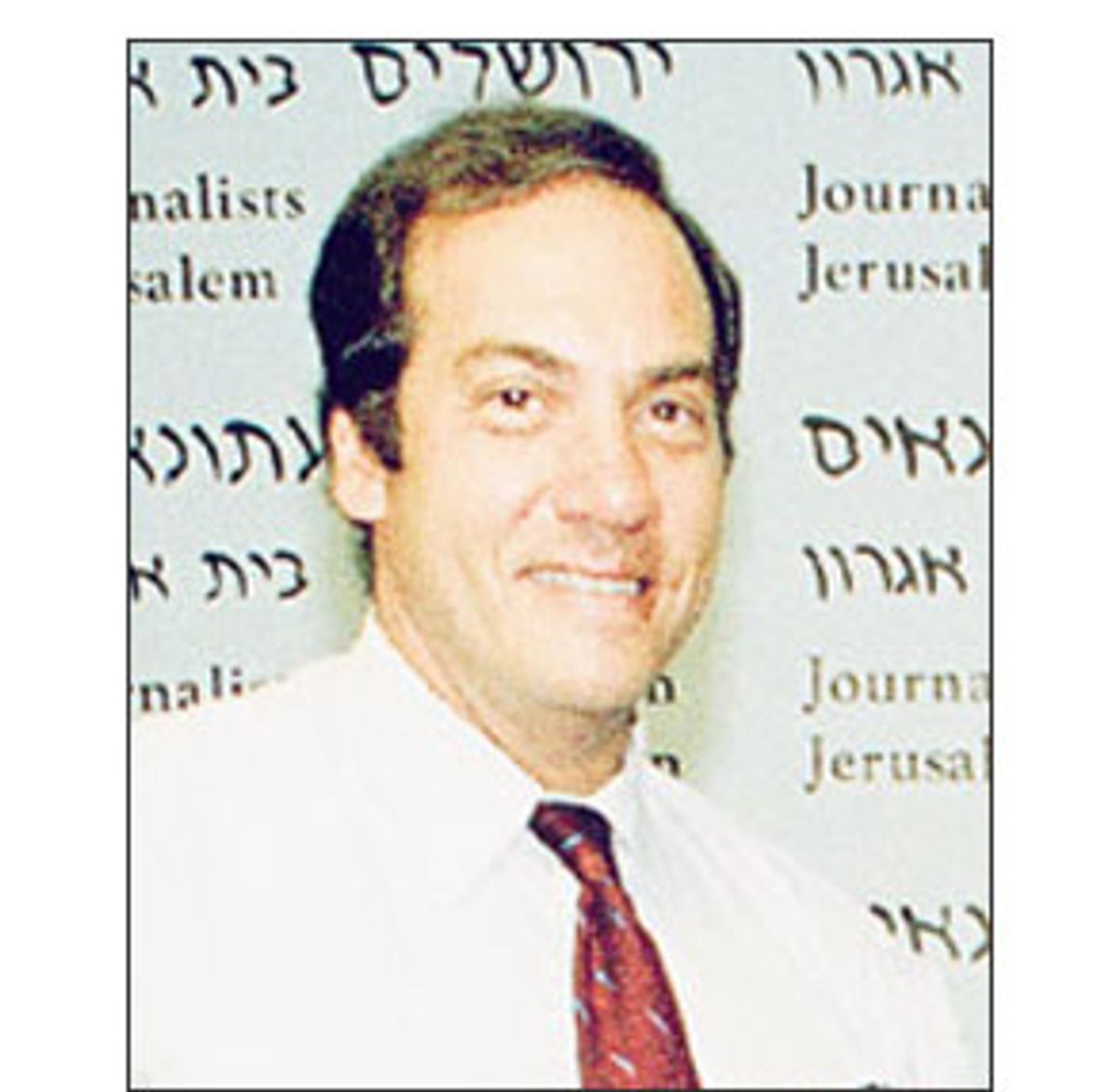
Max Blumenthal

Born-agains for Sharon

Savvy salesman Rabbi Eckstein has convinced evangelicals to support Israel -- and he's hobnobbing with the likes of Pat Robertson and Ralph Reed. But what will he do if Kerry wins?

  • more
    • All Share Services

Born-agains for Sharon

For some 7 million evangelicals at 25,000 churches worldwide, Oct. 17 was the third Annual Day of Prayer and Solidarity with Israel. For President Bush’s Southeastern regional campaign coordinator, Ralph Reed, and Israeli Prime Minister Ariel Sharon’s liaison to the U.S. evangelical community, Rabbi Yechiel Eckstein, the event was their latest attempt to rally Bush’s base to the side of Sharon. To help make their point, Eckstein and Reed summoned 21 of Israel’s diplomatic representatives in the U.S. to the pulpits of some of America’s leading conservative churches.

In Atlanta, at the Mount Paran Baptist Church, to which Reed belongs, Israel’s consul general to the Southeast, Shmuel Ben-Shmuel, shared the stage with Pastor David Cooper, author of the bestseller “Apocalypse.” Meanwhile, Israel’s ambassador to the United States, Danny Ayalon, traveled to Colorado Springs, Colo., to pay a visit to New Life Church and its senior pastor, Ted Haggard, president of the National Association of Evangelicals and a star in the glowing documentary about Bush, “Faith in the White House.”

Eckstein was confident the Annual Day of Prayer event would keep pro-Israel pressure on Bush. “Over 30 percent of the evangelical respondents to an online survey we conducted last week said support for Israel was their number one factor in electing a president, and another 61 percent identified Israel as an important factor in their choice,” he stated in a press release six days prior to the event. “This confirms what our experience tells us — evangelical support for Israel hasn’t diminished one bit. If anything, it’s stronger than ever.” Though evangelicals undoubtedly will vote overwhelmingly for Bush, the irony is that Jews in America, who support Israel for a different set of reasons than the evangelicals targeted by Eckstein do, are expected to vote overwhelmingly for John Kerry.

Evangelical support for Israel has increased dramatically in the past four years even as the country’s international reputation has suffered as a result of Sharon’s repressive, unilateral policies. To most evangelicals, Israel is “covenant land,” a place granted to the Jews in God’s covenant with Abraham; to many, Israel also represents the eventual landing pad for the Second Coming of the Messiah. While this scenario is not exactly friendly to Jews — according to premillennial theology, once biblical Israel is fully resettled and Christ returns, Jews must accept him or perish — evangelicals’ theological interest in Israel renders them fervently opposed to any territorial concessions to the Palestinians and, thus, the natural allies of Sharon and his rightist Likud Party.

Rabbi Eckstein seems to have reached the apex of his lonely, 25-year-long quest to cultivate America’s evangelical community as Israel’s financial lifeline and most ardent lobbying bloc. Once a pariah among his peers, he has gained influence through savvy salesmanship, building his International Fellowship for Christians and Jews into a philanthropic powerhouse that donates tens of millions of dollars to Israel annually. In the process, he has forged close relationships with popular right-wing evangelical leaders such as Pat Robertson and Gary Bauer, as well as White House neoconservatives like Elliott Abrams, who is in charge of Middle East policy on the National Security Council. Together, Eckstein and his allies have played an instrumental role in pressuring the Bush administration to abandon the so-called road map to peace and defend Sharon’s ham-handed handling of the occupation unconditionally.

I met with Eckstein in August at the IFCJ offices, which occupy an entire floor of a building in Chicago’s Loop. Inside his office, Eckstein reclined behind a desk, looking out over the city’s breathtaking skyline. Husky and youthful at 53, he looked more like a pro athlete than an Orthodox rabbi. (Think legendary Buffalo Bills quarterback Jim Kelly with a yarmulke.) He lives in Israel, where he serves as an informal advisor to Sharon, and was in Chicago to attend to business and visit his family.

During our meeting and an hourlong phone conversation the month before, Eckstein spoke glowingly about the Christian-Zionist alliance he has brokered. “With evangelicals, I haven’t had to change opinions like I do with the [liberal] National Council of Churches. All I have to do is tap into their abiding love for Israel,” he told me. “Since 9/11 and since the intifada, the Jewish community has become much more pragmatic; they feel Israel’s survival is at stake, and they’ve recognized the one group that stands with us boldly and proudly is this evangelical group.”

Eckstein found his calling in 1977 when he was director of inter-religious affairs for the Anti-Defamation League. When some neo-Nazis planned a provocative march in Skokie, Ill., a heavily Jewish community with numerous Holocaust survivors, the ADL sent him to Chicago to marshal Christian opposition to the march. Eckstein soon found himself in Wheaton, Ill., the epicenter of the mounting evangelical movement. It was during a meeting with the director of Wheaton College’s Bible study program and the dean of Trinity Evangelical Divinity School that Eckstein had his epiphany about the role of evangelicals.

“The Jewish community was very frightened by this phenomenon of the rising Christian right, but I came to know that evangelicals are not bogeymen; they are simply a group of serious people who felt the pendulum had swung too far to the left and that what was needed was to return to the Judeo-Christian roots.”

By 1983, Eckstein had formed the IFCJ and become a fixture at National Religious Broadcasters conferences, where he promoted tourism to the Holy Land and solicited donations for his organization. “When I started out 25 years ago, there was nobody in the field. I went to my first NRB convention and I was the only Jew there, and I went for 15 years straight,” Eckstein recalled. “What I participated in spawning has kind of caught on … Now there are 10 to 15 booths at NRB conferences selling Israeli or Jewish stuff and lots of Jews in yarmulkes walking around.”

Five years later, Eckstein was in New York helping maverick Republican presidential primary candidate Pat Robertson “mitigate Jewish opposition” to his campaign — and cultivating him and his legion of followers as supporters of Israel. In 1986, Robertson had compared non-Christians to termites deserving of “godly fumigation”; he later asserted, in the book “The New World Order,” that communism was “the brainchild of German-Jewish intellectuals.” But while Robertson may not be particularly fond of secular Jewish liberals, he has always been an ardent Christian Zionist who, in his preaching and pulp-prophecy books, refers to the Jewish presence in Jerusalem and Israel’s victory in the 1967 war as miracles presaging the Second Coming.

In 1994, when the ADL issued a scathing report blasting fundamentalist evangelicals, and Robertson’s Christian Coalition in particular, as a grave threat to Jewish life, Eckstein leaped to defend his allies. He convened a meeting in Washington between evangelical and Jewish leaders, and convinced the ADL’s director, Abe Foxman, to invite Robertson’s master tactician, Reed, to issue a call for reconciliation at ADL’s annual conference. And in a 1995 address broadcast nationally by C-Span, Reed reassured the ADL of the Christian Coalition’s commitment to a pluralistic society, recounted a moving visit to the Yad Vashem Holocaust museum in Jerusalem and issued a call for Jews and evangelicals to “move from confrontation to cooperation.” According to Eckstein, “Reed made a wonderful impression.”

The following year, Eckstein capitalized on his successes by forming the Center for Christian and Jewish Values in Washington. Co-chaired by Orthodox Jewish Sen. Joe Lieberman, D-Conn., and evangelical Sen. Sam Brownback, R-Kan., the now-defunct center, according to Eckstein, “brought together disparate groups to find common ground on issues of shared concern.” While Eckstein did bring people of different faiths under one roof, their ideological leanings were mostly uniform. The center was made up almost entirely of right-wing evangelicals like then Family Research Council director Bauer, Southern Baptist Convention executive director Richard Land and the dean of Robertson’s Regent University’s school of government, Kay James. (James is now director of the Office of Personnel Management under Bush.) Also involved were neoconservatives such as Abrams, William Kristol and William Bennett. The center was essentially a command post for the culture war.

Despite its pantheon of influential conservatives, however, the center produced little more than a flurry of symbolic resolutions calling for religious freedom in the Third World, more education for what Eckstein termed “non-abortion” and a moment of silence as an alternative to school prayer. The center also served as the platform for Lieberman, Bennett and Brownback’s censorship crusade, which ultimately amounted to a few blustery editorials blasting Hollywood’s “mental poison” and a failed bill in 1997 that would have mandated that TV manufacturers install “V-chips” allowing parents to block offensive programming.

While the center’s culture warriors soldiered on, Eckstein shifted his focus to filling the IFCJ’s coffers. By 1999, he had settled in Israel and was cruising the Holy Land in a van with his own film crew to produce a line of fundraising videos custom-tailored to evangelical tastes. In one of the videos, “Guardians of Israel,” Eckstein appears amid scenes of heart-wrenching poverty, staring directly into the camera like Mister Rogers’ long-lost brother, his hand on the shoulder of one destitute Israeli or another, pleading for Christian money. “If you don’t hear this woman’s tears, you’re not human,” Eckstein says in “Guardians of Israel,” while standing above a sobbing woman in Nazareth. In another of Ekstein’s videos, “On Wings of Eagles,” a narrator, soliciting money for his immigration program for Russian Jews, informs viewers, “Just $350 can save one Jew.”

After viewing one of these videos in 2000, the ADL’s Foxman accused Ekstein of “schnorring from non-Jews to help Jews.” However, what may seem like shameless pandering to Eckstein’s critics is, in fact, effective salesmanship to those familiar with the insular evangelical culture. When Eckstein looks into the camera with tears welling in his eyes and declares, “I couldn’t face God if I didn’t open up to you, Christians” — a phrase few Jews could imagine themselves uttering — he is appealing to the confessional tradition that stresses God’s transformative power. It is the same tradition that prompts President Bush to say, “There is only one reason I am in the Oval Office and not in a bar. I found faith.”

Eckstein’s uncanny ability to penetrate evangelical culture has fed a perception among his detractors that he is really a “Jew for Jesus.” One of Eckstein’s most strident critics, Jerusalem City Councilor Mina Fenton, has enlisted a group of high-profile rabbis in a campaign to in effect excommunicate him. Fenton points as proof of Eckstein’s crypto-Christianity to his fictional novel, “The Journey Home,” loosely based on his friendship with evangelical pastor Jamie Buckingham. In the book, Eckstein writes, “While I still don’t believe in Jesus as the Christ as Jamie does, and view him instead as a Jew who brought salvation to the gentiles, in some respects, that is exactly what I have become — a Jew for Jesus.”

In an interview with the Israeli daily Ha’aretz, Fenton accused Eckstein’s IFCJ of trying to “create a situation of dependency [of Israel on evangelical funding], so that they can control us. They pour money galore into welfare, absorption, aliyah [Jewish immigration to Israel], and education and find our weak points.” Fenton also believes that by pumping so much evangelical money into Israel, Eckstein is helping to further evangelicals’ apocalyptic “end times” agenda.

That charge has dogged Eckstein throughout his career in spite of his best efforts to defuse it. In 2003, he commissioned the Tarrance Group to conduct a poll of evangelicals’ attitudes on Israel. While a majority of respondents cited a literal belief in Genesis 12:3 — “he who blesses Israel shall be blessed” — as their primary reason for supporting Israel, a minority, albeit a large one at 28 percent, cited “reasons related to the End Times.” Even though the Tarrance Group is run by veteran GOP operative Ed Goeas, who has collaborated with Reed on numerous campaigns, Eckstein feels vindicated by the poll.

“The media portrays [evangelicals] as premillennialists who do this [support Israel] to get all the Jews to Israel, … [so] those who don’t accept Jesus will be killed. It’s just hogwash. If anything, it’s about Genesis 12:3,” said Eckstein.

Eckstein’s close associate Bauer echoed his opinion. “Among Christians, there’s just a fundamental religious idea that the Jews are God’s people and the land of Israel is covenant land that God granted them. Beyond that, what drives Christian support for Israel is that Christians tend to see U.S. foreign policy in very moral terms,” Bauer told me. “We believe Israel and the U.S. are facing the same types of totalitarian forces, and we as two countries that share the same values should stand against that.”

Away from the media’s critical eye, however, Eckstein has struck an altogether different tone. In “On Wings of Eagles,” as montages of former Israeli Prime Minister Yitzak Rabin and Palestinian leader Yasser Arafat shaking hands in Oslo in 1994 and the crumbling Twin Towers flash across the screen to an ominous soundtrack, a narrator intones, “The mosaic of events we see happening today is like a gigantic jigsaw puzzle with the pieces beginning to form the exact picture foretold by the prophets.” Next Eckstein appears standing on a mountaintop somewhere in Israel, and, before launching into a pitch for donations, says, “You can see the pieces of the puzzle that are coming together.” Is he insinuating that with so many “end times” prophecies in the headlines, evangelical support for Israel is all the more urgent? It’s unclear what else he could mean.

However controversial Eckstein’s fundraising techniques may be, they are working. His videos enjoy widespread viewership on Robertson’s Christian Broadcasting Network and through paid spots on local networks across America’s heartland. Eckstein has even organized aggressive fundraising campaigns in countries like Mexico and El Salvador, where nearly half of the population lives below the poverty line. With nearly 350,000 donors, the IFCJ was able to dole out a whopping $20 million to 250 social welfare projects in Israel last year, including an armored, mobile dental clinic that provides services to Jewish settlers in the occupied territories. Today, the IFCJ is the second largest nongovernmental donor to Israel, next only to the quasi-governmental Jewish Agency for Israel.

By building the IFCJ into a such a powerful philanthropic force, Eckstein has mollified erstwhile critics like Foxman. “I’m popular now because we give away money and that has helped leverage this whole issue [evangelical support for Israel] to give it legitimacy in the Jewish community,” Eckstein said proudly. As a testament to Eckstein’s success, in 2002 Foxman took out full-page ads in major U.S. papers, reprinting a pro-Israel Op-Ed written by Reed, then chairman of the Georgia Republican Party.

When Sharon and Bush came to power in 2000, they began a cozy relationship that has become iconic of the evangelical-Likudnik marriage Eckstein helped broker. With Eckstein as his advisor, Sharon has courted the support of evangelicals more aggressively than most of his predecessors. In the fall of 2002, for instance, Sharon told a crowd of 3,000 evangelical tourists in Jerusalem, “I tell you now, we love you. We love all of you!”

That same year, he invited Bauer to Jerusalem for a private meeting with his Cabinet. “I was given a great deal of access and a number of briefings on the various issues they’re facing,” Bauer told me. “In my meeting, … I attempted to explain that they had a much broader base of support in the U.S. than perhaps they realized and they should be sensitive to the fact that more Americans than they think regard Israel as a natural ally.” To help make his point, Bauer gave Sharon a letter of support signed by leading evangelicals like Charles Colson, Jerry Falwell and Focus on the Family president James Dobson.

As for Bush’s friendly relations with Sharon, Brent Scowcroft, national security advisor for the first President Bush, told the Financial Times this month, “I think Sharon just has [Bush] wrapped around his little finger.” Yet Bush is complaisant not only to Sharon but also to his own domestic base. After all, over the past four years, Eckstein and his evangelical allies have waged a fierce lobbying blitz to pressure Bush against participating in the Israeli-Palestinian peace process that every American president since Jimmy Carter has engaged in.

Their campaign gained momentum at the National Rally in Solidarity with Israel in April 2002 on Washington’s Mall, which was attended by over 100,000. While popular figures like author Elie Wiesel and former New York Mayor Rudy Giuliani issued fiery denunciations of Palestinian terror, the most boisterous applause of the day was reserved for evangelical radio host Janet Parshall, who boomed, “We will never give up the Golan. We will never divide Jerusalem.” None of the rally’s Jewish speakers was nearly as strident; in fact, Deputy Secretary of Defense Paul Wolfowitz, a prominent neoconservative, was booed for referring to the daily suffering endured by Palestinians under occupation. The rally coincided with the initiation of Reed and Eckstein’s Day of Prayer and Solidarity with Israel, which mobilized 17,000 evangelical churches to pray for Israel that October.

With a number of close associates now working in the White House, Eckstein and company leveraged their grass-roots muscle into high-level access. In July 2003, Eckstein brought 20 leading fundamentalist evangelicals to the White House for “a quiet meeting” with National Security Advisor Condoleezza Rice and Middle East advisor Abrams. There, delegation members stated their fervent opposition to the Israeli-Palestinian road map while Rice explained the administration’s sympathy for their position. Rice “talked about her religiousness and how her father was a Baptist minister,” Eckstein recalled. “And she explained the administration’s position: It’s Bush’s faith that prompts him to take some of his major positions. I think that’s what’s so attractive about Bush to people,” Eckstein added. “You can become relativistic, but what’s needed is black and white.”

Alhough Eckstein says his meeting with Rice marked the first time leaders of the Christian right had met with a high-level White House official on Israel policy, it wasn’t the last. As Rick Perlstein of the Village Voice reported, in March Abrams met with leaders of a self-identified “theocratical” lobbying group, the Apostolic Congress, to allay their concerns about Bush’s pending endorsement of Sharon’s Gaza pullout plan. And evangelical leaders like late Religious Roundtable director Ed McAteer have reportedly held numerous off-the-record meetings on policy toward Israel with White House public liaison Tim Goeglein, who was the spokesman for Bauer’s 2000 presidential campaign.

Curiously, Eckstein refused to tell me who was among the delegation he brought to the White House, though he did mention that Bauer was pointedly uninvited as punishment for running against Bush in the 2000 Republican presidential primaries and attacking him as insufficiently conservative. Yet lack of direct access hasn’t prevented the wily Bauer from influencing White House policy on Israel. When the Bush administration criticized Israel’s botched assassination of Hamas leader Abdel Aziz Rantisi in June 2003, Bauer e-mailed an alert to 100,000 followers calling for pro-Israel pressure on the White House. “We inundated the White House with e-mails and faxes arguing that Israel had the same right to defend itself as we did. In very short order, the tone of the White House changed dramatically, and I believe it was the reaction of Christian conservatives in favor of Israel that changed the tone,” Bauer said. And when Israel did kill Rantisi in April, the White House issued the now boilerplate statement of support for Israel’s “right to defend herself.”

Bauer’s influence earned him the keynote address at the 2003 annual convention of pro-Israel lobbying powerhouse AIPAC (American Israel Public Affairs Committee), where he says he was interrupted 12 times by standing ovations. Bauer has also played a leading role in lobbying on behalf of Israeli settler groups (he refused to say which ones) against both the road map and Sharon’s Gaza pullout plan. “Off and on over the years I have met with various groups in the West Bank, and they’ve come to the U.S. I’ve given them my best read on what the lay of the land is in Washington and how they might be more effective in getting their message out here,” Bauer said. “I oppose ethnic cleansing, and the idea that the West Bank or Gaza should be a Jew-free zone is deeply offensive,” he added.

Bauer, unlike Eckstein, who is beholden to Sharon and his Gaza policy, has little to lose and everything to gain by working with Israel’s most reactionary elements. Through his political action committee, the Campaign for Working Families, Bauer is aggressively soliciting donations from conservative Christians for the Bush campaign while plugging the latest version of the GOP’s anti-Kerry “flip-flop” attack on his group’s Web site. Bauer ostensibly hopes that by backing Bush, he can heal the wounds his 2000 primary run opened and, if Bush wins, earn back his place at the grown-ups table.

Although Eckstein says he’s a registered Democrat, he has converted to Bush’s side and is urging other Jews to join him. “I personally think the Jewish community and America should vote for Bush because I think he will be stronger on terrorism. And anything less than a full confrontation [with terrorists] has the potential, God forbid, to spell the end of Western civilization as we know it,” Eckstein said. “I, like many Jews, support John Kerry’s domestic agenda, and that’s why I think many Jews are struggling with this choice in a big way.”

Whether or not Jews have struggled with their choice, most are supporting Kerry. A nonpartisan poll taken by the American Jewish Committee in September showed 69 percent of Jews supporting Kerry, compared with 24 percent for Bush. The poll’s other findings reveal strong Jewish opposition to Bush’s policies on social issues, but overwhelming support for further dismantling of Jewish settlements in the occupied territories, an issue Kerry has studiously avoided and Bush has refused to press with Sharon.

Another factor in Jewish support for Kerry is his unabashedly pro-Israel platform. To reinforce Kerry’s message, his campaign in July released a policy paper, “Strengthening Israel’s Security and Bolstering the US-Israel Special Relationship,” stating positions on the Gaza pullout and Israel’s separation wall that are identical to Bush’s.

But if Kerry is elected, members of the Christian-Zionist lobby should not expect any backslaps from the new president. With Bush back in Crawford, Texas, Eckstein and company’s White House soul mates would have to return to their think-tank fellowships and academic jobs, severely compromising the influence and access the lobby has worked for over two decades to attain.

Already, Bauer is grumbling, “I would be happy if Kerry was overall pro-Israel, but I would have to caution that before the race got going in earnest, Senator Kerry repeatedly said where the president failed in not having a balanced approach in the Middle East. A balanced approach is the last thing I would want.”

Continue Reading Close

James O’Keefe’s race problem

A photo of the righty stuntman at a white-nationalist confab illustrates a career marked by racial resentment

  • more
    • All Share Services

Topics: ,

James O'Keefe's race problemJames O'Keefe, photographed at a white nationalist conference by One People's Project.

(This article has been corrected since publication.)

Many of the conservatives who gleefully promoted James O’Keefe’s past political stunts are feigning shock at his arrest on charges that he and three associates planned to tamper with Louisiana Sen. Mary Landrieu’s phone lines. Once upon a time, right-wing pundits hailed the 25-year-old O’Keefe as a creative genius and model of journalistic ethics. Andrew Breitbart, who has paid O’Keefe, called him one of the all-time “great journalists” and said he deserved a Pulitzer for his undercover ACORN video. Fox News’ Bill O’Reilly declared he should have earned a “congressional medal.”

His right-wing admirers don’t seem to mind that O’Keefe’s short but storied career has been defined by a series of political stunts shot through with racial resentment. Now an activist organization that monitors hate groups has produced a photo of O’Keefe at a 2006 conference on “Race and Conservatism” that featured leading white nationalists. The photo, first published Jan. 30  on the Web site of the anti-racism group One People’s Project, shows O’Keefe at the gathering, which was so controversial even the ultra-right Leadership Institute, which employed O’Keefe at the time, withdrew its backing. O’Keefe’s fellow young conservative provocateur Marcus Epstein organized the event, which gave anti-Semites, professional racists and proponents of Aryanism an opportunity to share their grievances and plans to make inroads in the GOP.

One People’s Project covered the event at the time, sending a freelance photographer to document the gathering. Project director Daryle Jenkins told O’Keefe manned a literature table  filled with tracts from the white supremacist right, including two pseudo-academic publications that have called blacks and Latinos genetically inferior to whites: American Renaissance and the Occidental Quarterly.  The leading speaker was Jared Taylor, founder of the white nationalist group American Renaissance. “We can say for certain that James O’Keefe was at the 2006 meeting with Jared Taylor. He has absolutely no way of denying that,” Jenkins said. O’Keefe’s attorney did not respond to a request for comment on his client’s role in the conference.

[Subsequent to publication, freelance photographer Isis told Salon she saw O'Keefe helping with the event and believed he staffed the literature table, but her only photograph of O'Keefe was cropped so that the literature table isn't evident. "He was helping Marcus Epstein in the execution of the event," the photographer recalls. "O’Keefe was involved the same way you would be involved if you went to a party and you put out the cups and stocked the cooler.”]

O’Keefe’s racial issues can be seen in many of his prior stunts The notorious ACORN videos highlighted images of himself dressed as a pimp, deceptively edited through hidden camera footage as he baited African-American office workers into making statements that could be perceived as incriminating. There were also lesser-known but equally inflammatory  spectacles like the “affirmative action bake sale” O’Keefe and his conservative comrades held when they were students at Rutgers University. During the event, O’Keefe stood at a table in the center of campus offering baked goods at reduced prices to Latinos and African-Americans while whites were forced to pay exorbitant amounts. (Native Americans, he announced, would eat free.)

By O’Keefe’s own account, his racial troubles became acute when he entered the multicultural atmosphere of Rutgers University’s dormitory system. In an online diary that has since been scrubbed from the Web (but not before being captured on Daily Kos), he wrote that he was forced to live on an all-black dormitory floor after refusing to live with the gay roommate he was initially assigned. O’Keefe claimed his next roommate was “an Indian midget … who smelled like shit.” The roommate left, however, and was replaced by “a greek kid.” The new roommate complained to a residential administrator that O’Keefe had called his neighbors “niggers,” prompting the school to expel him from the dorm. He rejected the accusation as a “complete lie,” writing, “I was lead out of the room crying and screaming at him and my situation, no friends, no one one [sic] to talk to, forced to go in front of a black man, Dean Tolbert, to defend myself and help explain that I did not call anyone any names.”

The following year, despite this record, O’Keefe secured a dream job in the conservative movement, employed by the Leadership Institute, a Northern Virginia-based outfit that serves as the movement’s most prolific youth training operation. There, O’Keefe met Marcus Epstein, a fellow ideologue who as editor of a conservative publication at the College of William and Mary assailed Martin Luther King Jr. for “philandering and plagiarism” and challenged his patriotism and Christianity.

In August 2006 Epstein planned an event that would wed his extreme views on race with his ambitions. Epstein invited white nationalist  Jared Taylor  and homophobic white-grievance peddler John Derbyshire of the National Review to speak at the Leadership Institute’s Northern Virginia headquarters, at a mock symposium called “Race and Conservatism.”

According to a post on the white supremacist Web site Stormfront, Taylor and Derbyshire debated “the role of race in policy decisions and the racial future of the Republican party.”

When the Southern Poverty Law Center denounced Taylor’s participation in the event, sparking damaging publicity for the Institute, Epstein shifted it across the street, where he played host under the auspices of a “traditionalist” group he founded called the Robert A. Taft Club. O’Keefe joined him after the last-minute move. A speaker from the right-wing black front group Project 21, led by white conservative David Almasi, was added at the last minute.

According to One People’s Project, which dispatched an undercover reporter to the event, about 40 people attended the event, including several white supremacists. They included Michael Hart, a Jewish astrophysicist and advocate of racially partitioning the U.S., who once clashed with David Duke at a conference over the Ku Klux Klan leader’s anti-Semitism.

The event’s headline speaker, Jared Taylor, is the publisher of one of the white supremacist movement’s foremost journals, American Renaissance, which seeks to apply an academic gloss to the racialist screeds contained on its pages. According to a report on the conference published in Taylor’s magazine, Taylor argued that a taboo against discussing the alleged criminal behavior and lower intelligence of blacks and Latinos twisted political discourse, and he advocated a strong white nationalism to counter it. Derbyshire denounced “this whole rickety apparatus of affirmative action, discrimination lawsuits, corporate shakedowns, profiling protests and ‘speech codes.’” But the National Review editor expressed doubt that a sufficiently large white nationalist movement could be mustered to do much about it.

Epstein and O’Keefe moved on from the “Race and Conservatism” conference to better things. After graduating from the Leadership Institute, Epstein held jobs as executive director of both former Republican Rep. Tom Tancredo’s Team America PAC and Pat Buchanan’s American Cause. He also started a group called Youth for Western Civilization that dedicated itself to “defending the West on campus.” An essay featured on the group’s Web site complaining that “largely Jewish intellectual elites have utterly transformed American social and political discourse” suggested that Epstein’s outfit was only his latest attempt to push white nationalism and anti-Semitism into the conservative mainstream.

Epstein’s career unraveled in June 2009, when a violent racial assault he committed two years earlier was disclosed. According to a court affidavit, Epstein had karate-chopped a random African-American woman in the face and called her a “nigger” during a drunken late-night romp bar-hopping on Washington’s M Street in 2007, leading to his arrest by an off-duty Secret Service agent. He signed a plea bargain requiring him to attend alcohol rehabilitation courses and donate $1,000 to the United Negro College Fund as a token of his contrition.

Meanwhile, O’Keefe lost his job at the Leadership Institute in 2007 after a prank call he made to an Ohio-based Planned Parenthood clinic. During the call, O’Keefe offered a donation to the clinic on the condition that it would be earmarked to pay for aborting African-American fetuses. “Because there’s definitely way too many black people in Ohio,” O’Keefe remarked to the receptionist. “So, I’m just trying to do my part.” Leadership Institute founder Morton Blackwell said O’Keefe’s stunts went beyond the right-wing group’s standards. “He wanted to do sting operations that would affect legislation; he made some calls which have been covered in the news media to Planned Parenthood,” Blackwell told the New York Times. “That was beyond the scope of what we had hired him to do. We are an educational organization. We are not an activist organization.” Blackwell told O’Keefe he had to choose between his job and his activism, “and he said he was committed to the activism,” according to the Times.

O’Keefe’s termination by the Leadership Institute hardly ended his career as a conservative activist. Right-wing online publicist Andrew Breitbart, hearing of the merry prankster’s exploits, hired him to carry out the ACORN operation that would make him famous. Since his arrest, however, some of O’Keefe’s former associates are scrambling to save face. “I am shocked by the reports of this behavior,” declared O’Keefe’s collaborator on the ACORN operation, Hannah Giles. (Giles had tarted up as a prostitute for the stunt.)

O’Keefe has now hired a defense attorney and is waging a high publicity battle against charges that could land him in prison for nearly a year. Some of his old allies, like Breitbart, remain in his corner. Fox News’ Sean Hannity hosted O’Keefe for a sympathetic sitdown Feb. 1, where the young right-winger played victim, claiming he was being persecuted by “flat-out slandering” and “journalistic malpractice.”

Continue Reading Close

The new Palin campaign commences

Her publicity blitz begins today -- and all the slings and arrows will only make her stronger

  • more
    • All Share Services

Topics: , , ,

The new Palin campaign commencesIn this photo taken Wednesday, Nov. 11, 2009 and released Friday, Nov. 13, 2009 by Harpo Productions, Inc., seen is talk-show host Oprah Winfrey, second from right, with former Republican vice presidential candidate Sarah Palin and her daughters, Willow, right, and Piper, left, during the taping of "The Oprah Winfrey Show" in Chicago. The show will air on Monday, Nov. 16. (AP Photo/Harpo Productions, Inc., George Burns) ** MANDATORY CREDIT: Harpo Productions, George Burns. NO SALES **(Credit: AP)

Sarah Palin’s heavily publicized book tour begins in earnest this Monday, but weeks before, her ghostwritten memoir, Going Rogue: An American Life, had already vaulted into the number one position at Amazon. Warming up for a tour that will take her across Middle America in a bus, Palin tested her lines in a November 7th speech before a crowd of 5,000 anti-abortion activists in Wisconsin. She promptly cited an urban legend as a “disturbing trend,” claiming the Treasury Department had moved the phrase “In God We Trust” from presidential dollar coins. (The rumor most likely originated with a 2006 story on the far-right website WorldNetDaily.)

In fact, a suggested alteration in its position on the coin was shot down in 2007 after pressure from Democratic Senator Robert Byrd. Nonetheless, Palin did not hesitate to take up this “controversy,” however false, since it conveniently pits a tyrannical, God-destroying, secular big government against humble God-fearing folk. In doing so, of course, she presented herself as this nation’s leading defender of the faith.

In a Republican Party hoping to rebound in 2010 on the strength of a newly energized and ideologically aroused conservative grassroots, Palin’s influence is now unparalleled. Through her Facebook page, she was the one who pushed the rumor of “death panels” into the national healthcare debate, prompting the White House to issue a series of defensive responses. Unfazed by its absurdity, she repeated the charge in her recent speech in Wisconsin. In a special congressional election in New York’s 23rd congressional district, Palin’s endorsement of Doug Hoffman, an unknown far-right third-party candidate, helped force a popular moderate Republican politician, Dede Scozzafava, from the race. In the end, Palin’s ideological purge in upstate New York led to an improbable Democratic victory, the first in that GOP-heavy district in more than 100 years.

Though the ideological purge may have backfired, Palin’s participation in it magnified her influence in the party. In a telling sign of this, Congressman Mark Kirk, a pro-choice Republican from the posh suburban North Shore of Chicago, running for the Senate in Illinois, issued an anxious call for Palin’s support while she campaigned for Hoffman. According to a Kirk campaign memo, the candidate was terrified that Palin would be asked about his candidacy during her scheduled appearance on the Chicago-based Oprah Winfrey Show later this month — the kick-off for her book tour — and would not react enthusiastically. With $2.3 million in campaign cash and no viable primary challengers, Kirk was still desperate to avoid Palin-backed attacks from his right flank, however hypothetical they might be.

“She’s gangbusters!” a leading conservative radio host exclaimed to me. “There is nobody in the Republican Party who can raise money like her or top her name recognition.”

During the 2008 presidential race, some Republican Party elders warned of Palin’s destructive influence. They insisted she was a polarizing figure whose extremism would accelerate the Party’s slide toward the political and cultural margins. New York Times columnist David Brooks, a card-carrying neocon who had written glowingly of Senator John McCain, claimed Palin represented “a fatal cancer to the Republican Party.” Peggy Noonan, a former speechwriter for President Reagan and columnist for the Wall Street Journal, blasted Palin as “a dope and unqualified from the start.” Last June, Steve Schmidt, the former McCain campaign chief of staff, warned that Palin’s nomination as the GOP’s 2012 presidential nominee would be “catastrophic.”

New polling data appears to support such doomsday prophecies. According to an October 19th Gallup poll, the former governor of Alaska has become one of the most polarizing and unpopular politicians in the country. Since she quit the governorship to pursue her lucrative book deal, a move that upset many in Alaska’s Republican leadership and cost the state’s taxpayers almost $200,000, her unfavorability rating has spiked to 50 percent while her favorability has sunk to 40 percent, again according to Gallup’s figures. (The only nationally-known politician who is less popular right now, according to the poll, is John Edwards, the former one-term senator who fathered a child out of wedlock and paid his mistress hush money while campaigning for the Democratic presidential nomination on a social justice platform.)

Queen Esther

If Palin is indeed a cancer on the GOP, why can’t the Republican establishment retire her to a quiet life of moose hunting in the political wilderness? Why has her appeal only increased in the wake of her catastrophic political expeditions? Why won’t she listen to, or abide by, conventional political wisdom?

The answer lies beyond the realm of polls and punditry in the political psychology of the movement that animates and, to a great degree, controls, the Republican grassroots — a uniquely evangelical subculture defined by the personal crises of its believers and their perceived persecution at the hands of cosmopolitan elites.

By emphasizing her own crises and her victimization by the “liberal media,” Palin has established an invisible, indissoluble bond with adherents of that subculture — so visceral it transcends any rational political analysis. As a result, her career has become a vehicle through which the right-wing evangelical movement feels it can express its deepest identity in opposition both to secular society and to its representatives in the Obama White House. Palin is perceived by its leaders — and followers — not as another cynical politician or even as a self-promoting celebrity, but as a kind of magical helper, the God-fearing glamour girl who parachuted into their backwater towns to lift them from the drudgery of everyday life, assuring them that they represented the “Real America.”

If McCain had taken his preferred choice for a running mate in 2008, he would have chosen Joseph Lieberman, the turncoat Democrat and his best friend in the Senate. But with the base of the Republican Party subsumed by a Christian right that detested the senator, his advisors urged him to choose the untested, virtually unknown Alaskan governor to bring the faithful back to him. Their gamble paid off — at least in the short-term. When Palin was revealed as the vice presidential nominee at an off-the-record gathering of the Council for National Policy, a secretive cabal of the conservative movement’s top financiers and activists, Tom Minnery of the Christian right outfit Focus on the Family recalled, “People were on their seats applauding cheering, yelling… that room was electrified.”

Before her nomination, the provincial Palin had traveled outside the country only once and demonstrated little, if any, intellectual curiosity. During the campaign, she was flummoxed when CBS Evening News anchor Katie Couric simply asked what magazines she read. Yet the fact that she had such a limited understanding of the world actually recommended her to the Republican base.

The gun-toting, snowmobile-cruising former beauty queen became an instant cultural icon. Little understood by those outside this culture was her religious worldview, cultivated during the 20 years she spent worshipping at the Wasilla Assembly of God, a right-wing Pentecostal church in her hometown north of Anchorage. When I visited the church in October 2008, a pastor from Kenya, Bishop Thomas Muthee, was at the podium comparing Palin to Queen Esther, the biblical queen who used her wiles to intercede for her people. The reference was clear enough: Palin, the former beauty pageant contestant who had chosen Esther as her biblical role model when she first entered politics, would topple America’s secular tyrants, leading her people, the true Christians, into the kingdom. As he concluded his sermon, Muthee gesticulated wildly and spoke in tongues, urging parishioners to “come against the spirit of witchcraft as the body of Christ.”

Three years earlier, in 2005, Muthee had anointed Palin during a public ceremony at the Wasilla Assembly of God, laying his hand on her forehead while praying to protect her “against all forms of witchcraft.” The bishop claimed that he had personally battled a witch in his hometown of Kiambu, Kenya, driving the evildoer from the town and thereby ending an epidemic of crime and licentiousness. The episode was later revealed as a farce by a reporter from Women’s eNews who traveled to Kiambu and found the supposed witch, a local healer named Mama Jane, still living happily in her compound. In palling around with Muthee, whom she credited with helping propel her into the governor’s mansion by anointing her, Palin revealed herself as an authentic religious zealot. Whatever her flaws might have been, this was what mattered to the movement in 2008 — and what matters now.

Once Palin was nominated, her sixteen-year-old daughter Bristol (named for Bristol Bay, Alaska) became the subject of ferocious media scrutiny. She had, it turned out, been impregnated by Levi Johnston, a local eighteen-year-old jock who identified himself on his MySpace page as “a f**kin’ redneck.” To media outsiders, Bristol’s out-of-wedlock pregnancy was particularly startling, given Palin’s advocacy of abstinence-only education. In the eyes of many liberals, Palin had been revealed as but another family-values hypocrite, but to members of the Christian right, she was something quite different — a glamorized version of themselves. As the Palin family became a staple of late-night comedy monologues, Palin fought back against the secular enemy, slamming David Letterman for “sexually perverted jokes” about her daughter. With that, the movement’s adulation for her overflowed.

The culture of personal crisis

Palin’s daughter’s drama caught vividly a culture of personal crisis that defines so many evangelical communities across the country. That culture is described in a landmark congressionally funded study of adolescent behavior, Add Health, revealing that white evangelical women like Bristol Palin lose their virginity, on average, at age 16 — earlier, that is, than any group except black Protestants.

Another recent study by sociologists Peter Bearman and Hannah Bruckner notes that over half of evangelical girls who have pledged to maintain their virginity until marriage wind up having sex before marriage, and with a man other than their future husband. Bearman and Bruckner also disclose that communities with the highest population of girls who attend so-called purity balls, where they vow chastity until marriage before their fathers in a prom-like religious ceremony, also have some of the country’s highest rates of sexually transmitted diseases. In Lubbock, Texas, where abstinence education has been mandated since 1995, the rate of gonorrhea is now double the national average, while teen pregnancy has spiked to the highest levels in the state.

“So many families deal with the same issues Sarah Palin is dealing with, so we really can relate to what she is going through,” Grace Van Diest, a middle-aged Alaskan delegate from Wasilla, told me on the floor of the 2008 Republican National Convention. Van Diest then described how each of her daughters went on “a date with their dad” to discuss their pledge to “keep themselves pure until marriage.”

Palin consolidated her bond with the movement in another very personal way. She cradled her new son Trig, born with Downs Syndrome, before the klieg lights. Her husband Todd had chosen the name believing it was Norse for “strength.” (“Trygg” actually means “safe” or “reliable” in Norwegian.) Palin’s decision to carry the baby to term excited many evangelicals and anti-abortion activists, including James Dobson, who wrote a letter congratulating her for having what he called “that little Downs Syndrome baby.” “What a way to emphasize your pro-life leanings there!” he exclaimed during a radio broadcast in which he endorsed the McCain-Palin ticket, even though he had denounced McCain as a “liberal” only weeks before.

After the market collapsed in the fall of 2008 and the McCain campaign ran off the rails, Palin untethered herself — as her book title has it, she went “rogue” — ignoring McCain’s rules on attacking Obama. Instead, she lashed out at candidate Obama in her own distinctive way. “This is a man who launched his political career in the living room of a domestic terrorist,” she insisted. “This is not a man who sees America the way you and I see America.” With these two lines, apparently uttered without the permission of McCain or his top aides, Palin opened up a deep schism within the campaign, while unleashing a flood of emotions from the depths of the Party faithful.

“Kill him!” a man shouted at a campaign rally in Clearwater, Florida, when Palin linked Obama to terrorism, according to Washington Post reporter Dana Milbank.

The next time she mentioned Obama, another man cried out, “Terrorist!” “Treason!”

“Go back to Kenya!” a woman typically screamed during a Palin rally in Des Moines, Iowa.

While Obama entertained visions of a blissful post-partisan, post-racial America, Palin almost single-handedly gave birth to the birthers who would, after his inauguration, dedicate themselves to proving he was not, by birth, an American. By “going rogue,” Palin instinctively and craftily propelled her ambitions beyond Election Day, and so anointed herself as the movement’s magical helper in the Obama era.

Elevated by yesterday’s man, Palin now represents her Party’s future — and the greatest danger it faces. Her intimate bond with the Republican grassroots has made her the indispensable woman, even if she provokes a visceral sense of revulsion from many independents and moderates. Other Republican frontrunners like former Massachusetts Governor Mitt Romney and Minnesota Governor Tim Pawlenty have a debilitating problem to face in any race for the presidency: they are viewed as inauthentic candidates by the movement — cardboard men in suits who are only pantomiming appeals to cultural resentment.

Mike Huckabee, an ordained Baptist minister who understands the nuances of evangelical culture, nonetheless bears the burden of being a 2008 primary loser. At that time, the former governor of Arkansas had a clear field when it came to the religious right, but was unable to expand beyond his Southern bastions of support.

Palin was, after all, chosen. She never lost a primary — and it was McCain who lost the race. If Huckabee sought to run again for the nomination, he might have to compete against her for the allegiance of the evangelical constituency.

Nor can she be easily criticized. Palin is so well positioned as the darling of the movement that any criticism of her would be experienced by believers as a personal attack on them. In this way, their identification with her through the politics of personal crisis is complete. Any Republican primary challenger assailing Palin will be seen as victimizing her, as channeling the attacks of the liberal elites, and possibly as having a secret liberal agenda. On the other hand, to embrace her is to risk losing the great American center.

For the 2010 mid-term elections, Palin’s endorsement is already a coveted commodity — as Mark Kirk’s desperate bid to secure it demonstrates. The more she is attacked, the more the Republican base adores her. As she sets out on her book tour, the slings and arrows of outrageous fortune only propel her forward. Her influence on a party largely devoid of leadership is expanding. If she doesn’t prove to be the Party’s future queen, she may have positioned herself to be its future king-maker — and potentially its destroyer. You betcha.

Continue Reading Close

Meet Sarah Palin’s radical right-wing pals

Extremists Mark Chryson and Steve Stoll helped launch Palin's political career in Alaska, and in return had influence over policy. "Her door was open," says Chryson -- and still is.

  • more
    • All Share Services

Topics: ,

Meet Sarah Palin's radical right-wing pals

On the afternoon of Sept. 24 in downtown Palmer, Alaska, as the sun began to sink behind the snowcapped mountains that flank the picturesque Mat-Su Valley, 51-year-old Mark Chryson sat for an hour on a park bench, reveling in tales of his days as chairman of the Alaska Independence Party. The stocky, gray-haired computer technician waxed nostalgic about quixotic battles to eliminate taxes, support the “traditional family” and secede from the United States.

So long as Alaska remained under the boot of the federal government, said Chryson, the AIP had to stand on guard to stymie a New World Order. He invited a Salon reporter to see a few items inside his pickup truck that were intended for his personal protection. “This here is my attack dog,” he said with a chuckle, handing the reporter an exuberant 8-pound papillon from his passenger seat. “Her name is Suzy.” Then he pulled a 9-millimeter Makarov PM pistol — once the standard-issue sidearm for Soviet cops — out of his glove compartment. “I’ve got enough weaponry to raise a small army in my basement,” he said, clutching the gun in his palm. “Then again, so do most Alaskans.” But Chryson added a message of reassurance to residents of that faraway place some Alaskans call “the 48.” “We want to go our separate ways,” he said, “but we are not going to kill you.”

Though Chryson belongs to a fringe political party, one that advocates the secession of Alaska from the Union, and that organizes with other like-minded secessionist movements from Canada to the Deep South, he is not without peculiar influence in state politics, especially the rise of Sarah Palin. An obscure figure outside of Alaska, Chryson has been a political fixture in the hometown of the Republican vice-presidential nominee for over a decade. During the 1990s, when Chryson directed the AIP, he and another radical right-winger, Steve Stoll, played a quiet but pivotal role in electing Palin as mayor of Wasilla and shaping her political agenda afterward. Both Stoll and Chryson not only contributed to Palin’s campaign financially, they played major behind-the-scenes roles in the Palin camp before, during and after her victory.

Palin backed Chryson as he successfully advanced a host of anti-tax, pro-gun initiatives, including one that altered the state Constitution’s language to better facilitate the formation of anti-government militias. She joined in their vendetta against several local officials they disliked, and listened to their advice about hiring. She attempted to name Stoll, a John Birch Society activist known in the Mat-Su Valley as “Black Helicopter Steve,” to an empty Wasilla City Council seat. “Every time I showed up her door was open,” said Chryson. “And that policy continued when she became governor.”

When Chryson first met Sarah Palin, however, he didn’t really trust her politically. It was the early 1990s, when he was a member of a local libertarian pressure group called SAGE, or Standing Against Government Excess. (SAGE’s founder, Tammy McGraw, was Palin’s birth coach.) Palin was a leader in a pro-sales-tax citizens group called WOW, or Watch Over Wasilla, earning a political credential before her 1992 campaign for City Council. Though he was impressed by her interpersonal skills, Chryson greeted Palin’s election warily, thinking she was too close to the Democrats on the council and too pro-tax.

But soon, Palin and Chryson discovered they could be useful to each other. Palin would be running for mayor, while Chryson was about to take over the chairmanship of the Alaska Independence Party, which at its peak in 1990 had managed to elect a governor.

The AIP was born of the vision of “Old Joe” Vogler, a hard-bitten former gold miner who hated the government of the United States almost as much as he hated wolves and environmentalists. His resentment peaked during the early 1970s when the federal government began installing Alaska’s oil and gas pipeline. Fueled by raw rage — “The United States has made a colony of Alaska,” he told author John McPhee in 1977 — Vogler declared a maverick candidacy for the governorship in 1982. Though he lost, Old Joe became a force to be reckoned with, as well as a constant source of amusement for Alaska’s political class. During a gubernatorial debate in 1982, Vogler proposed using nuclear weapons to obliterate the glaciers blocking roadways to Juneau. “There’s gold under there!” he exclaimed.

Vogler made another failed run for the governor’s mansion in 1986. But the AIP’s fortunes shifted suddenly four years later when Vogler convinced Richard Nixon’s former interior secretary, Wally Hickel, to run for governor under his party’s banner. Hickel coasted to victory, outflanking a moderate Republican and a centrist Democrat. An archconservative Republican running under the AIP candidate, Jack Coghill, was elected lieutenant governor.

Hickel’s subsequent failure as governor to press for a vote on Alaskan independence rankled Old Joe. With sponsorship from the Islamic Republic of Iran, Vogler was scheduled to present his case for Alaskan secession before the United Nations General Assembly in the late spring of 1993. But before he could, Old Joe’s long, strange political career ended tragically that May when he was murdered by a fellow secessionist.

Hickel rejoined the Republican Party the year after Vogler’s death and didn’t run for reelection. Lt. Gov. Coghill’s campaign to succeed him as the AIP candidate for governor ended in disaster; he peeled away just enough votes from the Republican, Jim Campbell, to throw the gubernatorial election to Democrat Tony Knowles.

Despite the disaster, Coghill hung on as AIP chairman for three more years. When he was asked to resign in 1997, Mark Chryson replaced him. Chryson pursued a dual policy of cozying up to secessionist and right-wing groups in Alaska and elsewhere while also attempting to replicate the AIP’s success with Hickel in infiltrating the mainstream.

Unlike some radical right-wingers, Chryson doesn’t put forward his ideas  freighted with anger or paranoia. And in a state where defense of gun and property rights often takes on a real religious fervor, Chryson was able to present himself  as a typical Alaskan.

He rose through party ranks by reducing the AIP’s platform to a single page that “90 percent of Alaskans could agree with.” This meant scrubbing the old platform of what Chryson called “racist language” while accommodating the state’s growing Christian right movement by emphasizing the AIP’s commitment to the “traditional family.”

“The AIP is very family-oriented,” Chryson explained. “We’re for the traditional family — daddy, mommy, kids — because we all know that it was Adam and Eve, not Adam and Steve. And we don’t care if Heather has two mommies. That’s not a traditional family.”

Chryson further streamlined the AIP’s platform by softening its secessionist language. Instead of calling for immediate separation from the United States, the platform now demands a vote on independence.

Yet Chryson maintains that his party remains committed to full independence. “The Alaskan Independence Party has got links to almost every independence-minded movement in the world,” Chryson exclaimed. “And Alaska is not the only place that’s about separation. There’s at least 30 different states that are talking about some type of separation from the United States.”

This has meant rubbing shoulders and forging alliances with outright white supremacists and far-right theocrats, particularly those who dominate the proceedings at such gatherings as the North American Secessionist conventions, which AIP delegates have attended in recent years. The AIP’s affiliation with neo-Confederate organizations is motivated as much by ideological affinity as by organizational convenience. Indeed, Chryson makes no secret of his sympathy for the Lost Cause. “Should the Confederate states have been allowed to separate and go their peaceful ways?” Chryson asked rhetorically. “Yes. The War of Northern Aggression, or the Civil War, or the War Between the States — however you want to refer to it — was not about slavery, it was about states’ rights.”

Another far-right organization with whom the AIP has long been aligned is Howard Phillips’ militia-minded Constitution Party. The AIP has been listed as the Constitution Party’s state affiliate since the late 1990s, and it has endorsed the Constitution Party’s presidential candidates (Michael Peroutka and Chuck Baldwin) in the past two elections.

The Constitution Party boasts an openly theocratic platform that reads, “It is our goal to limit the federal government to its delegated, enumerated, Constitutional functions and to restore American jurisprudence to its original Biblical common-law foundations.” In its 1990s incarnation as the U.S. Taxpayers Party, it was on the front lines in promoting the “militia” movement, and a significant portion of its membership comprises former and current militia members.

At its 1992 convention, the AIP hosted both Phillips — the USTP’s presidential candidate — and militia-movement leader Col. James “Bo” Gritz, who was campaigning for president under the banner of the far-right Populist Party. According to Chryson, AIP regulars heavily supported Gritz, but the party deferred to Phillips’ presence and issued no official endorsements.

In Wasilla, the AIP became powerful by proxy — because of Chryson and Stoll’s alliance with Sarah Palin. Chryson and Stoll had found themselves in constant opposition to policies of Wasilla’s Democratic mayor, who started his three-term, nine-year tenure in 1987. By 1992, Chryson and Stoll had begun convening regular protests outside City Council. Their demonstrations invariably involved grievances against any and all forms of “socialist government,” from city planning to public education. Stoll shared Chryson’s conspiratorial views: “The rumor was that he had wrapped his guns in plastic and buried them in his yard so he could get them after the New World Order took over,” Stein told a reporter.

Chryson did not trust Palin when she joined the City Council in 1992. He claimed that she was handpicked by Democratic City Council leaders and by Wasilla’s Democratic mayor, John Stein, to rubber-stamp their tax hike proposals. “When I first met her,” he said, “I thought she was extremely left. But I’ve watched her slowly as she’s become more pronounced in her conservative ideology.”

Palin was well aware of Chryson’s views. “She knew my beliefs,” Chryson said. “The entire state knew my beliefs. I wasn’t afraid of being on the news, on camera speaking my views.”

But Chryson believes she trusted his judgment because he accurately predicted what life on the City Council would be like. “We were telling her, ‘This is probably what’s going to happen,’” he said. “‘The city is going to give this many people raises, they’re going to pave everybody’s roads, and they’re going to pave the City Council members’ roads.’ We couldn’t have scripted it better because everything we predicted came true.”

After intense evangelizing by Chryson and his allies, they claimed Palin as a convert. “When she started taking her job seriously,” Chryson said, “the people who put her in as the rubber stamp found out the hard way that she was not going to go their way.” In 1994, Sarah Palin attended the AIP’s statewide convention. In 1995, her husband, Todd, changed his voter registration to AIP. Except for an interruption of a few months, he would remain registered was an AIP member until 2002, when he changed his registration to undeclared.

In  1996, Palin decided to run against John Stein as the Republican candidate for mayor of Wasilla. While Palin pushed back against Stein’s policies, particularly those related to funding public works, Chryson said he and Steve Stoll prepared the groundwork for her mayoral campaign.

Chryson and Stoll viewed Palin’s ascendancy as a vehicle for their own political ambitions. “She got support from these guys,” Stein remarked. “I think smart politicians never utter those kind of radical things, but they let other people do it for them. I never recall Sarah saying she supported the militia or taking a public stand like that. But these guys were definitely behind Sarah, thinking she was the more conservative choice.”

“They worked behind the scenes,” said Stein. “I think they had a lot of influence in terms of helping with the back-scatter negative campaigning.”

Indeed, Chryson boasted that he and his allies urged Palin to focus her campaign on slashing character-based attacks. For instance, Chryson advised Palin to paint Stein as a sexist who had told her “to just sit there and look pretty” while she served on Wasilla’s City Council. Though Palin never made this accusation, her 1996 campaign for mayor was the most negative Wasilla residents had ever witnessed.

While Palin played up her total opposition to the sales tax and gun control — the two hobgoblins of the AIP — mailers spread throughout the town portraying her as “the Christian candidate,” a subtle suggestion that Stein, who is Lutheran, might be Jewish. “I watched that campaign unfold, bringing a level of slime our community hadn’t seen until then,” recalled Phil Munger, a local music teacher who counts himself as a close friend of Stein.

“This same group [Stoll and Chryson] also [publicly] challenged me on whether my wife and I were married because she had kept her maiden name,” Stein bitterly recalled. “So we literally had to produce a marriage certificate. And as I recall, they said, ‘Well, you could have forged that.’”

When Palin won the election, the men who had once shouted anti-government slogans outside City Hall now had a foothold inside the mayor’s office. Palin attempted to pay back her newfound pals during her first City Council meeting as mayor. In that meeting, on Oct. 14, 1996, she appointed Stoll to one of the City Council’s two newly vacant seats. But Palin was blocked by the single vote of then-Councilman Nick Carney, who had endured countless rancorous confrontations with Stoll and considered him a “violent” influence on local politics. Though Palin considered consulting attorneys about finding another means of placing Stoll on the council, she was ultimately forced to back down and accept a compromise candidate.

Emboldened by his nomination by Mayor Palin, Stoll later demanded she fire Wasilla’s museum director, John Cooper, a personal enemy he longed to sabotage. Palin obliged, eliminating Cooper’s position in short order. “Gotcha, Cooper!” Stoll told the deposed museum director after his termination, as Cooper told a reporter for the New York Times. “And it only cost me a campaign contribution.” Stoll, who donated $1,000 to Palin’s mayoral campaign, did not respond to numerous requests for an interview. Palin has blamed budget concerns for Cooper’s departure.

The following year, when Carney proposed a local gun-control measure, Palin organized with Chryson to smother the nascent plan in its cradle. Carney’s proposed ordinance would have prohibited residents from carrying guns into schools, bars, hospitals, government offices and playgrounds. Infuriated by the proposal that Carney viewed as a common-sense public-safety measure, Chryson and seven allies stormed a July 1997 council meeting.

With the bill still in its formative stages, Carney was not even ready to present it to the council, let alone conduct public hearings on it. He and other council members objected to the ad-hoc hearing as “a waste of time.” But Palin — in plain violation of council rules and norms — insisted that Chryson testify, stating, according to the minutes, that “she invites the public to speak on any issue at any time.”

When Carney tried later in the meeting to have the ordinance discussed officially at the following regular council meeting, he couldn’t even get a second. His proposal died that night, thanks to Palin and her extremist allies.

“A lot of it was the ultra-conservative far right that is against everything in government, including taxes,” recalled Carney. “A lot of it was a personal attack on me as being anti-gun, and a personal attack on anybody who deigned to threaten their authority to carry a loaded firearm wherever they pleased. That was the tenor of it. And it was being choreographed by Steve Stoll and the mayor.”

Asked if he thought it was Palin who had instigated the turnout, he replied: “I know it was.”

By Chryson’s account, he and Palin also worked hand-in-glove to slash property taxes and block a state proposal that would have taken money for public programs from the Permanent Fund Dividend, or the oil and gas fund that doles out annual payments to citizens of Alaska. Palin endorsed Chryson’s unsuccessful initiative to move the state Legislature from Juneau to Wasilla. She also lent her support to Chryson’s crusade to alter the Alaska Constitution’s language on gun rights so cities and counties could not impose their own restrictions. “It took over 10 years to get that language written in,” Chryson said. “But Sarah [Palin] was there supporting it.”

“With Sarah as a mayor,” said Chryson, “there were a number of times when I just showed up at City Hall and said, ‘Hey, Sarah, we need help.’ I think there was only one time when I wasn’t able to talk to her and that was because she was in a meeting.”

Chryson says the door remains open now that Palin is governor. (Palin’s office did not respond to Salon’s request for an interview.) While Palin has been more circumspect in her dealings with groups like the AIP as she has risen through the political ranks, she has stayed in touch.

When Palin ran for governor in 2006, marketing herself as a fresh-faced reformer determined to crush the GOP’s ossified power structure, she made certain to appear at the AIP’s state convention. To burnish her maverick image, she also tapped one-time AIP member and born-again Republican Walter Hickel as her campaign co-chair. Hickel barnstormed the state for Palin, hailing her support for an “all-Alaska” liquefied gas pipeline, a project first promoted in 2002 by an AIP gubernatorial candidate named Nels Anderson. When Palin delivered her victory speech on election night, Hickel stood beaming by her side. “I made her governor,” he boasted afterward. Two years later, Hickel has endorsed Palin’s bid for vice president.

Just months before Palin burst onto the national stage as McCain’s vice-presidential nominee, she delivered a videotaped address to the AIP’s annual convention. Her message was scrupulously free of secessionist rhetoric, but complementary nonetheless. “I share your party’s vision of upholding the Constitution of our great state,” Palin told the assembly of AIP delegates. “My administration remains focused on reining in government growth so individual liberty can expand. I know you agree with that … Keep up the good work and God bless you.”

When Palin became the Republican vice-presidential nominee, her attendance of the 1994 and 2006 AIP conventions and her husband’s membership in the party (as well as Palin’s videotaped welcome to the AIP’s 2008 convention) generated a minor controversy. Chryson claimed, however, that Sarah and Todd Palin never even played a minor role in his party’s internal affairs. “Sarah’s never been a member of the Alaskan Independence Party,” Chryson insisted. “Todd has, but most of rural Alaska has too. I never saw him at a meeting. They were at one meeting I was at. Sarah said hello, but I didn’t pay attention because I was taking care of business.”

But whether the Palins participated directly in shaping the AIP’s program is less relevant than the extent to which they will implement that program. Chryson and his allies have demonstrated just as much interest in grooming major party candidates as they have in putting forward their own people. At a national convention of secessionist groups in 2007, AIP vice chairman Dexter Clark announced that his party would seek to “infiltrate” the Democratic and Republican parties with candidates sympathetic to its hard-right, secessionist agenda. “You should use that tactic. You should infiltrate,” Clark told his audience of neo-Confederates, theocrats and libertarians. “Whichever party you think in that area you can get something done, get into that party. Even though that party has its problems, right now that is the only avenue.”

Clark pointed to Palin’s political career as the model of a successful infiltration. “There’s a lot of talk of her moving up,” Clark said of Palin. “She was a member [of the AIP] when she was mayor of a small town, that was a nonpartisan job. But to get along and to go along she switched to the Republican Party … She is pretty well sympathetic because of her membership.”

Clark’s assertion that Palin was once a card-carrying AIP member was swiftly discredited by the McCain campaign, which produced records showing she had been a registered Republican since 1988. But then why would Clark make such a statement? Why did he seem confident that Palin was a true-blue AIP activist burrowing within the Republican Party? The most salient answer is that Palin was once so thoroughly embedded with AIP figures like Chryson and Stoll and seemed so enthusiastic about their agenda, Clark may have simply assumed she belonged to his party.

Now, Palin is a household name and her every move is scrutinized by the Washington press corps. She can no longer afford to kibitz with secessionists, however instrumental they may have been to her meteoric ascendancy. This does not trouble her old AIP allies. Indeed, Chryson is hopeful that Palin’s inauguration will also represent the start of a new infiltration.

“I’ve had my issues but she’s still staying true to her core values,” Chryson concluded. “Sarah’s friends don’t all agree with her, but do they respect her? Do they respect her ideology and her values? Definitely.”

Continue Reading Close

Backlash on the border

An anti-immigrant ballot initiative with ties to racist groups threatens to split the GOP and derail Bush's chances in Arizona.

  • more
    • All Share Services

Topics: ,

In the third and final presidential debate in Tempe, Ariz., George W. Bush and John Kerry were called upon to explain their positions on immigration, an issue so hotly debated in Arizona that debate moderator Bob Schieffer remarked, “Mr. President, I got more e-mail on this question this week than on any question.” In his response, Bush focused on his support for a guest worker program for undocumented immigrants “that allows a willing worker and a willing employer to mate up.” His mention of the program was surprising — since he first proposed it in his State of the Union address last January, he has carefully avoided discussing it, even when trolling for Latino votes on the campaign trail.

Bush’s reticence is well advised. His initial proposal of the program sparked a bitter backlash from the traditionalist, anti-immigration wing of his party that threatened to shatter his grass-roots base. Three weeks after Bush’s State of the Union address, at a House Republican retreat, angry conservative members of Congress surrounded presidential advisor Karl Rove and demanded that the White House bury the guest worker plan.

Thanks to Bush’s ensuing silence on immigration reform, the degenerating situation in Iraq and a grinding presidential race, the intraparty conflict Bush’s proposal caused has largely subsided. But in Arizona, where rapidly changing demographics and a constant stream of Mexicans and Central Americans crossing the border into the state have inspired a wave of public resentment, the anti-immigration backlash is still gaining momentum. It has propelled a divisive anti-immigrant ballot proposition that is using anti-elitist populism and coded racial appeals to harvest votes from fearful and frustrated Arizonans. Some of the proposition’s supporters are even working to defeat Bush in Arizona. While it’s hard to gauge how much impact they are having, the furor over immigration could spell trouble for the GOP — not only by weakening Bush’s base but also by awakening the sleeping giant of Arizona politics — Latino voters, most of whom are Democrats.

“Bush brought the immigration debate to the table. But he’s scared now because he’s gotten so much blow-back from his own party,” said Virginia Abernethy, a Vanderbilt University emeritus professor and self-described “ethnic separatist” who edits the journal of the Council of Conservative Citizens, self-advertised as a “European-American rights” group. “And now,” she told me, “I think we’re getting to a tipping point where the base will not vote for a politician who doesn’t represent their views on immigration.”

In July, Abernethy was appointed national chairwoman of the campaign for the Arizona ballot initiative, Proposition 200. The proposition would bar undocumented immigrants from receiving a host of public services and, because of an unfounded assumption by its proponents that undocumented immigrants are voting in state elections, would require Arizonans to prove their citizenship when they vote.

An anthropologist at the center of the paleoconservative intellectual movement for over 30 years, Abernethy has played a key role in defining the new anti-immigration movement’s ideas and strategies. She’s the “grand dame” of the movement, says Prop. 200 director Kathy McKee. Prop. 200 is also being used as a vehicle by America’s largest anti-immigration organization, the Federation for American Immigration Reform, or FAIR, which has spent years trying to secure Arizona as a platform for its nationwide organizing efforts.

Opposing the initiative are not only Latino civil rights groups like National Council of La Raza and liberal unions like the Service Employees International Union but also Arizona’s political establishment. Democratic Gov. Janet Napolitano, the conservative Arizona Chamber of Commerce and the state’s entire congressional delegation, including Sen. John McCain, all vehemently oppose it. They argue that Prop. 200 will wreck Arizona’s business climate while imposing onerous requirements on the state’s residents by, for example, threatening public employees who fail to report any suspected undocumented immigrant in their midst with up to four months in jail. The opposition also claims that by forcing Arizonans to prove their citizenship before voting, Prop. 200 would make absentee balloting and clipboard registration impossible. And they say the proposition would put all Arizonans in danger by barring undocumented immigrants from receiving immunizations and requiring firefighters to verify a resident’s citizenship before putting out a fire in his or her home.

“What Prop. 200 will really do is, in effect, poison our own well to stop other people from drinking our water,” said Steve Roman, a Republican consultant working on behalf of those opposing Prop. 200. “The biggest unintended consequence is that it will take the focus off of real immigration reform, which must take place at the federal level.” Asked if he’s concerned that Bush has studiously avoided discussing immigration reform on the campaign trail, Roman paused before carefully replying, “I am not focused on anything other than this proposition specifically.”

Despite the breadth of the opposition, encompassing Democrats and Republicans, labor and business groups, and a blitz of anti-Prop. 200 ads starring the popular McCain, supporters still outnumber opponents by 42 percent to 29 percent, according to a poll conducted on Oct. 11 by Northern Arizona State University. “People in Arizona believe illegal immigration is a significant problem, and they perceive this proposition as being an anti-immigration bill, whether it is or not. In other words, it’s the only thing out there that lets them voice their frustration,” said Bruce Merrill, an ASU political science professor who has also done polling on Prop. 200.

Prop. 200 advocates call their opponents a “cheap-labor lobby” that is threatening the working class, and routinely portray undocumented immigrants as criminals. In doing so, the Prop. 200 campaign has assiduously cultivated the support of what sociologist Donald Warren termed “Middle American radicals,” or MARs. “MARs are a distinct group partly because of their view of government as favoring both the rich and the poor simultaneously,” Warren wrote in his 1976 book, “The Radical Center: Middle Americans and the Politics of Alienation.” “If there is one single summation of the MAR perspective, it is reflected in [the] statement … the rich give in to the demands of the poor, and the middle income people have to pay the bill.” This group, historically assuming varying demographic forms but now generally white and middle or working class, is defined by its belief that it is squeezed between a powerful, internationalist elite and a besieging “other,” sometimes possessing characteristics like dark-hued skin, criminality and subversive intent.

Sam Francis, an influential paleoconservative columnist who was fired a decade ago by the Washington Times for defending slavery, now works with Abernethy as editor of the Council of Conservative Citizens’ journal and is active with anti-immigration groups like the American Immigration Control Foundation. He has referred to the movement’s appeal to Middle American radicals as the “sandwich strategy.”

Francis and Abernethy’s Council of Conservative Citizens, which evolved from the race-baiting White Citizens Councils that battled integration in the South, was active in George Wallace’s presidential campaigns and in the anti-busing demonstrations of the early 1970s. Wallace carried five Southern states in his 1968 independent presidential bid by harnessing the resentment of socially conservative whites against flag-burning radicals, civil rights protesters and the federal government. The same strategy undergirded the anti-busing demonstrations, when urban, ethnic whites took to the streets to battle the inner-city blacks and “limousine liberals” who were trying to forcibly integrate their schools.

Abernethy, who was on a fellowship at Harvard Medical School at the height of Boston’s anti-busing demonstrations, said it is that experience that informs her understanding of anti-immigrant sentiment in Arizona today. “These lower-middle-class people saw their schools and their values under threat,” Abernethy said of the anti-busing protesters. “It is always people with moderate resources who want to be upwardly mobile who see themselves under threat when people who are not like them come into their community, or when people threaten their jobs because they’re willing to work for less with no benefits. So I think [Arizona is] somewhat like Boston. In Arizona, because of the language issue and the voting issue, resentment may be more intense.”

According to ASU’s Merrill, Prop. 200 supporters are more likely to be conservative Republicans than Democrats, are less likely than Prop. 200 opponents to have a high level of formal education, and are most likely to live in the most urbanized area of the state, Maricopa County, which contains Phoenix, its sprawling suburbs and nearly 50 percent of Arizona’s voting population.

Another likely factor in Prop. 200′s popularity is the huge migration of retirees to Maricopa County and greater Arizona in recent years. A 2002 study by ASU’s School of Public Affairs showed that nearly half of Arizona’s retirement age population is from out of state and that 85 percent of the retirees are white. By 2050, the study predicts, the state’s retirement population will have tripled to 3 million. This swelling population has fueled an increasing demand for new housing, a phenomenon that, ironically, is luring droves of Mexican migrant laborers to the state’s metropolitan areas to fill construction jobs.

Democratic state Rep. Tom Prezelski considers Arizona’s out-of-state retirees a wellspring of support for the anti-immigration movement. “I think Prop. 200 is strongest in retirement communities and some of the more transient, faster-growing areas. People who haven’t lived here that long and don’t understand our history or culture, they walk in here thinking there’s some kind of conspiracy going on,” Prezelski said. “I don’t think the retirement community mentality can allow for a full understanding of what’s going on. They tend not to look beyond that oasis.”

Arizona’s retirees are notorious for backing tough law-and-order measures. In Maricopa County, they are among the most fervent supporters of country sheriff Joe Arpaio, a draconian figure who makes male prisoners wear pink underwear and once installed webcams in his jail, allowing Internet users to view female inmates using the toilet. Retirees’ “biggest concern is crime and violence, and that’s why they love Joe Arpaio,” Merrill explained. “He talks the language that they like. The way immigration issues are presented, they’re framed in terms of crime and violence, so they support it.”

Indeed, Prop. 200 director McKee, herself a Phoenix-area retiree, named the measure “The Arizona Taxpayer and Citizen Protection Act.” She has also asserted that “for a good proportion of these people [undocumented immigrants], the American dream is crime and welfare, not jobs.”

Abernethy has used somewhat more imaginative language to boost Prop. 200. In an article for the anti-immigrant webzine VDare, Abernethy attacked the proposition’s labor union opponents: “Today’s unionistas support mass immigration because poor and uneducated immigrants are potential recruits.” In her articles for paleoconservative journal Chronicles and the Council of Conservative Citizens’ Citizens’ Informer, of which she is editor, Abernethy charges Latin American immigrants with everything from causing California’s 2001 power crisis to driving untold numbers of middle-class whites into homosexual lifestyles. Her menacing portraits of Latin American immigrants and their powerful friends conspiring to leave the average Joe out in the cold perfectly reflect the “sandwich strategy.”

Alexis Mazon, chairwoman of the Coalition to Defeat Prop 200, a Tucson grass-roots group, said, “The backers of Prop. 200 have taken advantage of people’s anger about a host of complex problems to pin the blame on our most vulnerable group, which is migrant workers. This isn’t original, nor is it surprising. But it’s an incredibly effective tactic and it’s worked again and again throughout American history.”

Although Prop. 200 has benefited from the support of FAIR, which spent approximately $500,000 last spring on the signature-gathering drive that ensured the measure a place on the November ballot, FAIR recently disavowed any connection with Prop. 200′s grass-roots leadership after FAIR waged a failed court battle to seize control of the campaign last spring. The disavowal was couched in personal attacks on McKee and the controversial Abernethy designed to make FAIR look like the moderate wing of the Prop. 200 campaign. In a July press release, FAIR called Abernethy’s ethnic separatist views “repugnant” and “divisive” and dubbed McKee’s behavior “inexplicable and erratic.”

Given FAIR’s long history of involvement with both women, however, the press release stretches the limits of credulity. Not only has FAIR’s founder, John Tanton, published Abernethy’s polemical studies in his Social Contract Press journal, but he has been a board member of an anti-immigration outfit she has directed, Population Environment Balance. Meanwhile, on the “Get Involved” section of its Web site, FAIR still lists McKee among its national network of grass-roots activists.

If there is anything that truly distinguishes FAIR from Prop. 200′s leadership, it isn’t ideology but, rather, the scope of the two groups’ ambitions. McKee’s objectives with Prop. 200 are entirely parochial, while for FAIR, Prop. 200 represents the best chance to secure Arizona as a beachhead for its national agenda. “Arizona has become an important bellwether,” said Devin Burghart, a coordinator for the Chicago-based Center for New Community, which monitors the national anti-immigration movement. “FAIR hopes to use the state as a platform to roll out their arguments to the entire country, either to push measures similar to Prop. 200 in other states or use it as a means to pressure Congress to take action on immigration.”

FAIR is backing a handful of anti-immigration congressional candidates nationwide. Its star candidate is Kris Kobach, a Republican running to unseat Democratic Rep. Dennis Moore in Kansas’ 3rd District. Kobach is serving as FAIR’s attorney in a contentious court battle the group is waging to prevent undocumented immigrants from receiving in-state tuition rates at public colleges in Kansas. A former general counsel to Attorney General John Ashcroft, the youthful, handsome Kobach not only is the darling of the anti-immigration movement but is being groomed as a future Republican leader. He was even awarded a coveted speaking role at the Republican National Convention in New York. On the opening day, Kobach took to the podium to call for the deployment of the U.S. Army along the U.S.-Mexican border to stop immigrant border crossers, in a bold rebuke of the party’s more moderate immigration platform. (The national press ignored Kobach and missed the simmering issue.)

Yet far from being isolated for his hard-line views, Kobach got a visit from Vice President Cheney, who came to his district to campaign for him. Speaker of the House Dennis Hastert also went out of his way to endorse him.

Back in Arizona, the anti-immigration movement is continuing to harness resentment of Bush’s guest worker proposal, and some activists are even campaigning against the president. Ron Prince, who worked with FAIR on numerous failed anti-immigrant ballot measures in California, has launched a radio ad campaign in Arizona that encourages voters to punish Bush for his proposal by ousting him from office. “With this contest, where both Kerry and Bush are standing on the edge of the cliff, just one little push could make all the difference,” Prince told the North County Times, a conservative Southern California daily.

While the effect that Prince’s ads and the Prop. 200 campaign will have on Bush’s chances in Arizona is unclear, a poll released after the second presidential debate shows that Kerry has pulled within striking distance of Bush after slipping badly in September. According to Northern Arizona State’s poll, Bush leads Kerry 49 percent to 45 percent — a net gain of five points for Kerry since the first debate. And now that Bush reiterated his support for the guest worker plan in the final presidential debate (held in the heart of Arizona), Prop. 200 could gain increased momentum.

Even if Arizona’s anti-immigration backlash doesn’t derail Bush in the state this year, it is certain to spell trouble for Republicans in the future by driving a higher share of the state’s swelling, mostly Democratic Latino population to the polls. “The power elite in Arizona is made up of older white, Republican businesspeople and the Christian right, and their strategy has always been to never let anything like Prop. 200 get on the ballot because they don’t want to give the lower socioeconomic groups and minorities the motivation” to vote against them, said ASU’s Merrill. “Latinos basically don’t vote here. If they ever get to the point of becoming more politicized, in a decade they’re going to control politics in the state. So the elite wants to let a sleeping dog lie.”

If voters approve Prop. 200, critics of the measure say it’s so poorly worded — the term “public benefit,” for instance, is never clearly defined in the proposition — that it is unlikely to withstand judicial review. But if Prop. 200 is approved and judged legal by Arizona’s Supreme Court, the Center for New Community’s Burghart said it could add more fuel to the flames of Arizona’s anti-immigration backlash — and serve as an instrument of further polarization.

“What the Prop. 200 people have done throughout their campaign is detract from the real issues that are important in Arizona. It’s clear the issues people are concerned about are the issues that Prop. 200 doesn’t really address,” Burghart said. “What you have, then, is a self-fulfilling prophecy where even if [Prop. 200] does stay on constitutional grounds, when people realize it doesn’t solve any of these problems, it’s only going to intensify their frustration.”

Continue Reading Close

The other regime change

Did the Bush administration allow a network of right-wing Republicans to foment a violent coup in Haiti?

  • more
    • All Share Services

Topics: , , ,

The other regime change

On Feb. 8, 2001, the federally funded International Republican Institute’s (IRI) senior program officer for Haiti, Stanley Lucas, appeared on the Haitian station Radio Tropicale to suggest three strategies for vanquishing Haiti’s president, Jean-Bertrand Aristide. First, Lucas proposed forcing Aristide to accept early elections and be voted out; second, he could be charged with corruption and arrested; and finally, Lucas raised dealing with Aristide the way the Congolese people had dealt with President Laurent Kabila the month before. “You did see what happened to Kabila?” Lucas asked his audience.

Kabila had been assassinated.

IRI’s communications director, Thayer Scott, in an interview with Salon, characterized Lucas’ radio remarks as “a comparative analysis of countries that embrace democracy and those that do not.”

Whatever the case, Lucas and IRI, a nonprofit political group backed by powerful Republicans close to the Bush administration, did more than talk. Throughout the last six years, IRI, whose stated mission is to “promote the practice of democracy” abroad, conducted a $3 million party-building program in Haiti, training Aristide’s political opponents, uniting them into a single bloc and, according to a former U.S. ambassador there, encouraging them to reject internationally sanctioned power-sharing agreements in order to heighten Haiti’s political crisis. Moreover, Lucas’ controversial personal background and his ties to Haitian opposition figures with violent histories — including some who participated in a coup against Aristide in February — raise questions about whether IRI’s Haiti program violated its own guidelines and those of its funders.

The recent political turmoil in Haiti and in Venezuela (where the Bush White House tacitly supported a coup against President Hugo Chavez in 2002, and where IRI also has a murky history of involvement) reflect a troubling pattern in the Bush administration’s prevailing approach to the export of “democracy.” When George W. Bush entered the White House in 2001, he adopted a policy of studied neglect toward Haiti, scaling back President Clinton’s policy of direct engagement while appointing veteran anti-Aristide ideologues to key State Department positions. Meanwhile, the well-connected, smooth-talking Lucas acted as the Haitian version of Ahmed Chalabi, the Iraqi exile who helped neoconservatives in Washington promote the war against Saddam Hussein. Like Chalabi, Lucas ingratiated himself with powerful Republicans sympathetic to the concept of regime change in his native country and lobbied for increased funding to the opposition groups he advised and helped train.

Impeccably dressed and charming, as a young man Lucas gained renown as a Caribbean judo champion and well-connected socialite. He is the scion of a pro-Duvalier Haitian landowning family from the town of Jean Rebel. According to Amnesty International and a longtime Jean Rebel resident now in the U.S. who spoke on condition of anonymity, in 1987 Lucas’ cousins Leonard and Remy organized a machete-wielding mob to hack to death 250 peasants protesting for land redistribution outside their ranch. IRI’s Scott dismisses the massacre as an “urban legend.”

At the time of the massacre, Lucas was active in plans to crush Haiti’s nascent democracy movement. According to Kim Ives, who has known Lucas since 1986 and is editor of the independent Haitian weekly Haiti Progres, during a chance encounter in 1988 in Port-au-Prince, Lucas told him he was training Haitian soldiers in counterinsurgency tactics. “I’d always pictured him as more of a playboy than anything,” Ives recounted. “That was the first time I realized he was a serious player involved with the soldiers preparing to put down the popular uprisings to come.”

According to Bob Maguire, a leading Haiti expert at Trinity College and former State Department official, Lucas’ personal history raises serious questions about IRI’s integrity. “Having this guy as your point person for Haiti, with this kind of background, is just incredibly provocative,” says Maguire. “If your organization wants to have a useful, balanced program, how could you have this guy as your program officer?”

The role of figures like Lucas in the coup suggests a complex web of Republican connections to Aristide’s ouster that may never be known. What is clear, though, is that the destabilization of Aristide’s government was initiated early on by IRI, a group of right-wing congressmen and their staffers by imposing draconian sanctions, training Aristide’s opponents and encouraging them in their intransigence. The Bush administration appears to have gone along, delegating Haiti policy to right-wing underlings like the assistant secretary for the Western Hemisphere, Roger Noriega, a former staffer to Sen. Jesse Helms, R-N.C. Not only did Noriega collaborate with IRI to increase funding to Aristide’s opponents, but as a mediator to Haiti’s political crisis he appears to have routinely acquiesced with the opposition’s divisive tactics.

In February 2004, as insurgents went on the offensive and Haiti began descending into chaos, Defense Secretary Donald Rumsfeld outlined the Bush administration’s view of the situation at a Feb. 10 press briefing: “Everyone’s hopeful that the situation, which tends to ebb and flow down there, will stay below a certain threshold … we have no plans to do anything.” Two weeks later, an international delegation was unable to broker a compromise; Aristide agreed to a power-sharing peace deal, but the rebels declined. With the insurgency sweeping toward the capital on Feb. 28, top Bush officials convened, but rather than send in troops to protect Aristide’s government, they reversed their official position of support, asking Aristide to leave the country immediately under U.S. stewardship. Haiti’s elected leader left on a plane the following day in the company of U.S. diplomats, bound for exile in the Central African Republic.

To be sure, Aristide was a corrupt, problematic leader — but since his ouster, the situation in Haiti appears to have deteriorated to a point lower than at any moment during his tenure. The looting that followed Aristide’s departure has cost Haitian businesses hundreds of millions of dollars; most of the Haitian national police force’s weapons and equipment were stolen and over half of its officers quit; and the price of rice, essential to the diet of Haiti’s poor, has more than doubled in the last four months. Moreover, recent reports describe rampant human rights abuses and extra-judicial killings filling the power void.

For the majority of Haitians who live on one meal and less than a dollar a day, regime change has only brought more violence, chaos and starvation.

The right-wing campaign to oust Aristide has its roots in the GOP’s longstanding support for pro-U.S. dictators in Haiti. In 1971, President Nixon restored U.S. military aid to the brutal regime of dictator Jean-Claude Duvalier, whom he considered an anticommunist counterweight to Cuba. The Duvalier regime eventually crumbled beneath a wave of popular opposition in 1986; a procession of GOP-backed puppets and military dictators followed, until the charismatic Aristide won Haiti’s first democratic election in 1990. But Aristide was overthrown a year later by FRAPH, a CIA-backed junta led by Raoul Cedras, a Haitian army officer trained by the U.S. Army and openly supported by prominent Washington conservatives like Helms.

When Aristide fled Haiti in 1991, he was given sanctuary in Washington by sympathetic liberal politicians and intellectuals, especially members of the Congressional Black Caucus, who were eager to show solidarity with the first democratically elected leader of the world’s oldest black republic. In 1994, under intense pressure from congressional Democrats, President Clinton returned Aristide to power by military force. Though Aristide accepted onerous economic reforms as a condition of his return, his legacy as a liberation-theology preaching slum priest thrust to power by Haiti’s poor masses fueled a perception among conservatives that he was the next Fidel Castro.

The GOP secured a majority in Congress in 1994. Soon afterwards Helms, who chaired the Senate Foreign Relations Committee; his counterpart in the House, Ben Gilman, R-N.Y.; and House Intelligence Committee Chairman Porter Goss, R-Fla. (now considered a potential successor to former CIA Director George Tenet) passed a stream of bills ordering U.S. troops out of Haiti, terminating a host of infrastructure-building initiatives there and imposing an embargo on lethal and nonlethal weapons to the Haitian national police force. Helms even presented a now-discredited CIA document on the Senate floor in 1995 claiming Aristide was “psychotic.”

With conditions deteriorating, Aristide clung to power using a mixture of firebrand rhetoric and repression, surrounding himself with cronies and hiring armed gangs to intimidate his opponents. Meanwhile, confronted with a Clinton White House that preferred to hold its nose to Aristide’s corruption and focus on building Haiti’s fragile democracy, a coalition of Republicans used IRI as a Trojan horse. From the beginning of its Haiti program, in direct contradiction of many of its own guidelines, IRI embraced reactionary political elements far more antidemocratic than Aristide.

IRI was created by Congress in 1983. It has an approximately $20 million annual budget granted by its bureaucratic parent, the National Endowment for Democracy, the U.S. Agency for International Development, and conservative corporate and philanthropic groups. But past IRI activity highlights an agenda for regime change far from democratic in its methods, from organizing groups that participated in a 2002 coup attempt in Venezuela, to hosting delegates from right-wing European parties at a September 2002 conference in Prague to rally support for war on Iraq. Its Haiti program is the brainchild of its vice president, Georges Fauriol, who is a member of the Republican National Committee and the Center for Strategic and International Studies. At CSIS, a conservative Washington think tank, Fauriol worked closely with Otto Reich, a hawkish Iran-Contra figure who served as the Bush administration’s special envoy to the Western Hemisphere until his resignation this June. Fauriol, who rejected an interview request, has worked as a Latin America expert for CSIS since the days when Duvalier ruled Haiti.

By 1992, while the U.S.-friendly Cedras’ FRAPH death squads rampaged through Haiti’s slums and slaughtered Aristide supporters by the thousands, IRI hired Haitian national Stanley Lucas to head its operations there. Though elections had already been nullified by Cedras, IRI spokesman Scott says the group’s work in Haiti at the time consisted of “election monitoring.” Lucas himself rejected an interview request.

For IRI’s Washington backers, Lucas meant unparalleled access to the key anti-Aristide figures on Haiti’s political scene. By 1998, when IRI’s “party-building” program officially began, Lucas spearheaded the training of an array of small parties at IRI meetings in Port-au-Prince. IRI’s Scott characterized the seminars as benign lessons in “Democracy 101.”

Indeed, Lucas and IRI’s involvement with some of Aristide’s most unsavory enemies suggested an altogether different agenda. Among invitees to IRI’s seminars were members of CREDDO, the personal political platform of Gen. Prosper Avril, the former Haitian dictator who ruled with an iron fist from 1988 to 1990, declaring a state of siege and arbitrarily torturing his opponents. Avril wrote about IRI’s meetings in his 1999 memoir, “The Truth About a Singular Lawsuit,” describing a truce he signed “under the auspices of IRI” with his former torture victim Evans Paul. Thanks in part to the rapprochement, Paul became the de facto spokesman for the coalition of parties trained in 1999 by Lucas and IRI: the Democratic Convergence.

Despite IRI’s efforts to create a credible opposition to Aristide, the Convergence proved a lame horse; the party was blown out by Aristide’s popular Lavalas party in the 2000 local and parliamentary elections. Yet questionable vote counting prompted the Clinton administration to block over $400 million in multilateral loans to Haiti. As economic conditions deteriorated there, Convergence changed its tactics. In addition to boycotting the 2000 presidential elections, between 2000 and 2002 Convergence rejected 20 proposed power-sharing compromises designed to ease Haiti’s political crisis. In 2003 the party formed an ersatz transitional government to challenge Aristide’s legitimacy, and its relationship with IRI and Washington Republicans grew even cozier.

According to IRI’s Scott, from 1998 to 2002, IRI bolstered Convergence with “less than $2 million.” In 2000, $34,994 of that money was granted to IRI from NED to junket Convergence leaders to several meetings in Washington designed “to open channels of communication” with “relevant policy makers and analysts.” IRI met Convergence leaders again in February 2002 in the Dominican Republic with a delegation of congressional Republicans including Caleb McCarry, a staunchly anti-Aristide staffer on the House Foreign Relations Committee who, according to a former senior State Department official, “worked hand in glove with Lucas to tie funding to the opposition.”

Secretary of State Colin Powell advised the continuation of Clinton’s Haiti policy — Aristide had eventually “corrected” the election results — calling for increased international aid, but his diplomatic efforts were stymied by Convergence’s rejectionism — and by a White House that seemed determined to move Haiti policy in an opposite direction. By 2002, Bush had eliminated the State Department position of special Haiti coordinator and removed the national security advisor from daily involvement with Haiti. He also appointed Helms’ ideological heir, Noriega, first as the U.S. ambassador to the OAS, and later to assistant secretary of state for the Western Hemisphere, in turn strengthening the influence of IRI.

Meanwhile, IRI’s Lucas began to sabotage the U.S. ambassador, Brian Dean Curran, a career diplomat and Clinton appointee who had evidence that Lucas was undermining diplomatic efforts to resolve Haiti’s political crisis. Seeking to weaken Curran politically, Lucas spread destructive rumors about his personal life, according to a close associate of Curran’s who asked to remain anonymous. A journalist with access to U.S. diplomats in Haiti offered a similar account. Curran’s associate also said that Lucas threatened Curran and another embassy official, claiming they would be fired “as soon as the real U.S. policy is enacted.” IRI refused to discuss Lucas’ interactions with Curran or embassy officials.

In response to Lucas’ freebooting, Curran demanded that USAID block him from participating in IRI’s Haiti program. During a March 10, 2004, Senate hearing on Haiti, Sen. Chris Dodd, D-Conn., pressed Noriega for details of Lucas’ involvement. “The approval of this new grant was conditioned on the IRI [Haiti] director, Stanley Lucas, being barred from participating in this program for a period of time because the U.S. ambassador in Haiti had evidence that he was undermining U.S. efforts to encourage Haitian opposition cooperation with the OAS efforts to broker a compromise. Is that not true as well?” Dodd asked Noriega.

“Yes, sir,” Noriega conceded.

Dodd continued: “Is Stanley Lucas still involved?”

“As far as I know, he is still part of the program,” Noriega said. According to IRI’s Scott, Lucas was barred for only four months by USAID.

Lucas’ continued role frustrated Curran; he resigned in July 2003. In his farewell address in Port-au-Prince, Curran remarked, “There were many in Haiti who preferred not to listen to me, the president’s representative, but to their own friends in Washington, sirens of extremism or revanchism on the one hand or apologists on the other,” Curran said. “They don’t hold official positions. I call then the ‘chimeres’ [a Haitian slang term for "political thugs"] of Washington.”

By the time of Curran’s departure, IRI’s Haiti program was flush with a $1.2 million grant from USAID for 2003 and 2004. According to IRI’s Scott, “roughly $200,000″ of that grant was used to junket over 600 Haitian opposition figures to the Dominican Republic and the U.S. to meet with IRI. With IRI’s help, they formed a new coalition called Group of 184 representing the “civil society” wing of the opposition. IRI currently hosts Group of 184′s home page on its Haiti policy Web site, which features photos of anti-Aristide demonstrations in Port-au-Prince last March. And Scott acknowledged that “IRI played an advisory role in Group of 184′s formation.”

Group of 184′s power brokers were divided into two camps: its majority constitutional wing, which emphasized protests and diplomacy as the path to forcing Aristide out, and a hard-line faction quietly determined to oust Aristide by any means necessary. The constitutionalists were represented by Group of 184′s spokesman and most prominent member, Andre Apaid Jr., a Haitian-American of Lebanese descent who controls one of Haiti’s oldest and largest sweatshop empires. The hard-liners were led by Wendell Claude, a politician who was hell-bent on avenging the death of his brother Sylvio, a church minister burned to death by a pro-Aristide mob after the coup in 1991.

While the constitutional wing mounted a series of anti-Aristide street protests through late 2003, provoking increasing unrest, Claude and the hard-liners hatched plans for a coup. They tapped Guy Phillippe, a U.S.-trained former Haitian police chief with a dubious human rights record. He was to lead a band of insurgents consisting almost entirely of exiled members of FRAPH death squads and former soldiers of the Haitian army, which Aristide had disbanded in 1995. For three years, they camped in Perenal, a border town in the Dominican Republic, using it as a staging point for acts of sabotage against Aristide’s government, including a July 2001 hit-and-run attack on the Haitian police academy that killed five and wounded 14.

Lucas appears to have had at least casual contact with the insurgents. In an interview by cellphone from Haiti, Phillippe said he and Lucas grew up together and that Lucas is a longtime family friend. And though Phillippe said he met with Lucas late last year in the Dominican Republic, he maintained the meeting was not political: “He [Lucas] was helping organize a democratic opposition. I really don’t know about his job because I never would talk about politics with him.”

Others describe more formal ties between IRI and the insurgents. Jean Michel Caroit, chief correspondent in the Dominican Republic for the French daily Le Monde, says he saw Phillippe’s political advisor, Paul Arcelin, at an IRI meeting at Hotel Santo Domingo in December 2003. Caroit, who was having drinks in the lobby with several attendees, said the meeting was convened “quite discreetly.” His account dovetailed with that of a Haitian journalist who told Salon on condition of anonymity that Arcelin often attended IRI meetings in Santo Domingo as Convergence’s representative to the Dominican Republic.

IRI’s Scott fervently denies involvement with the insurgents. “IRI has never dealt with Guy Phillippe or the leaders of other violent groups,” he says. During Senate hearings on Haiti this March, Sen. Dodd probed Secretary Noriega about links between Lucas and Phillippe, and he, too, issued a denial: “I have never heard that [Lucas and Phillippe were associated in any way], and to my knowledge, it wouldn’t be the case. It certainly wouldn’t be acceptable.”

Besides violating its own stated guidelines, IRI also may have broken the rules of its chief funder, USAID, which forbids grantees from working with “undemocratic parties” that do not “eschew the use of violence to overthrow democratic institutions” or “have endorsed or sponsored violence in the past.”

In February 2004 the insurgents attacked, crossing into Haiti and laying siege to its second largest city, Cap-Haitien. Rather than send troops to stop them, the Bush administration sent Noriega on Feb. 18 to attempt to stanch the violence with a power-sharing deal between Aristide and the opposition, which was represented by Group of 184′s Apaid. That afternoon, Noriega presented the proposal to Aristide, accompanied by his general counsel, Ira Kurzban. “Within two hours,” Kurzban said, Aristide agreed to the proposal.

But when Noriega sat down with Apaid that evening, he handled him with kid gloves. “Once we explained to Noriega the situation in Haiti, he understood. I cannot say that he pushed us,” said Charles Baker, Apaid’s brother-in-law and a Group of 184 board member who was briefed on the meeting by Apaid.

“This guy’s an American citizen,” Kurzban said of Apaid, who was born in New York. “You don’t think if the U.S. wanted to put pressure on him, they couldn’t put pressure on him? So it’s like, OK, Andy,’ with a wink and a nod, ‘Take another couple of days to decide.’” Needless to say, Apaid rejected the compromise.

The following day, Phillippe and a band of 200 insurgents armed with vintage rifles and M-16′s (some of which, according to Le Monde’s Caroit, were provided by the U.S.-armed Dominican military) captured Cap Haitien and began their advance on Port-au-Prince.

On Feb. 28, Bush’s top foreign policy officials, including Dick Cheney, Donald Rumsfeld, Condoleezza Rice and Colin Powell, held a teleconference meeting and, according to the Washington Post, decided to press for Aristide’s ouster. The next day, with Haiti’s police in full retreat and the insurgents bearing down on Aristide’s residence, U.S. Embassy officials presented Aristide with a stark choice: stay in Haiti without protection or accept a U.S.-chartered plane into exile. He took the plane. The following day, Phillippe marched into the capital, greeted cheering supporters and boasted to foreign reporters that he was “the chief.”

According to the Post, Bush was not involved in the decision to press for Aristide’s ouster nor was the president aware a decision had been made to ferry Aristide into exile. When Aristide was flown out of the country on Feb. 29, Bush had to be awakened from his slumber by a late-night phone call from Rice to inform him. It was only then that he authorized the deployment of U.S. Marines to quell the violence in Haiti.

Aristide’s corruption and authoritarianism may have justified his ouster in the eyes of his opponents, but now that he is gone, is Haiti any better off?

The answer, at present, is that by giving anti-Aristide figures in Washington and Haiti a free hand, the Bush administration has created a situation worse than the one it inherited — and one reminiscent of Iraq after the fall of Saddam. In the wake of Aristide’s departure, widespread looting erupted across Haiti; well-armed thugs terrorized businesses and ravaged the country’s public infrastructure. Virtually every prison in the country was emptied, freeing both common criminals and human rights violators — including Stanley Lucas’ notorious cousin, Remy.

Many Haiti experts, including Trinity College’s Maguire, project the next elections there will be held sometime in the next two years. For now, Haiti’s president is Gerard Latortue, a former World Bank official hailed by Florida Gov. Jeb Bush in a March 23 Washington Post editorial for his “integrity and selfless service.” Yet with no domestic constituency, Latortue has had to kowtow to Phillippe and the insurgents, whom he has publicly called “freedom fighters.” Like another Bush-installed leader — Afghan President Hamid Karzai, whose shaky administration relies on U.N. peacekeeping forces concentrated in his country’s capital — Latortue’s government wields little authority: According to a June 15 press release from the nonpartisan Council on Hemispheric Affairs in Washington, in addition to many hundreds of Aristide supporters murdered inside Port-au-Prince itself, convicted criminals, former paramilitary leaders and other vigilantes retain effective control of most of the Haitian countryside.

And, as it did with European governments on Iraq, the Bush administration’s Haiti policy has provoked a diplomatic crisis in the Caribbean basin: Over four months after Aristide’s departure from Haiti, the 15-nation Caribbean Community still refuses to recognize Latortue’s government, and in June the OAS opened an investigation into Aristide’s ouster. U.S. troops handed over control of the peacekeeping mission in Haiti to the U.N. on June 20.

“One has to be very concerned with the country’s direction,” says Maguire. “An awful lot of people who have been discredited in the past for abusing power and people have been climbing back into government. So far there is no sign that the new government or the U.S. will confront these antidemocratic forces.”

An April press release from the independent Haitian factory workers’ union, Batay Ouvriye, made an urgent plea:

“There is no person legitimately in charge anywhere. A whole series of upstarts have taken advantage of this situation to set themselves up as the authorities, as chiefs, and, in the process, the people are really suffering. THIS SITUATION CANNOT CONTINUE!”

Continue Reading Close

Page 1 of 2 in Max Blumenthal