Toyota

Missing the hybrid moment

Fixated on an elusive hydrogen future, Detroit carmakers are letting Japan waltz in and grab a market that could explode.

  • more
    • All Share Services

Missing the hybrid moment

An invitation to visit General Motors’ main R&D facility, just north of Detroit, is like being given a ticket back to a mid-1950s World’s Fair. The General Motors Technical Center, as it is called, was designed by the architect Eero Saarinen — who would later collaborate on the IBM pavilion at the 1964 World’s Fair in New York. Saarinen’s research campus for GM features a stainless-steel water tower that resembles a spacecraft ready for liftoff, stately rectangular reflecting pools punctuated by fountains, a 65-foot-tall dome, and sprawling, low, International Style office buildings. All that’s missing as I park my rental car is the surging, glockenspiel-heavy “World of Tomorrow” soundtrack.

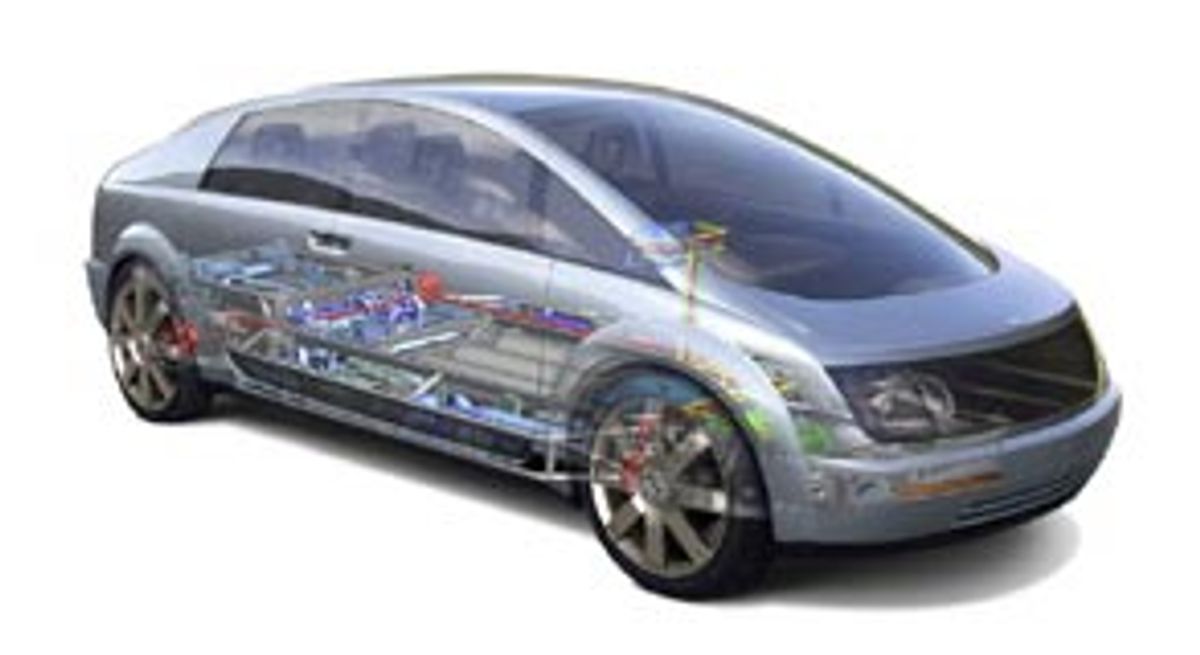
I’d come to talk to some of General Motors’ top research executives about the company’s investment in hydrogen fuel cell technology. (GM has been touting hydrogen as the fuel of the future and showing off a concept car called the Hy-wire.) But I ended up surprised at the swipes GM executives took at Honda’s and Toyota’s success with hybrid vehicles. They accused the two Japanese carmakers of selling their hybrids at a loss to generate positive environmental buzz, and argued that hybrids appeal only to a microscopic subsegment of U.S. consumers.

“You always have your early adopters,” said Alan Taub, GM’s executive director for R&D, about today’s hybrid buyers. “Toyota sells as many Priuses as we sell Pontiac Aztecs. Is that a success?” Earlier this year, at the Detroit International Auto Show, Bob Lutz, GM’s vice chairman of product development, had said that the company’s decision not to make a hybrid car “was a mistake from one aspect, and that’s public relations and catering to the environmental movement.”

It is true: Hybrids — vehicles that improve gas mileage by pairing internal combustion engines with batteries and electric motors, and recapturing some of the energy that is usually lost in braking — represent only a tiny sliver of cars sold in the United States this year. For 2004, they’ll account for about 0.52 percent of total sales, or 88,000 vehicles, according to Anthony Pratt, an analyst at JD Power and Associates. But is that a sign of a weak market, or merely the thin end of a wedge that could quickly become very, very large? Toyota recently announced that it will double the number of Priuses that it allocates to the United States next year, from 50,000 to 100,000, and Honda will introduce its third hybrid model this month, the first hybrid version of its popular Accord sedan. Pratt expects hybrids to account for 1.3 percent of all car sales in the United States next year, and other industry observers say that Toyota could surpass General Motors as the world’s biggest automaker by 2006, partly on the strength of its hybrids.

As for the question of whether the Japanese carmarkers are selling their hybrids at a loss, just to look good for P.R. purposes — well, the closer one looks, the less that seems to be true. Instead, Japanese carmakers appear to making the kind of front-end investments that pay off in the long run, with market share and eventual profits.

GM is not alone in its hybrid disdain. Its Detroit rivals have been similarly slow to warm up to hybrids. DaimlerChrysler, which is more interested in cleaner diesel engines than hybrids, did announce plans to produce a hybrid version of its Dodge Durango SUV by 2003, but that vehicle has apparently gotten lost on the way to dealerships. The introduction of Ford’s first hybrid, the Escape SUV, was delayed from 2003 to 2004. General Motors aims to be the first company to profitably sell a million hydrogen vehicles — “we measure success when it has six zeroes behind it,” Taub told me. But the company has so far introduced only two “mild hybrid” pickup trucks, which improve gas mileage by about 10 to 15 percent, in a few scattered markets. (By comparison, Ford’s hybrid Escape drives nearly twice as far as the traditional Escape on a gallon of gas.)

Back in the 1970s, the Big 3 carmakers watched in dismay as Japanese imports carved a huge swathe through their traditional markets. Is history about to repeat itself? Is Detroit missing out on a major shift in technology — and car-buyer psychology — by committing only grudgingly to hybrid vehicles? By betting big on the ever-elusive technologies of tomorrow, like hydrogen, carmakers such as GM may be letting the present slip away.

GM’s research executives work in sleek offices and conference rooms reached by ascending Saarinen’s renowned floating spiral staircase; the spaces would make ideal sets for a revival of “How to Succeed in Business (Without Really Trying).” The executives seem to view hybrids as a steppingstone on the way to hydrogen-powered vehicles, which would use fuel cells to turn hydrogen into electricity. (The problem with hydrogen is that there’s no guarantee of three important things: that hydrogen fuel will be cost competitive with gas, that it will be produced in an environmentally sensitive way and that a hydrogen fueling network will be built anytime soon. Consumers also associate the gas with an ill-fated blimp that crashed in New Jersey.)

“By 2010, we want to be ready with a commercially viable hydrogen car technology,” says Byron McCormick, GM’s executive director of fuel cell technology and commercialization. He spins out visions of hydrogen cars that could serve as electrical plants for individual homes, plugging into the garage at night to produce power. “If you had just 10 percent penetration of fuel cell cars in California, the cars would have more generation capacity than the electrical grid,” he says. The company is investing more than $1 billion in its hydrogen car development program.

But the day when 10 percent of Californians will be tooling around in fuel cell vehicles is still far off, as is the fantastical year of 2010, when teenagers will travel by personal jet pack and Christmas dinner will be packaged in a pill. Today, consumers who care about gas mileage and limiting their impact on the environment are purchasing hybrids.

General Motors’ first forays into consumer hybrids, its Chevy Silverado and Sierra pickup trucks, aren’t really in the same category as the Toyota and Ford hybrids. They’re “mild hybrids,” which seek fuel efficiency by capturing energy lost in braking and by shutting off the engine when a driver is stopped at a red light, using batteries to power accessories like the radio and air conditioning. Full hybrids like the Prius do those things, too, but they also use banks of batteries and electric motors to actually propel the vehicle when it’s moving at low speeds. GM won’t offer a full hybrid until 2007. (DaimlerChrysler has yet to start selling its first hybrid of any sort in the U.S., though now it seems that a Dodge Ram pickup will likely be first in line.)

GM’s Taub says the company is trying to “take the hype out of hybrids,” introducing the technology slowly, and in vehicles where it will have the greatest environmental impact, like trucks and SUVs, which swill more gas and emit more pollutants than passenger cars. And he adds that GM doesn’t intend to sell money-losing vehicles. “The question with hybrids is who will be the cleverest at driving down costs the fastest,” Taub says.

It’s true that hybrids will have more mass-market appeal once they’re no longer priced at a premium. (Today’s hybrids can cost $2,000 to $3,000 more than their nonhybrid doppelgangers.) But it’s also true that the Japanese carmakers, by virtue of five years of production experience, are already figuring out how to drive down manufacturing costs more quickly than their rivals in Detroit. Toyota is already producing some of its Priuses on the same assembly lines it uses to produce traditional sedans — rather than their own dedicated lines. That’s a precursor to being able to cost-effectively offer any vehicle type in one of two flavors: regular or hybrid.

“It’s natural to wonder how we can make a profit on these vehicles,” says Wade Hoyt, a spokesman for Toyota Motor Sales USA. “I would chalk it up to sour grapes. We broke even on the first-generation Prius during its model run, and the current generation will be profitable after about two years on the market, which is typical for any vehicle.” The company’s high-end Lexus division, which will start selling its first hybrid SUV next year, has tallied up more preorders for the Lexus RX 400h than any other vehicle in Lexus’ 15-year history.

Honda won’t disclose whether individual car models are profitable, but spokesman Chris Naughton says that while “some things may not be profitable from Day One, we are in the business to make money.” Naughton says Honda had its three consecutive best months of sales of the Civic hybrid last spring, when fuel prices were peaking. The company expects to sell about 20,000 of the new Accord hybrids in the coming year. “Hybrids are selling in increasing numbers as there are more available in the marketplace, and as customers understand that you don’t have to plug them in,” Naughton adds.

And neither company is ignoring hydrogen fuel cell technology, either. In 2002, Toyota and Honda were the first to begin leasing fuel cell vehicles in California. But, as Hoyt puts it, “whether or not the hydrogen market ever develops is something of a crapshoot.” Toyota isn’t giving up the bird in the hand for the one in the bush. The company is also licensing its hybrid technology to other carmakers, like Nissan and Ford, leading some analysts to compare Toyota to Intel. “They’re kind of becoming the ‘Intel Inside’ for hybrids,” says Pratt at JD Power. And it’s highly unlikely that Toyota is selling hybrid technology to its competitors without turning a healthy profit.

“There’s no question that Toyota and Honda are ahead of all the other carmakers, including the European manufacturers, when it comes to hybrids,” Pratt says.

GM and its Detroit brethren do seem to be stuck in neutral, with GM in particular obsessed by the hydrogen-powered world of tomorrow. But that could change quickly. The forecasting firm CSM Worldwide expects 20 new hybrid vehicles to be introduced by 2007. “General Motors sells about 1.2 million full-sized trucks and SUVs every year based on one platform,” says Lindsay Brooke, an analyst at CSM. “If GM prices its hybrids well, and markets them and advertises them in the right way, GM could well be the volume leader in hybrids.”

Brooke says that while the Japanese carmakers have earned bragging rights by being first to market with hybrid vehicles, it’s too early to pick a true winner. But if there is a victory in store for one of the Big 3, it’ll be one of the come-from-behind variety.

Scott Kirsner is a Boston writer who covers business and technology for Fast Company, Boston Magazine, Wired, and CIO.

Toyota recalls 2.17 million vehicles for gas pedal problem

Gas pedals stuck in floor mats lead the Japanese automaker into a safety and public relations fiasco

  • more
    • All Share Services

Toyota recalls 2.17 million vehicles for gas pedal problemA worker checks Yaris compact sedans, set for export to North America, at a plant of Toyota Motor Co.'s group company Central Motor Co. in Ohira in Miyagi Prefecture, northern Japan, Wednesday, Feb. 16, 2011. Toyota celebrated the opening of the auto plant in a forsaken rural area of Japan, which promises to grow into a new production point for the world's largest automaker. (AP Photo/Koji Sasahara)(Credit: AP)

Toyota Motor Corp. recalled 2.17 million vehicles in the United States on Thursday to address accelerator pedals that could become entrapped in floor mats or jammed in driver’s side carpeting, prompting federal regulators to close its investigation into the embattled automaker.

The Transportation Department said it had reviewed more than 400,000 pages of Toyota documents to determine whether the scope of the company’s recalls for pedal entrapment was sufficient.

“As a result of the agency’s review, (the National Highway Traffic Safety Administration) asked Toyota to recall these additional vehicles, and now that the company has done so, our investigation is closed,” said NHTSA administrator David Strickland.

Toyota has now recalled more than 14 million vehicles globally to fix gas pedals and other safety problems since 2009. U.S. regulators said earlier this month that electronic flaws were not to blame for reports of sudden, unintended acceleration. The company paid the U.S. government a record $48.8 million in fines for its handling of three recalls.

The world’s No. 1 auto company said more than half of the vehicles under recall were being added to a massive 2009 recall that fixed gas pedals getting trapped in the floor mat.

The Japanese automaker said it would add three models to the 2009 pedal entrapment recall: about 600,000 4Runner SUVs from the 2003-2009 model years; 761,000 RAV4 compact SUVs from the 2006-2010 model years; and 17,000 Lexus LX 570s from the 2008-2011 model years.

The recall also includes 372,000 RX 330, RX 350 and RX 400H vehicles from the 2004 through early 2007 model years and 397,000 2004-2006 Toyota Highlander SUVs and hybrid versions to replace floor carpet covering and retention clips on the driver’s side that could interfere with the accelerator pedal arm.

Toyota also recalled 20,000 2006 through early 2007 GS 300 and GS 350 all-wheel drive vehicles to change the shape of a plastic pad embedded in the driver’s side floor carpet that could cause pedal interference.

Toyota spokesman Brian Lyons said the company was unaware of any accidents or injuries related to the new recalls.

Continue Reading Close

Government investigation finds no electronic flaws in Toyotas

The Obama administration found that it wasn't electronic flaws led to a massive Toyota recall in 2009

  • more
    • All Share Services

Government investigation finds no electronic flaws in ToyotasIn this Jan. 11, 2011 photo, the 2011 Toyota Corolla is shown at the North American International Auto Show in Detroit. Toyota sold 20,581 Corollas, up 20.2 percent, and 10,635 of its fuel-efficient Prius, up 25.4 percent in the month of Jan., 2011. (AP Photo/Paul Sancya)(Credit: AP)

The Obama administration’s investigation into Toyota safety problems found no electronic flaws to account for reports of sudden, unintentional acceleration and other safety problems. Government investigators said Tuesday the only known cause of the problems are mechanical defects that were fixed in previous recalls.

The Transportation Department, assisted by engineers with NASA, said its 10-month study of Toyota vehicles concluded there was no electronic cause of unintended high-speed acceleration in Toyotas. The study, which was launched at the request of Congress, responded to consumer complaints that flawed electronics could be the culprit behind Toyota’s spate of recalls.

“We enlisted the best and brightest engineers to study Toyota’s electronics systems and the verdict is in. There is no electronic-based cause for unintended acceleration in Toyotas,” Transportation Secretary Ray LaHood said in a statement.

Toyota has recalled more than 12 million vehicles globally since fall 2009 to address sticking accelerator pedals, gas pedals that became trapped in floor mats, and other safety issues. The recalls have posed a major challenge for the world’s No. 1 automaker, which has scrambled to protect its reputation for safety and reliability.

Toyota did not immediately comment on the report. Shares of the automaker climbed on the New York Stock Exchange following the news. Toyota shares were up more than 4 percent, to 89.00 in mid-afternoon trading.

Toyota paid the U.S. government a record $48.8 million in fines for its handling of three recalls. The company has said it has not found any flaws in its electronic throttle control systems and said the previously announced recalls have addressed the safety concerns.

LaHood said NASA engineers “rigorously examined” nine Toyotas driven by consumers who complained of unintended acceleration. NASA reviewed 280,000 lines of software code to look for flaws that could cause the acceleration. Investigators tested mechanical components in Toyotas that could lead to the problem and bombarded vehicles with electro-magnetic radiation to see whether it could make the electronics cause the cars to speed up.

A preliminary part of the study, released last August, failed to find any electronic flaws based on a review of event data recorders, or vehicle black boxes.

Despite its findings, LaHood said the National Highway Traffic Safety Administration was considering new regulations to improve safety. They include requiring brake override systems on all vehicles, standardizing keyless ignition systems and requiring event data recorders, or vehicle black boxes, on all new vehicles.

Transportation officials said they would also consider conducting more research on electronic control systems and review the placement and design of accelerator and brake pedals.

In Tokyo on Tuesday, Toyota reported a 39 percent slide in quarterly profit but raised its full-year forecasts for earnings and car sales. It is a mixed picture for the automaker, which is enjoying booming sales in high-growth markets in Asia, Africa and South America, while facing lingering worries about quality lapses in the U.S.

In addition to the recalls, Toyota began installing brake override systems on new vehicles. The systems automatically cut the throttle when the brake and gas pedals are applied at the same time. The company also created engineering teams to examine vehicles that are the subject of consumer complaints and appointed a chief quality officer for North America amid complaints its U.S. division did not play a large enough role in making safety decisions.

Consumer advocates and safety groups raised concerns that flawed electronics could be causing unwanted acceleration in the Toyotas. They have questioned the reliability of the event data recorders studied by the government, saying they could be faulty or fail to tell the whole story of the individual crashes.

Toyota’s safety issues received broad attention from the government after four people were killed in a high-speed crash involving a Lexus near San Diego in August 2009.

NHTSA has received about 3,000 reports of sudden acceleration incidents involving Toyota vehicles during the past decade, including allegations of 93 deaths. NHTSA, however, has confirmed just five of them.

Congress considered sweeping safety legislation last year that would have required brake override systems, raised penalties on auto companies that evade safety recalls and given the government the power to quickly recall vehicles. But the bills failed to win enough support, and it remains unclear if Congress will pursue similar legislation before the 2012 elections.

The National Academy of Sciences is conducting a separate study of unintended acceleration in cars and trucks across the auto industry. The panel is expected to release its findings this fall.

Continue Reading Close

Why Mitch McConnell is worse than Charles Rangel

Both men misused their power -- but the Senate leader gave corrupt BAE Systems $17 million in 2010 earmarks

  • more
    • All Share Services

Why Mitch McConnell is worse than Charles RangelU.S. Senate Minority leader Mitch McConnell (R-KY) listens during remarks about leadership elections on Capitol Hill in Washington, November 16, 2010. REUTERS/Jim Young (UNITED STATES - Tags: POLITICS)(Credit: Reuters)

On the same day that the House Ethics Committee convicted Rep. Charles Rangel of nearly a dozen violations of congressional rules, Sen. Mitch McConnell announced that under pressure from fellow Republicans, he will surrender his beloved earmarks. This is a notable coincidence because, like Rangel, McConnell has rewarded corporate donors to an academic center named after him — and used earmarks for that purpose. The top corporate recipient of earmarks from the Kentucky Republican in the 2010 budget not only happens to be a donor to the McConnell Center for Political Leadership at the University of Louisville, but one of the largest and most corrupt defense contractors in the world.

Topping the list of Rangel’s transgressions was the misuse of his congressional clout to raise money for a vanity academic “center” named after him at the City University of New York from private donors. Yet somehow McConnell got away with the same kind of dubious dealings at the University of Louisville — and was allowed to reward BAE Systems, donor of $500,000 to the McConnell Center, with $17 million worth of defense earmarks.

For years, the long list of corporate donors to the university’s McConnell Center for Political Leadership was kept secret, presumably out of deference to the senator and his well-heeled friends, including Toyota, AIG, RJ Reynolds and Philip Morris, among others. Perhaps the most questionable gift came from United Defense, a subsidiary of BAE Systems, the Pentagon contractor that finally settled a huge, transatlantic bribery case with the Justice Department last spring. United Defense gave $500,000 to the McConnell Center, and the senator has continued to perform for the company ever since, even while BAE was subject to a federal investigation that led to a record $450 million fine and three years of monitoring by a court-appointed “compliance officer.” Ironically, the chief accusations against BAE involved bribery of public officials (in Saudi Arabia, not Kentucky).

Everyone knew that BAE was suspected of serious corruption — and under investigation not only here but in Britain and Austria as well — when McConnell sponsored $25 million of earmarks for the company back in 2007. By the time he pushed through the FY 2010 earmarks last year, both the United Kingdom’s Serious Fraud Office and the Justice Department were preparing to file criminal charges. BAE’s sales tactics in the Mideast and Central Europe were not only crooked but interfered with American oversight of sensitive defense technology, according to Justice Department officials.

So while McConnell and his caucus are (temporarily and reluctantly) giving up their power to reward dubious donors like BAE with earmarks, it is hard not to wonder how the stringent “reformers” of the Tea Party can support his reelection as Republican leader. 

Continue Reading Close

Joe Conason blogs in Salon several times a week and writes a weekly column for the New York Observer. His latest book is "It Can Happen Here: Authoritarian Peril in the Age of Bush."

Toyota to roll out 2 new Prius cars

The automaker will begin selling a hybrid station wagon starting next summer as either a 2011 or 2012 model

  • more
    • All Share Services

Toyota plans to roll out two new cars under the Prius name by next year, according to a dealer briefed on the plans, as the automaker seeks to turn its popular hybrid into a family of vehicles.

The Japanese automaker will begin selling a Prius station wagon starting next summer as either a 2011 or 2012 model, said Adam Lee, president of the Lee Auto Malls chain of dealerships in Maine. It will sell a plug-in version of the Prius that can get 30 miles on a charge starting later in the year, he said.

Toyota unveiled the new vehicles at its annual dealer meeting in Los Vegas this week. Lee was briefed on the new models by the manager of his Toyota dealership, who was in attendance.

Toyota spokesman Sam Butto declined to comment on any specific product plans,

“We will be coming out with some additional Prius products, but that’s really all I can say at this time,” Butto said.

Toyota has said in the past it hopes to expand the Prius name to a family of vehicles. The Prius is the best-selling hybrid in the U.S., but sales have been flat this year as the automaker continues to suffer from the fallout from huge recalls.

The automaker has recalled more than 10 million cars and trucks worldwide over the last year for a variety of problems, including a problem with the antilock braking system in its Prius hybrid and a Lexus hybrid. Toyota said this week it had fixed 86 percent of the hybrids recalled over the braking problem.

Also at the dealer meeting this week, Toyota President Akio Toyoda sought to reassure the company’s 1,200 U.S. dealers that the company is on track for sales growth in the U.S., Toyota said in a statement on Thursday. The company also told dealers of plans to make standard a free maintenance program that it first rolled out earlier this year.

Continue Reading Close

Panda squashes ninja; Prius saved

Not a coincidence: Japan releases Chinese fishing captain and Congress gets busy on rare earth elements

  • more
    • All Share Services

Panda squashes ninja; Prius savedA Toyota Motor Corp's staff wipes the logo of the company's Prius Plug-In Hybrid during a promotional event in Hitachiota, about 130 km (81 miles) north of Tokyo June 17, 2010. As Japanese car sales plummet, Toyota is trying to get consumers here excited about cars -- and driving -- by promoting cities and villages around the country that can only be reached by automobile. REUTERS/Yuriko Nakao (JAPAN - Tags: TRANSPORT EMPLOYMENT BUSINESS)(Credit: © Yuriko Nakao / Reuters)

Whether or not China officially halted exports of rare earth elements to Japan in retaliation for the imprisonment of a Chinese fishing captain is now irrelevant. Japan has buckled. There is no other way to interpret the following statement.

From the Wall Street Journal:

“We decided it was inappropriate to continue the investigation while keeping the suspect in custody any further, considering the future of the Japan-China relationship,” said Kenji Suzuki, a senior prosecutor at the Naha prosecutors’ office in Okinawa, a hastily called news conference Friday afternoon.

Japanese hybrid car manufacturers, who gobble up huge quantities of rare earth elements, might be breathing a sigh of relief, but the story doesn’t stop here. Japanese citizens are unhappy, the Economist is huffily warning that China’s “entirely disproportionate action” calls “into question its maturity as a responsible international actor, and the U.S. government is finally paying serious attention to America’s utter dependence on China for a critically important resource. On Thursday, the House Committee on Science and Technology approved H.R. 6160, the Rare Earths and Critical Materials Revitalization Act of 2010.

From the press release:

[R]are earths are necessary components of such advanced technologies as wind turbines, hybrid-vehicle batteries, weapons guidance systems, oil refining catalysts, computer disk drives, televisions and monitors, compact fluorescent light bulbs, and fiberoptic cable, to name a few. China currently controls an estimated 90-97 percent of the world’s supply of rare earths, and it is pouring effort and money into a rapid buildup of its own high-technology industries that rely on rare earths. China began imposing export quotas on rare earths in 2006; the quotas have gotten steadily stricter, and China cut its rare earths exports for the second half of this year by 72 percent.

H.R. 6160 is co-sponsored by two Democrats and two Republicans. It will be interesting to see whether the bill ends up getting caught in the same partisan cross-fire crippling just about everything else currently struggling to move through Congress.

Continue Reading Close
Andrew Leonard

Andrew Leonard is a staff writer at Salon. On Twitter, @koxinga21.

Page 1 of 6 in Toyota