Jude Law
“Closer”
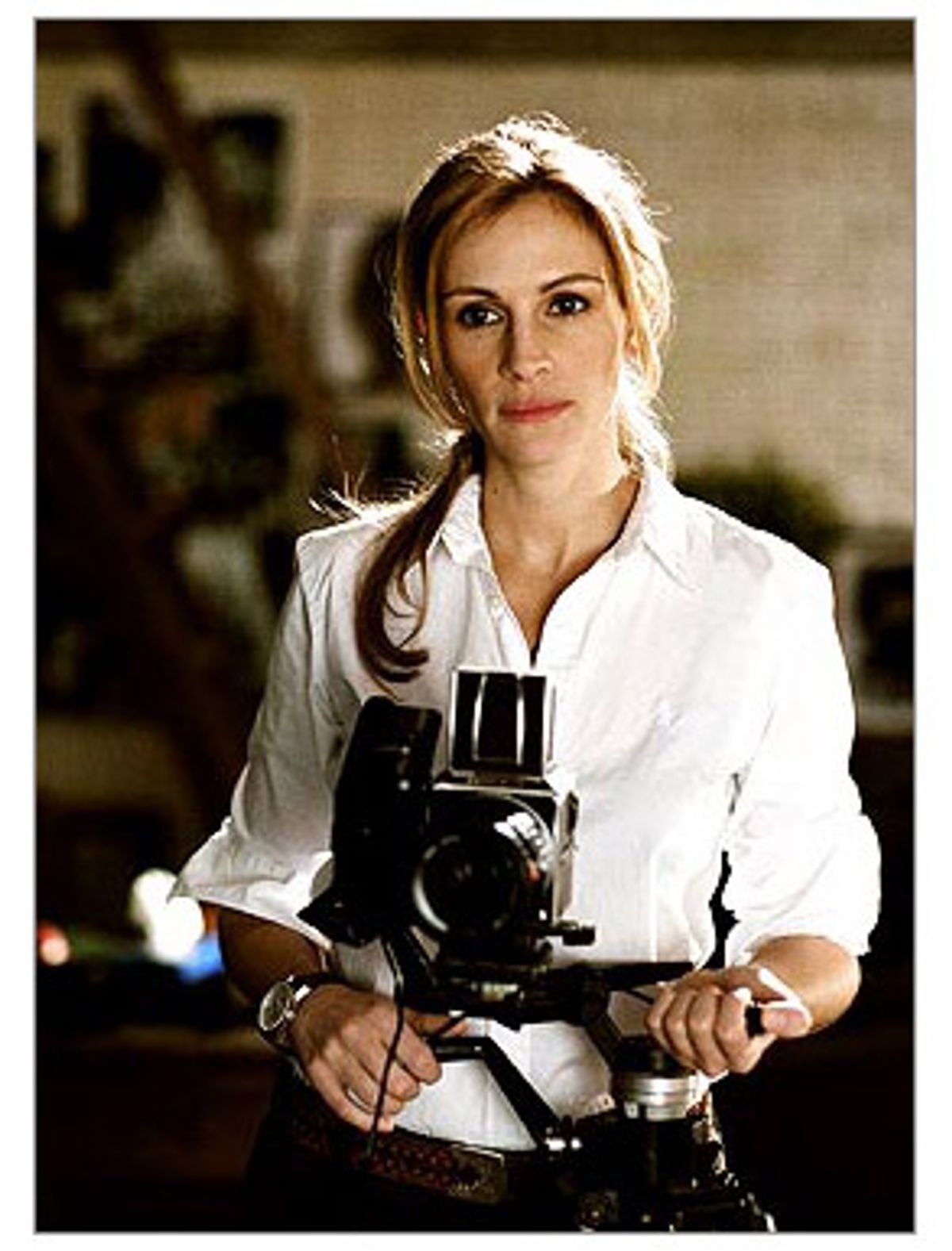
Julia Roberts and Jude Law star in Mike Nichols' coldblooded examination of modern mating.
The big selling point, if there is one, of Mike Nichols’ version of the Patrick Marber play “Closer” is seeing big-name star Julia Roberts use words like “fuck.” In Nichols’ world that, as well as casting Natalie Portman as a stripper, Jude Law as a shallow philanderer and Clive Owen as a horn-dog dermatologist, supposedly represents some kind of revolutionary sexual frankness, the sort of thing anyone interested in honest art should be flocking to.
But “Closer” is so bloodless that it feels like an act of arty dishonesty. Nichols and Marber seem to think they’re serving up the raw goods of modern romance, but they’re really just arranging its pickled innards on a pristine, chilly porcelain plate. It’s a marvel of modern filmmaking in the way it so immediately renders universal human experience almost unrecognizable.
Aside from the fact that they trusted their director and the material, the myriad problems of “Closer” aren’t the fault of the actors: You can see them all working hard to make something affecting, or at least engaging, from this overmasticated material. Roberts, Portman, Owen and Law play the four points of an unlikely love parallelogram: In the first scene, Law’s Dan, a London obituary writer, meets Portman’s Alice, an American taking a holiday from an alluded-to painful past. Fast-forward a few years: Dan and Alice have become a couple. He has written a novel and Roberts’ Anna is the photographer who’s taking his publicity photos. He tries to seduce her; she rebuffs him. Then, as the result of a nasty practical joke Dan plays on her, she meets and falls for (although you never see anyone in “Closer” doing anything so overtly emotional as falling) dermatologist Larry, played by Owen. That means Larry can stop frequenting sex chat rooms, as he was formerly wont to do.
The members of these two couples obsess, cheat and cross-connect, or at least just interact in a highly scripted way. None of them are allowed to have feelings that haven’t been polished and minimalized into self-conscious, synthetic verbal sculptures. Love and intimacy, bitterness and resentment, loyalty and betrayal: “Closer” examines them all, with dialogue so meticulous it bears no resemblance to the way people actually talk, let alone think. “She has the moronic beauty of youth, but she’s sly,” Larry observes of Alice after he meets her for the first time, a playwright’s semaphore, maybe, for “She’s kind of cute.” But Marber and Nichols both seem to have forgotten — or, worse yet, they don’t care — that lines have to be uttered by actual actors. At best, Nichols manages to get a tepid, sub-Bogey-and-Bacall crackle (at least an Ernest Borgnine and Ethel Merman crackle) out of the interplay between his characters, as when Dan tries to weasel a kiss out of Anna, at their first meeting in her photography studio. “I don’t kiss strange men,” she tells him. “Neither do I,” he retorts.
Nichols prunes, shapes and pares down each scene until it meets some inexplicable, exacting specification — he’s more of a topiary artiste than a director. As a piece of direction, “Closer” is a feat of stagey diligence. Nichols is a well-respected filmmaker, if not a well-loved one. Moviegoers tend to utter his name as if it were a well-known, reliable brand of laundry soap, like Tide, some kind of signifier of quality that’s beyond reproach — and then they often find themselves struggling to name more than two or three pictures, of the many he’s made, that they actually like.
“Closer” may garner respect in some quarters, but it’s almost willfully unlikable. Its hollowest, most calculated scene takes place in the strip club where Alice works. Larry, depressed and unshaven, watches her perform and pays for a private dance during which he paws at her and berates her, moaning about his need for human connection; she, supposedly responding with brainy banter, does the verbal equivalent of snapping gum in his face.
None of these characters is behaving particularly humanely. In fact, the movie depends on our fascination with their nastiness toward one another — their talky self-centeredness is the only thing that gives the movie any tension. But their awfulness is written onto them in hieroglyphs, a playwright’s construct — we never sink into the skin of the characters. Instead, we’re left to snigger at snip-snappety lines like the one Alice utters when she rejects Dan’s offer of a tuna-fish sandwich. She doesn’t eat fish because “fish pee in the sea.” Dan tells her that children do too. “I don’t eat children, either.” The characters’ personalities lie quivering, flat and dull and nearly lifeless, on the surface of Marber’s dialogue.
Law and Portman give studied, strained performances here, but they do manage to throw off a few sparks of chemistry together. Neither Roberts nor Owen gives off any heat at all, but it’s clear they’ve put a great deal of effort into thinking their way through the material. Owen (normally a marvelously muted actor) hangs onto his bruised-boxer dignity here, even if he is uncharacteristically stiff. And Roberts is so game that she sometimes comes dangerously close to making the material work. In her big confrontational scene — giving away the specifics of it would spoil the few meager surprises “Closer” has to offer — she rustles up the closest thing to an emotional charge any of these allegedly angry, frustrated characters can muster. (The dirty words she uses are mere trappings.) It’s the only time you sense blood coursing beneath the picture’s surface, but it lasts only a few minutes. The rest of the time, “Closer” feels so remote that it renders itself inconsequential. Instead of collapsing the distance between the audience and the characters, it makes that space feel a mile wide.
Stephanie Zacharek is a senior writer for Salon Arts & Entertainment. More Stephanie Zacharek.
“Sherlock Holmes”: Downey by Law
Guy Ritchie's version of the detective classic is hectic but harmless. Thank God for the film's two stars
Robert Downey Jr. and Jude Law in "Sherlock Holmes" Guy Ritchie’s “Sherlock Holmes” is entertaining in a glossy, mindless way — every corner of it is packed with hyperkinetic life, which is not to say that it’s likely to stick in your memory for more than a few hours after you’ve seen it. The screenplay and story are credited to no fewer than five writers, and that’s not even counting Sir Arthur Conan Doyle, who created the characters — and brought them to life with his elegant prose — in the first place. Ritchie seems to think that a detective-and-doctor team who solve crimes by, oh, thinking about them just isn’t dynamic enough for the screen, so he turns Sherlock Holmes and Dr. John Watson — played by Robert Downey Jr. and Jude Law — into action heroes: They kick, punch and karate-chop their way through various scenarios in which the cutting is fast, even when the motion is slow, and the computer-generated effects are plentiful.
Continue Reading CloseStephanie Zacharek is a senior writer for Salon Arts & Entertainment. More Stephanie Zacharek.
Films of the decade: “A.I. Artificial Intelligence”
Kubrick? Spielberg? Never mind -- it's a misunderstood masterpiece
A still from "A.I. Artificial Intelligence" I’m not the only one to consider “A.I. Artificial Intelligence” a very great and deeply misunderstood film; others as disparate as Andrew Sarris and the late Stan Brakhage have more or less agreed with me, as well as my friend and favorite academic critic, James Naremore. (Click the link above to read my full review.) But it’s also clear to me that any ordinary auteurist way of processing cinema can’t begin to handle this masterwork adequately: Reading it simply as a Spielberg film, as most detractors do, or even trying to read it simply as a Kubrick film, is a pretty futile exercise with limited rewards, even though the fingerprints of both directors are all over it. Seeing it as a perpetually unresolved dialectic between Kubrick and Spielberg starts to yield a complicated kind of sense — an ambiguity where the bleakest pessimism and the most ecstatic kind of feel-good enchantment swiftly alternate and even occasionally blend, not to mention a far more enriching experience, however troubling and unresolved. As a profound meditation on the difference between what’s human and what isn’t, it also constitutes one of the best allegories about cinema that I know.
Film Salon has invited a group of special guests to write about their favorite film(s) of the 2000s. To read the entire series, go here.
Wong Kar-wai’s blueberry-pie America
In this video interview, the Chinese art-film demigod talks about directing Norah Jones in his first American movie (and her first movie, period).
The Weinstein Co.
Jude Law and Norah Jones kiss in “My Blueberry Nights.”
You can argue that the Chinese-born, Hong Kong-based filmmaker Wong Kar-wai was jumping off a cliff by making “My Blueberry Nights” — a movie written in English, shot in the United States, and starring an untested pop singer with no acting experience — but you can’t argue it was the first time. In eight feature films spread over two decades, Wong has made a violent gangland drama, a period romance, a 1960s coming-of-age picture, an elliptical science-fiction epic and a tale of bohemian gay lovers shot in Argentina. It’s difficult to say whether any of his pictures belong to the same genre as any of the others, but they’re all defiantly Wong Kar-wai films that seem to fuse the traditions of Western and Eastern art cinema, languorous dreamlike experiences where plot is secondary to mood and where the beauty of each episode, each face, each room and each moment is paramount.
Continue Reading CloseIndie box office: Lennon’s assassin a hit, man
"Chapter 27" strong in NYC bow -- and don't miss an ultra-cool doc on L.A.'s hot modern art scene.
Arthouse Films
Still from “The Cool School.”
I was tied up in screenings on Monday, and when I wasn’t doing that I was hunkered down, trying to sharpen my mind and harden my spirit, or something of the sort, in preparation for a Tuesday interview with Wong Kar-wai. How do you tell an artist you admire immensely that you think he’s made a dreadful mistake, one that raises a whole range of questions about his entire career? I’ve now seen “My Blueberry Nights” — that’s Wong’s forthcoming English-language debut, an episodic American road movie with Norah Jones, Jude Law, Natalie Portman and Rachel Weisz — twice, first last year as the opening-night film at Cannes, and second a week ago. (It opens in the United States on Friday.) I guess he re-cut it in between or something, but it hasn’t improved.
Continue Reading CloseBeyond the Multiplex
Norah Jones and Jude Law seduce viewers with slow, lonely smooches and bites of blueberry pie as Cannes kicks off.
You have to suspend all varieties of disbelief and float along with “My Blueberry Nights,” which opened the 60th Festival de Cannes with a splashy red-carpet premiere on Wednesday night. That’s rather like the attitude required by this festival, both so inconvenient and so delightful, and by the storybook landscape of the Côte d’Azur. Reactions to the opening film have been muted here so far, more polite than enthusiastic. Costar Jude Law was the principal focus of paparazzi attention, climbing the steps of the Palais des Festivals in Ray-Bans and a classic tuxedo; with all the gentlemanly grace you’d expect, he tried to deflect the focus toward a winsome, awkward, clearly overwhelmed Norah Jones, the film’s unlikely lead. (I’m underqualified as a fashion critic, but did she choose the slightly dorky gown, with the high waist and poofy sleeves, on purpose?)
Continue Reading ClosePage 1 of 6 in Jude Law