Kanye West

Goodbye, pimps and hos!

The year's biggest pop stars dropped the skanky booty-shaking, and -- like much of the country -- chose a conservative path.

  • more
    • All Share Services

Goodbye, pimps and hos!

Quoth Jay-Z: “You can’t be running around in jerseys when you’re 30 years old.”

The oracle spoke, the people listened. Jay-Z, with his new fondness for suits and button-up shirts, best set the year’s tone: Maturity was in, clean-cut was in. An old-fashioned, elegant idea of what was stylish was ascendant. In popular music, this was the year of the white suit, of the rakishly angled hat.

The new aesthetic was everywhere: in the retro-utopian ballrooms of R. Kelly’s “Happy People” and Outkast’s “I Like the Way You Move” videos; in the speak-easy vibe of Beyoncé’s “Naughty Girl” video; in the “Ed Sullivan Show” theme of the “Hey Ya” video; in the sudden celebrity of P. Diddy’s natty manservant, Farnsworth Bentley. Nelly, the man who brought us “Hot in Herre,” released a record called “Suit.” And look at what happened to Christina Aguilera! I don’t know how they got the skank out of that girl, but now she’s dressing in ’20s-style flapper dresses with a coquettish curly bob. Even Britney is grown up, married with children. In the upper echelons of hip-hop and pop, it was out with the hoodies and gold chains, and in with a more classically moneyed style, with all the trappings of wealth and maturity. Out with bling, in with bespoke.

This may have been most transparent in fashion and in visual aesthetics, but it also came through loud and clear in the year’s most successful music. In place of the forward-looking, sparse, jabbing production and challenging harmonic terrain that had been so dominant in hip-hop and pop, there was a new emphasis on warmth and fullness, on sumptuous orchestrations and comfortable, well-worn harmonies and baroquely florid arrangements. Perhaps taking a cue from an increasingly politicized culture — where the hysterical response to an exposed nipple at the beginning of the year put pop culture on notice — the most popular music stayed conservative, channeling the sepia-toned lushness of classic soul and pop.

Consider the two greatest critical/commercial triumphs of the year: Usher and Kanye West. Rapper/producer and critic’s darling Kanye had more impact on the sound of pop music this year than any other single artist, both with his own singles (“Through the Wire,” “Jesus Walks”) and productions for other artists (Twista’s “Slow Jamz” and “Overnight Celebrity”; Alicia Keys’ “You Don’t Know My Name”). Kanye’s music is built on the analog warmth and nostalgic crackle of old soul samples and smoothly sophisticated string orchestrations, and “Slow Jamz” might be the distilled essence of it all: lyrics referencing great slow jam artists of the past (“Marvin Gaye, some Luther Vandross, a little Anita,” for starters), a couple of nostalgia-inducing soul samples, a silky smooth, string-laden arrangement, but also a finicky complexity to the way it’s all fit together, with Twista’s lightning-fast rapping interlocking precisely with the sample above it.

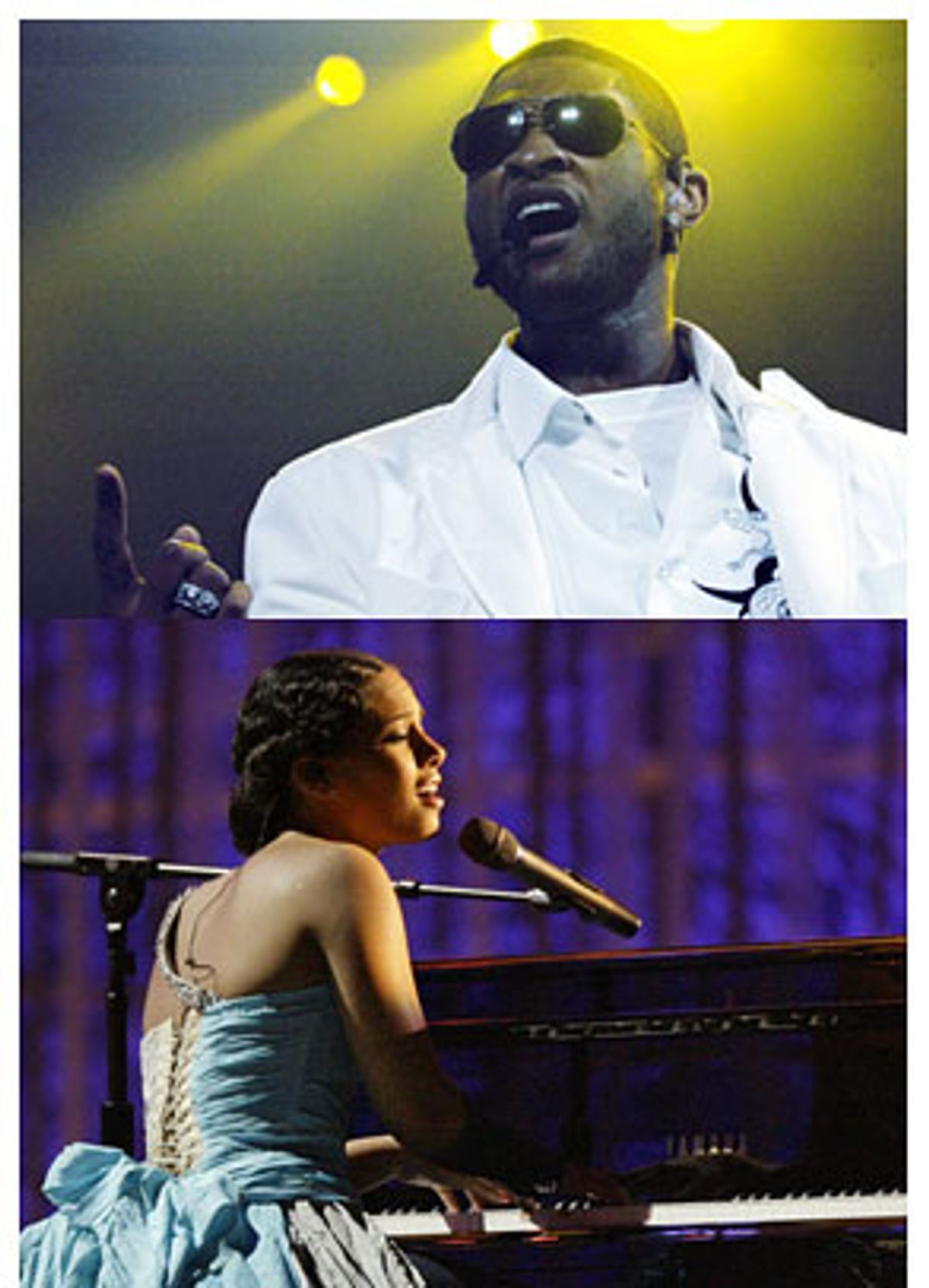
What’s extraordinary about Usher is simply the magnitude of his success; that a straight-up R&B crooner, singing thoroughly unmodern ballads like “Burn” and “Confessions (Part 2),” could be not just a big seller, but also a hip, young celebrity with real glamour and star power. Usher’s female counterpart, Alicia Keys, has an appeal based entirely on her nostalgic evocations of classic soul, and by the air of “class” provided by a grand piano. The flashy piano run in the chorus of her hit “You Don’t Know My Name” was an extreme example of the kind of gushingly complex flourishes so in vogue this year. Usher and Keys currently hold the No. 2 spot on the Billboard singles chart with their duet “My Boo,” a slick, sentimental ballad that represents everything unadventurous, retiring, and uninteresting about this year’s pop music.

Notable by their absence in 2004 were Timbaland and the Neptunes, the producers who had been such dominant commercial and artistic forces for the last few years, their lean, sharp-edged tracks replaced by Kanye’s warm, rounded, lushly blended fantasias. The Neptunes have finally come storming back with one of their oddest, and coolest, productions, Snoop’s “Drop It Like It’s Hot,” currently at the top of the charts. And if there’s any justice, the brilliant new Timbaland-produced Ludacris track, “The Potion,” will be joining it there soon. But until the recent release of those songs, this year had produced nothing with the bumping minimalism of Missy Elliott’s Timbaland hits like “Get Ur Freak On” and “Work It,” or the out-of-nowhere strangeness of Kelis’ Neptunes-produced “Milkshake.” Those songs were part of a daring, forward-thinking spirit in pop music, testing the bounds of how abstract and alien it was possible for a hit song to be. But that pretty much evaporated this year.

Instead we got Usher’s slow-burning ballads, the downy-soft warmth of “I Don’t Wanna Know” by piano-playing crooner Mario Winans, the smooth, placid synth-strings of Eamon’s “Fuck It (I Don’t Want You Back),” the delicate and complex sample of Chinese music that runs behind the entirety of Christina Milian’s “Dip It Low,” and Prince’s nostalgia-driven comeback hit, “Musicology.” Another emblematic success story is Maroon 5, a band that sneaks a sleek, retro, Stevie Wonder-inspired vibe into their otherwise lily-white smooth pop. Their record, “Songs About Jane,” which yielded hits like “This Love” and “She Will Be Loved,” was actually released in June 2002. It’s no coincidence that this was the year for it to finally become such an enormous hit.

Every action has a reaction, and this year’s was crunk: jagged, brutal and in your face. If the decadent streak in this year’s music was the product of an engorged culture crumbling under the weight of its own wealth and waste, crunk was the barbarians at the gate.

There’s nothing smooth about crunk: beats that sound like they’re blasting out of a crappy car stereo that can’t quite handle the volume, shrill synth sounds, often just a single sliding oscillator, way up high, with nothing in between but the (usually aggressive) rapping. Led by hit-making producer Lil Jon, crunk was a generous pinch of salt in what otherwise could have been a cloyingly sweet year.

A cynic might say that the trend toward sweet, smooth, retro sounds was evidence of an art form losing its youth and freshness, becoming self-conscious, but I don’t think that’s what’s happening here. Music doesn’t develop in a straight line. It moves in fits and starts, reactions and counterreactions, a pendulum swinging back and forth, with each generation correcting, and usually overcompensating for, the excesses of the previous one: the romantic torrents of Berlioz and Chopin replaced the cerebral, methodically structured classicism of Haydn and Clementi; punk-rock sharpened its fangs to puncture the bloat of prog-rock and scratch the glossy facade of disco. The last few years have been dominated by the brutal minimalism of Timbaland and Missy (and a legion of imitators), the glittering, brash futurism of the Neptunes; by pimped-out guys and skanked-out girls. What more natural reaction than lush orchestrations and an elegant white suit?

But there’s also more than a whiff of conservatism to the whole thing, of playing it safe, of new money trying to pass for old because it’s more respectable. After all the excitement of the hip-hop high life, of rap moguls like P. Diddy and Jay-Z shattering the glass ceiling, even the rebel kings are putting on suits and telling people to grow up. There’s also an air of post-Nipplegate timidity, fear of Michael Powell and the “moral” watchdogs. Sex is still being sold, of course, but more subtly, without all the sweat and physicality, without the big-ass Timbaland beats and booty shaking.

In a year of such intense political polarization, so much anger and activism, it’s surprising that popular music has withdrawn into relative conservatism, that major statements like Eminem’s searing “Mosh” were so rare. Or maybe not. Just as often as popular music provides a rallying cry, giving voice to people’s angers and frustrations, it can provide an escape from them.

- – - – - – - – - – - -

For the year’s best albums, best singles, and best free downloads, stay tuned for this week’s Wednesday Morning Download.

Thomas Bartlett is a writer and musician in New York. He maintains a blog called doveman.

Why I miss the monoculture

We don't agree on anything the way we agreed about Prince, Nirvana and MJ -- and our cultural life is poorer for it

  • more
    • All Share Services

Why I miss the monocultureMichael Jackson, Kurt Cobain and Prince(Credit: AP)

I love Massive Music Moments.

I live for those times when an album explodes throughout American society as more than a product — but as a piece of art that speaks to our deepest longings and desires and anxieties. In these Moments, an album becomes so ubiquitous it seems to blast through the windows, to chase you down until it’s impossible to ignore it. But you don’t want to ignore it, because the songs are holding up a mirror and telling you who we are at that moment in history.

These sorts of Moments can’t be denied. They leave an indelible imprint on the collective memory; when we look back at the year or the decade or the generation, there’s no arguing that the album had a huge impact on us. It’s pop music not just as private joy, but as a unifier, giving us something to share and bond over.

Actually, I should say I loved Massive Music Moments. They don’t really happen anymore.

The epic, collective roar — you know, the kind that followed “Thriller,” “Nevermind,” “Purple Rain,” “It Takes a Nation of Millions to Hold Us Back,” and other albums so gigantic you don’t even need to name the artist — just doesn’t happen today. Those Moments made you part of a large tribe linked by sounds that spoke to who you are or who you wanted to be. Today there’s no Moments, just moments. They’re smaller, less intense, shorter in duration and shared by fewer people. The Balkanization of pop culture, the overthrow of the monopoly on distribution, and the fracturing of the collective attention into a million pieces has made it impossible for us to coalesce around one album en masse. We no longer live in a monoculture. We can’t even agree to hate the same thing anymore, as we did with disco in the 1970s.

If you’re under 25, you’ve never felt a true Massive Music Moment. Not Lady Gaga. Not Adele. Not even Kanye. As the critic Chuck Klosterman has written, “There’s fewer specific cultural touchstones that every member of a generation shares.” Sure, Gaga’s “The Fame Monster” spawned several hit singles. Adele’s “21″ and Jay-Z and Kanye West’s “Watch the Throne” were massively popular. Kanye’s brilliant “My Beautiful Dark Twisted Fantasy” was beloved and controversial and widely discussed enough to give a glimpse into the way things used to be. But those successes don’t compare to the explosive impact that “Thriller” and “Nevermind” had on American culture — really, will anyone ever commemorate “21″ at 20, the way the anniversary of Nirvana’s album has been memorialized in the last month?

Numbers don’t tell the whole story about how these cultural atomic bombs detonated and dominated pop culture. But at its peak, “Thriller” sold 500,000 copies a week. These days, the No. 1 album on the Billboard charts often sells less than 100,000 copies a week. What we have today are smaller detonations, because pop culture’s ability to unify has been crippled.

I miss Moments. I love being obsessed by a new album at the same time as many other people are. The last two albums that truly grabbed an enormous swath of America by the throat and made us lose our collective mind were “Nevermind” and Dr. Dre’s “The Chronic.” They sprung from something deep in the country’s soul and spoke to a generation’s disaffection and nihilism. They announced new voices on the national stage who would become legends (Kurt Cobain and Snoop Dogg) and introduced the maturation of subgenres that would have tremendous impact (grunge and gangsta rap).

Some might argue “The Miseducation of Lauryn Hill” had a unifying impact on a large swath of America. Others point to Alanis Morrissette’s “Jagged Little Pill.” Both albums were important. But did they pull together gigantic diffuse constituencies of Americans? Eminem is perhaps music’s biggest star of the last decade. He stands for many things (the freedom to be antisocial, self-empowerment, the legitimization of whiteness in hip-hop culture), and “The Marshall Mathers LP” was a huge success. But no Eminem disc has changed America or made a true generational statement.

Nowadays my music conversations run like this:

“So what are you listening to?”

“Aw, you gotta check out Danny Brown and Abbe May and Das Racist.”

“OK, cool. I’ve never heard of them.”

“What are you listening to?”

Cat’s Eye and Ariel Pink and Little Dragon.”

“Oh. I gotta check them out.”

No connection is made. Pop music has historically been great at creating Moments that brought people together. Now we’re all fans traveling in much smaller tribes, never getting the electric thrill of being in a big, ecstatic stampede. It’s reflected in the difference between the boombox and the iPod. The box was a public device that broadcast your choices to everyone within earshot and shaped the public discourse. The man with the box had to choose something current (or classic) that spoke to what the people wanted to hear. Now the dominant device, the iPod, privatizes the music experience, shutting you and your music off from the world. The iPod also makes it easy to travel with a seemingly infinite collection of songs — which means whatever you recently downloaded has to compete for your attention with everything you’ve ever owned. The iPod tempts you not to connect with the present, but to wallow in sonic comfort food from the past.

Back when MTV played videos, it functioned like a televised boombox. It was the central way for many people to experience music they loved and learn about new artists. Thus MTV directed and funneled the conversation. Now there’s no central authority. Fuse, where I work, plays videos and concerts and introduces people to new artists. But people also watch videos online, where there’s an endless library of everything ever made but no curation, killing its unifying potential.

These days, there are many more points of entry into the culture for a given album or artist. That can be a good thing — MTV, after all, played a limited number of videos in heavy rotation. Now there’s the potential to be exposed to more music. But where there used to be a finite number of gatekeepers, now there’s way too many: anyone with a blog. This is great for the individual listener who’s willing to sift through the chatter to find new bands. But society loses something when pop music does not speak to the entire populace.

I remember the night “Watch the Throne” came out — at 12.01 a.m., Twitter lit up with download links and then people quoting lines and excitedly trading notes about the songs and the sound. One hundred-forty character instant reviews popped up in quick succession for hours. Questlove was blown away by a certain song. Michael Smith from ESPN by another. A professor I follow was captivated by both. It was such a rush to be in an intense community constructed around one album. In the midst of all that, I sighed. I thought, This is the way it used to be. Only smaller — even with Twitter to amplify our voices. When you listened to “Thriller” in its infancy, the nation listened with you.

Hollywood, too, is struggling to unite us. “Star Wars” and “The Matrix” and “Pulp Fiction” were so big they changed American film — as well as our visual language and Madison Avenue. You didn’t need to actually see the films to feel as if you had consumed them. Their impact was so pervasive, they seemed to bang down your door and announce themselves. The Harry Potter films and “Avatar” stand out for the size of the marketing and ticket buying associated with them. But did they bring large, diverse swaths of America together? Did they speak to something deep in the American soul?

It’s not just technology’s fault. In order to get everyone’s attention, an artist has got to be proposing some sort of revolution. It may be a social revolution (“Don’t join the rat race!”) or an aesthetic revolution (Nirvana bringing their punk-rock sensibility to the masses or Run-DMC rhyming over rock records). You’re stoking revolution when you rewrite what it’s possible to do in music (hip-hop in the ’80s) or what an artist can do in America (Prince wearing panties, heels and blouses and still coming across as cool as hell, Nirvana giving voice to the disaffection so many Gen-Xers felt).

When you’re stoking revolution, you have the chance to grab the intense love of a large swath of people, many of whom may not care for the particular genre you come out of but still get swept up in your innovative message. Today’s artists are less interested in aesthetic or social revolution than they are all about greed or nostalgia. As Simon Reynolds notes in his brilliant new book “Retromania,” retro — sonically, sartorially or stylistically — is a revolt against the present moment. It’s a plaint that something is missing (quality or purity or realness or showmanship or something else). But it doesn’t offer a solution; it’s escapist. It’s the enemy of revolution, which dares to imagine a new future, not a clearly articulated past.

Maybe there are artists out there who want to stoke some sort of revolution. There must be, right? But where? Perhaps they’re stuck in obscurity, unable to get the push they need. Last week at the Rock and Roll Hall of Fame nominating committee meeting, Steve Van Zandt from the E Street Band told me: “Nothing is inevitable.” What he meant is that no one is so talented that success is a given without a skillful manager with the vision and ability to sell them to the various facets of the music industry. “The Beatles would still be in Germany,” he said. “The Stones would be playing a dinner theater.”

He’s right — stars don’t just naturally ascend. There’s no meritocracy in music. Audiences don’t find great bands because their songs are undeniable. The infrastructure of the music business — the managers, the marketers, the radio programmers, the DJs, the A&Rs, the chief execs — all those people are necessary to help put talented artists on a platform large enough that they’ll be seen by a mass audience. But the music biz is slowly crumbling. It has lost its way and its mojo. When businesses have their back to the wall, they’re less likely to take chances on kids proposing some sort of revolution — even though that may be exactly what they need to do.

Maybe the audience doesn’t want revolution. Sociologists say millennials are less interested in rule-breaking and less trusting of the grand generational statement. Maybe they don’t want to try to speak for all their peers. Millennial king Mark Zuckerberg’s Facebook has no political component. It makes no statement; it’s just a portal to connect with your friends and acquaintances. Facebook can be used to connect politically minded people, but it doesn’t propose anything. It’s a vessel into which you can pour whatever you want. Also, revolutions are generally desired by the young, who have everything to gain from overturning society as well as a desire to put their mark on the world. But the modern audience of culture consumers is not just composed of the young. My colleagues at Fuse like to talk about “threenagers,” who are similar to what others call “kidults” — people in their 30s (and 40s) who are as into and invested in pop culture as teenagers and emerging adults typically are. The older you are, the less likely you are to want pop culture to offer a societal revolution. And you’re not likely to look for revolution from recording artists, who are younger and less wise than you.

With pop music struggling to create the Moments that once seemed common, we have lost something that could bring us together. There are niche joys everywhere, but nothing I can obsess over alongside a million others. Nothing that makes a big statement and speaks to what America is or should be or will be. Nothing that has a chance to pull me closer to my friends and acquaintances in a hallway or at a concert that’s really a lovefest. I want music that bonds me to my peers and my generation. I’m stuck with music that makes me happy, but makes me feel like I’m alone.

Touré’s latest book is “Who’s Afraid of Post-Blackness: What It Means to Be Black Now” (Free Press).

Continue Reading Close

The importance of “Watch the Throne,” with Nelson George

Is Jay-Z and Kanye West's new album the first collaboration of equals in hip-hop history? A music expert responds

  • more
    • All Share Services

The importance of Kanye West and Jay-Z collaborate for "Watch the Throne."

In a day that may go down in music history, two of hip-hop’s biggest names have released the entirety of their first collaborated album on iTunes. Although Jay-Z and Kanye West leaked tracks from “Watch the Throne” earlier this summer (“H*A*M” and “Otis,” a tribute to Otis Redding), the debut studio release has been as closely guarded as it has been highly anticipated.

To promote the album, Jay-Z and Kanye will be touring from October till December, and already rumors have leaked about backstage screaming matches and physical altercations between the hot-tempered Kanye and his more cautious, frugal and commercially successful mentor. Kanye rose to fame working as a producer on Jay-Z tracks; now he’s famous in his own right (though not always for the right reasons), and this collaboration will be the first time the duo will share equal billing for their creative endeavor.

As the hip-hop industry isn’t quite known for its stars’ ability to share the spotlight, I spoke to Nelson George — music journalist, culture critic and author of “Hip Hop America” — on what makes “Watch the Throne” a truly unique experiment.

What were your thoughts on Jay-Z and Kanye West doing an album together? They have a personal relationship going way back, but their public images –as both individuals and performers — couldn’t be more different.

Well, one is a very mature guy with a lot of charm, who has been through a lot. And the other is, in a sense, a very young guy who is constantly trying to prove himself to people. Jay-Z has an incredible personal sense of charm, so I think it’s interesting to see how the dynamic of their personalities interact while remaining so radically different. I remember watching one of Kanye’s first shows at S.O.B.’s, when he did about a 20-minute set during Roc-A-Fella’s height of those type of tours. And he had this yearning, urging intensity to prove. I think the chip on his shoulder is humongous.

I’ve read interviews before where you talk about Jay-Z being very surface-smooth … like he has nothing left to prove. And Kanye is the opposite: He has this constant need to be a lightning rod, to provoke controversy and prove himself. So do you think this collaboration works because of, or in spite of, their differences?

I think what unites them is that they’ve both collaborated with a lot of different people. Kanye is a very self-conscious rapper, but as a producer he’s very open to outside influences, and so is Jay. What I think is so interesting about them as it relates to hip-hop history is that when it started in New York City, there wasn’t any defined hip-hop sound. It was anything that could be adapted, that you could put into a boombox and rap over. And both these artists have gone back to that. You’ll notice that there’s not a quantified Jay-Z “sound.” Maybe Kanye to some degree has a certain quantifiable style; stuff on the new album that’s kind of a throwback to what he was doing when he first became a producer, which is speeding up these old R&B tracks. But even that shows you how open he is to outside music. So in that respect, both artists show a real knowledge of hip-hop’s history.

Remember, hip-hop is pop music in the highest sense now. The biggest pop stars take what is out there, and make it their own by personalizing it. They are cheerleaders for sounds and music that are not mainstream, and both Jay and Kanye are very good at that.

So I take it you’ve heard their track “Otis”?

I grew up on Otis Redding; he was my mother’s favorite singer. “Otis” was a little odd to hear … it’s hard for me to get around that song particularly, because Otis was really a god in our house. I can’t get past my sense-memory of the original version to really appreciate it. I think it’s all right, but I don’t love it. Too many memories of the original.

So what I’m hearing from you is that maybe these two megastars aren’t as different as they might seem, despite their public personas. That for all Jay-Z’s laid-back attitude and Kanye’s peacocking, when it comes to the music they share very similar sensibilities.

Look, I don’t think they’d be able to work together if they didn’t have shared values. They both believe that hip-hop is an expansion of the art form. They both believe in making records for the street, but also for the globe. I think they both feel like they are huge figures in the culture, and they have no shame about that … though Jay wears that particular role more comfortably than Kanye does. Those are the crucial things that unite them, that’s why they both work together. They’ve really imposed their perspective on music culture, and they’re not minimalists. If they can do records to market (themselves), they’ll do it. But what they really want to be doing is playing 50,000-seat stadiums.

Well, that goes back to the big story earlier this month about their feud: Kanye allegedly wanted to spend $400,000 a night on this extravagant setup, and Jay-Z wanted it more toned down. And then Jay went on Hot97 and said that naturally Kanye and he fight about all kinds of things, but it’s all in an effort to push each other to be greater. That, yes, it’s annoying to fight, but people who have a problem with being pushed are complacent in life.

From the stories I’ve heard about Kanye, he’s an extreme micromanager type, especially when it comes to the performance side. I could see how he could drive you crazy, especially if you had to work with him constantly. But here’s the difference: Jay and Kanye are equal partners, and they both have a lot of space in this collaboration. I’m sure in the studio it’s easier, but during a stage show there are too many other elements besides being a producer: There’s lighting, there’s the sequencing of the songs, dancing, the set. So there’s a lot more complicated collaboration involved with doing a show, but when those things come up, these two artists have a foundation of friendship and respect to lean on.

So maybe Jay-Z is the one person who could collaborate with Kanye as an equal and rein in Kanye’s more temperamental side. After all, Kanye’s song “Big Brother” is about Jay.

Maybe. I’m trying to think of analogies here of hip-hop artists coming together: What if Biggie and Tupac had made a record? What if Run-D.M.C. and Public Enemy made an album together back at their peak? You see this a lot more in rock music: I think of Jay-Z and Kanye’s collaboration is much more like the Traveling Wilburys, where you have Dylan and George Harrison and Tom Petty. That’s a much better analogy than anything you’ll find in hip-hop.

Interesting. So you’re saying this is the first of its kind in terms of equal-footing collaboration in hip-hop between two artists?

For an entire album to be made together with men of their stature? I don’t even know what that would look like in contemporary rap or hip-hop. I guess if Lil Wayne and Eminem got together and made a record, that’s maybe the one thing that could have the same kind of impact and significance as “Watch the Throne.”

Continue Reading Close

Drew Grant is a staff writer for Salon. Follow her on Twitter at @videodrew.

Five pop culture items we missed

Today's catch: "Glee's" graduating class, an oral history of "Friday Night Lights," and turning a highway into art

  • more
    • All Share Services

Five pop culture items we missed

1. Not-so-”Gleeful” news of the day: Chris Colfer, Lea Michele and Corey Monteith won’t be returning for a fourth season of “Glee.” Ostensibly, they’d be graduating, right? What, did everyone else fail high school?

2. S’Paz of the day: “Empire Boardwalk’s” Paz de la Huerta got more than a slap on the wrist for her bar brawl back in April. Though prosecutors were going to let her off on the condition she enter an alcohol treatment program and do a couple of days of community service, Judge Diana Boyar said Paz had to be evaluated by a rehab facility before she signed off on the deal.

3. “Friday” of the day: Grantland has compiled an oral history of “Friday Night Lights’” successes — and failures — throughout the years.

4. Fashionista of the day: Kanye West, who certainly knows a thing or two when it comes to coordinating your bling, may be designing a womenswear line for Fashion Week this fall.

5. Conceptual art of the day: This is what happens when you dump a lot of paint in the middle of a busy street, as demonstrated by Berlin bikers last year.

Yay for art, but who the hell is going to clean this mess up?

Continue Reading Close

Drew Grant is a staff writer for Salon. Follow her on Twitter at @videodrew.

Kanye West’s “Monster” video: Warning does not excuse misogyny

The final version of the hip-hop epic includes a lot of dead women piled up. Is it art just because we're told so?

  • more
    • All Share Services

Kanye West's Kanye absolves himself for dead model imagery in "Monster."

Back in December, a video leaked of Kanye West’s “Monster,” featuring Jay-Z, Nicki Minaj and Rick Ross. Today, the video has “officially” come out, though the only thing that’s changed is the inclusion of a dubious warning label.

Websites like the Huffington Post are reporting that a disclaimer at the beginning of “Monster” reads, “The following content is in no way misogynistic or negative towards any groups of people. It is an art piece and shall be taken as such.” I don’t see that disclaimer anywhere in the 5-minute official video, but even if there is one, does it make any difference? The theme of the “Monster” video is “dead models”: There they are hanging by nooses, getting rearranged in bed by Kanye, stuffed in between cushions, getting stepped over by Jay-Z. It’s like something Patrick Bateman might have been into, and when you use such powerful imagery throughout your music video, you don’t get a pass just because “it’s a work of art.” You still need to explain why you chose these images, what cultural significance they have, or what they symbolize. Just saying, “It’s art,” and then showing a bunch of dead women is a cheap way to cop out of the claims of misogyny.

If “Monster” speaks to hip-hop’s history of objectifying women by taking it to its illogical extreme, then that should be Kanye’s official statement. Or Kanye should have enough faith in his viewers that they would understand the video’s commentary without being told that it’s not misogynistic. But what worries me is that there is no statement behind these images: that they are meant only to provoke and sensationalize, and that Kanye thinks a magic phrase like “artistic license” suddenly absolves him of any responsibility for the piece.

Here is “Monster,” in its NSFW glory:

Do you think having a disclaimer on this piece helps explain some of the imagery?

Continue Reading Close

Drew Grant is a staff writer for Salon. Follow her on Twitter at @videodrew.

Interpreting the plot of Katy Perry and Kanye West’s “E.T.”

The new music video from Mrs. Russell Brand is kind of confusing. We're here to help

  • more
    • All Share Services

Interpreting the plot of Katy Perry and Kanye West's Katy needs to phone home.

The first mistake you can make while watching the music video for the Katy Perry’s song “E.T.” (featuring Kanye West) is thinking that it has anything to do with Steven Spielberg’s 1984 film of the same name. It doesn’t. There are approximately zero Reese’s Pieces featured here, and also a suspicious lack of both flying bicycles and Drew Barrymore. In fact, it’s kind of ambiguous who or what the aliens are in this little vignette by Floria Sigismondi, who also directed “The Runaways.” Here’s our best guess.

Okay, so: Katy Perry is floating in space, changing her outfits and stuff and looking kind of terrifying. She and Britney Spears apparently swapped manicure tips while Britney was flying by in her own alien spaceship from the “Hold It Against Me” video, because Katy’s are hella long. She sings about kissing her with your poison and infecting her, and she has a line that is definitely “Boy, you’re so alien.” So Katy isn’t an alien. Or is she?!

Eventually she reaches a planet that is like a sadder, non-Pixar version of the one from “Wall-E.” There she meets a robot, and inside the robot is a floating Kanye West, singing about bars on Mars, because he’s got a friend there who is a bouncer and can totally get robot Kanye and Avatar Katy (Oh yeah, Katy now looks less like a freaky drag queen and more like one of the N’avi with those weird marks on her face) in after 11.

Katy is very impressed by this news. She makes out (as best she can), with the robot with a television screen for a face…a possible metaphor for modern consumerist culture? They have that bright beam from “The Fifth Element” come down to engulf them, and the robot/alien is revealed to be an albino African (or African-American, although it’s a post-apocalyptic society and this guy was just a robot, so I don’t really think he’s bugging out too much about his nationality). Katy Perry reaches down and finds a pair of sunglasses, because the one nice thing about being around after the fall of capitalism is that there is just free shit, everywhere.

Katy undoes her dress (sexy!!) and we see she has deer hooves for legs, which I guess reveals that she’s the alien? Although the fact that she crash-landed on a planet and can change her genetic makeup at will (mostly grooming purposes though) kind of tipped us off. Katy the alien and her new albino boyfriend walk/trot off into the scorching sun of their new home planet.

Kanye West is left floating around in darkness, wondering if anyone is still planning on going to that club on Mars later.


Continue Reading Close

Drew Grant is a staff writer for Salon. Follow her on Twitter at @videodrew.

Page 1 of 5 in Kanye West