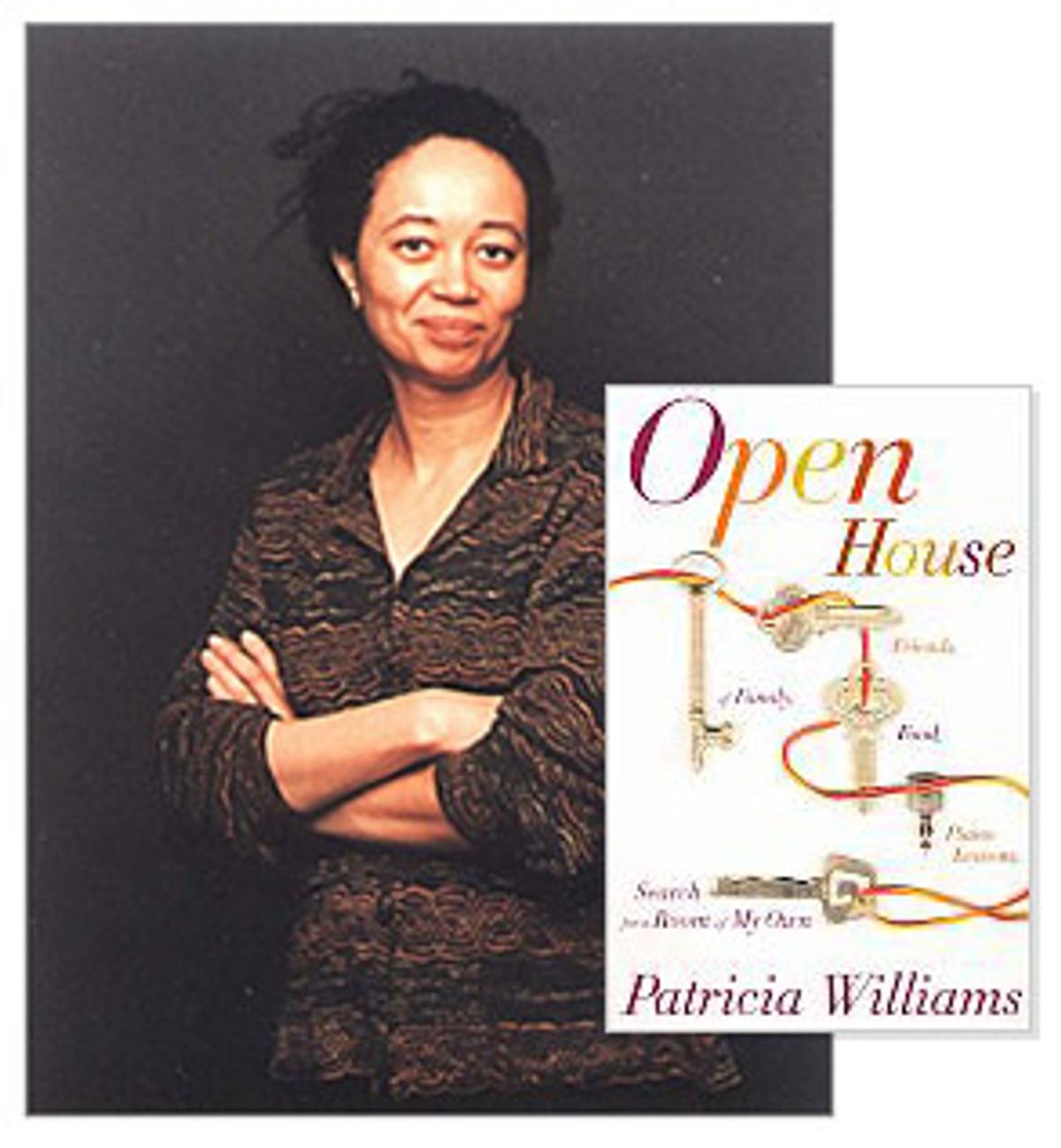
Corrie Pikul

The secret history of black people

Law professor and commentator Patricia Williams talks about passing, choosing her adopted son from a racial menu, and the myth of Condoleezza Rice.

  • more
    • All Share Services

The secret history of black people

Patricia J. Williams, a professor of law at Columbia University, isn’t afraid to take on controversial subjects — even if they lead to death threats, insults (a student once said that she “epitomized liberal bias”) or hysterical labels like this one from London’s Daily Mail: “She’s a militant black feminist who hates all white people.” One of America’s foremost commentators on race, rights and gender, she writes a regular column for the Nation (“Diary of a Mad Law Professor”), and is the author of three books about race. To Williams, the personal is always political, and vice versa; most of her writing is rooted in personal experience. However, Williams’ latest book, “Open House: Of Family, Friends, Food, Piano Lessons, and the Search for a Room of My Own,” is her most inner-directed and autobiographical yet.

“Open House” is organized into metaphorical “rooms” in which Williams moves gracefully from personal anecdotes to discussions of social issues. In “The Outhouse,” she uses the story of her great-aunt Mary to discuss racial “passing.” The daughter of a light-skinned black mother and the descendant of a wealthy white landowner, Mary spent her childhood as a servant to distant white relatives in St. Louis, then moved home to her family’s house in Tennessee. As an adolescent, she desperately wanted to be educated. Inspired by an advertisement on the toilet sheets in her family’s outhouse, Mary hatched a plan to pass as a Native American in order to receive a scholarship to an elite Boston finishing school.

In “The Music Room,” Williams talks about her decision to take piano lessons at age 50 as an antidote to a midlife crisis (she finds it “a wonderful form of meditation”), and ends with a conversation she had with some of her friends about the discrimination they face as outspoken black women. And in “The Crystal Stair,” Williams weaves together the history of the black middle class, the irony of African-American cliques and secret societies, and her pet issue, affirmative action.

Salon met with Williams in her office at Columbia, where she looked nothing like the way she describes herself in the chapter titled “The Boudoir.” (“I dress down instead of up, and my hair is a complete disaster.”) Draped in an elegant black shawl, her bob held back by clips, Williams, 53, talked about public intellectualism, Bill Cosby and her uncomfortable relationship with the “myth” of Condoleezza Rice.

You received a MacArthur Fellowship in 2000. What’s it like being considered a “genius”?

It makes me laugh every time somebody says I’m a genius. In fact, after I got it, some friends of mine made me a little ankle bracelet with the word “Genius” on it, but the letters never stayed in the right place. So people would look at it and say, “Eniusg?”

The MacArthur lends you legitimacy and credibility. People think you’re much smarter than you are. It has been instructive because I think you ratchet yourself up because of it.

In your opinion, what’s the current state of American intellectualism?

American intellectuals are busy writing their hearts out and conversing away, but the real function of intellectualism is to be a broader conversation with the public and particularly with political life. That’s clearly where we as Americans seem to be diverging from an intellectual tradition. Intellectualism is disparaged as elitist. I’m thinking particularly of the slashing of the budget of the National Science Foundation, or the stacking of scientific review committees with industry people so that you manipulate the facts to come out the way you want, or the failure to collect data in any number of realms — that worries me a lot. I don’t think this is just a matter of religious fundamentalism, to which it’s frequently attributed. I think it’s a broader way in which believing something because you want it to be so has replaced research, reservation, caution and critique.

What did you think about Bill Cosby’s inflammatory comments on the anniversary of Brown vs. Board of Education? Among other things, he said, “In the neighborhood that most of us grew up in, parenting is not going on … They’re buying things for the kid. $500 sneakers, for what? They won’t buy or spend $250 on ‘Hooked on Phonics.’”

There was such a brouhaha about what Bill Cosby said about anti-intellectualism in the black community. I disagreed with the way in which he presented that. I actually thought that the more interesting point was that we Americans are undergoing the very anti-intellectualism that he seemed to limit only to the black community. Then again, maybe he wanted to make a point to one community, but I think it let too many people off the hook to say, “See? You black people just don’t study hard enough!” This was against a backdrop of a political discussion in which people were saying that one of the presidential candidates speaks in paragraphs that are too long, and that the other is a populist — not because he supports populist programs but because [of his] malapropisms and because he speaks in split infinitives!

From your family history, we learn about the educated black upper-middle class of the early 1900s. However, this segment of society is not often mentioned as part of America’s demography — as you put it, they’re “hidden pockets of history.”

There is an ambivalence about that generation. The beneficent gift of education to that class came about because of the generosity of the people who formerly owned them. It’s the same situation as Strom Thurmond paying for his black daughter’s education. Educating the mistresses’ children is always a complicated phenomenon. In the wake of slavery there were missionary schools, schools set up for African-Americans, and the historically black colleges were set up, but it was by and large for the children of a certain — not class. It’s complicated to call it upper class, because often it was not accompanied by a great amount of money; you were upper class in the black community, but the actual salary you earned was way below that of working-class whites. That was part of an invisible dual structure of class; it overlapped with skin color. When you start talking about that it scratches the surface of this deep, horrible history of “colorism,” as it’s called in the black community, and it overlaps with people like my great-aunt Mary, who really couldn’t be bear being black and who disdained her blackness.

A lot of black history gets lost. It’s just uninteresting to a larger audience. I was thinking as I was going through books that my godmother left me that there are cycles of literature: There was the Frederick Douglass generation, the W.E.B. Du Bois generation, the Harlem Renaissance, the Richard Wright era, the black-power writers, then the public intellectuals. Now there’s a new crop of hip, young artists coming up. But it is as though people forget about that history, that literature, the intellectual voice of African-American culture. It goes in cycles of almost every 20 years, then it gets disparaged, and it’s terrible and nobody talks about it and you become this cipher for all things stupid. But then somebody “discovers” that there’s a Toni Morrison.

I think that the device by which this is consistently buried and not a permanent part of our history has to do with the fact that African-American contributions to American society — African-American brainpower, intellectualism, science, math ability as well as literary and art ability — are always figured as exceptional. The notion of exceptionalism buries us cyclically.

In the book, you attribute your accomplishments as “proceeding from intergenerational gifts of learning from progressively well-educated family members.” You then go on to explain that your relatives were “beneficiaries of a world that did not then hoard learning like water in the desert.” How is education being “hoarded” today? How do class and race factor into that?

People tend to separate the African-American crisis of access to education from the general American crisis of access to education. There has been a real decline in the quality of education for all of us, whites and blacks. There have been several cycles of destroying our public school education: One was pulling resources out of public schools in the wake of white flight (particularly in the urban North) after migration from the South in the ’60s and ’70s of blacks to the inner city. But the second was the sort of tax withdrawal, so that you have a system like California’s. When I first graduated from law school and moved to California, California had the No. 1 public school system and university system in the country; but it is now at the bottom because they purposefully took money out of it. They destroyed it. Yes, home schooling is fine, and yes, there are private schools. But if that’s what we rely on, we rely on something less than a notion of universal access and something other than a system that unsettles a class system. If private schools and home schooling are all we have, we have a much more static society, rooted in generational class stasis.

You write, “For black middle-class and upper-middle-class parents, schooling means segregation of a different sort — children who almost never encounter another black child, who are always ‘the’ integration wherever they go.”

For most of my son’s academic career, he has been the only black kid in his class, though not in his school. For most of my black friends it’s the same thing: Living in an integrated world means you’re really living in a mostly white world, and you are the integration. As children take it in, it’s sort of funny sometimes. For example, my son went to a birthday party once. This little kid invited lots of other kids from around his neighborhood, beyond the classmates who knew my son. So when we came in the door, I heard the kid saying about my son, “This is my friend; he’s black!” He was just so excited.

In the book, I mentioned the conceptual artist damali ayo, who has this Web site called Rent-a-Negro.com. She has a book coming out about people who want to have a black person to impress their friends and to prove they’re not racist. This little kid, of course, was not a racist, but it was clear that being the only black person means you are a perpetual novelty. And children don’t censor their sense of that novelty. They tend to connect you to the only other black people they know.

For a long time that was Michael Jordan, but now that Michael Jordan has faded as a role model (unfortunately), he has been replaced by any variety of singers and rap stars. It’s interesting because now that my son is just on the cusp of adolescence — he’s 12 — you see all the kids, black and white, imitating these sportslike gestures. They expect my naive little boy to teach them “the secret handshake,” and my son is making them up to be “race cool,” so to speak. It’s amusing, but it’s also a little worrisome.

In the book, you say your son “knew about Martin Luther King Jr. and had read books about the necessity for black self-esteem and education and economic power and how beautiful we all were.” And yet, he still asked if his light-skinned black grandmother was “white” because she was lighter than an Italian neighbor. Now that he’s getting older, has there been a defining moment where he has been, like, “Mom, I get the ‘black’ thing now”?

Yes. It was when the father of one of his friends talked about “these black kids who are criminals.” This man started talking about “black boys” like he had forgotten my son was there. He had categorized him differently, or exceptionalized him separately. But my son got it. He was 8 years old.

That moment comes for all of us. For me it was when one of my friends’ fathers in Boston decided that when blacks moved into his neighborhood, he was going to move out. So for me, it was hearing what he thought through this little girl, my friend. It’s often peers or parents of those peers who bring this realization.

There’s a chapter in the book called “The Boudoir,” where you briefly discuss dating with your “best white friend,” but otherwise men, romance and sex are conspicuously absent from your book. Why?

[Loud sigh] I think my relationships were all good ones, and I’m sorry that some of them didn’t work out. I used to be sorrier, but as I approach middle age, a large percentage of my friends are engaged in child custody battles or divorce, and my sister is a widow. I think that as you grow older, you take what life gives you, and I don’t regret it as much as when I was younger, in my aspirational prime.

Can you tell me how you came to the decision to adopt your son? That, too, is absent from the book. You say you were working on adoption case law, but not much else.

My last major relationship had broken off, and I was 40, and I wanted a child. I am a very lucky person and I’ve had a very lucky life; I have a lot of resources at my disposal. I literally went down to an adoption agency on my 40th birthday. It was really odd, actually, because the adoption agency presented all the racial combinations that they had at the time: everything from Sino-Japanese to Afro-Celtic to Senegalese. It was like going to Kentucky Fried Chicken. The array of options felt almost as vulgar as choosing a leg or a wing. I really didn’t care about any of this, gender or race. My son is black.

Toward the beginning of the book, you bring up a question asked by Anna Deavere Smith: “Who is the one person you could never be?” You say the whole book began as an effort to answer that question. Have you come to an answer yet?

I did a column for the Nation recently in which I was thinking about the complicated icon that Condoleezza Rice is. Now, I don’t know Rice as a person — she has been very effective at keeping her life private. But the myth of Condoleezza Rice’s life is so akin to what so many of us at a certain age survived, lived, how we constructed ourselves, how we wanted to appear to the public, how we watched the borders of who we were. We were the same kind of achievers. When I hear about the lessons she went to, I think of all the Saturday lessons I went to –swimming, piano. We had to be really well scrubbed. The message you got from your parents was that you might be the first black person a white person had ever seen; you had this whole burden of race on your shoulders. She evokes that feeling in me more than any other public figure.

At the same time, here’s someone who clearly represents the ideological opposite end of everything I believe in and stand for. So I think when the question “Who could I never be” gets asked, I’m confronted with the enormous paradox of being human. There is nobody I could say I’d never be. Once I’ve even asked the question, I am mired in a sense of identification. Because I think of someone who is so different from me, but then I think, “Oh really?” I am already engaged in this person.

Japan’s first female P.M.?

Former TV anchor Yuriko Koike is the first woman ever to run for head of state in Japan.

  • more
    • All Share Services

When 56-year-old Yuriko Koike announced her intention to run for the newly vacated position of Japanese prime minister Monday, making her the first woman to attempt to become the leader of that country, the news lacked a little of the invigorating snap it may have had, say, a month ago. In the post-Palin era, one can almost — almost! — be forgiven for feeling a touch of “first woman ever” fatigue. We can’t help sizing up the latest lady to burst onto the international political stage with a sidelong, skeptical eye.

In Koike’s case, the scrutiny seems to be well rewarded. Like our wannabe V.P., Koike had an early stint as a television anchor. But instead of calling hockey shots, Koike, who covered current affairs and then business, followed battles in the Persian Gulf and on the trading floor of the Tokyo Stock Exchange. In her 16 years in politics, Koike served as minister of the environment under Junichiro Koizumi, and last year, she earned became Japan’s first female minister of defense. In addition to Japanese, she speaks fluent English and Arabic. As part of her bid for prime minister, Koike has pledged to focus on the economy and the environment.

So Koike’s got the résumé, the public-speaking experience, the platforms and the connections (former Prime Minister Koizumi is rumored to be backing her candidacy). And as the only female in a field that will consist of at least four male candidates, she’s also getting the lioness’ share of the press. But how relevant is Koike’s gender to the job? Has she said anything about helping, you know, women? Because they could use it: In terms of economic, political and educational equality, Japan ranks 91 out of 128 countries, according to the World Economic Forum’s 2007 Global Gender Gap Report (The U.S. ranks 31.) Japanese women have become notorious for stubbornly refusing to reproduce, and their country has become almost as notorious for its masochistic workplace customs, which make child rearing unappealing to men as well as women.

Koike, who doesn’t have any children, hasn’t yet suggested any mom-friendly policies, but she appears to have been reaching out to professional women for years. According to her Web site, she has written books and articles (it’s unclear which are which) with titles like “Network for Women,” “Women in the Environmental Business,” and the catchy-if-slightly-incongruous “Climbing the Pyramid in a Kimono.” Since sidling into the spotlight, she’s drawn on her gender advantage when talking to the press. “Change is not happening fast enough for women, either in Japanese society or our political world,” she recently told London’s Daily Telegraph. When asked by a male TV anchor if she would fight with strength rather than beauty, Koike replied: “Naturally. In the first place, I’m not beautiful.” Weird question, smooth (if untrue) answer.

Koike, who has professed admiration for Margaret Thatcher and Hillary Clinton, clearly understands that Japanese ladies sure could use a leg up on the political ladder. According to the Inter-Parliamentary Union, which ranks 188 countries based on the number of women represented in Parliament, Japan slides in at a dismal 102 (tied with Gambia and Romania), as only 9.4 percent of the 480 lower House members in the Japanese Parliament are women. Another report shows that only 13 percent of Japan’s ministerial positions are held by women. And guess how many female heads of government Japan has had in the past 50 years? Hint: The same number of female presidents the U.S. has had in the past 219 years.

Despite the favorable international media attention, Koike is an acknowledged long shot for the prime minister position. To vie for the top spot, Koike would first need to become head of the ruling Liberal Democratic Party, but Secretary-General Taro Aso is the party fave. (Only one woman has ever led a major Japanese political party; a woman named Mizuho Fukushima currently heads the tiny Social Democratic Party.) But Koike, a legitimate politico, is no straw woman. Some have speculated that this is a warmup for a future run. As Koike’s fellow Hillary admirers are reluctantly learning, change doesn’t come all at once.

Continue Reading Close

To cut my breasts off, or not to cut my breasts off …

After testing positive for the "breast cancer gene," "Gilmore Girls" writer Jessica Queller made a radical choice -- a preventive double mastectomy.

  • more
    • All Share Services

To cut my breasts off, or not to cut my breasts off ...

One morning in September 2004, while writing a rent check to her landlady and brainstorming ideas for a meeting, Jessica Queller made the call that would throw her life into a tailspin. Queller, a successful, 34-year-old television writer in excellent health, was about to discover she tested positive for the dreaded BRCA “breast cancer gene” mutation, which meant she had an 87 percent chance of developing breast cancer and a 47 percent chance of developing ovarian cancer — the disease that had killed her mother almost exactly one year earlier. What’s more, there was no way of predicting when the disease would strike; she could be 36 or 56. “It was as if I’d fallen down the rabbit hole and decks of cards were talking. As if the logic and rules of my universe had suddenly changed. And in fact, they had,” Queller writes in her new memoir, “Pretty Is What Changes: Impossible Choices, the Breast Cancer Gene, and How I Defied My Destiny.”

Queller eventually learns that women with the BRCA mutated gene face a no-win situation: They can submit to a life of constant medical surveillance (not to mention ever-present anxiety), or they can have radical preventative surgery — having their breasts and ovaries removed.

“To cut my breasts off or not to cut my breasts off,” she writes at one point. “That is the question.” This unforgettable memoir, which evolved from a provocative 2005 editorial in the New York Times, takes us through Queller’s agonizing decision to undergo a double mastectomy. (She plans to eventually have her ovaries removed as well.) In addition to explaining the medical research for laypeople, she turns her focus inward to examine notions of beauty, sexuality and identity, in a way that is not just personal and moving but also sharp and funny. Queller is a former actress who has worked as a writer and producer for shows like “Gilmore Girls,” “Felicity,” and currently, “Gossip Girl,” and her humor and cinematic narrative skills give her story a lively snap.

Finally, Queller uses this book to pay homage to her glamorous fashion designer mother, whose slow death by cancer at 58 clearly still haunts her. “For me, this book is about my mom,” Queller says. “My decision to choose surgery is nothing compared to what she went through, and what my sister and I had to watch.”

Jessica Queller recently spoke with Salon by phone from her home in Los Angeles.

Can you explain how you came to take a test for the breast cancer gene?

When my mom was diagnosed with this advanced ovarian cancer, my best friend from high school, Gillian, said, “I’m on the board for a charity for women’s cancers, and I think you’re at high risk now. You should speak to my friend who runs this organization and get some information.” I was not worried about myself at all at that point. I was 31 years old, and even though I knew my mom was dying, I felt completely invincible — my own health was not on my mind.

I didn’t think about it once for the next two years. Then, about eight months after my mom died, I was finally going back to L.A., getting a job and going back to normal. I was realizing that my driver’s license had expired, my teeth hadn’t been cleaned in three years, all these things. So I started to think about focusing on my own life, after three years of taking care of my mother. I said to myself, “I might as well just get that blood test and know for sure that I have a clean bill of health.”

After you tested positive, what was your reaction when the counselor brought up the idea of prophylactic surgery like mastectomies and oophorectomy?

I was indignant. I thought she was supposed to be a therapist, helping me to feel better, and it was like she was scaring me with these outrageous proposals. How dare she make me feel like I was sick or could be sick soon! Looking back on it now, I realize I was just so in the clouds.

In the book, you express frustration that there was “no clear course of action” and that the doctors couldn’t offer you any guidance. What was the guidance you were looking for?

When you find yourself in that kind of dire medical situation and you’re feeling very vulnerable, you want the doctors to just tell you what to do. But it was surprising to me that none of the experts really felt they could give you a directive. There are pros and cons to each decision, and it’s such a personal choice. As science advances, I think it’s important for all people to grasp that they will have to be their own medical advocates in the future, and that doesn’t mean you don’t get guidance from doctors, but every person is responsible for educating themselves as much as possible and weighing the choices, because they’re not clear-cut.

How did you come to the decision of getting the preventative double mastectomy?

This kind of thing really forces you to soul-search and tap into your own values. For me, the question was: Would I be happier to not to take the test at all, not have the knowledge, and whatever happens happens? A lot of people feel that way. Or would I be happier knowing everything, even if I don’t like the news? Then, later, the question became, would I be happier to keep my breasts and take my chances and if I get cancer I’ll just deal with it then, or will I be happier to go through this awful surgery now and have peace of mind that I probably won’t get cancer?

People often ask me, “Do you tell all women that they have to do this?” I don’t believe in proselytizing about anything, and especially about this subject. Obviously I felt that the choices I made were right for me and my life, but this is so personal that everybody really has to decide for themselves what would make them most at peace.

When your mom was your age, this test didn’t exist, so she never had to face this kind of decision. Were there moments when you envied that kind of blissful ignorance?

I had a few moments of that, but mostly I didn’t feel that way. My personality is such that if there is news out there, I want to know it, even if it’s bad news. I’m the type of person who wants to know if my boyfriend is cheating on me. I don’t like people to know things that I don’t know. I do wish the test wasn’t true. I do wish I didn’t have this gene. But if I had it, then not knowing wasn’t going to make me feel any better.

Were there people who tried to convince you that the mastectomy was an unnecessary measure?

Absolutely. Many of my friends were shocked and horrified and thought I was being melodramatic. They thought this was just extreme, and wrong, that I was traumatized from my mom’s death. People were very judgmental. Everyone from my friends to strangers online. So many people posted things online after this “Nightline” interview that I did, saying things like, “Please, Jessica, don’t do it, you could get hit by a bus tomorrow, you never know. ” One guy wrote, “I can’t believe she’s doing this. It’s the equivalent of being castrated.”

Why do you think people had that kind of reaction?

This concept touches a nerve. People are imagining themselves in this situation and trying to decide what they would do, and they don’t want to accept that [the preventative surgeries] might be a smart thing. The concept of mastectomy is still so scary. After hearing my story, strangers would actually say, there’s no such thing as that test, that can’t possibly exist. This is alien to a lot of people. And it does seem very science-fiction.

At the time you were writing for “Gilmore Girls.” What was it like to write for a show about two women who are quite possibly the most idealistic mother-daughter pair ever, when you suddenly had to start worrying about your own chances of bearing a child?

Making up silly plotlines like, “Are Luke and Lorelai finally going to get together? Is Lorelai going to go back to Christopher?” — it was not that emotional. My own life was so heavy that writing for TV was an escape.

Did you ever think about incorporating any of your own experiences into your work?

For stuff like “Gilmore Girls,” it wasn’t really appropriate. But my friend David was the head writer for “ER,” and he actually wrote an episode for that show based on my story. He called to tell me they were doing the show just as I was going under the knife. I was in bed, in bandages, when I watched the “ER” episode. I had such a crazy emotional reaction. I’m usually the one in the writer’s room stealing stories from all my friends’ lives, and now I was the subject of this drama that I normally make up! It was very surreal. A few weeks later, “Grey’s Anatomy” did a story almost identical to my story as well. I never got confirmation that it was based on me, but I’ve worked with some of those writers previously.

The prophylactic surgeries are still not 100 percent effective, are they?

The statistics I read online said it only decreased your chance of breast cancer by 90 percent, and that concerned me. But when I interviewed surgeons, I learned that if you go to a very aggressive surgeon who focuses on getting every cell, every scrap of breast tissue, the odds improve. The studies haven’t come out yet, but it is believed that your chances of getting breast cancer can be reduced to 1 to 3 percent, whereas the average American woman has more like a 12 percent chance of getting breast cancer. That made me feel comfortable. I went to one plastic surgeon who told me I should go to a breast surgeon who leaves some tissue because I’d get a better aesthetic result. I was like, “Are you insane?! The point is to have a zero percent chance of getting cancer! I’m not going to leave in tissue so that my breasts look a little prettier!” You can never be 100 percent sure, but I feel really confident that the danger of my getting breast cancer now is minute.

The reconstructive surgeries sound much more advanced than I’d expected.

Thank God! I think the reason why I was terrified — and a lot of women are still terrified — about the concept of a mastectomy is because we think about our mothers’ generation and our grandmothers’ generation and what a mastectomy looked like back then. The concept and the stigma still linger, but plastic surgery is so advanced that you’re really put back together again beautifully.

Your last reconstructive operation was two years ago. Are you still happy with your breasts?

I am happy. I had nipple reconstruction, because preserving your own gives you a higher risk of getting cancer. So they’re not real — it’s skin grafting from my hips. But they look so real, it’s uncanny. I do have visible scars, battle scars. But otherwise, it’s totally fine. For a year, my breasts were numb, like with Novocaine. And then all of a sudden, I was like, oh my God! I have feeling in them again!

You know, I just have to say, it’s really embarrassing for me to talk about anatomy and this kind of thing out loud. If I hadn’t been through all of this, I’d be the last person who would ever be talking about my body.

Well, I thought it was wonderful how all the post-mastectomy women you talked to in the book were so open. The women who’d had reconstructive surgery seemed so eager to show you their new breasts!

It’s very sweet. Everyone who has to go through this is so afraid that they’re going to look deformed, and that their femininity will be ruined and their appeal will be gone. So when the results actually are quite pretty and appealing, you want to be like, “Look! Don’t be scared! It’s not that bad. It’s even kind of nice.”

As a single woman who has yet to have kids, have you found that you are in the minority among women who chose to undergo prophylactic surgeries?

When I was having my surgeries three years ago, I was. Back then, I couldn’t find any threads on the FORCE [Facing Our Risk of Cancer Empowered] Web site about young single women. Now, there are dozens of them. It’s definitely moved into the zeitgeist, especially in this past year. A woman in Chicago named Lindsay Avner started an organization called Bright Pink as a resource for young women dealing with this. Lindsay had prophylactic mastectomy at 23. She’s been all over the media, and she’s kind of become the spokeswoman for young women like us.

You’re 38 now. Are you still planning on having your ovaries removed at age 40?

Yes. Ovarian cancer is rarely early onset, and risks increase tremendously after age 40. Ovarian cancer is especially deadly because there isn’t a reliable screening method. By the time someone is diagnosed, it’s often late-stage.

In the book, you talk about your desire to have children of your own. Are you seeing anyone now?

I am not. My last serious boyfriend and I broke up about a year ago, and I dated a little bit after that, but right now I’m really focused on fertility.

Have you pursued your intention to become artificially inseminated?

Yes. I’ve tried artificial insemination several times, and so far it hasn’t worked out. With the stress of traveling and promoting the book, I’ve put it on hold. To be honest, I had been hoping to be pregnant by the time the book came out.

In the book, you mention a technique called preimplantation genetic diagnosis that would allow you to genetically test fertilized embryos for the BRCA mutation. Are you considering this procedure?

No. I don’t think I could do it. To not select embryos that have the gene that I had and my sister had … the guilt would be too much to handle. If I have a daughter I will pray she is in the 50 percent that don’t have the BRCA mutated gene. If she does, I’ll hope that by the time she’s 35, we’ll have a cure for breast cancer. Now, I’m not pregnant yet, so I suppose I could change my mind. But at this point, I feel like that’s a line I can’t cross.

Continue Reading Close

Geisha grrrls

The author of a new book about gender in Japan sets aside Western stereotypes and talks about how ordinary women are fueling a feminist revolution that's transforming the country.

  • more
    • All Share Services

Geisha grrrls

The American media loves Japanese women, especially when they’re dressed in kimonos or school uniforms, or covered head to toe in brand names. But according to Veronica Chambers, a journalist, a novelist and the author of “Kickboxing Geishas: How Modern Japanese Women Are Changing Their Nation,” those stylish stereotypes distract us from the real story. Chambers claims that there’s a major cultural power shift taking place in Japan — and it’s ordinary working women who are shaking things up.

Chambers first sensed the tremors of revolution when she visited Japan on a media fellowship in 2000; her interest piqued, she set out to find enterprising Japanese women who were bucking the corporate system and creating financial and personal success on their own terms. The task turned out to be harder than she expected — not because the women didn’t exist (to the contrary) but because they didn’t think their stories were worth sharing with each other — or with nosy journalists.

Chambers says she started to feel like one of the Western men of the 19th century who were obsessed with the myth of the exotic Japanese female. But instead of following the flash of red lips or the clatter of geta sandals down the alleyways of Gion, Chambers tracked groundbreaking businesswomen and iconoclastic entrepreneurs to their offices and homes. She spent three years discussing ideas of autonomy and ambition with more than 74 women, including young hipsters like a hip-hop DJ and an extreme snowboarder; barrier breakers like a senior executive at Canon and an openly gay Osaka assemblywoman; and dozens of small-business owners, artists and creative types. Through her interviews, Chambers discovered that feminism is alive and even thriving in Japan — albeit in a way that might seem a little, well, foreign to American women. And as American women continue to strive for true equality in the workplace, the White House and beyond, she hopes it may be helpful to hear how our counterparts across the globe — who don’t have mandatory maternity laws, who have fewer female representatives in government than most other industrialized nations and who earn half of what men do — are doing.

Salon spoke to Chambers about “empowered” office ladies, fed-up salarymen, and power-suited female execs who shamelessly play geisha on weekends.

When did you first realize “regular” Japanese women were in the middle of a major cultural shift?

The year I was in Japan for my fellowship was the year of the yamamba girl. Those were the girls with the extremely suntanned faces, the platform shoes and the bleached-blond hair. Also, the subways were filled with these signs that said “No Touching,” because there was a big problem with girls being groped on the trains. I read in newspapers that part of the reason some of the girls adopted yamamba dress was to make themselves unappealing to Japanese businessmen. I felt like something really interesting was going on. It wasn’t exactly “feminism,” but I was hearing girls and women talk about wanting things to be different. I was curious about how women in Japan were changing, and I wanted to look beyond the shop-happy girls in Omotesando, the yamamba girls in Roppongi, the street-fashion girls in Harajuku, and find three-dimensional women doing interesting and pioneering things.

How did you go about finding them?

I started going to the newsstand and picking up magazines and newspapers that looked like they had profiles or stories about women. I’d come back to the U.S., pay to get these articles translated, then fax the translations [about] women who seemed interesting to the Japan Society, with requests for them to help me find them. My contacts at the Foreign Press Center in Japan were almost all women. I’d usually bring a translator with me on interviews, and the women from the Foreign Press Center would say to me, “Can I come with you? I’ve always wanted to meet someone like this.”

Now, these are the people who set up press conferences when Hillary Clinton or Sofia Coppola comes to Japan — they’re not easily impressed. But you don’t see a lot of People magazine-type stories or Oprah segments in Japan about regular people doing inspiring things. So the women at the center were really excited to interact with these Japanese women, and that made me feel like I was on the right track.

Just about every major Japanese company is filled with “office ladies,” who are uniformed secretaries and administrative assistants. Why is it so hard for them to advance up the corporate ladder?

When I’d go to meetings at companies, I’d meet almost all men. There’d be one woman, maybe — and she’d be pouring tea. Even at the copier giant, Canon, all the women who work at the front desk wear pink blouses, pink skirts, white gloves. It’s like Renée Zellweger in that movie “Down With Love.”

When I interviewed Canon’s Masako Nara, one of the few women in Japan who is a senior executive at a traditional company, she didn’t even acknowledge these women. Here in the U.S. it’s understood that you’ve got to get on the good side of the secretaries and the receptionists, because they tell you everything that’s going on. But there it felt like a huge divide between Masako and her female subordinates. Masako later told me that once she got on the corporate track, another woman — her mentor — warned her to never pour tea. “Once you do,” said the woman, “the men in the office associate you with the women in pink who pour tea; they’ll think that’s all you can do. You’ll never gain back their respect.”

If the few women who are making strides in corporate Japan aren’t lending a hand to those below them, who is?

It’s true that Masako Nara wasn’t really feeling the sister-woman thing. She was at a point in her career where she was realizing that she had seven or eight years left to make a mark on the company, and then she was just going to be waiting out retirement. For her, making her mark meant bringing about innovation, it meant becoming powerful — it didn’t necessarily mean bringing in more women. But the fact that she is a woman in a high-level position at a big company like Canon means something, and because she’s really good at her job, it will make it easier for the next woman who comes along.

There will always be individuals slipping in the door; the question is, how do you open the door wider so that more women can participate? When Carlos Ghosn, the Brazilian head of Nissan, announced in late 2005 that he was going to double the percentage of women in the company’s Japanese sales force from 5 to 10 percent, people said it wasn’t a big deal. But at car companies like Honda and Nissan, you have to do all the jobs — including selling cars — before you can become a V.P. So Ghosn is actually giving a lot of female Nissan employees an opportunity they didn’t have before. But it was telling that it took a foreigner to make that decision.

Is there even a female equivalent for the Japanese word “salaryman”?

No. But then again, who wants to be a traditional salaryman? They work long, grueling hours and have little time to spend with their families.

Here’s the classic Japanese situation: A salaryman puts in for his vacation, which he’s entitled to. The dedicated thing to do is to show up at work on the first day he’s supposed to be out. His supervisor sees him and says, “What are you doing here?! Aren’t you supposed to be on vacation?” The salaryman replies, “I was, but I have too much work to do!” Another example: It’s rare for salarymen to have a lunch hour or to go out for a big expense-account lunch. They usually take about 15 minutes to slurp noodles at the train station, or they eat quickly at their desks. At lunchtime, restaurants are all full of nicely dressed Japanese women — no men.

How does the presence of modern women in the office affect the way men behave?

The women tend to take their vacations, and their sick days too. Men see their female co-workers taking advantage of their vacation time, and enjoying long, leisurely lunches, and they think, “Hey, the world didn’t fall apart while they were gone. And besides, I’m entitled to this, too!” The men start taking their vacations; they start going out to a real lunch. Their world opens up a little.

The women you talked to didn’t seem negative or bitter about their position, though. One woman even said that being an office lady can be empowering. What did she mean by that?

If a Japanese man leaves a company, it’s not like here, where you can quit and find a new job at the same level or even higher. It’s a huge risk. Even though the financial bubble has burst in Japan and lifetime employment there isn’t what it used to be, the fact is that most people still spend their lives at one company. But so few women really have a chance within corporate Japan; they’re not on the fast track at a major company, so they can afford to leave and start their own businesses, or to take a couple of years off from work to travel and study different languages.

If Japanese women aren’t clawing their way to the top in the traditional sense, what are they doing instead?

There are more women entrepreneurs than men. They’re exploring new paths to economic and personal fulfillment — like Makiko Fujino, who ran for office after years of being a television chef and won a seat in the Diet, and Junko Asazuma, who became an internationally ranked snowboarder after spending years as a “freeter,” or part-time worker.

What about working moms? You write that in Japan, maternity leave isn’t that common, and neither are nannies or day-care centers. How on earth do Japanese women balance work and family?

You have to really love your job to go back to work after having a kid, and there aren’t many women in corporate Japan who love their jobs. So, once they get married and pregnant, most women simply quit. The women who do make it to the upper levels at corporate companies tend not to have kids. For example, Masako Nara was divorced, and didn’t have any children. It’s not that there’s a stigma against working women or mommy executives, it’s just that there aren’t that many of them. It will be the younger generation that will have to test that out.

What kinds of messages about work, family and home are young Japanese women getting from their mothers?

Out of the 75 women I interviewed, there were five, maybe 10, women whose moms were not housewives. If the family had a business or owned a farm, the mother might work, but for the most part, if you grew up in the ’60s, ’70s or ’80s in Japan, your mom stayed at home. They’re now telling their daughters, “I was trapped by the money. If I had the financial means now, if I knew what to do with myself, I’d get a divorce. Don’t let yourself get into this situation.”

Japanese women are delaying marriage and not having as many kids — if any — and it’s because they got smart. They hear this stuff from their moms, And they’re like, “Once you get married and have kids, you’re locked into an 18-year job.” If you can delay that, then you can travel, you can learn languages, you can make your own money, do your own thing. So there’s actually this worldliness and sophistication that you see in young, single working women.

Compared with Japanese women, it sounds like Japanese men work more, take fewer vacations, have less free time, are less valuable to their global companies and are less sophisticated than their female counterparts.

It becomes hard to say who has the better — or worse — deal. There are women, especially young women, who would really like to run a company and have the opportunities that the men have. On other hand, you have men saying, “Company life isn’t that great. I’d love to learn a foreign language, travel, have hobbies …” The sexism is obvious, but at the same time, that sexism has created what one might call a sort of freedom. But it’s not truly freedom, because the fact is that women should have a choice. Right now, women don’t have a choice to be part of corporate Japan, and so what they’ve done is made these interesting other choices, like starting their own businesses and creating new roles for themselves within traditional companies.

You compare women’s situation in Japan today with that of women in the U.S. circa 1974. What do you mean by that?

Think about what was going on here, with the ERA, with women getting some opportunities in the workplace but also talking more about what else they could do. Think of [TV's] Mary Tyler Moore: She was an associate producer on a news show, but she still answered her male boss’s phone. In Japan, women might have a title and an opportunity to get their foot in the door, but they still don’t necessarily have the power to do what men have traditionally done.

But in the U.S. in the ’70s, those feelings and frustrations led to a major, organized push for women’s equality. Is there an organized feminist movement in Japan?

This is a revolution without a movement. With the birthrate dropping, women getting married later and the level of women’s entrepreneurship increasing, there’s a feeling that things are changing. But I couldn’t find the Japanese equivalent of NOW or anything like that. There’s this one female media figure, Yoko Tajima, whom everyone refers to as the Gloria Steinem of Japan, but she doesn’t represent an organized movement or agenda. She means a lot to a lot of women, but she’s acting individually. Part of that is because Japan doesn’t have a sit-in, petition, rally, movement type of culture. That’s not the way that things get done there. When I first arrived, I actually thought all of this was going to grow into a movement by the time I left. I thought things were going to change, and I still do, but I’m not sure if it will be organized in a way that I or other American feminists can understand.

Do you think American women can learn from the way Japanese women conceive of work, home and success?

In the U.S., there seems to be a big divide separating women who stay at home with their kids and women who work in the office. It feels like you need to take a side. But most of us carry both of those ideas within ourselves: Women who work want nothing but the best for their children, and women who stay home still want to be intellectually engaged and challenged.

I think Japanese women are a little more comfortable taking from the old and new without feeling bad about either. Like American women, the Japanese women I interviewed were trying to construct a life with a meaningful sense of work and with satisfying relationships. But there’s more of a “don’t throw the baby out with the bathwater” sense in their regard for tradition. Japanese women are trying to create a more modern sensibility, but there is also a connection to the past. I don’t think the Japanese feel like they have to be career women or mothers; they don’t feel like they have to be feminist or traditional. You can find a woman who works as a vice president at Canon and also really likes playing the shamisen, which is one of the traditional geisha arts, or a snowboarder who spends her off-season doing ikebana, or flower arranging. And that’s not an embarrassing admission at all. The old is always with you, and not something to reject in order to create a new definition of yourself.

How did the women you interviewed greet the idea that they are part of a national “revolution,” and that the choices they make at work and at home could impact other women’s lives?

Japan is a very humble nation. One of the biggest hurdles was convincing women that they — as individuals — were important and interesting enough to be featured in the book. I spent a lot of time wooing women, trying to put across how important I thought they were to the project. At the same time, I was assuring them that I wasn’t singling them out as “the nail that stands out and should be hammered down,” to paraphrase the old Japanese saying.

It sounds like the changes taking place are positive, but they’re not as earth-shattering or widespread as American feminists might expect, or want. Why should we feel optimistic for women in Japan?

It’s easy to say that they are so far behind us because there’s so little room for women in corporate Japan, and that corporate Japan is a chauvinistic system that locks women out. But it’s more like corporate Japan is a strict and difficult taskmaster, and both sexes are trying to deal with that. At the same time, we’re seeing a lot of highly educated American women, who were on the fast track in the corporate U.S., simply walk away from it all.

Which is all to say, is it possible that 30 or 40 years from now, Japanese women and American women could end up in a remarkably similar place? I think it is. It could be that Japanese women will carve a thoroughly modern existence and paths to opportunity without those early 10 or 20 years that American women spent in big corporations, feeling our way around in our skirt suits and blouses with floppy ties, some of us wanting to fast-track it in the Fortune 500. But many of us — maybe most of us, like most men — do not.

Continue Reading Close

Back to school at 52

Anthropology professor Cathy Small went undercover to find out why her students kept sleeping in her class. She learned some very strange lessons.

  • more
    • All Share Services

Back to school at 52

After 15 years of teaching anthropology at Northern Arizona University in Flagstaff, Cathy Small was feeling more out of place as a college professor than she had when she studied social stratification on a remote Polynesian island. Befuddled by a student population that seemed increasingly disrespectful and uninterested, Small decided that the best way to understand her students (and improve her teaching) was to become a university freshman herself.

So, in fall of 2002, when she was 52, Small enrolled at NAU, moved into a dorm, signed up for a meal plan, handed over her faculty parking pass, and told family and friends that she wanted to be as lonely and homesick as the typical freshman, and thus wouldn’t be able to hang out much during the school year. Assuming that students and professors would treat her differently if they knew about her study, Small constructed a persona for herself: Hoping that people wouldn’t push her for more specific information, she became a writer with an undeclared major, “born and bred in New York,” who was at school to “see what college was like.” With few exceptions, she didn’t disclose that she was an anthropology professor at that very university.

For one year, Small took classes, hung out in the student lounge (where she once got busted by the R.A. for drinking beer), participated in pickup volleyball games, and asked her fellow students a lot of questions. In addition to her own “undercover” observations, she pored over research and conducted formal interviews with more than 50 students, over half of whom eventually figured out that she was a professor at their school. Those “informed” students signed consent forms saying they could be quoted, though not by name. Small says that she didn’t quote anyone who knew her only as a fellow student, but that she did use the observations she made while undercover to formulate questions to her informed interviewees.

The result is “My Freshman Year: What a Professor Learned by Becoming a Student.” To protect the privacy of her students and her university, Small published the book under a pseudonym, Rebekah Nathan, and referred to NAU as “AnyU.” In an afterword on ethics and ethnography, Small wrote, “I certainly would have preferred to put my real name on my work, and I am not terribly worried about the possibility that, in time, that information will come to light. But for now, while student friends are still in school … this affords another level of both ambiguity and privacy.”

Or so she thought. Two weeks before the book’s Sept. 1 publication date, an article appeared in the New York Sun in which journalist Jacob Gershman correctly surmised that “AnyU’s” Rebekah Nathan was really NAU’s Cathy Small. Media outlets around the country jumped on the story, and Small’s project sparked numerous debates about the ethics of going undercover at a university, about the intellectual laziness of college students, and about Small’s career motives for writing the book.

Salon spoke with Small last week over coffee in a Manhattan cafe.

Your main reason for embarking on this project was that you felt out of touch with your students, that they had become “increasingly confusing” to you. What was confusing about their behavior?

They would eat in the middle of my lecture — sometimes a full meal. Or someone would put their head down on the table and sleep. The primary questions I got in class would be, “Is it going to be on the test?” “Should this be double-spaced?” I would be careful to have plenty of office hours at convenient times and then sit in my office waiting, and no one would ever come.

So you decided the best way to learn about students was to become one.

I felt like I was looking at students as if they were Martians, or from a different culture. Given that I’m an anthropologist, I knew the best way to get insight about a different culture was to go and live like them. Not just by talking to them or observing them, but becoming them and seeing what I came up against.

You seemed disappointed to learn that students don’t really discuss the content of their courses outside of class — you write that more frequent topics are “bodies, bodily functions, and body image,” relationships, personal history, pop culture, alcohol and drug experiences. When they did talk about class, it was to complain about the amount of work, compare grades and test answers, and assess their professors attractiveness or likability. Did this really surprise you?

There is an awful lot of conversation about nonacademic, nonpolitical, nonphilosophical things, but I saw something very interesting also. Anyone who said they did have a philosophical conversation might qualify it, like, “Yeah, we were really drunk that night, so we got into all this deep philosophical stuff,” or “Yeah, sometimes I get into this dorky mood and then I talk about deep topics.” When you hear that as an anthropologist, you think the students are responding to a criticism that isn’t even being made, that is in their head.

What do you mean? What’s the criticism?

Students don’t like to sound like they’re trying too hard. That’s what I would see in the pre-class conversations. You know, “How’d you do?” “Pretty good. I got an A, but I barely studied.” Or “I did well, but it’s amazing, because I thought I totally bombed this.” You have to seem like [success] is effortless, or like you haven’t put a lot of work into it. And that becomes part of the culture. I think a lot of students want to have [more substantial conversations], but they don’t feel comfortable doing so.

Do you think that is specific to your university? Northern Arizona University is a fourth-tier, non-elite public university that, you write, draws most of its students from within the state. Do you think students at, say, Yale, are having more intellectually passionate discussions in and out of class?

I absolutely don’t. I think AnyU is “any U.” I’ve had conversations with someone from Duke, for example, who said the exact same thing: “You can’t seem like you’re trying too hard. You don’t want to make out like you’re dorky and that you spend all your time studying or that you’re really into a certain topic.” I really think this holds true across the board.

Why did you want to be undercover and anonymous?

“Undercover” and “anonymous” are different. The undercover part was so that I could experience life as a student. If I went and announced to my classes, “Hey, I’m a professor,” would the professor teach me the same way? Am I going to be allowed into study groups? Am I going to get the real experience of being a student?

As for the anonymity part, an anthropologist always makes up a name for their village. When I go overseas and write about the South Pacific, I make up a different name for my village.

To protect the villagers’ privacy?

Yes. So I made up a name for my university. When I interviewed people, I told them, “I will not use your name if I quote you, I will not use your dorm, and I won’t say the name of the university. I’ll make something up.” And I did that. But in my classes and in the dorm, I wasn’t anonymous. People called me by my real name. It wasn’t until later, when I was writing, that I thought, if I’m not going to use the name of the university, then I can’t use my name, because that would identify the school. Of course, you write a book, you want to have your name on it. But I realized, if I’m going to keep my promises to the students, then I’ve got to make up a name for myself.

How did Jacob Gershman from the New York Sun figure out who you were?

He said he found clues in the book — that the university was near Las Vegas, that it was close to the mountains, that I grew up in New York, that I was in my 50s and had done anthropological research abroad — and he probably found clues because I wasn’t very paranoid about it. Like I said, anthropologists always make up the name of the villages they study. So I figured, who would care what school this is? Who cares who I am? I’m nobody! I guess he thought that [identifying me] was an important thing to do.

Other papers picked up on the New York Sun story, including my own state paper, the Arizona Republic. They disclosed my identity on the front page. Then all of a sudden we had all these reporters at the university, and I was faced with a situation that I didn’t anticipate. I was concerned about breaking the agreement I’d made with students. I thought the only thing to do was to come out and talk to the press. By not confirming, I was fanning the media fires. So now I’m talking to people, but this was not what I intended to have happen. This book should have been about an anonymous university, and I should have been anonymous.

Your undercover research method has stirred up quite a bit of controversy.

Part of the problem was that people [made comments about the book] before reading it. When they read I went undercover as a professor, they said, “How could you do that?” not realizing I actually did informed consent with people I talked to. All of the observations I made while living as a student were always public. I never report any private conversations. If it’s something private someone said to me thinking I was a fellow student, I can’t report it. There are no quotes from people who haven’t given me permission.

How do you respond to critics that say you did this study primarily to advance your career?

The idea that it would advance my career is wild. How does it advance my career when I try to write the book anonymously, and I have no intention of ever revealing that I ever wrote the book, and it’s not even in my field of interest? I am at the end of my research career, and this was about me becoming a better teacher.

Why did you think you needed the on-the-record interviews in addition to your observations?

I realized that at my age, I’m not having the quintessential student experience in all respects, and I really needed to talk to other people, as well.

Since you mentioned it, you really don’t look like the typical college student. I thought more students would be suspicious, or at least probe into your background. Yet only one student, a journalism major, seemed to suspect anything unusual. Later, some student friends told you they thought “it was a little sad for an older woman to be living in the dorms” and they didn’t want to ask too many questions for fear there was a messy divorce story.

Truthfully, I felt I just wasn’t that interesting to them. The questions they asked me were the same questions they asked each other: What is your major? Where is your hometown? And there were plenty of older, nontraditional students like me in school. I wasn’t the only one, and it wasn’t that strange. There were even a few others in the dorms, just not in my dorm.

How did you avoid your colleagues on campus?

I took classes with professors who I didn’t know and assumed they didn’t know me. I consciously selected subjects that were not my forte, like business and engineering and computer science.

It sounded like you had to work pretty hard to socialize with the students in your dorm, because they were never around! As part of your research, you consulted studies (including the 2003 National Survey of Student Engagement) that suggested that students today study less and socialize less than students from the ’70s and ’80s. From what you saw and heard, what fills this extra time?

Students have more pulls on them today. In the group of 50 students I interviewed, none spent more than three hours a day socializing. Instead, they were in student clubs, they were taking five classes, some were double-majoring so they were even taking six. They had volunteer work, and way over half of them were working. That’s a major thing. National data reports that students are working over 10 hours a week.

Why are so many students working?

My impression was that the work is not enough to pay for tuition. They’re taking out loans, and the loans are really paying for tuition. The jobs are more of a supplement. They pay for the way of life the students are accustomed to: their iPod, their computer and their car. Most of these things students didn’t have or care about years ago. They’re also supporting their nights out, which can include eating or drinking, and shopping.

It sounded like work, present and future, is a huge aspect of college students’ lives. In addition to spending their leisure time working at part-time jobs, most of the students’ energy seemed to be focused on preparing for future careers. Everything they did — clubs, volunteer work, even friendships — seemed geared toward getting them a job after school.

Well, research shows that 61.7 percent of those who finish high school go on to college. Before World War II, only 16 percent of the population attended college. So now we have a much less elite group of people in college. State universities are helping people get a leg up on life. At the same time, tuition costs are rising, and as a result, people are going into greater debt to pay for their education. I don’t think there’s anything wrong with thinking about a career. I don’t want my students to exist only in the world of ideas.

You spend a lot of time talking about “community” as it relates to college life. Why was this such an important topic for you?

In the book, I look at things that the university says it wants to focus on. They say, “We’re a community of scholars, we’re a community of diversity, we’re about intellectual life.” That’s what the university thinks it is. From what I saw, the student’s version of these concepts is very different.

What does “community” mean to the students you talked to?

I saw a much more individualized version of community. For most people who said, “I’ve got community here,” it was the five people they hang out with. And that really becomes their university.

You can see that in the kinds of housing that students are attracted to. The old dorms are built according to the “big community” idea, with huge lobbies furnished with big overstuffed chairs, three TVs in giant rooms. But nobody is using them! People are going to an off-campus apartment to visit friends, or they’re all congregating in one person’s room. At my university we have one dorm with a waiting list, and of course this dorm has big suites, four rooms with a living room, washer and dryer, bathroom. It’s like an apartment with everything there. Students only ever have to interact with three or four other people.

I talk about the time my dorm had a big Super Bowl party and only a handful of people attended. Everybody else was sitting alone or with one or two other friends in their own rooms, watching the game.

You suggest that our “overoptioned” public university system is not conducive to building community. Can you elaborate on that?

You have so many choices in a university that people become a community of one. You have a hundred majors to choose from. So let’s say you have 10,000 people. Then you’ve got 1,000 people in each major, and you break them down even further by saying, do you want to live on campus or off-campus? Do you want a meal plan in the dining halls or do you want to eat off-campus? Do you want to join a club? The students have so many choices that by the time everyone is done choosing, nobody is living the same life. It’s 6 p.m. in the dorm, and you’re done with classes, so you say, “Do you want to get dinner?” And everyone’s like, “I can’t because I’ve got this, I’ve got that.” That makes it much harder to connect.

That’s one of the justifications for fraternities and sororities: They make the university smaller and give people a sense of community.

Fraternities and sororities are a big way that people can hang out. But in terms of diversity, you end up with people just like you. But it’s not only the Greek system [that works against diversity]. Many of the things universities do to construct an early freshman experience limit diversity. For example, summer river trips, getting all the kids who are the first in their families to go to college together, holding special socials for the Hispanic kids … If you do that right away, those are the kids that will stick together.

But at least then they’ll be able to spot familiar faces within the larger, more intimidating, faceless university population.

The university is pitting this [abundance of options] against community, and they need to find the right balance. Maybe there’s some timing involved. Maybe in first semester, there is less choice, then you can open it to more choice later.

You wanted to find a “model” of a class that students were really excited about. That class happened to be Sexuality.

Students seemed to be excited about the fact that there was a connection between the things they were doing outside of class and the things they were studying inside of class. One of the questions I asked in the formal interviews was, “What are you in college for?” People would say, “To learn. I’m not just here to party.” But they told me that 65 percent of what they were learning came from outside of class, and only 35 percent came from in class. I was a little surprised by the percentages. But since I am trying to be a better professor, I have to take a lesson from classes like Sexuality and try to connect the information that students are learning in class to their lives outside of class.

Since you’ve gone back to teaching, have you been able to do that?

Yes. I’m now teaching a freshman class called The Anthropology of Everyday Life. Before I did the research for this book, I wasn’t teaching freshmen at all, only graduate students. But after this experience, I decided I wanted to go back to undergraduate teaching. In this class, I’m trying to connect anthropological concepts to things that are going on in their lives. For example, let’s say I’m teaching about cultural expression or art in another culture, and I’m showing all the different ways that these expressions reflect cultural values. I take freshman into the dorms, and I say, “Let’s look at how students decorate their doors. Look at the phrases, the images. What are we saying about ourselves?”

The students at AnyU develop strategies for getting the best grades possible, often at the expense of learning, absorbing new material, or challenging themselves. Many students talk about “working the teacher,” some admitting that they tell the teacher what he or she wants to hear, even when it’s contrary to their own opinions.

It’s not surprising to me that students work professors and are into grades. The surprising thing about that conversation was that the student who said that she “worked the professor” also said that she had learned more from that course than anything else. Before my study, I was always on the lookout for this [kind of behavior]. Now I’m not as concerned if I feel like somebody is “working me” to get a good grade. It isn’t personal. Before, I was annoyed if people ate or slept in class. Now I’m concerned. I know people are living very busy lives, they have a packed schedule, and sometimes they don’t even have time for a meal or a break.

No doubt there are some students that are going to try to pick all easy A’s, and for those students I probably feel the same way as I used to: Come on, what are you here for? But for most students I no longer think that is what is going on. I realize what they’re up against, and I realize how hard it is to get everything to work in the schedule. With the student whose only reason for wanting to join my class is because “it’s the only thing that fits in the schedule,” instead of being annoyed, I now think, at least I have the opportunity to teach them something about anthropology and maybe spark an interest in them for the rest of their lives.

Continue Reading Close

The girls are all right

A new book says that teen girls aren't the drug-addicted, eating-disordered monsters that the media makes them out to be.

  • more
    • All Share Services

The girls are all right

When her daughter was on the verge of adolescence, journalist Karen Stabiner was warned by an acquaintance that “life between a mother and a teenage girl gets as bad as it once was good.” At the time, Stabiner’s daughter, Sarah, was an affectionate 10-year-old who made daily declarations of love for her mom and wrapped herself around her mother’s shoulders “like a vine.” Could it be true that soon she would suddenly turn into an insecure, angry parent hater? The kind of disaffected girl whom Stabiner read so much about in the newspaper and saw portrayed on TV and in the movies?

Stabiner was suspicious — but frightened nonetheless. So she decided to turn her reporter’s eye on her daughter and document her entry into adolescence. Stabiner, the author of four nonfiction books, spent three years observing Sarah and her friends, taking daily notes on everything from the tone of voice they used with their parents to the way the girls interacted at birthday parties. She interviewed other mothers (most of whom she knew personally), delved into research on adolescent girls and spoke with experts in adolescent psychology, all in an effort to uncover what really happens to girls when they hit their teens.

The resulting book, “My Girl: Adventures With a Teen in Training,” is a touching exploration of what it’s like to be the mother of a preteen girl. Nervous parents who had nightmares after watching “Thirteen” will be relieved to learn that Sarah made it through her early teen years without acquiring a wicked best friend, an eating disorder, a drug addiction, a baby or a pierced tongue. Stabiner asserts that her experience with her daughter — mostly smooth, though punctuated by small triumphs and disappointments — is the norm. Sure, Sarah experienced some difficulties with navigating the coolness hierarchy at her middle school, and she occasionally snapped when she felt like her mom was being overbearing or clingy, but overall, she was just fine. In fact, many times in this journal-like book, the anxious mother is the one who seems to need the self-esteem boosting, the reassurance and the encouragement.

Stabiner spoke with Salon by phone from her Santa Monica, Calif., home about how stereotypes can obscure the joys of raising a daughter, why girls are fed up with how they’re portrayed in the media — and why moms should be, too.

Around the time Sarah turned 10, you started to worry that life would change for the worse once she hit her teens. What did you fear might happen?

I thought to myself, if I’m to believe what I see in our culture, then she’s going to turn into Linda Blair from “The Exorcist” overnight. She’ll be mean to her peers, she’ll develop every diagnosable disorder, she’ll want to dress like a slut. She’s going to stop talking to [me] — and even if she does talk to [me], it’s only going to [be to] say something nasty. She’s going to be involved in sex, drugs and rock ‘n’ roll. I mean, rock ‘n’ roll’s fine, but the other two aren’t.

And you think the culture spurred your feelings of dread?

All you have to do is look at titles of books and magazine articles. There was this rash of books that came out in the spring and summer of 2002 with incendiary titles such as “Fast Girls: Teenage Tribes and the Myth of the Slut.” The movie “Thirteen” is another good example. If you believe the headlines, you should be worried. But I also got a lot of it from other mothers of older girls. There was this horrific Greek chorus of doomsayers. The happier we seemed, the more they wanted it to end.

Why do you think these moms said these things?

I think there are three groups of women who believe the hype about “bad girls”: women who did have bad experiences themselves, women who have sons — “Oh, you poor thing. Little Freddy/Joe/Bob is so much easier than I imagine a girl would be” — and women who don’t even have children. They’d heard all this stuff and couldn’t figure out why I was being so blind to it.

Why are we so prone to believe the worst about girls?

It is a hard time to be a girl in this culture. I’m not saying all girls are happy. There are girls today facing profound and genuine problems. Where we’ve gotten into trouble is [when] we’ve taken those stories, which are real, and extrapolated them to all girls. If you actually go back and look at stats and the research, most girls do not suffer from the kind of stuff we hear about all the time. Ninety-seven percent of girls do not have a diagnosable eating disorder. Eighty-five percent don’t have food issues — or don’t have reported food issues. Fewer teen girls are having intercourse than they did 10 years ago. Illicit drug use is going down. More girls are participating in sports than their mothers did. More are going to college. You don’t hear about that. You hear a disproportionate amount about those in trouble.

I think moms tend to be more worried about this, because they were teenage girls once. Part of what’s so hypocritical now is that we were not angels, yet we expect our daughters to be not only angels but executive angels. I was recently speaking to a group of women, and I said, “Raise your hand if your daughter talked back to you today.” Every hand went up. I said, “You may only put your hand down if you never talked back to your mother.” Every hand stayed up. There is a strange double standard these days where everything our daughters do is wrong.

So you had a hunch that the media and the fear-mongering moms were blowing things out of proportion.

The thing that really got me focused on this was the girls at the all-girls school I wrote about in my last book. While working on that, I hung around with five girls, seniors in high school, and spent a lot of time with their families. I was like, “Look at all these wonderful girls! They’re not monsters.”

There was a girl in that book who was at school when a speaker came to talk about girls and body image. This woman was a very well respected cultural historian. We adults loved the speaker’s effort to take a historical look at adolescent girls, and we loved all the examples of how society — through advertising and media — pressured girls to embrace a pretty rigid aesthetic. We thought she’d help turn the girls into savvier consumers, and provide them with a defense against the onslaught of media messages they see every day that tell them how they ought to look.

But after the talk, this one girl was very angry. She was like, “How dare you come to this school full of girls who want to make a vibrant life for themselves and assume we are anything less than marvelous?” She and other girls took [the speaker's presentation] as an insult; they didn’t like the suggestion that they were a bunch of sheep that were incapable of evaluating society on their own.

All the adults were fascinated by the girls’ perspective. Sarah was 8 or 9 when I was working on that book, and the idea for “My Girl” came right off that one. I thought, “She’s my daughter. Why would I want to embark on the most interesting and full-of-change part of her life assuming the worst? Why not assume the best and see what we get?”

Who was the speaker?

I’d rather not say.

How do you think negative stereotypes affect people’s perceptions of their daughters?

There’s a mother in the new book whose daughter is about to turn 13, and every time the girl opens her mouth the mom is like, “Oh my goodness, look at her. I can’t believe I’m going to have a teenager in the house! I don’t know what I’m going to do!” Can you get any more unfair than that? Many of us with decent daughters are missing the good stuff because we’re so programmed to notice and respond to the bad stuff. Forget notice — we now anticipate it! Girls feel like they have to work 14 times as hard in order to make us feel like they’re OK.

According to the book, Sarah has made it through ages 10 to 14 without encountering any problems. No drop in self-esteem; no change in grades; no issues with sex, drugs, alcohol; no all-consuming desire to rebel against her parents —

Sarah’s not perfect. She is a regular kid. She talks back, she drops her clothes on the floor, she makes mistakes. She is a real girl.

Are you as close now as you used to be?

We are close in a totally different way. We’re both very aware that she needs me less than she used to. I think the pressure is on me at the moment to yield gracefully, to know when I need to be the parent and when I need to let her take care of herself.

The book is more of a memoir of motherhood than a chronicle of pre-adolescence. Did you think there would be so much of you in the book when you took on the project?

I was really interested in the mom’s role in all of this. Mothers and daughters have a very intense relationship. I wanted to see what [adolescence] was going to do to her, and I also wanted to see what it was going to do me. They’re so tied up together.

How did Sarah feel about you writing this book?

People ask me that all the time. Many assume that she would not be happy about this. It was that same assumption all over again: Girls are trouble; this is going to cause problems. I don’t think these people were even thinking about Sarah and me, specifically. They’d bought the stereotype about polarized moms and daughters, and they couldn’t imagine us communicating enough to fill a book. Maybe a small pamphlet, but a whole book? Full of what — “Where’d you go?” “Out.” “What’d you do?” “Nothing.” It’s what we fear and expect, and the notion of an alternative brings out the skepticism in everybody.

What I heard from Sarah and her friends was that girls are starting to resent the way they’re portrayed in this culture. They’re like, “Enough already.” Sarah liked the idea of a reappraisal that would attempt to give girls their due. She was really excited to see the first copies of the books, and she seems very happy with the result.

In the book, you mention several psychologists and scholars who have written about adolescent girls, including Judith Rich Harris, Lyn Mikel Brown, Carol Gilligan, Mary Pipher and Rosalind Wiseman. It sounds like you were suspicious of some of this work, especially Pipher’s ideas that girls’ self-esteem plummets as they hit adolescence.

I didn’t make a conscious decision to take on anyone who has written about adolescent girls. I’m not here to say throw out all the books about “bad girls,” girls who are having problems. They exist and they need the compassion and attention that we can give them.

But I also think we shouldn’t assume that all girls are going to end up that way. When you look at the statistics, most girls are not going to have those problems.

[It's like what happened with] menopause. We used to think it was a living nightmare. The only data we had was from women who were in real distress. Their distress was real, but the vast majority of women were too busy living to report their problems. We never saw that population. That population didn’t have a voice in the same way reasonable girls who are neither wretched nor perfect don’t have a voice right now.

You admit that your small sampling “is no more statistically significant than all the bad-girl data, but it is no less true.” If you really wanted to show the world that not all girls go bad, and that a troubled few get all the attention, why did you decide to make the book so autobiographical? Why not interview large numbers of mothers and daughters?

I felt there was enough research at the base of this to make it credible. I really believe a detailed story about one person carries a different kind of resonance than a story about lots of people. You get fewer numbers but more impact.

Yes, but you also set yourself up for skepticism, for people to say, “Well, that’s just a small number of girls.”

Here’s my question for those skeptics: Why are you so eager not to believe this? If it’s your kid, why are you so unwilling to entertain the notion that she’s marvelous?

Sarah is an accomplished rider and has her own horse. To many people, equestrian sports are the domain of the rich and privileged. Do you worry that this will cause other moms to hold the book — and your conclusions about happy teens — at arm’s length? Do you think people will say to themselves, “How could Sarah not grow up happy? She’s lived a privileged life. She’s one of the lucky ones.”

It’s the girls of the middle- and upper-middle class who often suffer the kinds of problems that we read about — eating disorders, drug and alcohol abuse, the oral sex epidemic. But our sense of proportion about them — It must be everyone! Everywhere! — is so out of whack. If anything, Sarah’s demographics make the message here even more urgent.

If you look through the bad-girl literature and watch the bad-girl movies, you usually see girls who have all the creature comforts. Since they don’t have to deal with basic needs, they go looking for more imaginative ways to get into trouble. But the bad-girl cliché is just that. It doesn’t pertain to all girls, or even to most girls, and I like the idea of Sarah and her pals standing up for the rest of our daughters.

Is this book your attempt to present a different spin on pre-adolescence?

There are other books that are oral histories of difficulty. There is no history of regularness, of reasonableness, or of the attempts to maintain a relationship. What I found when I started to ask around was that there were a lot of moms who never said anything about [the experience of raising their daughters] because their experience had been fine. They just didn’t speak up because they didn’t know that [women like me] needed reassurance.

When I ask women who have children what they thought of the book, they say they felt a tremendous amount of relief. They felt like they weren’t crazy and alone. Or, if their daughters are younger, they feel the way I felt when I met those high school girls: “Oh my goodness, it’s not going to be that bad.” I hope that people will gain strength and encouragement from this.

Why did you choose to end the book with Sarah’s 14th birthday? She doesn’t even have her driver’s license yet — a milestone you referred to several times, with notable apprehension.

When I started the book and she was 10, people would say, “She’s not 12 yet, just you wait.” Then we’d get to 12, and they’d say, “Just wait until she’s 13.” No matter where I was, the only reason she was good was because we hadn’t gotten to “bad” yet. Well, she’s 15 and a half and we’re fine, thank you. If the guillotine is still hanging over my head, the hinges are starting to rust. If you [as a parent] have “the end is nigh!” philosophy, you’re going to miss everything.

Continue Reading Close

Page 1 of 5 in Corrie Pikul