Jude Law

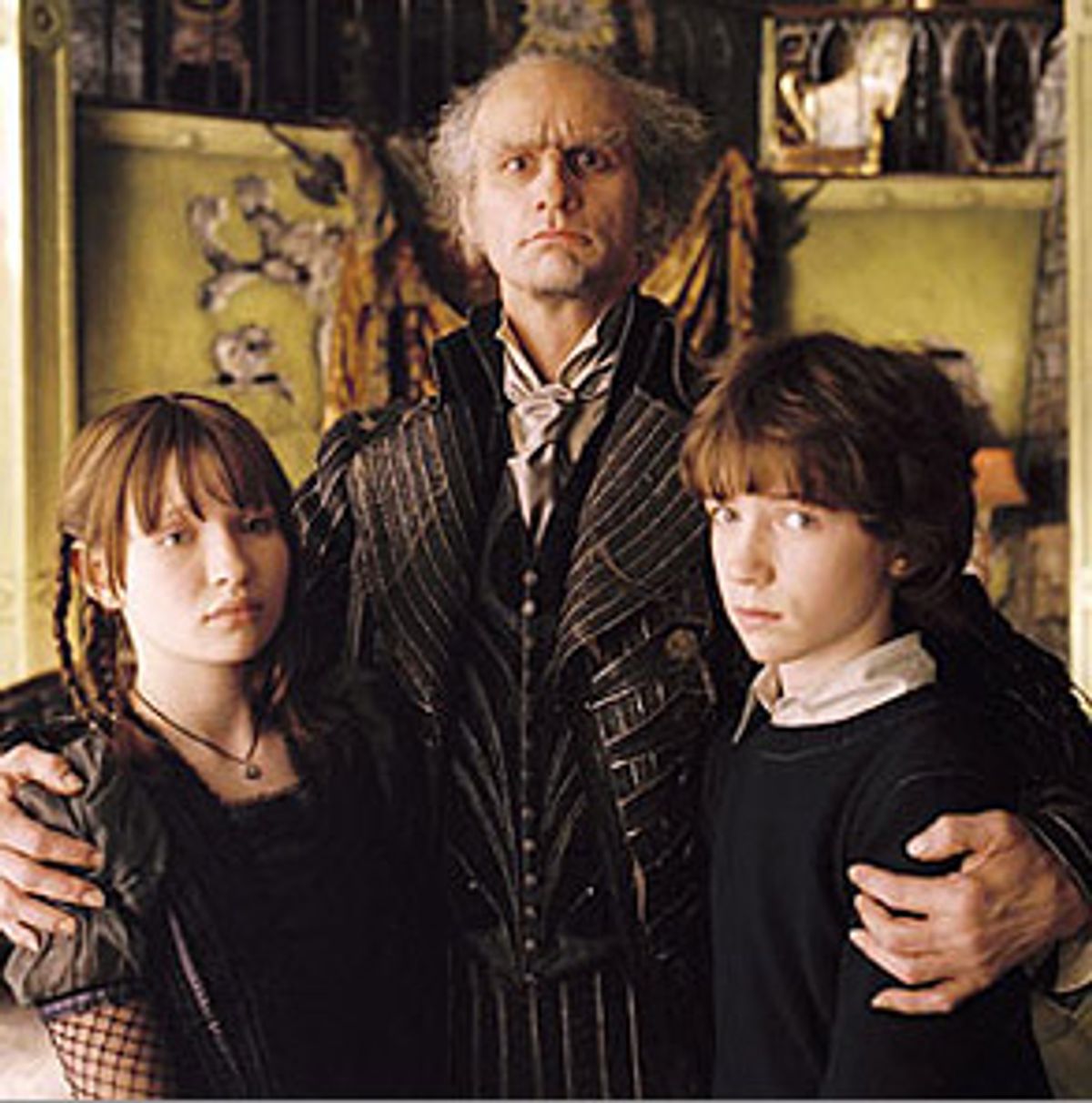
“Lemony Snicket’s A Series of Unfortunate Events”

This adaptation of the popular children's book series gets so much right. So why does it feel so wrong?

  • more
    • All Share Services

Most people who love to read hate to see Hollywood get ahold of their favorite books. But even more heartbreaking than a movie that gets a book completely wrong is one in which every detail, from the costumes to the faces of the actors to the production design to the spirit of the dialogue, is calibrated with exceptional thought and care to capture the essence of a book — and is still mysteriously, inexplicably dull.

“Lemony Snicket’s A Series of Unfortunate Events,” based on the enormously popular series of children’s books in which some very bad things happen to three very appealing orphans, is that sort of movie: As it ticks by, laboriously, it leaves you feeling that you should be enjoying it more than you are.

There’s so much right with “A Series of Unfortunate Events” that it’s hard to believe it goes so wrong. The story is narrated by a mysterious gentleman, seen only in murky shadows as he taps away at the keys of an old manual typewriter; he goes by the name of Lemony Snicket. (In real life, a boring construct with which we won’t concern ourselves now, Lemony Snicket is the pseudonym of novelist Daniel Handler; in the movie, Lemony Snicket is played by Jude Law, and his crisp enunciation perfectly suits the sorrowful Victorian undertones of Handler’s pleasurably grim work.)

Lemony Snicket is here to tell us the story of the Baudelaire children — three “clever and reasonably attractive orphans” — who embark on a shaky adventure after their home burns down, killing their parents. Violet (Emily Browning), at 14, is the eldest: She’s a serious-minded girl with a knack for inventing things. Klaus (Liam Aiken), the middle child, is a brainy book-lover who retains every word he’s ever read. And Sunny, barely more than an infant (she toddles about swathed in velvet Victoriana), has the unique distinction of being very good at biting things — sometimes right through things.

The Baudelaire siblings are deposited with the closest living relative, in this case the wiry, conniving Count Olaf (Jim Carrey), who lives in a dark, craggy house that’s a far cry from the cozy mansion the children are used to. Count Olaf wants nothing to do with the children — he makes them sleep in a cold, tiny room, and assigns them a double-digit list of onerous chores every day — but he’s very interested in the fortune that their parents have left them. So to get his hands on it, he comes up with one outlandish scheme after another, and the Baudelaire orphans, by their wit, their cleverness, and sometimes just their skill at biting, outwit him each time.

But this is, as Lemony Snicket repeatedly reminds us, not a happy tale: “This is an excellent opportunity to leave the theater, living room or airplane where this film is being shown,” he warns at one point. The horrible mishaps that befall the Baudelaire orphans are what give the Lemony Snicket books their distinctively smart, dour character. (The 11th installment was published in September; the series, when completed, will comprise 13 books total.)

Set in an era that’s not quite Victorian and not quite modern, these are darkly funny versions of 19th century kids books in which punishments and tragedies were vividly outlined for the sole purpose of scaring the bejesus out of impressionable little minds. The Lemony Snicket books have a wry, Edward Gorey-style elegance, and kids love them — stylistically, they’re the missing link between jet mourning jewelry and glitter glue.

Brad Silberling, the director of “A Series of Unfortunate Events,” clearly has a grip on the mood of the books — he has said he was aiming for a cross between “Mary Poppins” and “Night of the Hunter,” which sounds just about right. The picture was shot by the extraordinarily gifted Emmanuel Lubezki (“Sleepy Hollow”) in rustley satin tones of gray and green.

The characters, from Carrey’s Count Olaf (who has long, rangy eyebrows brushed into swooping, wispy peaks) to Meryl Streep’s dithering, agoraphobic Aunt Josephine (who wears her hair in a loose bun that flops indecisively around the top of her head), strike the proper notes of menace and benign eccentricity as needed. Appearances by Timothy Spall, Cedric the Entertainer, Catherine O’Hara and Scottish comic and actor Billy Connolly are fun, even if they don’t amount to much. And, most blessedly of all, “A Series of Unfortunate Events” doesn’t have the manic desperation of so many contemporary kids movies: It isn’t noisy or boisterous or loaded with garish action. Silberling seems to be more interested in his characters than anything else, and he trusts that his audience will be, too.

With all that going for it, “A Series of Unfortunate Events” should work — and yet it doesn’t. Its pace is tedious and pokey; sometimes there seems to be too much slack between the characters’ lines, as if they (or Silberling) weren’t quite sure how to hit the right rhythms.

Carrey is, at times, a pleasure to watch: The picture allows him to unleash some of his gangly physicality — he strides, crab-walks and skitters through it like a malevolent daddy long legs. But as funny as he is, his mugging becomes a little wearisome. I’m beginning to think that even though Carrey is a brilliant comic, his dramatic roles (as in “Eternal Sunshine of the Spotless Mind”) have both more depth and more surface texture than his recent comic ones — they may not have the same crazy energy, but they seem to challenge him in ways that often startle us, too.

The episodic nature of “A Series of Unfortunate Events” causes some problems too — the story moves from here to there in a series of discrete jumps, and Silberling can’t quite build and sustain enough tension to hold these sequential bits of story together. The movie doesn’t really have an ending, and worse yet, its feeble attempt at a wrap-up just gives us a tidy, comforting summation that the real Lemony Snicket would never countenance.

That said, “A Series of Unfortunate Events” does have its share of wondrous moments, as well as some just plain funny ones. Sunny (she’s played by Kara and Shelby Hoffman) is one of the movie’s most endearing and mysterious characters. Her lines consist mostly of monosyllabic exclamations like “Ga!” and “Woo!” but subtitles reveal what, in her brilliant but as yet nonverbal mind, she’s really thinking. And she has a fine moment in which, cooing and giggling, she snuggles into the embrace of a reputedly deadly python.

In the loveliest bit in “A Series of Unfortunate Events,” the miserable orphans huddle in their damp, gray room, but with the few possessions they were able to retrieve from the rubble of their wrecked mansion, they make it feel like home. Violet has rescued a set of framed silhouettes of the orphans’ mother and father, drawn on glass and connected by a hinge; Klaus has salvaged a magic lantern. They string up an old curtain, using it as a kind of scrim, and turn the space behind it into a refuge. We see the three of them in silhouette, laughing and talking, the benevolent profiles of their dead mother and father hovering just above them.

Once a family, always a family, is the unspoken message, and it’s a profound but unsentimental one. Yet “A Series of Unfortunate Events” creeps along too sluggishly to have much of an impact. If only it moved like “Night of the Hunter.” By commanding our attention, it might have stood a better chance of capturing our love.

Stephanie Zacharek is a senior writer for Salon Arts & Entertainment.

“Sherlock Holmes”: Downey by Law

Guy Ritchie's version of the detective classic is hectic but harmless. Thank God for the film's two stars

  • more
    • All Share Services

Robert Downey Jr. and Jude Law in "Sherlock Holmes"

Guy Ritchie’s “Sherlock Holmes” is entertaining in a glossy, mindless way — every corner of it is packed with hyperkinetic life, which is not to say that it’s likely to stick in your memory for more than a few hours after you’ve seen it. The screenplay and story are credited to no fewer than five writers, and that’s not even counting Sir Arthur Conan Doyle, who created the characters — and brought them to life with his elegant prose — in the first place. Ritchie seems to think that a detective-and-doctor team who solve crimes by, oh, thinking about them just isn’t dynamic enough for the screen, so he turns Sherlock Holmes and Dr. John Watson — played by Robert Downey Jr. and Jude Law — into action heroes: They kick, punch and karate-chop their way through various scenarios in which the cutting is fast, even when the motion is slow, and the computer-generated effects are plentiful.

But much as Ritchie and his multiple screenwriters have cranked up, supercharged, and otherwise monkeyed with Doyle’s original ideas, it’s hard to get too bent out of shape about “Sherlock Holmes,” partly because the actors seem to take so much pleasure in the act of giving us a crazy spectacle. The plot darts here, there and everywhere like a hepped-up cocaine fiend: Dr. Watson is engaged to be married to Mary Morstan (Kelly Reilly), a lovely, intelligent young woman who seems to genuinely care for him. Holmes is indifferent about the match: It’s clear he feels a bit of jealousy at the idea of losing his dearest friend to marriage, which raises a meek specter of harmless, homoerotic frisson. But it’s definitely a mini-frisson, because when Rachel McAdams’ Irene Adler (“To Sherlock Holmes she is always the woman,” writes Watson at the beginning of Doyle’s “Scandal in Bohemia”) drifts back into Holmes’ world, he perks up considerably, to the point that he may be unaware of danger afoot. Adler may be involved with a group of black-magic baddies, the baddest of whom, Lord Blackwood, is played by a glowering Mark Strong. The serpentine plot also involves conniving politicians, the skeptical law-enforcement official Inspector Lestrade (Eddie Marsan), and a “ginger midget.”

The story may be squirrelly, but it’s at least worked out with some care. Some of the actors get a little lost in Ritchie’s manic stew: McAdams, in particular, drops out of the movie’s focus periodically, although she does look fetching in an assortment of bustles, picture hats and riding gear. The movie, shot by Philippe Rousselot, has a heavily antiqued, steampunky aura about it and features a suitable number of velvet curtains and dark alleys.

And both of the movie’s two big stars hold their own surprisingly well in the midst of the movie’s clutter. Law has the right amount of fidgety elegance: He plays Watson as a smart-enough fellow who nonetheless remains in awe of his dazzling friend — over and over again, he allows himself to be impressed by Holmes’ ability to unravel a complex mystery by breaking it into a series of seemingly mundane but significant details.

Law makes a low-key, unassuming second banana to Downey’s Holmes, maybe because he knows he could never compete. Who could? Downey is exciting to watch here, even though much of the movie around him is almost instantly inconsequential. Ritchie decides to dramatize Holmes’ brilliant deductive skills by showing, in flashy, rapid cuts, how multiple bits and bobs of evidence fit together, helped along by an explanatory voice-over from Holmes. But really, all that excessive cleverness is unnecessary: It would be exciting just to watch Downey’s Holmes think. Few other actors can show such a wide range of feelings — amusement, consternation, resentment or doubt — with little more than the twitch of an eyelid or a subtle shift in the set of a frown or a smile. Downey is the central cog in this movie’s crazy watchworks. He takes a licking and keeps on ticking.

Continue Reading Close

Stephanie Zacharek is a senior writer for Salon Arts & Entertainment.

Films of the decade: “A.I. Artificial Intelligence”

Kubrick? Spielberg? Never mind -- it's a misunderstood masterpiece

  • more
    • All Share Services

Films of the decade: A still from "A.I. Artificial Intelligence"

I’m not the only one to consider “A.I. Artificial Intelligence” a very great and deeply misunderstood film; others as disparate as Andrew Sarris and the late Stan Brakhage have more or less agreed with me, as well as my friend and favorite academic critic, James Naremore. (Click the link above to read my full review.) But it’s also clear to me that any ordinary auteurist way of processing cinema can’t begin to handle this masterwork adequately: Reading it simply as a Spielberg film, as most detractors do, or even trying to read it simply as a Kubrick film, is a pretty futile exercise with limited rewards, even though the fingerprints of both directors are all over it. Seeing it as a perpetually unresolved dialectic between Kubrick and Spielberg starts to yield a complicated kind of sense — an ambiguity where the bleakest pessimism and the most ecstatic kind of feel-good enchantment swiftly alternate and even occasionally blend, not to mention a far more enriching experience, however troubling and unresolved. As a profound meditation on the difference between what’s human and what isn’t, it also constitutes one of the best allegories about cinema that I know.

Film Salon has invited a group of special guests to write about their favorite film(s) of the 2000s. To read the entire series, go here.

Wong Kar-wai’s blueberry-pie America

In this video interview, the Chinese art-film demigod talks about directing Norah Jones in his first American movie (and her first movie, period).

  • more
    • All Share Services

Wong Kar-wai's blueberry-pie America

The Weinstein Co.

Jude Law and Norah Jones kiss in “My Blueberry Nights.”

You can argue that the Chinese-born, Hong Kong-based filmmaker Wong Kar-wai was jumping off a cliff by making “My Blueberry Nights” — a movie written in English, shot in the United States, and starring an untested pop singer with no acting experience — but you can’t argue it was the first time. In eight feature films spread over two decades, Wong has made a violent gangland drama, a period romance, a 1960s coming-of-age picture, an elliptical science-fiction epic and a tale of bohemian gay lovers shot in Argentina. It’s difficult to say whether any of his pictures belong to the same genre as any of the others, but they’re all defiantly Wong Kar-wai films that seem to fuse the traditions of Western and Eastern art cinema, languorous dreamlike experiences where plot is secondary to mood and where the beauty of each episode, each face, each room and each moment is paramount.

Having seen two versions of “My Blueberry Nights” — the cut that was screened at Cannes last May, and the slightly shorter, less complicated edit opening this week in the U.S. — I’ve pretty well concluded that it’s a noble experiment that doesn’t quite work. (If anything, I liked the first version better. Or else it was just Cannes, and I was drunk on good wine and louche atmosphere.) Fans of Wong’s now-classic Hong Kong films, from “Days of Being Wild” and “Ashes of Time” to his international hit “In the Mood for Love” and the incoherent but gorgeous “2046,” will likely find “My Blueberry Nights” lightweight and sentimental. On the other hand, anybody who shows up to see Jude Law and Norah Jones in a love story may be mystified by Wong’s near-plotless Americana road movie, which contrives improbable means of keeping the central couple apart as long as possible.

As I wrote when I reviewed the first version at Cannes, you need to detach yourself from any desire for plausible reality if you want to enjoy “My Blueberry Nights.” More than that, you have to survive the film’s awkward and embarrassing first 10 minutes, because it gets a lot better after that. The New York coffee shop run by Jeremy (Law), where heartbroken Elizabeth (Jones) starts showing up to drown her sorrows in late-night coffee and slabs of left-over blueberry pie, has nothing to do with the real New York of 2008. It’s a vision drawn from 1940s films and Edward Hopper paintings, infused with Wong’s trademark midnight-fluorescent colors. (As Wong explained in our conversation, he used a restaurant in Manhattan’s SoHo neighborhood and various exteriors in Brooklyn and Queens.) If there are some similarities between this film and Wong’s 1994 shopping-mall romance “Chungking Express” — still my favorite of all his movies — “My Blueberry Nights” is even closer to Alan Rudolph’s wistful 1984 indie hit “Choose Me.”

Jones is a lovely woman and a likable screen presence, but not much of an actress; she plays Elizabeth as a good girl with bad posture who doesn’t quite realize that she’s beautiful. Both Elizabeth and Jeremy, a cheerful Mancunian expat who’s somehow become a diner proprietor, are presumed to be so dense, and so damaged by their respective broken hearts, that they don’t notice how movieland-perfect they are for each other. (As ever, Law is a total ham. I always wonder why his slightly self-mocking pretty-boy shtick doesn’t bug me more than it does, but I always like him.) On one hand, this plot element is pretty damn far-fetched, but on the other, it underscores how stilted and inert the film’s early scenes are, and how devoid of sexual chemistry the Jones-Law pairing is.

That said, once Elizabeth hits the road and becomes a bystander to other people’s doomed love stories instead of a protagonist in her own, Wong’s film — shot by Darius Khondji, instead of his longtime collaborator Christopher Doyle — begins to exert a peculiar charm. Elizabeth tarries in Memphis awhile, befriending an alcoholic cop (a simply great performance from David Strathairn) who can’t let go of an evil, evil woman (Rachel Weisz, in a traffic-stopping role). Later, in rural Ely, Nev., Elizabeth explores a Thelma & Louise friendship, possessing an infinitesimal lesbian undertone, with a trashy tomboy gambler played by Natalie Portman. Both these episodes are arguably much more interesting than the question of when Elizabeth’s getting back to New York, or whether Jeremy will still be there waiting for her. (Chan Marshall, aka the singer Cat Power, is terrific in a cameo as Jeremy’s ex-girlfriend. And see if you can find Tim Roth, in an uncredited role as a sleazeball in a Hawaiian shirt.)

I had to resist the tendency to pick these characters and settings apart, but they’re not meant to be naturalistic. They’re snippets of American archetype, picture postcards mailed from a Chinese director’s road trip through our collective past. After discussing the film with Wong, I’m inclined to view it more generously, and not just because he was charming and his wife made me a cup of tea. The fact is, it’s awfully easy to sit in the audience and snicker knowingly at the most ungainly aspects of “My Blueberry Nights,” as a handful of younger critics were doing at the screening I attended last week.

If this film is in certain respects a failure, it’s an ambitious one, belonging to the same noble species as other intermittently terrible and thrilling films about America made by international directors, from Antonioni’s “Zabriskie Point” to Emir Kusturica’s “Arizona Dream” to Andrei Konchalovsky’s “Shy People” to Bruno Dumont’s “Twentynine Palms” … one could go on. Without those kinds of failures, maybe you don’t get the other kind of American films made by foreigners, like, say, “It Happened One Night” and “Vertigo” and “Sunset Blvd.”

I guess what I’m saying is that Wong Kar-wai has earned the right to jump off any cliff he damn well pleases. You can fall in love with the lighter-than-air, imagined-America sweetness of “My Blueberry Nights” or you can write outraged Internet screeds against it, as some offended Wong cultists have done. But it might also be wise to wait and see where Wong’s idiosyncratic journey takes him next. (Reportedly, that will be a long-delayed remake of Orson Welles’ 1947 “The Lady From Shanghai,” and there’s nobody better to take it on.) I met with Wong in his New York hotel room, a few hours after his arrival from Hong Kong. He speaks fluent English, but his grammar and syntax are not perfect; here and there I’ve cleaned up the transcript for clarity.

(You can listen to a complete audio podcast of this interview here.)

You’ve spent much of the last year going around the world talking about your decision to make a film in America, and in English. So I bet you’ve got a really good answer to that question. Why was this an important thing for you to take on in your career?

First of all, it’s because of Norah Jones. Obviously I cannot make her speak Cantonese, so I have to make the film in her language. The second thing is, I think, after “2046″ — a film I spent five years making — I tried to do something which is very different than that. I thought it might be a very nice idea to shoot in English, to shoot in a country where I’ve never worked before. It was something I wanted to do at that point.

I guess you can say that all of your films have been different — formally different from each other and in different genres. So in that sense it was truly what you’ve always done, take on something new with each new project.

I think so. The only difference is here, the language is so different and it is not a language with which I am familiar, which I can command. The process at the very beginning is a bit difficult but it also gives me a chance to open myself up. That means I have to ask my crew and my cast to collaborate with me. This film, in a certain way, is almost like a student film. We worked together instead of saying, “I have an idea and I want everyone to do it this way or that way.”

I know you co-wrote the screenplay with Lawrence Block, the New York mystery novel writer. How did that come about? How did you meet him?

I’m a big fan of Larry and I like his work, especially the Matthew Scudder series. At that point, I had been discussing with Larry to work on something, maybe to adapt one of his books. Then somehow I had a meeting with Norah and then we decide to make a film together. The story is based on a short film that I made a few years ago. I wrote it myself and then I needed someone to help me, so I proposed [the idea] to Larry. At first I proposed that he write the New York chapter, but he really understood most of the characters so I asked him to help me with the whole story.

You’ve said the starting point was Norah Jones. She’s obviously a beautiful woman and a talented performer, but she had not acted before. Why were you so convinced that you could make a movie with her?

First of all, it’s basically instinct, because casting is really like love at first sight. You look at the face and you have a sense that this is something worth working on and this is a person that is very interesting. You can create a story out of her. Also, Norah has been performing since she was 15, so I had no doubts that she could act.

The story begins and ends in New York but along the way it’s a road movie. In that sense it’s a very classic American film genre.

To tell you the truth, the original story took place in New York, in that diner. It’s almost like a “Nighthawks at the Diner” story. But shooting the whole film in New York became too expensive for the production so we decided to move part of the story out of New York. We decided to shoot this film fairly quickly, and I thought the best way to do that, just because it was Norah, was a road tour, like a band. So we traveled across the country and ended up back in New York.

Once the Norah Jones character hits the road with a broken heart, the first place she lands is Memphis. I think that’s my favorite section. Did you actually shoot in Memphis?

That’s Memphis. We took three trips across the country to decide where we were going to shoot the rest of the film. I thought we should definitely have something from the South. We went to New Orleans after Katrina, like a week after Katrina. At that point, Louisiana was offering very good rebate for film productions, but I decided not to do it because the film had nothing to do with Katrina and I didn’t want to take advantage of that. So we moved on to Memphis and I remember the night we got there, the first place we went was to the bar [that became a location in the film]. In most towns, the first way to understand the town is to drop by the bar. The people there will tell you a lot about the place. I was amazed by the structure of this corner because right across the street there’s another diner and there’s the streetcar passing by. It reminded me of all those Tennessee Williams stories. He’s one of my favorite writers so it was interesting to make a stop in Memphis, to have all these blue, Tennessee Williams elements in it.

The Memphis story is about a busted-up love affair, with David Strathairn as an alcoholic cop and Rachel Weisz as the femme fatale who has broken his heart and maybe still loves him. It’s definitely very Tennessee Williams, archetypal.

For Norah, even though in this chapter she seems to be someone looking on from the side, in both characters — David and Rachel — is a reflection of herself. At first she identifies with David because he’s being cheated on and betrayed by the partners. But then she sees the perspective from the other side, from Rachel’s long conversation with her.

Later in the film, we get to Nevada, another place where lots of films have been set, and then you get the Western landscape. You have the story about Natalie Portman as a professional gambler, this tomboy, butch kind of woman. Did you need to find a story that was very specific to that landscape?

In fact, it was really by accident. We went to this small town called Ely, Nev., which is like five hours out of Las Vegas, because we got lost in the desert. We get to this small town and the first thing we notice is that in the gas station there is a Korean woman running a grocery store. It’s very strange. I speak a little bit of Korean and we became very friendly. She explained the background of this town, and it was really interesting. I felt like if Norah Jones’ character dropped by this town and spent some time there, it could be interesting, instead of going to Vegas, which is more or less expected.

There’s a tradition of great international filmmakers coming to America and making, with lesser or greater success, films about America, films that engage the archetypes of America. There are the obvious immigrant directors like Billy Wilder and Frank Capra, but I’m also thinking about Antonioni, Emir Kusturica, Wim Wenders, Bruno Dumont and other people. Did you think about that at any point?

I think no matter where we live, we all grew up with fragments of American culture. I think the most interesting and joyful aspects of making this movie was the joy of revisiting those fragments and paying homage to them. It’s very hard for me to think like an American. No matter how many trips I take, it’ll take a lifetime. I can only be a visitor or a traveler.

Some reviewers have called attention to logical inconsistencies in the plot: Why does Elizabeth travel all the way across the country to buy a car and drive back? I wonder if you would argue that asking those questions is to miss the point of what you’re trying to accomplish in the movie, what you want the viewer to see?

I think so, because there’s so many ways to explain why and, in fact, it’s not the point. I think the point of this film is about letting go. At certain points, we all have to let go of something which means a lot to us but somehow we realize it’s not that way anymore. It doesn’t only apply to relationships, it can apply to a lot of things. We’re living in a world, in a daily life, that has so many routines. We rely on something, we’re obsessed with something, but sometimes you have to let go.

Continue Reading Close

Indie box office: Lennon’s assassin a hit, man

"Chapter 27" strong in NYC bow -- and don't miss an ultra-cool doc on L.A.'s hot modern art scene.

  • more
    • All Share Services

Indie box office: Lennon's assassin a hit, man

Arthouse Films

Still from “The Cool School.”

I was tied up in screenings on Monday, and when I wasn’t doing that I was hunkered down, trying to sharpen my mind and harden my spirit, or something of the sort, in preparation for a Tuesday interview with Wong Kar-wai. How do you tell an artist you admire immensely that you think he’s made a dreadful mistake, one that raises a whole range of questions about his entire career? I’ve now seen “My Blueberry Nights” — that’s Wong’s forthcoming English-language debut, an episodic American road movie with Norah Jones, Jude Law, Natalie Portman and Rachel Weisz — twice, first last year as the opening-night film at Cannes, and second a week ago. (It opens in the United States on Friday.) I guess he re-cut it in between or something, but it hasn’t improved.

I think “My Blueberry Nights” now takes its place in the canon of ill-advised American road trips made by international art-film directors. (See also Antonioni’s “Zabriskie Point,” Emir Kusturica’s “Arizona Dream,” Bruno Dumont’s “Twentynine Palms” and the career of Andrei Konchalovsky.) That’s already a lot more than I should be saying before I even meet Wong, but I’m guessing he won’t be up early this morning Googling himself. His publicists might, and in that case, lucky me.

Not much to report from the weekend box office, although Steve Ramos at indieWIRE is on it, as usual. The semi-controversial “Chapter 27,” with Jared Leto as John Lennon assassin Mark David Chapman, opened strongly — but that was at one theater, the Angelika Film Center in Manhattan, which gives us no idea how broadly this little schizo-world picture will draw. (“Chapter 27″ opens this week in Los Angeles, and will reportedly reach 40-plus screens by the end of May.)

A disparate pair of foreign films I reviewed last week, the great Russian director Alexander Sokurov’s oblique wartime drama “Alexandra” and Italian filmmaker Daniele Luchetti’s far more mainstream ’60s family epic “My Brother Is an Only Child,” also had strong one-screen Gotham bows. (Does that sound like trade-magazine writing or what?) “My Brother” will open in Chicago, Los Angeles and Washington over the next couple of weeks, but I don’t know anything about the future of “Alexandra” yet. Christophe Honoré’s odd, winsome French musical “Love Songs” continues to do well after two weeks, but it too has yet to venture across the Hudson River.

Laura Dunn’s gorgeous land-war documentary “The Unforeseen” also had a terrific single-theater weekend, but that theater was in Austin, Texas, which is Dunn’s hometown and the site of its haunting and dramatic tale. It’s great to see that. Maybe all the market segmentation (or niche marketing or narrowcasting or whatever you want to call it) in the movie business is starting to make room for a return to regional American filmmaking, and regional distribution as well. I hear about small movies all the time that find audiences outside the traditional New York-L.A. nexus, and I vow, hear and now, to pay more attention to them.

Morgan Neville’s new documentary “The Cool School” is a fine example of regional history and regional filmmaking, and ought to find its biggest and most loyal audience on the West Coast. Since Neville’s subject is how Los Angeles’ nascent visual arts scene, from the mid-’50s to the mid-’60s, played a crucial role in the history of modern art — and in the birth of what we’d now call postmodernism — it’s odd that right now “The Cool School” is only playing at New York’s Cinema Village, right in the heartland of old-line Abstract Expressionism.

Neville packs a lot of fascinating characters and enthralling history into his imaginative, jazz-inflected film, but the subject is too large and too complicated for 90 minutes. Several of the macho, hard-drinking artists who drew ideas (and colors and materials) from car culture and put the City of Angels on the modern art map went on to greater fame, like Ed Ruscha, Ed Kienholz and their architect pal Frank Gehry. The ones who were sucked under and died or disappeared, like Billy Al Bengston and Wallace Berman, might be even more interesting. Each almost seems to merit his own film. Speaking broadly, the L.A. artists were a group of hypermasculine, hypercompetitive, anti-intellectual assholes (a sign over the bar at Barney’s Beanery, seen several times in the film: “FAGOTS STAY OUT”), which does not diminish their accomplishments but may explain, in part, why their movement imploded in the late ’60s.

Neville’s movie is mainly about Walter Hopps and Irving Blum, the mismatched pair of entrepreneurs behind West L.A.’s legendary Ferus Gallery. Unbelievable as this may seem to some New Yorkers, Ferus hosted Andy Warhol’s first solo show, and for several years was far ahead of the New York art world (which resisted Pop and clung to Abstract Expressionism). Even Blum and Hopps’ story of ambition, betrayal, daring and venality — not to mention the beautiful ice blonde who married them both — gets a bit compressed here. Still, for art buffs this is a wild ride, and packed with stuff you probably won’t know about. Jeff Bridges narrates, and Dennis Hopper and Dean Stockwell (who both followed the L.A. art scene closely in their salad days) pop up here and there to offer stoned, laconic commentary.

Continue Reading Close

Beyond the Multiplex

Norah Jones and Jude Law seduce viewers with slow, lonely smooches and bites of blueberry pie as Cannes kicks off.

  • more
    • All Share Services

Beyond the Multiplex

You have to suspend all varieties of disbelief and float along with “My Blueberry Nights,” which opened the 60th Festival de Cannes with a splashy red-carpet premiere on Wednesday night. That’s rather like the attitude required by this festival, both so inconvenient and so delightful, and by the storybook landscape of the Côte d’Azur. Reactions to the opening film have been muted here so far, more polite than enthusiastic. Costar Jude Law was the principal focus of paparazzi attention, climbing the steps of the Palais des Festivals in Ray-Bans and a classic tuxedo; with all the gentlemanly grace you’d expect, he tried to deflect the focus toward a winsome, awkward, clearly overwhelmed Norah Jones, the film’s unlikely lead. (I’m underqualified as a fashion critic, but did she choose the slightly dorky gown, with the high waist and poofy sleeves, on purpose?)

“My Blueberry Nights” may not quite be what fans of either Jones or Wong Kar-wai — directing his first film in English — are expecting. It’s a late-night, lovelorn mood piece in a minor key, not complicated or convoluted, finally more confection than substance. I’m not the first person to observe that it bears a startling, if presumably accidental, resemblance to Alan Rudolph’s 1984 indie hit “Choose Me.” Still, the longer this slice of fanciful blueberry-pie Americana sits with me, the better I like it.

This wistful, unobtrusive film has almost no connection to realism or plausibility. (The director’s recent Chinese films, like “2046″ and “In the Mood for Love,” certainly aren’t interested in those things either, and one could debate the naturalism of his early work as well.) It was shot by Wong and cinematographer Darius Khondji in a series of iconic American locations: Manhattan, Memphis, Tenn., the Nevada desert, Venice Beach, Calif. Except for a handful of exteriors, most of it could have been made on a soundstage; you learn no more about what Memphis looks like in 2007 from this movie than you do from listening to Elvis sing “Mystery Train.”

Even by Wong’s standards, the film has a dreamy midnight aesthetic, along with a supersaturated color palette that throbs with purple, gold, indigo and every other Crayola shade you can imagine. I’m not sure what burnt sienna and raw sienna actually are, but I guarantee you they’re in here. The shadows in this movie have shadows; the grains of film shed and subdivide into dark snowflakes of black and crimson and green.

What’s the point of all this gorgeousness? That may pose a difficult question for some viewers. I guess it’s just meant to put you in the mood for love, as it were. Or at least in the mood to watch a couple of beautiful and lovelorn loners, Elizabeth (Jones) and Jeremy (Law), moon around in an empty New York diner, eating blueberry pie and pining for their lost whoevers. We’re not merely supposed to buy Law as a diner proprietor but also supposed to imagine that these two people have been unceremoniously dumped by their true loves, and that Elizabeth wanders off on a no-destination road trip after Jeremy has kissed her. (Pop quiz for female readers: Jude Law has just smooched the pie-à-la-mode stains off your upper lip. Is your very first reaction to buy a bus ticket for parts unknown?)

All that stuff bothered me at first, along with the fact that Jones can’t really act. When she’s required to display emotion about the former boyfriend, it’s more like watching somebody miss the bus or lose her cellphone than undergo a very early midlife crisis. Still, the camera loves her, as they say. (If there’s one thing Wong Kar-wai knows how to do better than any other filmmaker, it’s shoot beautiful women so they look their best.) She has a little of the young Julia Roberts, or a less extreme Angelina Jolie, about her. As the film progresses Wong seems to make more modest demands of her; on her road trip from one service-sector job to the next, Elizabeth is a likable wallflower, an observer of other people’s lives rather than the subject of her own.

Similarly, the chemistry between Law and Jones is nearly null at first — when Jeremy nuzzles in to give Elizabeth that sleepy smackeroo, I half-wondered if he was really after the dribbles of ice cream — but Wong and Khondji eventually create it out of images. There’s no nudity in “My Blueberry Nights,” and if anything it’s aggressively chaste. Except for a few cuss words it could probably be rated G. But the curves and swells and furrowed brows and twitching lashes of Law and Jones, captured in one lingering close-up after another, become their own kind of erotic landscape.

But because this is a movie about unfulfilled longing and delayed gratification, Elizabeth can’t just hang around Wong’s painterly New York night, watching the subway clatter overhead and inhaling pieces of blueberry pie with a really cute guy who happens to be single too. Jeremy’s diner doesn’t look like anyplace in the real New York, but I eventually quit worrying about that once I realized that no part of the movie happens in the real world. Wong’s America is the mythic, heartbroken America of Edward Hopper paintings and rhythm and blues records and Jim Thompson novels, and you can pretty much baste yourself in that flavor or move on.

In some ways, the nonromance between Elizabeth and Jeremy is the least substantial of the three roughly parallel segments of “My Blueberry Nights.” Once Elizabeth ends up in Memphis, where she becomes a waitress and bartender named Lizzie, who observes the not-so-gradual disintegration of a drunken cop (David Strathairn), the film’s prettiness and artifice finally yield some grit. Sitting in the moonlit shadows of Lizzie’s dive bar, Strathairn demonstrates why he’s among the finest of American character actors. With his bowed head, a few tired gestures and an almost masklike expression, he shows us a decent man drawing very near the end of a road paved with bad women (the worst of them played by Rachel Weisz) and bad liquor.

In the film’s Nevada section, Lizzie becomes Beth, a waitress at a backwater casino — I’m pretty sure it’s the Hotel Nevada, in Ely — who befriends a vivacious, tough-talkin’ Texas card shark named Leslie (broadly and enjoyably played by Natalie Portman, in a bad blond do and a succession of almost-trashy outfits). Wong and co-writer Lawrence Block (the well-known mystery novelist) flirt with cliché here, or maybe they embrace it whole-hog. After Leslie’s big showdown at the poker table (her weedy nemesis is Tim Roth, in an almost unrecognizable cameo), she and Beth hit the road in Leslie’s Jag for some lightweight “Thelma and Louise”-style adventures.

Neither that detour nor the film as a whole quite manages the emotional payoff it aims for, but by the end of this slight, charming, vaguely silly picture I was enchanted anyway. Art-house devotees of Wong’s work may have a tough time accepting the setting or the star (or the lightweight, sentimental tone) of “My Blueberry Nights.” And who knows whether Jones’ fans want to see her in a nearly plotless movie where she can’t make up her mind to snog with Jude Law. Still, this movie will seduce viewers one at a time with slow, lonely smooches and forkfuls of blueberry pie, even if it probably won’t be remembered as a major career event for its director and stars.

All in all, it wasn’t an uproariously successful opening for Cannes, but anybody left in a bad mood by “My Blueberry Nights” — not to mention the blue skies, blue sea and pink wine out in the French night — is just a sourpuss. Beginning Thursday, new films will roll onto the Riviera beaches like waves; among the most promising weekend premieres are Hou Hsiao-hsien’s “Flight of the Red Balloon” (inspired by the famous 1950s French short film), Michael Moore’s already-controversial “Sicko” and the Coen brothers’ violent western, “No Country for Old Men.” More soon.

* * * * For more coverage of the Cannes Film Festival, click here.

Continue Reading Close

Page 1 of 6 in Jude Law