What to Read
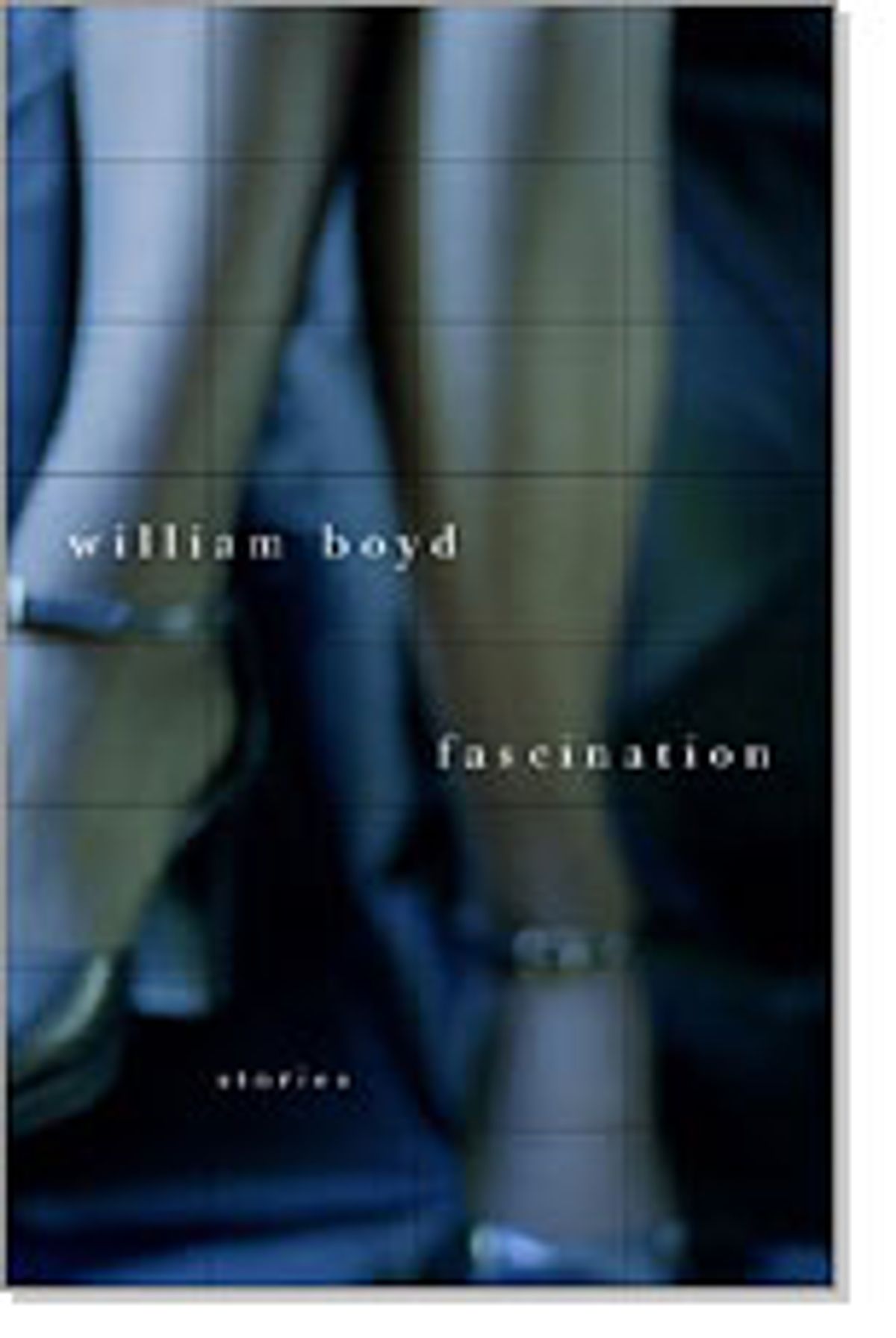
“Fascination” by William Boyd
A collection of stories teeming with infidelity and selfishness will fill you with nothing less than fascination.
Here’s the thing about short story collections: They can showcase an author’s range — or call attention to his limitations. And not infrequently, they do both.
Such is the case with “Fascination,” a new book of 14 short stories by British writer William Boyd (author of eight novels, including 2003′s critically lauded “Any Human Heart”). Boyd’s character-based yarns take place in all sorts of cities around the world — in various eras — and are told by men, women, children, and men and women who act like children. They also reveal Boyd’s almost single-minded preoccupation with infidelity, sexual selfishness and emotional disconnect between the genders. And while, at points, the frequent soundings of the same themes teeter on the edge of growing tiresome, Boyd snatches them back from the brink by imbuing each story with enough freshness to not only hold his readers’ interest but to pass along to them the fascination he clearly has with the quirky characters of his creation.
There’s Edward, a feckless graduate student and aspiring novelist so misanthropic and innately false that he not only suspects his blind tutee of faking sightlessness, but beds the young man’s sexy sister behind the back of his own blindly trusting girlfriend. Edward, who narrates the collection’s opening story, “Adult Video,” returns in the collection’s title story, “Fascination,” and comes off as no less of a rat in middle age, making a play for a teenage high-jumper half his age and lying shamelessly to that same trusting girlfriend from the first story, who is now his wife, sole financial support and the mother of his child.
Any growth we might have hoped for from Edward at the end of the first story is soundly dashed in this follow-up, but then, such disappointing men are par for the course in Boyd’s collection. In “Notebook No. 9″ we’re treated to the journals of a fatuous film director who is in love with a famous actress, yet irritated by the very existence of her young child. In the surreal “The Haunting,” a successful landscape architect becomes possessed by the spirit of a long-dead hydrodynamic engineer with something to prove; naturally, the ghost is a louse and a lech who forces the architect to drink too much, sleep around and make a mess of the lives of his wife and kids. You get the idea.
That’s not to say that the women in Boyd’s book are all noble sufferers, though certainly many of them are. No, some of these women are just as oversexed and selfish as the men they share their stories with: a mother who cheats on her husband essentially under the gaze of her young son, the ultimate victim of her betrayal; a mistress who betrays her lover and conceives a child with his best friend.
And just when you think it’s all getting too dark, Boyd offers you a few bittersweet heartwarmers: a shadowy tale of a poor, young dancer/prostitute in Germany with a sick baby to support who finds a flicker of hope in a young pianist she meets on the street one night in the dim light of a gas lamp; an amnesiac English soldier who finds comfort in the fictional love of a fantasy girl … before he dies suddenly of a massive brain hemorrhage; a 19-year-old kid who works in an American-style gym in the U.K. and saves bodybuilders from the deleterious effects of steroids by selling them placebos of his own devising (the crappier the packaging and higher the price, the more successful the product, he’s found).
That last fellow — doing good by doing bad — is also studying philosophy, trying to solve the mind-body problem in a school paper: “What do we do when we look at our fellow human beings?” he writes. “The bulk of their behaviour is as unpredictable as the weather. We intuit that they have mental lives — minds — of one sort or another, but beyond that we arrive at perplexity.”
Boyd tells the stories of these fellow human beings of varying moral character and tracks their unpredictable behavior. And though he declines to offer explanations and motives, he manages to lead us beyond intuition and past perplexity, until we arrive, finally, at fascination.
“Tubes”: What the Internet is made of
If you think your data lives in the cloud and flies through the air, you're wrong
Andrew Blum The title of Andrew Blum’s “Tubes: A Journey to the Center of the Internet” is a ricocheting joke. When Alaskan Sen. Ted Stevens described the Internet as a “series of tubes” back in 2006, he was roundly mocked for not understanding the online world despite being chairman of the Commerce, Science and Transportation Committee and therefore instrumental in overseeing it. Stevens may not have known what he was talking about, Blum (a correspondent for Wired magazine) acknowledges, but he wasn’t wrong, either. In writing this account of “the Internet’s physical infrastructure,” Blum found that “one thing [the Internet] most certainly is, nearly everywhere, is, in fact, a series of tubes.”
Continue Reading Close
Laura Miller is a senior writer for Salon. She is the author of "The Magician's Book: A Skeptic's Adventures in Narnia" and has a Web site, magiciansbook.com. More Laura Miller.
“People Who Eat Darkness”: The disappearing blonde
A true crime story set in Tokyo illuminates the complicated truths behind media cliches
Joji Obara and Lucie Blackman (Credit: Estate of Lucie Jane Blackman) Lucie Blackman, 21, went out for the afternoon in 2000, phoning her roommate and best friend Louise to arrange a meeting later that night. Lucie never showed up, and within a few days she’d become one of those vanished blondes whose fates fuel headlines and hours of speculative media coverage. She was British, a former flight attendant, and she and Louise were living in Tokyo. They were also bar hostesses, a profession with a very specific meaning in Japan, difficult to explain to foreigners and not entirely clear to the Japanese themselves. Lucie both did and didn’t match the classic Missing Blonde profile, and for a while the mystery of what happened to her threatened to lapse into permanent obscurity.
Continue Reading Close
Laura Miller is a senior writer for Salon. She is the author of "The Magician's Book: A Skeptic's Adventures in Narnia" and has a Web site, magiciansbook.com. More Laura Miller.
“The Aleppo Codex”: The bizarre history of a precious book
A reporter traces the shadowy fate of the definitive version of the Hebrew Bible
Matti Friedman An ancient and priceless book, a murky history of evasions and coverups, an underground of sinister and possibly violent dealers, a former spy who drops tantalizing hints and a wily 84-year-old millionaire who says stuff like, “The problem with this story is that it could damage your health”: Are these the ingredients for a cheesy, improbable historical thriller? Yet “The Aleppo Codex,” Matti Friedman’s account of his attempts to learn the history of one of the world’s most precious books, sports all of these assets, and it’s nonfiction. If reporting this story damaged Friedman’s health, it probably happened when he realized what he’d stumbled into and his reporter’s heart started beating in doubletime.
Continue Reading Close
Laura Miller is a senior writer for Salon. She is the author of "The Magician's Book: A Skeptic's Adventures in Narnia" and has a Web site, magiciansbook.com. More Laura Miller.
“Bring Up the Bodies”: Hilary Mantel’s power play
The sequel to her Booker-winning "Wolf Hall" is a thrilling exploration of what it took to run Tudor England
“Bring Up the Bodies,” Hilary Mantel’s follow-up to her Man Booker Prize-winning 2009 novel, “Wolf Hall,” is a high-wire act, a feat of novelistic derring-do. Mantel makes bold not with form — by now meaningful experimentation in that area seems exhausted — but with the very material that brings most readers to novels in the first place: our imaginative identification with fictional characters and the experiences we feel we’re sharing with them.
Continue Reading Close
Laura Miller is a senior writer for Salon. She is the author of "The Magician's Book: A Skeptic's Adventures in Narnia" and has a Web site, magiciansbook.com. More Laura Miller.
“Words Like Loaded Pistols”: The not-so-lost art of rhetoric
A new book celebrates the power of persuasion, from ancient Greece to Barack Obama
Sam Leith (Credit: Alice Bowden) When people use the term “rhetoric” these days, they usually mean empty language — be it high-flown or spoken in high dudgeon. A few may think of rhetoric as a deadly classical discipline devoted to the exhaustive parsing and labeling of figures of speech: zeugma, anyone? Yet as Sam Leith points out in his delightful and illuminating “Words Like Loaded Pistols: Rhetoric from Aristotle to Obama,” we live in the most rhetorical era in human history, surrounded by and embroiled in argument, enticement, invective and panegyric wherever we turn.
Continue Reading Close
Laura Miller is a senior writer for Salon. She is the author of "The Magician's Book: A Skeptic's Adventures in Narnia" and has a Web site, magiciansbook.com. More Laura Miller.
Page 1 of 25 in What to Read