Gay Marriage

Paralyzed Broadcasting System

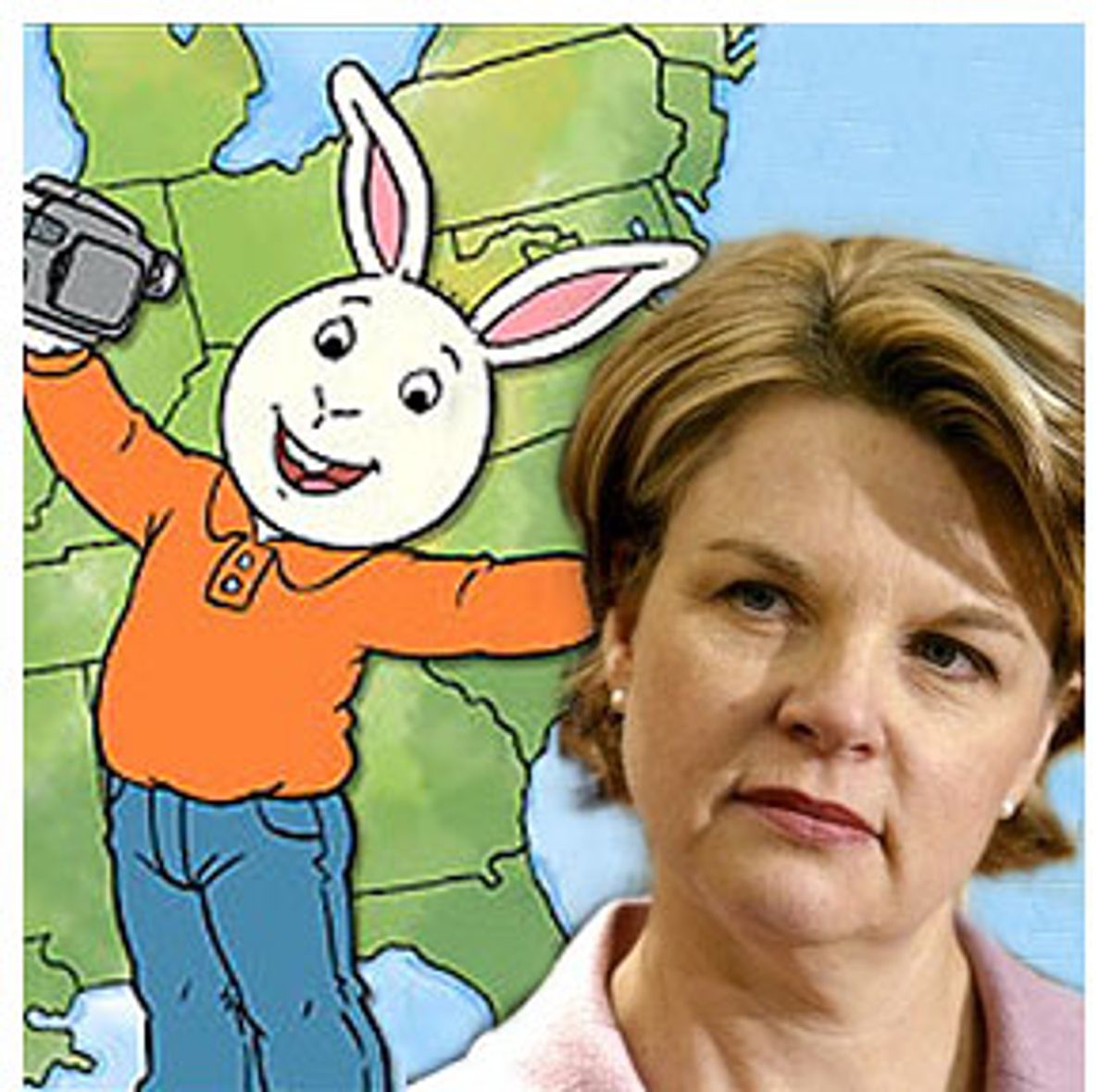
When Bush's education secretary objected to a lesbian couple in a children's cartoon, PBS instantly caved in. Is the network becoming the White House's lap dog?

  • more
    • All Share Services

Paralyzed Broadcasting System

On Wednesday afternoon this week, elementary school children and their parents in the Boston area who were watching public television got to see perhaps the only educational cartoon ever forced to fend off efforts to ban it. Given the Bush administration’s success in keeping the show off the air — except in Boston and a handful of other PBS markets — it might not be the last time, as cultural conservatives and the Public Broadcasting System seem destined to continue to do battle over programming. And considering how quickly PBS conceded defeat this round, that battle may become increasingly lopsided.

The controversy surrounding the children’s series “Postcards From Buster,” featuring a cartoon bunny who, in one episode, visits Vermont to make maple syrup and meets children from two families headed by lesbian couples, generated headlines last week when incoming Education Secretary Margaret Spellings lambasted the episode as inappropriate. Many observers likely viewed the showdown as little more than another head-shaking episode in the ongoing culture war. (The “Buster” flap erupted the same week that Christian talk show host James Dobson warned parents that a classroom video on intolerance featuring SpongeBob SquarePants “could prompt [teachers] to teach kids that homosexuality is equivalent to heterosexuality.”)

But for PBS insiders and longtime supporters, the skirmish, and the speed with which PBS backed down in the face of threats from the Bush administration, mark a new low point for the broadcasting institution and a dangerous development for the public. Low because the content of the “Buster” episode was so innocuous. And dangerous because it highlights the inside-the-Beltway environment in which PBS is forced to operate, where funding concerns often trump programming decisions, and the fear of upsetting conservatives has become a driving force.

“Political decisions now come to bear on public television, despite the fact its specific mission is not to be partisan,” says one former PBS staffer. “The conservative right, slowly but surely, is chipping away at PBS. They have Republican lobbyists counseling them, ‘Do the right thing or we can’t help you on Capitol Hill.’ It’s a chilling effect. And every time PBS gives in to them, that gives [conservatives] more say over the programming.”

According to a knowledgeable source, one outside lobbyist for PBS, Karen Nussle, the wife of Rep. Jim Nussle, R-Iowa, told executives at the network that if they went ahead and aired the disputed “Buster” episode, she would not be able to help them politically. “She’s a good representative to the Republican Congress, and if they lost her that would set the relationship back and PBS would be left exposed on the Hill,” says the source, who adds that PBS’s main lobbyist, John Lawson, president of the Association of Public Television Stations, also warned the network against fighting the administration. “He told them, ‘This threatens our relationship by making Margaret [Spellings] have to deal with this,” says the source. Lawson, who is Spellings’ brother-in-law and who attended her swearing-in ceremony this week, declined to comment for this article. Nussle did not return calls seeking comment.

Asked about what influence Nussle and Lawson might have had internally as PBS wrestled with its decision, John Wilson, PBS’s senior vice president for programming, says he never spoke to them. “I don’t seek out the advice of lobbyists.”

Even before she was sworn into office as the new education secretary, Spellings, a former Bush White House advisor, condemned the TV bunny. She afterward warned PBS about its tenuous federal funding and demanded that PBS refund the Education Department for the grant money it had contributed to the show’s production, approximately $125,000. It was an unprecedented attempt to micromanage — and humiliate — PBS.

“I don’t think we’ve ever been contacted by a Cabinet secretary about anything, let alone a particular [children's] episode,” Wilson says.

In the wake of all the pre-broadcast hype, those watching WGBH in Boston Wednesday may have been most surprised by what they didn’t see in the “Buster” episode, titled “Sugartime!” “It was totally benign,” says Peggy Charren, the children’s programming advocate and public television pioneer who serves on the board of trustees of WGBH, the PBS station that produced the series. “I was expecting there to be a discussion about lesbian families. There was nothing. I watched the tape twice and then called over to ‘GBH and said, ‘Are you sure this is what all the fuss is about?’ The amount of information about lesbian families in the program is zero. I learned more about cows — that all cows are female — than I did about lesbians.”

Other PBS veterans agree that the Republican reaction was wildly overblown. “I viewed the episode and it’s a lot of hullabaloo about very little,” says Jeff Clarke, president and CEO of KQED, the San Francisco PBS outlet. “It’s about kids milking cows and playing in hay. It’s not about pushing any agenda.” PBS president Pat Mitchell initially agreed, giving the episode a green light after reviewing it. But four days later, on Jan. 25, she reversed course and announced that PBS would not distribute the show nationwide. The same day, Spellings’ office issued a blistering letter denouncing the program and demanding a refund of the government’s grant. (PBS will not refund any money to the Education Department but, rather, ask WGBH to create a new, replacement episode so that the “Postcards From Buster” series can still broadcast the planned 40 episodes.)

A handful of stations other than WGBH, such as KQED, WNET in New York and KVIE in Sacramento, Calif., bucked PBS’s decision and plan to broadcast the show at various times between now and March. “We decided there was no reason not to air the episode,” Clarke says.

Ever since America’s public television system was established through the 1967 Public Broadcasting Act, it has had to dodge political bullets, nearly always fired by Republicans. Despite the consistent and high-profile presence on PBS over the years of right-leaning pundits such as William Buckley, John McLaughlin, Ben Wattenberg, Fred Barnes, Peggy Noonan, Tony Brown and Morton Kondracke, Republicans have insisted for decades that the network is guilty of a liberal bias. During the early ’70s the Nixon administration, reportedly unhappy with public television’s voluminous coverage of the Watergate hearings, tried to silence the network by curtailing funding for the Corporation for Public Broadcasting, a presidentially appointed oversight body that channels federal dollars into PBS and local stations. Originally conceived as a way to shield PBS stations from political pressure, the CPB under Nixon tried to do the opposite by exerting more control over programming decisions.

During the Republican revolution of the ’90s, the attack was more frontal, with House Speaker Newt Gingrich declaring a war on “Sesame Street’s” Big Bird and deriding PBS as “this little sandbox for the rich.” He proposed to “zero-out” its federal subsidies, dismissing the network’s supporters as “a small group of elitists who want to tax all the American people so they get to spend the money.” The offensive put PBS on notice, but politically it was a failure. So Republicans adjusted their sights. As Ken Auletta noted in the New Yorker last year, “The American right has stopped trying to get rid of PBS. Now it wants a larger voice in shaping the institution.” And it’s clearly getting that voice.

Last summer, the CPB (whose senior vice president for TV programming, Michael Pack, enjoys close ties to the Bush White House) announced funding for two new public affairs programs, each hosted by conservative commentators who were already widely expressing their views on mainstream media outlets: Tucker Carlson, formerly of CNN’s “Crossfire,” and Paul Gigot, editor of the Wall Street Journal’s editorial page (a page that in the past has argued for the complete withdrawal of federal funding for PBS). The CPB also announced there would be no funding for the TV newsmagazine “Now,” hosted by liberal advocate Bill Moyers, which some Bush-appointed members of the CPB board dislike. According to the New Yorker, during a CPB meeting last winter, “board members attacked Moyers as partisan. One member reportedly screamed, ‘You’ve got to get rid of Moyers!’” Moyers has since left the weekly show, which has also been cut from one hour to 30 minutes.

Yet relations between PBS and Republicans have been surprisingly cordial over the last couple of years. Laura Bush, a former librarian, has spoken warmly about PBS’s children’s programming and embraced the Ready to Learn initiative, an effort to help prepare kids for school. And against the backdrop of congressional hearings on indecency in commercial broadcasting and bipartisan opposition to further media consolidation, PBS has been able to stake out a unique, and largely welcomed, territory in the eyes of Congress. PBS has also worked at ingratiating itself with Republicans. It tapped Gingrich as its keynote speaker in 2003, when PBS station managers made their annual pilgrimage to Washington to schmooze with politicians and ask for funding. That’s one reason why Spellings’ full-throated attack on a cartoon bunny caught so many people off-guard.

“Postcards From Buster” is a spinoff of the award-winning animated children’s program “Arthur.” In each episode Buster, a high-strung bunny, visits real-life families in towns around the country — such as Park City, Utah, and Whitesburgh, Ky. — to learn about local customs and different cultures. During Buster’s trip to Vermont, he learns about milking cows and making maple sugar while briefly meeting two families headed by gay parents. The Education Department contributed $23 million to the Ready to Learn program, and $5 million of that went to “Postcards From Buster,” which targets 6-to-8-year-olds. Officials at the Education Department knew ahead of time that the pair of lesbian moms appeared in one episode because WGBH, upon request, sent over a rough cut of the series in early January. “It’s not common, but we work cooperatively with them,” says Jeanne Hopkins, a spokeswoman for WGBH.

On Jan. 21, PBS announced that its broadcast of the “Sugartime!” episode would be postponed until March 23 so stations around the country could preview it. Some outlets, such as Alabama Public Television, immediately balked on airing it. APTV spokesman Mike McKenzie said that introducing the issue of gay marriage, even indirectly, “would violate the trusted relationship between parents and the stations.”

But on Jan. 25 PBS reversed course and opted to not distribute the episode nationally, a rare move. (Stations that choose to air the show will get it from WGBH.) Then, a few hours later, came Spellings’ attack. “It’s sort of frightening that on her second day in office the secretary of education finds a half-hour children’s program to complain about,” Charren says.

Wilson, the PBS programming executive, says the show was yanked because it failed, adding that it failed, ironically, because the gay mothers played too small a role in the episode. “If the goal was to explore alternative family structures, we would have done it thoroughly and thoughtfully. Instead, the episode opened the door to a sensitive issue and then didn’t fully explore it, [which] then lets parents down.” Of course, if Spellings found a pair of lesbian mothers in the background objectionable enough to demand a refund, who knows how far she would have gone if PBS had produced a full-fledged exploration of gay parents in its children’s programming.

It’s possible the lobbyists are right, and that yanking “Sugartime!” off most PBS stations will help preserve the network’s working relationship with those who have the power to cut funding, or hold hearings on the network’s “bias,” as has occurred in recent years. But Charren wonders at what price. “I don’t think you can afford to have a relationship like this,” she warns. “It doesn’t help PBS at all to have the public think that whenever the White House snaps its fingers, PBS jumps. People don’t give money to PBS in order to have the White House tell it what to do.”

Continue Reading Close

Eric Boehlert, a former senior writer for Salon, is the author of "Lapdogs: How the Press Rolled Over for Bush."

Democrats’ gay marriage excuse

Are Democratic politicians, like Andrew Cuomo, using social issues to distract from the economic status quo?

  • more
    • All Share Services

Democrats' gay marriage excuseAndrew Cuomo (Credit: Reuters/Hans Pennink)

Headlines transmit information in its rawest form — and the best of headlines crystallize indelible truths. Such was the case this week when the New York Daily News blared this simple but iconic headline: “Cuomo: Minimum Wage Harder to Get Than Gay Marriage.”

The story quoted New York Gov. Andrew Cuomo (D) claiming that the effort to raise wages for the poorest of his constituents represents a “broader and deeper” divide than the recent successful fight to legalize same-sex matrimony in the Empire State. Though the piece quickly dissolved into the ether, it should have received more attention because it is an important Rosetta Stone — one that translates this era’s inscrutable political rhetoric into a clear admission that money trumps everything else.

Decoding this Rosetta Stone requires just a bit of contextual information from Siena College. According to the school’s surveys, only 58 percent of New Yorkers support legalizing gay marriage, while a whopping 78 percent support raising the minimum wage from $7.25 to $8.50.

Put Cuomo’s declaration next to those numbers, and the revelation emerges: in a political arena dominated by corporate money, the governor is acknowledging that politicians will champion initiatives that don’t challenge corporate power, but will avoid promoting those that do. Not only that, Cuomo is admitting this is the case regardless of public opinion.

Events in New York illustrate the larger dynamic at work. As the New York Times reported, despite lukewarm public support, Cuomo was able to get the state legislature to legalize gay marriage after Wall Street financiers dumped cash into the campaign for equal rights. Knowing that marriage doesn’t threaten their profits, these moneyed interests opted to help their ally Cuomo notch a strategic win — one that allows the governor to preen as a great liberal champion to the state’s left-leaning voters, all while he simultaneously presses an anti-union, economically conservative agenda that moneyed interests support.

Now, of course, the situation is reversed. With New York’s recession-battered voters supporting a minimum wage hike, the greed-is-good crowd is firmly aligned against the initiative. Why? Because unlike gay marriage, which requires no corporate sacrifice, the modest minimum wage boost may slightly reduce corporate profits — and that’s something the fat cats in the executive suites never permit without a fight.

Knowing this, a hack like Cuomo — a guy who asks “how high?” when his campaign contributors say “jump” — is using his power to undermine the popular minimum wage initiative. In this case, he is cooking up a self-fulfilling prophecy about the measure being a political non-starter.

Not surprisingly, this sleight of hand is not limited to one locale. In Colorado, Democratic activists have cast Gov. John Hickenlooper as a great liberal for supporting same-sex civil unions, all while he loyally shills for oil and gas corporations. At the federal level, the Obama reelection campaign is doing the same, trumpeting the president as a progressive hero for endorsing gay marriage, all while he slow-walks tougher bank regulations.

Even on Wall Street itself, Goldman Sachs CEO Lloyd Blankfein has lately portrayed himself as a great humanitarian. As proof, he doesn’t cite any willingness to acknowledge financial-sector crimes. Instead, he cites his decision to become the Human Rights Campaign’s national spokesman for gay marriage.

Noting all this isn’t to disparage the push for same sex marriage (I’m a strong supporter!) — it is merely to spotlight a bait and switch whereby social issues are increasingly used to perpetuate the economic status quo.

Obviously, it’s possible to simultaneously guarantee equal rights and fix the economy. But as New York most recently proves, it’s much harder to do both when money dictates political outcomes, and when bought-off politicians employ social issues as an excuse to ignore economic justice.

Continue Reading Close
David Sirota

David Sirota is a best-selling author of the new book "Back to Our Future: How the 1980s Explain the World We Live In Now." He hosts the morning show on AM760 in Colorado. E-mail him at ds@davidsirota.com, follow him on Twitter @davidsirota or visit his website at www.davidsirota.com.

When leaders actually lead

Some Obama backers insisted the president could do nothing on his own to advance gay marriage. Boy, were they wrong

  • more
    • All Share Services

When leaders actually leadU.S. President Barack Obama speaks at a campaign fund raising event in Denver, Colorado May 23, 2012. (Credit: Reuters/Kevin Lamarque)

I count myself as a supporter of President Obama who reserves the right to criticize him when I disagree. And I disagreed with his reluctance to come out in support of gay marriage for a long time. I’m also on record wishing he’d taken a stronger public stance behind several big progressive priorities — a larger stimulus, tougher Wall Street reform, a public option for health insurance, a big jobs bill – whether or not he had the congressional support to make it happen.

Throughout the president’s first term, his most ardent supporters have reacted to those of us pushing him to do – and say – more on such issues with frustration and anger, some of it nasty and personal, some of it thoughtful and well-argued. They rightly blame Congress for blocking action on key progressive priorities, but strangely downplay the power of presidential leadership. Late last year, New York magazine’s Jonathan Chait twice attacked liberal Obama critics for being “unreasonable” about what the president alone could accomplish, because “liberals, on the whole, are incapable of feeling satisfied with a Democratic president.”

Chait took particular aim at lefty image guru Drew Westen, a one-time Obama admirer who criticized the president in the New York Times not merely for what he hadn’t accomplished, but for failing to tell a compelling story. Chait accused Westen and other progressives of embracing:

…a model of American politics in which the president in not only the most important figure, but his most powerful weapon is rhetoric. The argument appears calculated to infuriate anybody with a passing familiarity with the basics of political science. In Westen’s telling, every known impediment to legislative progress — special interest lobbying, the filibuster, macroeconomic conditions, not to mention certain settled beliefs of public opinion — are but tiny stick huts trembling in the face of the atomic bomb of the presidential speech. The impediment to an era of total an uncompromising liberal success is Obama’s failure to properly deploy this awesome weapon.

Chait caricatured Westen’s argument (and the beliefs of those who agreed with it), but he got lots of love for both pieces in the pro-Obama blogosphere, where folks finally felt they had a real diagnosis for the illness of those they dismissed as “emoprogs.” But now that we see the changes wrought by Obama’s politically risky embrace of gay marriage, maybe it will be easier for folks to understand that it’s the job of political advocates not merely to praise, but to push their leaders forward.

Steve Kornacki runs down the astonishing political changes we’ve seen in the mere two weeks since the president carefully announced his supposed change of heart on gay marriage. The nation’s largest African-American organization, the NAACP, has come out behind it – and maybe most important, recognized it as an important civil rights issue. Maybe most dramatic, in Maryland, African-American voters have now flipped to support the state’s gay marriage ballot measure 55 to 36 percent –almost the exact percentage by which they opposed it in previous polling on the state issue. And in the latest ABC News/Washington Post poll, African-Americans’ support for gay marriage jumped to 59 percent from 41 percent in the wake of the president’s historic announcement.

Now, I’m not going to argue that Obama’s turnaround alone caused this sea change. The arc of the moral universe has been bending toward justice on gay rights for a long time, and as I wrote last week, the president gave it an additional tug. There have been advocates within the NAACP working to make this happen for a long time, and they deserve a lot of credit. African-American voter opinion had already been trending in this direction, even if black voters had been less receptive to gay marriage than other demographic groups. There is also an emotional and personal component to the president’s stance that makes his moral suasion hard to replicate on behalf of, say, the jobs bill or the public option. (And let’s also remember it’s white voters who are most hostile on some of those economic issues, thanks to the divide and conquer politics of the GOP over the last 40 years.)

Still, it’s hard not to conclude that Obama’s words made a significant difference in the political course of this debate. Ironically, it was once critics of Obama who mocked the power of words, and specifically the candidate’s own oratorical gifts. Obama shot back at them many times.

“Don’t tell me words don’t matter,” he told Wisconsin Democrats in February 2008. “‘I have a dream’ — just words. ‘We hold these truths to be self-evident, that all men are created equal’ — just words. ‘We have nothing to fear but fear itself’ – just words. Just speeches.” At many times over the last three years, I’ve been amazed at how Obama’s critics and supporters seemed to change sides on the question of the power of his words.

I give the folks who call themselves “prag progs” – pragmatic progressives, as opposed to “unreasonable” emoprogs – a lot of credit for fixing attention on what the president has accomplished, and reminding others not merely to fixate on what he hasn’t. But I think it’s time that all of us acknowledge that there’s a role for constructive pressure, too. Progressive change has always required impatient agitators – and it will continue to.

Continue Reading Close
Joan Walsh

Joan Walsh is Salon's editor at large.

Marvel Comics plans wedding for gay hero Northstar

Out since 1992, the openly gay superhero will walk down the aisle in late June

  • more
    • All Share Services

Marvel Comics plans wedding for gay hero NorthstarThis comic book cover image released by Marvel shows "Astonishing X-Men," No 51. Marvel Comics said Tuesday, May 22, 2012 that the Canadian character named Jean-Paul Beaubier, right, will marry his beau, Kyle Jinadu, in this edition due out June 20. (AP Photo/Marvel Comics)(Credit: AP)

PHILADELPHIA (AP) — Wedding bells will ring this summer for Marvel Comics’ first openly gay hero, super speedster Northstar.

The New York-based publisher said Tuesday that Canadian character Jean-Paul Beaubier will marry his beau, Kyle Jinadu, in the pages of “Astonishing X-Men” No. 51. That’s due out June 20.

Northstar revealed he was gay in the pages of “Alpha Flight” No. 106 in 1992. He was one of Marvel’s first characters to do so.

Since then, numerous comic book heroes and villains have been identified as gay, lesbian or transgender.

Marjorie Liu is writing the series. She says the decision to have the pair marry was fitting, noting that the relationship between Kyle and Northstar has grown in recent years.

___

Marvel Entertainment LLC is owned by The Walt Disney Co.

Manny Pacquiao loses his crown

The boxer's anti-gay remarks lead us to take an unprecedented step: We're revoking his Salon Sexiest Man title

  • more
    • All Share Services

Manny Pacquiao loses his crownSteve Carell and Manny Pacquiao (Credit: AP)

We’re all relieved around here that Manny Pacquiao is not really some Leviticus-quoting loon who says that gays “must be put to death” – even if that may have something to do with the fact that he admits “I haven’t read the Book of Leviticus yet.”

But it’s nonetheless disappointing that a man we at Salon bestowed our highest honor to just six months ago has proven himself so terribly unenlightened. In an interview for Examiner.com last week, one of our 2011 Sexiest Men declared of marriage, “It should not be of the same sex so as to adulterate the altar of matrimony, like in the days of Sodom and Gomorrah of Old.” Oh dear. Winning lots of fights? Sexy. Getting elected to the Filipino Congress? Sexy. “Donating millions to improve living conditions in his poverty-stricken nation”? Super hot. Not being down with civil rights? Bzzzzzzt!

That is why we have decided to take an unprecedented step here at Sexiest Men World Headquarters. We have in the past fought epic, bloody internal battles over men like Zach Galifianakis, Al Franken and Louis C.K. But we have never, in our sexy, sexy history, revoked a man’s title. Until now.

We understand that the Roman Catholic boxer has to be true to his beliefs, and we would never insist that falling in lock step with Salon’s own socialist, American fabric-destroying agenda is the only criterion for making the list. It’s just that we suddenly don’t feel like going a few sweaty rounds with a dude who thinks civil rights “adulterate the altar of matrimony.”

So instead we’re passing on the crown to one of last year’s runner-ups. Like Pacquiao — and also like our beloved first Sexiest Man, Carell’s former “Daily Show” colleague Stephen Colbert – he’s a happily married, self-described “born and bred” Catholic. But this one says, “I stay clear of declaring my political choices,” insisting humbly, “I feel like my voice is no more valuable, no less valuable than anyone else’s.”

What really makes us go weak in the knees is how he turned a bumbling, inept bag-of-wind character and made us care when he said goodbye to “The Office.” And, last summer, he took a broken, pathetic, recently divorced dad and made him so tenderly romantic (and so darn good-looking in a tailored suit) he nearly made us forget Ryan Gosling in “Crazy, Stupid Love.” We’ve had a thing for him since before he became a 40-year-old virgin. We’d choose him as our friend for the end of the world. How could we ever have been so blinded by that pugilistic piece of beefcake? That’s why today, we’re asking newest Salon Sexy Man Steve Carell, will you gay marry us?

Continue Reading Close
Mary Elizabeth Williams

Mary Elizabeth Williams is a staff writer for Salon and the author of "Gimme Shelter: My Three Years Searching for the American Dream." Follow her on Twitter: @embeedub.

Jonathan Rauch: “We are a sideshow no longer”

At his first same-sex marriage since Obama's big announcement, a longtime advocate reflects on a decades-long fight

  • more
    • All Share Services

Jonathan Rauch: (Credit: Chris Howey via Shutterstock)

It’s a beautiful spring day in Washington, D.C., around 5 p.m. I am arriving at the august Peterson Institute for International Economics. Today, however, the place is not a think tank but a chapel, and the important words to be uttered are not “trade-weighted exchange rates” but “I do.”

My old friend Joe Gagnon is getting married today to Paul Adamczak, his longtime partner. How I hate that word “partner”! As if Joe and Paul were members of the same law firm. Within the hour, I am pleased to realize, they will be partners no longer. Under District of Columbia law, they will be husbands.

Today’s ceremony is freighted with extra excitement. Only three days ago, President Obama announced his support for same-sex marriage. The subject is much discussed here at the wedding. Of course, as an invitee mentions, Obama’s endorsement alters not a jot of law, not a tittle of policy. Yet a cultural barrier has been crossed, a taboo forever retired. The highest officer in the land and, by extension, his political party and half the country have embraced today’s ceremony as their own. We are a sideshow, an outlier, no longer.

The think tank’s auditorium is transformed by draperies, flowers, gentle lighting, rows of plush chairs. Lovely. It occurs to me, as I reflect on the week’s events, that only one decoration is missing. An American flag would be very much in order.

Chamber musicians play as I take a seat. A few rows ahead of me sits a restless boy, perhaps 8 or 9 years old. My mind pitches back to an earlier time, more than four decades ago, and another boy, about the same age. He is sitting on the piano bench in his house in suburban Phoenix. I remember exactly the spot, exactly the moment, though I could not tell you the date exactly. Suddenly, out of the blue, the boy realizes that he will never be married. He does not know why marriage and family are out of his reach. He will in fact not understand why for almost 20 years, when he comes to understand he is homosexual. But children understand marriage long before they understand sex, and this boy knows, intuitively, that he is different in some way that rules out the kind of life that other people take for granted. He will always be an outsider to family life.

I look again at the boy in front of me and try to imagine what it is like to be him. He will never experience the desolate realization that I had long ago in Phoenix. He will never even be able to comprehend it. The wedding he now witnesses seems ordinary to him. For the whole span of his life, whether he is straight or gay, there will be a destination for his love within the folds of marriage. I find I envy him.

The grooms are walking down the aisle, Joe accompanied by his father, Paul by his mother. In front, two candles are lit for the parents who are not here. I wonder how Joe’s father feels, giving away his son to a man in a legally recognized ceremony. I think back on a conversation with my own father. This is in 1995, not so very long ago, but an eon as it seems today. He is urging me not to write about gay marriage, a subject I will soon take up for the Economist and the New Republic. He knows and accepts that I am gay; that is not the problem. It is my career he is worried about. The idea of a man marrying a man or a woman marrying a woman, he tells me, is such an outlandish idea that if I associate myself with it I will no longer be taken seriously as a writer. People will think I’m a nut. At the time, his prediction seemed plausible.

My gaze alights on one of the absent parents’ candles. My father lived to know and love Michael, who became like another son to him. He lived to see same-sex marriage legalized in Massachusetts and then in several other states. Alas, he died only a few months before Michael and I could legally marry in Washington, D.C. Had he been at our wedding, he would have blessed us, happy to see his prediction proved so blessedly wrong.

The officiant begins the ceremony and the grooms join hands. There are readings from Robert Frost and Plato’s Symposium. Later, Joe will admit to worrying that the readings might seem hackneyed. But the words have their intended effect as my eyes well up. They have an unintended effect, also, as I realize the improbability of what I am witnessing: a thoroughly conventional same-sex wedding.

Earlier that very day, as it happens, I had received an email that was like a bad LSD flashback. Objecting to a recent pro-gay-marriage article of mine, the writer identified himself as a member of the Stonewall generation. “I myself  was active in the Gay Liberation Movement way back in the beginning in the early ’70s and am now horrified by the whole cloying Gay Marriage issue,” he wrote. “It seems deranged that we should now want to ape straights; surely we should continue to do what we’ve always done best: standing aside from, and viewing sardonically, the straight world.”

When I began advocating gay marriage in the mid-1990s, and then well into the new century, I used to hear this kind of objection all the time. A gay couple first attempted to marry in 1970, just a few months after the famous riots outside the Stonewall Bar in New York City; but marriage was not then taken up by the gay-rights movement. Matrimony seemed not only out of reach but out of touch with the liberationist, libertine ethos of the time. We were supposed to be breaking the fetters of conventionality, reinventing sexuality and ourselves.

But then came the plague, and the discovery, too often, that we had only each other for family, yet we had none of the tools to care for one another that families need. We could not enter the hospital room; sometimes, we could not even enter the country. We would use our bodies to warm our shuddering “lover” (such was the term in those days — even worse than “partner”). We would hand-feed him as he wasted. Then, when he passed, we would be sent packing by the relatives who had never known or cared we existed.

Never again, we said. That was when we understood that real liberation lies in family’s embrace, not its rejection. Triple-drug HIV therapy and the gay-marriage movement arrived almost simultaneously. No coincidence, that.

Conservatives worry that gay participation will change marriage for the worse. Gay-liberationists (the few that remain) worry it will change gays for the worse. I wish they could all be here, as the grooms take their vows, to see how marriage has changed gays for the better. The ancient words wash over me. To have and to hold … for better for worse … until death do us part. These are words with the power not only to turn unrelated individuals into next of kin, to bond their extended families, to shelter their children, and to build communities; they are words that have reformed, and indeed re-formed, an entire culture.

As I sit here, I cannot help feeling vindicated by the rage of that aging gay objector. He has lost. It is over. Gays have not claimed marriage; it has claimed us.

The couple, now husbands, are returning down the aisle amid a commotion of hugs and smiles. Now there will be a cocktail reception, then a dinner, then a honeymoon — in Disney World, no less. It occurs to me that I have never seen so traditional and comfortingly familiar an occasion. It occurs to me that to be alive just now, seeing what I am seeing, is a miracle. The air around us is thick with the spirits of long-passed homosexual men and women, so many of them tormented and persecuted, who could never have dreamt of this future.

As I pass a multi-tiered wedding cake, I suddenly wish I could rectify a blunder. A couple of days earlier, in a radio interview, an interviewer asked me how I felt, as a gay man, about Obama’s announcement. I had been expecting to talk about politics and polls, not myself. Caught off guard, I rambled about being pleased and surprised and whatnot. Only now do I realize that the right answer was a single word. “Grateful,” I should have said. “I feel grateful.”

I kick myself. Why does one always think of the right answer when it’s too late? But the reproach barely registers before I am lost in the happy glow of sunshine and champagne.

Continue Reading Close

Jonathan Rauch is a guest scholar at the Brookings Institution and author of "Gay Marriage: Why It Is Good for Gays, Good for Straights, and Good for America."

Page 1 of 69 in Gay Marriage