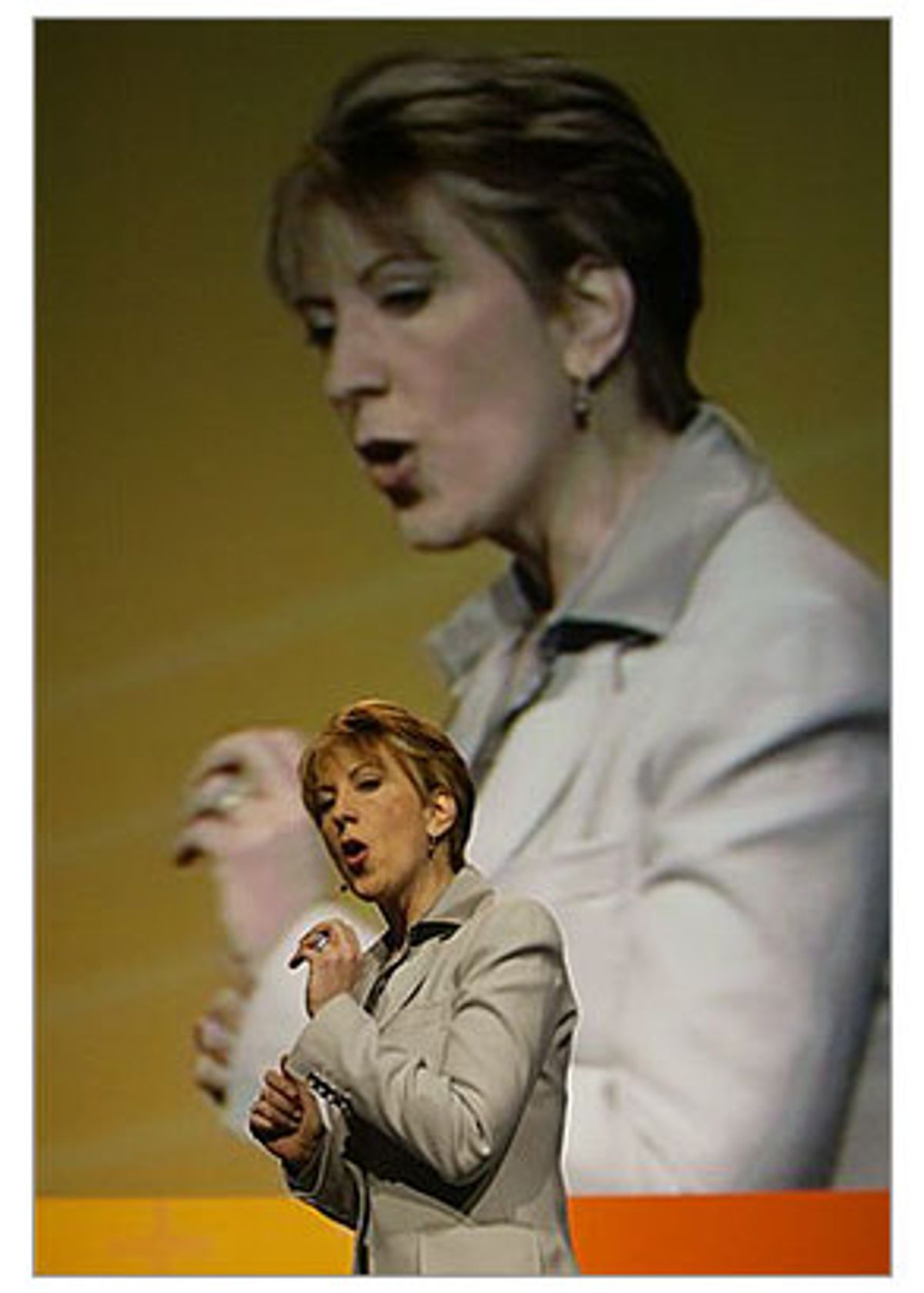
Carly Fiorina

End of a hatchet woman

Hewlett-Packard's ousted CEO Carly Fiorina destroyed a great company's creative soul and trashed its business.

  • more
    • All Share Services

End of a hatchet woman

Carleton S. Fiorina’s fall from grace was dramatic, as was most of her career. But don’t cry for Carly; her way of doing business remains ascendant, and has already triumphed over that quaint set of humanistic values known as “The HP Way.”

I well remember my first meeting with Carly, who from an early date seemed destined to be one of those first-name-only stars like Cher or Madonna. Months before Hewlett-Packard named her its chief executive, the company had invited me and John Markoff, my friend and colleague at the New York Times, to spend a day with the engineers at its legendary research labs. But midway through our morning in nerd nirvana, Carly paid us a “surprise” visit.

She was, of course, charming, well-coiffed and coutured, as nearly every article at the time would mention. And as I watched her perform, amid an awkward group of guys who really were wearing short-sleeved sta-press shirts with pocket protectors, I realized I was seeing the new and old faces of Silicon Valley, up close and personal.

On one side of the hall were these unassuming but enormously bright individuals who came to work each day on Page Mill Road, in Palo Alto, Calif., not to make a killing in high tech, but for the sheer joy of inventing cool things. On the other was the perfect pitch person, singing Wall Street’s tune absolutely in key.

From early in her six-year reign, Carly’s mendacity was breathtaking, as she methodically eviscerated HP of everything the company once stood for. Is that too harsh? Recall the “invent” campaign, launched soon after she joined, where she plastered billboards and ads with the image of Bill Hewlett and Dave Packard’s sainted Palo Alto garage, even as she was slashing the company’s research budget and laying off scores of real-life inventors. After all, tinkering with the outer reaches of particle physics may be cool, but it’s hardly a bottom-line contributor, not this quarter anyway.

At the same time, the truly inventive side of Hewlett-Packard, as well as its historical heritage, was being spun off as a separate company, now known as Agilent. To be fair, HP’s board initiated this thrilling bit of stupidity before hiring Carly, but she had plenty of time to stop it and did not.

HP’s test and measurement instruments, direct descendants of the audio oscillators that launched the company in 1939, were and are considered the best that money can buy. Despite increasing global competition, these products command a premium price and maintain high profit margins because they are simply higher performing, better built and more innovative than the offerings of other companies. They are, in a word, “differentiated.”

Yet Carly and the HP board chose to dump this profitable business to concentrate on commodity products like printers and PCs. Why? The answer at the time was that securities analysts accustomed to following straightforward companies such as Dell Computer really couldn’t understand a complex business like test and measurement. And, to be sure, Wall Street’s shills fell into lockstep, praising the divestiture as a brilliant strategic move that would, in that tired phrase, increase shareholder value.

As HP’s best and brightest headed for the doors, whether they jumped or were pushed, some of them were not shy about calling a reporter who had covered the company for many years. As I talked to these talented people from every level of the company, one interpretation of events emerged with remarkable consistency. Carly had no intention of sticking around Hewlett-Packard for very long, these folks said. Her real intent was to do a quick, Lee Iacocca-style turnaround, accompanied by the best autobiography money could buy, and in 2004 run for the U.S. Senate, against Barbara Boxer.

It seemed a little far-fetched, but soon the photo-op shots of Carly in the company of high-ranking Republicans began proliferating. Even as Carly’s script for HP ran into harsher realities, even as Boxer retained her seat, the story never really died. And in retrospect, it offers the only explanation that makes any sense at all of Carly’s biggest strategic move. I’m referring here to the acquisition of the Compaq Computer Corp.

Prior to launching that deal, Carly had said her intention was to pattern HP after Lou Gerstner’s version of IBM, which had successfully leveraged its low-margin hardware business to sell high-margin consulting services. To that end, she initially negotiated to acquire the consulting arm of PricewaterhouseCoopers, the global accounting firm. She punted at the last minute, and IBM ultimately acquired PwC’s jilted consultants at a substantial discount.

Undaunted, in 2002 Carly moved to acquire Compaq, which was bleeding market share to Dell and losing money at an even faster rate than HP’s PC business. Never mind that no big merger in the history of high tech had ever really worked; never mind that Compaq itself had already made two big acquisitions — Digital Equipment Corp. and Tandem Computer — that had failed to add any value; never mind that Dell rapidly seized on the inevitable uncertainty to take even more customers away from both HP and Compaq. Even the pointed opposition of founder’s son Walter Hewlett didn’t dissuade Carly and the HP board from this historic blunder.

At the time, I was on staff at a consulting firm that was retained by one of the family foundations to analyze the merger. In the process, we spoke with a number of people close to both companies and their remarks were stunning. “The collision of two garbage trucks,” was how one put it. “Doubling down on a dog,” was another take. Without naming the firm, or their specific recommendations, it was obvious to anyone who cared to look that Carly’s projections could only materialize if IBM, Dell and Sun Microsystems took a collective nap for the next five years, and every single one of her rosiest scenarios came true at once. Any resemblance to the Bush budget is entirely coincidental, I’m sure.

So why did she do it? For one reason: Wall Street loves big mergers. The investment banks collect immense fees for their roles as advisors, regardless of the ultimate soundness of the deal. And their securities analysts all write positive reports, which prompt a lot of rubes to buy shares, which generates a flood of trading commissions. Big mergers and acquisitions are almost always a net negative for the companies and communities involved, but a win-win for the bankers, lawyers and other deal makers.

A second reason is that it should have worked well enough for Carly to declare victory and move on to the political stage. Despite their dismal long-term success record, big mergers usually can “achieve synergies,” Wall Street-speak for massive layoffs, which reduce costs enough to show a big if fleeting bump in earnings per share.

There was a brief period where the credulous might have believed that this merger was working, thanks entirely to such redundancies eliminated and other corporate bloodletting. But it didn’t last, as Carol Loomis’ masterful article in last week’s Fortune magazine made all too clear. Loomis did the tough analytical work that the board should have done, published it for all to see, and in the end, HP’s recalcitrant directors had to act.

To those who will inevitably say that Carly has been singled out for harsh treatment because she is a woman, nonsense. Anne Mulcahy of Xerox, Meg Whitman of eBay and Carol Bartz of Autodesk, among others, have all shown that a Y chromosome is no prerequisite to performing the CEO’s role with quiet competetence. What these leaders share besides their gender is they don’t make promises they can’t possibly keep.

As the Fortune article makes clear, Carly’s numbers didn’t work because they couldn’t work, which is of course what folks like Walter Hewlett were saying three years ago. And so a once great company is a shadow of its former self, and Fiorina is out of a job. But don’t cry for Carly. Given her way with numbers, there’s surely a spot for her in the Bush administration. Secretary of the treasury, perhaps.

Election night speeches: The best and worst

Linda McMahon shows surprising class and Crazy Carl breaks out the bat: Six memorable moments from Tuesday night

  • more
    • All Share Services

Election night speeches: The best and worstCarl Paladino holding a baseball bat during his concession speech Tuesday night.

Most election night speeches from winning and losing candidates follow a simple, bland formula. But occasionally, for reasons good or bad, there’s a surprise. Tuesday night produced a few of them, which we recall here.

THE BEST SPEECHES

1. Rep. John Yarmuth, D-Ky.

Yarmuth took his surprising win — as an incumbent Dem from a GOP-friendly Kentucky district, he was widely considered a goner — as an opportunity to deliver one of the most passionate and generous speeches of the evening. In a campaign that saw many House Democrats sell out Nancy Pelosi (with her blessing!) in an attempt to appeal to right-leaning voters, Yarmuth was happy to stand by the speaker (granted, it was after the polls closed):

“I almost wish there were another podium here tonight, because I feel like Nancy Pelosi has been in this campaign the whole time. And Nancy ought to take a victory lap with me. And maybe President Obama as well. The disservice and disrespect that has been leveled on them has been so outrageous and so unjustified that it makes me really fear for this country. When you have two people who work every day to make life better for every American and they put up with the nonsense … [I]t’s not only unjustified, it’s un-American.”

2. Linda McMahon (candidate for Senate in Connecticut)

McMahon, the WWE executive who spent over $40 million on her own campaign, suffered a solid defeat. The general tone of her aggressive campaign attacks on Richard Blumenthal might have led viewers to expect a bitter concession; however, her performance was surprisingly classy. On a night when platitudes about “Pennsylvanians,” “Nevadans” and “the people of Delaware” largely came across as tinned, her profession of “love” for the people of her state sounded genuine. And perhaps most significant, in a year of rabid partisanship, she was one of the only losing candidates to insist that her followers transfer their support to a victorious rival, projecting her voice over a booing crowd to say: “Each of us, because we [carry] a love for this state and for our country, in our hearts, we are all going to be supportive of our newly elected officials. Because we want them all to succeed; because if they succeed, we succeed.”

3. Sen. Russ Feingold, D-Wis.

With his three-term run in the Senate coming to an involuntary end, Feingold’s concession speech was short and sweet. “Being your senator has been the greatest honor of my life,” he told a disappointed crowd, before offering a quote from Bob Dylan’s “Mississippi”: “But my heart is not weary, it’s light and it’s free/I’ve got nothing but affection for those who’ve sailed with me.”

THE WORST

1. Carly Fiorina (candidate for Senate in California)

Strictly speaking, Fiorina’s speech to supporters last night was not a “concession,” since she didn’t actually concede. Though every network had already called the race in favor of Barbara Boxer by the time Fiorina took the stage, the Republican still told an audience in Irvine that she and Boxer were in a “dead heat tie.” In a performance entirely consistent with the snarky tone of Fiorina’s television ads (not to mention the “sooo yesterday” jab at Boxer’s hairstyle that an open microphone picked up earlier this year), she said of those who had called the race for Boxer: “Maybe that was probably not a smart thing to do.” Words she’s probably regretting right about now.

2. Carl Paladino (candidate for governor of New York)

No one with any knowledge of the Paladino campaign could have been surprised by the eccentric nature of his concession speech. Brandishing an orange baseball bat, “Crazy Carl” issued his victorious opponent, Andrew Cuomo, a bizarre threat:

“I have a message for Andrew Cuomo, the next governor of New York. I’ve always said my baseball bat is a metaphor for the people, who want to take their government back. But this isn’t my bat, after all. As our next governor, you can grab this handle, and bring the people with you to Albany. Or you can leave it untouched, and run the risk of having it wielded against you. Because make no mistake, you have not heard the last of Carl Paladino.”

The bat comes out around the 5:55 mark.

3. Christine O’Donnell (candidate for Senate in Delaware)

One of the earliest concessions of the night, O’Donnell’s speech began on a decidedly positive note. “We have won,” she announced, “because the Delaware political system will never be the same.” (This apparently confused O’Donnell’s brother, who could be heard remarking, “We won, did I miss something?”) Soon, though, O’Donnell was lecturing the candidate who defeated her (by 16 points), Chris Coons, about his responsibilities in the years ahead. Among other things, O’Donnell said she had already asked Coons to watch a 30-minute infomercial produced by her campaign. “We can only hope and pray that he chooses to go against his party leadership and do what’s right for the people of Delaware,” she said.

Continue Reading Close

Emma Mustich is a Salon contributor. Follow her on Twitter: @emustich.

Carly Fiorina to be released from hospital

The Republican Senate candidate will resume her campaign schedule tomorrow

  • more
    • All Share Services

Republican Senate candidate Carly Fiorina will be released from the hospital Wednesday and is preparing to resume a full campaign schedule, a day after she was sidelined by an infection related to her recent reconstructive surgery for breast cancer.

Fiorina’s campaign said the former Hewlett-Packard Co. chief executive has been successfully treated for the infection at a Los Angeles-area hospital.

“This morning, her doctors gave her the good news that she will be released from the hospital today and can resume her busy campaign schedule tomorrow,” Fiorina’s chief of staff, Deborah Bowker, said in a statement. “Carly is grateful for the outpouring of well wishes and prayers from so many Californians.”

The first-time candidate, who is 56, was diagnosed with breast cancer in February 2009 before she formally announced her run against Democratic Sen. Barbara Boxer. She completed chemotherapy and radiation treatments a year ago and had reconstructive surgery in July after having a double mastectomy.

Recent polls show the race between Boxer and Fiorina tightening with just six days left before the election.

A University of Southern California-Los Angeles Times poll released Sunday showed Boxer maintaining a narrow advantage, 47 percent to 41 percent, against Fiorina. The gap was smaller than the same poll showed a month ago.

Both women have maintained busy schedules criss-crossing the most populous state in the nation.

On Tuesday, Fiorina sent supporters to take her place to meet with small business owners in two Riverside County cities to discuss jobs and the economy. Supporters will again take her place at a scheduled campaign stop in San Diego on Wednesday afternoon.

Boxer, meanwhile, appeared Tuesday night with first lady Michelle Obama and Jill Biden, wife of Vice President Joe Biden, to urge Democratic supporters to grant Boxer a fourth term.

Mrs. Obama was scheduled to appear at a private lunch at a West Los Angeles home Wednesday on Boxer’s behalf. Boxer was scheduled to meet with volunteers in West Hollywood in the afternoon.

Continue Reading Close

Carly Fiorina hospitalized one week before election

Campaign's chief of staff cites infection associated with former CEO's post-breast cancer reconstructive surgery

  • more
    • All Share Services

California GOP Senate challenger Carly Fiorina is in the hospital to be treated for an infection associated with her reconstructive surgery after breast cancer.

Deborah Bowker, the campaign’s chief of staff, says in a statement issued Tuesday that Fiorina was admitted to a hospital and is being treated with antibiotics. The campaign will not say when or where she was admitted.

Fiorina, who is 56, fought breast cancer before her run against Democratic Sen. Barbara Boxer. The former Hewlett-Packard Co. CEO has maintained a busy campaign schedule in the final weeks of the race.

Bowker says Fiorina has canceled Tuesday campaign events in Riverside and Coachella. She says she expects Fiorina to return to the campaign trail soon.

It’s not morning in California

It's an apocalyptic twilight; Barbara Boxer as the new Herbert Hoover

  • more
    • All Share Services

It's not morning in California


Adam Hanft dissects and deconstructs political advertising at Spin Season, where this originally appeared

Somebody’s been spending some time researching Google images and the bleak 1930s iconography of Dorothea Lange and Walker Evans.

Carly Fiorina’s new attack on Barbara Boxer goes for the depression jugular, with a stark series of graphic, high-contrast black-and-white shots that paint a eschatological picture of California. One photograph, depicting the liquidation of a retail store, could have been lifted from a Walker Evans retrospective at the San Francisco MOMA

Check out that opening scene. Grim-faced farmers standing on a barren field, a Grapes of Wrathian image if ever there was one. During this, the equally ominous announcer intones:

“After 28 long years of Washington partisanship, this is Barbara Boxer’s California. Trillions in reckless wasteful spending. Destroying small business. Killing jobs. Crushing hopes.”

It’s a calculated effort to move people by activating the neural circuits that exist in their brains. We all have imprints of the calamity of the Great Depression, and this spot seeks to summon them up and pin them on Boxer. As Drew Westen, who wrote “The Political Brain” puts it:

“Electoral success is about shaping and activating voters’ networks of association — bundles of thoughts, feelings, sounds, and images that become linked in the brain. Political campaigns are about activating and shaping networks through stories and images.”

Will the spot succeed? For it to work, there needs to be an existing network of imprints about Boxer that can be stimulated by the imagery we’re seeing. You need to connect with a fundamental impression to be able to amplify and harness it. I don’t think that’s the case here.

Yes, Boxer is seen as a dogmatic liberal, a big spender, and somewhat self-righteous. But the commercial pushes too far past the boundaries of Boxer’s perceptual map. Voters just won’t emotionally accept the argument that the economic wreckage they see around them is “Barbara Boxer’s California.” They recognize, on some equally deep level, that the responsibility for California’s condition is spread wide. The exaggeration doesn’t fit the crime.

By contrast, Boxer’s new spot is positively chirpy, with upbeat music and a string of her accomplishments, from veteran’s benefits to after-school centers to “fighting for new jobs.”

But the commercial is a dud. Just as Fiorina overstates Boxer’s culpability, this spot feels blithely detached from the immediate and profound crisis California is facing. What Senator couldn’t dredge up and string together a few one-off accomplishments after decades in the Senate?

Boxer’s previous spot, vilifying Fiorina for layoffs and shipping jobs offshore when she ran HP, were negative but far more effective, because they tapped into another set of neural circuits – that Fiorina is cold and calculating.

So as far as this round of spots goes, it’s Fiorina’s landscape of destruction versus Boxer’s landscape of denial. Boxer is slightly ahead in the polls, and Fiorina’s shout-out to John Steinbeck might actually widen the gap.


Continue Reading Close

Adam Hanft writes and comments frequently on politics and culture for The Daily Beast, Fast Company, Huffington Post, CNN, Fox News, Politics Daily, the Barnes & Noble Review, and elsewhere. He is founder of Hanft Projects, a strategic and brand consultancy.

Are GOP midterm expectations oversold?

The "Democratic doom" narrative is meant to demoralize, but even Scott Rasmussen believes Dems will hold the Senate

  • more
    • All Share Services

Are GOP midterm expectations oversold?Sen. Barbara Boxer (D-Calif.) and Kentucky Senate candidate Jack Conway.

Creating the universal premonition of Democratic doom is always among the most useful elements of Republican strategy. A broad feeling of foreboding demoralizes the party base, repels independent voters who prefer the winning side, and strikes emotional chords that are at least as important in electoral behavior as ideologies and issues. So Republican leaders and pundits regularly issue outlandish predictions of crushing victory, echoed across the media spectrum until they become self-fulfilling.

This year’s real conditions for Democrats are certainly threatening, but there are indications that the impending repudiation will not be as devastating as suggested by the current narrative. Whatever ultimately happens in the House, where a Republican takeover appears likely if not inevitable, the Senate will probably remain under Democratic control — despite enormous spending by “independent” groups such as the Club for Growth, the voice of Wall Street conservatives; American Crossroads, the Karl Rove outfit; and the Chamber of Commerce.

At least that is the view of Scott Rasmussen, the pollster whose survey techniques and conservative predilections have often provoked suspicions of Republican bias in his results. As of last Friday, Rasmussen’s latest “Midterm Election Update” said that “a Republican takeover of the Senate appears unlikely,” with Democrats predicted to hold at least 51 seats, Republicans at least 45, and four races (in Nevada, Colorado, Wisconsin and Illinois) rated as tossups. Today Rasmussen marginally revised that estimate by moving West Virginia into the “Toss-up” column when a new poll showed popular Democratic Gov. Joe Manchin slightly behind Republican businessman John Raese in the Senate race.

Meanwhile the revision of Republican expectations of glory is fully underway in California, where Sen. Barbara Boxer was once among the GOP’s prime targets. Now the incumbent Democrat is starting to pull ahead of Republican Carly Fiorina, despite a wave of negative ads bought by the Chamber of Commerce and other third-party opponents. (Last week Rasmussen revised its assessment of the race from Toss-Up to Lean Dem.) Even more notable is the surge of Attorney General Jerry Brown, the Democrat running for governor against former eBay CEO Meg Whitman, billionaire darling of the Republican right, whose record campaign expenditure of $120 million (and climbing) is expected to be four or five times more than that of her opponent. That massive spending imbalance, with thousands of anti-Brown commercials flooding the state’s airwaves on her behalf, has itself become a symbol of Whitman’s distance from ordinary citizens.

Other signs of life on the Democratic horizon include the surprising polls showing that Kentucky Democratic Senate nominee Jack Conway is roughly tied with Republican Rand Paul, the Tea Party’s favorite loony until the advent of Christine O’Donnell. If Conway had enough money to match the third-party expenditures on Paul’s behalf, he might even have a chance to win.

Democrats elsewhere could learn from the examples of Brown and Boxer — and even Conway — who haven’t hesitated to strike back hard or behave like winners. What those races show is that monetary advantage need not always determine outcomes. If Democrats stop ducking and cowering — and offer an aggressive “closing argument” — they may still escape the worst possible debacle in November.

Continue Reading Close

Joe Conason blogs in Salon several times a week and writes a weekly column for the New York Observer. His latest book is "It Can Happen Here: Authoritarian Peril in the Age of Bush."

Page 1 of 6 in Carly Fiorina