Neal Pollack

Grammy whammy!

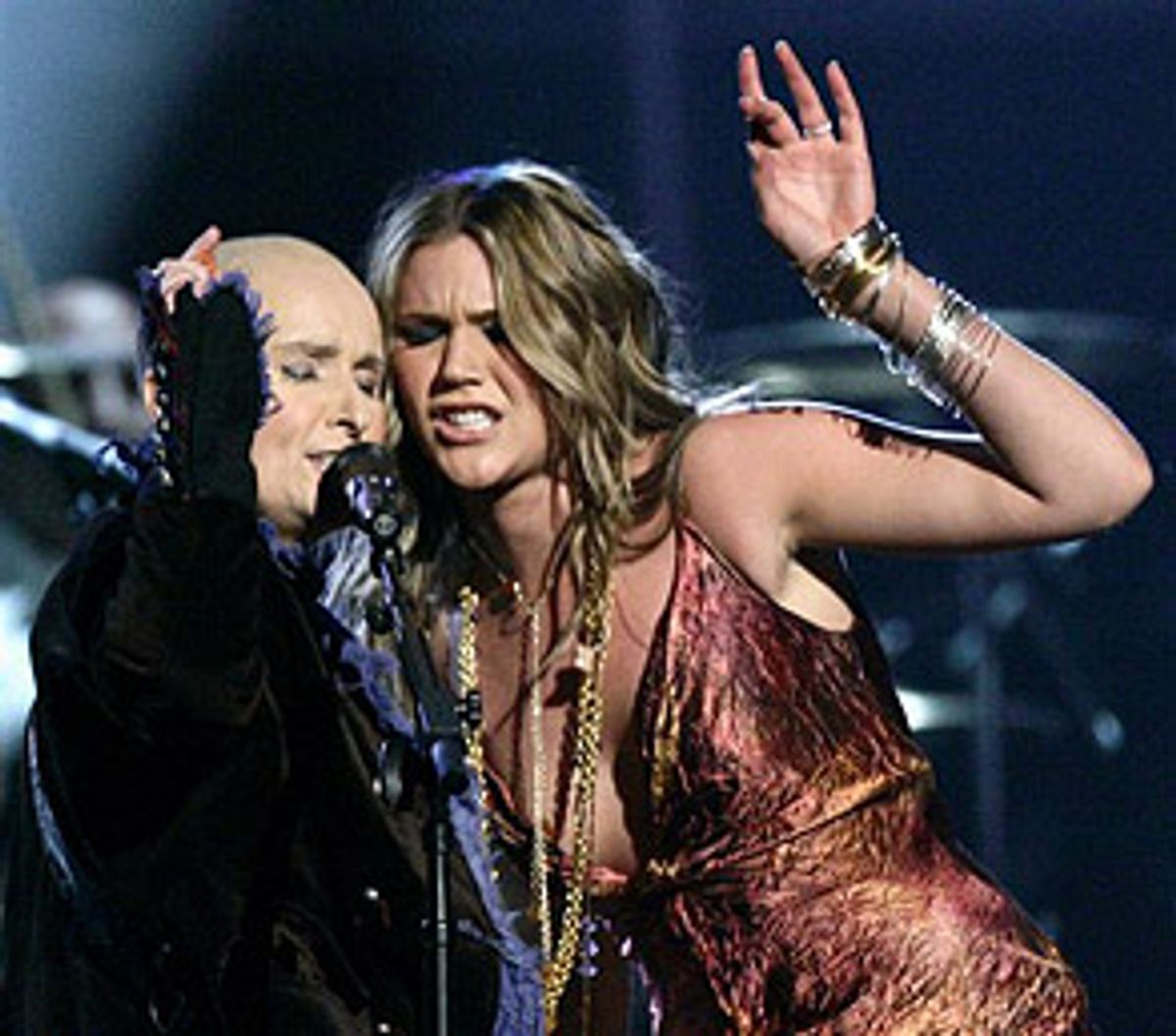
Yes, we had to endure J.Lo and Tim McGraw. But the Grammys offered one of the most entertaining musical events in TV history.

  • more
    • All Share Services

Grammy whammy!

Last night, I began my annual forced viewing of the Grammy telecast with a thesis: that the past year was one of those rare blips in musical time where what’s popular and what’s good actually intersect. Just before the telecast, I looked at the nominee list to see if this would actually bear out. Kanye West, check. Green Day, check. Franz Ferdinand, check. Modest Mouse, Loretta Lynn and Jack White, Alicia Keys, check, check, check.

As always, the Grammy selection committee tortured us with some duds. Hoobastank? Melissa Etheridge, no, Tim McGraw, no as always, y pienso que Los Lonely Boys son overrated. And then there were the usual safe nominations for dead guys. It doesn’t exactly take a lot of guts to toss a Grammy to Ray Charles or Johnny Cash now. Plus, shouldn’t a song be exempted from Grammy consideration after it’s been used as a theme for the NBA Playoffs? I’m looking at you, Black Eyed Peas.

But a closer examination of the list dampened my raging cynicism. Tom Waits, Jill Scott, the Scissor Sisters? Got a Grammy nomination? But I saw the Scissor Sisters live two years ago! I’d never seen a live band before they received a Grammy nomination. Who cares whether I liked them or not? My thesis was holding water! I had no idea, though, that I was about to watch one of the most entertaining musical events in television history.

What you’re about to read was written in real time, edited slightly for coherence, and partially drained of hipster pretension. No TiVo was deployed in compiling this report. All times are Central Standard. It’s 6:55 p.m. Let’s get it started in here!

7:00 p.m.
Queen Latifah appears and informs us that there are four stages and five bands, and this is just the opening number. Why look! It’s the Black Eyed Peas, singing the LeBron James highlight-film theme song. Is this our new national anthem? Before I can get a chance to write down another basketball joke, there’s Gwen Stefani, wearing what remains of Kevin Kline’s outfit from “The Pirates Of Penzance.” Goddamn, that woman’s got gams! She’s accompanied by Eve, who looks like Whitney Houston version 2.0. Hot Asian girls, also kind of dressed like pirates, surround them. Why am I not TiVoing this? Oh, that’s right. I don’t have TiVo. But if I did, this segment would scream late-night freeze-frame!

Band No. 4 is the mysterious Maroon 5 with that song I hear all the time at the gym. Catchy! The lead singer looks like Keanu Reeves and the keyboardist looks like a PIRG canvasser. They won’t be around next year. Uh-oh. The Black Eyed Peas are singing and Maroon 5 is playing, followed by Franz Ferdinand, a better band. Suddenly everyone is singing and playing at the same. Despite what the New York Times said this morning, it’s not a mash-up. It’s more like the finale of “Les Miz,” with guitars and break dancing.

Ellen DeGeneres seems to like it, because she dances to her own tune. Still, if this is the sound of today, then my thesis is holding. Also, the lead singer of Black Eyed Peas will be making a special appearance this Friday on “Joan of Arcadia,” playing a substitute gym coach who teaches Joan the importance of running a decent song into the ground.

7:15 p.m.
Queen Latifah informs us that tonight is the 50th birthday of rock ‘n’ roll, but then proceeds to not elaborate. I think she was trying to toss props to Little Richard, an act of amateur ethnomusicography that probably raised Greil Marcus’ hackles. She also makes a saucy joke about how she went to Bono’s dressing room and says that Bono is looking “adorable.” The thought of Queen Latifah in Bono’s dressing room makes me feel empty inside.

7:18 p.m.
Steven Tyler pays lip service to the great piano player Pinetop Perkins, who’s in the audience looking leathery and wearing a cowboy hat, no doubt thinking, Boy, I was living in a garage in Mississippi while you were doinking Bebe Buell upstairs at the Mudd Club. Where the hell were you then? Then Los Lonely Boys win an award, and Perkins rolls over in his future grave.

7:25 p.m.
Another lip service, this one for jazz great Art Blakey. But at least they follow him with Alicia Keys, a person so far out of my league that I don’t even deserve to be in the same room as her discarded wisdom teeth. She sings to great effect. Then Jamie Foxx shows up to lay down the yellow brick for his Oscar. He does a remarkably hip “Georgia on My Mind” duet with the new woman of my dreams. I briefly want to consider this annoying, but then again, try to imagine Adrien Brody or Roberto Benigni pulling it off.

7:40 p.m.
Jerry Lee Lewis gets a Grammy lifetime achievement award. Jerry Lee is sitting in the audience, looking like he could still bite the head off a rat. “Rock ‘n’ roll has its fathers, and here are its sons,” says Queen Latifah. That means U2. Bono says that his father was a postman with a beautiful tenor voice, and he would like to think he passed that voice on to Bono. Jerry Lee Lewis thinks, I busted my ass for this?

7:46 p.m.
There’s lot of lifetime achievement tonight, probably too much, as Led Zeppelin gets a lifetime achievement award. In a case of reverse irony, Green Day wins best rock album immediately after. They’re a band far better than Zeppelin, though the sex to their music goes at a much less seductive pace. Those Green Day guys worked damn hard; they deserve it. In the audience, Cyndi Lauper appears pleased.

7:55 p.m.
Queen Latifah informs us that tomorrow morning, “everyone will be talking about the next 15 minutes.” Everyone who didn’t watch “Desperate Housewives” or the Pro Bowl, that is. It looks like the unstoppable conversation express is being led by the world performance debut of the world’s most passionate husband and wife, Jennifer Lopez and Marc Anthony!

He stands at a purple-lit window that fronts a set on loan from Home Depot. The set parts to reveal J.Lo, wearing a lime-green curtain held together by long strips of silver and gold glitter. She’s in what appears to be the honeymoon suite at the world’s cheesiest boutique hotel. There’s a reason these two haven’t sung together in public before. It’s because Marc Anthony is humiliatingly better than Jennifer Lopez. At least with Ben Affleck, it was an even match of talentlessness; the equivalent to J.Lo performing with Marc Anthony would be Affleck hitching his wagon to Frances McDormand. I think J.Lo’s handlers assume that we’ll take the spiciness of their love for granted because they’re Latin, but those of us who have truly felt passion cannot be deceived! They walk around the hotel room in what is supposed to be a dance of seduction, but they don’t even really acknowledge each other’s presence. Mike Wallace and Morley Safer have more sexual chemistry onstage than J.Lo and Marc Anthony.

Following that atrocity of God, Matthew McConaughey, a man once arrested in my home city of Austin, Texas, for streaking, shows up and makes a convincing case for how Southern rock is still alive and well and also rockin’. As an avatar of this truth, Gretchen Wilson and Lynrd Skynrd appear and sing “Freebird.” In their hands, rock’s biggest clichi sounds like “I Will Always Love You.” Now, I’m not a Southerner by birth, nor was I born to be a rocker. But I know quite a few Southern rockers down here who would take exception at such a flimsy portrayal of down-home virtues. What a goddamn embarrassment.

Keith Urban and Elvin Bishop follow with an acceptable version of “I Fooled Around and Fell in Love,” but the mood has already been ruined. Dickie Betts, whose name was, I shamefully admit, new to me, performs “Ramblin’ Man.” Tim McGraw shows up for duet purposes, and, as always, ruins the song. He was no more born in the back seat of a Greyhound bus than I was born in a rice paddy.

Then Skynrd — Skynrd, Whoooooooo! –returns for a version of “Sweet Home Alabama” that legitimately rocks but is marred by McGraw and by Gretchen Wilson, who sounds like Britney Spears singing with Aerosmith at the Super Bowl.

8:16 p.m.
Queen Latifah gets to sing, an honor usually reserved among award-show hosts for Billy Crystal. But instead of going, Rwanda! How I love ya, how I love ya, my dear Rwanda! as Crystal would do but Chris Rock probably won’t, the Queen fills out a black dress, wears a string of pearls just right, and sings a pretty damn convincing medley of ’40s jazz diva tunes. You know, just when you think someone totally sucks, she goes ahead and does something like this. She deserves a Grammy merely for making people think of Dinah Washington at all.

Tyra Banks and Hoobastank follow, offering a lifetime Grammy to the late conductor Morton Gould, an act so deeply ironic that it defies further comment. Maroon 5 then beat Kanye West for best new artist, who hugs the band very sincerely, and Maroon 5 practically offer the award to him. Kanye West is smooth. The lead singer of Maroon 5 says, “These guys are my best friends, and this is the trippiest thing I’ve ever gone through in my life.”

8:30 p.m.
Quentin Tarantino says that Green Day has released a concept album with a unique concept: “All the songs are good.” Call me naive, but I can’t even begin to say how much I admire these guys. Not every band that works hard gets successful for the right reasons, but it’s nice to see it happen at least once.

8:35 p.m.
I notice that Crucial, from Alicia Keys’ band, is wearing a really stylish brown fedora-like hat. Oh, please, make it acceptable for white people to dress like that again! If there are a million universes, perhaps in one of them, I am Alicia Keys’ kept potentate. A boy can dream.

8:43 p.m.
The Staples Singers win a lifetime Grammy, and then Mavis Staples actually gets to come out and sing. Meanwhile, Pinetop Perkins and Jerry Lee Lewis are shooting heroin in the bathroom of the nominees’ lounge, wondering where it all went wrong. Suddenly, things take a turn for the iconographic.

A preacher rails against sin in front of a sizable congregation of middle-aged black people, who are backed by a church set with authentically beautiful mocked-up stained-glass windows. Kanye West runs down the aisle, doing “Jesus Walks.” He dances himself into a passion play with Mavis Staples. A curtain drops. Kanye dances in silhouette with increasing drama, until we see a video image of a dove flying away into an exploding sunset. The curtain rises, and the Blind Boys Of Alabama are in the church, singing over a coffin. Kanye returns, wearing an all-white suit. He then rises above the crowd wearing angel’s wings. I guess it’s too much to ask that one of these things totally transcend ego. West’s acceptance speech follows form, ending with him holding up his award and saying, “Everybody wanted to know what I’d do if I didn’t win. I guess we’ll never know.”

The Grammys are really entertaining this year.

9:00 p.m.
Kris Kristofferson, who got a lifetime achievement nod himself at the Country Music Association Awards, presents a lifetime achievement award to Janis Joplin. Are you meaning to tell me that Janis Joplin doesn’t have a lifetime Grammy yet? Austin is insulted, sirs! And we’re further insulted that Joss Stone gets to perform the tribute. Nice dress, 6-foot Joss, but Janis never wore that much makeup on every day of her life combined! Actually, I have no idea how much makeup Janis Joplin wore. But the tribute was still a little off.

9:11 p.m.
Eddy Arnold gets his lifetime achievement recognition from Billy Bob Thornton, who then introduces Tim McGraw to sing a song. Hmm. Bad Santa considers Tim McGraw “a good friend.” Perhaps I should reexamine my opinion of Tim McGraw. Nope. I’m sorry, call me an indie snob if you want, but Tim McGraw is just a country version of “Tuesdays With Morrie.” The song, “Live Like You Were Dying,” is about a man who gets bad news from his doctor, but doesn’t let that stop him from going out and doing adventure sports.

Tim McGraw, how many of your fans can afford to go sky-diving or Rocky Mountain climbing? How many of them even have health insurance? If I found out I were dying, I’d fall into a sobbing heap for about two days, which is what most people would do, and then I’d start figuring out a way to use my sympathetic status so I could sit on the Phoenix Suns bench during the playoffs. Skiing wouldn’t be high on my priority list.

Hallelujah! The Good Lord rains justice down from the heavens as Loretta Lynn defeats Tim McGraw for best country vocal. Ms. Lynn takes the stage with power, grace and class, sucking any lingering stupidity out of the room. Jack White, growing nicely into his Johnny Depp phase, plays the polite young man role to the hilt. He says, “We recorded this record on Loretta’s front porch, and one day she told me, ‘Jack, 14 times my record got banned from country radio, and every one of those records went to No. 1. Well, this record got ignored by country radio as well. And look who’s No. 1!’”

Rarely has an award winner satisfied me more.

9:26 p.m.
Rob Thomas, who doesn’t owe his career to Ahmet Ertegun, announces that the founder of Atlantic Records has won First President’s History of Greatness Award or something, Too little, too late. Still, it’s nice to know that a native Turk can receive a major award on American television.

9:30 p.m.
U2 wins an award. Bono says this is “the best Grammys I’ve ever seen.” And he’s right! It feels like the moment when the music business has finally matured; culture has met commerce at the crossroads, and they’ve shaken hands in friendship. Everyone seems to respect everyone else, they’re feeding off one another’s energy, and we’re all enriched. We’d better enjoy it. Next year it could easily be Christina Aguilera paying tribute to Billie Holliday, Jessica Simpson and Nick Lachey singing the songs of Kenny and Dolly, and J.Lo doing a forbidden, fully synthesized dance with her new husband, Colin Farrell.

But for this brief moment, the mainstream rules, and this is before the James Brown dance duet with Usher! As Steven Tyler, Billie Joe Armstrong, Norah Jones, Alison Krauss, Bono, Alicia Keys and others perform an absolutely magnificent cover of “Across the Universe,” with all proceeds going to tsunami victim relief and a harmonica solo from Stevie Wonder, for god’s sake, I have a rare flash of optimism, thinking that music really is going to change the world this time. As soon as they stop giving solos to Tim McGraw.

I knew Christopher Hitchens better than you

Every writer who had a drink with Hitch has now told his story. But even Rushdie and Amis didn't know him like this

  • more
    • All Share Services

I knew Christopher Hitchens better than you Christopher Hitchens. (Credit: AP/Chad Rachman)

Christopher Hitchens and I were friends for 40 years, plus another five when we were enemies. He took ideas so seriously that if he disagreed with you on a matter that he deemed important, he’d literally throw you in a ditch. It was 1972, the height of our mutual virility. He and I went to a pub to celebrate his most recent intellectual victory over the establishment press. I intimated that sometimes women could be funny on purpose. Even back then, the thought enraged him. Hitchens threw a drink in my face, pressed a lit cigarette into my neck, and hit me over the head with a barstool. The next thing I knew, it was two days later and I was lying hogtied and naked beside the M5. Hitch had already severely damaged my reputation in a vicious essay in the Guardian. But that’s how he operated, and that’s why we loved him.

University, as you know, is the only time in one’s life when anything really worthwhile happens. I met Hitch there. The first time I saw him, he had a bird on each arm and a woman by his side. She beamed as he read aloud passages from “Homage to Catalonia.” He looked up.

“Who the hell are you?” he said.

“I’m your housemate,” I said.

“Are you in favor of the war in Vietnam?”

“Of course not.”

Hitch put down the book and took a swig of cheap Scotch.

“Good,” he said. “Because I refuse to fraternize with men who are afraid to be intellectual heroes.”

In the annals of history, only Orwell, Voltaire and maybe a half-dozen other guys could match’s Hitch ideological bravery and breadth of political knowledge. In 1977, after I’d returned to his graces by aiding him in a plot to assassinate Henry Kissinger’s character, Hitch and I visited Borges’ library in Buenos Aires. At the time, Hitch was working for the KGB while pretending to work for the BBC, and I was working for the Mossad while pretending to work for Burger King. But our many identities were merely covers for our lives as political writers at low-paying magazines.

Borges invited Hitch and me into his home, fed us tea and empanadas, and launched into a seamlessly brilliant discourse on surrealism in Latin American history. He talked for 30 minutes without stopping, during which time Hitch smoked six-dozen cigarettes. When Borges finished, Hitchens paused, spat in his ashcan, and said,

“Of course, you know, you’re wrong about everything.”

He then proceeded to refute Borges, point for point, until he reduced the blind scribe of Buenos Aires to tears.

No one loved ideas more than Hitch.

Much ink has been spilled, of course, about the legendary friendships Christopher forged with other writers throughout his life. For a time in the 1980s, he, Martin Amis, Salman Rushdie and I lived together in London. Hitchens rented us a six-story flat so we could swap partners more easily. Many was the time we passed the bottle until dawn, bemoaning Thatcher’s England, Reagan’s America, and also some stuff about the Middle East. Sometimes Hitchens would bring over a dissident writer who was fleeing oppression in his native country, and we’d all make fun of Mother Teresa and Princess Diana, then remove our pants to compare our manhoods. We were so middle-aged and foolish then, so committed to the struggle.

Hitchens spoke out against war, and also for war. In a span of five years, he bore witness to the fall of the Berlin Wall, the explosion of the Eiffel Tower, and the construction of the new holographic Eiffel Tower. He had acid in his pocket, acid in his pen and acid in his veins. Then Darkness fell, on Sept. 11, 2001. We’d all moved to America and gotten totally rich.

Hitchens changed that day. For months, he’d wander the streets at night, looking to drunkenly berate someone who disagreed with him about the evils of Islamofascism. Occasionally he’d attempt to strangle young journalists, who admired him unquestioningly, with their own neckties. But he was right. He was always right. Even when he was wrong.

The night they killed Osama bin Laden, he showed up at my apartment, drunk but lucid, quoting T.S. Eliot, Longfellow and, of course, himself. We stayed up watching CNN, which was actually pretty boring. In the morning, over a breakfast of corn flakes and whiskey, I said, “Well, I guess that’s the end of Islamofascism. Good job!”

Hitchens went into my kitchen, took a cutting board off the counter, and threw it into my forehead, drawing blood.

“Don’t be an imbecile,” he said. “The struggle never ends. Also, you must remember that there is no God.”

I needed four stitches that day. Hitch put them in himself, with his teeth. What a friend he was.

Rest in peace, dear man.

Continue Reading Close

The secret to our happy marriage: Traveling alone

It may sound odd, but solo adventures give my wife and me our freedom -- and the gift of missing each other

  • more
    • All Share Services

The secret to our happy marriage: Traveling alone

One afternoon in the summer of 2009, I came downstairs from my office. My wife, Regina, sat at her computer, gazing wistfully at crop-circle photos. In her leisure time, Regina consumes endless hours of home-renovation shows. She bakes brownies. When I first wrote this, she was making cute little witches out of clothespins for a crafting booth at our son’s school’s annual Halloween carnival fundraiser. She’s a normal mom who also happens, very quietly, to be really into crop circles.

“They’re so beautiful this year,” she said. She sighed. “I wish I could be there.”

This was the spousal equivalent of a Bat Signal, a distress call from a sinking midlife ship. Regina’s 40th birthday loomed only three weeks away. We’d been trying to figure out what would be an appropriate celebration. A party didn’t seem like a good idea. While I wasn’t entirely happy about the fact, we’d pretty much turned the corner from the party period of our life toward the middle-years, middle-class, middlebrow New Age fruitcake period.

The very real possibility of a darkly unrecognized milestone loomed; our life had become a thick catalog of reluctantly managed expectations. But there are times to sit around and mope about your lousy cash flow and increased feelings of irrelevance, and then there are times to damn those things to hell. My wife needed to have an adventure for her 40th birthday, and I needed to make that happen, whether I went with her or not. Regina and I have friends who vacation in Europe with their children, who love showing off photos of their progeny discovering Morocco or Vietnam. That’s not our world, not even close. Date nights almost never happen in our lives; it’s been more than a year since we paid for a baby sitter, and I can only leave the kid at my sister’s so often. But stagnation is marriage’s greatest enemy, so sometimes Regina and I go on trips without each other.

I understand why some couples don’t like the idea of traveling apart. There’s the thought that you’ll be missing out on all the fun, or that an attractive stranger might walk into the bar (which happens in Jennifer Aniston movies, but not so much in real life). Realistically, though, how are two middle-aged people with limited income and children to support supposed to have long-term romantic getaways? They’re not. Allowing your partner to travel alone means acceptance of your modest circumstances. To follow dreams, sometimes you have to give up illusions.

To me, Regina’s crop-circle travel desire seemed odd, but who was I — someone who still vaguely imagined getting asked someday to be a celebrity judge at the Cannabis Cup in Amsterdam — to say anything? I didn’t want to change her or hold her back; I wanted her to be happy on her own terms. Adult responsibilities shouldn’t force you to submerge some vital part of your identity. If you even think about suppressing those impulses in your partner, that’s the beginning of the end for a happy marriage. Regina took her trip. She didn’t call home very often. When she did, she sounded ecstatic, and, on more than one occasion, a little tipsy. Her compatriots on the tour took her to the pub for her birthday and bought her a cake. Then she came home 12 days later with a thousand photos, a few friends for life, and semi-conclusive proof that the truth was out there. It had been, she said, one of the most important and redemptive experiences of her life. “Thank you so much for doing this for me,” she said. “My pleasure,” I said, and I really meant it.

From all the middle-aged fruitcake yoga I’d been doing I’d somehow gleaned the sentiment that the sum total of happiness in your life can be measured by the amount of happiness you bring to others. By merely sending Regina on a trip, I’d made her life better, and that made me feel good. But just because I’d done something nice for my wife didn’t mean I’d suddenly transformed into an exemplar of selflessness.

Regina grew up Southern Presbyterian, trained to suffer silently and never complain. I was brought up, on the other hand, to whine about every slight problem, real or perceived, as though it were an injustice of Jim Crow proportions. My 40th birthday came six months later, and I wanted my own adventure.

I like taking trips with my family, but that usually entails dealing with spills, fretting about bedtimes, and sitting numbly on park benches wondering where the time’s all gone. These things comprise the matter of life, and shouldn’t be traded, but they also don’t afford the fresh experience of solo adventure. It stirs the imagination. For a few days, or weeks, you can revive your youthful illusions of wonder. You can eat what you like, go where you like, and use the toilet whenever you want without anyone screaming your name across the house.

For my 40th birthday I went to Boulder, Colo., for the entire month of June, to attend yoga school. Regina had given me the precious gift of time, and it didn’t cost her anything because I raised all the money for the trip online. But my experience wasn’t as drenched in transcendent fabulosity as my wife’s had been.

Just before leaving, I shredded my left hamstring. My industrial-size bottle of Advil and I ended up renting the spare bedroom of a semi-reformed Deadhead’s condo located next to a trailer park, which I limped through to yoga class every morning at 7:30. My month of freedom, which I’d imagined I’d spend cruising around on my bike stoned and strolling up mountain paths in a state of sainted bliss, was instead defined by cooking frozen salmon burgers in a pan, watching the basketball team I hate the most win another NBA title, and reading arcane and inscrutable documents of ancient Indian philosophy while squirming in pain on a used mattress in an unadorned room. It was an often sad and exhausting time. For the first time in many years, I felt lonely, and I missed the cozy confines of my domestic life.

I needed my family. That’s a nice feeling to have, even if it’s painful at the time. Solo traveling, it turns out, gives you a tangible and surprising gift: It creates actual longing. Less than half an hour after the program ended, I was waiting at the bus depot for a ride to the airport, and four hours after that, I was finally, gratefully home.

Of course, we don’t always travel alone. The weekend before I’d left, Regina and I celebrated our 10th wedding anniversary. We’d been intending to revisit the four-star resort in the Smoky Mountains where we’d spent several lovely days of our honeymoon, but finances wouldn’t permit that. So instead, I got us a midweek rate at a small hotel in Desert Hot Springs. We left the kid with a friend for a couple of nights and drove out. For 48 hours, we soaked and relaxed, and took a daylong hike in Joshua Tree National Park. We drank champagne and did anniversary things. Just like old times, we put on our boots, drove out to a honky-tonk, and ate mediocre barbecue. We had a really fun and memorable time. Best of all, we had it together.

Continue Reading Close

Die, smug yoga teacher, die

I wanted exercise and a little peace, not lectures on ethical veganism

  • more
    • All Share Services

Die, smug yoga teacher, die

The following is excerpted from the book “Stretch: The Unlikely Making of a Yoga Dude” by Neal Pollack. Reprinted by arrangement with Harper Perennial, an imprint of HarperCollins Publishers.

One afternoon in New York, I found myself on a street corner in midtown, licking salt off a slightly burned soft pretzel. I gazed about in a wondering daze, transfixed by the LCD nightmare. Time seemed to stop for me just then, as though I were Dr. Manhattan from “Watchmen,” only without the continually erect blue penis. Suddenly, I knew that everything in Times Square — the breeze-blown fliers for some outlier porn shop, the vaguely contraband luggage stores, the endlessly replicated advertisements for TV shows that never had a prayer, even the tourists from Nebraska — was part of a larger cosmic reality whose boundaries we can’t begin to perceive. The power of the universe, I realized, is transcendent, infinite, all-knowing, beautiful beyond measure. I quaked at the awesome kindness of its eternal might.

This, in yoga terms, is called Samadhi, the divine perception of universal consciousness, though the realization may have come to me because I was in the middle of a five-day drug bender. I’d bought some full-melt sativa hash capsules at my neighborhood medical-marijuana dispensary before coming to town, had taken two caps before getting on the plane, and had refried my brain first thing three consecutive mornings. Visions like these were happening regularly now; my synapses had begun to fray around the edges.

All I needed was to lie down for a couple of hours with a wet washcloth over my face, but I’d made plans to meet a friend for an early evening yoga class at her favorite studio. Once again, yoga had imposed itself upon my life. After a harsh period defined by career disappointment and excessive doughnut consumption, I’d taken up the practice and had been at it for four years, pretty steadily. While yoga’s magical transformational properties hadn’t entirely taken hold, I did feel a little better, overall. So I kept going. Sometimes, instead of meeting friends at bars, I’d meet them at yoga studios. My friend was excited to share this experience with me. Doing yoga at Jivamukti, she said, had made her life so much better.

“Fuck yeah!” I said, when she asked me. “I love yoga!”

Jivamukti (a Sanskrit word that means “liberation while living”) is a yoga method that combines physical postures with scriptural study, music, chanting, meditation, animal rights, veganism, environmentalism and political activism. The practice is adored by many and considered the height of pretension on Earth by others. Later, when I mentioned it to a friend, she referred to it as “Jive-Ass Monkey.” Of course, I knew none of this when I got off the elevator and entered the Jivamukti den, high as an Underdog balloon. I was planning to simply take another class on another chilly spring afternoon. My friend and I would do some yoga, towel off in separate locker rooms, and then go get some tasty noodle soup.

I entered a room the size of a soccer pitch. Students set up their mats so they were nearly touching, in rows of ten. My preference would have been to hide in the middle-back. That way, the teacher might forget about me. But my friend plopped down in the front row, close to the door, so I had to splay next to her. Across the aisle from us, an equally deep number of full rows took shape, like an opposing phalanx in some sort of yoga war. I was used to studying in small rooms with no more than 20 people, and often fewer than 10. This felt about as intimate as getting on the subway.

Several short women wearing white, v-neck blouses walked around the room, hands behind their backs, examining the scene. They looked kind of like massage therapists to me. I grew hopeful — a massage sounded pretty good. Maybe I shouldn’t do yoga today, I thought. Maybe I should get a massage instead.

The instructor entered. She was tall and lithe, and she moved with a healthy, almost ethereal confidence. A few freckles, perfectly placed, dotted her angular face. You’ve had many yoga instructors who’ve looked like her, except that she was hotter by a degree of ten. She walked into the center of the room.

“OK, the thing you have to understand about the world,” she said, “is that most people are totally selfish, right?”

Well, that was always a good conversation starter.

“If you’re being selfish,” she continued, “if you’re only thinking about yourself, then you’re hurting the world. And what you have to understand, you guys, is that the choices you make, right, totally affect the environment. And that you have a responsibility to the world to make the right choices.”

Usually, my yoga teachers never gave a rap longer than, “I’ve had kind of a rough day, and I’ve been thinking I need some yoga to center myself, so let’s get started.” But this went on and on. I wasn’t then aware that Jivamukti instructors are required to give a 15-minute dharma lecture before class. They’re told to stress the yamas, or codes of conduct, for yogic living. These include: Non-harming, non-stealing, non-lying, non-attachment, and the always unpopular sexual continence.

“I like to think of myself as an ethical vegan,” the teacher continued. “And that informs my yoga practice, and it helps me to heal the world. Did you know, you guys, that research has shown if you eat meat, you’re doing more harm to the environment than if you drive an SUV? Think about that while you’re doing your yoga. If 98 percent of the people who drove SUVs stopped driving them tomorrow, it still wouldn’t help the environment because of all the damage that meat-eaters do. So when you’re eating meat, think about all the harm you’re doing to the world because you’re selfish and greedy and don’t think about others.”

This particular dharma lecture confused me. Weren’t yoga teachers supposed to present themselves as humble servants of a higher power rather than moral paragons above reproach or laughter? Also, while I’ve had some raw food episodes in my life, and understand and appreciate the philosophy behind veganism, her science was almost as faulty as her manner was condescending. Someone needed to take her down a notch. The right time to do it, I figured, was during a yoga class attended by a hundred of her followers, while I was toasted to the nines.

“Bullshit!” I said.

My friend looked at me, pained and nervous, pleading with her eyes for me to stop. The teacher heard because she was right in front of me.

“If someone disagrees with what I’m saying,” she said, “they’re obviously not well-informed and are speaking from a position of insecurity.”

“I’m not the only one,” I mumbled under my breath.

This wasn’t going to go well. She huffed haughtily and resumed her dharma talk. Finally, our physical practice began. It pushed way beyond any level I could handle. The flow moved too fast, and many of the positions were new to me. I stumbled around, flinging sweat off my head onto other people’s mats, huffing and sighing. The instructor, by now, had me in her crosshairs. She kept giving me adjustments, though the most effective adjustment might have been to put me in a chair and leave me there.

“Maybe you should practice a little bit before you start criticizing,” she said.

“Maybe I should.”

“Maybe you should.”

“That’s what I just said.”

She walked away. I don’t think I was her type of student. Then again, I’d yet to find a yoga teacher who was naturally drawn to sarcastic, incompetent fat asses. I closed my eyes and tried to focus on the practice. Then the teacher’s voice lowered about two octaves, and she started talking much more slowly. In fact, it sounded like another voice altogether.

“Now,” said the voice, “keep your heart open — wide open — and move your shoulder blades apart as you slide your hands into warrior two.”

I opened my eyes as I moved into the pose. One of the women in white was now guiding the practice. This teacher had assistants, for god’s sake.

“Is this some sort of cult?” I said.

My friend, realizing she’d made a horrible mistake by inviting me, drew her lips together with a loud SHHHH.

Yoga teachers don’t need assistants, I thought. Sure, if you’re Patthabi Jois or B. K. S. Iyengar or some other nonagenarian whose near-divine presence has made practice possible for millions of people, you’ve earned the right to sit quietly while your senior disciples do the heavy lifting. But for the love of Krishna, if you’re a sexy Manhattan broad at the height of your powers, don’t pawn your extra vinyasas off on underlings!

At some point, after she’d retaken control of the tiller, the instructor made a joke. By now, we were doing the seated poses, so I could at least breathe. I don’t remember the joke, but, for some reason, I laughed.

“Oh, so the comedian thinks I’m funny,” she said. “I must be doing something right.”

Lady, I’m no comedian, I thought. I’m a comic writer. There’s a difference.

Finally, we got to savasana. Boy, did I need it. I lay down on my rental mat and prepared for ten minutes or so of sweet relief from the nightmarish yoga journey I’d just endured. Then I heard a voice. Some sort of recording was being played. The voice was British, with the hint of a Middle Eastern accent, and as preachy as Noam Chomsky being interviewed by a college-newspaper editor.

“The United Nations estimates,” said the voice, “that more than four hundred thousand people have died in Iraq since the start of the Gulf War. The estimated profits made by U.S. corporations since that time have equaled …”

“Are you kidding me?” I said.

“Please don’t do this,” said my friend, rapidly becoming my former friend.

“In 1980,” said the tape, “Saddam Hussein met with Donald Rumsfeld …”

I stormed out, mat in hand. Sure, I was against the war in Iraq and all, really against it, big time. I’d organized a group to march against George W. Bush’s first inauguration, for god’s sake. My lefty bonafides didn’t need proving. But the last thing I needed to hear during savasana was a recitation of recent U.S. war crimes in the Middle East.

I went into the lobby and gave the desk clerk the crazy druggie eye.

“WHO DOES THAT TEACHER THINK SHE IS?” I said.

The desk people ignored me. “I WANT TO FILE A COMPLAINT!” Still, they ignored me. “THAT WAS AWFUL, WHAT WENT ON IN THERE! ALL THE POLITICAL RANTING! THIS IS YOGA, DAMMIT! I CAN’T BELIEVE IT! THIS PLACE IS A NIGHTMARE!”

It didn’t occur to me that the people working behind the desk at Jivamukti might side with the teacher in any disagreement.

Five minutes later, my now former friend came out of class. We went downstairs to the street. “I can’t believe you did that,” she said.

“That bitch,” I said.

“I don’t care if you disagreed with her. This place is important to me, and you embarrassed me in class.”

“But …”

“That was totally humiliating for me.”

My friend wanted an apology. So, about six months later, I emailed her one. The incident continued to trouble me, though. The teacher had preached, didactically and unpleasantly. But what I’d done in response, I finally realized, had been totally wrong and disrespectful. It took months for me to look Jivamukti up online, to understand that I’d gone blindly into one of the founding studios of modern yoga, thrown a fit worthy of a toddler so far gone that no shiny object could distract him from his rage, and left with nothing in return.

Before the yoga, I’d behaved that way fairly often. It was about as far from my best self as I could get. In fact, I’d even go so far as to call it my bad self. But even serious yogis, I was learning, are often tempted to get down with their bad selves. Trying to contain it was the true yoga practice, the real discipline and dedication, and getting there, I began to understand, would take a lot more practice, and maybe a little less drugs.

Continue Reading Close

Holy moguls: My cousin the Olympic whirlwind

I knew my cousin would be competing in the Olympics. But I wasn't prepared for how wild it was -- or how she'd fare

  • more
    • All Share Services

Holy moguls: My cousin the Olympic whirlwindMichelle Roark of the USA reacts after her moguls qualifications run at the Vancouver 2010 Olympics in Vancouver, British Columbia, Saturday, Feb. 13, 2010. (AP Photo/Bela Szandelszky)(Credit: AP)

I’ve never had a more personal connection to sports than I did last night, the first of the 2010 Winter Olympics. An actual real live family member of mine, Michelle Roark, competed for a medal. When I say “family member,” I’m defining the term quite loosely. Technically, Michelle, my step-uncle’s sister’s stepdaughter, is no more my relative than, say, Sidney Crosby, Apolo Ohno, Bing Crosby or Yoko Ono. Yet my extended family is freakishly large, strangely tight-knit, and almost disturbingly supportive, a big, goofy tent that holds a lot of people. When Michelle stood at the top of the hill for her qualifying run in the Women’s Freestyle Mogul competition, we were all giving her a metaphorical push.

Michelle got a lot of press leading up to the games, and not just because she was the 2009 U.S. freestyle skiing champion with a batch of international victories under her jumpsuit. On a U.S. Olympic team that includes a “Dancing With The Stars” champion and a longhaired snowboarding corporation, Michelle gets a perfect score from the eccentricity judges. As the Wall Street Journal reported in October, she stands two classes short of a degree in chemical engineering from the Colorado School of Mines, and uses her scientific skills to run a natural perfume company called Phinomenal. She mixes her potions herself in a Denver lab next door to a warehouse where she trains for mogul runs by jumping on a trampoline. Her company’s name, explained the WSJ, derives from the phi, or the number 1.618, otherwise known as the “Golden Ratio,” which appears in the length of plant stems, DNA strands, and serves as the architectural basis of the Parthenon. Before competing in a race, Michelle spritzes a blend called “Confidence,” made of Bulgarian rose oil, Italian Bergamot and Florida grapefruit, on the back of her neck and behind her ears.

All of this is true.

When I last encountered Michelle, at a family wedding in the summer of 2008, she was two years past competing in Torino (where she finished 18th after an unfortunate stumble) and had endured three surgeries on each knee. Yet, as she entered her mid-30s, she was still poised to make a medal run in Vancouver. But she spent more time talking about her fragrance line than she did about her chances at making the Olympics, and she did so in a tone so enthusiastic, so chirpy, and so optimistic, that I, despite a series of brutal hangovers that plagued me all weekend, almost found myself sharing her enthusiasm for life.

One morning, on the lawn of the house where we were staying, she led more than a dozen family members through a semblance of her brutal daily workout. Not about to humiliate myself in such a forum, which featured more organized lunging than makes me comfortable, I watched from an upstairs window, thinking that Michelle was one of the coolest, weirdest, most interesting people I’ve ever encountered. How could you not root for someone like her?

So when my stepcousin, in town with his family last weekend, told me that Michelle had qualified for the Olympics, I knew my viewing agenda was set. She’d finished fourth out of four American women in her event, but that still put her in the top eight in the world. “She definitely has a chance to medal,” he said.

I kept that in mind as Michelle took to the hill last night. Honestly, I hate skiing, and therefore had no idea what I’d be watching. When I saw that Michelle had to go down a steep, slushy black diamond run punctuated by two over-iced ramp-like ski jumps, I thought, I wouldn’t even try that on Xbox. My respect for her grew a thousandfold.

And then she launched her qualifying run, all five feet, 105 pounds, and 35 years of her. It included some kind of 720-degree spin that just looked amazing and seemed to really impress color announcer Jonny Moseley, who knows a thing or two about such matters. Michelle had been a competitive figure skater in a former incarnation, Moseley said, and “she’s always been a great spinner.” She ended the qualifying round in seventh place, and her Facebook update read, “I landed my 720, qualified in the top 10, going for gold!!! Thanks for all your support and positive vibes!!”

Go Michelle!

It was 11:05 p.m. before she made another appearance on the screen. Canadian ace Jenn Heil and two quirky American gals, Shannon Bahrke (with her pink hair and her own business roasting coffee beans in her garage), and 23-year-old Hannah Kearney had run stronger than Michelle in the qualifying, and a few others stood between her and a medal. Thus, Michelle took the Olympic stage for almost certainly the last time. Less than ten seconds into the run, on her first jump, she tried another 720, and executed it quite well. But then she landed, moved into her first mogul turn, caught a ski in the slush, and hit the skids, taking an awkward cross-hill tumble. She then got up nobly and cruised down toward what would eventually be a 17th-place finish. Her tremendously risky jump, and the knowledge that she’d gone for it all, would have to be its own reward. (Kearney won gold; Heil, silver; Bahrke, bronze.)

It had been a tough week for Michelle. On Wednesday, the Washington Post reported, her husband Mike Hormell was banned from the Olympics after officials say he attempted to watch her practice without proper clearance. Michelle claimed that Mike had the paperwork but Olympic officials say they didn’t have it; appeals to the USOC went unheeded. This must have disappointed her deeply. I can’t think of a sweeter and more supportive person than Mike, who stands quietly, calmly, and good-humoredly in the face of Michelle’s awesome whirlwind. But she still went out there and pushed herself to the true Olympic edge.

I also know for sure that Michelle had many other loved ones watching her on the course, from parents to cousins to children of cousins, to the children of cousins’ children. My family always puts in more than a token appearance. And the rest of us were watching her at home, admiring her spirit, and proud to call her, um, third stepcousin twice removed or whatever. As someone who may or may not be my relative posted on her Facebook page: “Way to fight it out, Michelle! It doesn’t matter how you fall but you got up and showed you are a true champion!!”

Indeed. Michelle Roark is the best, and around the country and maybe the world, all the Roark/Dougherty/Porter/King/Pollack/Allen/Hummel/Smith/ Schein/Deimerts are full of love and pride tonight.

Now everyone else buy her perfume, because it smells really good.

Continue Reading Close

Confessions of a salvia eater

This hallucinogenic herb offers an experience as intense as LSD, but the trip only lasts five minutes. Is it any wonder states are banning it?

  • more
    • All Share Services

Confessions of a salvia eater

In 2003, always looking for ways to distract myself from the terrifying emotional burdens of adulthood, I ordered some herbs from a Web site that sold “marijuana alternatives.” One of those herbs was a sizable bag of salvia divinorum, which I’d read about in Daniel Pinchbeck’s book “Breaking Open the Head.” He touted it as a visionary plant favored by native Mesoamericans. I like visions, and I like Mesoamerica, so I tried the salvia almost immediately after I bought it, smoking a small bowl at an outdoor Flaming Lips show — you know, because the Flaming Lips are “trippy.” No visions emerged, which, given my pathetic reasoning, is exactly what I deserved. I didn’t even get a headache. The next time, I decided, I’d actually get some directions on how to use the drug, and then maybe I’d even follow them.

I put the salvia in my freezer and didn’t touch it for almost two years. Then I had a free midnight, and it occurred to me to try some. I took a pinch of salvia from my bag, rolled it into a ball and stuck it under my tongue; all the Web sites say that sublingual absorption leads to stronger trips. It tasted bitter but not much worse than, say, collard greens. I gave it a chew and placed it under my tongue for another 30 seconds. I repeated this process a few times until I’d created a slightly acrid green brew in my mouth; I sloshed it around and kept chewing. By degrees, I felt nauseated, like I’d eaten vitamins on an empty stomach, but my gut held. After 20 minutes, I spit the whole megilla into the toilet, put some bhangra on the iPod, lay down on my guest bed, and closed my eyes.

Almost immediately, I had visions. Great, thick green vines, ancient beyond measure, stretched out into infinite space. A being that looked like an Aztec God flew above, spewing fire. I saw my head splitting open. Red goo poured out and melded into what appeared to be the cosmos. I had another vision, of me dancing with my son, which was a bit more pleasant. A large hole opened in the universe. I flew toward it. A beautiful woman in a white robe took my hand and guided me through. This, I later learned, was the “salvia spirit,” who appears in most salvia-inspired visions, or at least the ones that get chronicled on Erowid. She’s also repeatedly depicted in online “salvia art”. I opened my eyes, and the trip was over. Ten minutes had passed.

The next night, I repeated the dose. While I had a few small visions, I mostly felt that my body was stretching out beyond its boundaries, moving into infinite space. The night after that, I did a third consecutive salvia chew. Nothing came of it, and around 1 a.m., I fell asleep.

Approximately two hours later, I snapped awake, aware that the room had shaken with a tremendous thud, as though something very heavy had landed. A massive stone warrior, looking vaguely like a lost piece of Mesoamerican art, stood in the middle of the room. “Don’t mess with what you don’t understand,” he said to me. Terrified, I closed my eyes, and saw the woman again. I seem to recall begging her to show me the secrets of the universe. She spoke for the first time as well. “You take yourself too seriously,” she said. The sensation of traveling through space returned, and then I fell asleep. The next morning, when I woke up, I was seized with the urge to see how my fantasy baseball team was doing.


On a scale of drug harshness, salvia falls on the mild end, stronger than weed but weaker than ecstasy, and it doesn’t even register in the same league as the hard drugs like cocaine and heroin and meth. It should be classified as a mild hallucinogen. Well, perhaps “mild” isn’t the right word, since the effects are intense, but it’s short-lived. I haven’t done psychedelic mushrooms or acid in nearly 20 years, but I remember those trips as being very, very long and annoyingly open-ended. You never knew exactly what you’d see or experience, though you were pretty much guaranteed to sweat a lot and have a nasty backache the next day. Salvia, on the other hand, is quick, focused and almost uniform in its effects. Salvia is non-toxic, and too intense to be addictive. Anyone who does it more than once a month should literally have their head examined.

People who hate drugs have been busy excoriating salvia this year. Salvia is currently illegal in Delaware, Florida, Kansas, Louisiana, Maine, North Dakota, Oklahoma, Tennessee and Virginia, and bills are on the table in many other states. In Ohio, a 12-year-old-boy, who said he uses salvia, shot and killed another boy, though there’s no clear evidence that the shooter was on salvia at the time. In 2006, a Delaware teenager, who’d written about salvia in the past, committed suicide, prompting that state’s ban. Tragic as those events may be for the people involved, salvia does not appear to have torn apart our precious social fabric. It barely even scratches around the edge. The “salvia trip video” is a standard bearer on YouTube, but you end up watching either giggling Jew-froed teenagers or bearded grown-ups falling back into their couch and saying, “Whoa.” There are few things more boring than grainy footage of someone else’s drug trip, and I don’t think the proselytizing is going to get more high-end any time soon.

My recommendations, for all that they’re worth, are as follows: Salvia isn’t a drug for the young. No one under 21 should ever touch the stuff, and if anyone else is going to use it, do so wisely. First-timers might be helped to have a sober “guide,” preferably one experienced with salvia, nearby. It’s good to have someone to talk with when you’re done; also, if you forgot water, you’re going to want someone to get you some, because you’ll come back really thirsty. Users know well enough not to make any big plans for a couple hours after the trip. The intense effects only last a short time, but you should never, ever drive after using salvia.

I’ve continued to do salvia a couple times a year. That’s all I need, and all I can really handle. After I moved to Los Angeles, I spent some time looking around the drug boards for a reliable source. I found a vintage clothing store on Melrose with a quasi-legal head shop hidden in back, behind the winter-coat rack, the last place anyone ever looks in a Southern California vintage shop. There, a one-armed Lebanese man sold me a couple of discounted packets of 25X salvia extract, an extremely concentrated form of the drug that transports you to salvia land very quickly. One small pipeful, and you’re gone.

“You need to be careful with this,” he said.

“I know what I’m doing,” I replied.

By now, I’ve gotten over the intensity of the trip, the descent (or ascent) into another dimension. I know, for the most part, what to expect; it barely even seems weird to me anymore. Unlike my early trips, which were just random explorations, now I only go to the salvia if I have an intractable problem, if my life seems blocked somehow, or if I have a complicated existential question to ask. There’s always a purpose, however obscure, for my visits.

I have a salvia routine. After the family has gone to sleep, and the house is very quiet, I go down to my basement office with a glass of ice water. I turn on some mellow music and sit in my big blue easy chair. A small pipeful of salvia concentrate waits for me. I smoke the bowl. My head and chest start to throb. I sink back in my chair and close my eyes, trying to keep my question of the day at the forefront of my thoughts. A trip through the vines follows. I pass a phalanx of guards, who look like the caterpillar in the “Alice in Wonderland” cartoon. Sometimes, I travel over arid plains or behold mountain views of indescribable beauty. But eventually, I always get to that secluded glen where the salvia spirit is waiting, on a vine-covered throne. She’s usually in a damn good mood, and is always glad to see me. We commune for a while, she shows me unusual things, and while I don’t directly ask my question or express my concern, I keep it floating around the edges of consciousness. She’s always gently mocking, in a “foolish human!” kind of way, and her response always leaves me feeling a little bit better.

Gradually, the visions fade, my heart starts beating more normally, and I open my eyes. For a few minutes, everything seems gauzy and pixelated, as though I can nearly see the other world just beyond my field of perception. Then the salvia trip ends without harm to others, or to myself.

Continue Reading Close

Page 1 of 3 in Neal Pollack