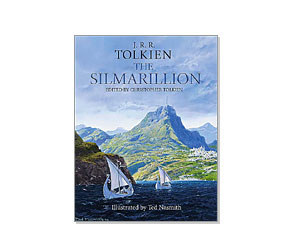

In the last dread days of disco-dûr, in the midst of the Seventh Age — known in perhaps a more familiar tongue as “the Nineteen Seventsies” — there emerged from the House of Houghton Mifflin, and later from that of Ballan-tine, a great book of which much was expected, though few but the most ardent of devotees could wholly comprehend it. It has, in the Tolkienian spirit, valiantly returned.
“The Silmarillion,” J.R.R. Tolkien’s fantastically complex, comprehensive and, yes, uneven mythological narrative was his life’s work — the underlying structural legend of the world into which young Frodo Baggins would later walk, many millennia hence, on his arduous journey to cast the One Ring into the fires of Mount Doom. Its narrative principally concerns the time before “The Lord of the Rings,” from the genesis of Eä and Arda (the universe and Earth, in Tolkien’s legendarium) to the creation of Middle Earth and its denizens — the divine, the Elvish, and the human, with nary a hobbit in sight.
“The Silmarillion” was published and edited by Tolkien’s son Christopher, four years after the Oxford don’s death in 1973, to largely negative critical reaction (The word “genesis” earlier was not idly chosen — Tolkien’s creation myth approaches both the tone and the style of the Bible and could be thought of as a “Bible of Middle Earth” of sorts, though Tolkien would certainly have stressed a distinction.) Its legacy is troubled, though for a time, quite like the One Ring, it passed from the minds of men (apologies — the temptation to drift into legend language is impossible to resist sometimes).
Now a new generation, armed with extravagantly appendixed, extended editions of Peter Jackson’s trilogy of films on DVD, has the opportunity to contend with its knotted and besotted history. The professor’s pre-magnum opus has been re-released, bound in a gorgeously illustrated, and pleasantly weighty, hardcover edition that sits comfortably in your lap, just as all grand fairy tales should.
By virtue of aesthetics alone, this new volume of “The Silmarillion” should bring a great many more readers into fuller appreciation of not only the book but also Tolkien’s universe at large. Exquisitely illustrated by Ted Naismith, who worked on Robert Foster’s “Complete Guide to Middle Earth,” this new edition is the model of what a 21st century, ancient cosmological text should look like, if that makes any sense. I feel almost silly for saying it, but it’s a really pretty book: From the typescript to the spacious layout — not to mention the extremely useful appendixes of genealogical tables, notes on Elvish pronunciation, indexes of names, and linguistic elements of Tolkien’s two Elvish tongues — the publishers have done well to give Tolkien’s saga a tangible feeling of the momentous mythological history its author meant it to be.
But what exactly did Tolkien mean for us to make of “The Silmarillion”? And what the heck is a Silmarillion anyway? (I promise it’s not just the name of a late-’70s progressive rock band.) The answers to those questions are conveniently found in a 1951 letter — included in this volume — which Tolkien wrote to his friend Milton Waldman, an editor at the publishing house then known simply as Collins. Christopher Tolkien explains that this lengthy letter was the result of his father’s working out difficulties that arose over his insistence that “The Silmarillion” and “The Lord of the Rings” be published in “conjunction or in connexion … as one long Saga of the Jewels and the Rings.”
“The Silmarillion” as published is a compendium of five works: the “Ainulindalë,” a cosmological myth that recounts the creation of the universe by Eru Ilúvatar (God) and the music of the (angelic) Ainur; the “Valaquenta,” a comparatively brief description of the Valar and Maiar, supernatural beings; the “Quenta Silmarillion,” or “Silmarillion” proper, which forms the bulk of the collection and recounts the fall of the most gifted kindred of Elves whose fate is tied to the Silmarilli, or Silmarils — jewels into which was imprisoned the light of the world; the “Akallabêth,” concerning the downfall of the Númenóreans — the Kings of Men — and the destruction of their Atlantean island Númenor; and finally “Of the Rings of Power and the Third Age,” which takes us from the forging of the One Ring through more familiar territory — the passing of the Ringbearers into the Undying Lands at the end of the “Rings” epic.
Tolkien began work on “The Silmarillion” as early as 1917 when, as a British officer stationed in France during World War I, he was laid up in a military field hospital with trench fever. What began as a language lover’s way to entertain himself by inventing creatures (Elves) who spoke invented languages (Quenya and Sindarin, derived from Finnish and Welsh), became a way for Tolkien to bestow upon his beloved England a mythology all its own. (For more on the life of Tolkien, please refer to Salon’s own Andrew O’Hehir and his magisterial treatise on Tolkien’s treatment by intellectuals.)
Tolkien wrote in the letter to Waldman, “I was from early days grieved by the poverty of my own beloved country: it had no stories of its own (bound up with its tongue and soil), not of the quality that I sought, and found (as an ingredient) in legends of other lands. There was Greek, and Celtic, and Romance, Germanic, Scandinavian, and Finnish (which greatly affected me); but nothing English … Of course there was and is all the Arthurian world, but powerful as it is, it is imperfectly naturalized, associated with the soil of Britain but not with English; and does not replace what I felt to be missing.” E.M. Forster had similar feelings, expressed in “Howards End”: “Why has not England a great mythology? Our folklore has never advanced beyond daintiness, and the greater melodies about our countryside have all issued through the pipes of Greece. Deep and true as the native imagination can be, it seems to have failed here.”
What Tolkien gave us in “The Silmarillion” and “The Lord of the Rings” is an amalgam of myth, fairy story, heroic legend and still yet another element, truth. He explains, “I believe that legends and myths are largely made of ‘truth’, and indeed present aspects of it that can only be received in this mode; and long ago certain truths and modes of this kind were discovered and must always reappear.” Perhaps that is why Tolkien’s myths feel so familiar in their foreignness: They tap into a collective, unconscious sense of loss — loss of the once oral tradition of storytelling and mythmaking — rekindled in “The Silmarillion” with the epitaphs and purposefully grandiloquent speech of gods, Elves, and Men (believe me, I’d say Women too, but Tolkien so rarely did) in a time before religion (as we know it — mythmaking was itself a form of religion).
For a work that according to his son became for the elder Tolkien “the vehicle and depository of his profoundest reflections,” it is especially sad that “The Silmarillion” was deemed largely impenetrable, even by many Tolkien fans, upon its release in 1977. The extravagantly stylized language, a seeming overabundance of genealogical history, and a lack of deeply crafted characterization were cited as its major faults. (Claims of impenetrability did little to damage the book’s sales, though. “The Silmarillion” sold over a million copies that year, soaring to the top of the New York Times bestseller list, and it continues to make a positive impression on its publishers’ balance sheets today, both in the United States and the United Kingdom. It’s a book that everyone wanted but seemingly no one wanted to read all the way through.)
Negative reactions were, alas, nothing new to Tolkien’s works of fantasy. In 1956, modernist critic Edmund Wilson famously scoffed at “The Lord of the Rings,” calling it “juvenile trash.” In 1961, Philip Toynbee prematurely celebrated the fact that Tolkien’s “childish” books “have passed into a merciful oblivion.” In a sense, “The Silmarillion” drew criticism for not being trashy or juvenile enough.
A review in the September 1977 issue of the Economist was so virulently dismissive of “The Silmarillion” that it required a seemingly palliative preface directed at Tolkien enthusiasts, acknowledging that those readers would “have little sympathy with the ‘curmudgeonly’ note of the following article by one of our reviewers.” (The editors then revealed that they published the review “in the interests of provoking further disagreement between those who live outside the Tolkien world and those inside it.”)
The great chasm between those wholly taken with Tolkien and those who avoid his works of fantasy like a medieval plague has always been as unbridgeable as, say, the abyss at Khazad-dûm into which Gandalf and the fiery Balrog fall. Yet much of the criticism originally directed at “The Silmarillion” singles out Tolkien’s liberal sampling of European lore as well as his reluctance to flesh out his characters beyond their heroic (or villainous) archetypes. But isn’t the creation of archetypes the greater part of what mythmaking is all about? I am no Oxford medievalist, but it seems to me that creating enduring types to which succeeding generations can attach new significance is a success, not a failure.
John Gardner — the author of “Grendel,” and who, like Tolkien, was a noted professor of medieval literature and a scholar of ancient languages — reviewed “The Silmarillion” for the New York Times upon its release in 1977. He wrote, “If ‘The Hobbit’ is a lesser work than the Ring trilogy because it lacks the trilogy’s high seriousness, the collection that makes up ‘The Silmarillion’ stands below the trilogy because much of it contains only high seriousness; that is, here Tolkien cares much more about the meaning and coherence of his myth than he does about these glories of the trilogy: rich characterization, imagistic brilliance, powerfully imagined and detailed sense of place, and thrilling adventure.” A lover of languages, Gardner had none for his fellow scholar: “Tolkien’s language is the same phony Prince Valiant language of the worst Everyman translations and modernizations.”
These are fair criticisms, if a bit stuffy — but to be fair, Gardner’s review is not wholly damning; he does have (tempered) praise for “the total vision, the eccentric heroism of Tolkien’s attempt,” which is certainly a large part of its importance. While I agree with Gardner that “The Silmarillion,” and its forest of names denser than Fangorn, might not make for the simplest reading immediately after finishing the last bit of your Longbottom Leaf, I do think that there is something more primal, more vital — and more pagan than papal — to its appeal. (Yes, Tolkien was a Christian, but the myths he imagined here are intended as fundamentally pre-Christian.)
Sure, there are certain interminable portions that read much like those sections in the Bible where W begat X, who begat Y and Z, and some stories are given inexplicably short shrift. But that only reminds me of something else Gardner said (though not in that Times review): “Reading the Bible straight through is at least 70 percent discipline, like learning Latin. But the good parts are, of course, simply amazing. God is an extremely uneven writer, but when he’s good, nobody can touch him.” The same is true for Tolkien and “The Silmarillion” (and no, I’m not comparing Tolkien to any manner of Supreme Being, though the most fervent of Tolkienians might wish me to).
Despite its complexity, “The Silmarillion” has at its core the simple, cyclical story of a fall — a great fall, with many smaller ones within. Tolkien himself said, “There cannot be any ‘story’ without a fall — all stories are ultimately about the fall — at least not for human minds as we know them and have them.” Its story arc is one suffused with loss and bereavement, tracking the gradual darkening of the original light of the world; things are created, then marred or destroyed, then are re-created, but with less luster — lights shine with less brilliance, men act with less virtue — as things grow further away from their original perfection. The one bright thought that remains with the reader throughout is the comforting knowledge that the time of “The Lord of the Rings” is still to come.
It’s not a complete downer though. “The Ainulindalë” offers many beautiful moments — the idea that the world was created out of themes given to the Ainur by Eru, out of which they made “a great music … of endless interchanging melodies woven into harmony that passed beyond hearing into the depths and into the heights … and the music and echo of the music went out into the Void, and it was not void” — and others more sinister.
Here appears Tolkien’s great villain, Melkor, later called Morgoth. The most powerful (power was always close kin to evil in Tolkien’s world) of the Ainur — the fallen Angel greedy for glory — Melkor began singing his own song, clashing with the harmony of the other Ainur, thinking himself greater than the rest. Eru responds by laying down the ultimate corrective: “And thou, Melkor, shalt see that no theme may be played that hath not its uttermost source in me, nor can any alter the music in my despite. For he that attempteth this shall prove but mine instrument in the devising of things more wonderful, which he himself hath not imagined.”
Tolkien’s greatest gifts to us in “The Silmarillion” are his villains. Melkor/Morgoth, who ever opposes the immortal Valar, sets forth the cyclical making and unmaking of the world by destroying the beacons of light that the Valar construct to illuminate the world for the coming of Elves and Men. The most dramatic scene of bold destruction comes in “The Silmarillion” proper, when Morgoth and the monstrous, never sated spider Ungoliant — in my view the vilest, most sickening, and best-named character in the book — poison and kill the Two Trees of Valinor that had lit the world before the coming of the Sun and the Moon, while also stealing the Silmarils and darkening the world again.
Thus the epic is set forth. The Noldor Elves — the central figures of Tolkien’s tale and those in whom we might recognize a bit of the author in their “love of words,” who “sought ever to find names more fit for all things that they knew or imagined” — are doomed to desire possession of the Silmarils.
“The Silmarillion’s” most fully realized and emotionally invested fairy tale is the story of Beren and Lúthien. Beren (which if it isn’t, should be Elvish for “badass”) is an outlaw wanderer (a man) who falls in love with the Elf Lúthien Tinûviel — “the most beautiful of all the Children of Ilúvatar” — after watching her dance and sing alone in woods lit by moonlight. She returns his love, but the two are parted by Lúthien’s father, King Thingol, who challenges Beren to win the hand of his daughter with a task he knows will seal the man’s doom: “Bring to me in your hand a Silmaril from Morgoth’s crown; and then, if she will, Lúthien may set her hand in yours.” Beren responds, laughing, “It is for little price … do Elven-kings sell their daughters: for gems and things made by craft. But if this be your will, Thingol, I will perform it. And when we meet again my hand shall hold a Silmaril from the Iron Crown; for you have not looked the last upon Beren son of Barahir.” (I told you he was a badass.) It is an incredible story, long, exquisitely detailed, and poignant, so I am loath to give away its truly gripping ending, but I may already have said too much. (The story is invested with even more meaning by the knowledge that Tolkien had “Beren” inscribed on his headstone and “Lúthien” on that of the love of his life, Edith Bratt.)
Had I but world enough and time, I’d tell you about the unluckiest man in the book, Túrin Turambar, whose life resembles that of Oedipus and other doomed figures, and of Dior, one of Tolkien’s few “multicultural” heroes (being part Man, part Elf, and part Maia — a lesser Ainur), the Elf-on-Elf crimes that forever doom the Noldor, and of the origin of the Orcs (corrupted Elves in a sense, bred in envy and mockery of them, and perhaps the vilest deed of Morgoth, for they hate all, but hate their creator most for birthing them), but I don’t, so I’ll leave those for you to discover.
As is often the case, the greatest pleasures are the small ones: Reading a familiar description or seeing a familiar place name will, for the Tolkien fan, set off a flood of memories of what will come to pass in later “years.” And of course, revisiting “The Lord of the Rings” becomes all the richer with all of this new-old knowledge, throwing various elements of the story into fuller light. (When Aragorn recounts the love story of Beren and Lúthien to his enthralled hobbit band on Weathertop before the Nazgûl attack, you realize how close their tale is to his and Arwen’s.)
Reading Tolkien’s “Silmarillion” is like looking at a frayed and faded picture of your grandfather and all of a sudden recognizing why your nose is shaped just the way it is. “The Silmarillion” is both profoundly satisfying and profoundly warming, even despite those who think its prose cold and unfeeling. It answers — at least for Tolkien fans always desirous of more — the fundamental question, why? If Tolkien knew (and he probably did) why the sky is blue, the answer would be in “The Silmarillion.”
“The Silmarillion” is a special work because it offers what few other books of Tolkien’s do: a true beginning, a fresh start. It is the beginning, of all things. For those willing to surrender themselves to his bookish universe, watch the films, or at least make a valiant attempt at penetrating the veil of scholarly geekdom surrounding most Tolkieniana, the opportunity exists here to start from scratch, from the One, Eru, “who in Arda is called Ilúvatar.” Both the Tolkien arriviste and the scholar — for once on a level playing field — are presented with the clean slate of creation time where myth can be made and remade within the mind of the reader. A final word is always difficult, so perhaps it’s best to leave you with the Oxford philologist’s opening lines in his letter to Milton Waldman, lines that are quintessential Tolkien:
“My dear Milton, you asked for a brief sketch of my stuff that is connected with my imaginary world. It is difficult to say anything without saying too much: the attempt to say a few words opens a floodgate of excitement, the egoist and artist at once desires to say how the stuff has grown, what it is like, and what (he thinks) he means or is trying to represent by it all. I shall inflict some of this on you; but I will append a mere resume of its contents: which is (may be) all that you want or will have use or time for.”
Ser Jorah’s face grew thoughtful as their horses trod together down the godsway. “When I first went into exile, I looked at the Dothraki and saw half-naked barbarians, as wild as their horses. If you had asked me then, Princess, I should have told you that a thousand good knights would have no trouble putting to flight a hundred times as many Dothraki.”
“But if I asked you now?”
“Now,” the knight said, “I am less certain.”
– George R.R. Martin, “A Game of Thrones”
Epic fantasy — sprawling stories full of swords, castles, magic, kings and lots and lots of white people – is slowly finding its way into America’s cultural mainstream. In the age of the anemic box office, Peter Jackson’s films of J.R.R. Tolkien’s Lord of the Rings trilogy remain a gold standard of blockbusterdom – and his forthcoming version of “The Hobbit” will almost certainly follow suit. Newer writers like Brandon Sanderson and Patrick Rothfuss have sold hundreds of thousands of their “door-stopper” tomes of wizardry and courtly intrigue. And tonight, countless viewers will be glued to their sets for the return of what is arguably the hottest show on television, “Game of Thrones,” HBO’s adaptation of George R.R. Martin’s A Song of Ice and Fire fantasy novels.
This is all a bit odd for those of us who grew up with – maybe even got beaten up for – an obsession with these sorts of books. Accustomed to being mocked for our profoundly uncool fixations, many fantasy nerds, myself among them, have an almost nurtured notion that our love of the fantastic and the pseudo-medieval is something that the rest of the world Just. Doesn’t. Get.
But now, as our beloved genre finds its way into “normal” people’s hearts and minds, fantasy fans are increasingly confronted with an inversion of this notion – a question that I, as an Arab-American fantasy fanatic, have been wrangling with for years: If the mainstream doesn’t get fantasy, just how well does epic fantasy, with its lily-white heroes, get the multicultural real world of 21st-century America? As some of the most popular works in the genre’s history – works that shed any pretension of being children’s fare – A Song of Ice and Fire and its wonderful TV spawn are particularly useful springboards for this question.
When it comes to inherited conventions regarding race in epic fantasy, “Game of Thrones” is, in a sense, standing on the shoulders of dwarfs. The Lord of the Rings is the most obvious predecessor to Martin’s work, and it’s not hard to find subtle rhetorical responses to Tolkien in his books. When Time magazine dubbed Martin “the American Tolkien,” it highlighted not only Martin’s rather astonishing genius in world-building and narrative scope, but also the ideological baggage that all of us writing in the genre have inherited from our shared progenitor.
And it’s heavy baggage indeed, however much we love Tolkien’s creation. His half-sublimated wranglings with race are more complex and fraught than either his shrillest detractors or his most fawning defenders would have us believe. But there is some irreducible ugliness in his masterpiece that really can’t be convincingly redeemed. The men of the global East and global South (“black men like half-trolls with white eyes and red tongues”) are monstrous and evil, naturally and culturally inclined to bow to Sauron, and to make war on the good men of the North and West. The bestial visages of orcs bear a striking resemblance to racist caricatures of African and Asian facial features. Above all, to be dark-skinned in Middle Earth is to be part of a savage horde – whether orcish or human – rather than to be a true individual.
The savage hordes described by Tolkien have been imported by his dozens of imitators over the years, becoming a mainstay of fantasy in books, movies and video games. It’s a convention that Martin both takes up and departs from in depicting the Mongol-inspired Dothraki. As a people en masse, the Dothraki value only their horses, treating life cheaply, and reveling in violence:
Across the road, a girl no older than Dany was sobbing in a high thin voice as a rider shoved her over a pile of corpses, facedown, and thrust himself inside her. Other riders dismounted to take their turns. That was the sort of deliverance the Dothraki brought the Lamb Men.
The HBO production – which has been so remarkable on so many fronts — has exacerbated this hard-R-rated cartoonishness, bringing out some of the novel’s more unfortunate tendencies. The show’s depiction of the Dothraki has been positively cringe-inducing. In the novels, Martin’s quasi-Mongol warrior culture is depicted in a problematically essentialist, but still complex fashion. But HBO has nudged Martin’s creation fully into racial caricature by casting a seemingly random variety of colored people, and apparently raiding productions of both “Hair” and “Braveheart” to clothe them.
Even so, by skillfully replicating the juxtapositions posed by Martin’s back-and-forth POV, the show has managed also to replicate his ultimate, rather un-Tolkienish subtext: There is nothing unique about the savage horde’s savagery. If Dothraki society is depicted as violently perverse, so is Westerosi (i.e., quasi-European) society, which bows to the whims of the Aryan-featured boy-monster King Joffrey, and which has knighted mass murderers and rapists like Ser Gregor Clegane, one of the most horrifying minor characters in all of fantasy. Every culture is savage in “Game of Thrones,” and that’s a very different view of the world than what Tolkien gave us.
- – - – - – - – - – - – -
Sunday’s Season 2 premiere begins HBO’s adaptation of “A Clash of Kings,” the second book of A Song of Ice and Fire. Book II is even more wide-ranging in terms of setting and scope than Book I was, so viewers can expect brief glimpses of characters from other parts of the world, including the Summer Isles, Martin’s analogue for Africa.
Unfortunately, some of these depictions partake in some pretty familiar stereotypes about African sexuality. It will be interesting, for example, to see what the show does with Chataya, an associate of Tyrion’s from the Summer Isles, and an upscale brothel madam. Chataya blithely sends her own 16-year-old daughter into prostitution at her “pillow house.”
Chataya continued, “My people hold that there is no shame to be found in the pillow house. In the Summer Isles, those who are skilled at giving pleasure are greatly esteemed. Many highborn youths and maidens serve for a few years after their flowerings, to honor the gods.”
“What do the gods have to do with it?”
“The gods made our bodies as well as our souls, is it not so? They give us voices, so we might worship them with song. They give us hands, so we might build them temples. And they give us desire, so we might mate and worship them in that way.”
“Remind me to tell the High Septon,” said Tyrion. “If I could pray with my cock, I’d be much more religious.”
Again, an entire nonwhite culture is presented as holding skewed values. But this wince-inducing depiction is tempered by some interesting implied questions about sex and commerce and spirituality and culture and power. Here’s hoping there’s a hint of this in the show’s version of things as well.
Part of the challenge of adapting Martin’s novels for television has to do with honoring his skill in constructing jaw-droppingly epic sweeps of plot and setting from beautifully rendered small details. If there’s a saving grace for the racial imagery in A Song of Ice and Fire, it’s in some of these little glimpses and hints that appear throughout – skillful deployment of which on”Game of Thrones” could help make an already good show great.
As an example, the only black character in the first novel is the barely mentioned, but deeply intriguing Jalabhar Xho, “an exile prince from the Summer Isles who wore a cape of green and scarlet feathers over skin as dark as night.” In the first novel, Xho’s most notable act is to frighten one of Sansa Stark’s fellow court ladies with his exotic appearance. So the first black guy to show up in A Song of Ice and Fire basically scares a white girl and then disappears. (He also ties for second place in an archery competition.) Not exactly marquee stuff, but – if online reader reactions are any measure – tantalizing. Yet the character didn’t appear at all in Season 1 of “Game of Thrones” – an understandable enough choice, given that Xho is essentially court furniture, but still a disappointing one for those of us who notice such things.
Another minor character who might have been used a bit more effectively to add a smidge of color to the screen in Season 1 is Syrio Forel, Arya Stark’s vaguely Mediterranean “dancing master” (a gender-acceptable euphemism for “sword-fighting teacher”). Forel is a fan favorite among readers, much more than one might guess from his brief appearances. The show could certainly have added a scene or two more of the wonderful actor Miltos Yeromelou, giving us just a bit more of his character training Arya in the deft swordsmanship of the East. All the more so because Arya’s POV on the show has thus far felt a bit diminished from the books. One supposes training flashbacks are always possible …
Of necessity, turning 1,000 pages of prose into a relatively few hours of screen time involves dropping, combining and retooling elements of a novel. “Game of Thrones” has already taken a few liberties with Martin’s books – cutting minor scenes, combining some characters and eliminating others, and (most notoriously) signposting plot points and character motivations through clumsy new “sexposition” scenes. It would be nice if, moving forward, the writers and producers chose as well to keep an eye on these sorts of promising moments of cultural variety and — dare I say it? — color in Westeros. But, given the contempt our culture currently holds for anything smacking of the much maligned (if chimerical) “political correctness,” I’m not holding my breath.
- – - – - – - – - – - – - -
As an Arab-American writing fantasy fiction, I’ve been asked more than once whether fantasy’s race problem is in a better place now in the Age of Martin than it was in the Age of Tolkien. My short answer is yes, but honestly, I think such questions are almost beside the point.
Ultimately, A Song of Ice and Fire, like the Lord of the Rings, is the work of a brilliant and conscientious writer who is nonetheless writing in his own time and place. The United States in 2012 is, far too often, and even with a black president, still a culture rich in racist stereotypes and xenophobic fear-mongering. Expecting a writer to remain entirely unstained by this is expecting a person to live underwater without getting wet. If we still find troubling racial assumptions and caricatures in fantasy – whether on the page, or on the big or small screen — this probably tells us more about our culture-wide problems than it does about a single writer’s, or a single show’s issues. A Song of Ice and Fire is indeed our American Lord of the Rings, and if Westeros has its race problems, they are simply a powerful reflection of America’s.
Continue Reading
Close
Looking at the most visible exemplars of epic fantasy — from J.R.R. Tolkien to such bestselling authors as George R.R. Martin and Robert Jordan — a casual observer might assume that big, continent-spanning sagas with magic in them are always set in some imaginary variation on Medieval Britain. There may be swords and talismans of power and wizards and the occasional dragon, but there often aren’t any black- or brown-skinned people, and those who do appear are decidedly peripheral; in “The Lord of the Rings,” they all seem to work for the bad guys.
Our hypothetical casual observer might therefore also conclude that epic fantasy — one of today’s most popular genres — would hold little interest for African-American readers and even less for African-American writers. But that observer would be dead wrong. One of the most celebrated new voices in epic fantasy is N.K. Jemisin, whose debut novel, “The Hundred Thousand Kingdoms,” won the Locus Award for best first novel and nominations for seemingly every other speculative fiction prize under the sun. Another is David Anthony Durham, whose Acacia Trilogy has landed on countless best-of lists. Both authors recently published the concluding books in their trilogies.
Although they came to the genre from different paths, both Jemisin and Durham have used it to wrench historical and cultural themes out of their familiar settings and hold them up in a different light. “I never felt that fantasy needed to be an escape from reality,” Durham told me. “I wanted it to be a different sort of engagement with reality, and one that benefits from having magic and mayhem in it as well.”
In Durham’s trilogy, four royal siblings are deposed and then fight their way back to the throne in an empire presided over by the island city of Acacia. Their dynasty’s power resides in a Faustian bargain made with a league of maritime merchants: the League supplies a rabble-soothing drug in exchange for a quota of the empire’s children, who are sent off across the sea to meet an unknown fate. As promised, “Acacia” is a sweeping yarn filled with adventure, intrigue, sorcery and battles.
“There’s a little bit of the Atlantic slave trade in there, and there’s a bit of the Opium Wars and quite a bit of Halliburton,” Durham said. When set in the real world, such topics come “weighted with particular agendas and political orientations.” Readers often approach them with established opinions — or are so convinced they already know what the author is going to say that they never bother to approach them at all. When similar themes arise in an imaginary world, said Durham, “I have some readers who are quite liberal and some that are more conservative than I am, but they still engage with the book that I wrote, with all the components that are at play in it, in a way that I think they wouldn’t if they perceived me to have a political agenda right from the start.”
While Durham came to writing epic fantasy after publishing two literary novels (he has an MFA from the University of Maryland) and a historical novel about Hannibal’s march on ancient Rome, Jemisin has been a self-identified “black geek” since childhood. She started out reading science fiction, deeming fantasy to be insufficiently “real,” a notion she now considers “bizarre.” Furthermore, “I was reading almost exclusively male writers.” Her youthful attempts at writing her own stories hit a snag when her father prompted her to create a black female character, and she found she couldn’t do it. “I really didn’t know how to write from the female perspective, even though I was female.” An active search for more innovative science fiction led her to the work of Octavia Butler, “and my consciousness was utterly changed.”
Perhaps because the notion of envisioning a different future is baked into the form, science fiction is known for fostering such groundbreaking black authors as Butler and Samuel Delany. (Although, Jemisin pointed out, the first book she read by Butler featured no author photo and a cover illustration of white women, a practice known as “whitewashing.”) Much of epic fantasy — usually set in a preindustrial world — is more conservative. For example, the genre’s founding author, Tolkien, expressed a keen nostalgia for Anglo-Saxon rural life in the feudal past.
Still, some authors have tried to expand the genre’s borders. Both Jemisin and Durham cite Ursula K. Le Guin’s Earthsea books as an important influence. Le Guin, the daughter of a pioneering anthropologist, set her young-adult series in an archipelago of islands, and based its culture and religion on Asian and Native American models. Her primary characters in those novels were people of color.
Nevertheless, when Jemisin decided to write her own epic fantasy in grad school, she found herself abiding by some of the genre’s most shopworn conventions. Her main character was a man. “I was thinking it had to have a quest in it, with a MacGuffin of Power being brought to a Place of Significance,” she said. The book didn’t quite work, so she set it aside, and when she returned to it a few years later, she decided to start over. She made the main character a woman and, in an even more marked departure from the norm, she decided to have that character narrate the book in the first person. “I knew that what I was writing was inherently defiant of the tropes of epic fantasy,” Jemisin said, “and I wasn’t sure it would be accepted.”
Jemisin’s series, too, is set in the capital of an empire that has been run by an aristocratic clan for generations. The power of the Arameri family, however, resides in the gods — specifically a pantheon of deities whom they have imprisoned and enslaved. The narrator of “The Hundred Thousand Kingdoms” is the daughter of a renegade member of the clan who ran off with a foreigner. Raised in a remote kingdom with its own fiercely independent customs, she returns to the capital seeking information about her mother and, once there, becomes embroiled in vicious palace intrigues.
When Durham decided to write an epic fantasy, he set out to recapture the enchantment he felt as a 12-year-old, discovering Tolkien at his father’s house in Trinidad, while “brushfires and buzzards” ranged over the neighboring hills. Jemisin, on the other hand, based her trilogy on “the old-school epics: not Tolkien, but Gilgamesh.” The gods in her imaginary world evoke the squabbling divine families of the world’s great myths: “The ancient tales of mortals putting up with gods and trying to outsmart gods, of trickster gods outsmarting other gods: That’s the basis of my work.”
Despite such differences, what’s most striking about the fictional worlds Durham and Jemisin have created is how cosmopolitan they are. Their cities are populated by people of different races and religions, mixing together and comparing their respective values. They bridle at the limitations of class. Economics drive many of their actions, and the conflicts that inevitably arise can’t be easily parsed. “The strange thing about some of [the most popular epic] fantasy worlds,” Durham said, “is that it does seem that the entire world is northern Europe. That’s all there is. It’s always easy for me to engage with that, but then a part of my mind is also wondering, ‘What happened if you spin the globe?’ What are the people doing there? How is their history been shaped by the magic of that world? There’s something exciting about acknowledging that everybody is not the same and that affects their struggles.”
Jemisin finds deeper problems in “certain expectations of the genre that are rooted in Western cultural assumptions that are not necessarily true. For example: the whole good-versus-evil focus, the binary. You see that in so much of epic fantasy. The Dark Lord is really bad, we know this. Because he’s dark. Well, did you do something to him? Doesn’t matter, he’s dark. That’s why he’s bad and that’s why you’ve got to go kill him. That kind of thinking I inherently do not trust.”
If these writers can bring fresh perspectives to the genre, the genre reciprocates by bringing them new and more varied readers. Durham’s second book, a literary novel titled “Walk Through Darkness,” about an escaped slave and the man tracking him, “never made it to the front of the store, really, because it was immediately shelved as an ‘African-American novel.’” Now, “my stuff is being read by more and a wider range of people than it was in the early days.”
Jemisin has been annoyed to learn that her first novel sometimes gets shelved in the same section, which means that readers searching the science fiction and fantasy area can’t find it. “The inherent danger of that section,” she said, “are the ideas that, a) only African-Americans would be interested in it, and b) African-Americans are interested solely because there is something African-American associated with it — usually the writer. I don’t see the novels of white authors who write black characters getting shoved into that section.” This is all the more irksome when, as was the case with her first novel, people assume her narrator is black; Jemisin envisioned the character and her people as similar to the Incas. “Just because I am black,” she said, “does not mean I am always going to write about black characters.”
In fact, the epic fantasy genre makes an imaginative departure from the contemporary (or historical) African-American experience feel less politically charged. Although one of Durham’s royal siblings comes of age amid a dark-skinned people living on a savannah, the siblings themselves are brown with straight black hair. (He describes them as “sort of Mediterranean.”) Because slavery in Acacia isn’t tied to race, he can explore its consequences, as well as the effects of colonialism, apart from the issue of skin color.
“The genre can go many, many more places than it has gone,” said Jemisin. “Fantasy’s job is kind of to look back, just as science fiction’s job is to look forward. But fantasy doesn’t always just have to look back to one spot, or to one time. There’s so much rich, fascinating, interesting, really cool history that we haven’t touched in the genre: countries whose mythology is elaborate and fascinating, cultures whose stories we just haven’t even tried to retell.”
Continue Reading
Close
As bad lots go, you can’t get much worse than the hordes of Mordor from J.R.R. Tolkien’s “The Lord of the Rings.” Led by an utterly evil disembodied entity who manifests himself as a gigantic, flaming, pitiless eye, and composed of loathsome orcs (or goblins), trolls and foreigners, Mordor’s armies are ultimately defeated and wiped out by the virtuous and noble elves, dwarfs, ents and human beings — aka the “free peoples” — of Middle-earth. No one sheds a tear over Mordor’s downfall, although the hobbit Sam Gamgee does spare a moment to wonder if a dead enemy soldier is truly evil or has simply been misguided or coerced into serving the dark lord Sauron.
Well, there’s two sides to every story, or to quote a less banal maxim, history is written by the winners. That’s the philosophy behind “The Last Ringbearer,” a novel set during and after the end of the War of the Ring (the climactic battle at the end of “The Lord of the Rings”) and told from the point of view of the losers. The novel was written by Kirill Yeskov, a Russian paleontologist, and published to acclaim in his homeland in 1999. Translations of the book have also appeared in other European nations, but fear of the vigilant and litigious Tolkien estate has heretofore prevented its publication in English.
That changed late last year when one Yisroel Markov posted his English translation of “The Last Ringbearer” as a free download. Less polished translations of brief passages from the book had been posted earlier on other sites, but Markov’s is the “official” version, produced with the cooperation and approval of Yeskov himself. Although the new translation’s status as a potential infringement of the Tolkien copyright remains ambiguous, it may be less vulnerable to legal action since no one is seeking to profit from it.
The novel still has some rough edges — most notably, a confused switching back and forth between past and present tense in the early chapters — and some readers may be put off by Yeskov’s (classically Russian) habit of dropping info-dumps of military and political history into the narrative here and there. For the most part, though, “The Last Ringbearer” is a well-written, energetic adventure yarn that offers an intriguing gloss on what some critics have described as the overly simplistic morality of Tolkien’s masterpiece.
In Yeskov’s retelling, the wizard Gandalf is a war-monger intent on crushing the scientific and technological initiative of Mordor and its southern allies because science “destroys the harmony of the world and dries up the souls of men!” He’s in cahoots with the elves, who aim to become “masters of the world,” and turn Middle-earth into a “bad copy” of their magical homeland across the sea. Barad-dur, also known as the Dark Tower and Sauron’s citadel, is, by contrast, described as “that amazing city of alchemists and poets, mechanics and astronomers, philosophers and physicians, the heart of the only civilization in Middle-earth to bet on rational knowledge and bravely pitch its barely adolescent technology against ancient magic.”
Because Gandalf refers to Mordor as the “Evil Empire” and is accused of crafting a “Final Solution to the Mordorian problem” by rival wizard Saruman, he obviously serves as an avatar for Russia’s 20th-century foes. But the juxtaposition of the willfully feudal and backward “West,” happy with “picking lice in its log ‘castles’” while Mordor cultivates learning and embraces change, also recalls the clash between Europe in the early Middle Ages and the more sophisticated and learned Muslim empires to the east and south. Sauron passes a “universal literacy law,” while the shield maiden Eowyn has been raised illiterate, “like most of Rohan’s elite” — good guys Tolkien based on his beloved Anglo-Saxons.
The protagonist of “The Last Ringbearer” is a field medic from Umbar (a southern land), who is ably assisted by an Orocuen — that is, orc — scout, who is not a demonic creature like the orcs in “The Lord of the Rings,” but an ordinary man. They’re given the task of destroying a mirror in the elf stronghold of Lorien before the elves can further use it to infect Middle-earth with their alien magic. Meanwhile, the remnants of Mordor’s civilization fight a rear-guard guerrilla campaign to sustain the “green shoots of reason and progress,” in opposition to the “static” and “tidy” pseudo-paradise of Middle-earth under the elven regime.
Some of the supporting characters from “The Lord of the Rings” — such as Faramir and Eowyn — get more attention and and even a bit more respect in “The Last Ringbearer.” Others, like Aragorn — depicted by Yeskov as a ruthless Machiavellian schemer who is ultimately the puppet of his wife, the elf Arwen — have been completely transformed. (Still others, like the hobbits, don’t even exist.) Nevertheless, the primary characters are entirely Yeskov’s inventions, presented in a radically rethought version of Tolkien’s world. The novel is clearly dependent on Tolkien’s creation, but it’s also original and ingenious.
Some Tolkien fans have dismissed “The Last Ringbearer” as nothing more than fan fiction, although it certainly doesn’t conform to the stereotype of fan fiction as fantasies of unlikely romantic pairings among “canonical” characters as imagined by teenage girls. What the novel most closely resembles is “Wind Done Gone” by Alice Randall, a retelling of Margaret Mitchell’s “Gone With the Wind” from the perspective of a slave born on Scarlett O’Hara’s plantation. “Wind Done Gone” was published in 2001, prompting a copyright infringement suit from Mitchell’s estate. Randall, who is African-American, and her publisher mounted a defense resting in part on the argument that “Wind Done Gone” is a “parody,” intended to highlight the retrograde racial attitudes and historical distortions in Mitchell’s misty-eyed depiction of the Old South.
It should be said on behalf of “The Last Ringbearer” that it is superior to “Wind Done Gone” as both literature and entertainment. The two books do, however, have similar agendas. In Yeskov’s scenario, “The Lord of the Rings” is a highly romanticized and mythologized version of the fall of Mordor, perhaps even outright propaganda; “The Last Ringbearer” is supposed to be the more complicated and less sentimental true story.
The inhuman nature of the orcs and Tolkien’s depiction of Mordor’s human allies as swarthy-skinned outsiders has prompted complaints that his book obscures the moral conundrums of warfare and dabbles in racial demonization. The American critic Edmund Wilson described “The Lord of the Rings” as a children’s book that had “somehow got out of hand” and “juvenile trash,” in large part for such reasons. Others, like the novelist Michael Moorcock, have attacked Middle-earth as a childishly rose-tinted vision of the Merrie Olde England that never was, as well as willfully blind to the hardships and injustice of preindustrial and feudal societies.
“The Lord of the Rings” wouldn’t be as popular as it is if the pastoral idyll of the Shire and the sureties of a virtuous, mystically ordained monarchy as embodied in Aragorn didn’t speak to widespread longing for a simpler way of life. There’s nothing wrong with enjoying such narratives — we’d be obliged to jettison the entire Arthurian mythos and huge chunks of American popular culture if there were — but it never hurts to remind ourselves that it’s not just their magical motifs that makes them fantasies.
Yeskov’s “parody” — for “The Last Ringbearer,” with its often sardonic twists on familiar Tolkien characters and events, comes a lot closer to being a parody than “Wind Done Gone” ever did — is just such a reminder. If it is fan fiction (and I’m not sure I’m in a position to pronounce on that), then it may be the most persuasive example yet of the artistic potential of the form.
Continue Reading
Close