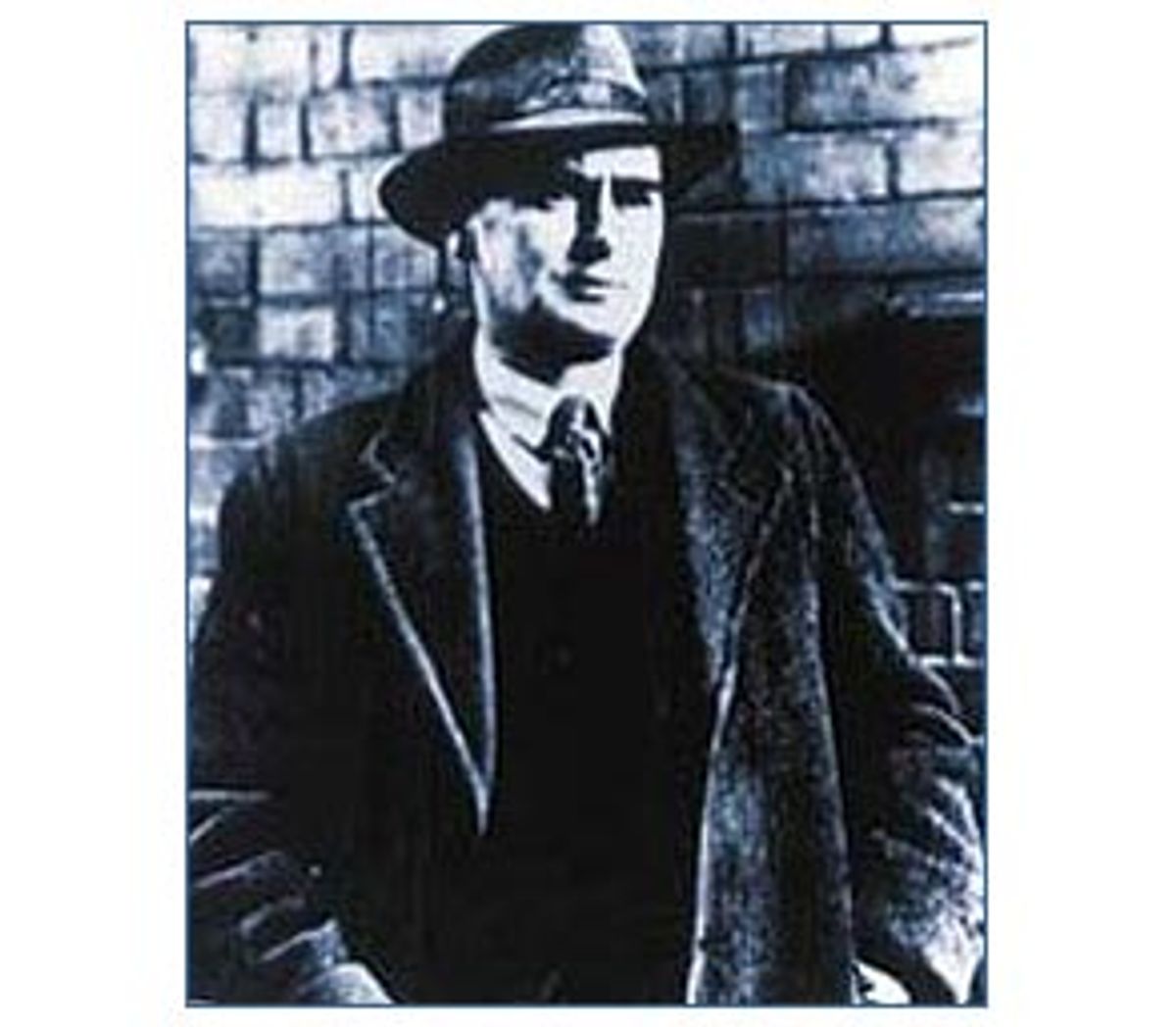
How many names can a cult favorite have? Let us count them: Brian Ua Nuallain (who was born in County Tyrone in either 1911 or 1912, depending on your source) was called Brian O'Nolan, named himself Myles na gCopaleen (pronounced "nagopaleen," which is translated by some as "Myles of the Little Horses" but which was rendered as "Myles of the Ponies" by the author, who insisted that the "autonomy of the pony must not be subjugated by the imperialism of the horse"), and became known as Flann O'Brien.
But, alas, he was not known by any name to very many. No 20th century Irish writer has had a classier set of groupies: James Joyce, Samuel Beckett, Graham Greene, Dylan Thomas, William Saroyan, John Updike and William H. Gass, to name just a few who offered him enthusiastic cover blurbs. Yet he remains Ireland's best kept literary secret, and probably always will. Myself, I divide all the people I have ever met into two broad categories -- my friends, and those who don't fall off their chair laughing heartily while reading O'Brien. On my soul, if she did not laugh at my favorite passages, I'd dump Angelina Jolie.
And yet, it's hard to argue with those who would count him as perhaps the greatest failure of Irish letters. Here's Hugh Kenner in "A Colder Eye: The Modern Irish Writers": "Was it the drink was his ruin, or was it the column? For ruin is the word. So much promise has seldom accomplished so little." By the end of his life, said Kenner, "a great future lay behind him."
There's no question that the drink didn't help. (Denis Donoghue described him as "a natural alcoholic.") Apparently every Irish writer from the mid-1930s to O'Brien's death in 1966 -- on April Fool's Day, no less! -- saw him drunk. (One of the last to testify was Nuala O'Faolain who, in her 1996 memoir, "Are You Somebody?" wrote, "I saw Myles na Gopaleen urinate against the counter in Neary's one night.")
"The column" was another matter altogether. For 25 years, he wrote one for the Irish Times, under the pen name Myles na gCopaleen, the content of which was accurately described by Richard Watts in a 1943 story for the New York Herald Tribune as "devoted to magnificently laborious literary puns, remarkable parodies of De Quincey and others, fanciful literary anecdotes, and erudite study of clichés, scornful dissection of the literal meaning of high-flown literary phraseology and a general air of shameless irony and high spirits." Watts neglected to mention that many of the columns were maddeningly strewn with Latin and Gaelic, which can cause a modern reader -- and for that matter, probably many in O'Brien's own time -- to alternate between fits of laughter and total frustration.
The column was a daily dose of vitriol, satire and just plain nonsense. In one, which can be found in the collection "The Best of Myles," he advertises a service to "maul the books of illiterate, but wealthy, upstarts so that the books will look as if they have been read and re-read by their owners. How many uses of 'mauling' would there be? Without giving the matter much thought, I should say four, including DeLuxe Handling. Each volume to be mauled savagely, the spines of the smaller volumes to be damaged in a manner that will give the impression that they have been carried around in pockets ... not less than 30 volumes to be treated with old coffee, tea, porter or whiskey stains, and not less than five volumes to be inscribed with forged signatures of the author." (Some of the remarks to be penned on the pages include "Rubbish!" "I remember poor Joyce saying the very same thing to me," and "From your devoted friend and follower, K. Marx.") There were mind-bogglingly elaborate shaggy dog stories featuring the comic duo "Keats and Chapman," ending in such puns as "dogging a fled horse," "she stupes to conquer," and "foals rush in where Engels fear to tread."
Then there was the "Myles na gCopaleen Catechism of Clichi," in which newspapers were combed for dead language. ("What inexpensive unrationed commodity is often said to exceed the man possessing it in value?" Answer: "His salt.") There were dialogues on topical matters with "The Plain People of Ireland" and diatribes against just about any subject unfortunate enough to walk into his sights. Poetry, for instance: "Having considered the matter in -- of course -- all its aspects, I have decided that there is no excuse for poetry. Poetry gives no adequate return in money, it is expensive to print by reason of the waste of space occasioned by its form, and nearly always promulgates illusory concepts of life. But a better case for the banning of all poetry is the simple fact that most of it is bad. Nobody is going to manufacture a thousand tons of jam in the expectation that five tons may be eatable." How true.
O'Brien's newspaper columns were irreverent, acerbic and outrageously self-indulgent, and much the same thing can be said of his works of fiction, particularly his first novel, in 1939, "At Swim-Two-Birds" (which sounds Joycean but is actually a literal translation of an Irish place name). Dylan Thomas praised it as "Just the book to give your sister, if she is a dirty, boozey girl." The book flopped, at least in part, legend has it, because damage from German planes destroyed some of the publisher's printing materials. Then again, that story may have been spread by O'Brien himself, who suggested that Hitler had started the second World War to prevent the circulation of "At Swim-Two-Birds." "In a grim irony that is not without charm," he wrote, "the book survived the war while Hitler did not." Actually, "At Swim-Two-Birds" didn't do a great deal better than Hitler; within six months of its initial printing, it had sold fewer than 250 copies and wasn't reprinted until 1960.
Only a fool would attempt to summarize the plot of "At Swim-Two-Birds." Here goes: An unnamed narrator is writing a book about a writer named Dermot Trellis who, it happens, is also writing a book. But Trellis' characters want to be left alone and conspire to keep Trellis asleep as much as possible. Trellis stays awake long enough to create a female character, Sheila Lamont, who bears his child. To be honest, even though I've read the book three times, I kind of lose the thread at this point. I do know that the story involves "the Pooka Fergus MacPhellimey, a species of human Irish devil endowed with magical powers," the great Irish hero Finn McCool (who I think is identified somewhere as Sheila Lamont's father), and "a cellar full of leprechauns."
There are also two American cowboys borrowed from a pulp novel by someone named William Tracy, though I'm pretty sure Tracy was not a real writer at all but another fictional creation of Dermot Trellis -- or maybe of the unnamed narrator. Or maybe of O'Brien himself; it's hard to tell. Trellis, says the narrator, "wants this salutary book to be read by all. He realizes that purely a moralizing tract would not reach the public. Therefore he is putting plenty of smut into his book. There will be no less than seven indecent assaults on young girls and any amount of bad language. There will be whiskey and porter for further orders."
There was also a long "pome" by "the Workman's Friend," Jem Casey, each verse of which ends with the phrase "A Pint of Plain Is Your Only Man." Sample:
"When things go wrong and will not come right,
Though you do the best you can,
When life looks black as the hour of night --
A Pint of Plain Is Your Only Man."
I'm fairly certain this is a parody of something, though I'll be damned if I know of exactly what (of the working-class-hero persona of playwright Sean O'Casey, I would imagine).
If I've gotten off the novel's plot, it's because I don't know how to follow it. Written in a style I can only describe as "stream of self-consciousness," "At Swim-Two-Birds" has been called the successor to "Ulysses" and "Finnegans Wake" (though O'Brien himself was often infuriated by the comparison: "If I hear of that word 'Joyce' again," he once wrote, "I will surely froth at the gob!"). It has also been called, by Hugh Kenner, "a prolonged college joke." If it is, it's a joke I don't understand but that I find irresistibly funny in the telling. Graham Greene compared "At Swim" favorably with "Tristram Shandy"; I'd say it's what "Tristram Shandy" might have read like if written by a 20th century Irishman fixated on Groucho Marx.
The book that should have established O'Brien's reputation, "The Third Policeman," was rejected by a publisher in 1940. For reasons that have never been made clear, O'Brien did not try another publisher and continued to live his life as a minor civil servant and pseudonymous columnist. "The Third Policeman" is a kind of phantasmagorical crime story in which a petty thief and murderer finds himself trapped in a cosmic police station where he learns about atomic theory and the intertwined destinies of men and bicycles -- yes, I know what you're saying, "That old plot again." In O'Brien's hands, though, it is something entirely original. For one thing, the narrator, who is also the murderer, is himself dead through nearly the entire story. (Trust me, it won't spoil the book for you to know that.) Try and imagine a pre-"Brideshead Revisited" Evelyn Waugh reinvented as an Irishman writing the script for "Carnival of Souls," and you're halfway to understanding what "The Third Policeman" is about. O'Brien would have cackled with glee at the irony that his novel about a dead man would go unpublished until 1967, a year after his death.
For a failure, O'Brien actually left behind quite an oeuvre. Two works of fiction, "The Hard Life" (1961) and "The Dalkey Archive" (1964), made it into print before he died; the latter features no less than St. Augustine and James Joyce himself among its characters. (O'Brien's Joyce maintains that "Ulysses" was written in Paris by a committee of pimps and thugs.) "The Poor Mouth," which O'Brien, in a particularly perverse mood, wrote in Gaelic, was finally translated into English in 1973. You really don't have to know that it is a parody of a typical Gaelic autobiography or even that such a thing exists. I didn't, and I laughed myself sick before I was 20 pages into it. (Actually, by Page 5, where the narrator's mother "took a bucket full of muck, mud, and ashes and hens' droppings from the roadside and spread it around the hearth, gladly in front of me. When everything was arranged, I moved over near the fire and for five hours I became a child in the ashes -- a raw youngster rising up according to the old Gaelic tradition.")
That passage will give you an idea of O'Brien's attitude toward most of the absurdities he saw around him that were accepted as typically Irish. In one of the columns included in "The Best of Myles," the most curmudgeonly satisfying compilation of his newspaper columns, he dismisses a seminar on Irish culture as a "virulent eruption of paddyism." In another collection, "Flann O'Brien at War," he implored readers, "If you are Irish, write and tell me about it. Write frankly, secure in the knowledge that no eye other than my eye will peruse your communication. Explain what it feels like to be Irish. State at what age you first realized you were an Irish person. When did you have your first fight? At what age did you make your first 'Irish' witticism? At what age did you become a drunkard? Please tell me all, because there can be no cure until the pathological background has been explored ... It is in your own interests to tell all. Remember that I too was Irish. Today I am cured. I am no longer Irish. I am merely a person. I cured myself after many years of suffering. I am sure I can help you if only you will have faith in me and write to me in confidence. Mark your envelope Irish in the top left hand corner."
Cured indeed. If you're looking for an antidote to the virulent eruptions of paddyism in your neighborhood, switch off "The Quiet Man" on St. Patrick's Day and curl up with Flann.
Shares