
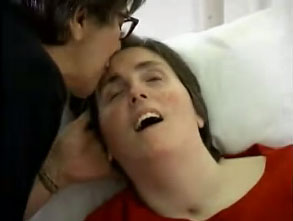

With cable television’s coverage of midnight congressional voting and the reports of President Bush’s cutting short his Easter holiday to fly back to the White House, the saga over Terri Schiavo’s feeding tube has consumed the media landscape. Since last Friday, cable news channels have covered little else other than this right-to-die case, while reporters and pundits have mostly ignored a crucial element of the story — public opinion.
Recent polling data, in outlets from Fox News to the Washington Post, shows that an overwhelming majority of Americans back the position of Michael Schiavo, Terri’s husband, that he, and not his wife’s parents, should have the final say about removing the feeding tube of his wife, who has been severely brain-damaged and incapacitated for the past 15 years. The polling data seriously undercuts the notion that Americans are deeply divided on the Schiavo case. Yet ever since March 18, when Republicans began their unprecedented push to intervene legislatively in a state court case that had already been heard by 19 judges, the press has all but disregarded the polls.
The Schiavo episode highlights not only how far to the right the GOP-controlled Congress has lunged — a 2003 Fox News poll found just 2 percent of Americans think the government should decide this type of right-to-die issue — but also how paralyzed the mainstream press has become in pointing out the obvious: that the GOP leadership often operates well outside the mainstream of America. The press’s timidity is important because publicizing the poll results might extend the debate from one that focuses exclusively on a complicated moral and ethical dilemma to one that also examines just how far a radical and powerful group of religious conservatives are willing to go to push their political beliefs on the public.
Imagine how differently the televised debate would have unfolded over the past few days if journalists had simply done their job and asked Terri Schiavo’s pro-life proponents why an overwhelming percentage of Americans disagree with them about this case. Indeed, polls taken over the past two years show that Americans are adamant that the spouse, and not the parents, should decide on a loved one’s right to die. And in the past week, an overwhelming majority — 87 percent — of Americans polled by ABC News and the Washington Post said that if they were in the same state as Terri Schiavo, they too would want their feeding tube removed.
Just as every judge who has heard the Schiavo case so far has ruled in Michael’s favor, so has every poll taken shown that the majority of the public supports the husband’s position. In survey after survey dating from 2003 to the present, asked who should have the final right-to-die decision, the majority of Americans have answered: the spouse. From national polls (e.g., ABC News/Washington Post, 65-25; and Fox News, 50-31) to statewide polls (e.g., KING-TV in Washington, 67-19; and St. Petersburg Times in Florida, 75-13) to unscientific, interactive polls (e.g., CNN, 65-26; and MSNBC, 63-37), the response has always been the same. A 2003 poll by CNN/USA Today had a similar result: Eighty percent agreed that a spouse should be allowed to decide whether to end the life of a person in a persistent vegetative state.
Which is why it has been so startling to find so few mentions by major news outlets of the recent polls regarding the Schiavo controversy. For instance, last Friday at 11 a.m., a Fox News reporter referenced a poll from earlier this month conducted by Fox that found that a strong majority — 59 to 24 percent — would remove Terri Schiavo’s feeding tube if they were her guardian. According to TVeyes, a digital, around-the-clock television monitoring service, that was the last time a Fox News reporter mentioned Fox’s own poll. Then again, that’s typical of Fox, which on Friday night’s “Hannity and Colmes” invited six strident pro-life advocates to argue why Congress should intervene on Schiavo’s behalf. No guests were booked to appear on the show and argue Michael Schiavo’s side.
But perhaps even more peculiar are ABC News and the Washington Post, which, like Fox News, commissioned their own poll regarding the matter, and yet, again like Fox, seemed to downplay the findings once the story became a political one. On March 15, when ABC devoted its “Nightline” program to the Schiavo story, host Chris Bury informed the audience, “A new ABC News poll suggests that a clear majority of Americans, 65 percent, believe that husbands and wives should have the final say in family disputes over life support. Only 25 percent say parents should make that decision. And when asked, ‘Would you want to be kept alive in Terri Schiavo’s condition?’ an overwhelming number, 87 percent, said no.”
The next morning, ABC’s “Good Morning America” repeated the poll’s finding. On March 17, however, as conservative Republicans in Congress announced that they would try to intervene on Terri’s behalf by passing legislation, it became clear that the story was morphing from a legal and ethical one into a political one. That night ABC’s “World News Tonight” covered the story, but suddenly any references to the network’s own poll had disappeared. The next night the same program opened with three straight reports about the day’s developments in the Schiavo story, this time including a brief on-screen graphic highlighting the 87 percent poll result.
Meanwhile, as of Sunday the Washington Post had not yet published the results of a poll it paid for in any of the nearly dozen stories it ran regarding Schiavo over the previous seven days. For Post readers, the data simply did not exist.
And the Post was not alone. During the same time span the Los Angeles Times ran 10 stories on Schiavo. None mentioned any poll results indicating how one-sided the nationwide debate has been, with so many Americans opposed to the position Congress is taking. The same is true of the Chicago Tribune (11 Schiavo stories, but no mention of polls) and the New York Times (10 stories, also with no specific mention of poll results). The Baltimore Sun, however, deserves credit for its story March 20 that referred, right in the fifth paragraph, to the ABC News/Washington Post survey. Two days earlier the St. Petersburg Times included an extensive breakdown of polling data on the Schiavo story. Those papers were virtually alone among major dailies in elevating the issue, according to a search of the Nexis electronic database.
On March 20 the New York Times published an article on the issue that contained a baffling reference to polls: The paper noted that Democrats had “pointed to public opinion polls that show support for Mr. Schiavo’s right to decide his wife’s fate.” That was peculiar for two reasons: One, the Times never bothered to inform readers about what the poll results were. (If they had, readers might have realized that “support for Mr. Schiavo” was putting it mildly.) And two, why couldn’t the Times have pointed to the polls — and their results — itself, instead of relying on “Democrats” to do so?
“Baffling” is also the only word to describe the Atlanta Journal-Constitution article this past Sunday that reported Americans are “split about 60 percent to 40 percent in favor of letting Schiavo die” (emphasis added). The paper then referred to a Fox News poll from “last year” that was “typical,” in which 61 percent of registered voters said they would remove the tube and let her die; [and] 22 percent would leave it in place.” If that poll was typical, why did the paper contradict itself by reporting that Americans are actually split 60-40 on the issue?
Television coverage was even more barren. NBC’s “Meet the Press” on Sunday featured its weekly roundtable of journalists, who discussed the Schiavo issue. Yet neither host Tim Russert nor guests Ron Brownstein (Los Angeles Times), David Broder (Washington Post), John Harwood (Wall Street Journal) or Gwen Ifill (PBS) ever mentioned any polls on the Schiavo case. That show was the model, across the dial, for television coverage over the weekend: Avoid the polls and — indirectly — any suggestion that Congress was acting in an radical manner.
Late on Sunday night, CNN’s Bill Schneider did at least address the topic of polls, highlighting the Fox News survey that found that Americans by a margin of more than 2-to-1 (59-24) would remove Schiavo’s feeding tube. (Schneider ignored the ABC News/Washington Post poll from five days earlier that found 87 percent would want their feeding tube taken out if they were in Schiavo’s position.) But Schneider then tried to brush off the results, insisting “polls do not tell the whole story” of the Schiavo debate.
Polls may not tell the whole story, but they tell an important part — a part the press has ignored.
This story has been corrected since it was originally published.
