
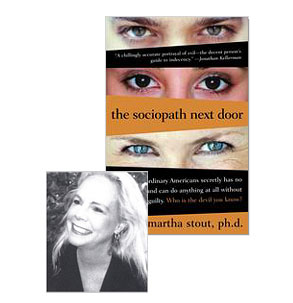

It sounds like a treatment for a creepy psychological thriller: a world in which one in every 25 people walks through life without a drop of human compassion. On the outside, these creatures appear perfectly normal. They get married, buy homes, hold down jobs. But on the inside, they’re morally bankrupt and completely unrestricted by conscience. They can do absolutely anything — lie, steal, sabotage — without feeling a shred of guilt or remorse.
Harvard psychologist Martha Stout, Ph.D., says this is not science fiction. In her controversial new book, “The Sociopath Next Door: The Ruthless Versus the Rest of Us,” Stout claims that 4 percent of the population are sociopaths who have no capacity to love or empathize. Using composites pooled from her research to illustrate her points, Stout details the havoc sociopaths wreak on unsuspecting individuals — marrying for money, backstabbing co-workers, or simply messing with people for the fun of it. The fact that most of us never suspect our friends and neighbors of sociopathy only makes the transgressions easier to pull off.
Stout, who is also the author of “The Myth of Sanity,” an analysis of forgotten childhood trauma and dissociated mental states, spoke to Salon from her home in Rockport, Mass., about serial killers, bad boyfriends and how to know if your boss is a sociopath or just a jerk.
This idea of ordinary people with no conscience is pretty radical and kind of terrifying. Why are so few of us aware of it?
Because we aren’t looking for it. We don’t imagine that there are human beings that exist without a conscience. And when we encounter it, we reinterpret it in all kinds of ways. Because who is going to believe you when you say that your psychotherapist lied to you in order to make you end up in restraints? Or that your colleague stole your briefcase to make you look bad? Or that a high-ranking political figure broke his secretary’s arm? It’s the sort of thing that makes people feel crazy, rather than making them feel like the other person is crazy.
How did you first become aware of these people?
I’ve been a therapist for trauma survivors for 25 years. I would listen to story after story, and I began to wonder about these people who were hurting my patients. They sounded so different from the rest of humanity. We have this feeling that if one person is capable of doing something, then under certain circumstances we would all be capable of doing the same thing. I no longer think that’s true. I think that 4 percent of us can do anything at all without guilt or remorse. And I do mean anything.
How did you arrive at the 4 percent figure? Most of what I’ve read about conscienceless people puts the rate at about 1 percent.
It is confusing. It’s confusing even if you know about psychological studies and how to compare them. Most of the data that we have still has to do with incarcerated felons — usually men who have been violent. There is very little data on non-incarcerated nonviolent sociopaths, and even less data on women than men. But we are increasingly finding that sociopathy is as common among women as it is among men.
I looked at it all, and given the increasing data about women, I came to the conclusion that it was approximately 4 percent.
But if there isn’t much data, how can you feel confident about your conclusion?
The 4 percent figure involves my equalizing a certain assumption that there are probably as many female sociopaths as male sociopaths. In the beginning, people thought that it was just men. Now we’re getting to the point where most researchers will say that perhaps there are as many women as men. Their behavior is just more difficult to pinpoint. You’re not going to get everyone to agree on that, but it seems to be coming to that.
So you consider this figure an estimate?
Definitely. And I consider it a conservative estimate. And let’s say it’s half that — that’s still one in 50 people. I feel very confident about it, and many of my colleagues have told me off the record that they also think it’s a conservative estimate.
Why off the record?
Because they’re not referring to any particular research. They’re just making observations based on their own practice.
Why is women’s sociopathy more difficult to pinpoint?
In general, women are less physical and more verbal in the way they express things. For a sociopath who is a woman, one would expect more social manipulation. Of course, women can be violent, but it’s less likely.
And that’s why we don’t see them as criminals? Because beating someone is a crime, but harming them emotionally is not?
Exactly. Getting someone fired or tormenting your children is usually pretty private and not always actionable.
What makes you decide that a person is or isn’t a sociopath?
Conceptually, for the purposes of the book, I’m talking about people who have exhibited symptoms such as extreme chronic deceitfulness, lack of remorse, lack of personal responsibility, and a general desire to control people and make them jump.
Clinically speaking, if someone is suspected of sociopathy, then the therapist would consider the DSM [The Diagnostic and Statistical Manual of Mental Disorders IV’s assessment for antisocial personality disorder] and apply the Hare inventory [the Psychopathy Checklist developed by Dr. Robert Hare]. Then we would talk to other people in the person’s family and in that person’s past and try to pin down the diagnosis.
You mention the Psychopathy Checklist. What’s the difference between a psychopath and a sociopath?
There is no completely agreed-upon difference between those two terms, but there are people who in their own studies will make a distinction. I tend to use them synonymously, and for the book I settled on “sociopathy.” People confuse “psychopathy” with “psychotic” — someone who is crazy and has hallucinations. That’s not what we’re talking about, so I think “sociopath” is clearer.
What does it mean to lack a conscience?
It’s a completely alien mindset. Most of us can imagine what it’s like to have depression or even be crazy. But not having a conscience? You can’t love anyone, even your own children? I believe that conscience, or lack of it, is a much more fundamental distinction than our moods or sense of rationality. All of us can be a little irrational. But our capacity to be emotionally linked to other people is much more fundamental, so much so that we don’t even think about it. You don’t ask yourself if you’re going to give your child lunch money. You don’t think of that as making a choice.
You said you became aware of this problem because of the things that your patients told you. What kinds of issues were they dealing with?
The people I work with were traumatized in childhood. I’m talking about moms and dads who inflicted terrible tortures on their children, stories that are very hard to hear. Kids that were seriously abused physically and sexually, kids that were abandoned.
Are the majority of sociopaths committing really heinous crimes?
No. Most sociopaths are not violent and probably never will be. They are the people we see every day: The boss who likes to ridicule people. The seduce-and-abandon lover who does this mainly for fun. The person who marries for money or prestige and no apparent other reason. These people aren’t necessarily serial killers, but they cause a lot of harm.
So how do you know if your boss is a sociopath or just a jerk?
If you have a jerk boss who’s lazy and always wants you to do things at the last minute, or asks for unreasonable things like making coffee, that’s not necessarily sociopathy. If you have a boss who likes to ridicule people and make them jump and seems to get a kick out if it, that’s more likely to be sociopathy. It’s motivation.
So how do you spot a sociopath?
This is very unscientific, but small children seem to be better than adults at being afraid of people who are not warm, people who have damaged interpersonal emotion abilities. There is an instinct in all of us to know when someone is not relating to us with a real attachment.
More scientifically, the best I can offer is the rule of three. If someone lies to you once or twice, it could be a misunderstanding. If someone lies to you three times, then chances are you’re dealing with a liar. And deceit is the central behavior of sociopathy.
You say in your book that sociopaths can be very charming. We’ve all had the experience of being around someone who is very flattering and uses that salesman’s trick of saying your name a lot. Is that what we’re talking about?
It can be that. But it can also be a quiet kind of charm — the all-American boy or girl. The shy person who needs to be rescued. People also talk about sociopathic eyes. There is a primal predatory charm that no one has been able to explain. What you hear over and over is that these charming eyes suddenly turned into empty, reptilian eyes.
Are you worried about people getting paranoid from reading the book?
I was concerned that people would begin to see sociopaths all around them, but I have not found that. What I have found, and what breaks my heart, is that I’m hearing from good people who are afraid that they are sociopaths. They are feeling disconnected from people for a variety of reasons and are questioning their own dark sides. But if you’re questioning your attachments to others and questioning your dark side, you don’t have very much of one. That is not a concern that a sociopath would have.
Do you ever see sociopaths in therapy?
Not unless the court refers them. They feel just fine about themselves.
Do they think we feel love and empathy? Or do they think we’re all just faking it?
They see that we have love and empathy. But I’ve heard them say that conscience is a sham, that it doesn’t exist. They’ll say, “That schmuck didn’t go for what he wanted because it was against his conscience. Who does he think he’s kidding?”
In your book you use composites of sociopaths and their victims. Why did you decide to tell their stories this way?
I did that way in “The Myth of Sanity” also. It’s part of my instinct as a therapist to preserve everybody’s confidentiality, even the guilty. I also have to have legal concerns about making statements about people.
You have one example of a women caught practicing psychology without a license or even a degree, and she did some pretty devastating harm to her patients. She told them that other therapists were lying to them and even sent one man to a locked ward after his therapist had recommended his discharge. How did she react when she was caught?
There was a complete lack of guilt or even embarrassment. After being seriously questioned about it, she walked out of the room as if she had been talking about the weather. She was one of the spookiest people I’ve ever met.
Do sociopaths seek out positions with a lot of authority, so they won’t be questioned?
I think there are certain professions that we understand as being humanitarian and good, and you won’t be questioned as much. And there are certain professions where you can make people jump, or the way you make them feel bad about themselves is more private. Certainly psychotherapy would be one of those. On the other side, there are the power professions where the goal is to win — politics, banking, etc. Those professions tend to be good places for sociopaths to hide and prosper, unfortunately.
Prosper because of the focus is on winning to the exclusion of other things?
Yes. It tends to excuse behavior that we might otherwise condemn. A little bit of lying might be considered clever rather than amoral. I think this particularly true in business and politics, especially in the West.
Is there the same level of sociopathy in other cultures?
No. In East Asian countries, China and Japan in particular, there is substantially less sociopathic behavior observed. It seems to me that the only explanation for that would deal with overall cultural attitudes. In the East, individual winning is not considered the appropriate goal. The culture is more group-oriented. A sociopath born in such a culture might learn to behave appropriately the way one might learn table manners. They might not have a conscience, but because sociopaths need to fit in, the behavior might be tamped down a bit.
Is a conscience something you’re born with?
About 50 percent of the variant seems to be accounted for by heredity. The other 50 percent would be shaped by something in the environment. The interesting thing is that we haven’t been able to determine what that is. Everyone’s first guess is child abuse, but it turns out that as group they haven’t been abused any more than any other group.
Can it actually be an advantage to be a sociopath?
For a while it can be an advantage. But most sociopaths end not with a bang but a whimper. There’s not much on this planet for us except our relations with other living forms. So for sociopaths, it’s a fairly barren landscape. In the end it can’t work out, but for a while it looks like it does.
