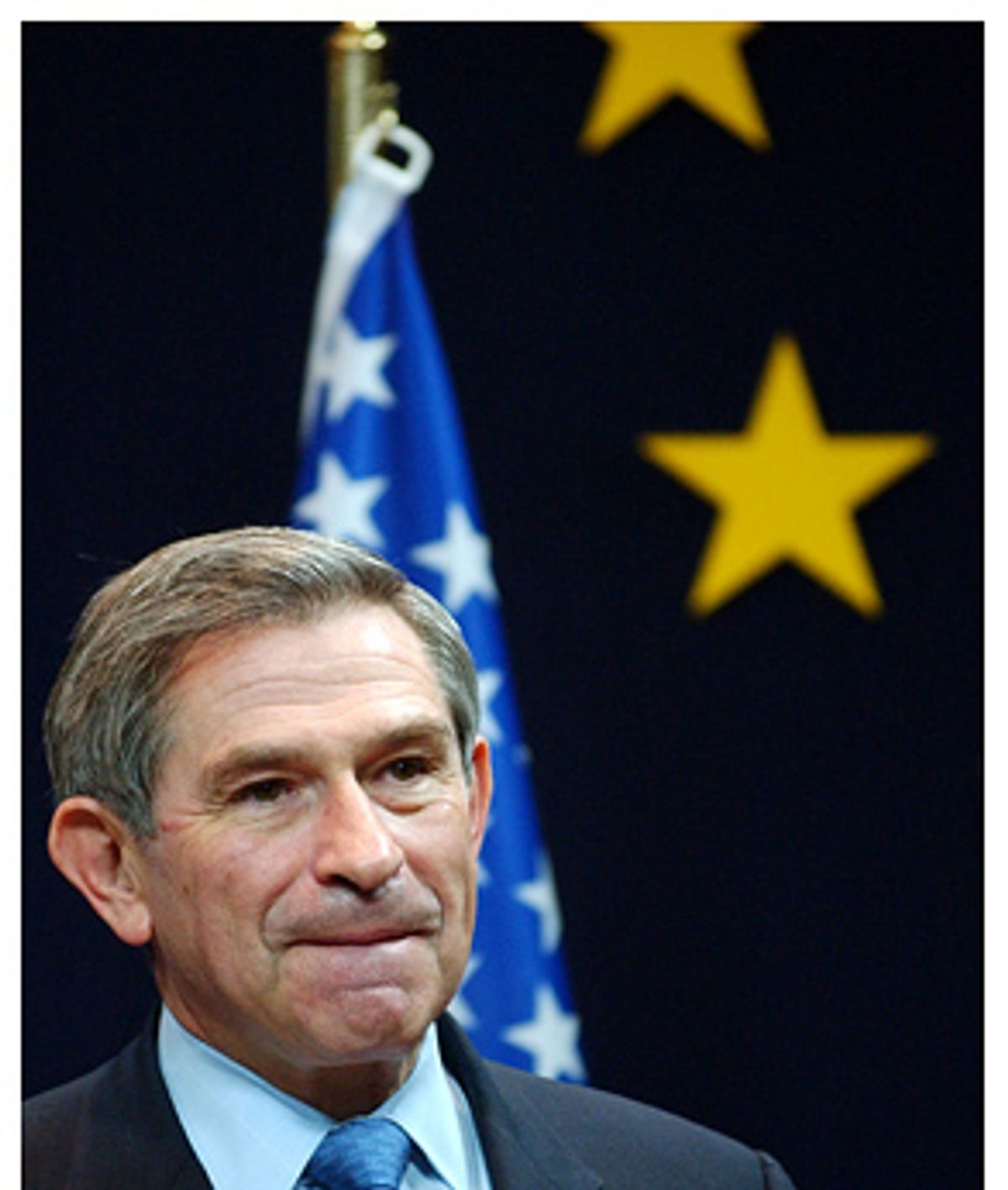
Pentagon

Wolfowitz’s new agenda

Experts say the war hawk's fealty to the oil industry could derail the World Bank's mission to reduce poverty.

  • more
    • All Share Services

Wolfowitz's new agenda

On the same day that Goldman Sachs predicted world oil shortages could spike the price of oil to $105 a barrel, Paul Wolfowitz was confirmed as the World Bank’s next president. The confirmation of Wolfowitz on March 31 turned around what might otherwise have been a bad-news day for the White House. Now, a leading architect of U.S. foreign policy would be in a position to pressure the world’s largest public financial institution to help pay for the exploration, drilling and transport of America’s most coveted natural resource.

Of course, it’s too early to know for sure what Wolfowitz will do. But experts who’ve followed the bank’s troubled history in financing the oil, gas and mining industries around the world have real concerns about how the soon to be ex-deputy secretary of defense will balance his long-touted commitments to a “new American century” with the very different ones he’ll assume on June 1 at the World Bank. Although Wolfowitz has assured his critics that he believes deeply in the bank’s aim of reducing poverty, calling it “a noble mission and a matter of enlightened self-interest,” U.S. foreign policy, forged under Wolfowitz’s strong hand, has been dedicated to American hegemony, energy security and the opening of foreign markets to U.S. business — goals that are often in conflict with the bank’s mission.

Whether the bank’s next leader can reconcile his old beliefs with his new position is a burning question among longtime critics of the World Bank’s financial support for companies like Halliburton, ChevronTexaco and ExxonMobil (among the bank’s biggest private beneficiaries), supposedly in the interest of alleviating poverty. Decades’ worth of studies, often performed by the bank’s own experts, have shown that oil, gas and other so-called extractive-industry projects have done little to promote growth in poor countries. On the contrary, countries that depend economically on oil exports tend to have slow growth, deep-seated corruption, repressive governments and frequent conflict. The phenomenon is so widely known it has a name — the resource curse. And it has led experts across the political spectrum to claim that the bank has been derelict in its duty to the world’s poor, employing policies that make poor countries even more dependent on selling their finite natural resources to the highest foreign bidder.

In response to mounting pressure, the bank commissioned an independent study in July 2001, which after two years of exhaustive research worldwide concluded that the bank should impose stringent standards and stronger safeguards on oil and gas projects and, by 2008, stop supporting oil production altogether. Ultimately, the bank’s top brass would not agree to stop financing oil industry projects, but they did promise future reforms aimed at curbing corruption and ensuring that oil profits reach countries’ poor.

It will now be up to Wolfowitz to carry out those reforms. But some are skeptical that he’ll be able to shed his Pentagon perspective enough to genuinely pursue the bank’s antipoverty mission. Indeed, some believe he was placed in his new post precisely to pursue U.S. policy objectives. Wolfowitz’s appointment “strongly suggests that President Bush has something specific in mind for the bank — to be an instrument of U.S. power,” says William Easterly, a former World Bank economist who now teaches at New York University.

Easterly is not alone in that view, and over the years, Wolfowitz himself has made it clear how he believes U.S. power should be exercised. “In the Middle East and Southwest Asia,” Wolfowitz wrote in a draft Defense Planning Guidance document in February 1992, leaked to the New York Times, “our overall objective is to remain the predominant outside power in the region and preserve U.S. and Western access to the region’s oil.”

Those sorts of statements are now causing serious concern. “I worry that Wolfowitz will be more concerned about increasing global fuel production, and less concerned about whether or not such projects actually contribute to economic development and poverty alleviation in oil-producing countries,” says Michael Ross, a UCLA politics professor who advised the World Bank’s extractive-industries review chairman.

Manish Bapna, director of the Bank Information Center, a watchdog group, warns that Wolfowitz’s past concern with U.S. oil security is in direct conflict with his more recent statements about promoting democracy. “The focus on strengthening democracy would seem to support requiring strong governance standards before providing financial support to countries to develop their oil resources. But much of the oil development in the world today is in countries which are not democratic and whose governments are not accountable to international norms. How will those objectives be reconciled?”

Not everybody lacks faith in Wolfowitz’s ability to shift focus. David Victor, a senior fellow at the Council on Foreign Relations and director of the Program on Energy and Sustainable Development at Stanford University, a project funded substantially by BP and the Electric Power Research Institute (created and supported by the major utility companies), says the appointment of Wolfowitz “offers the opportunity for the administration to extend to the bank a philosophy of development that focuses on underlying fundamentals — good fiscal management, rule of law, openness to trade — that have been shown to drive whether countries actually make good use of development dollars. I would be pretty confident this will be a big part of the philosophy at the bank: setting the conditions for sustainable development rather than just putting money into projects.”

Perhaps, but many industry experts note that supporting large oil and gas projects almost always comes into conflict with fighting corruption and promoting sustainable development. As UCLA’s Ross and others have shown, oil production often distorts the economy, exacerbates corruption and inhibits the development of true democracy. And the bank can easily become part of the problem, because large multinational corporations that borrow from the bank to invest in developing countries usually contract with national governments, which are typically in charge of the countries’ oil and gas industries. As a result, huge amounts of money often are funneled to corrupt, antidemocratic or repressive governments. With little incentive to insist on transparency or democratic reform, a corporation financed by the bank essentially ends up propping up a corrupt government and becoming a critical part of the corruption.

Allan Meltzer, professor of political economy at Carnegie Mellon University and a visiting scholar at the American Enterprise Institute, doesn’t think the problem of corruption is the fault of the oil industry per se but the result of years’ worth of financial support provided to corrupt governments. “The obvious thing is to say we’re not going to give money to countries that are corrupt,” he says. And he predicts that Wolfowitz — coming from the same administration that created the Millennium Challenge Account, a foreign-aid program designed to target aid toward well-functioning governments — may well try to institute such a reform.

Wolfowitz has certainly promised to crack down on corruption at the World Bank. And he touts his experience in Indonesia as an example of his interest in third-world development. But to many, his past actions don’t inspire confidence. After leaving his ambassador’s post, Wolfowitz used his Indonesian contacts to help found the U.S.-Indonesia Society, a private organization funded by oil and mining companies to press U.S. business interests in Indonesia, even though those companies knowingly financed the notoriously corrupt and abusive military-backed regime of President Suharto. The society’s most active members included New Orleans-based mining giant Freeport-McMoRan, one of the largest American investors in Indonesia, which generated billions of dollars for the Suharto government while so brutalizing the environment and endangering local residents that it lost its U.S.-backed political risk insurance in 1995.

And Wolfowitz was strangely silent on the Suharto government’s cronyism, even reporting to Congress in 1997 that Suharto provided “strong and remarkable leadership,” notwithstanding vast human rights abuses in East Timor. “He didn’t seem to look at who was really benefiting most from gross corruption in Indonesia,” says Ian Gary, an advisor on extractive industries for Catholic Relief Services. “For me, the question is whether Wolfowitz will make the intellectual connection between the role that natural resources and particularly oil have played in fueling corruption — by concentrating power in the hands of the elite few — and what he says is his interest in good government.”

Until now, Wolfowitz has expressed great faith in the capacity of oil to bail out developing nations. In fact, he said it would be the key to postwar development in Iraq. Iraq’s oil revenues “could bring between $50 [billion] and $100 billion over the course of the next two or three years,” Wolfowitz told the House Budget Committee in February 2003. “We are dealing with a country that can really finance its own reconstruction and relatively soon.”

But experts were already warning that the Pentagon’s faith in oil was folly. “His miscalculation on Iraq was appalling,” says Youssef Ibrahim, managing director of the Dubai-based Strategic Energy Investment Group and former energy editor for the Wall Street Journal. “Before the invasion, Iraq exported to the outside world 3.5 million barrels of oil a day. Today, on a lucky day, Iraq exports maybe 1.4 million barrels. Not only did he completely miscalculate what Iraqi production would be after the war, but in fact the world has lost nearly 2 million barrels a day of Iraqi oil.”

What’s more, even if oil does provide vast revenues to a government, many believe a public multilateral institution dedicated to fighting poverty ought not be financing the projects of private oil companies, which would be likely to invest in oil-rich developing countries anyway. “Oil is not an industry that is in need of any capital,” says Ibrahim, a consultant to major oil companies. “I’m concerned that he would divert funds from worthwhile projects to things like looking for oil, which are pretty much within the hands of major multinational oil companies (which have very deep pockets). This would be squandering the World Bank’s funds, and a misallocation of public resources.”

Wolfowitz’s long-standing support for privatization raises more concerns. He was one of the leading proponents of early privatization of state-owned enterprises in Iraq, including the oil industry, which likely would have been a violation of international law. Some watching the World Bank worry that as head of the world’s largest public lending institution, he’ll press governments to privatize their industries to make them available for U.S. investment, regardless of whether that’s in their best interests. They also worry that he’ll emphasize foreign corporate investment over government-run antipoverty programs, channeling more money toward the arm of the bank that lends to corporations and less toward poor countries’ governments. “Many of us fear that Wolfowitz will yank the World Bank away from a growing emphasis on programs that reach the poor and cast it back onto these giant infrastructure projects which primarily help big companies,” says John Cavanagh, president of the Institute for Policy Studies in Washington, which has tracked a recent significant shift by the bank away from financing governments and toward financing corporations in the oil and gas sector. (Altogether, the World Bank has put up more than $11 billion for oil, gas and coal projects since 1992.)

It was the last World Bank president to come from the Pentagon — Robert McNamara — who originally concentrated bank lending on huge infrastructure projects such as highways, ports and dams. Many of these projects, which some critics believe were chosen for supporting U.S. foreign policy interests rather than because of their suitability as development projects, in retrospect are viewed as environmental, social and economic disasters.

Wolfowitz will face another controversial policy debate at the bank — whether it should provide grants rather than loans to the poorest countries, a reform the Bush administration has pushed. While grants have the virtue of not encumbering poor governments with more debt, they make the bank more dependent on its member countries for replenishment of the unpaid money, and some of those countries face serious political obstacles to providing additional funds. The result, some fear, could be an overall shrinking of the bank’s investments in poor governments and an increasing dependence on multinational corporations, rather than democratic governments, to drive third-world development.

Now, some of the standards those companies must follow are at risk of being jettisoned. The International Finance Corporation, part of the World Bank, is currently reevaluating the environmental and social safeguards it requires of all World Bank-sponsored projects. These minimum standards ensure that companies borrowing from the bank employ modern environmental protections and consult with communities adversely affected — forced to move, for example — by bank projects. The bank’s requirements have been adopted by many major commercial banks and now set the standard for about 80 percent of the major infrastructure projects financed worldwide. Early drafts of the IFC’s proposed changes suggest the bank may water down those standards significantly.

“I worry that Wolfowitz will take advantage of lax safeguards at the IFC being created to promote a business agenda, as he did in Indonesia and has been done in Iraq, in a way that someone less oriented toward big business might not,” says Steve Kretzmann, founder of Oil Change, a new nonprofit focusing on petro-politics. As oil prices rise, shortages loom and the United States faces growing competition for oil supplies from emerging superpowers like China, the pressure to put American business interests first will only grow.

In the end, how Wolfowitz conducts his World Bank presidency will come down to whether he carries the resource curse into his new job. Can he shift his focus from the United States’ unilateral foreign policy objectives to the very different antipoverty mission of the most economically powerful multilateral institution in the world?

“Wolfowitz has instincts that are a sort of coercive utopian idealism, where American power, and now maybe World Bank financial muscle, are used to force the American version of utopian ideals like democracy and free-market opportunity on the rest of the world,” says Easterly, the former World Bank economist. “I actually believe in those ideals myself, but I don’t think they can be forced on anybody from the outside, and I don’t think that their current American incarnation represents some perfect model that everybody else should follow.”

Since all indications are that Wolfowitz wants the rest of the world to follow where America leads, his biggest challenge may be adapting his unqualified American utopianism to the murky realities of the developing world.

Continue Reading Close

Daphne Eviatar, a 2005 Alicia Patterson fellow, has written about international development for the New York Times Magazine, Newsweek, the Nation and others. She received research support for this story from the Nation Institute.

Welcome to Terminator Planet

Real-life drone warfare isn't quite living up to James Cameron's movie -- but it's closer than we'd ever dreamed

  • more
    • All Share Services

Welcome to Terminator Planet
This piece originally appeared on TomDispatch. It is an excerpt from Dispatch Books' first e-book, "Terminator Planet: The First History of Drone Warfare, 2001-2050".

U.S. military documents tell the story vividly. In the Gulf of Guinea, off the coast of West Africa, an unmanned mini-submarine deployed from the USS Freedom detects an “anomaly”: another small remotely operated sub with welding capabilities tampering with a major undersea oil pipeline. The American submarine’s “smart software” classifies the action as a possible threat and transmits the information to an unmanned drone flying overhead. The robot plane begins collecting intelligence data and is soon circling over a nearby vessel, a possible mother ship, suspected of being involved with the “remote welder.”

At a hush-hush “joint maritime operations center” onshore, analysts pour over digital images captured by the unmanned sub and, according to a Pentagon report, recognize the welding robot “as one recently stolen and acquired by rebel antigovernment forces.”  An elite quick-reaction force is assembled at a nearby airfield and dispatched to the scene, while a second unmanned drone is deployed to provide persistent surveillance of the area of operations.

And with that, the drone war is on.

At the joint maritime operations center, signals intelligence analysts detect the mother ship launching a Russian Tipchak — a medium-altitude, long-endurance, unmanned aircraft with “U.S.-derived systems and avionics” and outfitted with air-to-air as well as air-to-surface missiles. It’s decision time for U.S. commanders. Special Operations Forces are already en route and, with an armed enemy drone in the skies ahead of them, possibly in peril.

But the Americans have an ace up their sleeve: an advanced Air Force MQ-1000. Unlike the MQ-1 Predator and the MQ-9 Reaper, the MQ-1000 is capable of completely autonomous action, right down to targeting and combat.

Pre-programmed with the requirements and constraints of the mission, the advanced drone takes off, and American commanders let it do its thing. “The MQ-1000 … immediately conducts an air-to-air engagement and neutralizes the Tipchak,” reads the understated official account of the action. The special ops team then raids the mothership and disrupts the oil pipeline interdiction scheme.

The entire episode involves a seamless integration of robots and troops working in tandem, of next-generation drones “wired” together and operating in teams, and of autonomous drones making their own decisions. But there’s a reason you’ve never read about this mission in the New York Times or the Washington Post.  It won’t take place for 20 years.

Or will it?

The “African Maritime Coalition Vignette, 2030s” is a scenario offered up in “Unmanned Systems Integrated Roadmap, FY 2011-2036,” a recently released 100-page Defense Department document outlining American robotic air, sea, and land war-fighting plans for the decades ahead. It’s the sunny side of a future once depicted in the “Terminator” films in which flying hunter-killer or “HK” units are sent out to exterminate the human race.

Terminators of Today?

In some ways, of course, the future is now. When the first “Terminator” movie was released in 1984, its HKs seemed as futuristic as its time-traveling cyborg title-character. Nearly three decades later, we’re living in an age in which armed robots do regularly surveil, track and kill people. But instead of a self-aware computer network known as Skynet, it’s the American president or his intelligence officials and military officers who determine the human targets to be terminated by unmanned hunter-killer craft.

Washington’s post-9/11 military interventions have been a boon for drones. The numbers tell the story. At the turn of this century, the Department of Defense had 90 drones, with plans to increase the inventory by 200 over the next decade, according to Dyke Weatherington, a Defense Department deputy director overseeing acquisitions of hardware for unmanned warfare. As 2012 began, there were more than 9,500 remotely piloted aircraft in the U.S. arsenal.

Today, the Army, Navy, Air Force, Marines, and Special Operations Command all field drones with names that sound as if they were ripped from a Hollywood script or a comic book: Sentinel, Avenger, Wasp, Raven, Puma, Shadow, Scan Eagle, Global Hawk, Hunter, Gray Eagle, Predator, and Reaper. The latter three, “Unmanned Systems Integrated Roadmap” notes, “are weaponized to conduct offensive operations, irregular warfare, and high-value target/high-value individual prosecution, and this trend will likely continue.”

The Air Force’s MQ-1 Predator has been the workhorse of America’s hunter-killer drone fleet. By the end of 2001, Predators had cumulatively flown 25,000 hours. By this March, according to statistics provided by the Air Force, they had logged 1,127,400 flight hours, 1,041,740 of them in combat.

The military quit buying Predators in 2010, opting instead for the larger, more heavily armed Reaper.  These have flown more than 261,000 hours, including 228,000 in combat. The Air Force has already requested the purchase of 24 new Reapers in 2013 and Air Force spokesperson Jennifer Spires tells TomDispatch it plans to buy a grand total of 401 MQ-9s in the coming years.

In other ways, however, a sci-fi-style future is far off indeed.  In fact, after a decade of Defense Department cheerleading, as well as endless TV and newspaper puff pieces on the unlimited potential of drone technology, a grimmer and dimmer future for them is coming into view.

As a start, most of the drones in the Pentagon’s inventory aren’t sophisticated hunter-killer robots, but smaller, unarmed tactical models used only for battlefield surveillance. According to figures provided to TomDispatch by the Army, that service has approximately 5,000 drones, about 1,400 of them currently supporting operations in Afghanistan (where one of their key models, the Shadow, collided with a cargo plane last year). While it has plans to arm increasing numbers of its larger models with munitions, they’re hardly the stuff of Hollywood sci-fi flicks.

Even the Predator and the Reaper are little more than expensiveerror-prone, overgrown model airplanes remotely “flown” by all-too-human pilots. They tend to crash at an alarming rate due to weather, mechanical failures, and computer glitches, leaving shattered silver-screen techno-dreams of cheap, error-free, futuristic warfare in the dust.

Today’s armed drones are actually the weak sisters of the weapons world. Even the Reaper is slow, clumsy, unarmored, generally unable to perceive threats around it, and — writes defense expert Winslow Wheeler – “fundamentally incapable of defending itself.” While Reapers have been outfitted with missiles for theoretical air-to-air combat capabilities, those armaments would be functionally useless in a real-world dogfight.

Similarly, in a 2011 report, the Air Force Scientific Advisory Board admitted that modern air defense systems “would quickly decimate the current Predator/Reaper fleet and be a serious threat against the high-flying Global Hawk.” Unlike that MQ-1000 of 2030, today’s top drone would be a sitting duck if any reasonably armed enemy wanted to take it on. In this sense, as in many others, it compares unfavorably to current manned combat aircraft.

The Navy’s even newer MQ-8B Fire Scout, a much-hyped drone helicopter that has been tested as a weapons platform, has also gone bust. Not only was one shot down in Libya last year, but repeated crashes have caused the Navy to ground the robo-copter “for the indefinite future.”

Even the highly classified RQ-170 Sentinel couldn’t stay airborne over Iran during a secret mission that suddenly became very public last year. Whether or not an Iranian attack brought down the drone, the Air Force Scientific Advisory Board report makes it clear that there are numerous methods by which remotely piloted aircraft can potentially be thwarted or downed, from the use of lasers and dazzlers to blind or damage sensors to simple jammers to disrupt global positioning systems, not to mention a wide range of cyber-attacks, the jamming of commercial satellite communications, and the spoofing or hijacking of drone data links.

Smaller tactical unmanned aircraft may be even more susceptible to low-tech attacks, not to mention constrained in their abilities and cumbersome to use.  Sergeant Christopher Harris, an Army drone pilot and infantryman, described the limitations of the larger of the two hand-launched drones he’s operated in Afghanistan this way: the 13-pound Puma was best used from an observation post with some elevation; it only had a 12-mile range and, though theoretically possible to take on patrol, was “a beast to carry around” once the weight of extra batteries and equipment was factored in.

Terminators of Tomorrow?

As for the future, the Air Force’s 2011–2036 Roadmap has already hit a major detour.  In 2010, Air Force magazine breathlessly announced, “Early in the next decade, the Air Force will deploy a new, stealthy RPA — currently called the MQ-X — capable of surviving in heavily defended airspace and performing a wide variety of ISR [intelligence, surveillance, reconnaissance] and strike missions.”

Indeed, the 2011 Roadmap lists the MQ-X as the future of Air Force drones. In February 2012 however, Lieutenant General Larry James told an Aviation Week-sponsored conference: “At this point … we don’t plan, in the near term, to invest in any sort of MQ-X like program.”  Instead, James said, the Air Force will be content simply to upgrade the Reaper fleet and watch the Navy’s development of its Unmanned Carrier-Launched Airborne Surveillance and Strike or UCLASS drone to see if it soars or, like so many RPAs, crashes and burns.

The Holy Grail of drone ops is the ability of an aircraft to linger over suspected target areas for long durations. But ultra-long-term loitering operations still remain in the realm of fantasy. Admittedly, the Pentagon’s blue skies research arm, the Defense Advanced Research Projects Agency, is pursuing an ambitious drone project to provide intelligence, surveillance, reconnaissance, and “communication missions over an area of interest” for five or more years at a time. The project, dubbed “Vulture,” is meant to provide satellite-like capabilities “in an aircraft package.”

Right now, it sounds downright unlikely.

While the Air Force has had a hush-hush unmanned space plane orbiting the Earth for more than a year, much like a standard satellite, the longest a U.S. military drone has reportedly stayed aloft within the planet’s atmosphere is a little more than 336 hours. Plans for ultra-long-duration flights took a major hit last year, according to scientists at Sandia National Laboratories and defense giant Northrop Grumman.

In an effort to “to increase UAV [unmanned aerial vehicle] sortie duration from days to months while increasing available electrical power at least two-fold,” according to a 2011 report made public by the Federation of American Scientists’ Secrecy News, the Sandia and Northrop Grumman researchers identified a technology that “would have provided system performance unparalleled by other existing technologies.” In a year in which the Fukushima Daiichi nuclear disaster turned a swath of Japan into an irradiated no-go zone, the use of that mystery technology, never named in the report but assumed to be nuclear power, was deemed untenable due to “current political conditions.”

With the Pentagon now lobbying the Federal Aviation Administration to open U.S. airspace to its robotic aircraft and ever more articles emerging about drone crashes, don’t bet on nuclear-powered, long-loitering drones appearing anytime soon, nor on many of the other major promised innovations in Drone World coming online in the near term, either.

From Dystopian Fiction to Dystopian Reality

Until recently, drones looked like a can’t-miss technology primed for big budget increases and revolutionary advances, but all that’s changing fast. “Realistic expectations are for zero growth in the unmanned systems funding,” Weatherington explained by email. “Most increases will be in technical innovations, improving application of delivered systems on the battlefield and driving down the cost of ownership.”

Major Jeffrey Poquette of the Army’s Small Unmanned Air Systems Product Office talked about just such an effort. By the late summer, he said, the Army planned to introduce more sophisticated sensors, including the ability to track targets more easily, in its four-pound Raven surveillance drones. Put less politely, what this means is no roll-outs of sophisticated new drone systems or revolutionary new drone technology: The Army will simply upgrade a glorified model airplane that first took flight more than a decade ago.

Sci-fi it isn’t, but that doesn’t mean that nothing will change in the world of drone warfare.

The “Terminator” films weren’t exactly original in predicting a future of unmanned planes dominating the world’s skies. At the end of World War II, General Henry “Hap” Arnold of the U.S. Army Air Forces praised American pilots for their wartime performance but suggested their days might be numbered.  “The next war may be fought by airplanes with no men in them at all,” he explained. The future of combat aviation, he announced, would be “different from anything the world has ever seen.”

The most salient and accurate of Arnold’s predictions was not, however, his forecast about drone warfare. Pilotless planes had taken flight years before the Wright Brothers launched their manned airplane at Kitty Hawk, North Carolina, in 1903, and drones would not become a signature piece of American weaponry until the 2000s. Instead, Arnold’s faith in a “next war” — a clear departure from the sentiments of so many Americans after World War I — proved accurate again and again. Over the following decades, American aircraft would strike in North Korea, South Korea, Indonesia, Guatemala, Cuba, North Vietnam, South Vietnam, Laos, Cambodia, Grenada, Libya, Panama, Iraq, Kuwait, the former Yugoslavia, Afghanistan, Yemen, Iraq (again), Pakistan, Somalia, Yemen (again), Libya (again), and the Philippines.  New technologies came and went; air strikes were the constant.

In Vietnam, the former Yugoslavia, Afghanistan, Iraq, Pakistan, Yemen, Somalia, Libya, and the Philippines, the U.S. deployed pilotless planes as per Arnold’s other prediction. From Afghanistan onward, all of the countries that have experienced American air power have also experienced lethal drone attacks — just how many is unknown because figures on drone strikes are kept secret “for security reasons,” the Air Force’s Spires recently told TomDispatch. What we do know is that drone attacks have increased radically over the years. “More” has been the name of the game.

Still, barely a decade after our drone wars began, dreams of “Terminator”-esque efficiency and technological perfection are all but dead, even if the drone itself is increasingly embedded in our world.  Fantasies of autonomous drones and submarines fighting robot wars off the coast of Africa are already fading for any near-term future. But drone warfare is here to stay. Count on drones to be an essential part of the American way of war for a long time to come.

Air Force contracting documents suggest that the estimated five Reaper sorties flown each day in 2012 will jump to 66 per day by 2016. What that undoubtedly means is more countries with drones flying over them, more drone bases, more crashes, more mistakes. What we’re unlikely to see is armed drones scoring decisive military victories, offering solutions to complex foreign-policy problems, or even providing an answer to the issue of terrorism, despite the hopes of policymakers and the military brass.

Keep in mind as well that those global skies are going to fill with the hunter-killer drones of other nations in what could soon enough become a drone-eat-drone world. With that still largely in the future, however, the Pentagon continues to glow with enthusiasm over the advantages drones offer the U.S.

Regarding the importance of military robots, for instance, the Pentagon’s Dyke Weatherington explained, “Combatant commanders and warfighters place value in the inherent features of unmanned systems — especially their persistence, versatility, and reduced risk to human life.”

On that last point, of course, Weatherington is only thinking about American military personnel and American lives. Tomorrow’s drone warfare will likely mean “more” in one other area: more dead civilians. We’ve left behind the fiction of Hollywood for a less high-tech but distinctly dystopian reality.  It isn’t quite the movies, and it isn’t what the Pentagon mapped out, but it indisputably provides a clear path to a grim and grimy Terminator Planet.

Continue Reading Close

Nick Turse is the associate editor of TomDispatch.com and the winner of a 2009 Ridenhour Prize for Reportorial Distinction as well as a James Aronson Award for Social Justice Journalism. His work has appeared in the Los Angeles Times, the Nation, In These Times, and regularly at TomDispatch. This story is a joint investigative project of Salon, AlterNet, and Brave New Foundation.

Obama’s secret warriors

Under his watch, the military's least accountable assets have become the pinnacle of military prestige

  • more
    • All Share Services

Obama's secret warriorsU.S. Navy SEALs after a demonstration of combat skills in Fort Pierce, Fla. (Credit: Reuters/Joe Skipper)
This piece originally appeared on TomDispatch.

As he campaigns for reelection, President Obama periodically reminds audiences of his success in terminating the deeply unpopular Iraq War. With fingers crossed for luck, he vows to do the same with the equally unpopular war in Afghanistan. If not exactly a peacemaker, our Nobel Peace Prize-winning president can (with some justification) at least claim credit for being a war-ender.

Yet when it comes to military policy, the Obama administration’s success in shutting down wars conducted in plain sight tells only half the story, and the lesser half at that. More significant has been this president’s enthusiasm for instigating or expanding secret wars, those conducted out of sight and by commandos.

President Franklin Roosevelt may not have invented the airplane, but during World War II he transformed strategic bombing into one of the principal emblems of the reigning American way of war. General Dwight D. Eisenhower had nothing to do with the Manhattan Project that developed the atomic bomb. Yet, as president, Ike’s strategy of Massive Retaliation made nukes the centerpiece of U.S. national security policy.

So, too, with Barack Obama and special operations forces. The U.S. Special Operations Command (USSOCOM) with its constituent operating forces — Green Berets, Army Rangers, Navy SEALs, and the like — predated his presidency by decades. Yet it is only on Obama’s watch that these secret warriors have reached the pinnacle of the U.S. military’s prestige hierarchy.

John F. Kennedy famously gave the Green Berets their distinctive headgear. Obama has endowed the whole special operations “community” with something less decorative but far more important: privileged status that provides special operators with maximum autonomy while insulating them from the vagaries of politics, budgetary or otherwise. Congress may yet require the Pentagon to undertake some (very modest) belt-tightening, but one thing’s for sure: No one is going to tell USSOCOM to go on a diet. What the special ops types want, they will get, with few questions asked — and virtually none of those few posed in public.

Since 9/11, USSOCOM’s budget has quadrupled. The special operations order of battle has expanded accordingly. At present, there are an estimated 66,000 uniformed and civilian personnel on the rolls, a doubling in size since 2001, and with further growth projected. Yet this expansion had already begun under Obama’s predecessor. His essential contribution has been to broaden the special ops mandate. As one observer put it, the Obama White House let Special Operations Command “off the leash.”

As a consequence, USSOCOM assets today go more places and undertake more missions while enjoying greater freedom of action than ever before. After a decade in which Iraq and Afghanistan absorbed the lion’s share of the attention, hitherto neglected swaths of Africa, Asia and Latin America are receiving greater scrutiny. Already operating in dozens of countries around the world – as many as 120 by the end of this year — special operators engage in activities that range from reconnaissance and counterterrorism to humanitarian assistance and “direct action.” The traditional motto of the Army special forces is “De Oppresso Liber” (“To Free the Oppressed”). A more apt slogan for special operations forces as a whole might be “Coming soon to a Third World country near you!”

The displacement of conventional forces by special operations forces as the preferred U.S. military instrument — the “force of choice” according to the head of USSOCOM, Admiral William McRaven — marks the completion of a decades-long cultural repositioning of the American soldier. The G.I., once represented by the likes of cartoonist Bill Mauldin’s iconic Willie and Joe, is no more, his place taken by today’s elite warrior professional. Mauldin’s creations were heroes, but not superheroes. The nameless, lionized SEALs who killed Osama bin Laden are flesh-and-blood Avengers. Willie and Joe were “us.” SEALs are anything but “us.” They occupy a pedestal well above mere mortals. Couch potato America stands in awe of their skill and bravery.

This cultural transformation has important political implications. It represents the ultimate manifestation of the abyss now separating the military and society. Nominally bemoaned by some, including former Secretary of Defense Robert Gates and former Joint Chiefs Chairman Admiral Mike Mullen, this civilian-military gap has only grown over the course of decades and is now widely accepted as the norm. As one consequence, the American people have forfeited owner’s rights over their army, having less control over the employment of U.S. forces than New Yorkers have over the management of the Knicks or Yankees.

As admiring spectators, we may take at face value the testimony of experts (even if such testimony is seldom disinterested) who assure us that the SEALs, Rangers, Green Berets, etc. are the best of the best and that they stand ready to deploy at a moment’s notice so that Americans can sleep soundly in their beds. If the United States is indeed engaged, as Admiral McRaven has said, in “a generational struggle,” we will surely want these guys in our corner.

Even so, allowing war in the shadows to become the new American way of war is not without a downside. Here are three reasons why we should think twice before turning global security over to Admiral McRaven and his associates.

Goodbye accountability. Autonomy and accountability exist in inverse proportion to one another. Indulge the former and kiss the latter goodbye. In practice, the only thing the public knows about special ops activities is what the national security apparatus chooses to reveal. Can you rely on those who speak for that apparatus in Washington to tell the truth? No more than you can rely on JPMorgan Chase to manage your money prudently. Granted, out there in the field, most troops will do the right thing most of the time. On occasion, however, even members of an elite force will stray off the straight-and-narrow. (Until just a few weeks ago, most Americans considered White House Secret Service agents part of an elite force.) Americans have a strong inclination to trust the military. Yet as a famous Republican once said: Trust, but verify. There’s no verifying things that remain secret. Unleashing USSOCOM is a recipe for mischief.

Hello imperial presidency. From a president’s point of view, one of the appealing things about special forces is that he can send them wherever he wants to do whatever he directs. There’s no need to ask permission or to explain. Employing USSOCOM as your own private military means never having to say you’re sorry. When President Clinton intervened in Bosnia or Kosovo, when President Bush invaded Afghanistan and Iraq, they at least went on television to clue the rest of us in. However perfunctory the consultations may have been, the White House at least talked things over with the leaders on Capitol Hill. Once in a while, members of Congress even cast votes to indicate approval or disapproval of some military action. With special ops, no such notification or consultation is necessary. The president and his minions have a free hand. Building on the precedents set by Obama, stupid and reckless presidents will enjoy this prerogative no less than shrewd and well-intentioned ones.

And then what … ?  As U.S. special ops forces roam the world slaying evildoers, the famous question posed by David Petraeus as the invasion of Iraq began — “Tell me how this ends” — rises to the level of Talmudic conundrum. There are certainly plenty of evildoers who wish us ill (primarily but not necessarily in the Greater Middle East). How many will USSOCOM have to liquidate before the job is done? Answering that question becomes all the more difficult given that some of the killing has the effect of adding new recruits to the ranks of the non-well-wishers.

In short, handing war to the special operators severs an already too tenuous link between war and politics; it becomes war for its own sake. Remember George W. Bush’s “Global War on Terror”? Actually, his war was never truly global. War waged in a special-operations-first world just might become truly global — and never-ending. In that case, Admiral McRaven’s “generational struggle” is likely to become a self-fulfilling prophecy.

Continue Reading Close

Has the Pentagon learned nothing?

The Army's response to the attacks in Kabul reflects deadly misunderstandings that date back to the Vietnam War

  • more
    • All Share Services

Has the Pentagon learned nothing?Afghan special forces are seen on top of a building which was occupied by militants in Kabul, Afghanistan, Monday, April 16, 2012.(Credit: AP Photo/Musadeq Sadeq)
This piece originally appeared on TomDispatch.

Recently, after insurgents unleashed sophisticated, synchronized attacks across Afghanistan involving dozens of fighters armed with suicide vests, rocket-propelled grenades and small arms, as well as car bombs, the Pentagon was quick to emphasize what hadn’t happened.  “I’m not minimizing the seriousness of this, but this was in no way akin to the Tet Offensive,” said George Little, the Pentagon’s top spokesman.  “We are looking at suicide bombers, RPG [rocket propelled grenade], mortar fire, etcetera. This was not a large-scale offensive sweeping into Kabul or other parts of the country.”

Defense Secretary Leon Panetta weighed in similarly.  “There were,” he insisted, “no tactical gains here. These are isolated attacks that are done for symbolic purposes, and they have not regained any territory.”  Such sentiments were echoed by many in the media, who emphasized that the attacks “didn’t accomplish much” or were “unsuccessful.”

Even granting the need to spin the assaults as failures, the official American reaction to the coordinated attacks in Kabul, the Afghan capital, as well as at Jalalabad airbase, and in Paktika and Logar Provinces, reveals a fundamental misunderstanding of guerrilla warfare and, in particular, of the type being waged by the Haqqani network, a crime syndicate transformed by the conflict into a leading insurgent group.  Here’s the “lede” that should have run in every newspaper in America: More than 40 years after the Vietnam War’s Tet Offensive, after more than a decade of war in Afghanistan, even after reviving counterinsurgency doctrine (only to see it crash-and-burn in short order), the U.S. military still doesn’t get it.

Think of this as a remarkably unblemished record of “failure to understand” stretching from the 1960s to 2012, and undoubtedly beyond.

The Lessons of Tet

When Vietnamese revolutionary forces launched the 1968 Tet Offensive, attacking Saigon, the South Vietnamese capital, as well as four other major cities, 35 of 44 provincial capitals, 64 district seats and 50 other hamlets nationwide, they were hoping to spark a general uprising.  What they did instead was spotlight the fact that months of optimistic talk by American officials about tremendous strategic gains and a foreseeable victory had been farcical in the extreme.

Tet made the top U.S. commander, General William Westmoreland, infamous for having claimed just months earlier that an end to America’s war was on the horizon.  As he stood before TV cameras on the battle-scarred grounds of the U.S. embassy compound in Saigon — after a small team of Vietcong sappers breached its walls and shot it out with surprised U.S. forces — pronouncing the offensive a failure, he appeared to Americans at home totally out of touch, if not delusional.

Since that moment, it should have been clear that tactical success, even success in any usual sense, is never the be-all or end-all of insurgent warfare.  Guerrillas the world over grasped what had happened in Vietnam.  They took its lessons to heart, and even took them a step further.  They understood, for instance, that you don’t need to lose 58,000 fighters, as the Vietnamese did at Tet, to win important psychological victories.  You need only highlight your enemy’s vulnerabilities, its helplessness to stop you.

The Haqqanis certainly got it, and so just over a week ago sacrificed 57,961 fewer fighters to make a similar point.  Striking a psychological blow while losing only 39 guerrillas, they are distinctly living in the 21st century in global war-making terms.  On the other hand, whether its top civilian and military commanders realize it or not, the Pentagon is still stuck in Saigon, 1968.

Case in point: Secretary of Defense Panetta belittled the Haqqani fighters for not taking “territory.”  It’s a claim that, in its cluelessness, is positively Westmorelandish.

What territory, after all, could a relatively weak and lightly armed force like the Haqqani militants have been out to “regain” by attacking Kabul’s heavily defended diplomatic quarter?  The German Embassy?  And then what would they have done?  À la U.S. counterinsurgency doctrine, launch an oil-spot strategy, spreading out slowly from there to secure the American Embassy, the British Embassy and NATO headquarters?  While Panetta at least granted that the attacks were geared toward symbolic effect, he remained strangely focused on their “tactical” significance.

As was the case in Vietnam, the U.S. military in Afghanistan regularly attempts to prove it’s winning via metrics like the number of enemies captured and body counts from “night raids.”  No less frequently, its spokespeople create rules and measures for its enemies in an effort to prove they’re not succeeding. This Westmoreland-ian mindset was evident last week in those statements that the Haqqanis didn’t accomplish much of anything because they didn’t take territory, sweep into Kabul en masse, or carry out a sufficiently “large-scale offensive” — as if the Pentagon were the war’s ringside judge (as well as one of the fighters) and the conflict could be won on points like a boxing match.

In the Vietnam years, Westmoreland and other top U.S. officials were forever seeking an elusive “crossover point” — the moment when their Vietnamese foes would be losing more fighters than they could replace and so (they were convinced) would have to capitulate.  That crossover point was the Pentagon’s El Dorado and to achieve it, the U.S. military fought a war of attrition, just as in recent years the Pentagon has been trying to capture and kill its way to victory in Afghanistan through night raids and conventional offensives.

More than a decade after its own forces swept into Kabul, however, what began as a rag-tag, remnant insurgency has grown stronger and continues to vex the most heavily armed, most technologically advanced, best-funded military on the planet.  All of America’s “tactical gains” and captured territory, especially in the Taliban heartland of Helmand Province in southern Afghanistan, however, haven’t led to anything close to victory, and one after another its highly publicized light-at-the-end-of-the-tunnel offensives, like the much-hyped 2010 Marjah campaign, have faded away and been forgotten.

Afghan and American “Green Zones”

As the Haqqanis meant to underscore with their coordinated attacks, America’s trillion-dollar military and the hundreds of thousands of allied local security forces are still incapable of fully securing a small “green zone” in the heart of the Afghan capital, no less the rest of the country.

The conflict in Afghanistan began with its American commander declaring, “We don’t do body counts,” but a quick glance at recent U.S. military press releases touting supposed “high-value kills” or large numbers of dead insurgents indicates otherwise.  As in Vietnam, the U.S. is once again waging a war of attrition, even as America’s Afghan enemies employ their own very different attrition strategy.  Instead of slugging it out toe-to-toe in large suicidal offensives, they’ve planned a savvy, conservative campaign meant to save fighters and resources while sending an unmistakable message to the Afghan population, and simultaneously exposing the futility of the conflict to the American public.

The attrition of U.S. support for the war is unmistakable.  As late as 2009, according to a poll by ABC News and the Washington Post, 56 percent of Americans believed the Afghan War was still worth fighting.  Just days before the Haqqanis’ coordinated attacks, that number had sunk to 35 percent.  Over the same span, the number of Americans convinced that the war is not worth fighting jumped from 41 percent to 60 percent.  Whatever the Pentagon’s spin, the latest Haqqani offensive is likely to contribute to these trends, and Pentagon press releases about enemy dead are powerless to reverse them.

In the era of an all-voluntary military, of the “warrior corporation“ and its warzone mercenaries, breaching the “green zone” of American public opinion matters less than in the Vietnam era, but it still makes a difference.  The Haqqanis and their Taliban allies may be taking no territory, but in this guerrilla war it turns out that the territory that really matters, on all sides of the battle lines, is the territory inside people’s heads — and there the Pentagon is losing.

On April 12th, the same day that the ABC News/Washington Post poll was released, U.S. Air Force Lieutenant Colonel James Routt flew his last combat mission in Afghanistan.  It was a noteworthy flight.  After all, Routt began his career flying B-52 bombers at the end of the Vietnam War, and was even involved in support efforts for Operation Linebacker II, President Richard Nixon’s infamous “Christmas bombing” of North Vietnam.

Just a few years after those raids, Nixon was a disgraced ex-president and America’s Vietnamese enemies had won the war.  Decades later, the U.S. stands on the brink of another, more devastating defeat at the hands of far lesser foes, a minority insurgency with weaker allies (and no great power backers).  It’s an enemy that has fought far fewer battles and lost far fewer fighters, despite facing off against a far more sophisticated American war machine.

While Routt is hanging up his bomber jacket and walking away from another American defeat in Asia, the Pentagon continues its efforts to conjure up, if not victory then something other than failure, out of a mélange of money, dead bodies and rosy press releases.  The Haqqanis and their allies, on the other hand, having evidently learned the lessons of the Vietnam War, will undoubtedly continue their carefully controlled war of attrition, while Washington pursues the losing variant it’s been clinging to for years.

The Pentagon might have swapped the Vietnam Syndrome for an Afghan one, but its playbook remains mired in the Vietnam era.  It seems intent on proving that channeling William Westmoreland is the least effective way imaginable to win a war on the Eurasian mainland.

To stay on top of important articles like these, sign up to receive the latest updates from TomDispatch.com here.

Continue Reading Close

Nick Turse is the associate editor of TomDispatch.com and the winner of a 2009 Ridenhour Prize for Reportorial Distinction as well as a James Aronson Award for Social Justice Journalism. His work has appeared in the Los Angeles Times, the Nation, In These Times, and regularly at TomDispatch. This story is a joint investigative project of Salon, AlterNet, and Brave New Foundation.

Conservatives mad at liberal media, Obama over Afghanistan photos

Confused right-wing responses to a grisly scandal

  • more
    • All Share Services

Conservatives mad at liberal media, Obama over Afghanistan photosU.S. Army soldiers from 4-73 Cavalry Regiment, 82nd Airborne Division walk during a mission in Zhary district of Kandahar province, southern Afghanistan April 17, 2012(Credit: REUTERS/Baz Ratner)

The L.A. Times Wednesday published photos of American troops in Afghanistan posing and grinning with the body parts of dead Afghan insurgents. There are 18 photos in all of soldiers posing with human remains, all from 2010, and the Times published two of them. The newspaper received the photos from a soldier in the unit depicted, who, according to Times editors, sought to publicize “dysfunction in discipline and a breakdown in leadership that compromised the safety of the troops.”

The L.A. Times informed the Pentagon of its story and waited 72 hours before publishing. The Army, notably, had not launched a criminal investigation into the troops responsible for the photos until the Times contacted them. The Obama administration and the Pentagon have both condemned the soldiers responsible for the pictures, but also expressed disappointment in the Times for publishing them. Wired’s Spencer Ackerman refers to the photos as “yet another unforced error” for U.S. forces in Afghanistan. It’s a depressing and disturbing story, from a long and miserable war.

It’s also an opportunity, obviously, for various nuts to write asinine and offensive things.

Ralph Peters, a retired Army lieutenant colonel currently employed by the right-wing media as a cartoonish satire of bloodthirsty jingoist militarism, declared on Fox that he was furious not with the soldiers who created the disturbing photos, but with a military leadership that refused to “stand up” for our troops by not investigating them for crimes they commit. He also, naturally, blamed the liberal media:

“The real scandal is that the L.A. Times, desperate to survive, creates a scandal, publishes those pictures over the Pentagon’s objections. The real scandal is that the establishment media leaps on another chance to trash our troops. The worst of the scandal is that our leaders, in and out of uniform, rush to condemn our troops – no explanation, no context.”

“I suggest the White House spokesman Jay Carney join the military and see what it’s like himself before he condemns our troops,” Peters continued. “I’m especially appalled that those in uniform, General [John R.] Allen, our commander in Afghanistan, just jumped to trash our troops.”

(Peters, by the way, never actually saw combat during his years in the Army. That obviously doesn’t disqualify him from commenting on matters of war, but it ought to disqualify him from commenting that only people with armed forces experience can comment on matters of war.)

The “real scandal,” as ever, is not the actual scandalous thing. It’s some other thing, related to Obama’s secret radicalism or fetish for apologizing for America’s greatness, or the liberal media’s apparent hatred of our fighting boys in uniform.

At the National Review’s the Corner today, David French reports that the real scandal is not that these soldiers desecrated bodies, nor even necessarily that the L.A. Times published the photos, but that the L.A. Times didn’t publish some other thing, four years ago, that would’ve proved that Barack Obama is a Muslim, or just a guy who likes Muslims a little too much.

Let’s just reprint the whole thing because it’s a classic of the genre:

If there’s one thing that’s utterly predictable during the course of our war, it’s that major journalistic outlets will publish stories that shame our troops or place them at greater risk — but only after very public (and comically insincere) hand-wringing. I wonder … if any Afghan soldiers turn their weapons on their American allies as a reprisal, will the Times editors at least send flowers to the families of the fallen? Perhaps a card? “We’re sincerely sorry that our journalistic ‘ethics’ led to the death of your husband/wife/son/daughter, but there was a vital need to cast our war effort in a negative light. After all, the New York Times leads us in Pulitzers at the moment, and nothing says ‘Pulitzer’ like exposing two-years-old wrongdoing by privates.”

Did the soldier who sent the photos to the L.A. Times do so in order to help that struggling newspaper win a Pulitzer, do you think? Or did he do so because he is some sort of self-hating troop who wants troops like himself to be killed?

But if you’re one of those courageous and fearless “let’s tell the raw truth, and let the chips fall where they may” types, and you’re tempted to respect the L.A. Times for its journalistic integrity, let me remind you of a time when the newspaper showed restraint: When it decided — in the midst of a hotly contested presidential campaign — not to publish a videotape of Barack Obama praising former PLO spokesman Rashid Khalidi at a 2003 dinner. After all, that’s just a future president discussing one of the world’s most hot-button geopolitical issues (with a bonus appearance by applauding domestic terrorists). Move along. Nothing to see there.

The reason French knows about this shocking tape of Barack Obama praising a well-respected Columbia professor is because the L.A. Times reported on it, in great detail, repeatedly, in 2008. It didn’t release the video because its source gave them the video on the condition that they not release it. I assume the soldier who sent these Afghanistan photos did so on something like the opposite condition.

Finally, the sad lost children of Breitbart belatedly weighed in with this Big Peace post making an argument that I can’t quite follow. It is something like “the media and John McCain were mean to Donald Rumsfeld after Abu Ghraib which totally wasn’t even a big deal and it wasn’t Rumsfeld’s fault so it it will be hypocrisy if they don’t blame Obama for this thing.”

Continue Reading Close
Alex Pareene

Alex Pareene writes about politics for Salon and is the author of "The Rude Guide to Mitt." Email him at apareene@salon.com and follow him on Twitter @pareene

The GOP’s bloated Pentagon dreams

Romney and Santorum would both significantly expand America's unsustainable military budget

  • more
    • All Share Services

The GOP's bloated Pentagon dreams (Credit: AP/Steven Senne/Charlie Riedel)
This originally appeared on TomDispatch.

If you’ve been fretting about faltering math education and falling test scores here in the United States, you should be worried based on this campaign season of Republican math. When it comes to the American military, the leading Republican presidential candidates evidently only learned to add and multiply, never subtract or divide.

Advocates of Pentagon reform have criticized President Obama for his timid approach to reducing military spending. Despite current Pentagon budgets that have hovered at the highest levels since World War II and 13 years of steady growth, the administration’s latest plans would only reduce spending at the Department of Defense by 1.6 percent in inflation-adjusted dollars over the next five years.

Still, compared to his main Republican opponents, Obama is a T. rex of budget slashers. After all, despite their stated commitment to reducing the deficit (while cutting taxes on the rich yet more), the Republican contenders are intent on raising Pentagon spending dramatically. Mitt Romney has staked out the “high ground” in the latest round of Republican math with a proposal to set Pentagon spending at 4 percent of the Gross Domestic Product (GDP).  That would, in fact add up to an astonishing $8.3 trillion dollars over the next decade, one-third more than current, already bloated Pentagon plans.

Nathan Hodge of the Wall Street Journal engaged in polite understatement when he described the Romney plan as “the most optimistic forecast U.S. defense manufacturers have heard in months.”

In fact, Romney’s proposal implies that the Pentagon is essentially an entitlement program that should receive a set share of our total economic resources regardless of what’s happening here at home or elsewhere on the planet. In Romney World, the Pentagon’s only role would be to engorge itself. If the GDP were to drop, it’s unlikely that, as president, he would reduce Pentagon spending accordingly.

Rick Santorum has spent far less time describing his military spending plans, but a remark at a Republican presidential debate in Arizona suggests that he is at least on the same page with Romney. In 1958, the year he was born, Santorum pointed out, Pentagon spending was 60 percent of the federal budget, and now it’s “only” 17 percent. In other words, why cut military spending when it’s so comparatively low?

Of course, this is a classic bait-and-switch case of cherry-picking numbers, since the federal budget of 1958 didn’t include Medicare, Medicaid, the Environmental Protection Agency or the Occupational Safety and Health Administration. The population was 100 million less than it is now, resulting in lower spending across the board, most notably for Social Security. In fact, Americans now pay out nearly twice as much for military purposes as in 1958, a sum well in excess of the combined military budgets of the next 10 largest spending nations.

Of course, in a field of innumerates, Santorum’s claim undoubtedly falls into the category of rhetorical flourish. It’s unlikely that even he was suggesting we more than triple Pentagon spending — the only way to return it to the share of the budget it consumed in the halcyon days of his youth. (Keep in mind that profligate Pentagon spending in that era ultimately prompted President Dwight D. Eisenhower to coin the term “military-industrial complex.”) Still, Santorum clearly believes that there’s plenty of room to hike military spending, if we just slash genuine entitlement programs deeply enough. He would undoubtedly support a Pentagon budget at Romney-esque levels, as would Newt Gingrich based on his absurd claim that the Obama administration’s modest adjustments to the Pentagon’s record budgets would result in a “hollowing out” of the U.S. military.

Mitt Romney at Sea

But let’s stick with the Republican frontrunner (or stumbler). What exactly would Romney spend all this money on?

For starters, he’s a humongous fan of building big ships, generally the most expensive items in the Pentagon budget. He has pledged to up Navy ship purchases from 9 to 15 per year, a rise of 50 percent. These things add up.  A new aircraft carrier costs more than $10 billion; a ballistic missile submarine weighs in at $7 billion or more; and a destroyer comes with a — by comparison — piddling price tag of $2 billion-plus.  The rationale for such a naval spending spree is, of course, that all-purpose threat cited these days by builders of every sort of big-ticket military hardware: China.

As Romney put it late last year, if the U.S. doesn’t pump up its shipbuilding budget, China will soon be “brushing aside an inferior American Navy in the Pacific.”  This must be news to former Secretary of Defense Robert Gates, who noted in a May 2010 speech to the Navy League that the fleet is larger than the next 13 navies combined — 11 of which, by the way, belong to U.S. allies.  As for the Chinese challenge, much has been made of China’s new aircraft carrier, which actually turns out to be a refurbished vessel purchased from Ukraine in 1998 and originally intended to be a floating casino. It would leave the U.S. with only an 11 to 1 advantage in this category.

It’s true that China is increasing the size of its navy in hopes of operating more freely in the waters off its coast and perhaps the contested South China Sea (with its energy reserves), but it is hardly engaged in a drive for global domination. It’s not as if Beijing is capable of deploying aircraft carriers off the coasts of California and Alaska.  In the meantime, Romney’s shipbuilding fetish doesn’t add up. It’s as ludicrous as it is expensive.

Romney is also a major supporter of missile defense — and not just the current $9-$10 billion a year enterprise being funded by the Obama administration, primarily designed to blunt an attack by long-range North Korean missiles that don’t exist.  Romney wants a “full, multi-layered” system.  That sounds suspiciously like the Ronald Reagan-style fantasy of an “impermeable shield” over the United States against massive nuclear attack that was abandoned in the late 1980s because of its staggering expense and essential impracticality.

If the development of Romney’s high-priced version of a missile shield were again on the American agenda, it would be a godsend for big weapons-makers like Boeing, Lockheed Martin and Raytheon, but would add nothing to the defense of this country.  In fact, it stands a reasonable chance of making things worse.  Given the overkill represented by the thousands of nuclear warheads in the American arsenal, the prospect of a nuclear missile attack on the United States is essentially nil.

As arms experts like Dr. Theodore Postol of the Security Studies Program at the Massachusetts Institute of Technology have pointed out, in the utterly unlikely event of a massive nuclear missile attack, Romney’s plan would be virtually useless. There’s just no way to provide a near-perfect defense against thousands of warheads and decoys launched at 15,000 miles per hour.  The only reasonable defense against nuclear weapons would be to get rid of them altogether, a course suggested by scores of retired military leaders, former defense officials and heads of state.  Even Henry Kissinger has joined the “go to zero” campaign, supporting a far more sensible approach to the nuclear dilemma than Romney’s fantasy technical fix.

The Romney anti-missile program would, however, do more than just waste money. It would restore the Bush administration’s plan to emplace a long-range anti-missile system in Europe officially aimed at Iran but assumedly capable of taking out Russian missiles as well. Given that the Obama administration’s far more limited plan for Europe has already caused consternation among Russia’s leaders, imagine the harsh reaction in Moscow to the over-the-top Romney version. It could put an end to any hopes of further U.S.-Russian nuclear reductions — a significant price to pay for a high-tech boondoggle with no prospect of success.

Ensuring a Cost-Overrun Presidency

If you were hoping that, with an eye to fighting yet more disastrous wars in the Greater Middle East like the $3 trillion fiasco in Iraq, the U.S. would raise ever larger armies, then Mitt’s your man. While Secretary of Defense Leon Panetta’s latest plan would reduce the Army and Marines by about 100,000 over the next five years — essentially rolling back the increases that were part of the post-9/11 buildup — the former Massachusetts governor would double down by adding 100,000 more troops to present force levels.

His rhetoric and the bona fides of his neoconservative advisors suggest that one place President Romney might send those bulked up forces would be to Iran as “boots on the ground.” He has repeatedly claimed that, if President Obama is re-elected, Iran will get a nuclear weapon, and has asserted that if he is elected it will not.  He has mocked the president for not being “tough enough” on the Iranians and implied that a Romney administration would consider force a go-to option against that country, rather than a threat meant to back up a diplomatic strategy.

Keep in mind that if Romney were to follow through on these costly undertakings and others like them, it would only add to the good old-fashioned waste and fraud that’s the norm of Pentagon contracting these days.  As former head of the Joint Chiefs of Staff Admiral Mike Mullen pointed out, the post-9/11 national security spending binge played havoc with any sense of fiscal discipline at the Pentagon, eliminating the need to make “hard choices” or “limit ourselves” in significant ways.  In his former position as Pentagon procurement czar, Under Secretary of Defense Ashton Carter acknowledged that “in a decade of ever-increasing defense budgets… it was always possible for our managers… when they ran into a technical problem or a difficult choice to reach for more money.”

Romney’s Republican math would ensure that this will continue.  Defense giants like Lockheed Martin, whose F-35 combat aircraft has more than doubled in price over original projections, must be salivating at the prospect of another cost-overrun presidency, which would result in soaring profits and few punishments.

And let’s not forget the “spend more” brigades in the Republican House, led by Armed Services Committee Chairman Howard “Buck” McKeon (R-Calif.).  Having received more than three quarters of a million dollars in campaign contributions from weapons contractors since 2009, he has never met a weapons system he didn’t like.  Under a Republican administration, McKeon and his pork-barrel pals in Congress would have free rein to jack up spending on weapons and personnel with little concern for the impact on the deficit.

If a Republican president were to follow through on his campaign pledges, massive Pentagon increases and a dogged resistance to raising revenues would also result in major hits to every other item in the federal budget, from education to infrastructure.  According to a report by the Center on Budget and Policy Priorities, the Romney budget plan could cut domestic discretionary programs by as much as 50 percent over the next 10 years.

In an April 1967 speech against the Vietnam War, Martin Luther King assailed the buildup for that conflict as a “demonic destructive suction tube” that drew “men, money and skills” away from solving urgent national problems.  Romney’s military buildup would waste far more money than was expended during the Vietnam years.  His presidency would exceed King’s worst nightmare.  When will someone ask him to explain his fuzzy math?

To stay on top of important articles like these, sign up to receive the latest updates from TomDispatch.com here.

Continue Reading Close

Page 1 of 33 in Pentagon