
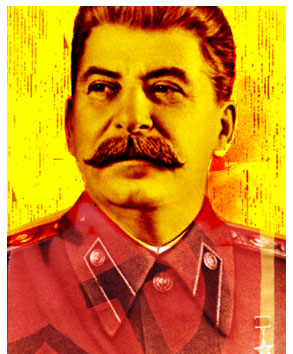

Stalin’s poetry isn’t too bad. It mainly consists of verses in a romantic-pastoral vein that was apparently conventional for Georgian poets of the 1890s:
The pinkish bud has opened,
Rushing to the pale-blue violet
And, stirred by a light breeze,
The lily of the valley has bent over the grass.
In English translation that’s nothing more than pleasant. To readers of the Georgian language, according to biographer Robert Service, “it has a linguistic purity recognized by all” as well as an obvious nationalist subtext. (Writing about the loveliness of the Georgian landscape was understood as a wink and a nudge that the Tsarist censors would never notice.) That poem, “Morning” (which continues for two more stanzas), appeared in the radical intellectual magazine Kvali, and was then published in an influential textbook by the Georgian educator and nationalist Yakob Gogebashvili. As art by future dictators goes, that’s a lot more success than Hitler ever enjoyed for his insipid watercolors.
Everyone in the modest literary scene of Tbilisi, the Georgian capital, knew the author. He was a 17-year-old seminary student named Joseph (or Yoseb) Dzhughashvili, and he was smart, ambitious, headstrong and quick to anger. For two years young Dzhughashvili was a rising star in Georgian poetry, but he quit writing sometime around 1897 to focus his attention on another passion: revolutionary Marxism. Stalin loved nature and the outdoors to the end of his life, and grew flowers and lemon trees. But he never wrote a poem again.
How much different would 20th century history have been if that pockmarked young man, already a survivor of grinding poverty, an abusive family life and a bout of smallpox that nearly killed him at age 6, had stuck with the poetical muse? Service’s fascinating new Stalin biography, the first comprehensive English-language treatment of his life since the opening of the Soviet archives in the mid-1990s, is full of historical what-ifs, some of them fanciful (like that one), others less so.
“Stalin: A Biography,” like Simon Sebag Montefiore’s 2004 “Stalin: The Court of the Red Tsar,” is a major landmark in the recent scholarly reassessment of the notorious dictator who consolidated Soviet power, launched vicious purges against his own people (and indeed his own political party), defeated the Nazis in World War II, and launched the Cold War. Service and Sebag Montefiore — colleagues and to some extent rivals at Oxford — aren’t trying to excuse Stalin’s crimes or apologize for them, but rather to rescue the real Stalin, as much as the record will let them, from the myths and caricatures that surround him.
If Stalin essentially created the Soviet Union in its finished form, Service argues, the Soviet state also created him, as the socialist demigod it needed to worship. The real Stalin had colleagues and sycophants, but almost no friends. He was a standoffish, awkward man, plagued by rheumatism, high blood pressure and bad teeth, whose idea of flirting with women (according to Service) was to flick bits of food across the table at them. He stood an unprepossessing 5-foot-6, wore the same clothes almost every day, and personally cut holes in his military boots to relieve the pressure of corns.
As he himself realized, the heroic, larger-than-life Stalin of Communist Party iconography was something entirely different. Sebag Montefiore quotes Stalin’s adopted son, Artyom Sergeev, remembering a family fight in which Stalin berated his wastrel son Vasily for cashing in on his surname. “But I’m a Stalin too,” Vasily protested. “No, you’re not,” Stalin replied. “You’re not Stalin and I’m not Stalin. Stalin is Soviet power. Stalin is what he is in the newspapers and the portraits, not you, no not even me!”
– – – – – – – – – – – –
Service tries to answer the question of how one Stalin begat the other — both how the Georgian seminarian became a mass killer and how the flesh-and-blood human became the mythical embodiment of Soviet power. If Sebag Montefiore’s book, which is primarily a study of the dictator’s inner circle during his years in power, makes for more vivid and exciting reading, Service’s trumps all other volumes now available on Stalin’s life. It synthesizes all the major narrative accounts and incorporates a good deal of revealing new information.
Hardly any historical figure of the 20th century has been written about more than Stalin, and few, Service and Sebag Montefiore would agree, have been as poorly understood. The caricature of Stalin as a bloodthirsty provincial buffoon, and perhaps a madman, was created by his enemies on the left — but soon embraced by those on the right as well. When Stalin’s rival Leon Trotsky was exiled from the Soviet Union in 1929, he wrote an influential memoir describing Stalin as a dim but vicious bureaucrat who could barely speak Russian, possessed no real understanding of Marxism, had played almost no role in the October Revolution of 1917, and had risen to the top of his party through sheer animal cunning.
Stalin’s entirely typical mode of revenge — he had Trotsky murdered in 1940, in his Mexican villa, with an icepick to the head — did nothing to dispel this portrayal. Superficially, it seemed to account for his regime’s horrors: the appalling famines; the ludicrous show trials of Stalin’s revolutionary colleagues; the Great Terror of 1936-38, in which more than a million people died; the fear-ridden police state of his later years. But it only heightens the dramatic story of this extraordinary (and, yes, extraordinarily evil) man to grasp that the depiction is entirely false.
Trotsky and his left-wing followers didn’t want to admit that they had been outsmarted by a superior politician after the death of Vladimir Lenin in 1924 — and they also didn’t want to admit that Stalin’s excesses were merely logical extensions of the Bolshevik obsession with centralized power and state terror. It was Trotsky himself who had said that the revolutionaries didn’t have the right not to kill people in the process of building socialism. Stalin believed he was building socialism too — and he deprived himself of the right not to kill millions.
On some level, Trotsky, like Lenin before him, was afflicted by class prejudice, of all things: They didn’t believe that a cobbler’s son from Georgia who hadn’t been to university could be as smart as they were. As Service presents him, young Joseph Dzhughashvili was strikingly intelligent from the start. He was born in Gori, a scenic Georgian valley town of 30,000 people, in 1878. (For uncertain reasons, Stalin always claimed to be a year younger than that.) He excelled in school immediately, and was put on the fast track toward the Russian Orthodox priesthood, about the most prestigious occupation a poor boy from the outer boondocks of the Russian Empire could hope for.
By the time he dropped out of the Tbilisi seminary and shifted his allegiance from God to Marxism, Dzhughashvili had had “a fairly broad education by the European standards of the time.” He had read Xenophon and Plato in the original, along with a good deal of Russian and Georgian literature. (Throughout his life he revisited the Georgian national epic “Knight in the Panther’s Skin,” by the 13th century poet Shota Rustaveli.) He had studied some higher mathematics, the history of the Romanov dynasty, and of course a lot of Christian theology. He had developed tastes of his own, too; he was twice disciplined for smuggling in novels by Victor Hugo (“modern” literature being forbidden).
Trotsky would never have admitted it, but Stalin became an intellectual in adult life, after his own dogmatic fashion. His essays synthesizing Lenin’s thought were clear and capable, and often more readable than the Bolshevik founder’s tangled prose. (Contrary to what most in the West assumed, Stalin never allowed a ghostwriter to touch his prose.) Although all sorts of spurious Marxist “science” was promulgated under Stalin’s reign, he was personally well informed on scientific and technological issues, and continued to read widely. The Soviet state proclaimed Gorky, Pushkin and to some extent Tolstoy as its literary avatars, but Stalin told his daughter that Dostoevski (although banned for his right-wing Christian mysticism) was the greatest Russian novelist.
All this was more remarkable when you consider his background. Joseph was the only child of a violent and abusive family. His parentage is not entirely clear. His father of record, Beso Dzhughashvili, was a cobbler who was driven out of business and forced to work in a factory. (Clearly this helped form young Joseph’s view of capitalism.) Beso drank heavily and beat Joseph and his mother Keke, while Keke was rumored to be sexually promiscuous and perhaps a prostitute. All this stood out in Georgia, which Service describes as a clan-based culture closer in tone to that of Greece or Italy than to Russia. Sex and gender roles were clearly defined, but family violence was unusual and parents tended to dote on their children.
As Service says, no psychology degree is required to see the roots of a disordered personality in this story. Certainly most people who are beaten viciously by their parents don’t grow up to be murderous dictators, but then again, they don’t usually get the chance. To the world’s misfortune, this shrewd and ambitious young man collided with the fast-rising politics of revolutionary communism.
Joseph’s boyhood friends in Gori remembered him for his pugnacity; he fought bigger and stronger boys who were likely to beat him badly, and then he sought out weaker, smaller boys to dominate. In later life, Stalin would use the image of physical beating over and over again in his speeches and writings. In 1931, when he was driving the Soviet economy furiously forward through the first Five-Year Plan, he gave a memorable speech to a conference of industrial managers:
“The history of old Russia consisted, among other things, in her being ceaselessly beaten for her backwardness. She was beaten by the Mongol khans. She was beaten by the Turkish beys. She was beaten by the Swedish feudal rulers. She was beaten by the Polish-Lithuanian lords. She was beaten by the Anglo-French capitalists. She was beaten by the Japanese barons. Everyone gave her a beating for her backwardness.”
Service notes the emotional intensity of the speech, but not its potent connection to Stalin’s own childhood, with its memories of both beatings and, from the Russian point of view, cultural backwardness. Lenin and Trotsky encouraged and committed acts of ruthless violence during the October Revolution and the ensuing Civil War, but they did so essentially as bourgeois dilettantes. Lenin was born into the lower Russian nobility and Trotsky into the Jewish intelligentsia. Stalin was a true son of the working class, forged by violence of the most intimate kind, and under his leadership the dictatorship of the proletariat was going to make damn sure it administered the beatings rather than receiving them.
Joseph Dzhughashvili didn’t make many friends in the Russian Social-Democratic Workers’ Party (as the future Communist Party was then known), but he distinguished himself through hard work and ideological commitment. While Lenin and most of the party’s other leadership lived in exile in Polish or Swiss or French villas during the years before 1917, Dzhughashvili was repeatedly arrested by the tsar’s secret police. He served several prison terms and was sent to Siberia three times, only to escape. (He seems to have treated this as an object lesson: There were few escapees from the Siberian Gulag under his reign.)
Trotsky’s famous claim that Stalin was a nonentity who “missed the Revolution” is not accurate. He made his way back to Petrograd after four years in northern Siberia just before the fall of the tsar in February 1917, and became one of Lenin’s most loyal lieutenants. As Trotsky must have known, Stalin — he had been using that name since 1912 — was elected to the party Central Committee and was an editor of Pravda, the party newspaper. He played a key organizational role that October, when the Bolsheviks (Lenin’s revolutionary faction of the party) seized power, and became a commissar in the new government.
If anything, Trotsky was trying to conceal the extent to which Stalin was already competing with him for Lenin’s favor. In the civil war that followed the Revolution, Stalin first became known for his brutality. He seized command of the Red Army near the city of Tsaritsyn (later to be called Stalingrad), ordered deserters shot, treated his own troops and the enemy mercilessly and had to be restrained from sinking a barge crowded with White Army POWs in the Volga.
By the time Lenin was felled by a stroke in 1922 (he would live for two more years, but take little part in running the nascent Soviet state), Stalin had positioned himself perfectly. If Trotsky was more charismatic and radical in tone, Nikolai Bukharin had more intellectual heft, and other Bolsheviks like Lev Kamenev and Grigori Zinoviev had more seniority, Stalin had established himself as a muscular leader devoted on the one hand to Leninist doctrine and on the other to preserving the Soviet revolution against its enemies (which at this early stage meant virtually the entire world).
As Service makes clear, this was exactly what the other Bolsheviks were looking for, and Stalin could never have emerged from the leadership struggle without widespread support. It’s true that Lenin grew mistrustful of Stalin, and sought to denounce him near the end. But Lenin’s famous “Testament,” while urging that Stalin be removed from his post as general secretary — more because Lenin saw him as “crude” and “uncouth” than because of any brilliant political foresight — failed to endorse Trotsky or Zinoviev or any other plausible candidate.
Stalin sat “pale as chalk” during the reading of Lenin’s Testament at the 13th Party Congress in May 1924. But in the end, Kamenev and Zinoviev supported him, and Trotsky wasted his last, best chance. So Stalin survived. After he emerged as the party’s sole leader a few years later, many of those in the room that day would not be so lucky.
– – – – – – – – – – – –
Virtually since Stalin assumed power, the left-wing line has been that the Georgian usurper had abandoned Marxism and betrayed the true promise of the Russian Revolution. There are grains of plausibility in this, Service argues, but not much more. A Trotsky-led Soviet Union might have been less repressive than Stalin’s, with more cultural freedom and some gestures toward “worker’s democracy” (although Service wonders how long it would have survived). But Stalin never lost his faith in the Marxist-Leninist doctrine that global communism was inevitable, and everything he did, no matter how brutal or irrational it seemed, conformed to his understanding of Marxist theory.
On the other hand, Stalin’s understanding of Marxism was very much his own invention. He introduced the heretical notion of building “socialism in one country,” which Lenin and Trotsky had always insisted was impossible. In fact, he announced that it had been accomplished, in November 1936, after his program of forced industrialization and the mass collectivization of agriculture had mostly been completed — causing a horrific famine in western Russia and the Ukraine in which somewhere from 6 million to 10 million people starved.
But the final stage, Marx’s classless workers’ paradise of communism — even the great Stalin couldn’t see that far. During the dictator’s 24 years in power, the Stalinist state certainly showed no signs that it might “wither away,” in Lenin’s famous phrase. Stalin’s task, as he saw it, was to defend his existing socialist state from all enemies, whether real, potential or entirely hypothetical. If that took an iron fist, well, so be it. He was the man for the job, and the worldwide proletariat would thank him for it one day.
In that context, Service’s reading of the Great Terror of 1936-38 is more nuanced, if that’s not an inherently offensive idea, than that of most other historians. He agrees that most of those arrested in this massive purge — among them Stalin’s longtime colleagues in the original Bolshevik leadership, including Bukharin, Kamenev and Zinoviev — had done little or nothing to threaten the regime. The conspiracies they were tortured into confessing were entirely fictitious. But by the late ’30s Stalin had come to see his own survival as crucial to the possibility of global communism, and Service believes that he also understood how widely dissatisfaction with his brutal regime had spread.
In fact, Service thinks that Stalin might have lost a crucial Central Committee vote in 1934, and that other leading Bolsheviks had asked Sergei Kirov, perhaps Stalin’s best friend at the time, to take over as party leader. But Lazar Kaganovich, a Stalin loyalist, was responsible for counting the votes, and the Boss — as many of his followers called him — survived again. Kirov would be “assassinated” in a highly suspicious incident before the year was out, and most of the others who could confirm or deny the story vanished in the Terror. (It’s surprising, in fact, that nothing happened to Kaganovich.)
Another event of 1934 that paved the way for the Terror was the suicide of Stalin’s wife, Nadya Allilueva (after a Kremlin dinner party at which he had abused and mistreated her). Clearly this was a key event in his transformation into an increasingly isolated, increasingly cruel despot. Kaganovich said Stalin was never the same man after that night, that he “turned in on himself and hardened his attitude to people in general,” as Service puts it. Nadya’s nephew, Leonid Redens, wrote that her death “altered history” and “made the Terror inevitable.”
This may be overstating things; the Terror was brought on by interlocking forces, and Stalin’s personality was only one of them. Still, as Sebag Montefiore puts it, “Nadya’s death created one of the rare moments of doubt in a life of iron self-belief and dogmatic certainty.” As he told numerous people after Nadya’s death, Stalin had been a bad husband. Husband and wife were both volatile and unbalanced people — she may have been schizophrenic, and he was, after all, Stalin.
But they obviously loved each other. Their letters are full of appealing endearments, which were unusual in the dreary era of everything-for-the-people Bolshevik correspondence. “I miss you so much Tatochka,” Stalin once wrote, using his pet name for her, “I’m as lonely as a horned owl.” Nadya’s response (to a different letter) concluded, “I am kissing you passionately just as you kissed me when we were saying goodbye!” — which was about as close as good Communists got to epistolary heavy breathing.
Stalin was already guilty of crimes against humanity by 1934, and it’s dangerously romantic to imagine a vastly different historical outcome with Nadya by his side. But it’s clear that this loss was a devastating blow to an already disordered personality, and it’s also true that Stalin the man had not yet become Stalin the Soviet icon or Stalin the murderous ogre. He still had human dimensions and human possibilities.
Whether the motivation was primarily political or personal, Stalin felt the need to consolidate his power and crush all resistance. The point of the Terror was, after all, terror — whose principal audience is not the people imprisoned and shot but the others who are left at their desks. It didn’t matter whether Stalin was annihilating his real enemies in the party (he got some of them but missed others), only that he was demonstrating what could happen to those who snickered at disloyal jokes or consorted with supposed counterrevolutionaries or had the wrong father-in-law or were just a little too Ukrainian or Polish or Armenian or Jewish.
Hence the precise numbers cooked up by his vicious secret-police chief, Nikolai Yezhov, which would seem like a parody of the Soviet quota fetish if they weren’t real: In the Terror’s first go-round, there were to be 268,950 individuals arrested, with just under 76,000 to be executed and the remainder sent to the Gulag. (The final numbers, of course, were much higher. No precise count is now possible, but Service thinks that roughly 1.5 million people were seized by Yezhov’s agents, with half of those summarily executed, and the rest exiled to labor camps. Only about 200,000 came home again.)
– – – – – – – – – – – –
One could view the Stalinist system as a vast production line, one of whose most consistent outputs was death. For Stalin, the lives of his own people were an almost infinitely expendable resource, not unlike the Siberian timber forests or the Ukrainian wheat fields. He starved them into modernization, drove them out to fight the German war machine by the hundreds of thousands, murdered them en masse to prove his own mightiness. As Service writes, “Stalin was willing to pay any price in lives to attain his objectives.”
Service insists that Stalin never lost either his Marxist faith or his sanity, but both became severely frayed as the dictator aged. Stalin never understood, Service suggests, quite how badly the Soviet state was being managed and how grim life was for ordinary people in the latter stages of his rule. He never traveled, except to and from his various dachas by limousine, and his sycophantic inner circle learned the hard way to avoid giving him any bad news. If he was as intelligent as Service thinks, he must have known, or at least suspected, that “socialism in one country” had become a cruel farce and that the adulatory Stalin cult masked an equally deep reservoir of hatred.
On at least one other occasion after 1934, Stalin apparently believed that a coup against him was imminent, or had already happened. After Hitler violated the Nazi-Soviet non-aggression treaty and launched Operation Barbarossa, the blitzkrieg June 1941 invasion that nearly brought Soviet Russia to its knees, Stalin ran state affairs for a week and then abruptly disappeared to his favorite dacha, instructing the staff to say he wasn’t there. It was probably what we’d now call a depressive episode. When several Politburo members went to fetch him, they found him slumped in an armchair, looking “strange” and “guarded.”
“Why have you come?” he asked. One visitor, Anastas Mikoyan, thought the Boss was expecting to be arrested. But his lieutenants lacked the nerve, or even the desire, to remove him. In the long run, Service thinks, Stalin’s bulldog leadership and symbolic importance to the Russian people were crucial to winning the war. For a short time during the wartime Alliance, he was a beloved figure in the West, our “Uncle Joe” standing tall against the Nazis. (When Roosevelt, who liked Stalin, told him about the Western media’s nickname, Stalin nearly walked out of the Yalta conference that was carving up the postwar world. He poked fun at himself sometimes, but never allowed others to do so.)
During the latter stage of his life, in the Cold War police state of the postwar period, Stalin must have experienced cognitive dissonance. He still believed in socialist world revolution, but what he had built looked more like a new version of the Russian Empire, more repressive and authoritarian than any since the days of Peter the Great and Ivan the Terrible (both of whom he admired). For ceremonial occasions he dressed up in his fruit-salad uniform as “Generalissimus Stalin,” which even he thought was ridiculous. Otherwise he never went out in public.
Stalin died at his dacha outside Moscow in March 1953, after a severe stroke. His guards were too terrified to go in the room, and he lay on the floor for most of a day, partly paralyzed and soaked with his own urine. Long before he was dead, the infighting to replace him was well under way, which was no more than he deserved. Russian historians have suggested that Lavrenti Beria, the secret-police chief of the later years, had him poisoned as part of a coup attempt, and amid all the dark skulduggery of who did what in those few days, Service admits that we’ll never know.
Some readers, no doubt, will object to Service’s dedication to “humanizing” his infamous subject by focusing on his ordinary and even congenial qualities: Beyond the troubled childhood, the youthful poetry and the fondness for trees and flowers, the Stalin we meet in his book can be a charming if mercurial host (who relished “crude masculine humor”), has a nice baritone singing voice and likes to play with children. (In his games with daughter Svetlana, she pretended to be the supreme dictator, writing him letters ordering him to take her to the movies. He wrote back: “All right, I obey.”)
Service pleads guilty as charged, arguing that it’s both naive and dangerous to depict Hitler, Stalin, Mao and the other great mass murderers of history as inhuman monsters. They all lived much of their lives as “normal human beings,” which does not mean that their official conduct was normal at all. (Hitler, famously, loved his dog — probably more than he loved any human being.) If we fail to recognize our essential kinship with such people, Service suggests, we will be unable to spot the next Stalin or Hitler who emerges among us.
For years after his death, Stalin remained less a historical figure than a political totem to be repeatedly repudiated, buried and then partway dug up again. He haunted the left like an especially bad conscience. To this day, cultish Stalinist organizations like the Workers World Party and its front groups (International ANSWER, the International Action Center, etc.) are treated by the American activist left with far more respect than they deserve. It’s as if some misty nostalgia for the original goals of revolutionary socialism can still cloud some people’s minds to the unforgivable crimes committed in its name. This is every bit as disgraceful as Trent Lott’s sentimental attachment to the era of white supremacy.
For socialists and other leftists, Stalin had to be apologized for or explained away or consigned to oblivion; there were idiotic debates about the precise moment when the Russian Revolution took its fateful turn toward totalitarianism. Perhaps understandably, the anti-communist left fled in the other direction. If some progressives have never confronted Stalin’s legacy honestly, others have ritualistically abased themselves, vowed their undying loyalty to American capitalism and sworn never ever to follow a bad god again.
For many on the right, including those founders of the neoconservative movement whose intellectual origins lie in communism or socialism, the Red tsar has been a useful cudgel with which to batter their political opponents. Look, they could say, holding up the dictator’s rotting head, here is the endpoint of all so-called progressive politics: the Gulag, the prison-state, the regime of lies. (That’s pretty much what David Horowitz, former editor of the Marxist magazine Ramparts, would tell you today.)
Service’s cold-eyed appraisal evades all these traps. He accomplishes the remarkable feat of painting Stalin as a believable human being, one who had sympathetic qualities but also suffered from a “gross personality disorder” that made his collision with history especially dire. This can be no consolation to Stalin’s millions of victims — nor indeed to the Russian nation, still in many ways trying to overcome his legacy — but he carried his wounds with him to the end and, like anyone else, held at least the possibility of other outcomes within him.
Among a very small cache of private papers found after Stalin’s death (including an angry note from Lenin demanding that Stalin apologize to Lenin’s wife for being rude) was his last communication from Nikolai Bukharin, the most adventurous intellectual among the original Bolsheviks. Stalin hounded him for years after taking power, and in March 1938 made him the star defendant in the last big show trial of the Terror. Bukharin had humiliated himself, confessed to imaginary anti-Soviet plots and pleaded for mercy. From his execution cell in Lubyanka Prison he wrote to Stalin, using a Georgian nickname only the dictator’s oldest colleagues knew: “Koba, why is my death necessary for you?”
Service assumes that Stalin kept this to gloat over his onetime foe, and felt a “frisson of satisfaction” while rereading it. That’s a natural conclusion. But its proximity to the Lenin note, which can only have stung him, is intriguing. Was some small part of him, whatever of the teenage Georgian poet had not been burned away, troubled by the question?
