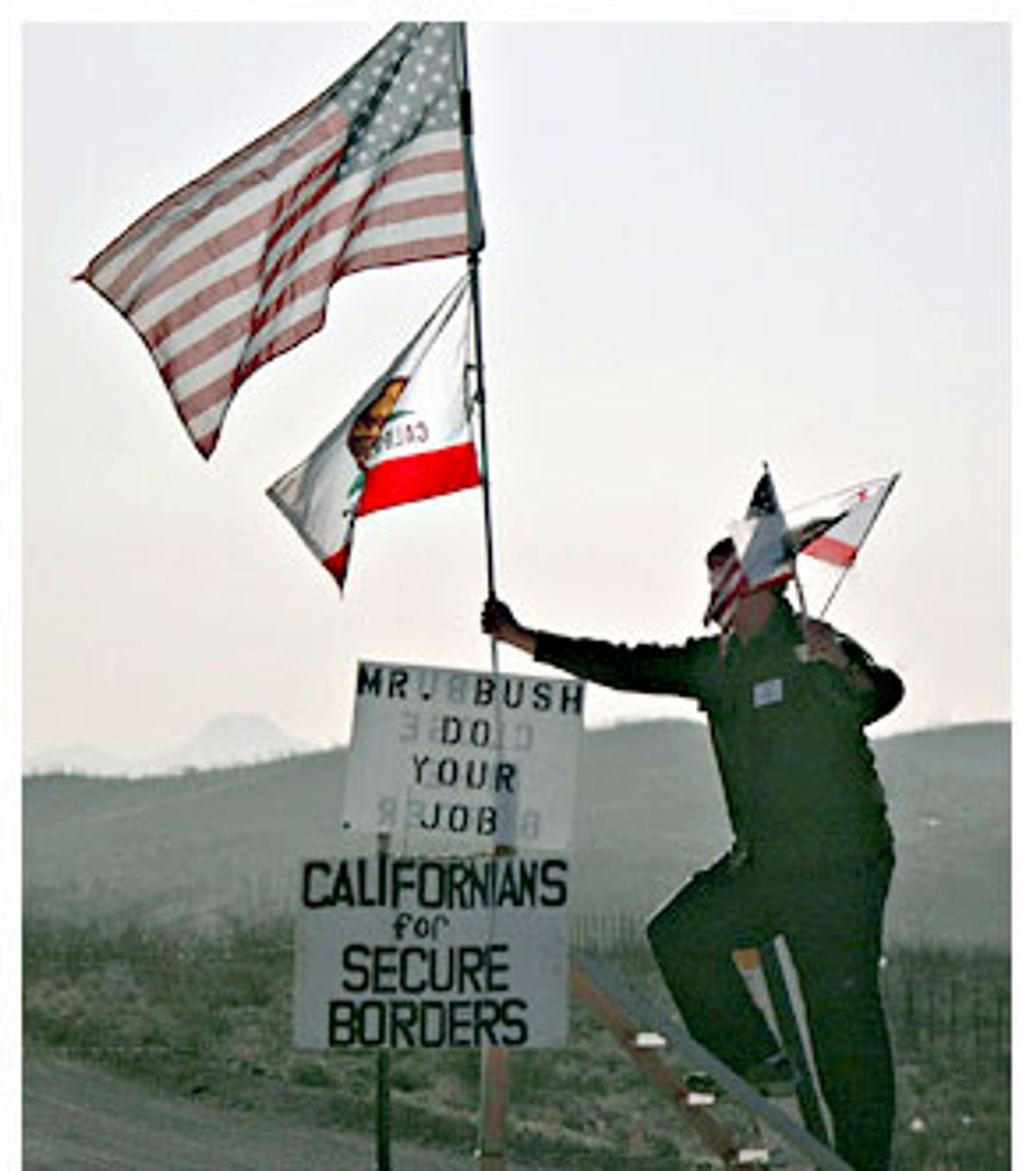
High drama suits Chris Simcox. You imagine that even when he's home alone talking to his cat, he acts as if he's addressing a sea of people. The hyperactive and bone-thin 43-year-old is the key organizer of and barker for the Minuteman Project, the citizen border patrol that in April sought with a single bold stroke to put a stop to illegal immigration along the Arizona-Mexico border. On the eighth day of the project, in the Arizona village of Palominas, Simcox is briefing 10 new recruits in a dirt lot near an oily little restaurant called the Trading Post. Several R.V. campers squat in the lot near a Port-O-San. Beyond is the empty scrub desert and two miles away the Mexican border.
"The government can't afford to let this thing succeed," Simcox tells the anxious men. "So stick to the SOP. That's the most important thing." Standard operating procedure is to call the U.S. Border Patrol at the sight of anyone trying to sneak across the border. Added to the tension is the news that Simcox has received death threats, supposedly from a Central American gang lord; he wears a bulletproof vest.
He tells the men they can carry pistols but they should not try to capture or detain migrants; there should be no contact at all between the Minutemen and their quarry. "It's gonna get boring because we have to shut down this border," he continues. "But don't get suckered into an encounter. People coming across to work are victims. Just as you are. Your most effective weapon is your video camera. Someone approaches, your video camera is on!"
This is the new Chris Simcox, the politically correct, sanitized version. In January 2003, federal park rangers arrested Simcox after he wandered onto national parkland in search of illegal immigrants. In his possession was a loaded pistol, two walkie-talkies, a police scanner, a cellphone, a digital camera and what appeared to be a toy figurine of Wyatt Earp on a horse.
But being convicted on a misdemeanor firearms charge and serving a year of probation obviously got to him. He put away his revolver, re-angled his rhetoric and ultimately netted hundreds of volunteers to his cause. Standing near the border, whipped by the desert wind, Simcox tells me, "This is the Boston tea party! We are reestablishing the can-do attitude! We're tough and tenacious but humane and civilized. We are the American spirit. We say no, we mean no. The word is 'temerity' -- rock-solid character! We are challenging two governments. This is about will."
The Minuteman Project commenced operations on April Fool's Day in the cardboard cowboy town of Tombstone. Day and night, nearly 900 working-class men and women from across the country, nearly all of them white, stood guard at half-mile intervals along a 23-mile stretch of the Mexican border in southeastern Arizona. Some carried pistols, some binoculars, some held scribbled signs, some sat in lawn chairs. They were angry and worried and depressed. To them, the deluge of illegal immigrants stole American jobs, drove down wages, burdened city services, and spawned crime waves. They loved their country but hated their government. It was failing to protect them and its own sovereignty. The American dream was dying on the border.
At the end of the month, the Minutemen announced with great fanfare that their presence, and their reports to the U.S. Bureau of Customs and Border Protection, had reduced illegal crossings on their little stretch of border by more than 98 percent, from 800 to 13 per day. California Gov. Arnold Schwarzenegger swallowed the hype, declaring that the Minutemen had done "a terrific job" in preventing illegals from crossing the border. He even suggested that they move the operation to California's equally porous border.
Federal customs officials, however, responded that the Minutemen did little more than get in their way; they were especially annoyed that the good citizens kept tripping motion detectors hidden in the brush. What neither border officials nor immigration experts deny, though, is that the Minuteman Project focused the hot light of the media on the world of problems surrounding illegal immigration.
"It seemed there were more stories in the papers about the Minutemen than there were migrants apprehended," says Tamar Jacoby, author of "Reinventing the Melting Pot: The New Immigrants and What It Means to Be American." "But they put the issue back in the news, that's for sure."
In 2004, more than 1 million illegal immigrants were captured on the Mexican border. In the previous 10 years, at least 2,500 died in the crossing from sun, cold, thirst. If the wrath of the desert didn't kill them, the pitiful conditions provided them by black-market smugglers did. The human flood resulted in endless troubles for patrol agents, who in greater numbers than ever were being shot at, stoned, ambushed, both by migrants and drug traffickers. In 2004, there were 118 assaults on border agents in just the 30 miles of border stretching east and west of Palominas.
With the migrations, violence and human smuggling, "People are right to be frustrated and angry with the border problem," says Jacoby. "Nobody can quarrel with the point that the system's broken."
Simcox, with his maniacal and often shameless declarations about immigration, and his contradictory sympathy for migrants, whom he appears to hate for coming to his country, is already imagining an outsize place for himself in the history books. He sees himself as the lone man who will fix the system and close down the border.
I got to know Simcox in the winter of 2003. I was in Arizona writing about a group of border "vigilantes" called Ranch Rescue, a heavily armed militia led by the baby-faced blowhard Jack Foote, who talked of invading Mexico and killing the leaders (though Foote, a former U.S. Army officer, had himself never seen action). The Ranch Rescuers wore camouflage fatigues, painted their faces, and tracked down migrants on midnight forays, carrying Kalashnikovs, Glocks and extra ammo. Occasionally their hunts went awry. One of Foote's militiamen was arrested in 2003 on assault charges after allegedly pistol-whipping a migrant waylaid deep in the desert. Mostly, though, the militiamen drank beer and whiskey and ate beans out of cans and smoked a lot of pot, which I found strange, as much of their mission was to interdict drugs. "Only if it comes in legally do we want it," the men told me, not realizing the ridiculousness of the logic.
But the drunken GI Joes weren't really Simcox's scene. He was a loner. In December 2003, I camped out with him for a night of watch in the desert plain near Palominas. He regaled me with the long arc of his life that brought him to the desert.
For 13 years, he taught kids at the private Wildwood School in Los Angeles. The school was "famous for teaching tolerance and diversity to the kids," he said. But he didn't mean that in a good way. Liberalism, he said, had produced the kind of tolerance that allowed illegal immigrants to pour into L.A. and form gangs. When he was young, he said, he produced rap albums in New York City, where, twice, he got mugged by people who didn't speak English.
After 9/11, Simcox confessed that he went crazy. He got fired from the school, his wife divorced him and took their teenage son. "My life collapsed," he said. He exiled himself to the Arizona desert, to Organ Pipe Cactus National Monument, a remote and hallucinatory place where the cactus looked like men with guns, or women dancing. He began to call himself a 21st century Paul Revere, certain that terrorists were creeping across the border.
One hot night, Simcox said, he was hiking and saw a convoy of troops in trucks and jeeps moving fast, escorted by jogging men carrying AK-47s. Simcox hid in a pinnacle of rock, terrified, awed. He went to the park rangers, who shrugged. "They're drug dealers," the rangers said. "Calm down." "Calm down!" Simcox told me. "No! This was an army! September 11! They're crossing the border! And these guys aren't gonna do anything about it!"
Simcox lived in the desert alone in his tent for three months, watching the drug convoys come. "I wanted to join the Border Patrol," he said. "They said I was too old. Too old? Our country is under attack! I applied to the Army, the Navy, Air Force, Marines -- too old!" A few days before Christmas, 2001, while camping in the high desert, the cold morning froze the zipper on his tent and so he melted it open with his cook stove. "That was it for me," he said. "I came in from the wilderness."
Simcox drained all his accounts, even those he'd saved for his child, and bought a local newspaper, the Tombstone Tumbleweed. He front-paged his plea: "A public call to arms! Citizens border patrol now forming! Protect your country in a time of war!" He exhorted Americans to "wake up" because "we cannot rely on law enforcement to enforce the laws." In an open letter to George W. Bush, Simcox warned: "You can stop me by throwing me in jail, killing me or otherwise ... What you cannot change is my passion."
Simcox enlisted a handful of men to his cause and they called themselves the Civilian Homeland Defense. They were disorganized, though, and Simcox often went on search missions by himself.
One cold morning, when I was with Simcox on the Palominas plain, he tracked a group of migrants through the arroyos, up the berms, through the mesquite and the spiky ocotillo plants. Finally he came upon a family of round little Indians with babies. They were country folk, farmers, who had fled Mexico after their chief crop, corn, had crashed in the debased market for Mexican agriculture. Simcox called in the coordinates to a Border Patrol unit, which arrived on foot and took the Indians away.
"There's only one way to stop this," Simcox said slowly, like a man about to hit an insect. "Mo-bi-li-za-tion! Militarize the border! It would create a boom economy! Think about it. A binational workforce that builds towers and surveillance and video cameras and sensors. I'm tired of this wishy-washy pussy country we've got. Republicans are stuffed suits! Pussies! Why is America not standing up and enforcing the law down here? Cause everybody's a victim, right?"
He scowled and scoffed and huffed. "I got dual feelings about migrants," he said. "I'm pissed at 'em because they're breaking into my country. But I feel for 'em because they're dying in the desert for a minimum wage, being exploited by two governments. Cheap labor! Capitalism! Exploitation! What in god's name is going on in this country? Who mows your lawn, washes your laundry, picks your food in the field, so you can sit around and watch 'Friends'? This is a psychosis."
Over the next two years, Simcox managed to calm down. With his newspaper and Web site, he tweaked his passion into savvy sound bites, gave the movement an epic banner, and began to drum up volunteers. The Minuteman Project, he bragged, was named after the militia of average men who fought the war that birthed this country.
On a hot afternoon, a week into the Minuteman Project, Simcox goes up and down the borderline near the Arizona town of Naco, cheering the troops. Observers with the American Civil Liberties Union are camped close by, on their own lawn chairs, watching the watchers. Simcox taunts the ACLU observers. He says he captured on film a group of them smoking marijuana. "Stoners! We're gonna get that video to Sean Hannity," Simcox says. The ACLUers conclude that the Minutemen are ignorant xenophobes.
Through the scrub, I spy Xavier Zaragoza, a Mexican-American reporter with the Douglas Daily Dispatch, a regional newspaper in southeastern Arizona. Zaragoza has been toiling on a documentary film about border politics for four years. With an impish smile, he says, "Every time I walk up to the Minutemen they say, 'You a citizen?' What are they judging me on? Skin color? 'You speak 'merican?' I hear it over and over. 'It's an invasion! Stealing our land! You bring leprosy! You speak 'merican?' It's pretty sad."
Zaragoza had gathered footage of dead migrants, of living migrants dashing to the border, of infants captured by Border Patrol, and of Ranch Rescue imploding in alcohol and idiocy. Now with his camera he was getting inside the Minuteman Project. He was sick of the border. "This place is a fucking nightmare," he says.
I have the good luck of finding a few articulate Minutemen. Like Simcox, they feel that migrants are victims of greedy American companies that exploit the pool of cheap labor. Mike Gaddy from Farmington, N.M., a retired Army paratrooper, walks to his truck to show me a biography of U.S. Marine Maj. Smedley Butler, a populist hero in the 1920s and '30s. "War is a racket," Butler famously observed in 1935. Gaddy, like Butler, spent over 30 years of active duty in the services. He recites his litany of service: "'64 to '94: 'Nam, Grenada, Beirut, Panama, Desert Storm," he says. He taps his hands on a page in the Butler biography and tells me to read: "I spent most of my time being a high-class muscle man for big business, for Wall Street, and for the bankers. In short, I was a racketeer for capitalism." Gaddy nods, his red beard shining. "When I read Smedley Butler, it was like the sun came out," he says. "It explained my whole life."
I bump into Johnny Petrello, a 33-year-old electrician from Arizona and one of the original members of Simcox's Civilian Homeland Defense. Petrello had assisted enough citizen arrests of migrants that a $10,000 bounty was placed on his head by Mexican gangsters operating out of Naco. Or so he claims. He laughs about it; he is sympathetic to migrants. "If I was a Mexican, a Guatemalan, Haitian or Colombian, you bet your ass I'd be trying to get into the United States, by any means necessary," he says. It's just that illegal migration, he says, is "a slap in the face" to his grandfather, who arrived on Ellis Island from Palermo, Italy.
He seems genuinely anguished and confused. Mexicans who work for cheap wages, he says, are ruining his own livelihood. "In 1990, I was making $15 to $20 an hour on construction sites. Now I make $8 an hour. The issue is not the Mexicans: they're good workers, they show up on time, work all day and go home." He pauses. "The more I look for answers, the more questions I have. And for this I've been called a Nazi, a fascist, a white supremacist, a racist, a redneck. A CNN reporter asked me, cameras rolling, 'John, how many Mexicans have you murdered on the border?' I nearly threw up. What a sucker punch. How could you even answer that without legitimizing it?"
Like Petrello, many Minutemen feel the need to impress on reporters that they are "not racists." This is only truly compelling when offered by the dozen or so Mexican-Americans who stand guard, such as Ruben Medina, of the San Fernando Valley in California. Medina says his father and mother are first- and second-generation Americans, the sons and daughters of legal Mexican immigrants. "I proudly speak Spanish when I go to see my cousins in Chihuahua," he says.
But he is also outraged that the services of six emergency rooms at hospitals in the San Fernando Valley have been slashed due to the systemic pressures from illegal aliens. This was his breaking point, and when Medina heard the Minuteman call, he took a week off from work to come to the border. "I hope one day that poor people in Mexico can enjoy an economic and political change so that both sides of the border can benefit," he tells me.
Other Minutemen complain that they are sick of paying taxes for social services like hospitals that are abused by immigrants. They also protest that because many of the private companies in their communities get tax breaks, and because those companies hire migrants, they are effectively subsidizing illegal immigration. Barbara and Jack Fagan, who had driven from Spokane, Wash., bitterly complain about the tax issues. A wind kicks up and blows dust in their eyes and mouths, but the couple, both retired, appear to enjoy themselves. I ask if they are wearing guns. Barbara Fagan says, "I'm wearing a crochet needle and thread."
Of course, some of the Minutemen fit the stereotype of the know-nothing. In Palominas, I talk to an 18-year-old girl named Ashley Miller, who is pregnant and whose 3-year-old stepson plays in the dust. Miller has lived on the border all her life and watched migrants cross her land without trouble. She is not happy with the Minutemen, nor is her family, who grow hay in irrigated fields nearby.
"These people come here for a minute and they think they're men," Miller says. "They don't live on the border, they don't know the border, they know hearsay, what they've read. They'll get some ego boost from saying they've defended the border." Then, she says, they will depart, and nothing will change, except that migrants crossing her land will now expect her father and uncle and grandfather to be armed and hostile. "These Minutemen are putting the children, the people waiting at a bus stop, the people in their homes in danger," she says.
At that point, a Minuteman with watery eyes and yellow teeth approaches, cursing Miller and me. "So," he says, drawing close. "Anti-Minuteman, eh, little girl? A l'il bit iffy about the situation, little girl?" He leers and sways and Miller recoils. "And you -- New York reporters! I've never been east of Jackson, Wyoming. So I say fuck y'all!"
"People like you make us feel ashamed," Miller says quietly.
"I'm trying to help you," he screams.
"Help me with what?"
"Freedom!" There is more screaming. Miller, near tears, picks up her 3-year-old and walks across the road to her home.
At the Naco Border Patrol detention center, I interview Jose Andres Perez, 21. He is bewildered and wide-eyed and covered in dirt. He tells me his story through a translator, and then is put back in a cage with a dozen other young men, all as filthy but not so innocent-looking.
Perez lived in Puebla, 1,200 miles south of the border, in a three-room hut that he rented with his mother and father and 13 others. They together worked a lemon farm but the money wasn't enough -- 300 pesos or $30, a week -- and his parents became ill. So Perez made the trek north -- a 20-day journey -- moving day and night, mostly on foot, but sometimes, if he was lucky, on hitched rides. At the border, before crossing, banditos robbed him at gunpoint of 500 pesos, along with his backpack and food -- everything he had. In the dusty, broken-down border town of Naco, he found a coyote to guide him over the desert into the towering Huachuca Mountains.
Coyotes, like their animal namesake, prey on pollos -- chickens -- like Perez. When a coyote gang leads pollos north, they march their cargo fast and cruelly. Families are often separated, wives from husbands, mothers from children, to keep them scared. Sometimes the coyote feeds his pollos pills, a mix of ephedrine, caffeine and aspirin. Ironically, the pill slows people up because of its diuretic effect -- migrants literally piss their lives away in the desert.
Perez crossed with a group of 16 others, after midnight, in cold winter, so he wore three torn layers -- a plaid button-down shirt, an orange vest, a blue windbreaker -- to keep warm. His dusky face was covered in dirt, his jeans -- he wore two pair, one over the other -- soaked in red mud. The group labored up the ridges, through the spiny cactus, to 7,000 feet, and snow fell as they climbed. Then they dropped, exhausted, into a sheer valley called Ash Canyon, where the coyote told them to sleep. As Perez lay in the snow, he thought of Los Angeles, where his two brothers had a job for him, sewing pants at a few dollars an hour. The next day, Perez was captured by Border Patrol after his coyote abandoned him while he slept.
Many border officials, like Simcox, say they don't fault people like Perez for trying to flee the poverty of Mexico. Instead they blame current American laws that punish immigrants but do little to penalize the businesses that profit from cheap labor. One U.S. park ranger, formerly with the Border Patrol, tells me that "border policy is clinically insane. It's schizophrenic." The ranger doesn't want to get on the wrong side of his boss, he tells me, so he won't let me use his name. To begin with, he says, "Stopping the flow at the border is a small part of the issue. Because they all make it through. I'm catching the same guys the next day, the same day, a week later."
Beyond that, the park ranger says he is frustrated because he can do nothing about an American economy that demands workers like Perez. "We can't go in and take 10,000 aliens from the tomato harvest because of the huge economic impact," he says. "We would cause a political uprising. People want their cheap lettuce, man."
Today, immigration observers point out that more than a billion dollars a year is sunk in keeping illegals out, and once they're in, billions of dollars depend on them staying. Without illegals, a great many industries -- agriculture, meat-packing, restaurants, hospitals, construction, landscaping -- would be thrown into chaos. It is no stretch to say that the hand of the Mexican migrant feeds the United States. He picks the food in the fields, stocks it on the shelves in the supermarkets, cooks it in the restaurants, and cleans the dishes afterward.
"Our economy depends on a robust influx of immigrant labor," says immigration scholar and author Jacoby. "Our workforce is more and more educated and middle-class. People don't want to work outside in the fields. So we have whole industries that rely on international smuggling cartels to get their workers." However, Jacoby says, "Illegal immigrants are not stealing jobs from American workers. They're doing jobs most Americans don't want to do."
In the meantime, "interior enforcement" -- raids on farms and construction sites that employ migrants -- has declined by 80 percent since 1998. In 1992, the Immigration and Naturalization Service fined 1,063 employers for illegal labor violations. By 2001, that number had plummeted to a piddling 78. A senior agent with the U.S. Border Patrol, who spoke honestly and therefore anonymously, tells me, "Well, why not hire the illegal? He works just as hard, if not harder, than an American, and for half the money. That's the big magnet. If you're ever gonna stop this, you gotta start fining employers. You gotta demagnetize the job pull."
It is these larger currents of business and politics that push the problems of illegal immigration far beyond the control of Simcox and company. Still, on their Web site, the Minutemen claim that their vigil on 23 miles (of the 2,000-mile border) reduced immigrant crossings by almost two-thirds over a year -- from about 12,000 in April 2004, to just under 3,000 this April. Spokespersons with customs and border patrol in both Washington and Arizona say the Minutemen skewed the numbers.
Barry Morrissey of U.S. Customs and Border Protection points out that apprehensions did decline in April 2005, but that's due to a new program, the Arizona Border Control Initiative, which deployed dozens of extra patrol agents along the border. The new program "was not done in conjunction with, or as a response to, the Minutemen," Morrissey says. Ultimately, he says, the Minutemen were more of a hindrance than a help with their reports: "In a number of cases, Border Patrol agents had to be deployed for no good reason."
Similarly, much of the Minutemen's rhetoric about illegal aliens sapping American services and burdening the tax system doesn't entirely stand up to the facts. As the New York Times reported in April, the Social Security Administration estimates that illegal immigrants, many of whom are Mexican, contribute as much as $7 billion annually in Social Security revenues and $1.5 billion to Medicare coffers. Illegal immigrants pay into both systems because they provide phony Social Security numbers and fake I.D.s to their employers, who then withdraw taxes from their paychecks. In this boon to the American social safety net, migrants don't reap the benefits. Studies show that when federal agencies contact employers about dubious Social Security numbers, employers fire the migrants or the migrants quit their jobs for fear of being deported. In the words of a Border Patrol officer, "That's an exploited worker."
Today, promising solutions linger on the horizon. This week, Sens. John McCain and Edward M. Kennedy will introduce an immigration bill that would make it easier for undocumented workers already in the U.S. to apply for visas or green cards after paying a fine. The migrants would receive three-year visas that could be renewed once. After working for six months, they would be able to apply for permanent legal residency. Last year, President Bush urged a "guest-worker" program that would be open to illegal immigrants and other foreigners. Bush supports giving workers legal status for three-year renewable periods, but wants them to return to their countries when their jobs are done.
Jacoby likes both plans. They "give the people already here a chance to earn their way in out of the shadows," she says. "And if all the jobs that Americans don't want to do are filled by authorized people, there's going to be much less incentive for other people to come walking across the border illegally."
For his part, Simcox endorses a guest worker program, but in a manner so demanding and far-reaching that it could never be implemented. "It would have to be all employer-paid," he says. "The employer pays for medical checkup and care, immunization, safe transport into the country -- so the worker can enter this country with dignity -- insurance, proper I.D., and a safe workplace. Anything that an American worker would have. All of a sudden employers are right back to paying $21 an hour. That's good capitalism."
I tell him this seems to refute his avowed distaste for government regulation and his self-styled image as a frontiersman. I point out, too, that millions of legal American workers do not have healthcare, safe transport, insurance or a safe workplace. But Simcox is not tripped up by his own contradictions. "No, it'll stop people from being exploited," he says. "It'll make employers think about hiring Americans again because they're gonna have to pay Mexicans the same goddamn wages."
This is the zealot's brand of twisted progressivism. You have to wonder whether Simcox even wants it to succeed. In the meantime, don't tell him that his Minuteman Project was a bust. It was nothing of the kind, he says. In fact, he has already roped in volunteers to monitor the California border in August. Simcox insists he will keep lobbying government to implement his guest-worker program and is determined to seal the border -- seal it utterly. "We, the Minutemen," he says proudly, "have modeled for the Department of Homeland Security what effective border security can be."
Additional reporting by Julia Scott.
Shares