Iraq war
A special relationship gone sour
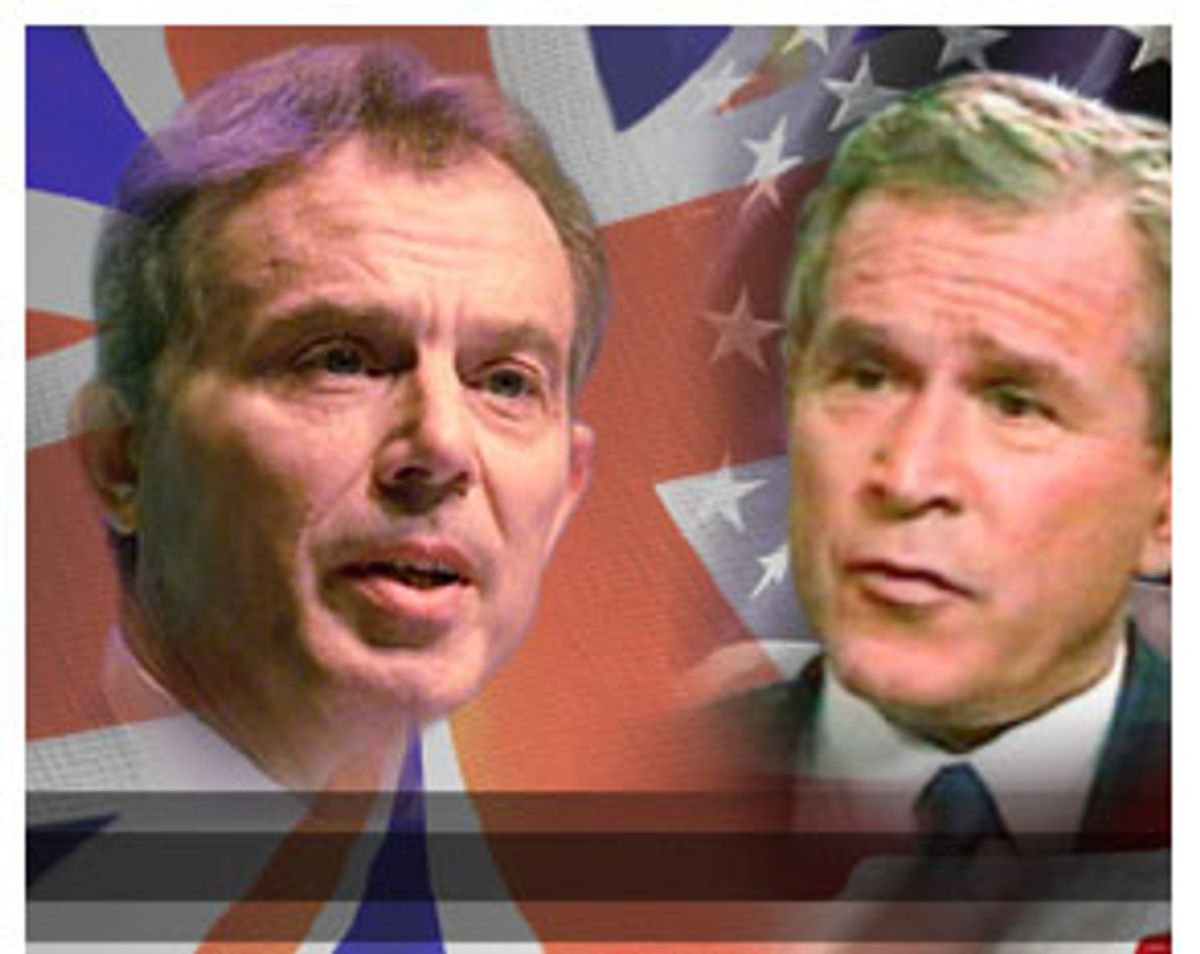
Tony Blair wouldn't come clean about his deep problems with the Bush team, making him look furtive and dishonest. And he paid the price at the polls.
Tony Blair’s nearly fatal political strategy in Britain’s election inadvertently but inevitably exposed him to the dilemma of his special relationship with President Bush. Blair had attempted to wage a campaign that skirted Iraq, which voters cited as the overriding issue in their disillusionment with the prime minister, with only about one-third willing to admit they trust him. His invitation to voters to vent their frustration at the beginning of the campaign, the so-called masochism strategy, naturally surfaced their anger over Iraq. But once he had raised the level of political toxicity, Blair simply froze.
Blair had achieved the extraordinary feat of persuading the Labor Party to transform itself into a party that wins power. But this time his ability to persuade was exhausted. When confronted with the criticism he had summoned, he offered no argument. Instead, he pushed voters away with a defiant exasperation that provoked their resistance as he challenged them to judge him. Why wouldn’t Blair persuade? Was it just weariness or ambivalence?
Blair knew that arguing over Iraq would blot out his effort to discuss his program for a third term. But his tongue was tied for other reasons as well. As the head of government, he could not speak of his disagreements with Bush. Out of loyalty to an ally, the national interest and protocol, he couldn’t acknowledge that he had urged alternative policies on Bush.
Blair never mentioned how he had wrung a commitment (honored or not) out of Bush to restart the Middle East peace process. He did not discuss how the Bush administration had systematically ignored the British representative in Iraq, Jeremy Greenstock. He did not note that Downing Street spit blood over the depredations visited on it by the bullying John Bolton and the rest of the neoconservative cabal. He did not allude to his national security team’s consternation over Condoleezza Rice’s incompetence. He did not reveal the many ways he had supported Colin Powell in his struggles with Donald Rumsfeld and Dick Cheney. Blair’s stalwart refusal to be transparent about his own good faith and positive actions contributed to his image as dishonest and furtive.
Blair’s interlocutor within the Bush administration, Powell, had a parallel quandary, and they bonded — and were exploited and tarnished together. Of course, if Blair had not joined with Bush he would have opened a large window of opportunity for the Tories. But Blair, like Powell, also convinced himself that going along in public was essential to his efforts to influence Bush behind closed doors. Every time Blair made a slight gain, like Powell, his delusion of influence was reinforced. Both undervalued their leverage.
Blair knew that Bush had no practical post-invasion scenario other than the neoconservative fantasy of a flower-strewn parade. “There was little discussion in Washington of the aftermath [of] military action,” according to the memo summarizing the report by Richard Dearlove, head of MI6, to Blair on July 23, 2002.
Before the war, Powell presented the State Department’s 17-volume “Future of Iraq” prospectus, but was ruthlessly shoved aside; Blair, cornered, felt compelled to go to war without a plan. Thus regime change was botched from the start. It was a subject he could hardly discuss in his campaign. He was perpetually cornered.
British prime ministers have misjudged American presidents to their detriment before: Winston Churchill and Franklin Roosevelt over the fate of the British empire, Anthony Eden and Dwight Eisenhower over Suez. The special relationship has been fraught by prime ministers intent on maintaining its veneer. Rumsfeld crudely drew attention to the inherently unbalanced nature of this alliance on the eve of the Iraq war when he declared that British military forces were unnecessary — “There are workarounds,” he said.
In his relationship with Bush, Blair apparently misread the outward signs of American culture and interpreted them through British eyes. Bush can be so amiable and informal dressed in blue jeans that his manner may be mistaken for openness and cooperation when it conceals a particular type of American class superiority and indifference. Bush, after all, seems so friendly compared with the glowering Cheney, who clawed his way upward. It’s not easy for someone who has never traveled in America to grasp the evolution of the Bush family from Northeast patricians to Texas Tories, and the dissolution of the New England character along the way, especially the sense of responsibility, duty and humility.
Bush’s amiability toward Blair merely demonstrates his acceptance of the prime minister into his private club. But even if Blair got Bush exactly right in every nuance, the outcome remains the same. (Chancellor of the Exchequer Gordon Brown, Blair’s presumed Labor successor, and Bush are a car crash waiting to happen. Bush has an instinctive revulsion against serious intellectuals with little capacity for the locker-room-like banter that is his mode of condescension.)
The underlying events that produced this election result provide a harsh, cautionary and unsettling lesson not only for Blair. British prime ministers to come will take the story of Blair’s embrace of a powerful ally’s mendacity and Blair’s subsequent loss of his country’s trust as a warning. Future U.S. presidents will be regarded with underlying suspicion far into the future. By chastening Blair, British voters have applied the only brake they have on Bush’s foreign policy. But the damage done to the U.S.-U.K. relationship may have incalculable long-term negative consequences for the world.
Sidney Blumenthal, a former assistant and senior advisor to President Clinton, writes a column for Salon and the Guardian of London. His new book is titled "How Bush Rules: Chronicles of a Radical Regime." He is a senior fellow at the New York University Center on Law and Security. More Sidney Blumenthal.
America’s real Hunger Games
Young people are already being sacrificed at the whims of the 1%. Just look at Iraq and Afghanistan
U.S. Army soldiers respond after a suicide attack on the US..-led provincial reconstruction team (PRT) compound in the Behsood district of Jalalabad, east of Kabul Afghanistan, on Sunday, April 15, 15 2012. (Credit: AP Phot/Rahmat Gul) When I was growing up, I ate books for breakfast, lunch and dinner, and since I was constantly running out of reading material, I read everyone else’s — which for a girl with older brothers meant science fiction. The books were supposed to be about the future, but they always turned out to be very much about this very moment.
Some of them — Robert Heinlein’s “Stranger in a Strange Land” — were comically of their time: that novel’s vision of the good life seemed to owe an awful lot to the Playboy Mansion in its prime, only with telepathy and being nice added in. Frank Herbert’s “Dune” had similarly sixties social mores, but its vision of an intergalactic world of disciplined desert jihadis and a great game for the substance that made all long-distance transit possible is even more relevant now. Think: drug cartels meet the oil industry in the deep desert.
Continue Reading CloseRebecca Solnit grew up in California public libraries and is thrilled to be revisiting them all over the state as part of the Cal Humanities California Reads project, which is now featuring five books, including her A Paradise Built in Hell: The Extraordinary Communities That Arise in Disaster. More Rebecca Solnit.
Neocons’ new lie
You thought they were gone, but now they're popping up to claim that Iraq inspired the Arab Spring
Dick Cheney, left, and Elliott Abrams (Credit: AP/Pablo Martinez Monsivais) The rulebook for conservative punditry is straightforward. Push for a policy. When it turns into a disaster, defend it. When the defense becomes untenable, ignore it. Finally, when something unrelated but positive occurs, take credit for it.
The newest conservative myth is that the upheavals in the Middle East — called the Arab Spring but occurring too in non-Arab countries like Iran — are a result of the Iraq War. The “freedom” that George W. Bush brought to Iraq had a domino effect on other countries in the region, the argument goes. Neocon Robert Kagan told Salon recently that “there were repeated free elections in Iraq and that undoubtedly had some effect on how neighboring people views their government.” Said Kagan: “I think Egyptians said. ‘If the Iraqis can have elections, why can’t we have elections?’”
Continue Reading CloseJordan Michael Smith writes about U.S. foreign policy for Salon. He has written for the New York Times, Boston Globe and Washington Post. More Jordan Michael Smith.
“War crime” delusions
A WikiLeaks video of an Iraq war massacre raises questions about international laws governing armed conflict
Still of Namir Noor-Eldeen, a 22-year-old war photographer, from WikiLeaks' Collateral Murder video Anyone who would like to witness a vivid example of modern warfare that adheres to the laws of war — that corpus of regulations developed painstakingly over centuries by jurists, humanitarians, and soldiers, a body of rules that is now an essential, institutionalized part of the U.S. armed forces and indeed all modern militaries — should simply click here and watch the video.
Wait a minute: that’s the WikiLeaks “Collateral Murder” video! The gunsight view of an Apache helicopter opening fire from half a mile high on a crowd of Iraqis — a few armed men, but mostly unarmed civilians, including a couple of Reuters employees — as they unsuspectingly walked the streets of a Baghdad suburb one July day in 2007.
Continue Reading CloseChase Madar, is a lawyer in New York, a contributor to the London Review of Books and Le Monde diplomatique and the author of a new book, The Passion of Bradley Manning (OR Books). More Chase Madar.
Our real Iraq losses
We left their nation in turmoil and our own country entangled in an endless "national security" nightmare
A man, left, inspects his destroyed vehicle at the scene of a car bomb attack in Ramadi, 70 miles (115 kilometers) west of Baghdad, Iraq, Tuesday, March 20, 2012. Officials say attacks across Iraq have killed and wounded scores of people in a spate of violence that was dreaded in the days before Baghdad hosts the Arab world's top leaders. (AP Photo) (Credit: AP) People ask the question in various ways, sometimes hesitantly, often via a long digression, but my answer is always the same: no regrets.
In some 24 years of government service, I experienced my share of dissonance when it came to what was said in public and what the government did behind the public’s back. In most cases, the gap was filled with scared little men and women, and what was left unsaid just hid the mistakes and flaws of those anonymous functionaries.
What I saw while serving the State Department at a forward operating base in Iraq was, however, different. There, the space between what we were doing (the eye-watering waste and mismanagement), and what we were saying (the endless claims of success and progress), was filled with numb soldiers and devastated Iraqis, not scaredy-cat bureaucrats.
Continue Reading ClosePeter Van Buren spent a year in Iraq as a State Department Foreign Service Officer serving as Team Leader for two Provincial Reconstruction Teams (PRTs). Now in Washington, he writes about Iraq and the Middle East at his blog, We Meant Well. His book, We Meant Well: How I Helped Lose the Battle for the Hearts and Minds of the Iraqi People (The American Empire Project, Metropolitan Books), will be published this September. More Peter Van Buren.
He was our eyes
The tragic death of Anthony Shadid has made the world a little darker
The late Anthony Shadid I was stunned and saddened to learn of the death of Anthony Shadid, the great New York Times reporter who covered the Middle East. Shadid was quite simply the best mainstream reporter working the most important foreign beat in the world. From his superb coverage of Iraq to his groundbreaking reporting on the Arab Spring, he set the journalistic standard. Shadid’s profound knowledge of the Arab world, his even-handedness, his historical sophistication, and above all his empathy for the ordinary people he wrote about, made him indispensable.
Continue Reading CloseGary Kamiya is a Salon contributing writer. More Gary Kamiya.
Page 1 of 299 in Iraq war