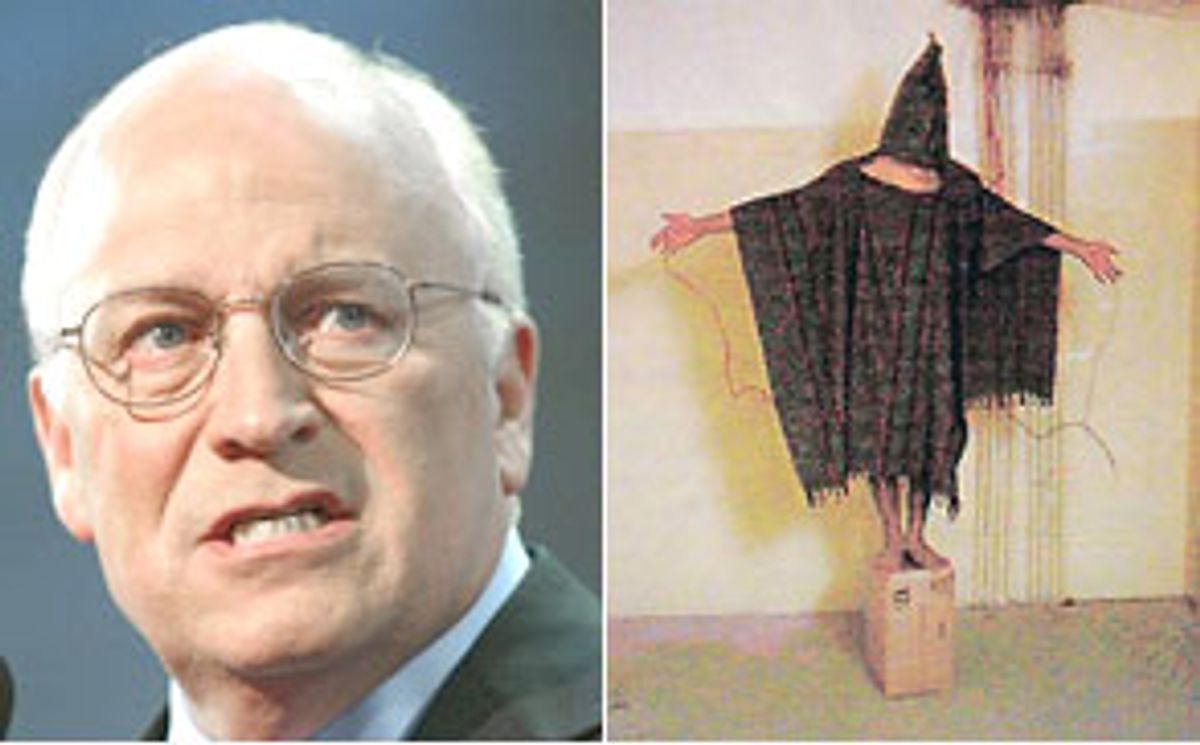
President Bush's press conference on Tuesday, at which he denounced Amnesty International's annual report containing allegations of torture by the United States as "absurd" and dismissed all such allegations as inspired by terrorists, was the crescendo of a concerted administration campaign to stifle the rising clamor on its torture policy.
Amnesty International released its report on human rights on May 25. Among other findings, it documents that some 500 detainees are being held at the Guantánamo military base. The Supreme Court ruled six months ago in Rasul vs. Bush that they are entitled to legal counsel and due process, but Amnesty noted that the detainees have not been provided with lawyers in secret administrative reviews to determine if they are "enemy combatants." And the more than 50,000 detainees being held in 25 prisons in Afghanistan and 17 prisons in Iraq are "routinely denied access to lawyers and families." An unknown number of people have disappeared into secret prisons -- having been "rendered" to U.S. allies like Uzbekistan, where torture is routine. The Amnesty report called this shrouded network "the gulag of our time," and concluded that the administration's methods are counterproductive: "The 'war on terror' appeared more effective in eroding international human rights principles than in countering international 'terrorism.'"
The Amnesty report followed on the heels of the Bush administration's blame casting at Newsweek magazine for provoking anti-American riots in Afghanistan that resulted in 17 deaths by its publication of a story that a Quran had been flushed down a toilet at Guantánamo. After the anonymous Pentagon source for the item hesitated about his certainty, the Defense Department, through its spokesman, Lawrence Di Rita, demanded that Newsweek apologize, and editor Mark Whitaker abased himself elaborately for its error. But a week afterward the Pentagon disclosed that there had indeed been five incidents involving abuse of the Quran, though not a toilet flushing. (Some further clarification may be helpful on this fine point: As it happens, the detainees don't have flush toilets but buckets.) At a press conference on the same day the Amnesty report was issued, Di Rita was asked, in light of the acknowledged Quran abuses and the apology he had insisted that Newsweek make, "Mr. Di Rita, as the Department of Defense, are you going to present your apologies to the Arab world?" Di Rita replied: "For what?"
A day later, on May 26, in a suit brought by the American Civil Liberties Union seeking information about detainees, federal District Court Judge Alvin Hellerstein ruled that 144 photographs of abuse at Abu Ghraib prison in Iraq must be publicly released. The judge stated that the "photographs present a different level of detail and are the best evidence the public can have of what occurred."
Immediately, the Bush administration launched a ferocious counteroffensive to obscure any debate about its torture policy, discrediting Amnesty's report, which was largely based on previously released official documents. The seriousness with which the administration regards the torture issue -- as a political matter -- was reflected by the senior level of the deniers. Now, the questions were not left to the likes of press secretaries Di Rita or Scott McClellan. All the voices sang in a choir from a common book of talking points. Secretary of State Condoleezza Rice hit Amnesty's report as "absurd." Joint Chiefs of Staff chairman Gen. Richard Myers called the report "absolutely irresponsible." And Vice President Cheney took umbrage at the insult: "Frankly, I was offended by it. For Amnesty International to suggest that somehow the United States is a violator of human rights, I frankly just don't take them seriously." He added that the "allegations of mistreatments" came from "somebody who had been inside and released to their home country and now are peddling lies."
The Wurlitzer of the conservative media was playing from the same songbook, but in a higher octave. On May 27, before the administration heavyweights made their statements, the Wall Street Journal's editorial page declared that the human rights report is "one more sign of the moral degradation of Amnesty International," which it labeled a "highly politicized pressure group" whose reports "amount to pro-al Qaeda propaganda."
The National Review chimed in with an article titled "Amnesty Unbelievable," charging that Amnesty's report "says much more about the nature of Amnesty International -- and the agenda of similar left-wing non-governmental organizations -- than it does about the human-rights record of the United States."
By the moment of Bush's press conference, every nuance of his response on the issue had been carefully configured and rehearsed by Cheney, Rice, Myers et al. "I'm aware of the Amnesty International report, and it's absurd," the president began. Then he repeated himself: "It's an absurd allegation." The country, he declared, is virtuous, and therefore, he suggested, his motives must be innocent. "The United States is a country that is -- promotes freedom around the world." Under him, the rule of law prevails: "When there's accusations made about certain actions by our people, they're fully investigated in a transparent way."
Bush repeated himself again: "It's just an absurd allegation." Once again, he claimed nothing had gone amiss. "In terms of the detainees, we've had thousands of people detained. We've investigated every single complaint against the detainees." Every complaint, he assured his audience, was false because the motives of the detainees are as evil as his are pure: "It seemed like to me they based some of their decisions on the word of -- and the allegations by -- people who were held in detention, people who hate America." Here, Bush turned lexicographer: "people that had been trained in some instances to disassemble -- that means not tell the truth." In conclusion he banged again on his drum: "And so it was an absurd report. It just is."
It may be of minor ironic interest that before the invasion of Iraq, the Bush administration cited Amnesty International's reports on Saddam Hussein's violations of human rights as unimpeachable texts. Secretary of Defense Donald Rumsfeld often claimed Amnesty as his ultimate authority. Now, inexplicably, Amnesty has gone over to the side of the devil. (On Wednesday, Rumsfeld assailed Amnesty as "reprehensible" and losing "any claim to objectivity or seriousness." But he admitted that some detainees have been mistreated, "sometimes grievously." Thus, according to the secretary of defense, they were not all "disassembling.")
Bush's press conference talking points apparently did not prepare him to engage particulars of the new Amnesty report: that even after the Supreme Court ruling in Rasul vs. Bush, "no detainee had had the lawfulness of his detention judicially reviewed"; that in Afghanistan, "the International Committee of the Red Cross (ICRC) had access only to some detainees in Bagram and Kandahar air bases"; and that "refusal or failure of the US authorities to clarify the whereabouts or status of the detainees, leaving them outside the protection of the law for a prolonged period, clearly violated the standards of the UN Declaration on the Protection of All Persons from Enforced Disappearance." For Bush, it seems, the devil is not in the details.
By training his fire on the new enemy -- Amnesty International, suddenly transformed from a do-gooder into an enabler of evildoers -- Bush seeks to obscure those who opposed the implementation of his torture policy: then Secretary of State Colin Powell, the senior military, the Judge Advocate General Corps and the FBI.
The conflict over that policy has pit Bush's civilian ideologues against much of the military and the national security apparatus. The policy was developed after Sept. 11, 2001, by a small group of political appointees clustered in the Office of Legal Counsel of the Department of Justice and the White House Counsel's Office. All were part of the tight-knit network of the right-wing Federalist Society, and shared contempt in principle for international law. These legal cadres produced a stream of memos arguing that the United States was not bound by the Geneva Conventions on torture, that torture even unto death was an acceptable technique, and that the president as commander in chief was beyond the confines of legal restrictions in war.
Powell, former chairman of the Joint Chiefs of Staff and representing the military's position as well as that of the Department of State, strenuously objected. His legal advisor, William H. Taft IV, argued in a memo on Feb. 2, 2002, that the United States should adhere to the Geneva Conventions because "it demonstrates that the United States bases its conduct not just on its policy preferences but on its international legal obligations." He emphasized that withdrawing from the Conventions in Afghanistan "deprives our troops there of any claim to the protection of the Convention in the event they are captured and weakens the protections accorded by the Conventions to our troops in future conflicts." But Powell lost the battle.
The application of the torture policy also stirred sharp objections from the Judge Advocate General Corps of the military, whose members are present in the interrogations of prisoners. A delegation of JAG officers brought their detailed information about torture to the Association of the Bar of the City of New York. The officers were highly agitated that they were being turned into accomplices of a policy they regarded as a violation of international law, contrary to American traditions and potentially threatening to U.S. soldiers in the field. They told Scott Horton, a partner at Patterson, Belknap, Webb and Tyler and chairman of the bar association's Committee on International Law, that Pentagon officials were pushing the torture policy and creating an "atmosphere of legal ambiguity." The JAG officers related their alarm that Douglas Feith, the neoconservative undersecretary of defense for policy, had called the Geneva Conventions "law in the service of terrorism." But their uniform objections did not stop the policy.
The latest of many official government investigations into torture -- all of which, beginning with the Taguba report on Abu Ghraib, have documented abuses -- was provoked by the objections of the FBI to incidents of torture its "shocked" agents were forced to observe. FBI agents have now been ordered by the bureau not to participate in this policy. Slivers of the new report, still being conducted by Lt. Gen. Randall Schmidt of the Air Force, have seen the light of day as a result of the ACLU suit. The FBI internal memos describe, among other details, shackled detainees who had "urinated or defecated on themselves" and one detainee "almost unconscious on the floor with a pile of hair next to him. He had apparently been literally pulling his own hair out throughout the night."
In the week before his press conference and as the Amnesty report was released, Bush expounded on his theory of communications. "See," he said, "in my line of work you got to keep repeating things over and over and over again for the truth to sink in, to kind of catapult the propaganda." His statement was an axiom to place alongside that of his chief of staff, Andrew Card, who explained in the summer of 2002, before the run-up to the invasion of Iraq, why there had been a lull in presidential public relations: "From a marketing point of view, you don't introduce new products in August."
But Bush's statement at his press conference on his torture policy is more than a case study of how his White House markets its "products." It reveals his fundamental misunderstanding of the political dimension of the war on terrorism and his failure to grasp the full range of instruments available to advance America's national interest. Bush imagines that his high-flown rhetoric about the "march of democracy" amounts to international diplomacy, but he has no concern for how people abroad can be expected to react to the continuing reports on torture. For him, any opposition becomes further proof of the righteousness of his cause. Bush has faith that he can dictate what should be perceived as fact even when it collides with facts on the ground. The talking points about his virtue prepared by his staff play to his vanity. But as he postures for the domestic political market, he undermines America's national interest in the world.
Shares