Fiction
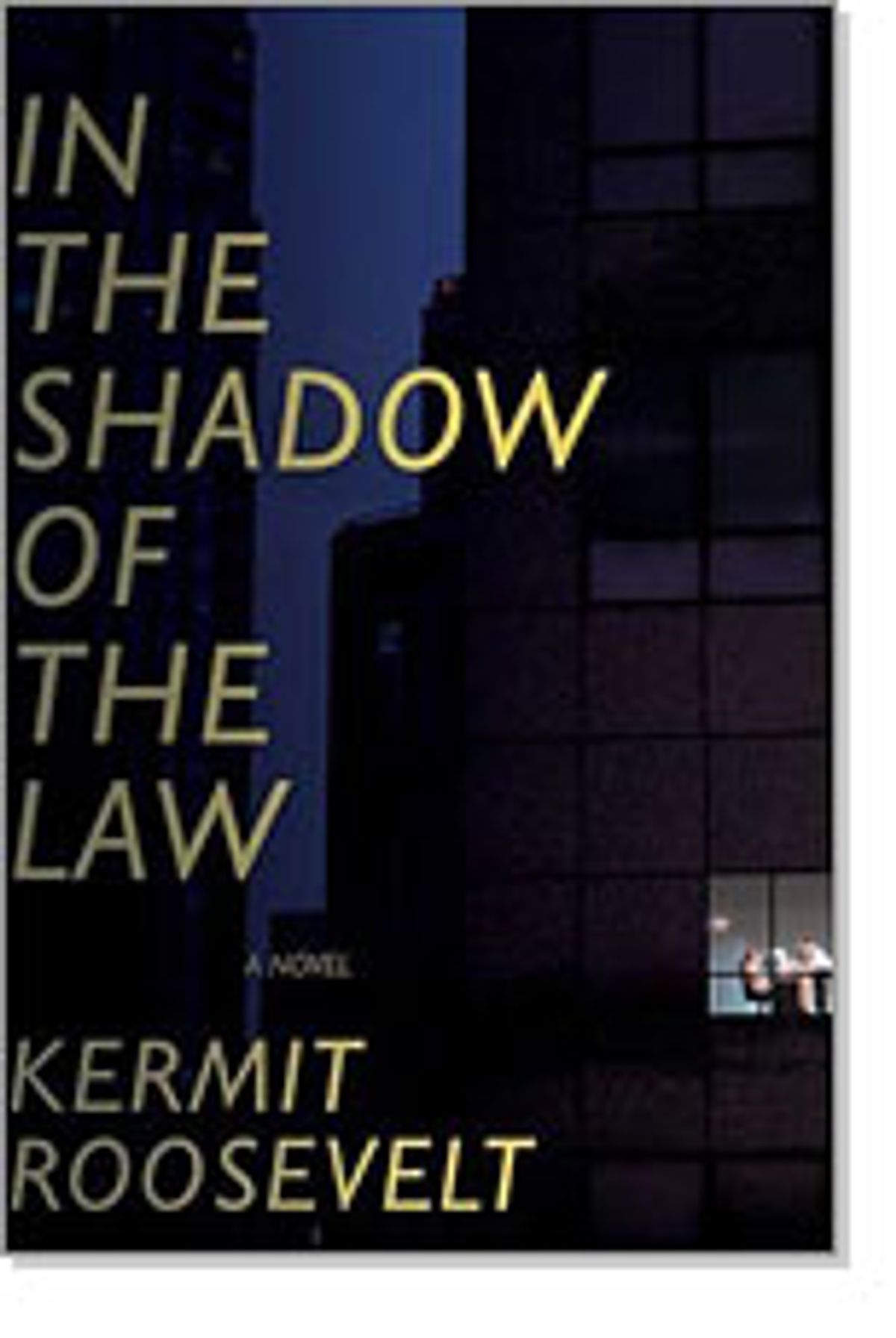
“In the Shadow of the Law” by Kermit Roosevelt
A terrifically idiosyncratic and colorful bunch of characters make this K Street thriller about corporate law a standout.
The paradox of legal thrillers is that they rely on the intrigue and drama of the law, yet they always seem to be written by people who are desperate to get out of the profession. Granted, most lawyers fall into that group, whether or not they write thrillers, but it does make for a weirdly conflicted genre.
Kermit Roosevelt’s “In the Shadow of the Law” embraces this ambivalence. The book’s characters work in one of the profession’s least exciting and heroic (if most remunerative) sectors: corporate law, on Washington’s K Street, no less. They are not, for the most part, on the side of the angels, and some of them are downright nasty. You can learn a lot from Roosevelt about how corporations protect themselves from the consequences of their deeds (and misdeeds), and about the ways the legal whizzes who help them justify their own complicity. None of this is pretty, but you have to admire the sheer, diabolical ingenuity of it.
Two cases thread through the novel: a pro bono death penalty appeal dumped on Mark Clayton, the least promising of the crop of young associates at the center of the story, and a class action suit against a chemical company whose plant explodes in the book’s first pages. The mysteries in each case unfold in clever ways, but the real fizz and pop in “In the Shadow of the Law” comes from the characters, a surprisingly vivid and idiosyncratic bunch (especially by thriller standards, which I do believe nearly disqualifies this book from the category). Roosevelt sketches them with such shrewd, witty aplomb that you feel impatient to get back to them whenever he turns to the plot.
In addition to the decent, yet hapless Mark, there’s the chronically horny Ryan Grady, who scans the downtown streets, asking himself, “How much would I have to make to get that woman to go out with me?” Ryan’s libido plays a key role in one of the book’s cases, but only accidentally. By the time he makes an unwitting discovery while trying to glimpse a female colleague changing clothes, he’s already realized that the glory days of college hookups are over and, appalled to learn that he’s not allowed to date the firm’s paralegals, he hits the books — men’s magazines, that is, studying them for tips on bedding women. “Fortunately,” he tells himself, “as with calculus, smarter people had managed to come up with formulas to eliminate the unnecessary effort.”
Like all the associates, Ryan is being milked by the firm for the maximum number of billable hours. (“It wasn’t even flattering,” Ryan thinks about the firm’s partners, in a lovely bit of tossed-off irony, “the way they’d stop him to offer assignments. He knew they didn’t see him as a person. Just a producer of billable hours, one of many, interchangeable objects of undifferentiated desire. Some kinds of attention, he was learning, were worse than being ignored.”) Leading them all is senior partner Peter Morgan, a barracuda who double-crossed his own father and will execute the novel’s most coldblooded betrayal by the end. He considers death penalty cases like the one Mark gets saddled with, “something the kids could get really excited about … like a class project or a hamster brought in to delight kindergartners … like hamsters, the prisoners usually ended up dead.”
Another partner, the litigator Harold Fineman, suffers one final spasm of conscience, which takes the form of a crush on the wearily idealistic young Katja Phillips (comparatively colorless, like all of the few women in “In the Shadow of the Law”). But the novel’s most fascinating character is the brilliant young associate and former Supreme Court clerk Walker Eliot, a savant who sees the law in something like the way Newton saw the universe, as a dazzlingly acrobatic interplay of abstractions. He’s so good “he could call the needed law into existence, do it with nothing but ink and imagination, like a cartoon character who sketches a door on a blank wall and ducks inside.”
They’re rich, they’re powerful and they’re scary, but (with the exception of the brutal Peter) you can’t help feeling sorry for the older guys who have given their lives to the firm of Morgan Siler, and you can’t help wildly rooting for the associates to get out while their souls are still intact. Maybe one of them should write a book.
Laura Miller is a senior writer for Salon. She is the author of "The Magician's Book: A Skeptic's Adventures in Narnia" and has a Web site, magiciansbook.com. More Laura Miller.
50 shades of Shutterstock
Slide show: Everyone's favorite light-bondage bestseller illustrated by inexplicable stock photography SLIDE SHOW
This week, for roughly the millionth time, E.L. James’ romance-bondage trilogy “50 Shades” nabs the No. 1, 2 and 3 spots on the New York Times bestseller lists. We don’t get it either. Every page of that book, which famously began as “Twilight” fan fiction, elicits a sigh of confusion and weird secondary embarrassment. The question is: Who would read this? (The answer is: Apparently everyone.) It’s the same baffled, helpless feeling we get when we sort through stock photos on a daily basis. Stock photos – which have been the subject of recent outstanding Internet satire – are used by this site, and many others, to illustrate our flood of content. Many are plain and simple, but a good portion are flat-out mind-blowing. Why did anyone think that photo was a good idea? It only made sense to join these forces. And so, we present to you passages from the most head-scratching bestseller of our time, illustrated with the assistance of inexplicable stock photography.
Megaphone by Natalie Bakopoulos
Miracles happen, even in an Athens crippled by a garbage strike, to a young mother unsure of her ability to love
(Credit: iStockphoto/caracterdesign) It’s the third week of the garbage strike and Athens has begun to smell. Bright-colored trash bags fill the curbs and alleyways, and we have learned to step over the rubbish and avoid the blocks that had become unnavigable. We know which stretches are particularly foul — a stretch along Mavili Square, or the entire top end of Monastiraki. Odos Athinas is a sea of trash, and Omonia is ghastly but we don’t go there anyway. May has gone from unseasonably cool to raging hot, and the garbage seems to be melting. In front of the museum it’s like yet another installation project. When I arrive each morning I want to wretch.
Continue Reading CloseNatalie Bakopoulos's first novel, "The Green Shore," will be published by Simon & Schuster in June 2012. Her work has appeared in Tin House, Ninth Letter, Granta Online, and The O. Henry Prize Stories 2010, and she is a contributing editor for the online journal Fiction Writers Review. More Natalie Bakopoulos.
Almost by Chris Pavone
She never thought of herself as ambitious, until motherhood and career collided in one horrifying hospital ride
(Credit: iStockphoto/caracterdesign) It’s just before dawn when Isabel puts the final page down on the fat stack of paper that sits on the rumpled bedspread, next to an overflowing crystal ashtray and a crumpled soft-pack of cigarettes. She’d tried Wellbutrin and Xanax; she’d used patches and gum. In the end, the only thing that made her quit smoking was being pregnant.
But then, after everything, she couldn’t help but start up again. At first it was just a single cigarette per day, or two. Then it became a few, and within months she was back to full-throttle. Over the past couple of years, she’s tried to quit a few times, but not seriously. She anticipates — she accepts — failure. Because she doesn’t want to quit, not really. She wants instead to try, and fail.
Continue Reading CloseMemorial Day fiction: Are we there yet?
Salon exclusive: At the start of the summer fiction season, new stories from Chris Pavone and Natalie Bakopoulos
(Credit: iStockphoto/caracterdesign) “Are we there yet?”
It’s a dreaded sentence. When it’s spoken by an anxious child from the back seat, it’s enough to make stressed-out parents wish they’d never taken a family vacation in the first place. And even if it’s delivered as a sing-songy punch line, from an impatient partner or spouse on a long road trip, it’s an irritating eye-roller of a joke.
So this Memorial Day weekend — the unofficial start of the summer vacation season, and therefore the summer fiction season — we asked two novelists to reclaim the sentence in a new and adult context. For our latest fiction project, there was only one simple rule: Each story had to include the line “Are we there yet?” in a fresh and surprising way.
Continue Reading CloseDavid Daley is the senior culture editor of Salon. More David Daley.
“Frankenstein” remixed
This masterful new adaptation of Mary Shelley's classic novel may be the best interactive fiction yet
Whatever interactive fiction is (and we’re still figuring that out) it suffers from all the problems of traditional fiction and then some. The vast majority of novels and short stories aren’t much good, but when a branching fiction — along the lines of the old “Choose Your Own Adventure” children’s books — fails to engage, the first impulse is to blame the form rather than the content. Let “Frankenstein,” just released by Inkle Studios and Profile Books, serve as a reproach to that reflex. The app is a creative, subtle and sensitive adaptation of Mary Shelley’s classic novella, and it has singlehandedly renewed this critic’s hopes for interactive fiction.
Laura Miller is a senior writer for Salon. She is the author of "The Magician's Book: A Skeptic's Adventures in Narnia" and has a Web site, magiciansbook.com. More Laura Miller.
Page 1 of 130 in Fiction


