Fiction
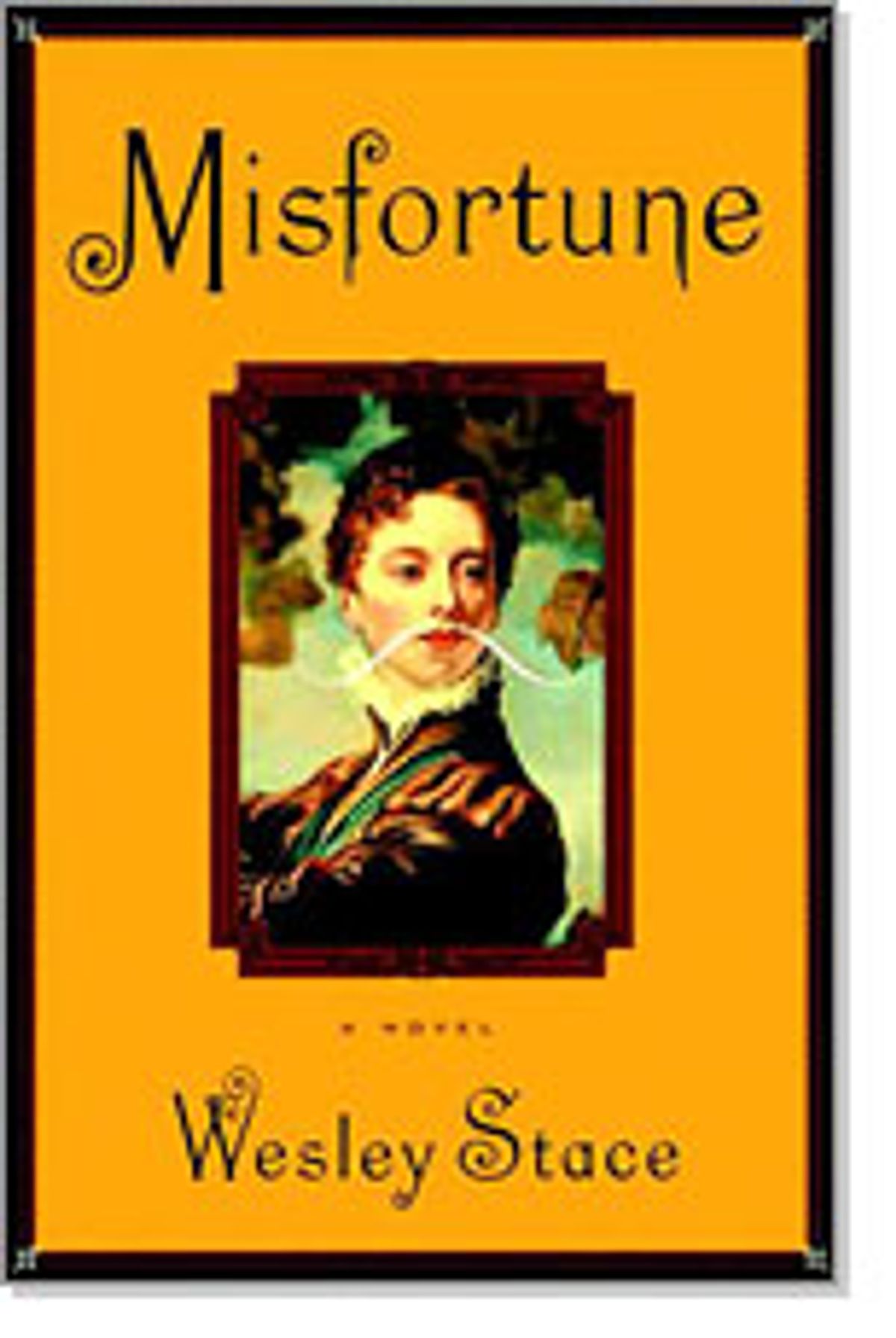
“Misfortune” by Wesley Stace
In this enjoyable 19th century potboiler with a twist, a boy is raised as a girl, and a balladeer plays a starring role in solving the mystery of her parentage.
An infant of mysterious provenance, a vast English country estate, family secrets, conspiracies, a stolen inheritance, secret codes, scheming relatives and a host of disguises — intentional and otherwise — these are the preposterous, old-fashioned devices upon which “Misfortune,” a fat novel set in the 19th century, rests. The author, Wesley Stace (aka, the singer-songwriter John Wesley Harding), makes a shameless bid to revive that silly yet satisfying genre, the Victorian potboiler, as practiced by a host of now-forgotten but once tremendously popular writers. Stace, however, adds a modern twist: This is “The Moonstone” meets “Middlesex.”
The eponymous heroine is one Rose Lovell, rescued as a newborn from the vast garbage dump where she was abandoned on the orders of a London madam and abortionist. Her savior, the effete Lord Geoffrey Lovell, is the richest man in England, still grieving for the death many years earlier of his beloved younger sister. He raises the child as his own daughter (after slapping together a hasty marriage with the family’s female librarian), and thereby fends off a battalion of horrid relations eager to get their paws on his inheritance should he die without an heir.
There is a slight problem, however: Biologically, Rose is a boy. The few people aware of this unfortunate fact refrain from pointing it out to the emotionally fragile Lord Lovell, and so the child is raised as a girl. Rose narrates most of the book, the best parts of which describe her years of typical childhood pursuits, infatuations and adventures, all overshadowed by an ever-increasing sense that something is off. When the reality of Rose’s situation can no longer be concealed, the Lovells’ ghastly relations move in for the kill.
Perhaps the freshest thing Stace brings to “Misfortune” is an appreciation for English popular ballads, the tabloids of their time, and the way balladeers wove current events and scandals into their musical tales. The works of an idiot savant balladeer play a key role in the quest to discover Rose’s true parentage, and a CD of all the songs printed in the novel (performed by Stace and a trio called the Love Hall Tryst) will be released later this year.
Granted, discerning readers will probably find Stace’s grasp of history too wobbly. Sometimes the characters behave like Victorians, sometimes as if they live during the Regency, the early era in which “Misfortune” is ostensibly set. There’s a big difference. In any case, no 19th century person would ever have uttered a sentence of 21st century grad-studentese like, “The question was one of gender, not one of sex,” and it’s hard to believe the tolerance with which even the kindest characters regard the adult Rose’s preference for wearing feminine clothes and a mustache. You have to be able to swallow a little Oprah with your melodrama to buy “Misfortune.”
Still, for the many readers who don’t care about the proper allocation of periwigs and hansom cabs, Stace has concocted a big, cheesy amusement completely unafraid to resort to the most outrageous stunts and caricatures to hold their attention. Historically, it’s about as unreliable as one of Stace’s beloved ballads, but on the upside, as a pastime, it’s also as fun.
Laura Miller is a senior writer for Salon. She is the author of "The Magician's Book: A Skeptic's Adventures in Narnia" and has a Web site, magiciansbook.com. More Laura Miller.
50 shades of Shutterstock
Slide show: Everyone's favorite light-bondage bestseller illustrated by inexplicable stock photography SLIDE SHOW
This week, for roughly the millionth time, E.L. James’ romance-bondage trilogy “50 Shades” nabs the No. 1, 2 and 3 spots on the New York Times bestseller lists. We don’t get it either. Every page of that book, which famously began as “Twilight” fan fiction, elicits a sigh of confusion and weird secondary embarrassment. The question is: Who would read this? (The answer is: Apparently everyone.) It’s the same baffled, helpless feeling we get when we sort through stock photos on a daily basis. Stock photos – which have been the subject of recent outstanding Internet satire – are used by this site, and many others, to illustrate our flood of content. Many are plain and simple, but a good portion are flat-out mind-blowing. Why did anyone think that photo was a good idea? It only made sense to join these forces. And so, we present to you passages from the most head-scratching bestseller of our time, illustrated with the assistance of inexplicable stock photography.
Megaphone by Natalie Bakopoulos
Miracles happen, even in an Athens crippled by a garbage strike, to a young mother unsure of her ability to love
(Credit: iStockphoto/caracterdesign) It’s the third week of the garbage strike and Athens has begun to smell. Bright-colored trash bags fill the curbs and alleyways, and we have learned to step over the rubbish and avoid the blocks that had become unnavigable. We know which stretches are particularly foul — a stretch along Mavili Square, or the entire top end of Monastiraki. Odos Athinas is a sea of trash, and Omonia is ghastly but we don’t go there anyway. May has gone from unseasonably cool to raging hot, and the garbage seems to be melting. In front of the museum it’s like yet another installation project. When I arrive each morning I want to wretch.
Continue Reading CloseNatalie Bakopoulos's first novel, "The Green Shore," will be published by Simon & Schuster in June 2012. Her work has appeared in Tin House, Ninth Letter, Granta Online, and The O. Henry Prize Stories 2010, and she is a contributing editor for the online journal Fiction Writers Review. More Natalie Bakopoulos.
Almost by Chris Pavone
She never thought of herself as ambitious, until motherhood and career collided in one horrifying hospital ride
(Credit: iStockphoto/caracterdesign) It’s just before dawn when Isabel puts the final page down on the fat stack of paper that sits on the rumpled bedspread, next to an overflowing crystal ashtray and a crumpled soft-pack of cigarettes. She’d tried Wellbutrin and Xanax; she’d used patches and gum. In the end, the only thing that made her quit smoking was being pregnant.
But then, after everything, she couldn’t help but start up again. At first it was just a single cigarette per day, or two. Then it became a few, and within months she was back to full-throttle. Over the past couple of years, she’s tried to quit a few times, but not seriously. She anticipates — she accepts — failure. Because she doesn’t want to quit, not really. She wants instead to try, and fail.
Continue Reading CloseMemorial Day fiction: Are we there yet?
Salon exclusive: At the start of the summer fiction season, new stories from Chris Pavone and Natalie Bakopoulos
(Credit: iStockphoto/caracterdesign) “Are we there yet?”
It’s a dreaded sentence. When it’s spoken by an anxious child from the back seat, it’s enough to make stressed-out parents wish they’d never taken a family vacation in the first place. And even if it’s delivered as a sing-songy punch line, from an impatient partner or spouse on a long road trip, it’s an irritating eye-roller of a joke.
So this Memorial Day weekend — the unofficial start of the summer vacation season, and therefore the summer fiction season — we asked two novelists to reclaim the sentence in a new and adult context. For our latest fiction project, there was only one simple rule: Each story had to include the line “Are we there yet?” in a fresh and surprising way.
Continue Reading CloseDavid Daley is the senior culture editor of Salon. More David Daley.
“Frankenstein” remixed
This masterful new adaptation of Mary Shelley's classic novel may be the best interactive fiction yet
Whatever interactive fiction is (and we’re still figuring that out) it suffers from all the problems of traditional fiction and then some. The vast majority of novels and short stories aren’t much good, but when a branching fiction — along the lines of the old “Choose Your Own Adventure” children’s books — fails to engage, the first impulse is to blame the form rather than the content. Let “Frankenstein,” just released by Inkle Studios and Profile Books, serve as a reproach to that reflex. The app is a creative, subtle and sensitive adaptation of Mary Shelley’s classic novella, and it has singlehandedly renewed this critic’s hopes for interactive fiction.
Laura Miller is a senior writer for Salon. She is the author of "The Magician's Book: A Skeptic's Adventures in Narnia" and has a Web site, magiciansbook.com. More Laura Miller.
Page 1 of 130 in Fiction


