Books
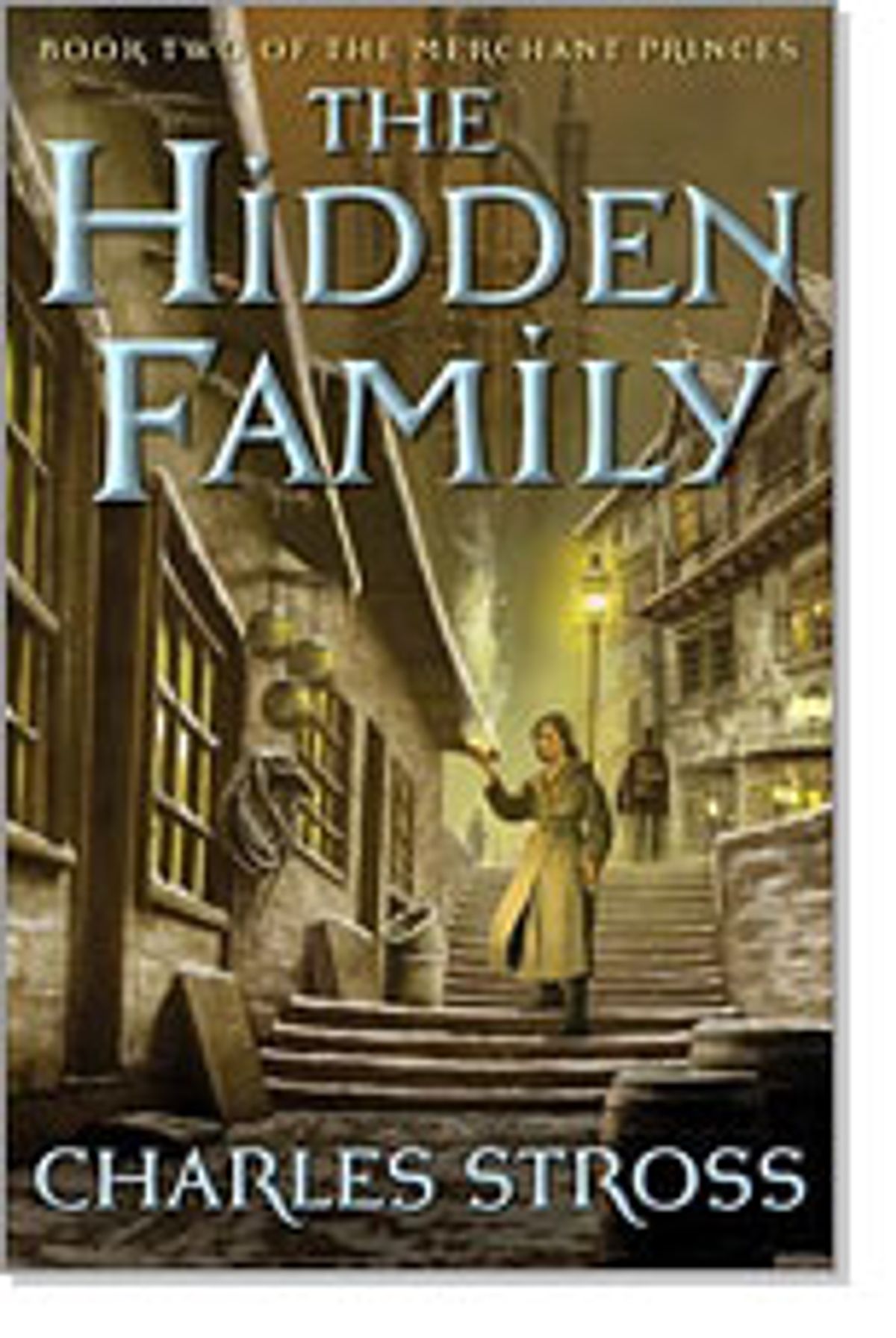
“The Hidden Family” by Charles Stross
In this second novel in "The Merchant Princes" fantasy series, past, present and future collide as investigative journalist Miriam Beckstein navigates parallel universes -- and alters the course of history.
These days, finding a science-fiction or fantasy novel that doesn’t feature a kick-ass babe who is either cybernetically enhanced, a martial arts master or a trained ninja killer (or all three) can be hard work. The genres don’t lack for Buffyesque role models.
But there’s something different about Miriam, the heroine of Charles Stross’ fantasy series “The Merchant Princes.” I read a lot of fantasy, and she’s the first investigative journalist covering the biotech venture capital scene I’ve ever seen featured in a novel that also includes travel between alternate worlds and medieval feudal lords who pack submachine guns.
It’s always a tricky maneuver, writing fantasy that attempts to connect the here-and-now world of the early 21st century to lands of magical make-believe. It’s easy enough to suspend disbelief when embarking on a journey through George R.R. Martin’s Seven Kingdoms or the Three Seas of R. Scott Bakker. We read such tours de force in part to escape mundane reality. Making a direct interface between the world of a journalist on deadline and a land of fantastical intrigue is almost an affront to the reader, directly posing the question: Come on, who would buy this poppycock?
It is a tribute to the budding powers of Stross, who works successfully in both the science fiction and fantasy genres, that he pulls off this feat in a fashion both amusing and gripping. It might be hard to imagine how the line “This isn’t an attempt to sell you shares in some fly-by-night dot-com” would have any place in a fantasy novel, but in context, it not only works, but is hilarious.
There’s more to the first two installments of “The Merchant Princes” — “The Family Trade” and “The Hidden Family” (it is essential to read the first before the newly released second) — than a plotline that focuses on a clan whose members have the ability to move between alternate worlds. There’s also a breezy exploration of capitalism and industrial development — Miriam’s expertise covering start-ups is important, because her life-or-death struggle with mysterious enemies requires her to come up with a business model that works under some very strange circumstances.
Seriously, a crucial step in Miriam’s plan to save the day in “The Hidden Family” is to introduce disc-brake technology to a backward world where Karl Marx was a crusader for democracy and the Industrial Revolution started about a century or two late. In a genre full of copycats, Stross is purveying that rarest of offerings, originality.
These are not novels drenched in magic. There really is only one fantastical element — the ability of the members of one related family to transport themselves to worlds on a different historical timeline. This family cleverly exploits this power to set itself up as a trading company — secret in our world, but economically dominant in its own land. Miriam, the journalist, turns out to be a member of the family who, for mysterious reasons, has been brought up in our world without any knowledge of her powers or origin.
Send an investigative reporter to an alternate reality, and you’re asking for trouble. Miriam is a terrific character, turning the tables on all who would attempt to manipulate her, and setting in motion events that promise to transform the evolution of no less than three separate worlds. For those of us who actually are journalists working on deadline, Stross gives us an escape fantasy that is most seductive, indeed.
Andrew Leonard is a staff writer at Salon. On Twitter, @koxinga21. More Andrew Leonard.
“The Aleppo Codex”: The bizarre history of a precious book
A reporter traces the shadowy fate of the definitive version of the Hebrew Bible
Matti Friedman An ancient and priceless book, a murky history of evasions and coverups, an underground of sinister and possibly violent dealers, a former spy who drops tantalizing hints and a wily 84-year-old millionaire who says stuff like, “The problem with this story is that it could damage your health”: Are these the ingredients for a cheesy, improbable historical thriller? Yet “The Aleppo Codex,” Matti Friedman’s account of his attempts to learn the history of one of the world’s most precious books, sports all of these assets, and it’s nonfiction. If reporting this story damaged Friedman’s health, it probably happened when he realized what he’d stumbled into and his reporter’s heart started beating in doubletime.
Continue Reading Close
Laura Miller is a senior writer for Salon. She is the author of "The Magician's Book: A Skeptic's Adventures in Narnia" and has a Web site, magiciansbook.com. More Laura Miller.
Augusten Burroughs: Conquer trauma by letting it go
Salon exclusive: The best-selling memoirist says past horrors haunt us because we think about them too much. Stop
Augusten Burroughs Many people continue to feel influenced and even controlled by the things that happened to them a long time ago. Sometimes, people harbor dark, traumatic memories from childhood. Or fragments of memories — incomplete scenes, uncomfortable feelings, perhaps even a sense of certainty that something specific and terrible happened to them, but little more than this.
Others experienced something traumatic in adulthood that continues to affect them day to day many years later. Maybe an assault has left a person afraid to leave their home or enter a particular neighborhood.
Continue Reading CloseAugusten Burroughs' many books include "Runnning With Scissors," "Dry," "Sellevision," "Magical Thinking" and "Possible Side Effects." His latest book is "This Is How." More Augusten Burroughs.
Why did we move to Paris?
Leaving New York seemed ideal. Until the crazy landlord, topless exams, the French flu, the lack of credit cards...
Rosecrans Baldwin Paris’s neighborhoods, the arrondissements, are organized like a twist. They spiral from the river like toilet water flushing in reverse and erupting out of the bowl — a corkscrew or what have you, a flattened pig’s tail, a whorling braid notched one to 20. But if you walk from one neighborhood to the next, there is little to suggest the numbers changing. So it was confusing. Anyway, if you began in the middle of the Seine and snaked around, we lived on the Right Bank in the top of the third arrondissement, called the haut Marais, the upper Marais, on Rue Béranger, a quiet little street curling down from Place de la République.
Continue Reading CloseRosecrans Baldwin is a founding editor of The Morning News. His first novel, "You Lost Me There," was named one of NPR's Best Books of 2010. His latest book is "Paris I Love You, But You're Bringing Me Down." More Rosecrans Baldwin.
Robert Caro’s bloated LBJ biography
Robert Caro's latest LBJ tome has everyone -- even Bill Clinton! -- hyping it. They've been had
“Even the President of the United States sometimes must have to stand naked.” When Bob Dylan wrote that line in 1964, the naked emperor was Lyndon Johnson, which makes that image perhaps the most disturbing in all of Dylan’s apocalyptic work.
By stripping down Lyndon Baines Johnson to his essence, Robert Caro has himself become an American legend. Since the publication of “The Path to Power” in 1982, Caro has transformed LBJ’s life into a cautionary tale of Shakespearean dimensions. In some wonky circles, the release of a new volume is heralded like the Summer of Love release of “Sgt. Pepper’s.” Can Caro possibly top his “Revolver”?”
Continue Reading Close“Bring Up the Bodies”: Hilary Mantel’s power play
The sequel to her Booker-winning "Wolf Hall" is a thrilling exploration of what it took to run Tudor England
“Bring Up the Bodies,” Hilary Mantel’s follow-up to her Man Booker Prize-winning 2009 novel, “Wolf Hall,” is a high-wire act, a feat of novelistic derring-do. Mantel makes bold not with form — by now meaningful experimentation in that area seems exhausted — but with the very material that brings most readers to novels in the first place: our imaginative identification with fictional characters and the experiences we feel we’re sharing with them.
Continue Reading Close
Laura Miller is a senior writer for Salon. She is the author of "The Magician's Book: A Skeptic's Adventures in Narnia" and has a Web site, magiciansbook.com. More Laura Miller.
Page 1 of 984 in Books