Tom Cruise

Missionary man

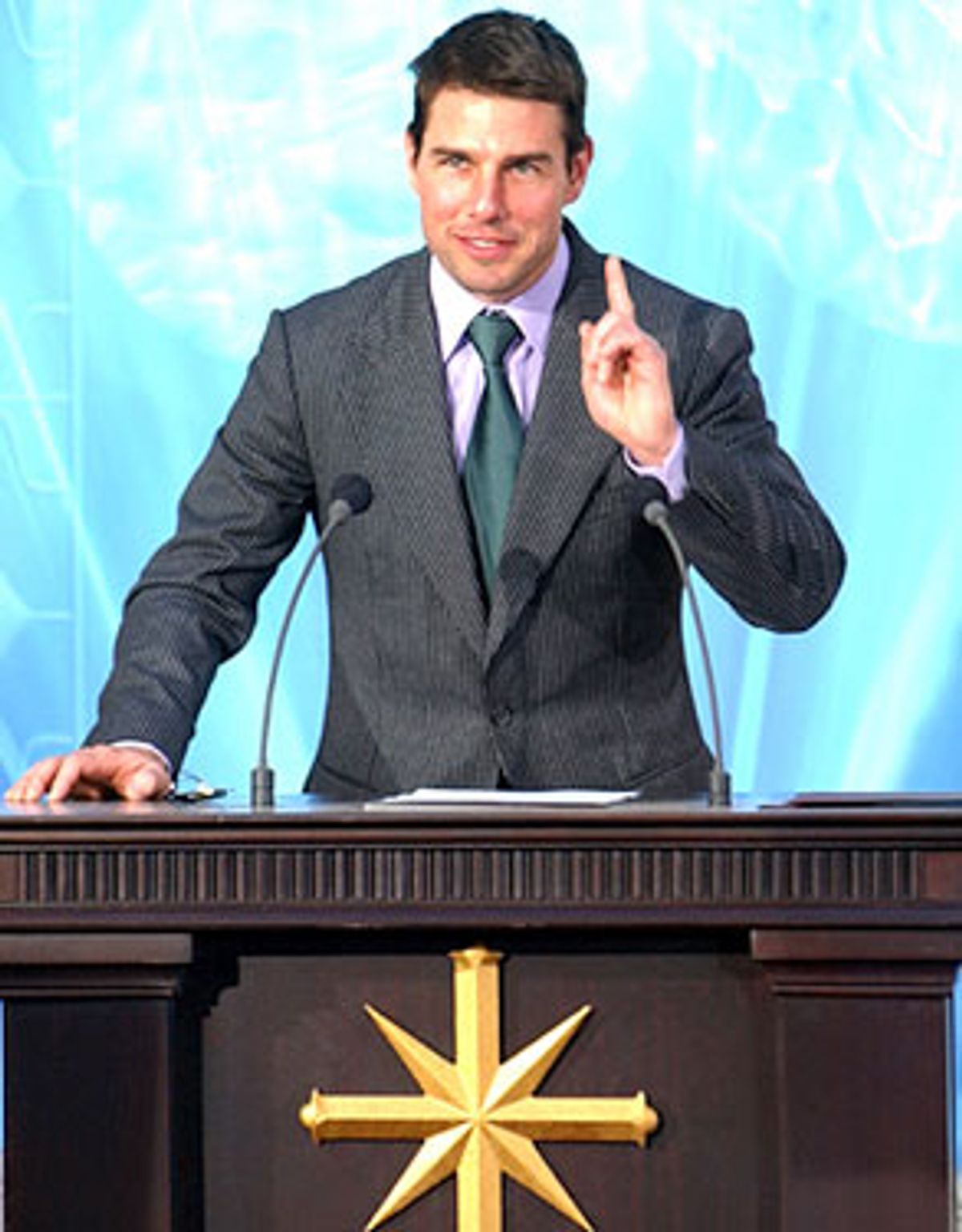
Tom Cruise has become a top proselytizer for Scientology. Is it because of a new private conviction, or a new public role for the church itself?

  • more
    • All Share Services

Missionary man

In the course of just a few months, Tom Cruise has made an astounding public leap: He has transformed himself from one of the world’s biggest movie stars into one of the oddest. It’s not just his sudden romance with and engagement to actress Katie Holmes, which has not yet managed to shake the air of improbability. There is also the matter of Cruise’s sudden outspokenness about, and even proselytizing for, the controversial Church of Scientology, to which he’s belonged for roughly 20 years.

Regarding the romance — who can explain love? It’s a mystery, particularly in Hollywood, and we’re unlikely to ever get the particulars about Cruise and Holmes. But the buzz in some Scientology circles is that Cruise may have reached one of the highest echelons of the Church of Scientology. While not a lot is known about this level, known cryptically as OT-VII, Scientology observers say that attaining it could explain Cruise’s behavior in recent months.

And that behavior has been mesmerizing: from putting up Scientology tents on movie sets to blasting Brooke Shields for using antidepressants, to promoting the church’s drug-treatment programs and, generally, to hectoring anyone who challenges him. On Friday’s “Today” show, after gentle prodding from Matt Lauer, he scolded, “You don’t know the history of psychiatry. I do.” Even his romance with Holmes has had a public Scientology veneer; Holmes has announced that she is taking Scientology courses and has added a new member to her entourage: a Scientology advisor who reportedly tells everyone she’s Holmes’ best friend.

According to experts and the church’s own literature, OT-VII (“OT” stands for Operating Thetan, “thetan” being the Scientology term for soul) is the penultimate tier in the church’s spiritual hierarchy — the exact details of which are fiercely guarded and forbidden to be discussed even among top members. It is where a Scientologist learns how to become free of the mortal confines of the body and is let into the last of the mysteries of the cosmology developed by the church’s longtime leader, science fiction novelist and “Dianetics” author L. Ron Hubbard. This cosmology also famously holds that humans bear the noxious traces of an annihilated alien civilization that was brought to Earth by an intergalactic warlord millions of years ago.

Lee Anne De Vette, Cruise’s publicist and sister, refused requests to comment for this article. And when asked about Cruise, Ed Parkin, vice president of cultural affairs for the Church of Scientology, said only, “We do not discuss the personal religious experiences of our members with the press.” Parkin also would not confirm or deny details of the OT teachings. Responding to questions about them, he wrote: “Scientology, which means ‘knowing how to know,’ is a religion based on the works of L. Ron Hubbard (1911-1986). Scientology addresses people as immortal spiritual beings. It gives them tools they can apply to their lives to improve conditions.”

But one Scientologist who left the church in 2003 after 30 years — and who had reached the OT-VII level and become a member of the church’s governing Sea Org — said it was his understanding that Cruise was very near completing, if he had not already completed, the OT-VII level. The former Scientologist would speak to Salon only on the condition of anonymity.

A current Scientologist who has reached the level OT-V, and who also spoke on the condition of anonymity, said that considering the amount of time Cruise has been in the church, an OT-VII status seems probable. And Stephen Kent, a professor of sociology at the University of Alberta who has published articles on Scientology and Hollywood, also said that Cruise’s behavior strongly suggests OT-VII.

Cruise is acting as though he “feels he’s more in control over his environment and can convince more people to look into the organization,” Kent said. “In the high OT levels one supposedly gains the skills to master one’s universe. One is removing countless entities that have been holding people back. Cruise feels that he has freed himself from thousands of errant thetans, and he seems to be in a kind of euphoria he hasn’t experienced before.”

J. Gordon Melton, the author of “The Church of Scientology” and director of the Institute for the Study of American Religion in Santa Barbara, Calif., confirmed the details of the OT teachings. “It’s basically a variation of the Gnostic myth about souls falling into matter and the encumbrances that come with that,” Melton said. “In the OTs, you’re finding out that you’re a thetan, that you’ve come into bodies before. Part of what you’re trying to learn is exteriorization — how to get out of your body. You also learn that you carry a lot of encumbrances from past lives.”

Melton, however, said that he did not believe public outspokenness about the church necessarily indicates a particular rank. The eight OT levels form the last and highest order in the intricate hierarchy Hubbard developed beginning in 1950, when his “Dianetics” was published. He named the hierarchy “the Bridge to Total Freedom.” Scientologists can only enter OT once they’ve gone “Clear,” meaning they have passed through the lower orders of the church and been shown that their personal inhibitions and flaws are the result of innumerable traumatic experiences built up over trillions of years of reincarnation.

A Scientologist becomes “Clear” by taking multiple courses and through copious “auditing,” a process in which they are counseled and encouraged by a more advanced church member to relive past traumas, with the help of an E-Meter, a device that Scientologists claim monitors brain activity. Before they’re allowed to continue on to OT, a rigorous screening process and background check are conducted, according to Melton and others. Reaching the highest OT levels usually takes from a decade to three decades, the current and former Scientologists say. Lower estimates for the total cost of this are around $30,000, but some people claim to have spent several hundred thousand dollars. The current Scientology member tells Salon he pays several thousand dollars a year for the services.

That’s a small investment if you’re Tom Cruise, who now demands $20 million per movie, or some of the other marquee names affiliated with the church, including actors John Travolta and his wife, Kelly Preston, Kirstie Alley and Jason Lee, musicians Beck, Lisa Marie Presley and Chick Corea, and Fox News anchor Greta Van Susteren. Celebrity Scientologists, like other Scientologists, do not publicly reveal their rank. But despite their vagueness on the subject, celebrities play a crucial role in the church’s image and its marketing of itself. According to Kent, beginning in the 1960s L. Ron Hubbard issued explicit directives for the church to recruit celebrities.

“There was a whole series of policies that talked about celebrities as opinion-makers,” Kent said. “He suggested to get celebrities on their way up or their way down. To get them on the way up meant, if they became famous, they might attribute their success to Scientology. On the way down meant if their careers get saved they could do the same.”

Also, said S. Scott Bartchy, director of the Center for the Study of Religion at UCLA, “They’re looking for high-profile people to say positive things about them, because they are so eager to be considered a legitimate religion, and because of all the problems they’re having abroad.” Germany, for example. And academics apparently have their own appeal: Bartchy said that high-ranking Scientologists had approached him and sent him materials in an attempt to “woo” him. (When asked about this, Parkin wrote Salon: “Professor Bartchy has told us that he gets many questions from students about Scientology and that he was happy to receive the information we have provided to help him answer them. I think you are mischaracterizing what, if anything, he may have told you to put your own spin on it. Professor Bartchy has always been very cordial with the people from the Church with whom he has spoken.”)

Cruise, who is 42, has been a member of the church since around the time of Hubbard’s death in 1986. (His first marriage, from 1987 to 1990, was to actress Mimi Rogers, also a Scientologist. His second marriage, from 1990 to 2001, was to Nicole Kidman, who is not a Scientologist.) Until recently, however, he almost never discussed his membership publicly.

That started to change a few years ago, when Cruise co-sponsored a Scientology detoxification center near ground zero in Manhattan. Last year, he had a Scientology tent set up on the set of “War of the Worlds.” He began openly boosting Narconon, the church’s drug rehabilitation program. And then last December, he was presented with the Freedom Medal of Honor by David Miscavige, chairman of the board of the Religious Technology Center, one of the church’s elite committees and, according to Melton and others, Hubbard’s hand-chosen successor.

This spring, Cruise kicked things into high gear. He Zorba-ed Oprah’s couch, and then he worried about his “Endless Love” costar Brooke Shields’ mental health, criticizing her publicized use of antidepressants to battle postpartum depression and implying they might have caused her career to decline (Scientologists strongly oppose the use of antidepressants and other behavior-modifying drugs). He plopped a Details reporter on the back of his futuristic new motorcycle and sped her to three different Scientology facilities, where he extolled the faith — for six hours. In an interview he and Steven Spielberg gave to the German paper Der Spiegel in April, Cruise defended Scientology, saying: “I’m a helper. For instance, I myself have helped hundreds of people get off drugs. In Scientology, we have the only successful drug rehabilitation program in the world.”

Then he burst into full Tom Joad mode: “If someone wants to get off drugs, I can help them,” he declared to the interviewer. “If someone wants to learn how to read, I can help them. If someone doesn’t want to be a criminal anymore, I can give them tools that can better their life. You have no idea how many people want to know what Scientology is.”

When he was asked by Entertainment Weekly this month why he’d suddenly become so vocal, he insisted: “What choice do I have?” Then he declared: “People are being electric-shocked. Kids are being drugged. People are dying.” In the same interview he supported the Scientology claim that psychiatry is a “Nazi science” and advanced several erroneous myths, which the E.W. editors helpfully pointed out in brackets:

“Jung was an editor for the Nazi papers during World War II. [According to Aryeh Maidenbaum, the director of the New York Center for Jungian Studies, this is not true.] Look at the experimentation the Nazis did with electric shock and drugging. Look at the drug methadone. That was originally called Adolophine. It was named after Adolf Hitler. [According to the Dictionary of Drugs and Medications, among other sources, this is an urban legend.]”

Cruise may now feel free to counsel others with a rare degree of authority. But sadly, Holmes may not be able to benefit much: The church forbids its OTs, even celebrities like Cruise, to discuss what they’re learning with lower members. Indeed, OTs are not allowed to discuss their secret knowledge even with each other.

Asked why he couldn’t discuss the details of OT teachings with anyone, including his peers, the current Scientologist said: “It’s confidential. And that’s the way that Mr. Hubbard wanted it. They’re not ready for it.”

The church claims that it has as many as 10 million members worldwide, but critics have suggested the actual number is far less. Melton said that the number of OT-VIIs and OT-VIIIs is in the hundreds. After years of study and introspection, achieving OT is supposed to create the kind of euphoria Kent referred to.

“The OT levels improve a person’s life,” said the current OT-V Scientologist, who did not want to be named. “All I know is I went through it and it changed my life dramatically. There is so much ‘case’” — a Scientology term meaning, essentially, mental blockage — “a person has. Reactivity, aberration, things that are not you. The Bridge gets rid of all that stuff. I have the ability to show love to anyone — from presidents down to bums. I can show love for anyone because I admire that being.”

OTs are also warned that any vacillation from the courses and auditing can be dangerous. “Beginning with OT-III, you’re taught that if you don’t follow the prescribed steps precisely, you could become very sick,” said the former OT-VII member. He stressed that he was not a critic of the church but had left because of personal differences.

Adding to all that stress is a series of very heavy theological revelations that begin with OT-III. The central creation story, according to Melton, Bartchy, Kent and the former member, is this: About 75 million years ago, a nefarious intergalactic warlord called Xenu rounded up the inhabitants of numerous planets, killed them, and brought them to Earth, then set off a chain reaction of cataclysmic volcanoes (the volcano pictured on the “Dianetics” cover was Hubbard’s favorite symbol for the notion of breakthrough and self-actualization), which dispersed their thetans into the atmosphere. These thetans now fester inside the bodies of all humans. They are to be located in specific body parts and summoned out.

“Part of the problem is how literally that is to be understood,” Melton said. “There are those who take it quite literally and those who don’t take it literally at all.” Then there is the problem of the church’s alleged treatment of OTs who have attempted to abandon the faith. Celebrity or not, an apostate Cruise might run into trouble.

“I doubt that Travolta or the other celebrities know what I know from people of how they’re treated when they try to leave,” Bartchy said. “What is probably told to the celebrities is that these are just very disgruntled people who aren’t to be taken seriously.”

Melton said only, “If you were a high-ranking member and simply said, ‘I’m quitting, bye,’ they look on you with a certain amount of animosity.”

How does the church respond to such criticism? “I am aware that a small cadre of anti-religious extremists are trying to generate hostility against Scientology by disseminating lies about it,” Parkin wrote in response to questions about the OT teachings and church policy. “This little group of insignificant people are the only ones in the world who are obsessed with extracting and altering out of context bits of esoteric data about Scientology and using it to create prejudice against Scientology through reporters such as yourself who buy into their agenda.”

If all of this is not too much to bear for Holmes or others contemplating Scientology as a religious choice — as it seems not to have been for Cruise — the process, at his level anyway, may prove quite enjoyable. According to “What Is Scientology?” a book put out by Bridge Publications, the church’s lucrative publishing arm, part or all of OT-VII and OT-VIII must be performed in the church’s headquarters in Clearwater, Fla., or aboard the Freewinds, a ship that houses parts of the church’s upper management. Happily, the weather makes up for the deprivations of sea life: The Freewinds is usually docked off the Caribbean island of Curaçao.

But should either of them decide to leave Scientology one day, Cruise and Holmes may also find themselves in a contractual bind. Scientologists are strongly encouraged to sign covenants of faith. And these aren’t contracts for the uncommitted; according to Melton, Kent and the current Scientologist, the most fervent covenant — which is common — has a duration of 1 billion years.

James Verini is a writer in Los Angeles.

“Mission: Impossible — Ghost Protocol”: At long last, the year’s best action flick

Don't count out the star or the franchise! The latest "Mission: Impossible" is a terrific holiday surprise

  • more
    • All Share Services

Tom Cruise in "Mission: Impossible - Ghost Protocol"

Take an aging star often viewed as a weirdo, a director who’s never made a live-action film and the fourth installment of a 15-year-old movie franchise whose roots go back to 1960s television. What do you get? Well, it certainly could have been a total disaster, or an awkward nostalgia exercise, but instead “Mission: Impossible — Ghost Protocol” is something even more unlikely: the most exciting action flick of the year, by a huge margin. Director Brad Bird brings all the wit, style and imagination of his animated films (“Ratatouille,” “The Incredibles” and “The Iron Giant”) to this slick secret-agent techno-fantasy. As for 49-year-old Tom Cruise, he’s surely ready for a comeback after weathering the worst publicity of his celebrity career. He’s back in his comfort zone here as renegade super-spy Ethan Hunt, who is exactly the kind of charismatic, overamped control freak we all believe (rightly or wrongly) that Cruise is too.

I’m not going to claim any degree of redeeming social value or trenchant political critique in “Mission: Impossible — Ghost Protocol.” It reflects a 21st-century climate of profound paranoia, high-tech espionage and renewed superpower tension between Russia and the United States, and that’s all accurate enough. But Cruise, as the executive producer who controls this franchise, is crafty enough to avoid anything that smacks of ideology; the bad guy here isn’t an Arab jihadi or a Moscow crime lord or a deranged American general or anything like that. Indeed, he’s almost a standard-issue Bond-style supervillain: Hendricks, aka Cobalt (Michael Nyqvist, of the Swedish “Dragon Tattoo” trilogy), is a Scandinavian scientist gone nutso, who has decided that the only way to save civilization is to erase it with nuclear war and start over again. (I find myself strangely willing to entertain this argument, on the intellectual plane — but the surgery required does seem radical.)

As the story begins, Cruise’s Agent Hunt is out of the picture, moldering in a Russian prison on unknown charges. (Remember, any IMF agent who gets caught is disavowed by the U.S. government: “Who, him? No idea; total bad apple. Go ahead and lock him up.”) Another team of agents, headed by newcomer Jane Carter (Paula Patton) and Anglo tech-geek and comic relief Benjy Dunn (Simon Pegg), run a mission that goes badly wrong in Budapest, thanks to an ice-blond French assassin (Léa Seydoux). Then they’re sent to Russia to spring Hunt from prison, in the first of several terrific action set pieces, whereupon they pick up their next assignment, a self-destructing video message (of course) in a decrepit Soviet-era phone booth (of course). It’s a simple mission: Break into a high-security archive inside the Kremlin and extract some important records before Cobalt gets them.

I shouldn’t give away much more, except to say that however ingenious and delightful the IMF’s plots and schemes are in this part of the movie, Cobalt is a step ahead of them the whole time. He sabotages their Kremlin break-in in spectacular fashion, not merely staging a headline-grabbing terrorist attack but making it bear the fingerprints of Ethan and friends and pushing the Russians and Americans right to the brink of war. This initiates “Ghost Protocol,” as Tom Wilkinson helpfully explains during a brief appearance as “the Secretary,” a shadowy U.S. government official in charge of the superspooks. Instead of pretending to be unauthorized, now the IMF team really is unauthorized. They’re supposed to stop Cobalt from blowing up the world, but without any government support or sanction or information, covert or otherwise.

Bird’s direction has such brio, and Cruise’s performance as the unkempt, long-haired version of Ethan is so relaxed and charming, that even when “Ghost Protocol” resorts to empty showmanship it feels like good fun rather than pure pandering. (The impressive cinematography, much of it in huge-format IMAX, is by Robert Elswit.) Oh, I could explain how and why Ethan winds up climbing the outside of the Burj Khalifa in Dubai, currently the world’s tallest building, using only magnetic “gecko gloves” that don’t quite work as well as advertised. But does it really matter? It’s a dazzling sequence with a smashing conclusion, that left the audience of cynical Manhattanites, at the preview screening I attended, first breathless and then cheering. (Cruise is such a madman that much of what we see in the film is really him stuck to the windows of the 2,700-foot skyscraper, although I’m not saying that stunt work and digital trickery aren’t also involved.)

First of all, Hunt, Carter and Dunn — joined by Jeremy Renner as Brandt, a CIA analyst with a troubled past — try to run a complicated sting on Cobalt, who is meeting the French killer-babe assassin in Dubai to haggle over stolen Russian nuclear codes he needs to launch his yearned-for Armageddon. Then there’s a pulse-pounding chase, on foot and by sports car, through a zero-visibility sandstorm. And then — what the hell? — the tour of nefarious night spots of the developing world moves on to Mumbai, where a lecherous Indian tycoon (Anil Kapoor) hosts a lavish party, Renner’s character dons magnetic chain-mail underwear, and Cobalt hopes to use a second-string telecom satellite to launch a Russian nuclear strike on San Francisco. (I wouldn’t call Josh Appelbaum and André Nemec’s screenplay profound drama, but it conceals its twists artfully.)

My only questions about Brad Bird as a director are: 1) Why the hell has he only made three movies in 12 years; and 2) If Tom Cruise saw that he could do this, why didn’t anybody else? Given Bird’s excellent animated features, you’d expect him to be adept with humor, character byplay and rapid-fire storytelling, and you’d be right. (He does especially well using Pegg’s character as the foil who continually punctures the hardass atmosphere.) But this movie has not just one or two but four or five of the most coherent and exciting action sequences in recent history, culminating with a beautifully choreographed final face-off between Cobalt and Ethan in a vertical Mumbai parking garage. Looking back at the “Mission: Impossible” franchise, each of the films has had a strong directorial signature, beginning with Brian De Palma’s 1999 original and continuing with subsequent entries by John Woo and J.J. Abrams. Whether “Ghost Protocol” is the best in that expensive series of helicopter shots and exploding speedboats is up for debate, naturally, but it’s pretty doggone close. This is pure escapist cinema at its best, without morality or apology or guilt.

“Mission: Impossible — Ghost Protocol” is now playing worldwide in IMAX theaters only, with wide release to follow beginning Dec. 21.

Continue Reading Close

Jessica Chastain: The dazzling redhead who's suddenly everywhere

After "Tree of Life" and "The Help" -- and with six more movies on the way -- Jessica Chastain's moment has arrived

  • more
    • All Share Services

Jessica Chastain: The dazzling redhead who's suddenly everywhereActress Jessica Chastain of the U.S. poses for photographers as she arrives on the "Wilde Salome" red carpet at the 68th Venice Film Festival September 4, 2011. REUTERS/Alessandro Bianchi (ITALY - Tags: ENTERTAINMENT PROFILE TPX IMAGES OF THE DAY)(Credit: Reuters)

Jessica Chastain may not yet qualify as a movie star, but within seconds of meeting her you completely understand why every casting agent in Hollywood is convinced she will become one. To put it bluntly, she is dazzling — and I’m talking more about her manner and presence than her beauty, although she’s exceptionally pretty, with flaming red hair and pale, translucent skin. She’s vivacious and charming, seemingly without effort, and has the kind of spectacular smile that uplifts everyone’s spirits within a 50-foot radius.

It makes you wonder where all those casting directors and filmmakers who so desperately want Chastain in their movies now were a few years ago, when she was a little-known television actress whose biggest part had been a four-episode role on “Law & Order: Trial by Jury.” There are no answers beyond the usual clichés: Showbiz is full of pretty faces, and sometimes all it takes is one little break. Chastain’s break was pretty big, and came when Terrence Malick cast her opposite Brad Pitt in “The Tree of Life,” where her shimmering, ethereal presence created a thematic and visual balance to Pitt’s intense, compulsive, authoritarian father-figure.

But “Tree of Life” was only the tip of the iceberg, and the 30-year-old Chastain has most definitely been making up for lost time. In terms of audience appeal, her biggest role has been as Celia Foote in “The Help,” the hapless, white-trash-made-good housewife who was both that film’s comic relief and, in an odd way, its most honest and unaffected white heroine. The scene when Celia insists on eating lunch in the kitchen with her African-American maid (Octavia Spencer) — who is none too sure she wants to be friends with this high-maintenance, neurotic white lady — was arguably more moving than “The Help’s” more histrionic race-relations drama.

It’s not much of an exaggeration to say that Chastain seems to suddenly be in every upcoming film. Within the last year or two, she has played a Mossad agent (the younger version of Helen Mirren) in “The Debt,” a detective in the serial-killer drama “Texas Killing Fields” (out next month), Virgilia in Ralph Fiennes’ version of Shakespeare’s “Coriolanus” (to be released this winter) and Salome in Al Pacino’s meta-theatrical “Wilde Salome,” which premiered in Venice a few days before I met her at the Toronto International Film Festival. Her big-budget Hollywood breakthrough may lie just ahead, since she will reportedly star opposite Tom Cruise and Olivia Wilde in “Horizons,” an interplanetary science-fiction thriller from “TRON: Legacy” director Joseph Kosinski.

Then there’s “Take Shelter,” an intense psychological horror drama from indie director Jeff Nichols — looking for his own breakthrough after the 2008 underground sensation “Shotgun Stories” — which Chastain was promoting in Toronto. I’ll have more to say on this film very soon, but it’s an absolute knockout, one of the best American films of the year. Chastain and the remarkable Michael Shannon play Samantha and Curtis, a married couple in small-town Ohio clinging to the lower edges of the working class. It’s very much a film about this moment in America, a film about economic recession and madness and faith and family, even  climate change and disastrous weather. Samantha must decide whether to cling to Curtis or flee from him as he goes through a breakdown and suffers from disturbing, apocalyptic visions — which may just have some basis in reality.

So, Jessica, you’ve had this amazing run of movies. I understand you can pull up the list in your mind pretty easily.

Yes! Let’s see, there’s “Tree of Life,” “The Help,” “The Debt,” “Take Shelter,” “Texas Killing Fields,” “Coriolanus” and then “Wilde Salome,” which just played in Venice. So six films that have already come out or are coming out, and seven if you include that one.

And you just finished shooting at least one other movie. Or two, if we count Terry Malick’s next film as well.

Yes, I just finished working on “The Wettest County in the World.” I’d be surprised if that came out this year.

That’s John Hillcoat’s film, right? Another collaboration with Nick Cave. (They made the 2006 Aussie western “The Proposition.”)

Yes! And I’m so excited about this film. I keep telling everyone that the acting, across the board is — oh, my gosh — every performance was mind-blowing. It’s got Guy Pearce, Tom Hardy, Shia LaBeouf, Gary Oldman, Mia Wasikowska. The ensemble is sick.

Can you actually keep all these movies clear in your head? I mean you come to a festival to help out some movie you shot a long time ago, and people like me ask you to remember specific episodes or specific scenes.

I mean, sometimes it’s hard. I don’t have a problem remembering the films, because they’re all like children at a certain point. But when people say, “Can you tell me a funny story, something that happened on set?” And you’re like, oh God, from “Tree of Life”? That was three years ago. So trying to think of a funny thing that happened, that’s a bit tough. Other than that, I remember them all like my beloved children.

Right. What about if I’m, like, “What was going through your mind in this scene? Why does your character do that?”

Oh, I’ll remember that forever, yeah. With the characters that I play, I absolutely know them and the psychology of where they come from. What they deal with every day, what their fears are. I don’t think I’ll ever lose that.

Well, you’ve been picking winners. It’s such a terrific list. In “Take Shelter” and “Tree of Life” and “The Help,” you play these really different women who are touchingly, doggedly loyal to very difficult husbands. That’s not much of a connection, maybe, but I do feel a kinship between Mrs. O’Brien in “Tree of Life” and Samantha in “Take Shelter.” Do you see it that way?

You know, I see more difference between these characters, because Mrs. O’Brien in “Tree of Life” is the representation of grace, whereas I feel like Samantha in “Take Shelter” is closer to nature. She has a lot of nature in her. The most dangerous animal in the wild kingdom is the mother grizzly, or, like, the female tiger. They’re the ones who do all the killing. I think Samantha is more like that. Nobody messes with her family, nobody hurts her child. In fact, she reacts with violence, she hits her husband in the face. She’s very, very strong. She’s the head of the household, really. He makes the money, but she makes the rules. For me, they are completely different women, but I can understand what people see there: They’re both women who stick with their husbands, they’re both powerful and committed mothers.

A lot of people talk about Terry Malick’s methods, and about his unwillingness to discuss the film too much. I wonder if that was a big difference between these roles, working with him versus working with Jeff Nichols. Because these are two powerful and disturbing films that have an allegorical quality.

Actually, when we did “Tree of Life” we talked about it a lot. I had the script and I knew exactly what the film was when we were making it. I was very much a part of that conversation. I think people who say they’re not sure are usually people who come in for a couple of days. I just had that experience recently on Terry’s new film. I don’t know what the film’s about, I never read a script, and I came in for less than a week! It was strange going from “Tree of Life” to this thing where I had to say, “I have no idea what I’m doing, but fine!”

“Take Shelter” was really different. We had no time to shoot this film! So we couldn’t have a lot of discussion. We really had to be quick. I met Mike [Shannon] on Saturday night, I think it was. On Sunday, we hung out with Tova Stewart, who plays our daughter, for a little bit, and then on Monday we were filming the doctor scene that comes at the end of the film. We had never met before, and for a movie that Jeff says is about marriage and faith, that’s a scary thing. You go in there and you think, OK, I have to make this relationship as real as possible. We don’t have time to be polite, we just have to be honest.

Did you have to do that classic actor thing, where you identify ways the character is like you, and work from that?

Not really. I kind of felt Sam before, I understood her journey. I’d had the script for a while, but I was mostly concerned with the relationship between Mike and me, between Curtis and Samantha. I mean, the whole film hinges on this relationship. What does this man have at stake, what does he stand to lose? If that’s not there or that’s not strong, then the film doesn’t work. Jeff even told us that there’s a look between Samantha and Curtis at the end of the film, at the very end. And if that look doesn’t work, the whole film falls apart.

I agree with that, and that’s really a devastating moment between them. Talk about the way Samantha changes, and this relationship changes. Because I think this is one of the most interesting screen depictions of marriage I’ve seen in a long time.

What I really like about the dynamics of what we play is that in the very first scene, we don’t even look at each other. It doesn’t mean we’re not in love, but I find that really honest. These are people who’ve been together a long time, they’re going about their day and saying, “Oh, don’t forget to pick up this thing. We’ve got to be here at this time.” There’s no time for, like, “Hello, darling.” Which sometimes you see in films, let’s show that they love each other: “Hello, my love.”

We’re being as realistic as we can, and then at some point there’s this change where she starts to look at him, and realizes something’s wrong. It’s like, how long have I not seen this? How long has this been going on? She’s wondering, have I been taking this relationship for granted? All of a sudden he’s somewhere else, and I don’t know how he got there.

To me, the most important shift in Samantha’s character is after the ambulance comes to the house [after Curtis suffers an apparent seizure in the middle of the night]. Then there’s a scene where Curtis lays everything out on the table. Before that, I think Samantha was heartbroken and thought their relationship was over. There was no communication left, and the closeness they had was gone. After that scene, when he shows such great faith in her, in telling her this and trusting her to be there, she in turn shows great faith in him. Even when something happens later and she feels like he hurts her daughter and she hits him, she still shows faith in this man, like she knows he’s beyond his own actions and behavior.

Often marriage is portrayed in the movies with these very even, steady arcs. Either the people are pulling apart, pulling apart, until it’s over or they have one big crisis and then get back together. This marriage has a lot of wobble, a lot of give and take. It shifts back and forth.

Yeah, absolutely. After that moment where I hit him — and I hated doing that scene, because I hate violence and I love Mike! I don’t want to hit him in the face! — after that scene, when she decides to come back, she lays everything out on the table. It’s not like [overdramatic voice], “I love you, my darling!” I loved that, and it’s not the expected idea of, you know, we just had a fight and let’s make up, in Hollywood. It’s not until the fish-fry scene, when they’re in public and she has demanded that he be there, that she truly understands the place where he has gone. [Curtis suffers a major public breakdown in that scene.] And from then on, she needs to act with the utmost compassion that she can muster.

That scene is something, as people will soon discover. Michael Shannon is a very powerful actor all the time, but that’s like watching a volcano erupt. We’ve been waiting for it and waiting for it, we know it’s going to happen, and then — oh, man.

It was amazing. He’s such a brilliant actor. After the very first take of that scene, all the people applauded. All the extras, and I was like, “No, you’re supposed to be scared of him! Don’t clap!” He’s one of those actors — it’s undeniable, his talent. He has so much intensity and power physically, because he’s a big guy, but also he’s got this great face and these amazing eyes. There’s such strength in him, and that masks this really intense vulnerability, this epic vulnerability. He’s got both, and that’s really exciting — to be in a scene with somebody who can muster such great strength and such vulnerability.

Let me ask this the right way: The end of “Take Shelter” is very ambiguous, and I’d like to hear your opinion. Without giving too much away, is Samantha entering his reality, maybe his madness? Or is what we see happening at the end of the movie really happening in the outside world?

I don’t want to answer that question.

I didn’t really think you would.

No! [Laughter.] I guess it’s because — and I found this out with “Tree of Life” — when I answer questions, it’s not as interesting as an audience member solving it for themselves. I made a mistake at Cannes, after someone saw “Tree of Life” and totally loved it, and then they asked me something. I answered the question and, like, you could see them going, “What?” They were so disappointed with my answer! I was like, whoops, I learned my lesson right now.

Well, if they were asking you the question, it probably means they already thought they knew the answer.

Exactly! They have an opinion about what it is, and they want me to validate their opinion. They want me to agree with them so they can say, “Oh! I was right!” But if you say something else, they’re wondering, maybe I didn’t get the movie, maybe I didn’t understand it. It’s more interesting when we see ourselves in films, when they move us on a personal level. For me to impose what I think it is robs the viewer of that experience.

“Take Shelter” opens Sept. 30 in New York and Los Angeles, with wider national release to follow.

Continue Reading Close

Pop Torn: 10 pieces of culture we’re feeling iffy about

We're on the fence about: Cats that act like dogs, Justin Timberlake's drug use, Tom Cruise's singing and more

  • more
    • All Share Services

Pop Torn: 10 pieces of culture we're feeling iffy about

1. Natalie Portman is now a mommy: The “Black Swan” had a little duckling this week that she is naming god knows what. Probably something odd though … that’s how celebrities are, you know?

2. Speaking of which: Robin Williams named his daughter Zelda because he liked the video game.

3. Gwyneth Paltrow just can’t stop being “Glee”-ful: The GOOP founder showed up at the live show on Thursday night in New Jersey to sing “Forget You.” Again? Again.

4. Justin Timberlake on marijuana: He smokes it!  Alert the presses!

“The only thing pot does for me is it gets me to stop thinking,” the “Bad Teacher” star explains. “Sometimes I have a brain that needs to be turned off. Some people are just better high.”

5. Katie Holmes continues to be a robot: Latest sign the actress has had a lobotomy? Going on record to say her husband, Tom Cruise, has an “incredible” voice.  You mean this guy?

6. She will never have to deal with bullies again: Leslie Taylor’s sweet 16 party included performances by Jay-Z and Kanye.  And what did your parents get you? (It better be a pony.)

7. Just call them the Spooky Lips: The Flaming Lips played Pink Floyd’s “Dark Side of the Moon” at the Hollywood Forever Cemetery this week. Then they raised the dead and had a party (not necessarily in that order).

8. Ladies, get ready: Turns out we’re more likely to get divorced if we had sex at a young age, and we’re still really terrible drivers.

9. John C. Reilly is not joining “The Hunger Games”: So sad. But has not said anything one way or another about joining “Game of Thrones” next season. Just sayin’.

10. Dogs that like cats that like dogs that like cats: And are having one hell of an identity crisis this week:

Continue Reading Close

Drew Grant is a staff writer for Salon. Follow her on Twitter at @videodrew.

Why do so many people dislike Katie Holmes?

The star inspires vitriol -- and fascination -- because she's the perfect mom we all know

  • more
    • All Share Services

Why do so many people dislike Katie Holmes?Katie Holmes

Is Katie Holmes truly so terrible? Well, she’s probably not all that great. In recent weeks, she’s been the subject of toxic rumors that her new thriller, “Son of No One,” was such a bomb at Sundance that audience members stormed out — a tale eagerly lapped up by legitimate news organizations like Reuters. The Hollywood Reporter observed, “When Katie showed up on screen, there was a collective groan. She plays the wife of a Queens cop and she was completely miscast. They have her cursing a lot. And when she swore, there were chuckles.”  And even though other critics who attended the screening have since offered differing accounts of what really went on, the fact that such a rumor started — and took off with such vigor — gives an indication of how little Holmes is regarded by audiences and the press.

Maybe the speculation was based on the blink-and-you-missed-it failure of her last Sundance outing, “The Romantics.” Or perhaps it was the mixed reviews for her 2008 Broadway debut in “All My Sons,” a performance that prompted Ben Brantley to observe that Holmes delivered her lines “with meaningful asperity, italicizing every word.” Or maybe it’s her freaky husband.

Long ago, the former “Dawson’s Creek” star was just another so-so television actress with a string of middling to decent movies under her belt — Neve Campbell without the girl-on-girl scenes.  But her public image changed forever the day she met actor and couch jumper Tom Cruise in 2005.  Within two months, she was engaged, and within a year she was married and toting around a baby daughter. By then, the actress, who once drew raves for “Pieces Of April” — Elvis Mitchell praising that “Each actor shines, even Ms. Holmes” — appeared to have been assimilated by the borg. The former Catholic had embraced her husband’s Scientology to the extent that she acquired a new “best friend” — who doubled as her “Scientologist chaperone.” And soon, like many new mothers, she had put her career on the back burner to raise her daughter, the world’s most obsessed-over little fashionista, Suri Cruise.

More than five years later, Holmes still seems better known for her shopping trips and hair color commercials than her work. Increasingly, she’s a woman who appears less and less to have a there there, one so placid, she’s repeated in several interviews that she lets her 5-year-old tell her what to wear

So when her latest project — starring as Jackie in an eight-, count ‘em, eight-hour miniseries on the pahk yuh cah Kennedys — was dumped by the History Channel, you could almost hear the schadenfreude. It hasn’t slowed down a bit now that the miniseries has been picked up by the fledgling Reelz network, thanks in part to the trailer’s revelation of Holmes’ apparent typecasting as the breathy, unblinking first lady.

Sure, a big part of the umbrage — and the bottomless tabloid fascination — concerns Holmes’ seemingly Svengali-like mate. For years, rumors have swirled that Cruise, learning nothing from Japanese horror movies, “auditioned” several comely starlets for the role of his offscreen leading lady before connecting with Holmes. But it’s not so much Cruise himself as the notion of a woman who would at best so easily surrender her religious convictions and personal ambitions that makes Holmes such an easy target for shudders. She may possess the Little Miss Perfect vibe that Gwyneth Paltrow practically invented, but she lacks Paltrow’s air of steely achievement. And she certainly inspires considerably more vitriol than her Oscar-winning predecessor, Nicole Kidman.

Instead, despite her fame and opulent wealth and weird religion, she hits a nerve because she is that familiar, one-in-every-crowd mom — the woman whose worshipful marital devotion can be summed up with, “We do collaborate on everything at home. But I mean, he’s Tom Cruise!” She’s that lady, the one who dabbles in fashion design even though her company’s website has zero images of its wares.  She’s the woman who seems, but for one or two different life choices, the sort who’d totally be dominating on “Toddlers and Tiaras.” She’s the one with the husband everybody really hopes doesn’t tag along on the play date, the one who, on the day after you’ve missed your child’s bedtime because you’re working overtime to pay for orthodontia, swans onto the playground to complain she’s thinking of firing her maid. It doesn’t matter if it’s true. What matters is how wholeheartedly audiences swallow it. Katie Holmes may be a well-rounded woman who happens to truly adore her beautiful daughter and movie star husband. But while she is no great actress, when she does her dead-behind-the eyes Stepford shtick, she’s chillingly convincing.


The Kennedys | Barry Pepper | Greg Kinnear | Katie Holmes | Tom Wilkinson | Movie Trailer | Review

Continue Reading Close
Mary Elizabeth Williams

Mary Elizabeth Williams is a staff writer for Salon and the author of "Gimme Shelter: My Three Years Searching for the American Dream." Follow her on Twitter: @embeedub.

“The Romantics”: A “Big Chill” for this decade?

Katie Holmes and Josh Duhamel make out and murmur Keats in this slight but intriguing ensemble wedding dramedy

  • more
    • All Share Services

Josh Duhamel and Katie Holmes

In “The Romantics,” a pleasantly lo-fi ensemble movie written, directed and produced by Galt Niederhoffer (and based on her own novel into the bargain), we’ve got the collision of two or maybe three achingly meaningful narrative and cinematic modes. It’s a wedding movie! It’s a country-house movie! (Arguably, the wedding-at-a-country-house movie, almost always set on the New England coast, is already its own genre.) It’s one of those “Big Chill”-type reunion movies, where an entire generation — or at least its richer, whiter, better-looking microcosm — faces the fact that it’s not as young as it used to be and that its dreams have, alas, turned to dust!

OK, I’m being mean, largely because “The Romantics” is a middling little movie that tries to trespass on Bergman-Renoir territory and simply isn’t adroit enough to pull it off, and because in its weaker moments it’s overheated and silly. Niederhoffer’s title is meant to refer to her characters, whose collegiate clique took on the name thanks to their incestuous dating habits, but also to the Romantics in the English-lit, turn-of-the-19th-century sense. So we get Katie Holmes and Josh Duhamel, as the maid of honor and intended bridegroom, not merely snogging furiously out in the woods on the night before the wedding like a couple of soap opera characters, but also murmuring snatches of “Ode to a Nightingale” into each other’s ears.

Thing is, Niederhoffer manages to sell us this codswallop, or very nearly does. There’s a reason why movies are so often staged around weddings and funerals; the metaphors they offer are meaningful. We’ve all had life crises at weddings, or at the very least drunk way too much and danced long into the night with someone we’ll never see again. There is something about the ritual, about the funny clothes, about the away-from-homeness, that brings buried emotions and repressed libido to the surface. And while Niederhoffer displays no particular aptitude for film direction — the movie’s awkwardly constructed and clumsily edited — she’s got a strong cast full of young Hollywood talent and intimate, imaginative photography by Sam Levy. (He also shot Kelly Reichardt’s “Wendy and Lucy” and Isabella Rossellini’s “Green Porno” series.)

Katie Holmes is probably better known to the public as a celebrity wife and mom than as an actress at this point. That’s genuinely too bad, and she gives “The Romantics” a halfway convincing spine as Laura, a doe-eyed and seemingly fragile New York writer whose old flame, Tom (Duhamel), is about to jump the broom with Laura’s onetime college roommate, the blonder, softer and bosomier Lila (Anna Paquin). Formally, the movie is built around these three characters in old-fashioned playwriting fashion: Collisions between Lila and Laura — the first friendly and the second apocalyptic — bracket the action, with intermediate tension-building encounters between Lila and Tom and then Tom and Laura. (The latter being the one where they’re scrunched up under a tree, mumbling, “My heart aches, and a drowsy numbness pains my sense …”)

Nearly everything that happens amid and among this trio is thoroughly and unfortunately predictable, and Duhamel’s Tom is written as such an irritating Gatsby-Kennedy Northeast Corridor cliché — an Irish-American Ivy League champion swimmer turned Ph.D. candidate — that you have to wonder what the two chicks are fighting over. Surely they can find a future of leafy suburban lawns, country-club memberships, prescription medications and being cheated on without all this sturm und drang on the road to the church.

Despite all that, there’s an interesting texture to “The Romantics” that renders it highly watchable right through to its mystifying conclusion. Levy’s camera roams among these drunken and fatefully uncertain people like an unseen cast member. Holmes’ gritty, agonized central performance is matched by Malin Akerman, who nearly steals the show as the promiscuous and debauched Tripler, who is married to Jake (Adam Brody) but itches to do bad things and mess up as many people’s lives as possible. Rebecca Lawrence is also good as Weesie, a wallflower who reveals hidden depths, but let’s not talk about Elijah Wood’s awkward turn as the drunken, lecherous Chip. (Wood needs to restart his career in Hungary or undergo radical surgery or simply quit — he played a hobbit, and there’s no undoing that fact.)

This isn’t the first young-adult-targeted movie to borrow moods or techniques from the ultra-indie “mumblecore” movement (meaning the films of Andrew Bujalski, Joe Swanberg and various others) and import them into a more commercial narrative form. I wrote exactly the same thing recently about the romantic comedy “Going the Distance,” and this movie is likely to be greeted with the same enormous collective yawn. There’s a larger issue here that we’ll have to talk about some other time, that being Hollywood’s sudden and near-total inability to make coherent and non-insulting movies aimed at adult female viewers. If I’m cautiously suggesting that “The Romantics” is worth your time — at least in a VOD or cable, not-much-else-going-on-tonight sort of way — it’s almost as a discussion topic. This is almost, but not quite, a contemporary relationship drama that might click with younger audiences. But isn’t somebody ultimately going to make that movie? I mean, someday?


Continue Reading Close

Page 1 of 22 in Tom Cruise