
Abortion

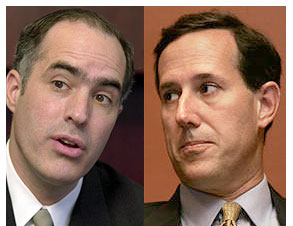
Casey vs. Santorum

The hottest 2006 Senate race is the stuff of Democratic Party dreams. But does the anti-choice Pennsylvania state treasurer from Scranton have what it takes to unseat the Christian right's poster boy?

  • more
    • All Share Services

Topics: , ,

Casey vs. Santorum

When Bob Casey Jr. won the Pennsylvania state treasurer’s race last fall, he rang up 3.35 million votes, more than anyone running for any office in the state — ever. With that decisive victory, the national Democrats came calling. They were in the market for a Democratic candidate for one of the most important races of 2006: the campaign to unseat Sen. Rick Santorum. After some lobbying from the likes of Pennsylvania Gov. Ed Rendell and U.S. Sens. Harry Reid and Chuck Schumer, and only four months after winning his race for state treasurer, Casey announced he was in.

And so the stage was set for the nation’s next marquee Senate race, which holds the stuff of Democratic Party dreams. In Bob Casey Jr., the anti-choice son of the late Pennsylvania governor, the party sees its chance to oust the poster boy of the right who posed as saint-in-waiting on the cover of the New York Times Magazine, is a loyal supporter of President Bush, and is the No. 3 leader in the GOP Senate.

Casey, whose late father was a staple of state politics for a generation and a two-term governor, was recruited to run against the conservative Santorum primarily because of his anti-choice views. This is high irony given that the senior Casey clashed with national Democrats over his anti-choice views. But as an anti-choice Democrat capable of tapping into Pennsylvania’s socially conservative rural and blue-collar vote and its urban bloc, many Democrats blissfully predict Casey Jr. will run Santorum ragged. And Democrats have some good reasons to be hopeful.

Santorum seeks reelection in a state that twice went to Bill Clinton, then to Al Gore and last year to John Kerry. A quarter of the state’s population is 55 or older (only Florida has a higher percentage of elderly) at a time when the president and his Social Security agenda, which Santorum has loyally backed, slip in national polls. Early in-state polls show Santorum lagging behind Casey. A Franklin & Marshall College poll this month has Casey up seven, and a Quinnipiac University poll released July 13 has him ahead by 11 points.

One might think, from all of this, that controversial incumbent Santorum, a national leader of conservative faith-based politics — whose new book “It Takes a Family” likens abortion to slavery — is now too far right for Pennsylvania. One might think his days are numbered in a state with a Democratic voter registration edge of 542,000-plus. And one might think the oh-so-many who view Santorum as intolerant, cocky and self-righteous are primed for victory.

“This is a golden opportunity for Democrats. It definitely is,” says Philadelphia political analyst Larry Ceisler. “Even though Pennsylvania is a blue state with red senators, Santorum’s out of sync politically with the state, and he is where he is because he’s always had opponents who ran bad campaigns.”

Still, this race looks different from a national perspective than it does locally. For reasons including money, issues and the nature of the combatants, things aren’t what they seem from outside looking in.

Casey, for example, though widely liked and admired, did not do well in a 2002 run for governor, a race far different than the three low-profile state row-office campaigns he’s won. (Before his election as treasurer, Casey served two terms as auditor general, an office also held by his father, and lost a gubernatorial primary to Rendell.)

Under bright lights, Casey can be halting and dull. His campaign for governor was badly focused, an almost entirely negative race that never told voters who he is or what he believes. High expectations, based mainly on his likability and name identification, never were met. As a result, some worry about another bad campaign, and a few key in-state Democrats are hoping for evidence this campaign is different, that Casey is a different candidate, this time around. “We want to help, lots of folks want to help, but not if it’s another run like the last one,” says a source close to a top elected Democrat.

Santorum, on the other hand, who’s been underrated his entire career, has never lost an election. He’s supple with spin and quick on his feet, has killer instincts and a seemingly innate drive to survive. These two candidates might look the same on paper (both 40-something, ramrod straight pro-life Catholics with a bunch of kids), but they are not. Santorum is a polished politician with national stature and experience; Casey is a state treasurer from Scranton.

There are other snags for Casey — on money and issues. Because he shares Santorum’s basic views on abortion, guns and stem-cell research (against, for and against), hardcore Democrats worry about enthusiasm among liberal leaders and rank and filers, which translates, of course, into cash.

Peter Buttenweiser, one of the nation’s major Democratic donors and fundraisers, actively works for Casey and says big-dollar givers are leery. “They’re certainly concerned and they’ve registered concerns,” Buttenweiser says. He adds, however, that he thinks that will change next year as more Democrats get excited about the prospect of defeating Santorum: “The most important thing is to keep at it and keep on it … I think there will be fervor in this race about returning this seat to a more moderate person.”

If so, the expected fervor seems to be simmering slowly.

New campaign-finance reports filed for the reporting period ending June 30 are expected to show Casey with a little more than $1 million (really not bad given the timeline). But Santorum raked in that much at one event with Bush in Pennsylvania — to add to the $2.8 million he was sitting on after the last report at the end of March. Insiders in both camps predict vast amounts of funding from the Internet and 527 organizations in a campaign that could top $50 million. And nobody doubts Casey eventually will have enough resources to compete. But nobody doubts, either, that Santorum will outraise and outspend Casey by a lopsided margin.

A national Republican source involved in the Santorum campaign says, “Understand, this will be all hands on deck: the White House, [John] McCain, [Rudy] Giuliani, the whole lineup.” And because many Republicans see the race as a referendum on the Bush presidency, gains by the right and maybe the future of the conservative movement, GOP funding and fervency are likely to hit record highs.

Even moderate Republican Sen. Arlen Specter, who, at 75 and fighting cancer, remains a formidable political force, is working hard for Santorum, especially fundraising in the Jewish community. As payback for Santorum’s helping Specter win a bitter GOP primary last year, Specter calls Santorum’s reelection his “No. 1 priority.” Even if there’s residual far-right angst about Santorum aiding Specter, Specter’s help now should balance the scales.

Yet on the other side there are concerns that Casey isn’t Democrat enough. Democratic sources say national fundraising efforts are drawing cool responses. Already bloggers are greeting fundraising e-mails from John Kerry with references to other potential candidates such as pro-choice Philadelphia University of the Arts professor Chuck Pennacchio. He and pro-choice Philadelphia lawyer Alan Sandals both say they’ll oppose Casey in a Democratic primary. And while there’s little concern about a competitive primary, an undercurrent of liberal dissatisfaction is setting up a potentially ugly scenario for Casey: Santorum drawing support from the full GOP spectrum and Casey unable to counterpunch.

“I don’t expect Bobby will be getting a check from Barbra Streisand,” said a Casey confidante speaking on condition of anonymity. A national Democratic source present at a private Democratic fundraiser with Hillary Clinton in San Francisco recently said the New York senator’s pitch for Casey landed as “a complete dud” with the crowd of potential donors. Even strong Casey supporters, some still smarting from the ’02 race, are frustrated and fearful of what lies ahead.

Donna Gentile O’Donnell, for example, a life sciences expert at the Eastern Technology Council in suburban Philadelphia, is an unofficial advisor to the Casey campaign, and she’s not happy. She says efforts to move Casey left on federal support for embryonic stem-cell research as a way to appeal to liberal voters are not going well. “I’m leaving my church since it named [conservative Cardinal Joseph] Ratzinger pope, and now I’m disturbed about my party,” O’Donnell says. “The anti-intellectual trend in the Catholic Church is troubling and is producing the kind of intransigent positions on stem cells consistent with Bobby’s historical position.” She says that position, which mirrors Bush’s and allows only limited stem-cell research, hurts Casey.

“It doesn’t help,” says another Casey ally, “when Gov. Rendell gets up at a [recent] biotech conference and says ‘anybody who’s reasonable’ supports more stem-cell research.” Meanwhile, there’s an obvious effort to mollify the left.

Pro-choice Barbara Hafer, a Republican turned Democrat who was originally recruited by Rendell to run against Santorum (she lost the 1990 race for governor to Casey’s father), recently endorsed Casey in an e-mail to “35,000 activists.” And pro-choice Democratic state House leader H. William DeWeese just published a letter to the editor in the Harrisburg Patriot-News pleading Casey’s case: “I have been an advocate of a woman’s right to choose for more than 30 years … [but] I am fed up with the notion that Democrats must go forward in zombie-like lockstep on every single issue.” He notes Casey supports public funding for family planning services and contraceptive equity for health insurance coverage.

Whether such efforts will succeed remains to be seen. Asked if he’s worried about early chilly receptions along the money trail, Casey says, “It really doesn’t concern me. There’s a tremendous outpouring of support in Pennsylvania and beyond the state … I thought the early months would be difficult, more difficult than they have been.”

Yet, Santorum, to many, seems so gettable.

He has a habit of saying things that make folks question his acuity if not his fitness for office. His new book, in likening abortion to slavery, states: “But unlike abortion today, in most states even the slaveholder did not have the unlimited right to kill his slave.” The book is supposed to “counter the worldview” of Hillary Clinton.

He has also likened Democrats to Nazis, claims Terri Schiavo was “executed,” said the mainstream media lies about him, equated homosexuality with bestiality, and claimed the Catholic priest pedophile scandal in Boston was really no surprise since Boston is “a seat of academic, political and cultural liberalism.” Santorum enraged Bostonians this week by standing by that statement, adding: “The basic liberal attitude in that area … has an impact on people’s behavior.”

Santorum also got attention this spring for showing up at Terri Schiavo’s deathbed while he was in Florida raising money for his campaign. And he took a hit last year for charging state taxpayers to cyber-educate his kids even though they live with him and his wife in Virginia. (This particularly rankles those who remember Santorum won a seat in Congress in 1990 by calling then incumbent Doug Walgren out of touch because he lived in Virginia.)

In addition, Santorum faces Casey in a year that Democratic Gov. and former national Democratic chairman Rendell seeks reelection. No incumbent Pennsylvania governor seeking a second term (since successive terms were permitted starting in 1974) has lost. And Rendell’s strongest draw is from the state’s southeast where he was a popular two-term mayor of Philadelphia, where 32 percent of the state’s voters live, and where Rendell’s presence on the ballot is certain to drive Democratic turnout and thus favor Casey.

Then there’s the whole Santorum-as-Bush tack. As the race takes shape, it’s clear Casey will go after Santorum on Social Security and healthcare, issues on which Bush and Republicans haven’t made progress, while the sub-campaign runs against, as one source puts it, “an intolerant far-right ideologue living in Virginia.” And whatever might be lost from liberals upset with Casey’s stand on abortion could be made up, says one Casey insider, with support from national gay groups eager to see Santorum fail.

And Santorum? Just as Casey’s camp seeks to push him right, he’ll no doubt try to push Casey left — just another obstructionist Democrat with no answers, only complaints.

The race could well redefine the Democratic Party and set the stage for the ’08 presidential election. Can Democrats embrace a candidate who disagrees with a fundamental party plank? Or, the race could reaffirm the power of the right. Can Republicans continue to keep conservatives in power? Either way, it’s a race in the spotlight, even if the picture isn’t quite in focus.

Continue Reading Close

The sex-selective abortion sham

Updated: The GOP is seeking a new line of attack on reproductive rights, requiring doctors to police women's motive

  • more
    • All Share Services

Topics:

The sex-selective abortion shamTrent Franks (Credit: AP/Matt York)

[UPDATED BELOW]

Today, the House of Representatives will vote on a bill banning sex-selective abortions, despite the fact that the GOP leadership has insisted that it’s focused on the economy — and not that pesky “war on women” stuff they keep getting tarred with. It’s okay, because its sponsor, Rep. Trent Franks, R-Ariz., has an easy explanation for what an abortion ban to combat a phenomenon that barely exists in the U.S. has to do with the economy: “The reason we have an economy,” he said, according to Politico, “[is] because … we in America believe that life is a gift from God.”

A more direct – and less theocratic – answer would be that this one got through because of the nature of the ban, which allows Republicans in an election year to once again accuse Democrats of waging the real war on women. Or, as the National Right to Life Committee put it, “Members who recently have embraced contrived political rhetoric asserting they are resisting a ‘war on women’ must reflect on whether they wish to be recorded as being defenders of the escalating war on baby girls.” In other words, this is about making Democrats squirm – not unlike what’s happening in reverse in the Senate.

Franks previously tried to attach his bill to the Violence Against Women Act, which has turned into another political cudgel. He made another concession when he dropped the “racial discrimination” provisions of the bill, which the Washington Post’s Dana Milbank aptly described as “the latest attempt to protect racial minorities from themselves.” Under the rules through which it was introduced, Franks’s Prenatal Non-Discriminational Act (PRENDA) needs two-thirds of the House to pass, meaning it needs roughly 50 votes from Democrats.

Today happens to be the third anniversary of the murder of Dr. George Tiller, who provided abortions in the most difficult cases amid actual violence, the daily threat of such violence, and politicized law enforcement tactics. PRENDA would ask the already besieged physicians still alive to police their patients’ decisions – especially their Asian-American patients, who would be singled out for disparate care – and to subject doctors to a fine or a up to a year in prison, or both. It’s utterly unconstitutional of course. Unless you’re in a state where later abortions are limited to special circumstances like threat to life, the United States doesn’t interfere, and rightly so, with a woman’s reason for having an abortion.

In the U.S., this is a “solution” in search of a problem. Even in immigrant communities that show very limited evidence of more boys being born than girls later in the birth order, abortion is far from the only mechanism available to sort for sex. Half of American fertility clinics offer some possibility of sorting by sex before a pregnancy. But if you ask people who actually work on this issue in Asia, where skewed sex ratios – whether achieved through IVF, abortion or even infanticide — can be socially destabilizing, they’ll tell you that limiting reproductive freedom isn’t the answer. The only mechanism that has changed anything (the go-to example is South Korea, where abortion is technically illegal but widely tolerated) is moving toward a more gender-equitable society where life as a woman is less of a burden. Part of that equitable society includes women making the decision when and if to be mothers. Seeking to chip away at that right is the true hypocrisy.

UPDATE: While a majority of the House voted in favor of PRENDA Thursday, 247-168, it did not pass since Republicans called it up under rules requiring a two-thirds majority.

Continue Reading Close
Irin Carmon

Irin Carmon is a staff writer for Salon. Follow her on Twitter at @irincarmon or email her at icarmon@salon.com.

An overdue abortion access expansion

Will Congress let the military cover abortions in the cases of female soldiers who suffer rape or incest?

  • more
    • All Share Services

Topics:

An overdue abortion access expansionJeanne Shaheen, Dianne Feinstein and Patty Murray (Credit: AP/J. Scott Applewhite)

As political dares go, this one could hardly have been more blatant. “[Republicans] say they didn’t launch a war on women,” Sen. Barbara Boxer said Wednesday, “so we’re giving them a chance to walk this back.” She added, “Personally I say it’s a war on women, and the more they protest it the more I say it.” And Sen. Barbara Mikulski channeled ”Network” (or maybe old-school feminist rage): “We’re mad as hell and we’re not gonna take it anymore.” Even Harry Reid got in on the action, saying on the floor yesterday, “Republicans deny they’re waging a war on women, yet they’ve launched a series of attacks on women’s access to healthcare and contraception this year. Now they have an opportunity to back up their excuses with action.”

What spurred such rage? Nothing so incendiary as transvaginal ultrasounds or birth control — just the Paycheck Fairness Act, which passed the Democratic House in 2009 but fell to a filibuster by two votes in the Senate in 2010. It modifies the 1963 Equal Pay Act, strengthening enforcement and creating better mechanisms for wage transparency, and authorizes new research on the pay gap and a grant program to teach negotiation skills to women and girls. And while it probably doesn’t have a prayer in the House — if it can even pass this Senate — it manages to bring feminist-friendly legislation back on the table while doubling as a political tool to force Republicans into an uncomfortable corner.

Better yet, it gets to the subject Republicans have intermittently accused Democrats of obfuscating: the economy. As Sen. Patty Murray taunted in a press conference, “To those Republicans who claim to be so concerned about the economy, now is your chance to sign on, When women are not paid what they deserve, middle-class families and communities pay the price.”

Whatever happens with the Paycheck Fairness Act (likely nothing) or the dueling versions of the Violence Against Women Act, this week also saw a bill move that, if it makes it into law, would represent a rare, if tiny, expansion of abortion access on the federal level. That would be the Shaheen Amendment, named for another female Democratic senator, which allows female servicemembers — who suffer disproportionate levels of sexual assault — insurance coverage for abortion in cases of rape and incest. (Currently, the Department of Defense offers coverage only if the woman’s life is in danger, a much more limited policy than that of other federal employees.)

The amendment passed in the Senate Armed Services Committee’s version of the National Defense Authorization Act, with three Republican votes — Sens. John McCain, Scott Brown and Susan Collins. (Democrat Ben Nelson voted against it). Of course, if it manages to get through the full Senate, it has the anti-choice House to contend with. That it would be incredibly narrow says a lot about the state of reproductive rights in this country — after all, rape and abortion exceptions are a compromise that, while reflecting American public opinion, truly jibe with neither side’s actual worldview. But you have to start somewhere, and a time of heated political rhetoric about women’s rights is as good as any other.

Continue Reading Close
Irin Carmon

Irin Carmon is a staff writer for Salon. Follow her on Twitter at @irincarmon or email her at icarmon@salon.com.

“Not allowed to speak”: GOP silences D.C. rep

Rep. Eleanor Norton tells Salon how Republicans wouldn't let her talk at a hearing to ban abortions in her district

  • more
    • All Share Services

Topics:

House Republicans seem to have learned this much in the past few months: It looks bad to turn away a woman from a hearing on women’s health. So when D.C. congresswoman Eleanor Holmes Norton was denied the courtesy of testifying at a subcommittee hearing yesterday in her district on banning abortions after 20 weeks, Chairman Trent Franks, R-Ariz., suggested a compromise of sorts.

“He said that the congresswoman could, if she desired, sit on the dais of the hearing, but she would not be allowed to speak,” Norton told Salon after the hearing. She declined an offer she said “no self-respecting member” would accept.

“I certainly didn’t give them that optic,” she said drily.

Franks was technically within his rights – per the rules, the Democratic minority was granted one witness, D.C. resident Christy Zinks, who had an abortion at almost 22 weeks after the detection of a severe fetal abnormality. Still, as Norton pointed out, “there is a long tradition that goes back more than a century of allowing members to testify on a bill that may touch upon the district.” Nancy Pelosi also condemned the move.

In the testimony she wasn’t allowed to give, Norton says the so-called Pain-Capable Unborn Child Protection Act “is the first bill ever introduced in Congress that would deny constitutional rights to the citizens of only one jurisdiction in the United States, and it is the first bill ever introduced in Congress that would ban abortions after 20 weeks of pregnancy.” Last year, House Republicans managed to strike a budget deal that would deny the District of Columbia the right to use its own Medicaid funds to pay for abortions — another byproduct of the fact that D.C. is ultimately under congressional oversight and has only partial self-governance.

Seven states have followed Nebraska in passing manifestly unconstitutional bans on later abortions without health exceptions, on the scientifically suspect notion that a fetus can feel pain after 20 weeks. So far, pro-choice organizations have declined to mount a legal challenge, for complicated reasons.

Norton called it a “stalking horse” for the overturning of Roe. “We understand we’re the vehicle, we know we’re not the object of affection,” she said. “What they want from the Congress is a federal imprimatur to continue their march in the states, to say, even the Congress has voted for a bill to limit abortion to 20 weeks.”

The National Right to Life Committee has called the bill its “top congressional priority for 2012,” and will score members based on their votes, even though it likely has no chance of getting past the Senate – or the president. “They are serious about this bill,” Norton told Salon. “They’re not playing.”

That said, she thinks that despite Franks’ zeal, other House Republicans have lost their zeal for fighting what’s still being called the war on women. An earlier Franks bill, seeking to limit race- and sex-selective abortions, didn’t make it to the floor. And on the House version of the Violence Against Women Act, fiercely opposed by the White House and women’s groups, “They keep saying that they’re working on a way to reach an accommodation, and for them, that is unusual to say,” Norton said.

“They didn’t anticipate the way the war on women, as it is called, has boiled up to the surface,” Norton said. “And they’re trying to quell it somewhat.”

Continue Reading Close
Irin Carmon

Irin Carmon is a staff writer for Salon. Follow her on Twitter at @irincarmon or email her at icarmon@salon.com.

Abortions made public

States want more data on abortion patients. Zealots want their hands on it. Shame is the new anti-choice strategy

  • more
    • All Share Services

Topics: , , ,

Abortions made public (Credit: Cannaregio via Shutterstock/Salon/Benjamin Wheelock)

It was an “anonymous informant,” Operation Rescue claimed last week, after someone slipped them the April records of 86 women who were treated at Central Family Medical. The clinic’s lawyer was blunter. “It certainly appears to me that a crime was committed,” Cheryl Pilate told the Kansas City Star. Though the clinic (which performs abortions) had already reported a break-in to a locked dumpster, Pilate said it wouldn’t have contained patient records, which are shredded. The “informant” must have gotten the documents – containing names, addresses and details of procedures – another way.

“Our concern is for the privacy of these women and for their health and safety, for which Central Family Planning has shown very little regard,” said Operation Rescue’s Troy Newman – while posting photographs of the documents, partially redacted in black marker, online.

Antiabortion activists want to create the impression that one way or another, a woman’s decision to have an abortion will be discovered and exposed. The Central Family Medical incident is only the latest skirmish in a decades-long effort to undermine the privacy of abortion patients and harass doctors. In the early ’90s, for example, at least one group of clinic protesters printed on their signs the names of women seeking abortions that day, alongside “don’t kill your baby.” Such actions, while failing to make abortion illegal, have nevertheless managed to cloak it in a stigma that belies the fact that one in three women will have an abortion before the age of 45. Now, activists are seeking new ways to shame women who seek abortions, from requiring them to hand over personal information to actually hacking into their medical records.

Kansas has been ground zero for this: Last year, the Kansas Board for Discipline of Attorneys recommended that former Attorney General Phill Kline, a hero to Operation Rescue, have his legal license suspended indefinitely for mishandling the records from murdered abortion provider George Tiller’s clinic. (The Kansas Supreme Court will make the final call.) But the zeal to keep, and sometimes steal, abortion records casts a wide net.

In Texas, the state Department of Health is trying to implement a failed legislative measure that would require abortion clinics to report far more information about their patients to the state. In Florida, voters will weigh in on a ballot measure that would exempt abortion from the privacy clause in the state constitution, with the short-term aim being to strip minors of a right to privacy that would preclude parental consent. The U.K. recently jailed a hacker who stole and intended to publish the records of 10,000 women who visited the country’s largest abortion provider.

“It promotes the idea that abortion – or your privacy, if you have any – is not safe,” says Katie Stack, a graduate student and activist who spoke out about her abortion on an MTV special, “No Easy Decision.” That put her in close contact with the “online ministry” – the name antiabortion activists have given their efforts to reach women considering abortions through the Internet.

This has been the unstated goal of many activists in the antiabortion movement — and, sometimes, the stated one. “This might sound a little strange,” said antiabortion activist Lila Rose at the Value Voters Summit in 2009, but “if I could insist, as long as they are legal in our nation, abortions would be done in the public square, until we were so sick and tired of seeing them that we would do away with the injustice altogether … maybe then we might hear angels singing when we ponder the glory of conception.”

Rose won’t get her wish any time soon, but antiabortion activists are trying to use the Internet to have a similar effect. Rose was recently on a panel at the International Pro-Life Youth Conference about social media and pro-life activism, where topics included targeting women who are seeking information about abortion online, whether through Yahoo Answers or YouTube commenters – including figuring out where they live and recommending a crisis pregnancy center nearby.

“Privacy is very important to women who have abortions,” says Kate Cockrill, program director of the Social and Emotional Aspects of Abortion project, at the University of California, San Francisco. She points out that abortion is traditionally underreported even in confidential surveys, “which is a good indication that women don’t want to be associated with abortion experience in the eyes of someone who’s gathering data, even if it’s anonymous.”

Cockrill recently conducted a survey, as yet unpublished, that seeks to measure the impact of social stigma on women who’ve had abortions. It asked 641 women who had had abortions about 61 items, including questions about the fear people would gossip about you, judge you or hurt you, or the fear that you would lose an important relationship.

So far, she’s found that the women who experienced the most stigma were worried about being judged more than they were about being hurt or harmed, that they feared loss of social status and the ruining of their public identity, that they felt isolated and guilty, and that they feared community condemnation.

But as with other abortion restrictions, which create extra burdens in the supposed service of changing women’s minds, it’s not clear that anyone’s mind is being changed.

“Lots of women who feel a lot of stigma about abortions have abortion anyway,” Cockrill says. “If it’s not doing what antiabortion people want it to do, which is reducing the number of abortions, is it doing something on the other end, [after the fact]?”

Cockrill and her team are going to be using their scale in a study next year to look at the relationship between stigma and poor coping after abortion. Given that antiabortion activists have added to their obsessions the alleged harm abortion causes to women, there’s reason to believe that this is a self-fulfilling prophecy.

Women who have abortions, Cockrill says, “have a huge range of political views.” In fact, in her survey, only 62 percent of the women identified as pro-choice. (Seven percent identified as prolife, and 18 percent described their position as “mixed or neither.”)

“A lot of women don’t experience their abortions as a political act,” Cockrill says, partly an extension of the fact that they don’t see it as constitutive of their identity.

Whether it’s political rhetoric or individual ambivalence, these women are highly sensitive about whom they tell they had abortions. Sixty-four percent of the women in the study said they’d “withheld information about my abortion to someone I’m close to,” and 45 percent said they’d “lied to someone I’m close to about my abortion.”

They may not see it as political, but that silence functions as a vicious circle that antiabortion activists happily seize upon and promote. Cockrill says, “Some people say, ‘We need to have more people come out about their abortions.’ But it’s impossible to get more women to talk about their abortions if they don’t feel supported. And it needs to be on women’s own terms.”

Continue Reading Close
Irin Carmon

Irin Carmon is a staff writer for Salon. Follow her on Twitter at @irincarmon or email her at icarmon@salon.com.

Texas’ abortion enforcer

Fifth Circuit Court Judge Jerry Smith makes sure that the state's antiabortion legislation gets upheld

  • more
    • All Share Services

Topics: ,

Texas' abortion enforcerJerry Smith

Here is what the state of Texas considers “irreparable harm”: Continuing to provide Planned Parenthood with federal funds for the Texas Women’s Health program, which it has done for several years. Here is what it does not find harmful: immediately denying healthcare access to tens of thousands of women who have been going to Planned Parenthood affiliates for basic health services that aren’t abortions.

On Monday, a U.S. District Court judge didn’t buy the state’s legislation defunding Planned Parenthood, putting a temporary stay on the enforcement of the law. But within a day, there was another judge who found the argument persuasive: Fifth Circuit Judge Jerry Smith, last seen obnoxiously demanding that a female Justice Department lawyer ”submit a three-page, single-spaced letter by noon Thursday addressing whether the Executive Branch believes courts have such power.” (Kevin Drum memorably compared it to “a middle school teacher handing out punishment to a student because of something her father said at a city council meeting the night before,” and you wouldn’t have to look hard to find the sexist condescension.)

The District Court judge had written 24 pages on the constitutional merits, focusing on Planned Parenthood’s First Amendment rights of association. Smith issued two sentences two hours after the state’s petition, undoing that, and apparently buying the state of Texas’ argument that Planned Parenthood’s alleged “abortion promoting” mission justified discriminating against a qualified provider of healthcare.  (The clinics receiving WHP funding don’t even provide abortions, but other Planned Parenthood clinics do.)

In an election year, these posturings take on new meaning; by today, Planned Parenthood was proclaiming in a news release, “What would Mitt Romney’s America look like for women’s health care?  We need look no further than Texas,” and highlighting the policy similarities of Romney and Perry on women’s health. Romney, of course, has pledged to defund Planned Parenthood, which during the primaries became a consensus Republican issue. The last federal attempt to do so, last year’s Pence Amendment, nearly shut down the entire government, though Obama held the line — as he pointed out in a recent campaign video supporting the organization.

The presidential policies matter, but as we can see from Texas, the judiciary, prompted by state legislatures that are coming off a wave of abortion restrictions, is currently wielding the most power when it comes to women’s everyday lives, and the 5th Circuit in particular has been unrepentantly hostile to reproductive rights. When they failed with Pence, right-to-lifers turned to the states, primed by the 2010 election of even more anti-choice legislators and governors. In Texas, the conservative 5th Circuit has become a brick wall, previously allowing enforcement of the most extreme ultrasound law in the country, one that requires a woman to listen to the results.

Smith is a Reagan appointee, as is his fellow 5th Circuit conservative gadfly Edith Jones, who wrote the opinion in the ultrasound case, though if they’re feeling particularly emboldened lately, you can’t really blame them. After all, the Obama administration has shown little interest in prioritizing the judiciary, even after Bush’s ambitious effort to fill federal appellate courts with movement conservatives. A January Brookings Institution report showed that Obama has nominated fewer federal trial judges than his predecessors, even as a wave of judges retires. (Unprecedented Senate intransigence is a major factor in confirmations, but doesn’t explain the nominations.)  And Dahlia Lithwick has argued that “Obama, like Bill Clinton before him, has selected lower court judges more notable for their racial and gender diversity than their hard-left judicial orientation.”

All of this is to say that as long as states like Texas keep passing laws that punish women and stretch the boundaries of constitutional interpretation, to put it mildly, the buck is likelier than ever to stop at a judge like Jerry Smith.

Continue Reading Close
Irin Carmon

Irin Carmon is a staff writer for Salon. Follow her on Twitter at @irincarmon or email her at icarmon@salon.com.

Page 1 of 128 in Abortion