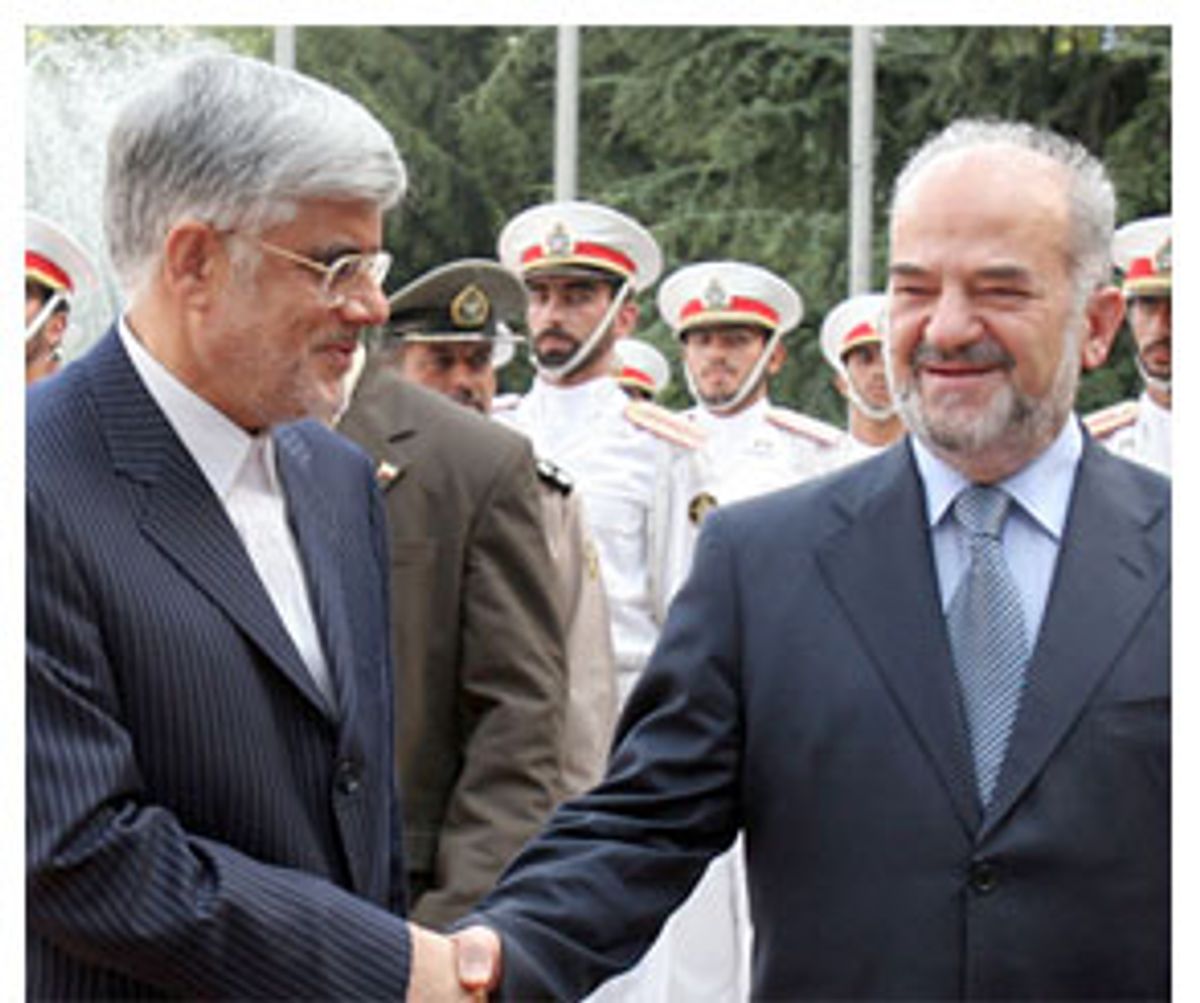
Iraq's new government has been trumpeted by the Bush administration as a close friend and a model for democracy in the region. In contrast, Bush calls Iran part of an axis of evil and dismisses its elections and government as illegitimate. So the Bush administration cannot have been filled with joy when Iraqi Prime Minister Ibrahim al-Jaafari and eight high-powered cabinet ministers paid an extremely friendly visit to Tehran this week.
The two governments went into a tizzy of wheeling and dealing of a sort not seen since Texas oil millionaires found out about Saudi Arabia. Oil pipelines, port access, pilgrimage, trade, security, military assistance, were all on the table in Tehran. All the sorts of contracts and deals that U.S. Vice President Dick Cheney had imagined for Halliburton, and that the Pentagon neoconservatives had hoped for Israel, were heading instead due east.
Jaafari's visit was a blow to the Bush administration's strategic vision, but a sweet triumph for political Shiism. In the dark days of 1982, Tehran was swarming with Iraqi Shiite expatriates who had been forced to flee Saddam Hussein's death decree against them. They had been forced abroad, to a country with which Iraq was then at war. Ayatollah Khomeini, the newly installed theocrat of Iran, pressured the expatriates to form an umbrella organization, the Supreme Council for Islamic Revolution in Iraq (SCIRI), which he hoped would eventually take over Iraq. Among its members were Jaafari and Abdul Aziz al-Hakim. On Jan. 30, 2005, Khomeini's dream finally came true, courtesy of the Bush administration, when the Supreme Council and the Dawa Party won the Iraqi elections.
Jaafari, a Dawa Party activist working for an Islamic republic, had been in exile in Tehran from 1980 to 1989. A physician trained at Mosul, the reserved and somewhat inarticulate Jaafari studied Shiite law and theology as an auditor at the seminaries of Qom. His party, Dawa, was briefly part of SCIRI but in 1984 split with it to maintain its autonomy.
Iraq has a Shiite Muslim majority of some 62 percent. Iran's Shiite majority is thought to be closer to 90 percent. The Shiites of the two countries have had a special relationship for over a millennium. Saddam had sealed the border for more than two decades, but throughout centuries, tens of thousands of Iranians have come on pilgrimage to the holy Shiite shrines of Najaf and Karbala every year. Iraqis likewise go to Iran for pilgrimage, study and trade. Although neoconservatives like Paul Wolfowitz maintained before the Iraq war that Iraqis are more secular and less interested in an Islamic state than Iranians, in fact the ideas of Khomeini had had a deep impact among Iraqi Shiites. When they could vote in January earlier this year, they put the Khomeini-influenced Supreme Council for Islamic Revolution in Iraq in control of seven of the nine southern provinces, along with Baghdad itself.
It was not only history that brought Jaafari to the foothills of the Alborz mountains. The Iraqi prime minister was attempting to break out of the box into which his government has been stuffed by the Sunni Arab guerrilla movement. Jaafari's government does not control the center-north or west of the country and cannot pump much petroleum from Kirkuk because of oil sabotage. Trucking to Jordan is often difficult. The Jaafari government depends heavily on the Rumaila oil field in the south, but lacks refining capability. Iraq lacks a deep water port on the Gulf and needs to replace inland "ports" like Amman because of poor security. An initiative toward the east could resolve many of these problems, strengthening the Shiites against the Sunni guerrillas economically and militarily and so saving the new government.
The last time Iran and Iraq had really warm relations was the mid-1950s. Iraq then had a British-installed constitutional monarchy, and Prime Minister Nuri as-Said was fanatically pro-Western. The CIA had put Mohammad Reza Shah back on the throne in 1953, deposing the democratically elected prime minister, Mohammad Mossadegh (who had angered the United States when he nationalized the Iranian oil industry). In 1955 Said and the shah both signed on to the Baghdad Pact, a U.S.-sponsored security agreement against the Soviet Union and Arab nationalist Gamal Abdel Nasser of Egypt. The pact proved ill-fated, however. A popular revolution overthrew the Iraqi monarchy in 1958, and Nuri's corpse was dragged in the street. Another popular revolution overthrew the shah in 1979. In 1980-1988, Iran-Iraq relations reached their nadir, as Saddam Hussein's Baath Party and Khomeini's Revolutionary Guards slugged it out on battlefields of a dreary horror not seen since World War I. Jaafari's visit was designed to erase the bitter legacies of that war.
Iraq's Eastern Policy does not come without at least symbolic costs. On Saturday, Jaafari made a ceremonial visit to the tomb of Ayatollah Khomeini, on which he laid a wreath. In a meeting with Supreme Jurisprudent Ali Khamenei on Monday, according to the Tehran Times, Jaafari "called the late Imam Khomeini the key to the victory of the Islamic Revolution, adding, 'We hope to eliminate the dark pages Saddam caused in Iran-Iraq ties and open a new chapter in brotherly ties between the two nations.'" The American right just about had a heart attack at the possibility (later shown false) that newly elected Iranian President Mahmoud Ahmadinejad had been among the militants who took U.S. diplomats hostage in 1979. But the hostage takers had been blessed by Khomeini himself, to whom Jaafari was paying compliments.
When Jaafari met the head of the Iranian judiciary, Ayatollah Mahmoud Hashemi Shahrudi, on Tuesday, the two discussed expanding judicial cooperation between the two countries. Shahrudi said that cooperation with Iran's Draconian "justice system" has had a positive impact on other Muslim countries. He called for Iraq to coordinate with something called the "Islamic Human Rights Organization" -- an Orwellian phrase in dictatorial Iran, a state that tortures political prisoners and engages in other acts of brutality. And he urged the Iraqi government to put greater reliance on "popular forces" (local and national Shiite militias) in establishing security.
Jaafari was probably only indulging his clerical host, but his Dawa Party certainly does hope to have Islamic law play a greater role in Iraqi society. The New York Times revealed on Wednesday that the new draft of the Iraqi constitution will put personal status matters, many of them affecting women, under religious courts.
For his polite forbearance as his Iranian hosts boasted of the superiority of their Islamic government and grumbled about all those trouble-making American troops in the Iraqi countryside, Jaafari was richly rewarded. Iran offered to pay for three pipelines that would stretch across the southern border of the two countries. Iraq will ship 150,000 barrels a day of light crude to Iran to be refined, and Iran will ship back processed petroleum, kerosene and gasoline. The plan could be operational within a year, according to Petroleum Minister Ibrahim Bahr al-Ulum, whose father is a prominent Shiite cleric.
In addition, Iran will supply electricity. Iran will sell Iraq 200,000 tons of wheat. Iran is offering Iraq use of its ports to transship goods to Iraq. Iran is offering a billion dollars in foreign aid. Iran will step up cooperation in policing the borders of the two countries. Supreme Jurisprudent Khamenei has called for the preservation of the territorial integrity of Iraq. In fact, Iran is offering so much for so little that it looks an awful lot like influence peddling.
The previous week, Defense Minister Saadoun Dulaimi had made a preparatory trip to Tehran, exploring the possibility of military cooperation between the two countries. At one point it even seemed that the two had reached an agreement that Iran would help train Iraqi troops. One can only imagine that Washington went ballistic and applied enormous pressure on Jaafari to back off this plan. The Iraqi government abandoned it, on the grounds that an international agreement had already specified that out-of-country training of Iraqi troops in the region should be done in Jordan. But the Iraqi government did give Tehran assurances that they would not allow Iraqi territory to be used in any attack on Iran -- presumably a reference to the United States.
Iranian leaders pressed Jaafari on the continued presence in Iraq of the Mojahedin-e Khalq (MEK), an Iranian terrorist organization with ties to the Pentagon, elements in the Israeli lobby, and members of the U.S. Congress and Senate. Saddam had used the MEK to foment trouble for Iran. Jaafari promised that they had been disarmed and would not be allowed to conduct terrorist raids from Iraqi soil.
Not surprisingly, the warming relations between Tehran and Baghdad have greatly alarmed Iraq's Sunni Muslims. They know that Iranian offers of help in training Iraqi security officers, and Iranian professions of support for a united, peaceful Iraq are code for the suppression by Shiite troops and militias of the Sunni Arab guerrilla movement. Many Iraqi Sunnis believe that the Sunni Arabs are the true majority, but that millions of illegal Iranian emigrants masquerading as Iraqi Shiites have flooded into the country, skewing vote totals in the recent elections. This belief, for all its irrationality, makes them especially suspicious of Shiite politicians cozying up to the ayatollahs in Tehran. A recent BBC documentary reported that the Sunnis of Fallujah despise Iraqi Shiites even more than they do the Americans, in part because they code them as Persians (in fact they are Arabs).
Although officials in Washington felt constrained to issue polite assurances that they want good relations between Iraq and Iran, the U.S. State Department, the Central Intelligence Agency, and hawks in the Bush administration all have a grudge against Iran, and would as soon overthrow the mullahs as spit at them. But thanks to the Iraq debacle, that is no longer a viable option. State Department spokesman Sean McCormack revealed the true amount of influence Washington has in Baghdad when he admitted that the Bush administration has not "had a chance" to discuss Jaafari's trip to Iran with the prime minister.
The Iranians hold a powerful hand in the Iraqi poker game. They have geopolitical advantages, are flush with petroleum profits because of the high price of oil, and have much to offer their new Shiite Iraqi partners. Their long alliance with Iraqi president Jalal Talabani gives them Kurdish support as well. Bush's invasion removed the most powerful and dangerous regional enemy of Iran, Saddam Hussein, from power. In its aftermath, the religious Shiites came to power at the ballot box in Iraq, bestowing on Tehran firm allies in Baghdad for the first time since the 1950s. And in a historic irony, Iran's most dangerous enemy of all, the United States, invaded Iran's neighbor with an eye to eventually toppling the Tehran regime -- but succeeded only in defeating itself.
The ongoing chaos in Iraq has made it impossible for Bush administration hawks to carry out their long-held dream of overthrowing the Iranian regime, or even of forcing it to end its nuclear ambitions. (The Iranian nuclear research program will almost certainly continue, since the Iranians are bright enough to see what happened to the one member of the "axis of evil" that did not have an active nuclear weapons program.) The United States lacks the troops, but perhaps even more critically, it is now dependent on Iran to help it deal with a vicious guerrilla war that it cannot win. In the Middle East, the twists and turns of history tend to make strange bedfellows -- something the neocons, whose breathtaking ignorance of the region helped bring us to this place, are now learning to their dismay.
More than two years after the fall of Saddam Hussein, it is difficult to see what real benefits have accrued to the United States from the Iraq war, though a handful of corporations have benefited marginally. In contrast, Iran is the big winner. The Shiites of Iraq increasingly realize they need Iranian backing to defeat the Sunni guerrillas and put the Iraqi economy right, a task the Americans have proved unable to accomplish. And Iran will still be Iraq's neighbor long after the fickle American political class has switched its focus to some other global hot spot.
Shares