Terrorism

Imagining a world without nuclear weapons

Historian Richard Rhodes talks about the atomic bombing of Japan 60 years ago, today's global arms race -- and the only way to stop a nuclear attack by terrorists.

  • more
    • All Share Services

Topics: , ,

Imagining a world without nuclear weapons

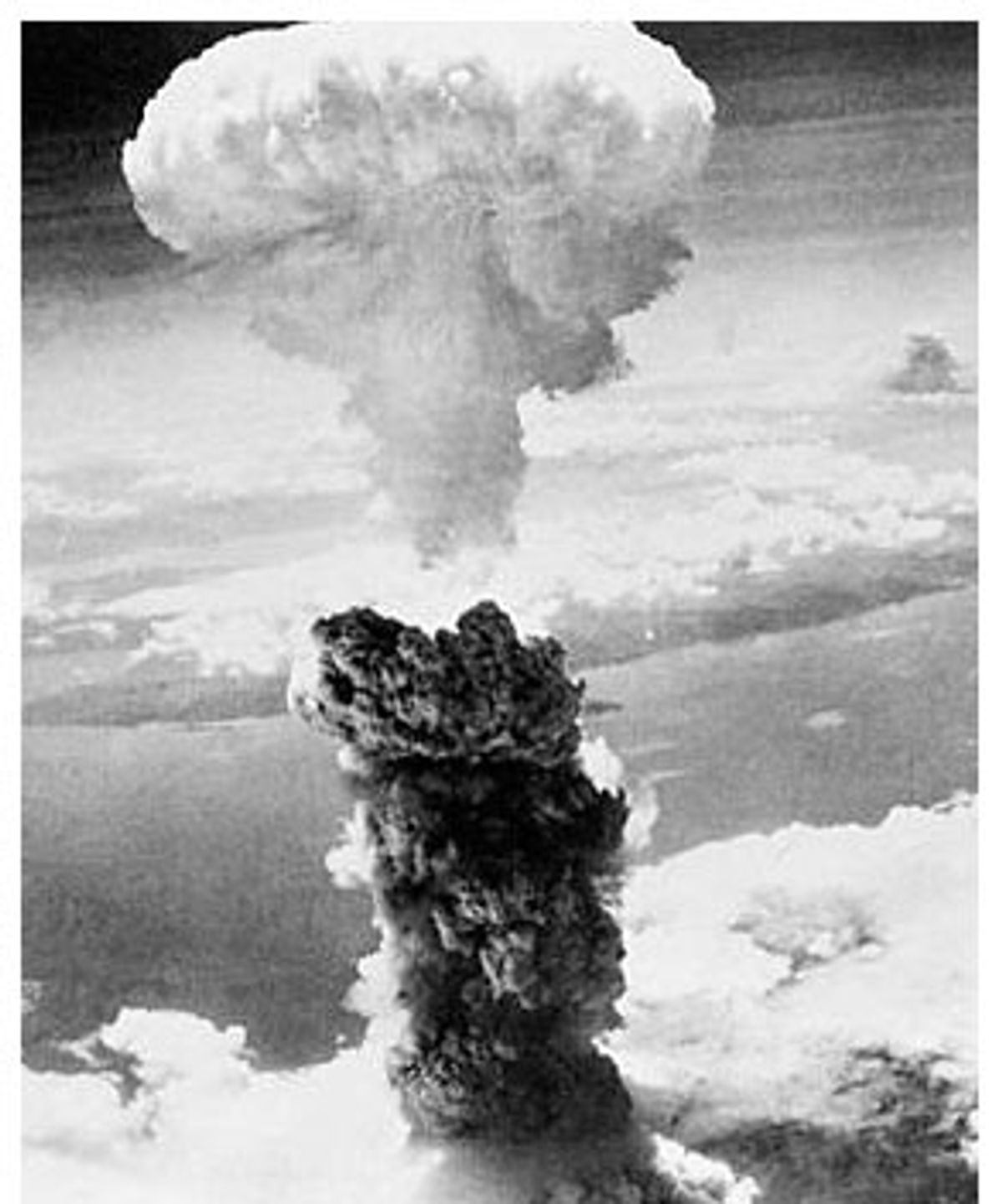
The atomic bombing of Hiroshima and Nagasaki, Japan, was the horrendous ending to a horrific war. But was there a silver lining? Atomic weapons historian Richard Rhodes, 68, is the author of 20 books, including the Pulitzer Prize-winning “The Making of the Atomic Bomb” in 1986. He has written extensively on the hydrogen bomb and nuclear energy, and is currently working on a book about nuclear weapons issues from the last 20 years. Spiegel Online spoke with Rhodes about how nuclear bombs limited 20th century violence, U.S. guilt for the arms race, and just how simple it may be for terrorists to acquire and set off a nuclear weapon.

Many in Germany see the dropping of atomic bombs on Hiroshima and Nagasaki on Aug. 6 and 9, 1945, as a mass slaughter of innocent human beings devoid of any strategic goals. Much of this, of course, stems from Germany’s own World War II history of genocide.

For me it’s a historical question. The atomic bomb was not more destructive than the mass forces the Allies were flying in Germany and Japan. If there was a moral issue involved, it was surely the decisions the Allied forces made in 1943 to begin the strategic bombing of cities — in particular, the decision to firebomb Japanese cities. So it’s a complicated question given the amount of civilians killed in these earlier attacks.

Was the destruction of Hiroshima and Nagasaki a war crime?

Curtis LeMay, who was the general in charge of the bombing campaign in Japan, said that if we’d lost the war we certainly would have been brought before an international tribunal. In that sense, he was admitting it was a war crime. Of course one is revolted by the idea of killing civilians. We killed almost 2 million Japanese civilians with bombing campaigns.

Why was the A-bomb dropped at all? What were the strategic goals the U.S. was attempting to achieve?

By the time the atomic bomb was dropped, we had destroyed virtually every Japanese city with a population of over 50,000. The logic went something like this: “If bombing a factory with workers inside it wasn’t a war crime, then why would it be a war crime to bomb the area around the factories where the workers live?” After that the bombing campaign was essentially to force the Japanese to surrender so that a land invasion would not be necessary and thus limit the loss of life. The atomic bombs were really just an extension of that. And in the end, it did shorten the war.

Was there a racist element to the decision to drop the A-bomb on Japan or would it have also been used in Germany had it been developed earlier?

The war in the Pacific was indeed an intensely racist war — on both sides of the lines. General Leslie Groves, who was in charge of the Manhattan Project which developed the bomb, was quoted after the war as saying that he had discussed the bomb with U.S. President Franklin Roosevelt in 1943 and that there was no question that Roosevelt would have been prepared to use it on Germany. On the other hand, they knew that the bomb would not be ready before mid- to late 1945 and most felt that the war in Europe would likely be over by then.

What about the scientists who worked on the bomb during the Manhattan Project? Were they horrified at what they had done when they were confronted by the carnage in Hiroshima and Nagasaki?

No, they weren’t, because they were working on the project in the middle of a war that cost 55 million human lives. From their point of view, this was going to be the weapon that was to end World War II — and it’s fair to argue that it did. And there was also a feeling that it might be a weapon that would end all wars. You can definitely argue that it ended world-scale war. If you look at the number of man-made deaths in the 20th century, you will see that around 1917 it was around 6 million per year and then in the 1930s it was around 4 million per year. During World War II, it spiked up to the horrendous figure of some 15 million per year. But then, immediately after World War II, it dropped off dramatically to around 1 million per year and stayed at that low level for the rest of the 20th century. What caused that dramatic change? I think pretty clearly the introduction of nuclear weapons.

After Roosevelt’s death, Harry Truman became president. He was ultimately responsible for making the decision to use the bomb in 1945. Did he give enough thought to using the weapon?

No. He had a sense that it was a cataclysmic weapon because he writes about it in biblical terms in some of his private journals. But Truman was a self-educated man and had some fairly original ideas about how the universe worked. I don’t think he spent much time thinking about the use of the weapon. After all, they were already in production and it was clear that Roosevelt had already endorsed and authorized them.

So if Roosevelt thought it was OK, then it was OK for him too?

Truman has won a rather rosy image over the years. But I think he was a great deal more like George W. Bush than he was like Franklin Roosevelt. He was an intellectually insecure man and he covered up that insecurity with a great deal of bluster and an almost obsessive attitude that “the buck stops here.” That was the attitude he used when approaching the atomic bomb. But he also had a visceral and existential response to the mass killings when he got the news of what had happened in Hiroshima and Nagasaki. After that, he was unwilling under any circumstances to use nuclear weapons.

So by virtue of the destruction nuclear weapons wrought in Japan, using such weapons has become impossible?

There were definitely some long-term results from the use of the A-bombs in Japan. One president after another and one leader of the Soviet Union after another looked at the destructive force of these weapons and made a private decision that there is no context in which they could ever be used. We came very close a number of times during the Cold War, of course. But sense prevailed.

Was physicist Niels Bohr right in arguing that the only way to control nuclear weapons is to make the technology open to everybody?

Bohr’s idea was that if nations forwent developing a nuclear arsenal, then they would receive assistance in developing civilian nuclear technology — an idea that is more or less in place today. But Bohr was really trying to make clear to the political leaders of the time that there was no way these weapons could be used once more than one nation had access to them. That’s how it turned out. But Bohr also thought that once nations realized this salient fact, they would forgo the arms race.

It doesn’t seem like too many people were listening to him.

These weapons still have lots of prestige as a symbol of national power. This attitude follows very directly from the continuing insistence on the part of the United States to this day that other nations shouldn’t have nuclear weapons but we should because it’s important to our national security. If we can make that claim, then so can any other nation or any other entity. And they have. A country like North Korea knows — especially after the invasion of Iraq — that being part of the “Axis of Evil” is a dangerous place to be. Because we insist on our primary right to be a nuclear power, they have no other option but to do the same.

Is disarmament a realistic goal? Can we turn back the clock?

It is possible to imagine a world without nuclear weapons, but the know-how would still be around and deterrence would still work. You only have to imagine it as extending the amount of time it takes to deliver a weapon to its target. Today it takes 15 to 30 minutes to deliver a nuclear weapon, which is hardly enough time for any kind of rational consideration. If you took the warhead off all the missiles and kept them in a separate place — which is how Pakistan maintains the security of its weapons — then it would take perhaps an hour or two hours. If you actually dismantle these weapons and put the parts in separate places, it would take three days. The countries like Germany that have the technology to go nuclear but have refrained from doing so have a delivery time of about a year. In such a world, if one country decides to start building a weapon, other countries might follow suit. At worst, that would bring us right back to where we are today.

How great is the danger that a nuclear weapon will be used again?

Everybody I talk to in the nuclear community is pretty comfortable that nation-states are not going to use nuclear weapons — even states like North Korea are clearly more concerned with the prestige factor than about actually using it. But everyone I talk to is greatly concerned about the very real possibility of a terrorist nuclear attack. Terrorist groups — al-Qaida is one example — would see a great amount of prestige if they were able to build and detonate a nuclear weapon in New York City or in Iraq’s U.S.-controlled Green Zone. In fact, everyone I take seriously in this field believes the possibility is 100 percent. The fact is, if you can get a sufficient quantity of highly enriched uranium, it’s very easy to make a nuclear weapon that would explode with about the same yield as the Hiroshima bomb. These weapons are so small and so portable and so vastly destructive for their weight and size that there is no effective defense against them except abolition.

- – - – - – - – - – - -

This article has been provided by Der Spiegel through a special arrangement with Salon. For more from Europe’s most-read newsmagazine, please visit Spiegel Online at http://www.spiegel.de/ international or subscribe to the daily newsletter.

Continue Reading Close

Senate Democrats heroically fund TSA

Democrats score the dumbest political victory of 2012

  • more
    • All Share Services

Topics: , , , , ,

Senate Democrats heroically fund TSA (Credit: Reuters/Frank Polich)

On Tuesday, a Senate Appropriations Committee vote effectively highlighted everything that is stupid about politics.

The Transportation Security Administration, a universally loathed government agency, is facing a shortfall, despite its more than $8 billion budget. Instead of having a debate over what effective airport security might actually look like and how much should reasonably be spent on the honestly rare threat of commercial-air-travel-based terrorism, there was a debate over how best to come up with the money needed for all the radioactive naked picture machines and bomb-sniffing dogs. The Democrats suggested passing on the cost of ineffective, cumbersome and intrusive security theater to citizens, via higher fees on airfares. The Republicans, even more predictably, suggested cutting spending that directly helps poor people to ensure there is enough to spend on stopping imaginary future 9/11s.

The newspaper account of the debate in The Hill just reinforced the Republican spin, highlighting the Democrats’ decision to make people spend more money on the hated TSA and downplaying the actual existing Republican alternative to the proposal, which was not “spend less on the hated TSA” but rather “raise money for the hated TSA by slashing needed aid to states.” The Democrats won, or “won,” and now they will earn the fruits of that victory: well-deserved scorn from everyone. And Ben Nelson (D-Troll Town) voted with the Republicans. (Though surely having users pay the fees for supposedly necessary security measures is perfectly conservative, isn’t it? Am I missing something here? I mean besides the fact that the two sides in this debate weren’t actually “liberal” and “conservative” but rather “people who want to come up with a way of paying for the oppressive and useless national security state” versus “people who want there to be an oppressive national security state but hate government spending on feeding and sheltering impoverished people.”)

I don’t know of anyone not employed by the TSA or some other arm of Homeland Security that believes the TSA does a good job and deserves its massive budget, but everyone in Washington apparently feels differently (and is terrified of being blamed for “voting to cut TSA funding” if there is another terrifying and deadly underwear bomber, of course). This is why everyone hates politics and Congress and Washington. This and Iraq. And the drug war.

Continue Reading Close
Alex Pareene

Alex Pareene writes about politics for Salon and is the author of "The Rude Guide to Mitt." Email him at apareene@salon.com and follow him on Twitter @pareene

Police arrest artist setting up ‘I Love NY’ work

The installation included a plastic bag with a battery inside of it, hanging from a tree

  • more
    • All Share Services

Topics: ,

Police arrest artist setting up 'I Love NY' work (Credit: http://tmiyakawadesign.com/)

NEW YORK (AP) — An artist who was setting up an “I Love New York”-themed public art display in Brooklyn was arrested after the wired contraption was mistaken for an explosive device.

Takeshi Miyakawa, a visual artist and furniture designer, was arrested Saturday after placing the installation in two separate areas of the same New York City neighborhood. His lawyer and employer both called the arrest a misunderstanding.

The first apparatus was found Friday morning after a caller reported a suspicious package to police. It consisted of a plastic bag that contained a battery and was suspended from a metal rod attached to a tree. The bag, which had the classic “I Love New York” logo printed on it, was connected by a wire to a plastic box that contained more wires.

The area was evacuated for two hours until a bomb squad determined that the device was not dangerous.

At about 2 a.m. Saturday, a police officer discovered Miyakawa on a ladder not far from where the first contraption was found. Police said he was tying a similar “I Love New York” bag to a public lamp post.

Miyakawa was charged with two counts of first-degree reckless endangerment, two counts of placing a false bomb or hazardous substance in the first degree, two counts of placing a false bomb or hazardous substance in the second degree, two counts of second-degree reckless endangerment and two counts of second-degree criminal nuisance.

A judge ordered him held pending a psychiatric evaluation. His lawyer, Deborah J. Blum, said Monday that she is filing for emergency relief to have Miyakawa released. A court date was set for June 21 to review the results of the evaluation.

“He’s still being held,” Blum said Monday. “I believe that it was a gross misunderstanding and other than that I don’t have any other comment.”

Miyakawa, who was born in Tokyo and is about 50 years old, has worked for a New York-based architect Rafael Vinoly for the last 20 years and also has an independent design practice.

Vinoly’s firm released a statement Monday praising Miyakawa for his “extraordinary brand of professionalism” and said he has been a mentor to generations of young architects.

“Takeshi is a fabulous human being and a person of extraordinary talent,” Vinoly said. “We hope this misunderstanding is cleared up as quickly as possible.”

New York Civil Liberties Union Executive Director Donna Lieberman said in a statement that the charges sounded “like a wild overreaction.”

“It’s hard to understand why a light-up bag in a tree would be treated as an attempted terrorist act unless there’s more to the story than has been reported in the press thus far,” she said.

In 2007, an artist touched off a terror scare in Boston by placing electronic devices around the city as part of a marketing stunt for Cartoon Network. The city closed bridges, roads and public transit before authorities realized the signs were not bombs.

On an average day, the NYPD receives nearly 100 reports of a suspicious package. Last year, there were more than 4,000 such reports. The number generally rises following any word of terror threats in New York and around the world.

Continue Reading Close

Behind the underwear bomb

The latest airplane terror plot wouldn't have been foiled without airport security -- but not the kind we all know

  • more
    • All Share Services

Topics: , ,

Behind the underwear bombTravelers line up at a TSA checkpoint at Los Angeles International Airport. (Credit: Reuters/Danny Moloshok)

Another deadly plot taken down in the planning stages. This time, thanks to the work of a CIA double agent, officials were able to infiltrate a Yemen-based al-Qaida plot to destroy a U.S.-bound jetliner using a nearly undetectable underwear bomb.The moral of the story: Airport security works!Am I being facetious?  Not necessarily.  It depends on your definition of airport security.

In my mind, the key to keeping airplanes safe is, and always has been, stopping acts of sabotage while they are still in the planning stages. Here in the age of the TSA checkpoint, with its toothpaste confiscations and obsession with pointy objects, we tend not to think this way, preoccupied instead with a kind of airport Kabuki — the tedious, fanatical screening of passengers and their carry-ons. Real airport security takes place offstage, as it were. It is the job of the folks at the CIA and the FBI, working together with foreign authorities. And while TSA has an important role here too, we can do without the spectacle of airport guards rifling through innocent people’s bags in a pathological hunt for what are effectively harmless items.

The concourse checkpoint needs to be there.  Just the same, chances are good that once an adversary has made it to the airport, he or she has engineered a way to outwit the system.  And spend as we might, there will always be a way to outwit the system.  ”Even if our technology is good enough to spot it,” said California Rep. Adam Schiff, commenting on the news of the latest underwear plot, “technology is still in human hands and we are inherently fallible.”

That’s one of the smartest things I’ve heard a politician utter in some time.

Getting a handle on this takes us all the way back to Sept. 11, 2001, the day that everything, and yet really nothing, changed.  I’ve said this before, but it bears repeating: Conventional wisdom holds that the 19 hijackers exploited a weakness in airport security by smuggling box cutters onto four Boeing jetliners. But conventional wisdom is wrong. What the men actually exploited was a weakness in our mind-set — a set of presumptions based on the decades-long track record of hijackings and how they were expected to unfold. (In prior years, a hijacking meant a diversion, perhaps to Havana or Beirut, with hostage negotiations and standoffs; crews were accordingly trained in the concept of “passive resistance.”) The presence of box cutters on 9/11 was merely incidental. The men could have used almost anything — a deadly sharp can be fashioned from a broken first-class dinner plate or a ballpoint pen — particularly when coupled with the bluff of having a bomb. The success of their plan relied not on hardware but on the element of surprise. It wasn’t a failure of airport security that allowed those men to hatch their takeover scheme. It was a failure of national security — a breakdown of communication and oversight at the FBI and CIA level.

To put it succinctly: The success of the 9/11 attacks had almost nothing to do with airport security at all — a great and painful irony, of course, to any passenger forced to endure the checkpoint rigmarole in 2012.

Not that frontline guards don’t play a deterrent role.  And, in the opinions of some, the plot uncovered in Yemen underscores the value of full-body scanners — those controversial walk-through machines that allow guards to look beneath a passenger’s clothing. It’s a compelling argument, but the way in which these scanners have — and have not — been deployed is apt to make some of us cynical. For instance, the vast majority of body scanners are found at U.S. domestic airports. Overseas, where a bomb is far likelier to originate, they are rare. Is this really about safety, we wonder, or is it about billions of dollars going into the coffers of the companies contracted to build these machines?

And although the scanners are effective, where does the arms race end?  Not long ago, the idea that passengers would be marched through body scanners and photographed naked before being allowed to board an airplane, would have seemed outrageous. Yet here we are. What might be next?  The stubborn truth is, we can turn airports into fortresses if we want (in some respects we’re well along that path), yet we’ll never be entirely safe. Airport screening alone, no matter how thorough, how expensive, and how technologically advanced, will never defeat a relentless enough, resourceful enough adversary intent on downing a plane.

That isn’t capitulation, it’s reality.  And acknowledging this reality would go a long way toward warding off panic and overreaction when the next successful attack occurs.

Regrettably, too, we often forget that commercial air travel has long been a target of terrorist extremists.  The 1970s and 1980s in particular were, as I like to describe them, a Golden Age of Air Crimes, comparatively rife with bombings, hijackings and other deadly assaults against airplanes and airports. Over one five-year span between 1985 and 1989 we can count at least six high-profile terrorist attacks, including the horrific bombings of Pan Am 103 and UTA 772; the bombing of an Air India 747 over the North Atlantic that killed 329 people; and the incredible saga of TWA Flight 847.  And let’s not forget what might have been, such as the so-called “Project Bojinka,” the 1994 scheme masterminded by Ramzi Yousef (nephew of Kalid Sheikh Mohammad), in which impossible-to-detect (at the time) liquid explosives were to be used to simultaneously destroy a dozen U.S. airliners over the Pacific Ocean. Fortunately the plot unraveled and Yousef was arrested.

While we can argue, quite persuasively, that many of the current-day security measures have done little if anything to make us safer, we’ve nevertheless introduced measures that have been useful and effective, from explosives screening of checked luggage to the sorts of trans-border partnerships that broke up the most recent plot from Yemen. Whether in spite of, or because of, the attention we’ve lavished on All Things Terrorism, the past decade has seen fewer attacks against commercial air travel than any since the 1950s.What we need to remember, though, is that our success has had more to do with the security measures we don’t see than those taking place in plain view. And if our luck is to hold, we need to better rationalize and streamline our entire approach to airport security. For instance, if we’re going to have those body scanners, let’s put them where they’re needed. If this requires negotiating with foreign authorities whose airports are beyond TSA’s jurisdiction, so be it. Meanwhile, here at home, TSA’s one-size-fits-all approach, in which every single person who flies is seen as a potential threat, is simply unsustainable in a country where close to 2 million people fly daily. Things like taking snow globes from children, haggling over tiny container sizes, or confiscating a dessert fork from a uniformed, on-duty airline pilot (it happened to me) serve no useful purpose whatsoever. On the contrary, they divert valuable time and resources away from the things that could make us safer.  Let’s scale back that concourse Kabuki and retrain guards in the finer points of a more sensible, risk-based assessment of passengers and their belongings.

And lastly, if only as an aside, let’s behold for a moment the term “underwear bomb.”  That was the operative phrase in literally hundreds of articles and broadcasts over the past several days, and nowhere did it raise a snicker.  What does it say about our country, I wonder, that such a preposterous expression is instantly understood and effectively taken for granted?

Strange times indeed.

Continue Reading Close

Hiding 9/11′s last secrets

The military tribunal for Khalid Sheikh Mohammed means the American people will never know what drove him to terror

  • more
    • All Share Services

Topics: , , ,

Hiding 9/11's last secrets (Credit: Reuters//Brennan Linsley)

After a Navy SEAL team killed Osama bin Laden at his Pakistan hideout a year ago this week, it flew his body to the Arabian Sea, weighted it down, and slid it silently off an aircraft carrier into the watery depths.

For many Americans, the secret raid provided a measure of revenge and catharsis for the strikes of Sept. 11, 2001. But it didn’t provide the kind of justice and official reckoning that the country needs to gain real closure. Now the government has a chance to achieve that through a full, fair and open trial of Khalid Sheikh Mohammed and four co-defendants, so the world can finally see the evidence against him as the true architect of the attacks on New York and Washington. The trial kickoff — an arraignment for the men — is scheduled for this Saturday at the U.S.-run detention facility in Guantanamo Bay, Cuba.

This should be our Nuremburg, the defining trial of the 9/11 era and a fitting coda to it.

Unfortunately, the U.S. government appears to be on the verge of squandering this opportunity, and with it, the best, and perhaps only, chance for the public to understand not only how the attacks came to be, but why Mohammed waged a relentless war against America and how we might stop the next would-be terrorist mastermind.

The problems lie within the reformed military-tribunal system that the Obama administration put in place after losing its fight for a civilian trial in New York. Political compromises have resulted in a flawed military commissions process that from outward appearances is not only rigged against the defense, but hyper-choreographed, censored and hermetically sealed.

“The process is designed to achieve a conviction, and to do it with as little revelation as humanly possible, but with the veneer of due process and justice,’’ said one participant who said restrictive gag orders prohibited him from talking publicly. “You’re talking about the most heinous crime ever, and we’re going to afford them less due process, less discovery, less of everything than we would the guy who shoplifted a pack of gum from CVS.’’

Obama administration officials say their reformed military commissions system is a vast improvement over the Bush administration’s version, which Obama moved to shut down on his first day in office in 2009.

Defense lawyers disagree, and insist they have been hamstrung in their efforts to mount the kind of aggressive defense needed to do their jobs including full and unfettered access to evidence, witnesses and even the accused themselves.

Four of the five legal teams had so few of their key players in place in recent months that they did not file the “mitigation submissions’’ that the government said it needed to decide which of the five men should face the death penalty and other key issues, such as whether to try them together or individually. They recently filed motions asking that the charges be thrown out because of fatal flaws in the system, which they say make it impossible for them to defend their clients.

“It’s window dressing,’’ Mohammed’s defense lawyer, David Nevin, said of the government’s improvements. “I am not all satisfied that it is a fair process. In fact, it is not a fair process.’’

Many of the defense lawyers have quit out of frustration or for other personal reasons stemming from the many delays in the process. Only a few have been there long enough to even begin to understand their clients’ case, not to mention the convoluted military commission process.

And they say they will be unable to effectively challenge confessions obtained when their clients were coercively interrogated in the CIA’s black site prisons, if they can broach the subject at all. This is important for the four men accused of helping Mohammed with the logistics of the plot. Several claim they have been wrongly accused, tortured into confessing, or both.

It is also important with regard to Mohammed, who confessed to dozens of plots while being waterboarded 183 times, and has said he may plead guilty even before the trial begins. Few U.S. counterterrorism officials believe all of his often boastful confessions, and it is important for the public to hear what, exactly, evidence the government has with regard to what he did and didn’t do, and whom he might have been protecting.

The team of Defense and Justice Department officials overseeing the military commission process, and the presiding judge, should quickly address the defense lawyers’ complaints, or a proceeding that some call “The Trial of the Century’’ will be delayed further by legal wrangling — and forever tainted by accusations of being unfair.

A full, fair and transparent trial, above all, will benefit the public. There is much the public doesn’t know about Mohammed, including the details of how he devised the plot, convinced bin Laden to let him do it and then orchestrated it “from A to Z,’’ to use his own words. It was Mohammed who masterminded dozens of other plots and attacks, some while staying a step ahead of the largest-ever criminal manhunt.

Mohammed, not bin Laden, was the one who traveled the world as a kind of “Johnny Appleseed’’ of terrorism, establishing alliances and creating a network of cells and lieutenants that in some cases remains today. And it was Mohammed who personally recruited young jihadist prospects much like a baseball scout, many of them Westerners, tapping into their grievances to turn them to his cause.

The U.S. government has kept the details of what Mohammed did — and how and why he did it — hidden in its most classified files since his capture in Pakistan nine years ago. The government should set the record straight on that, because there is an important lesson to be learned from the largely untold tale of Khalid Sheikh Mohammed: It isn’t some monolithic group like al-Qaida that poses a continuing threat, it’s the one intelligent and energetic person who can emerge from nowhere and orchestrate a 9/11 while the world focuses elsewhere.

To that end, the government should declassify as much evidence as possible, and explain how it obtained it. It should call numerous witnesses to testify, especially since the one who has been publicly identified, Majid Khan, claims he was tortured while in CIA custody overseas.

Instead of limiting access to a few closed-circuit TVs, it should consider televising the proceedings. It should ensure that censorship is minimized, and used only to protect intelligence sources and methods, not to save the government from embarrassment. And it should let Mohammed and the others testify at length on their behalf if they so desire.

By doing so, the Obama administration will be able to say it did its best to put on the kind of civilian trial it has wanted all along, and one with a similar outcome to that of the al Qaida members charged with blowing up two U.S. embassies in Africa in 1998.

Those of us who witnessed that trial in Manhattan in 2001 saw the defendants squirm in their chairs as prosecutors introduced mountains of evidence against them. We saw eyewitnesses point the finger at the accused, and surviving victims glare at them from the pews.

We heard from the terrorists themselves, and learned a lot about why they did it, about how terrorist networks operate and about what might be done to stop people like them. And when the jury convicted them, there was no question that justice was done.

Continue Reading Close

Josh Meyer is the author, with Terry McDermott, of the new book, "The Hunt for KSM: Inside the Pursuit and Takedown of the Real 9/11 Mastermind, Khalid Sheikh Mohammed.’’

FBI heroically locks up ridiculous anarchists on May Day

Feds stop inept radicals from carrying out a plot feds helped them conceive and carry out

  • more
    • All Share Services

Topics: , , ,

FBI heroically locks up ridiculous anarchists on May DayU.S. Attorney Steven Dettelbach, left, and FBI special agent in charge Stephen Anthony walk past a map showing the location of a bridge on Ohio Rt. 82. Five men, pictured on the wall behind the map, have been arrested for conspiring to blow up the bridge. (Credit: AP/Mark Duncan)

Happy May Day, fellow travelers! If you’re not currently disrupting capitalism and/or having your wrists zip-tied for exercising your right to freely assemble, you probably read about the Federal Bureau of Investigation’s latest, not-at-all suspiciously timed terror sting. The Bureau, in an inspired bit of early-20th century nostalgia, has railroaded a bunch of dangerous anarchists. (Or “dangerous” “anarchists.”) America will not waver in the face of the Galleanist threat!

Five young men from Cleveland are now in jail, accused of plotting to “blow up a bridge in the Cleveland area,” according to the FBI’s triumphant press release/criminal complaint. As is always the case with FBI terror stings, the “sting” part involved the bureau’s informant/agent provocateur mostly inventing the plot the accused have now been arrested for. In this case, the five planned to detonate smoke bombs as a distraction as they “topple[d] financial institution signs atop high rise buildings in downtown Cleveland.” But the informant (as usual, a sketchy unnamed character with a checkered past) strongly pushed the group to seriously consider different, more extreme plots. At the end, some or all of them were going to plant C-4 on the Route 82 Brecksville-Northfield High Level Bridge over the Cuyahoga Valley National Park.

So what was initially a political action aimed at financial institutions somehow morphed into a supposed attempt to destroy or damage a piece of publicly owned infrastructure in a national park. Anarchists sure do hate bridges, and parks, I guess. (No parliament of men has the authority to designate which spaces are “national parks”! The whole world is the worker’s national park!)

The FBI’s affadavit suggests that there was never actually a serious “plot.” The gang tossed around the idea of “taking out” a bridge in order to stop people from getting to work, but they also thought maybe they could use their (pretend) C4 on a Klan rally, or a neo-Nazi organization, or an oil well, or the Federal Reserve Bank. They eventually decided to maybe sink a ship. All of their many plans were super serious and well-thought out. (“To prevent capture, he suggested getting tacks that they could throw out of the back of a car if they get in a chase.”) Eventually they settled on the bridge thing, sort of, and bought fake IEDs from the guy they already suspected was a cop.

In other words, these are a bunch of dumbasses even by the standards of amateur “black bloc” dumbasses. Do you know how I know these morons weren’t serious? They planned to download the Anarchist Cookbook and follow its notoriously awful instructions. Every experienced anarchist knows that the Feds have a mole in your group house, but these guys were mainly concerned with having someone’s “hacker friend” explain to them how bitcoins work. Without the FBI’s intervention the most damage these idiots would’ve ever caused is a broken Starbucks window. So thank god they’re off the streets, and congrats to the FBI for getting this tale of dangerous, bomb-planting anarchists onto the news broadcasts on the day of Occupy’s big May Day action.

(At least the Feds are branching out from only targeting Muslims in these ridiculous “stings.” Some day all Americans, regardless of creed or color, will have their circle of friends secretly infiltrated by a paid informant.)

Continue Reading Close
Alex Pareene

Alex Pareene writes about politics for Salon and is the author of "The Rude Guide to Mitt." Email him at apareene@salon.com and follow him on Twitter @pareene

Page 1 of 159 in Terrorism