
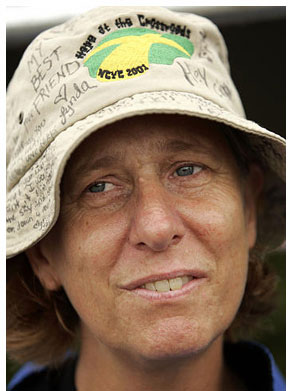

August was supposed to have been a quiet month for George W. Bush. Last year, the president cut short his customary weekslong vacation in order to campaign for reelection, so this year, unencumbered, he’d planned to spend more than a month in the sweltering heat of his ranch in Crawford, Texas. Then, last week, Cindy Sheehan, a grieving Northern California woman whose son was killed in Baghdad, Iraq in April 2004, showed up on Bush’s vacation doorstep. She refuses to leave until Bush meets her in person. Nothing’s been quiet in Crawford ever since.
It wouldn’t be quite right to say that Sheehan’s stand has vaulted the war back to the forefront of the national consciousness. Fresh horrors in Iraq daily are enough for that. But Sheehan is clearly forcing Bush to personally and publicly confront the consequences of his choices. And she’s forcing reporters to pay attention, too. On Thursday, Bush was asked to respond to Sheehan’s protest. “I sympathize with Mrs. Sheehan,” Bush said. “She feels strongly about her position. She has every right in the world to say what she believes. This is America.” But Bush also said that he disagrees with those Americans, like Sheehan, who want U.S. troops to pull out from Iraq. And he didn’t suggest he’d be meeting with Sheehan anytime soon, either.
Sheehan insists that she’s prepared to wait until Bush changes his mind. Sheehan, a founder of Gold Star Families for Peace, an antiwar group composed of families of troops killed in Iraq, has always been vocal in her opposition to the war. She participated in many rallies during the election last year, and even starred in an anti-Bush ad for MoveOn.org. She says that her late son Casey, a 24-year-old Army specialist who was killed in a rocket attack just two weeks after getting to the battlefield, felt the same way. And just as Casey went to Iraq to do his duty, Cindy Sheehan says she’s got to take a stand in Crawford to do hers.
As a matter of politics, Sheehan’s stand is brilliant. Bush’s chief political asset is his embrace of the troops and their families; the longer he refuses to meet with Sheehan, the more unconcerned — and even callous — Bush risks looking to the public. And by providing a genuine news event in the hot, sleepy confines of Crawford, she’s gotten far more media attention than she garnered as the star of a MoveOn ad. She’s been profiled in dozens of papers and hailed in a New York Times editorial. Consequently, she’s also been smeared by the right. Pundits have pointed out Sheehan’s apparent inconsistencies — in the past, she said that she believed Bush cares about the troops who’ve died, and she spoke warmly of a brief visit with the president after Casey’s death that she now recalls as insincere and impersonal. All this week Matt Drudge has hammered on Sheehan, publicizing criticism by some of her family members, who say they support Bush and the war. On the Tuesday edition of his show, Fox host Bill O’Reilly said Sheehan’s behavior “borders on treasonous.”
Conservatives have assailed Sheehan for her association with Michael Moore (she has been blogging on Moore’s Web site) and the antiwar group Code Pink. Some depict her as the left’s dupe, but Sheehan insists she came up with the idea for the Crawford visit on her own. In a telephone conversation with Salon on Friday afternoon, Sheehan explained her inconsistencies and defended her association with Moore and others on the left. Just before the call, Bush’s motorcade sped by “Camp Casey,” which is what Sheehan calls the protest stand she’s erected in her son’s memory. The cars didn’t even slow down.
So the president just drove by you a few minutes ago?
Well, I think he did, but I didn’t see him. A bunch of trucks drove by really fast and there were people in them. I didn’t see if any of them was the president, though. Chances are he was in the motorcade.
But needless to say he didn’t make any signal, meet with you or anything like that?
No. They sped by really fast. And I don’t want him to get out and shake my hand and just say, you know, whatever whatever. That’s not the kind of meeting I want.
What kind of meeting do you want?
I want the kind of meeting that holds him accountable for the words he’s actually said.
Well, do you want to debate with him? What do you mean by that?
What I want to ask is, “What noble cause did my son die for?” And if he says that it was to get rid of Saddam or liberate the Iraqi people, I’m not going to buy it. I want him to know that 62 million Americans oppose the war in Iraq. [During the interview, Sheehan used the number 62 million as well as 62 percent to refer to the strength of the opposition to the war. Recent polls show that majorities of Americans — in some surveys more than 60 percent — disapprove of the way the president is handling the situation in Iraq.]
Yesterday at a press conference the president acknowledged that many people want us to pull the troops from Iraq, and he specifically referred to you. What’s your response to what he said?
Why didn’t he say what Casey died for? And I’ve also asked them to quit using my son’s name in vain, to stop saying that we have to continue the mission in Iraq to honor the sacrifice of the fallen heroes.
So as far as you’re concerned he didn’t address your concerns yesterday, and you’re still looking for a meeting with him? Will you stay out there until he meets with you?
Yes. I’m going to be out here for the whole month of August unless he meets with me. I think I’ve said that a billion times.
But, realistically, do you think he’s going to meet with you?
Well, I’d say that nothing is impossible. But, you know, probably not.
Tell me what it’s like out there.
It’s really, really hot, but there’s so many people here and our spirits are so high. We know we’re doing a good thing. We have four Methodist ministers, and Bob Edgar [the general secretary of the National Council of Churches]. They came out and did a prayer service after the president drove by. And there’s people with bright yellow hair, and there’s people from all walks of life. It’s really cool.
One of the things that your critics have said — critics on the right — is that you’re making this into a media spectacle. And I’ve even heard people say that by being out there you’re dishonoring the memory of your son and other people who died in the war. How do you respond to that?
Well, I believe I’m honoring my son and people who died in the war by using their sacrifices for peace and love, not for war and hatred. I can’t speak for the other people whose children have died, but I can speak for my family and the other members of Gold Star Families for Peace. We believe we’re honoring our children by working for peace.
And it has turned into a media circus. But that’s not my fault. You know, I just came out here to confront the president and stop this war.
The media attention — obviously, though, that’s been helpful to your cause.
I believe it’s very helpful to the cause. You know what, the war has gone off the front pages. It’s gone off the mainstream media, and this has put it back on where it belongs, even if there has to be a grieving mother sitting outside Crawford, you know? I’m only really doing the media’s job for them.
What do you think your efforts are doing for the larger antiwar movement?
I believe it’s galvanizing the peace movement — I like to call it “peace movement” because that has more of a positive connotation than “antiwar.” I know that 62 percent of the American public believe the war was a mistake and we should bring our troops home. I think it’s giving those people a voice. People are dropping everything and coming from everywhere around the country to be here in Crawford, Texas.
It’s getting them off the fence to do something. Someone said that the opposite of good is not evil but apathy. This has really given people something to do.
You’ve always been against the war in Iraq, is that right?
Yes.
And I also want to ask about your son, his feelings about the war.
Casey disagreed with the war. He didn’t feel George Bush was using the troops in an effective way. Or in a good way. And I begged him not to go because he knew it was wrong. But he said, “You know what, Mom, I have to go. It’s my duty. And my buddies are going.”
Last year you met with the president. Tell me how that came about, and tell me what happened during that meeting.
We were invited by the protocol office at Ft. Lewis, Wash. They said the president wanted to have a sit-down with us. And we decided we wouldn’t use that time to debate the war with him. We wanted him to look at Casey, we wanted him to know about Casey, we wanted him to know what an indispensable part of humanity he was.
Tell me what the president was like during that meeting.
Well, he walked in and he said, “So who are we honorin’ here?” He didn’t know our name. He totally was disrespectful. He called me “Mom” the whole time. And he said some disrespectful things to us.
There’s been an account of you saying that you did think he was respectful during that meeting. [In June 2004, Sheehan told the Reporter, a newspaper in her home of Vacaville, Calif., that she believed Bush was “sorry” and felt “some pain for our loss.”]
Because at the end of the meeting, I said, “What are we doing here, Mr. President? We didn’t vote for you in 2000, we’re not going to vote for you this time. We’re lifelong Democrats.”
And he said, “It’s not about politics.” So we said, OK, we wouldn’t use it about politics and we tried to put a positive spin on it. But if you read the whole article you’ll see we already had misgivings about what was going on. A lot has been taken out of context.
Well, you said, “I now know he’s sincere about wanting freedom for the Iraqis … I know he’s sorry and feels some pain for our loss.” Do you still think he feels some pain for your loss?
No, no, I don’t think he does at all. Because it was all about politics. When he talks about how he meets with the families and they say, “Mr. President, we pray for you” — you know what, that’s not true. He used it for politics, because he doesn’t go to funerals and stuff like that. That’s what it was all about.
I’m just trying to get a sense, though, when you said that he feels some pain for your loss — you didn’t really mean that then, or at least you don’t think that now?
I don’t even know what I meant back in June of 2004. I was in shock, I was in grief. I’m still in a deep state of grief but I’m not in shock anymore. When he said it was not about politics I believed him. But he made it all about politics and that’s when I stopped believing him.
Yesterday there was a report — I’m not sure how accurate it is — but it was apparently a statement from other members of your family that said they disagree with what you’re doing.
I think it’s accurate. I think my husband’s family did write that. But I don’t really give — I don’t care what they wrote. Because, No. 1, it’s their opinion and they’re entitled to it. But No. 2, they called him something like “our dear Casey.” You know they’re hypocrites. They didn’t even know Casey. They didn’t spend any time with him in his life, and now they’re using his death for political reasons, I think.
Casey’s my hero because of the way he lived, not because of the way he died. For these people who never ever went out of their way to spend any time with him to actually dare speak for him, I think it’s hypocritical. Casey lived a great life and he was an honorable man and he died in a dishonorable war.
What about other members of your family — are there people in your family who do agree with you?
My immediate family, Casey’s dad and my three children and my sister, we’re all on the same page. And I really think that some of my husband’s siblings are with us too.
And I want to say something else, too. They said they support the troops. You know what? I support the troops. How’s anything I’m doing showing that I don’t support the troops?
What about parents of other soldiers who’ve been killed?
I would say the majority would agree with what I’m doing, because the majority of Americans think that this war is based on lies and deceptions and they think it was a mistake and they want the troops to come home.
Do you hear from many others?
I hear from them all the time, I do. We had a lot of military families speak out here. We have a lot here whose kids are still in harm’s way, and whose kids have died.
One thing I want to ask you is about the other groups that are supporting you. Some people on the right have been saying that you’re being “used” — that’s the quote I’ve heard. You’re being used by extreme left-wing groups. How do you respond to that?
I respond that this was my idea. This was my mission. This was my vision. And what we’re all doing is we’re working for peace. And all these groups together are working for peace. And they’re helping me with my vision. You know they’re not using me, and maybe I’m using them because they’re helping me out tremendously in this action.
But what about the pragmatics of it — if you associate with someone like Michael Moore do you risk losing the mainstream?
I think Michael Moore is an amazing man, an amazing, brave man. And I think people are probably going to start saying don’t associate with Cindy Sheehan. People who speak truth to power somehow are marginalized in this country.
I know you’re going to be out there for the month of August. How long do you think the media’s going to pay attention to you? Do you worry about that?
I don’t really care. I didn’t come out here to do this for the media. I came out here to do this to end the war. If the mainstream media’s not here we’ve got blogs, we’ve got the Internet. It’ll still keep going. Smart America will know what’s going on. They’re the ones who are going to put pressure on the elected officials to effect any change.
