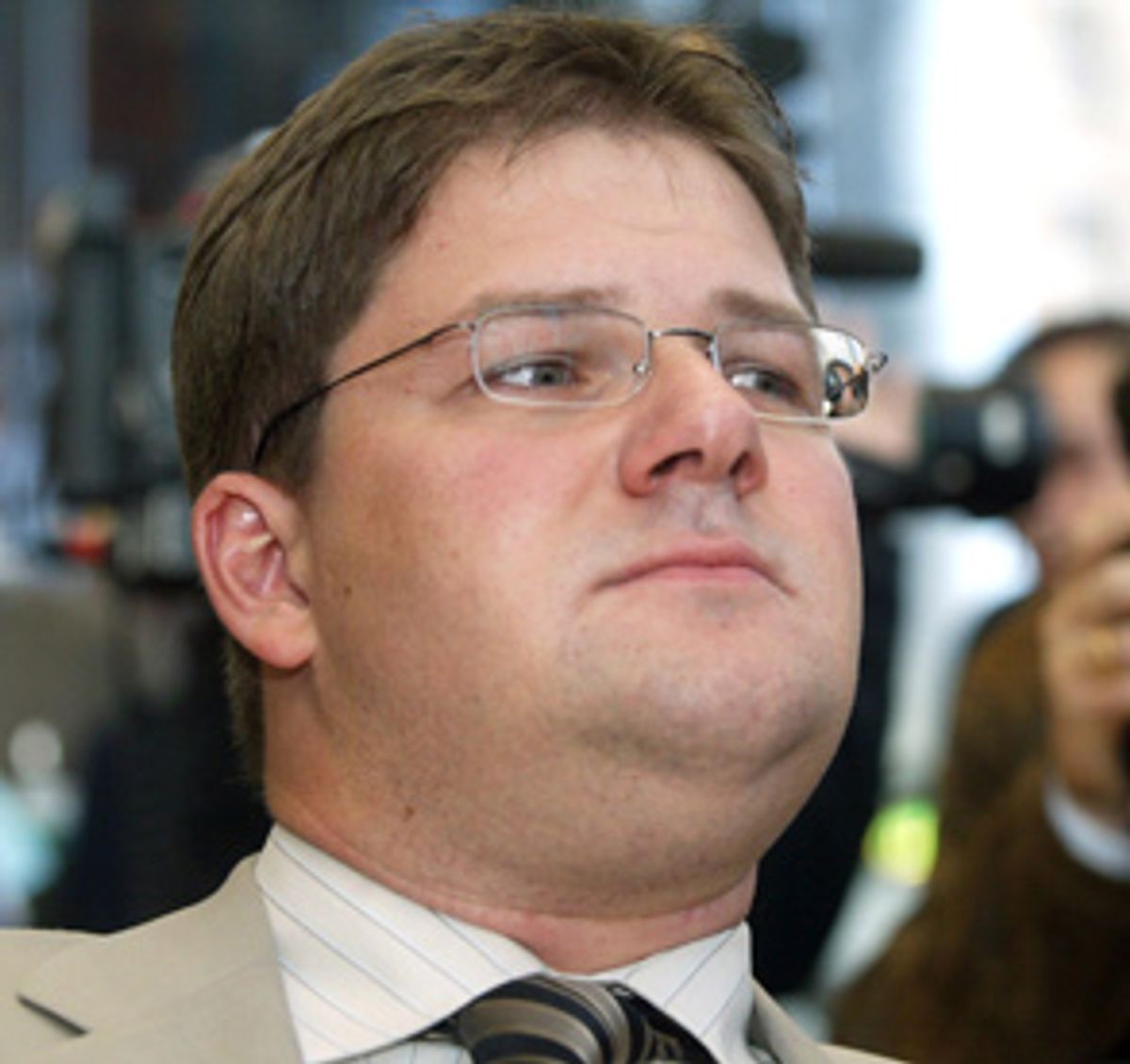
Holger Apfel is a burly, fat-cheeked 35-year-old with glasses, given to wearing brown suits. He leads a delegation of the neo-Nazi NPD (National Democratic Party of Germany) in the German state parliament of Saxony. In January, he stood up in the chamber to rage about the firebombing of Dresden. His timing was sharp: The parliament was trying to recognize the liberation of Auschwitz, but Apfel and his comrades had just caused a scandal by walking out of a minute's silence observed for the victims; now he wondered out loud why there was no minute of silence for all the dead Germans. He filibustered about "anti-Germanism" and the "German holocaust," and the Allied "air-gangsters" as terrorists and mass murderers, before someone turned off his microphone.
"He knew what he was doing," says Richard Herzinger, a German political essayist and journalist who watched Apfel's tantrum from the public gallery. "It was straight out of the playbook -- using the term 'holocaust' in a new way, casting Germans as victims. It was somehow postmodern. And absolutely calculated."
For the first time in more than three decades, Germany faces a national election with neo-Nazis sitting in a regional parliament. Most Germans find this embarrassing. The NPD won 12 seats in Saxony last fall -- about 9 percent -- and another far-right party called the DVU holds six seats in the state of Brandenburg. Few experts think even the stronger NPD can win seats in the national parliament this September, but the stirring of neo-Nazism in the countryside is a symptom of discontent not just in Germany but across Europe, where many voters feel threatened by the rise of Islamist terrorism, Turkish immigrants taking their jobs, and the idea that their culture might be losing ground to foreigners who don't understand its traditions. Charles Kupchan, an expert on Europe at the Council on Foreign Relations, thinks the EU experiment is swinging away from enthusiasm for "Europe" and back toward old-fashioned nationalism. "The concern is not just about immigration and unemployment," he says, "but also a dilution of European identity and community."
The NPD is all about German identity. It represents the extreme, stumpy end of the debate over multiculturalism. It used to be a postwar party with a single idea -- Germany for Germans -- but now it also makes noises against the EU, American imperialism and the standing government in Berlin. It insists that Germans were victimized in World War II. It pushes a cocktail of hard-right and hard-left "revolutionary" politics that plays well in the ex-communist east; and by hammering these new points, oddly, its members sound more than ever like members of Hitler's NSDAP.
"Germany has a legally operating Nazi party again," says Herzinger. "The mixture of anti-Semitism, anti-Westernism and anti-capitalism resembles the Nazi movement of the 1920s. Not everyone recognizes this. In Saxony, for example, the NPD is organized on a local level; they get involved in community work. So when anti-fascists come and say, 'But these people are Nazis,' the locals say, 'Well, maybe Nazis aren't so bad.'"
Small as it is, the NPD has the question of patriotism virtually to itself. Its leaders push German pride in a society where love of country is still taboo. "When you talk about patriotism here, you get tarred with the far-right brush," said Günther Waltz, a 40-ish man standing in a bar down the street from the NPD's headquarters in Köpenick, a depressed eastern suburb of Berlin. "And I think young people now are sick of hearing about the past."
Since outright Nazism is against the law in Germany, the NPD has to declare its blood pride without seeming racist. The party's national chairman, Udo Voigt, told me, "We are not a racist party, and not an anti-Semitic party. We don't use the motto, 'All foreigners must go.' That's nonsense. But we do think all foreigners should get out of German public welfare and the public health systems."
Voigt is a plain enough man in his early 50s, with a peppery mustache and a full head of gray hair. He looks and sounds -- at first -- like any brisk, assured conservative. He wears neat suits and holds a degree in political science. He's the son of a Nazi S.A. officer (the S.A. was the predecessor to the Nazi S.S.) and has belonged to the NPD since its early days in the 1960s, when he was a teenager. He knows how to talk to the press. You hear very little official anger from him toward Turks or Vietnamese or Jews. "Sometimes we don't shrink from saying Jews should shut up," says Voigt. "But that's not anti-Semitism."
Maybe not. But he's been known to slip. Last spring he gave a speech to a group of Young Nationalists and happened to mention Berlin's new Holocaust memorial, without realizing that a tape from the speech would be broadcast on national TV. "For us it isn't a Holocaust memorial," he quipped to the youngsters, "but we'd like to thank the government for laying the foundation for the chancellery of the next German Reich."
The NPD kicked off its national campaign in July at an open-air concert in the otherwise placid and leafy town of Gera, Thüringen, about three hours southwest of Berlin. Local police had gated off the Park der Jugend, or Young People's Park, to let about a thousand people gather on benches, drink beer and eat bratwurst. Udo Voigt was there, too, in his shirtsleeves and tie.
It was a warm summer day, with sunlight streaming between the beeches and elms. Women and a few young families mixed in with jackboots, suspenders and an ocean of inflammatory T-shirts. ("Master Race," "Ku Klux Klan," obscure praise for 9/11.) Germany has hundreds of disorganized gangs, Kameradschaften, and attracting them to this "Rock für Deutschland" concert was vital to the movement. Dr. Richard Stöss, a professor of political science at Berlin's Free University who studies the extreme right, says the NPD under Voigt "is always looking to integrate those smaller groups" as a way to swell the ranks. But the NPD wants to remain legal; so at the park entrance, banned slogans on T-shirts and improper tattoos -- Iron Crosses, swastikas, references to Hitler's S.S. -- had to be censored with packing tape.
Not everyone looked like a skinhead or outlaw, though. What the NPD supporters in Gera had in common wasn't a clothing style but a vigilant, defensive, urgent manner. About the only generalization you can make about neo-Nazis is that they're not relaxed people.
"Some of them are very well-educated," says Richard Herzinger. "You can almost compare the movement to the [radical-left] '68 movement in Germany, which also wasn't a function of material wealth -- some of them just broke with reality in favor of an absolute truth. That has an incomprehensible appeal. Because then you can place yourself over other people. It's not just a question of education."
The first speaker was an aging man in a blazer and glasses named Frank Schwerdt, the party chairman in Thüringen. He talked about merging the factions of the far right to win parliamentary seats. Then he mentioned the shuttered storefronts in Gera, joblessness, and the fact that people were migrating from their hometowns to cities like Berlin or even to other countries, like Austria, for work. Home was an important theme. He said the NPD understood that people needed jobs "da, wo sie zuhause sind" -- there, where they feel at home.
Then a "hatecore" band called Eugenik took the stage, and played masturbatory white noise for about an hour.
The festival mood in Gera is a snapshot of how the party has changed. The last time the NPD had power was in the late '60s, when its members swept briefly into 11 western state legislatures. Back then it ran on a single plank for aging reactionaries who resented foreign soldiers on their soil -- "Germany for Germans" -- but now it's a party for young people, with a platform that both resembles Hitler's old policies and blurs their essential Nazism.
"The NPD is basically devoted to a return of the German Reich," said Dr. Stöss, the political scientist. "Now imagine if you went to a depressed eastern state where immigration from Poland was a problem, and said, 'We think the western parts of Poland should be annexed to Germany.' [Something the NPD espouses.] No one would vote for you. So they couch their position in arguments about globalization ... They say they want to return to a closed, nationalized German state, away from the EU, away from foreign capital, away from the United States."
Hitler himself appropriated left-wing rhetoric about big business and banks. He called the Allies of World War I "gangsters" and "criminals." He railed against America. He inflamed German pride as an antidote to German shame, and in the early days of his party he swelled the rolls with malcontents: "A conglomeration of pimps, murderers, homosexuals, alcoholics, and blackmailers flocked to the party as if to a natural haven," wrote William Shirer in "The Rise and Fall of the Third Reich." "Hitler did not care, as long as they were useful to him." The NSDAP wanted to overturn the democracy in Berlin and replace it with a "folkish state," based on land and blood, just like Voigt's NPD.
The NPD's national office is a cramped lemon-yellow row house in Köpenick, called the "Carl-Arthur Bühring Haus," after a wealthy Holocaust denier. Bühring claimed the count of 6 million dead in the German gas chambers was a lie concocted by a former S.S. agent under American pressure during the Nuremberg trials. The NPD's Web site shows enough self-awareness to devote a pair of pages to explaining why the current German National Party is not related to, or even like, Hitler's NSDAP. But its defense is a technical one: It seems Hitler ran his party "dictatorially" from 1921 on, while Udo Voigt is more open-minded. The pages never address racism, the Holocaust, German borders, or Jews.
"We do want a new government in Berlin," Voigt told me. "East Germany was a child of the Russians, and West Germany was a child of America and the Allies. That's unacceptable to us. We want a free Germany, with no more occupation. Remember there are still American troops on German soil. Then we want a government that serves German interests -- German money for German projects, and an immediate halt to aid for Israel."
"Would Germany be democratic under the NPD?"
"Of course," he said.
"Would Jews have a role in the government?" I asked.
"Yes, of course. Jews have contributed a lot to German culture."
But is he telling the truth? Public anti-Semitism would be a kiss of death for the NPD; in fact the party was almost shut down in 2003 for flirting with overt Nazism. Dr. Stöss believes the party's political platform expresses what its leaders can't say out loud. "When they talk about globalism, they're talking about Jewish capital," he said. "They believe Wall Street is run by Jews. They argue that the Palestinians are the true nationalists in Israel -- the Jews in other words are 'internationalists,' with a plot to spread their global network. Whereas the Palestinians and the NPD are 'nationalists.'"
Most Germans hate or disregard the NPD. But the question of national identity flows under everyday politics in Germany, and warning about (not-very-numerous) outsiders is a safe way to win votes for politicians from across the ideological spectrum. The party that threatens to win parliamentary seats this fall from Berlin's ruling elite is a new far-left outfit called simply "the Left Party," and its leaders have also made anti-immigrant noises. Oskar Lafontaine, one of its founders, said in a speech in June, "In my opinion only people who take part in German society are German." Angela Merkel, the conservative leader considered a strong possibility to beat Gerhard Schröder in the fall, is also popular in part because she's against Turkish accession to the European Union.
"I have a German passport, but I'm still a foreigner," said Aynur Aktürk, a 40-year-old woman with hay-colored hair who moved to Berlin from Turkey as a teenager and now has two German-born kids. She spoke over lunch at a Turkish street fair this summer in Berlin. "My husband and I have jobs, we're lucky. But if we lose our jobs, I don't know what will happen. Germany is my home now, but it could change." She hesitated. "Germany could change again. The people aren't happy."
At the rally in Gera, I asked a pregnant woman pushing a stroller across the grass why she liked the NPD. Two young boys crawled at her feet. She looked like a young mother from Northern California: socks in sandals, a loose green maternity shirt, pale gentle eyes, and dirty-blond hair tied back with a scrunchie. "Because they stand for family. And for Germany. And because I won't vote for any of the established parties," she said with a slight smile, as if voting for Angela Merkel or Gerhard Schröder were absurd. "They put up with too much corruption."
Her stout-bellied husband, wearing shorts and a plaid shirt, hurried up. Journalists weren't welcome at the rally. He said, "I don't think we should give our names. We don't know what will happen. We don't live in such a free country."
This was the surprise of the afternoon, that NPD supporters at the concert believed they were free spirits, that their police-enclosed cauldron of racial pride was the only place where "true Germans" could express themselves. Freedom became a theme of Udo Voigt's speech. He mounted the stage between black columns of concert speakers and spoke with his sleeves rolled up, like a man with work to do. "Kameraden," he said, "democracy means rule of the people, democracy means freedom, and if you're afraid of [banned] songs, if you're afraid of lyrics -- then what are you afraid of? You're afraid of the people! And I say, the politicians in Berlin should be afraid ..."
But as he talked about freedom, a woman with loose hippyish hair wove through the crowd with a video camera. A man followed her, holding a cardboard sign: "Andrea Röpke, anti-fascist." She was a well-known journalist. People quit listening to Voigt and trotted over to the sign. Röpke had to keep moving. But wherever she went, the sign followed, and the flow of people around the park was like a school of hungry fish. The scene looked no different from a witch hunt.
"As for all you scribblers," Voigt went on, "who lie about us in the press: You should write this down. We don't want a multicultural society! We know what that brings! In Berlin we've learned about the first school without a single German child. Should this be the future of Germany?"
Next to me was a couple enthusiastically listening to the speech. The man was middle-aged but youthful, with prematurely gray hair and a camouflage soldier's cap, an Army-green T-shirt, and boots. His young wife had dyed strawberry blond hair and freckles dusted with makeup.
The man looked at me. "He means you," he said. "You should write this down."
"Anyone who wants this to be the future of Germany," hollered Voigt, "should vote for the established parties! Whoever doesn't want this to be the future of Germany should send the NPD to the national parliament!"
"Write that down!" said the man.
"It's the truth," said his wife.
"We need, in Germany, at last, a true national politics," said Voigt. "We have a dream -- that the Federal Republic of Germany should go into the dustbin of history, as quickly as possible, just like the GDR. That's our dream. We dream of a free and prosperous and peaceful Germany for true Germans ... We have the blood of our fathers flowing in our veins and we are proud!"
The crowd cheered, and the man in the camouflage cap smiled at me as if I'd been taught some sort of lesson.
"Good speech," said his wife.
The state of Thüringia, by the way, is about 98 percent German. The NPD does well in states with the smallest foreign populations. The party isn't popular in semi-integrated Berlin, where an NPD march was thwarted last May by thousands of regular citizens. "But in the long run," says Herzinger, "they have potential. They're determined, they're organized, and they have an influence on young voters that's horrifying. We're now dealing with a mini-NSDAP, comparable to the party of the 1920s. Which people back then didn't take seriously, either."
Shares