
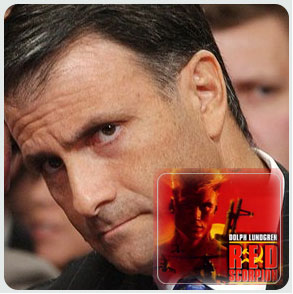

Before fallen lobbyist Jack Abramoff assumed his role as the most scrutinized man in Washington, he had a brief career as a budding Hollywood producer. He made just one movie, the 1989 Cold War bomb “Red Scorpion.” With its blatant propaganda, its collaboration with the apartheid South African government, and financial misdealing, it’s notable, even for Hollywood, for being one of the seamiest productions in recent memory.
Last week, Abramoff was arrested by the FBI after a grand jury indicted him and a partner on fraud charges (he’s out on $2.2 million bail). In Washington the Senate Indian Affairs Committee has been holding hearings on whether Abramoff, 46, bilked millions out of tribes he represented, and a joint task force is picking through his personal papers, including his credit card records, which show Abramoff purchased trips for members of Congress (including Tom DeLay). His days in the Capitol, it seems, are numbered. (Abramoff’s spokesman, Andrew Blum, responded to inquiries from Salon for this article with a written “no comment.”)
But long before he became the poster boy for the Beltway’s back door, the young Jack Abramoff was at a crossroads. It was 1987, he was in his late 20s, and the presidency of his political hero, Ronald Reagan, was winding to a tarnished close. The Iran-Contra hearings covered the front pages, and Oliver North, whom Abramoff knew and admired, was about to be indicted. The Republicans were disillusioned, and after years of service to the party — as chairman of the College Republicans from 1981 to ’85, he’d mentored Grover Norquist and Ralph Reed, had worked for one right-wing think tank, and founded another — Abramoff apparently was no longer sure he wanted to go into politics full time.
So he took a detour, doing what any other kid from Beverly Hills might when finding himself at a loss: He decided to try his hand at show business. Why not? Hollywood was no more than Washington for good-looking people, as the saying goes, and Abramoff, a student government officer and a football player at Beverly Hills High School, class of ’77 (he graduated from Brandeis University in ’81), was smart and charismatic and, if not actor handsome, at least physically imposing enough to be a producer. Through his father, a high-up executive at the Diners Club, he’d rubbed shoulders with some of L.A.’s elite.
Abramoff moved back to Los Angeles from Washington after finishing Georgetown Law School, and he and his brother, Robert, formed a production company, Regency Entertainment. They set to work on an action picture, a story about a rogue Soviet Spetsnaz soldier who is sent to quell a rebellion in a fictional African country — one that very closely resembled Angola — only to find that he sympathizes with the rebels. “Red Scorpion,” starring Dolph Lundgren, would be released in April 1989. The Abramoff brothers raised $16 million for it — the sources of the funding remain unknown — an impressive sum for a B-picture with an unproven star. It made a poor impression on audiences and critics. “The movie’s reflective moments belong to Mr. Lundgren’s sweaty chest,” wrote Stephen Holden in the New York Times.
But the story behind “Red Scorpion” is far more captivating. The film was to be a manifesto for Abramoff; a Rambo-like morality tale and a grand indictment of communism — his Reagan Doctrine parable in action-packed Technicolor. And in the process of conceiving of and making it, Abramoff helped groom an African despot, rose to high levels in the K Street food chain, and got to play international spy.
“There was some indication even in those days that he was not the sort of person who would feel overly constrained by the rules,” said Jeff Pandin, who worked closely with Abramoff in the 1980s.
The roots of “Red Scorpion” took hold in the early 1980s, when interventionist-minded folk in Washington had an array of global conflagrations to obsess over. The mujahedin were battling the Soviets in Afghanistan and the Contras were fighting the Sandanistas in Nicaragua. Some circles felt the United States was not doing enough to help them. The gripe heard in the office of CIA chief William Casey and among Oliver North’s cabal in the National Security Council was that Reagan was not fully Reagan when it came to foreign policy. A cottage industry of think-tank intellectuals and private crusaders sprouted up to build support for one or another set of freedom fighters. Abramoff was among the most active.
In Angola, the rebel group du jour, the National Union of Total Independence for Angola, or UNITA, had been taking on the Soviet- and Cuban-backed government since the 1970s. UNITA’s leader, a savvy warlord named Jonas Savimbi, had become a darling of the right. Savimbi received millions in aid and had even retained Washington lobbyists to press his case. Abramoff was interested in Angola, too. So was Lewis E. Lehrman, the millionaire behind the Rite Aid drugstore chain and the founder of the right-wing group Citizens for America, who made an unsuccessful run for governor of New York in 1982. Through Republican circles, Abramoff met Lehrman at some point in the early ’80s, and in 1985 Lehrman hired him. Abramoff came to Lehrman with an idea: What about a convention of disparate anti-communist rebel leaders, put together and paid for by Americans? It screamed of Abramoff’s cartoonishly outsized ambitions and worldview, and Lehrman liked it.
Jack Wheeler, a California entrepreneur and anti-communist activist who enjoyed deep entree in Washington at the time, had met Abramoff through the College Republicans in 1984. He immediately took to Abramoff, who had charmed him with a story about scandalizing fellow members of a Beverly Hills athletic club by wearing a T-shirt that read “I’d Rather Be Killing Communists.”
Wheeler and Abramoff began discussing the idea of the rebel convention. “The whole point of the Reagan Doctrine was to fight the phenomenon of communism, and if one regime fell, they’d all fall,” Wheeler said. “No Afghan knew where Nicaragua was, and no Contra knew where Angola was.”
Amazingly, they made it happen, and quickly. In the first week of June 1985, mujahedin, Contras and Laotian rebels joined Savimbi and his men in Jamba, Angola, UNITA’s jungle headquarters, for the Democratic International, as Lehrman had titled the event. For several days they commiserated and compared notes, huddling together in thatched huts and signing an anti-Soviet pact. Wheeler organized transportation, and Abramoff dealt with the money and logistics from Lehrman’s end. Lehrman himself read a letter of support from Reagan and handed out framed copies of the Declaration of Independence. It received some press coverage. Abramoff had pulled off his first far-right adventure.
In the eyes of many in the administration, particularly in the State Department, Abramoff and groups like Citizens for America were only serving to subvert years of careful negotiation. “These people were trying to undercut and divert official policy,” said Chester “Chet” Crocker, assistant secretary of state for African affairs from 1981 to 1989. “Our policy worked because we got Castro to decide the jig was up and go home — not because of the conservative activists.” (Cuba began pulling out of Angola in 1989.)
Loved or hated, Citizens for America was short-lived. Not long after the Democratic International — or the Jamboree in Jamba, as it was pejoratively known — funding for the group dried up. “Lehrman pulled the money out all of a sudden, and then Jack dropped out of it, and that was that,” Wheeler said. “Then Jack went to make his movie.”
According to Pandin, who went to work for Abramoff in 1986, Abramoff and Lehrman had had a falling out. “He was always looking to push the envelope,” Pandin said. “It was seen among Jack’s friends as a coup — he got stabbed in the back by people who weren’t comfortable with him.” When contacted by Salon, Lehrman submitted a short statement via a representative: “I was recruited by President Reagan to set up Citizens for America in 1983. It was a voluntary, part-time position which I held for about three years. Among the paid staff, Jack Abramoff came in well after CFA was started, was there only for a short while, before his termination.”
But Lehrman may have also gotten cold feet because it had become clear by the mid-1980s that Savimbi was not a paragon of democratic ideals. There were allegations of murderous purges in his own ranks. It is commonly agreed in Washington that it was Savimbi himself, and not the government of Angola, who in July 1991 had UNITA’s envoys to the United States and the United Kingdom, Tito Chingunji and Wilson dos Santos, and their families, killed.
Crocker described Savimbi, who was killed in 2002, as “a brilliant military warlord who operated by the gun, lived by the gun, and died by the gun and ultimately had a failure of judgment, like warlords often do.”
Others are less charitable. “He was the most articulate, charismatic homicidal maniac I’ve ever met,” said Don Steinberg, ambassador to Angola during the first Clinton administration.
With Citizens for America disbanded, and law school done, Abramoff moved to Los Angeles. He came up with the premise for “Red Scorpion” and hired Arne Olsen, a young screenwriter with no credits to his name, to write it. The Abramoffs told Olson they wanted to base the fictional African country in the film, Mombaka, directly on Angola, and the rebel leader on Savimbi. Olsen said he churned out a baldly propagandistic script.
“It definitely was an anti-Soviet thing,” Olsen said. “It was an easy target.”
Of the Abramoff brothers, he said, “This wasn’t their profession, what they’d do for the rest of their lives. It was a lark. They wanted to get a message across, but at the same time they were going for exploitation and of course trying to make some money.”
Initially, the movie was set to shoot in Swaziland, but at the last minute Abramoff moved the production to Namibia, which was occupied by South Africa’s apartheid government. Congress had passed (over Reagan’s veto) the Comprehensive Anti-Apartheid Act in 1986, making it very frowned-upon, when not illegal, to do business with South Africa or its proxies. This did not seem to bother Abramoff, who planned to use South African Defense Force vehicles and equipment on the set and soldiers as extras. By 1988, when shooting started on the film, Abramoff likely had connections in the South African government. For a decade, after all, South Africa had been Savimbi’s main backer, and according to Crocker and others, Abramoff would not have been able to put together the Democratic International without extensive help from the SADF.
But Abramoff’s plan backfired: it was not long before anti-apartheid activists were protesting at the “Red Scorpion” set, and Warner Brothers, who had signed on to distribute the film, pulled out.
James Glickenhaus, whose company, Schapiro Glickenhaus Entertainment, ended up distributing “Red Scorpion” after Warner Brothers jumped ship, said he was not aware of the help provided by the SADF, but he was aware of the controversy over the location. “Look, had the film been made in Nazi Germany, I wouldn’t have distributed it,” he said. “But I personally felt upon investigating that the Namibian government was more simpatico than the South African government.”
The movie seemed like an opportunity to turn a buck — if not win any awards. “There’s some fish for eating and some fish for buying and selling,” Glickenhaus said. “This was a fish for buying and selling.” In typical Hollywood tradition, Glickenhaus threw a party for the film at Cannes, his feelings about its quality notwithstanding. The Abramoff brothers came, but, he said, they “looked totally out of place.”
The actor Carmen Argenziano, who played the villainous Cuban colonel, said he knew that many of the men playing Russian and Cuban soldiers were actual SADF soldiers. There were also rumors going around the set that some of the funding for the film, not just props and extras, was coming from South Africa.
“We heard that very right-wing South African money was helping fund the movie,” Argenziano said. “It wasn’t very clear. We were pretty upset about the source of the money. We thought we were misled. We were shocked that these brothers who we thought were showbiz liberals — Beverly Hills Jewish kids — were doing this.”
But there was a lesser-known connection between the apartheid regime and Abramoff.
In the late 1980s, some conservatives in Washington saw P.W. Botha’s apartheid government in Pretoria as the last bulwark against communism in Africa. Certain Reagan domestiques had even gone to work for it. “The South African government was the only one that was, shall we say, anti-communist,” said Stuart Spencer, who’d help run Reagan’s 1980 and ’84 campaigns and later became a lobbyist for Pretoria.
Abramoff seems to have shared the sentiment. In 1986, he founded the International Freedom Foundation, whose stated goal was “to foster individual freedom throughout the world by engaging in activities which promote the development of free and open societies based on the principles of free enterprise.” More specifically, among the IFF’s aims were to oppose the Anti-Apartheid Act and other sanctions and to urge greater support in Washington for Pretoria and less support for the African National Congress, the party that would come to power in 1994 under Nelson Mandela. At its height, around the time “Red Scorpion” was released, the IFF employed about 30 young ideologues in offices on G Street in Washington, Johannesburg, London and Brussels. Churning out reports and presentations (for one such presentation on the Contras, it borrowed the slide show that North had used to raise money for his arms-deal network, according to Pandin), the IFF attracted notable members such as Sen. Jesse Helms, R-N.C., and Rep. Dan Burton, R-Ind.
“It was meant to be a way to institutionalize the contacts he’d made abroad — people who were interested in anti-communist stuff, democracy building, that kind of thing,” said Pandin, who held directorships at the IFF from its inception until it shut down in the early 1990s. “We were skeptical of the ANC,” he went on. “We did not want to see the U.S. imposing sanctions on South Africa.”
The IFF, however, could not claim impartiality on the subject. It was, in fact, clandestinely funded by the SADF’s military intelligence arm, according to former U.S. officials, ANC documents, and reports published in U.S. and U.K. According to a 1995 Newsday report, the IFF received up to $1.5 million a year from the SADF from 1986 through 1992, as a part of Operation Babushka, a smear campaign meant to discredit Mandela and the ANC by portraying them as allied with communist regimes. An SADF intelligence chief also told the Newsday reporters that the SADF helped fund “Red Scorpion.”
“We knew that the IFF was funded by the South African government,” Herman Cohen, who ran Africa operations for the National Security Council, told Salon. “It was one of a number of front organizations.”
“I would not be shocked if some of the money they were raising in the Johannesburg office was coming from those kinds of channels,” Pandin said, referring to the SADF.
Pandin recalled that Abramoff enlisted Russell Crystal, the head of the IFF’s Johannesburg office and an advisor to F.W. DeKlerk, to be an informal producer on “Red Scorpion” (whether this meant Crystal helped fund the film, Pandin did not remember). But Pandin says Abramoff refused to compensate Crystal afterward. “It wasn’t a good experience,” Pandin said of the film. “A lot of people didn’t get paid. Russell wasn’t entirely enamored of Jack after that.”
“Jack was always looking for angles and ways to do interesting things until people slowed him down,” he said, obliquely, when asked whether Abramoff, who resigned from a day-to-day position at the IFF in 1987 but remained a chairperson and closely oversaw operations, knew of the connection to the SADF. “He needs somebody to cool him down sometimes. Left to his own devices he’d be inclined to go a little crazy.”
“Maybe he should have paid more attention in some of his law school classes and spent less time making movies.”
Peter Roff, who is listed as Abramoff’s personal assistant in the credits of “Red Scorpion,” said he worked for Abramoff out of the latter’s Washington office during the time of the production in 1987 and ’88. Roff, however, recalled doing more work for the IFF than for the film. Indeed, he only vaguely remembered the name Regency Entertainment. He never went to L.A. or to the set in Africa. But Roff, who worked on George H.W. Bush’s ’88 campaign, claimed he too was unaware of the source of the IFF’s funding.
“I thought he was an exceptional person,” he said of Abramoff. “Creative, good person to work for, very encouraging of my ambitions to be part of something that helped make the world a better place.”
The SADF stopped funding the IFF in 1992. Apartheid had come to an end. By 1994, the organization closed its doors.
Asked by Newsday about the South African government’s connections to the IFF and “Red Scorpion” in 1995, the last time he seems to have entertained questions on the subject, Abramoff called the allegations “outrageous.”
When, inevitably, “Red Scorpion” was released, it was no study in nuance. Directed by Joseph Zito, whose previous credits had included the Chuck Norris movies “Missing in Action” and “Invasion U.S.A,” the dramatis personae consist of scheming, cackling communists on the one hand — the Russians not only tear apart the rebel village with attack helicopters, but also randomly gas a band of peaceful Bushmen and their animals — and noble guerrillas on the other, and the barely intelligible Lundgren in between. The action sequences have all the panache of a subpar “A-Team” episode.
There are some inspired moments, such as the climax, when Argenziano’s character, Col. Zayas, is left groping for his own dismembered arm, which clutches a live grenade (he doesn’t reach in time). There is also a rousing speech delivered by the token freewheeling American, a foul-mouthed, boozing journalist played by M. Emmet Walsh: “As a matter of fact, in America, an American can swear whenever, wherever and however much he or she fucking well pleases!” he yells at Lundgren. “A little something called freedom of speech, which I’m sure you Russians aren’t real familiar with!” In another nice touch, the closing credits roll over Little Richard’s “All Around the World,” remixed to include machine-gun and exploding-bomb sound effects.
If only things were as jovial off the set. They weren’t. Actors went unpaid; Argenziano said that although he was paid his initial salary, he has never received a residuals check for “Red Scorpion.” The manager of one of the major cast members, who did not want to be named, said that, according to her client, many of the actors and crew were never paid at all.
“I just wanted to get the hell out of there,” Argenziano said. “It was a very hard shoot. We were all worn out, so no one made a stink.”
Glickenhaus, who knew of crew and cast going unpaid, claimed that despite its poor box office receipts, “Red Scorpion” did well in video, television and foreign sales. Nonetheless, at some point prior to its release in April 1989, the Abramoffs and Regency found themselves in enough debt that the film went into the possession of Performance Guarantees, a completion bond company.
Abramoff also borrowed money from friends that he never repaid. During the production, he took a $50,000 personal loan from Ralph Nurnberger, a Georgetown professor and consultant. Nurnberger and Abramoff later worked together (from 1999 to the end of 2000) at Preston Gates Ellis. Abramoff has still not repaid the loan.
Remarkably, there was a “Red Scorpion 2.” It went straight to video in 1994 and did not star Lundgren. Abramoff is listed as an executive producer, but he had only a nominal connection to the film, according to its other producers. But by then, Abramoff had decided politics and not political movies were his true calling, and he was back in Washington, a lobbyist at Preston Gates (the lobbying firm run by the father of Microsoft founder Bill Gates). Now, of course, his decades-long ascent into Republican power circles is coming to a crashing end. Investigators are combing through every aspect of his life. He has become Washington’s summa persona non grata, disowned even by Rep. Tom DeLay, R-Texas, for whom he is alleged to have purchased a trip to Scotland.
After Jack returned to Washington, Robert Abramoff stayed in Los Angeles and continued to produce films. He is now a full-time lawyer. Reached at the offices of Burgee & Abramoff in Woodland Hills, he refused to speak about his brother or “Red Scorpion.” “It’s a family matter and I prefer not to comment on anything,” he said.
