Fiction
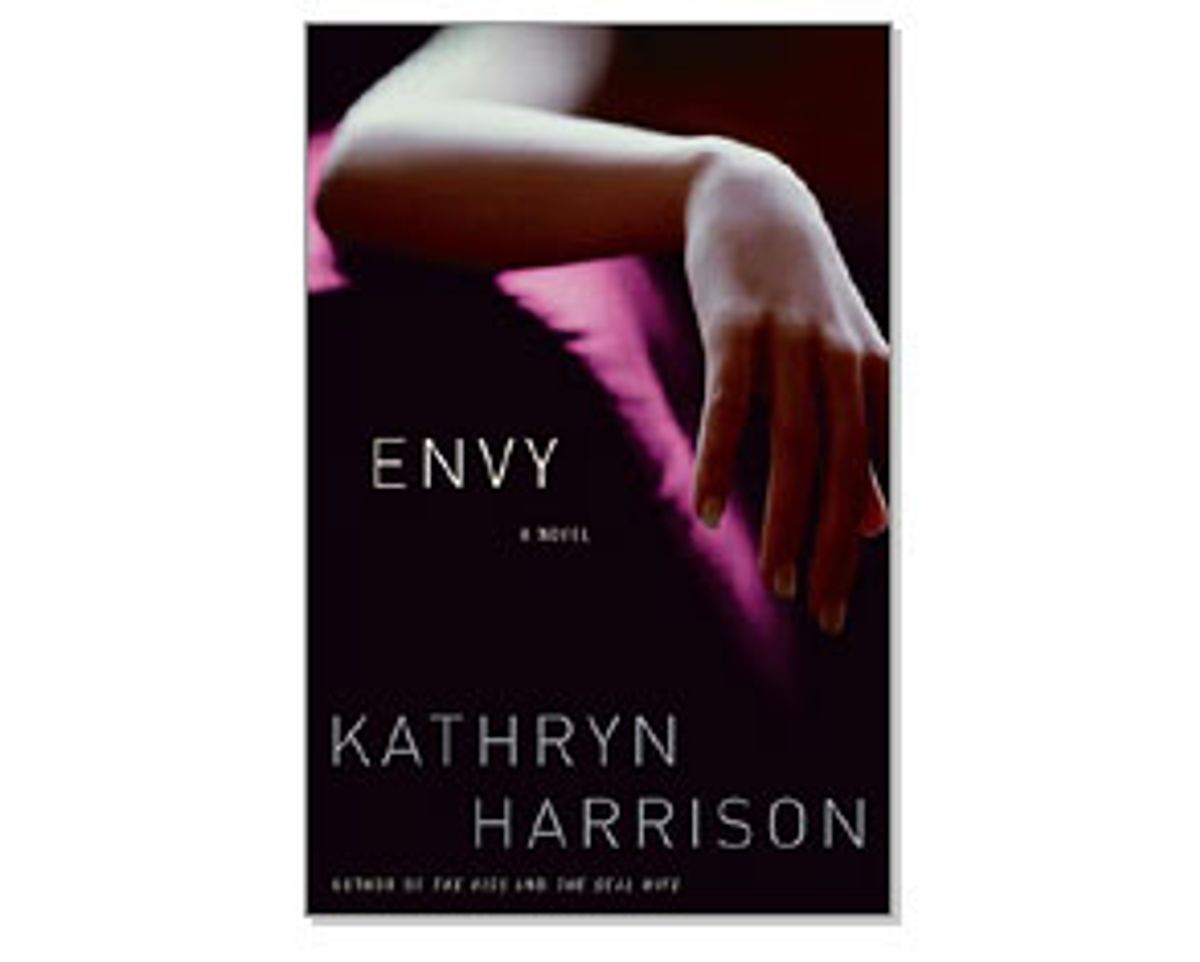
“Envy” by Kathryn Harrison
From the author of "The Kiss," a gripping, unsettling story about a middle-aged psychoanalyst's emotional and sexual adventures.
For at least the first half of Kathryn Harrison’s new novel, “Envy,” you might find yourself wondering about the title. So many other words seem more apt: “Desperation,” maybe. Or even “Perversion.” But then certain facts are revealed — and it makes perfect sense.
Listen, I won’t lie to you. There’s something deeply discomfiting about this story of a New York psychoanalyst, Will Moreland, coping with the death of his eldest child, the stagnation of his marriage, his long estrangement from his own twin brother and the breakup of his parents’ decades-long bond. After a chance encounter with an old girlfriend at his 25-year college reunion, a woman whose 24-year-old daughter may or may not be his, Will begins to unravel a few knotty, long-hidden truths about himself and the people closest to him.
At the risk of giving too much away about this tightly wound story, which unspools in somewhat unexpected ways, I’ll say that Harrison sticks fairly close to familiar terrain, in terms of subject matter and setting. (Her protagonist lives in Brooklyn’s Park Slope, a brownstone community that happens to be not only Harrison’s home turf, but mine too.) But her familiarity allows her to conjure the sorts of details that snap her story into sharp focus. Her characters live in houses with real addresses, walk real streets and eat in restaurants with names — and menus — that many New Yorkers will recognize.
And Harrison doesn’t shy away from recounting minute details even in the novel’s explicit sex scenes — right down to the Astroglide — rendering them unusually potent, repellent and compelling at the same time. For instance:
“‘Check this out,’ she says. Before he can protest she has a finger in his asshole, all the way in. ‘Hey, relax will you? This’ll be good. I know how to make this feel good.’
Will closes his eyes. The only other finger that’s ever been up there is the internist’s, a quick rubber-glove (and, yes, K-Y) check of his prostate, neither man looking at each other and neither, he’s quite sure, with an erection. But with her space-age product she’s doing some kind of inside-out hand job — finger job, he guesses he’d have to call it — and it’s … it is good. It’s really, really good.”
As this passage shows, Harrison has a knack for balancing the external and the internal. And though Will’s endless musing about his life — his losses, his dashed dreams, his recurring fantasies, and what it all means (he is a therapist, you know) — weighs down the story a bit at first, a key encounter sets off a chain of events that loops together much of Will’s seemingly disconnected swirl of thoughts and feelings and yanks us along to the story’s satisfying payoff. Once she gets moving, Harrison cruises, revealing secrets and hidden motives at a rapid, reader-pleasing clip.
For all of Will’s — and Harrison’s — psychobabble, the emotional truths of this story ultimately prove surprisingly simple. But the author clearly intends for her characters and their conflicts to work on a symbolic as well as a literal level: Is Will’s twin brother — a disfigured version of himself, a famous long-distance swimmer who is most alive in the water, a shadowy figure who has slipped out of his brother’s life but whose face haunts him from the covers of magazines — his id personified? Must Will confront and accept his imperfections — and those of his wife and marriage — as well as his capacity to transgress in order to become a complete version of himself?
Some of the novel’s more unsettling moments will stick with you far longer than you might like. And the graphic sex scenes may leave you with the urge to jump right into the shower and hose down. But would you expect anything else from the woman who memorably — and controversially — brought the world “The Kiss,” a memoir about Harrison’s incestuous adult relationship with her long-estranged father?
Harrison’s struggle with thinkier themes raises the book above the level of sticky erotica. She knows how to flatter her readers’ intelligence as well as their prurience; how to tease them along until she’s ready for her story to climax. And she knows how to satisfy. That, at the very least, is something truly worthy of envy.
50 shades of Shutterstock
Slide show: Everyone's favorite light-bondage bestseller illustrated by inexplicable stock photography SLIDE SHOW
This week, for roughly the millionth time, E.L. James’ romance-bondage trilogy “50 Shades” nabs the No. 1, 2 and 3 spots on the New York Times bestseller lists. We don’t get it either. Every page of that book, which famously began as “Twilight” fan fiction, elicits a sigh of confusion and weird secondary embarrassment. The question is: Who would read this? (The answer is: Apparently everyone.) It’s the same baffled, helpless feeling we get when we sort through stock photos on a daily basis. Stock photos – which have been the subject of recent outstanding Internet satire – are used by this site, and many others, to illustrate our flood of content. Many are plain and simple, but a good portion are flat-out mind-blowing. Why did anyone think that photo was a good idea? It only made sense to join these forces. And so, we present to you passages from the most head-scratching bestseller of our time, illustrated with the assistance of inexplicable stock photography.
Megaphone by Natalie Bakopoulos
Miracles happen, even in an Athens crippled by a garbage strike, to a young mother unsure of her ability to love
(Credit: iStockphoto/caracterdesign) It’s the third week of the garbage strike and Athens has begun to smell. Bright-colored trash bags fill the curbs and alleyways, and we have learned to step over the rubbish and avoid the blocks that had become unnavigable. We know which stretches are particularly foul — a stretch along Mavili Square, or the entire top end of Monastiraki. Odos Athinas is a sea of trash, and Omonia is ghastly but we don’t go there anyway. May has gone from unseasonably cool to raging hot, and the garbage seems to be melting. In front of the museum it’s like yet another installation project. When I arrive each morning I want to wretch.
Continue Reading CloseNatalie Bakopoulos's first novel, "The Green Shore," will be published by Simon & Schuster in June 2012. Her work has appeared in Tin House, Ninth Letter, Granta Online, and The O. Henry Prize Stories 2010, and she is a contributing editor for the online journal Fiction Writers Review. More Natalie Bakopoulos.
Almost by Chris Pavone
She never thought of herself as ambitious, until motherhood and career collided in one horrifying hospital ride
(Credit: iStockphoto/caracterdesign) It’s just before dawn when Isabel puts the final page down on the fat stack of paper that sits on the rumpled bedspread, next to an overflowing crystal ashtray and a crumpled soft-pack of cigarettes. She’d tried Wellbutrin and Xanax; she’d used patches and gum. In the end, the only thing that made her quit smoking was being pregnant.
But then, after everything, she couldn’t help but start up again. At first it was just a single cigarette per day, or two. Then it became a few, and within months she was back to full-throttle. Over the past couple of years, she’s tried to quit a few times, but not seriously. She anticipates — she accepts — failure. Because she doesn’t want to quit, not really. She wants instead to try, and fail.
Continue Reading CloseMemorial Day fiction: Are we there yet?
Salon exclusive: At the start of the summer fiction season, new stories from Chris Pavone and Natalie Bakopoulos
(Credit: iStockphoto/caracterdesign) “Are we there yet?”
It’s a dreaded sentence. When it’s spoken by an anxious child from the back seat, it’s enough to make stressed-out parents wish they’d never taken a family vacation in the first place. And even if it’s delivered as a sing-songy punch line, from an impatient partner or spouse on a long road trip, it’s an irritating eye-roller of a joke.
So this Memorial Day weekend — the unofficial start of the summer vacation season, and therefore the summer fiction season — we asked two novelists to reclaim the sentence in a new and adult context. For our latest fiction project, there was only one simple rule: Each story had to include the line “Are we there yet?” in a fresh and surprising way.
Continue Reading CloseDavid Daley is the senior culture editor of Salon. More David Daley.
“Frankenstein” remixed
This masterful new adaptation of Mary Shelley's classic novel may be the best interactive fiction yet
Whatever interactive fiction is (and we’re still figuring that out) it suffers from all the problems of traditional fiction and then some. The vast majority of novels and short stories aren’t much good, but when a branching fiction — along the lines of the old “Choose Your Own Adventure” children’s books — fails to engage, the first impulse is to blame the form rather than the content. Let “Frankenstein,” just released by Inkle Studios and Profile Books, serve as a reproach to that reflex. The app is a creative, subtle and sensitive adaptation of Mary Shelley’s classic novella, and it has singlehandedly renewed this critic’s hopes for interactive fiction.
Laura Miller is a senior writer for Salon. She is the author of "The Magician's Book: A Skeptic's Adventures in Narnia" and has a Web site, magiciansbook.com. More Laura Miller.
Page 1 of 130 in Fiction


