Fiction
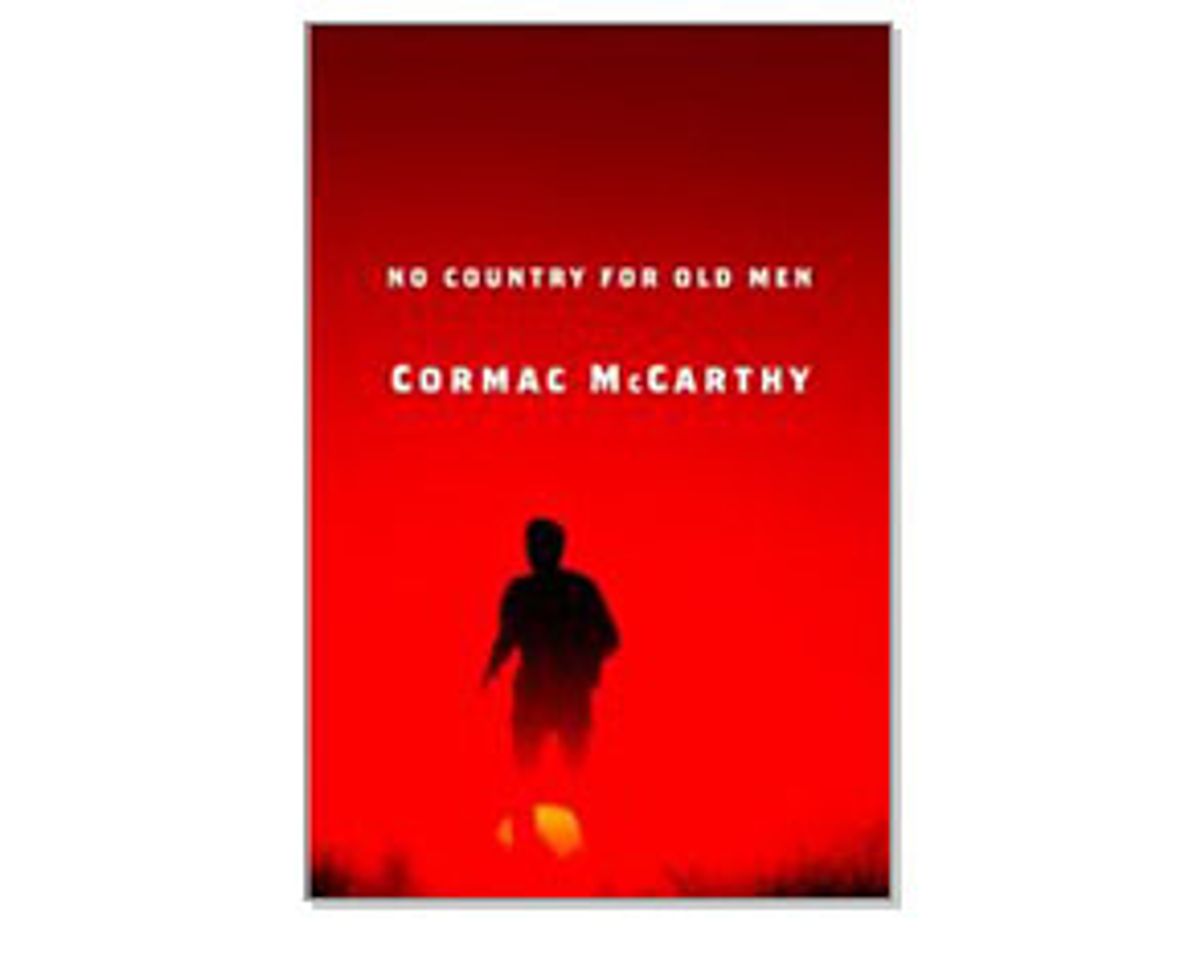
“No Country for Old Men” by Cormac McCarthy
The lord of horses and cowboys follows a modern-day Texas manhunt -- and a botched drug deal -- in this hard-boiled cinematic thriller.
As a matter of fair warning, know the following about Cormac McCarthy’s new novel “No Country for Old Men”: Women exist mainly to show primordial attraction and inarticulate loyalty toward men; men are more at ease sawing off shotgun barrels or dressing their own bullet wounds than they are in the presence of women, children or their own emotions; any character you find yourself rooting for is likely to be murdered within a few pages; and the old sheriff who acts as the book’s moral compass will complain, twice, about young people “with green hair and bones in their noses.” But to be put off by McCarthy’s crusty machismo would be to miss out on a taut thriller that not only holds, but also rewards, close attention.
Like several of McCarthy’s previous novels, “No Country for Old Men” chronicles a series of violent deaths along the Texas-Mexico border. But this time the setting is 1980, and instead of horses and land the mayhem revolves around a leather case packed with $2 million in drug money. Llewelyn Moss, a welder hunting antelope near the Rio Grande, comes across the remains of a botched heroin deal — shot up 4×4 trucks, Mexicans and the leather case. Moss carries the case away and becomes the object of competing manhunts. Among the hunters are Sheriff Bell, who shares a hometown with Moss and his wife, Carla Jean; Carson Wells, an ex-Special Forces officer hired by the case’s original owner; and Anton Chigurh, a freelance killer who dispatches some of his victims with a pneumatic prod made for slaughtering cattle. At one point Chigurh forces Carla Jean to call a coin toss for her own life. Where it falls is in keeping with the general tilt of the plot.
For all his hard-earned reputation as a throwback, McCarthy is a thoroughly cinematic novelist, and never more so than in “No Country for Old Men.” Here he sheds the bombast that weighs down some earlier works and leaves intact the precise description of movement and action for which he is justly famous. Here is Moss in a hotel room customizing a new gun:
He “unwrapped the shotgun and wedged it in an open drawer and held it and sawed the barrel off just in front of the magazine. He squared up the cut with the file and smoothed it and wiped out the muzzle of the barrel with a damp facecloth and set it aside.”
Nothing extraordinary perhaps, but even Ashton Kutcher would know just what to do during filming. Later we see and hear Chigurh offing a man at the same hotel:
“Chigurh shot him three times so fast it sounded like one long gunshot and left most of the upper part of him spread across the headboard and the wall behind it. The shotgun made a strange deep chugging sound. Like someone coughing into a barrel.”
(Not surprisingly, the movie rights to “No Country for Old Men” have already been sold. The job of adapting the screenplay should be the easiest money a writer ever made.)
But what’s so special about meticulous descriptions of gunplay? What separates McCarthy from high-grade pulp? The short answer is that the violence is headed somewhere unexpected. In what is sure to make for an adrenalized movie scene, an encounter between Moss and Chigurh leads to a chaotic shootout through the streets of Eagle Pass. Buckshot rattles off of balustrades and shatters windows, cars skid sideways down Main Street in clouds of rubber smoke, and Moss eventually staggers away wounded. In a run-of-the-mill thriller, the scene would be revisited, if at all, in a quick mention of police tape and bloodstained sidewalks. In “No Country for Old Men,” we get the hired hand, Carson Wells, inspecting the aftermath and discovering the victim of a stray bullet:
“A darkened room. Smell of rot. He stood until his eyes were accustomed to the dimness. A parlor. A pianola or small organ against the far wall. A chifforobe. A rockingchair by the window where an old woman sat slumped.”
Wells snaps a couple of photographs of the corpse and, when he catches up with the convalescing Moss, presents them to him. The 10 pages of dialogue that follow are as pitch-perfect and riveting as any that have been put on paper. The scene ends this way: “When he was gone Moss turned up the photographs lying on the bed. Like a player checking his hole cards.”
“There’s no such thing as life without bloodshed,” McCarthy said 13 years ago in a rare interview. And like his character Moss, McCarthy can’t help peeking. The constant question underlying his fiction is how we are to live on in the face of this knowledge. At the end of “No Country for Old Men,” in the last of his ruminations that punctuate the book, Sheriff Bell poses a version of this question as he ponders the unknown mason of an old water trough:
“That country had not had a time of peace of any length at all that I knew of … But this man had set down with a hammer and chisel and carved out a stone water trough to last ten thousand years. Why was that?”
Bell’s answer surely echoes McCarthy’s own project as a writer:
“And I have to say that the only thing I can think is that there was some sort of promise in his heart. And I dont have no intentions of carving a stone water trough. But I would like to be able to make that kind of promise.”
Here’s hoping the stone trough makes the director’s cut.
Ira Boudway is a freelance writer in Brooklyn and frequent contributor to Salon. More Ira Boudway.
50 shades of Shutterstock
Slide show: Everyone's favorite light-bondage bestseller illustrated by inexplicable stock photography SLIDE SHOW
This week, for roughly the millionth time, E.L. James’ romance-bondage trilogy “50 Shades” nabs the No. 1, 2 and 3 spots on the New York Times bestseller lists. We don’t get it either. Every page of that book, which famously began as “Twilight” fan fiction, elicits a sigh of confusion and weird secondary embarrassment. The question is: Who would read this? (The answer is: Apparently everyone.) It’s the same baffled, helpless feeling we get when we sort through stock photos on a daily basis. Stock photos – which have been the subject of recent outstanding Internet satire – are used by this site, and many others, to illustrate our flood of content. Many are plain and simple, but a good portion are flat-out mind-blowing. Why did anyone think that photo was a good idea? It only made sense to join these forces. And so, we present to you passages from the most head-scratching bestseller of our time, illustrated with the assistance of inexplicable stock photography.
Megaphone by Natalie Bakopoulos
Miracles happen, even in an Athens crippled by a garbage strike, to a young mother unsure of her ability to love
(Credit: iStockphoto/caracterdesign) It’s the third week of the garbage strike and Athens has begun to smell. Bright-colored trash bags fill the curbs and alleyways, and we have learned to step over the rubbish and avoid the blocks that had become unnavigable. We know which stretches are particularly foul — a stretch along Mavili Square, or the entire top end of Monastiraki. Odos Athinas is a sea of trash, and Omonia is ghastly but we don’t go there anyway. May has gone from unseasonably cool to raging hot, and the garbage seems to be melting. In front of the museum it’s like yet another installation project. When I arrive each morning I want to wretch.
Continue Reading CloseNatalie Bakopoulos's first novel, "The Green Shore," will be published by Simon & Schuster in June 2012. Her work has appeared in Tin House, Ninth Letter, Granta Online, and The O. Henry Prize Stories 2010, and she is a contributing editor for the online journal Fiction Writers Review. More Natalie Bakopoulos.
Almost by Chris Pavone
She never thought of herself as ambitious, until motherhood and career collided in one horrifying hospital ride
(Credit: iStockphoto/caracterdesign) It’s just before dawn when Isabel puts the final page down on the fat stack of paper that sits on the rumpled bedspread, next to an overflowing crystal ashtray and a crumpled soft-pack of cigarettes. She’d tried Wellbutrin and Xanax; she’d used patches and gum. In the end, the only thing that made her quit smoking was being pregnant.
But then, after everything, she couldn’t help but start up again. At first it was just a single cigarette per day, or two. Then it became a few, and within months she was back to full-throttle. Over the past couple of years, she’s tried to quit a few times, but not seriously. She anticipates — she accepts — failure. Because she doesn’t want to quit, not really. She wants instead to try, and fail.
Continue Reading CloseMemorial Day fiction: Are we there yet?
Salon exclusive: At the start of the summer fiction season, new stories from Chris Pavone and Natalie Bakopoulos
(Credit: iStockphoto/caracterdesign) “Are we there yet?”
It’s a dreaded sentence. When it’s spoken by an anxious child from the back seat, it’s enough to make stressed-out parents wish they’d never taken a family vacation in the first place. And even if it’s delivered as a sing-songy punch line, from an impatient partner or spouse on a long road trip, it’s an irritating eye-roller of a joke.
So this Memorial Day weekend — the unofficial start of the summer vacation season, and therefore the summer fiction season — we asked two novelists to reclaim the sentence in a new and adult context. For our latest fiction project, there was only one simple rule: Each story had to include the line “Are we there yet?” in a fresh and surprising way.
Continue Reading CloseDavid Daley is the senior culture editor of Salon. More David Daley.
“Frankenstein” remixed
This masterful new adaptation of Mary Shelley's classic novel may be the best interactive fiction yet
Whatever interactive fiction is (and we’re still figuring that out) it suffers from all the problems of traditional fiction and then some. The vast majority of novels and short stories aren’t much good, but when a branching fiction — along the lines of the old “Choose Your Own Adventure” children’s books — fails to engage, the first impulse is to blame the form rather than the content. Let “Frankenstein,” just released by Inkle Studios and Profile Books, serve as a reproach to that reflex. The app is a creative, subtle and sensitive adaptation of Mary Shelley’s classic novella, and it has singlehandedly renewed this critic’s hopes for interactive fiction.
Laura Miller is a senior writer for Salon. She is the author of "The Magician's Book: A Skeptic's Adventures in Narnia" and has a Web site, magiciansbook.com. More Laura Miller.
Page 1 of 130 in Fiction


