Fiction
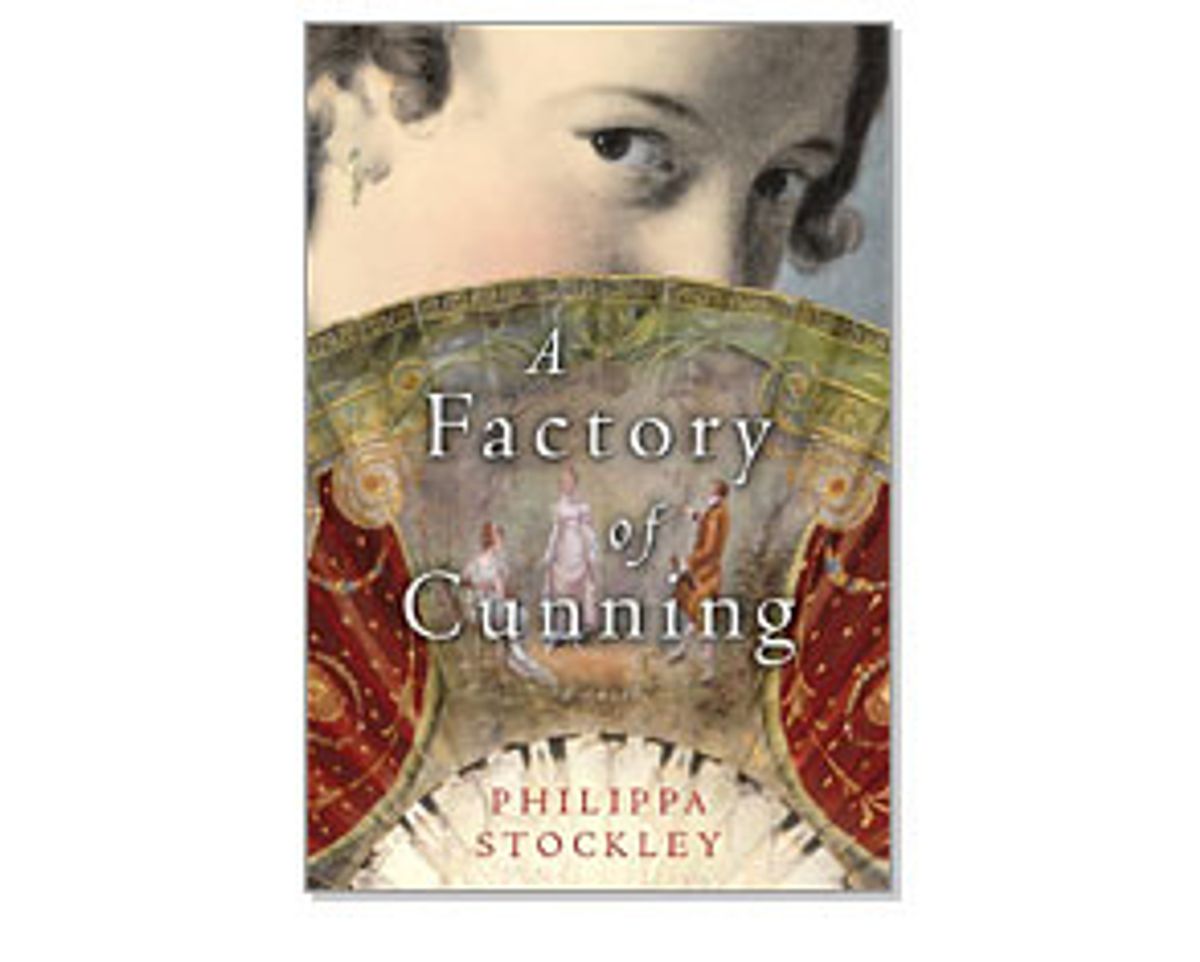
“A Factory of Cunning” by Philippa Stockley
In this well-crafted comedy of manners, a wickedly charming woman with a secret past stirs up trouble in 18th century London.
Mrs. Fox is not what she seems. The readers of Philippa Stockley’s “A Factory of Cunning” know this from the very moment the lady’s satin-clad foot steps onto the banks of the Thames in 1784. Freshly arrived in London from Amsterdam, she pretends to be a modest but well-connected widow; we know that she is really a French noblewoman fleeing a scandal that transpired several years earlier in her native land. It’s only much later in Stockley’s fizzy, twisty comedy of manners and morals that the astute reader will recognize “Mrs. Fox” as the veteran of a shocking affair described a long time ago in a book by somebody else.
Whoever she is, Mrs. Fox is a very wicked woman: manipulative, spiteful, selfish and misanthropic to a degree that nearly takes your breath away. She’s also clever, beautiful, charming and a consummate liar. The people of London — and especially anyone foolish enough to get on her bad side — won’t know what’s hit them by the time Mrs. Fox is done amusing herself. In particular, she intends to do a favor for a gentleman back in Amsterdam, the only human being, it seems, for whom she has any fondness. His old enemy, the rich, coldblooded, middle-aged rake Earl Much, ought to be taken down a few notches. Mrs. Fox is happy to oblige.
“A Factory of Cunning” is a well-made entertainment for people who don’t go soft at the prospect of corsets and powdered wigs. The 18th century milieu Stockley describes is so ruthless and exploitative that any shred of sentiment attached to the better-dressed past will be burnt to ashes on contact. Stockley’s fidelity to the period and its language is nearly faultless; the novel even includes a glossary for those readers unfamiliar with terms like “macaroon” and “slop-shop” or puzzled by the characters’ references to “that Shandy man” and Newgate. There are no missteps or anachronisms here to make you grind your teeth if that sort of thing irritates you, yet the pacing and ingenuity are contemporary.
The story is told mostly in letters and Mrs. Fox’s diary entries, and her shriveling wit is one of the novel’s chief pleasures. Her Parisian disdain for London society has her describing one arriviste patron of the arts as a man “to whose purse the finest of everything is as nothing and the finest of nothing everything. He has the judgment of an atom, a particle of sense, and an immense sensibility — such a striking amalgam of wealth and witlessness that someone should sell it as Essence of Englishness.” Admittedly, this lady isn’t perfectly credible as a foreigner. Her command of the language is formidable. And when she sniffs at London for being the kind of place “where pattern-book gentility passes for intellect and the profile of a mule for superiority” — a joke about the typical physiognomy of the British upper classes — she sounds rather English herself.
For a main character as thoroughly malevolent as Mrs. Fox to carry a novel, she has to have great energy in addition to being smarter than everyone else. Stockley packs her book not only with schemes and intrigues, but also with metaphors of a near-freakish vigor: a red-velvet-line theater box that sets off the women inside it “like teeth,” a coachman ducking his head down inside his collar until he resembles a “volcano,” quips and digs and startling images come flying off the pages so rapidly you can barely register them all. The momentum sweeps the delighted reader along until the end, when, alas, we’re confronted with just how ruthless our “heroine” really is, and some kind of moral equilibrium is restored. It’s a tricky transition to execute, and Stockley doesn’t quite pull it off. But if the arrival is bumpy, the ride up until that point is as plush as a spin in a coach-and-four.
Laura Miller is a senior writer for Salon. She is the author of "The Magician's Book: A Skeptic's Adventures in Narnia" and has a Web site, magiciansbook.com. More Laura Miller.
50 shades of Shutterstock
Slide show: Everyone's favorite light-bondage bestseller illustrated by inexplicable stock photography SLIDE SHOW
This week, for roughly the millionth time, E.L. James’ romance-bondage trilogy “50 Shades” nabs the No. 1, 2 and 3 spots on the New York Times bestseller lists. We don’t get it either. Every page of that book, which famously began as “Twilight” fan fiction, elicits a sigh of confusion and weird secondary embarrassment. The question is: Who would read this? (The answer is: Apparently everyone.) It’s the same baffled, helpless feeling we get when we sort through stock photos on a daily basis. Stock photos – which have been the subject of recent outstanding Internet satire – are used by this site, and many others, to illustrate our flood of content. Many are plain and simple, but a good portion are flat-out mind-blowing. Why did anyone think that photo was a good idea? It only made sense to join these forces. And so, we present to you passages from the most head-scratching bestseller of our time, illustrated with the assistance of inexplicable stock photography.
Megaphone by Natalie Bakopoulos
Miracles happen, even in an Athens crippled by a garbage strike, to a young mother unsure of her ability to love
(Credit: iStockphoto/caracterdesign) It’s the third week of the garbage strike and Athens has begun to smell. Bright-colored trash bags fill the curbs and alleyways, and we have learned to step over the rubbish and avoid the blocks that had become unnavigable. We know which stretches are particularly foul — a stretch along Mavili Square, or the entire top end of Monastiraki. Odos Athinas is a sea of trash, and Omonia is ghastly but we don’t go there anyway. May has gone from unseasonably cool to raging hot, and the garbage seems to be melting. In front of the museum it’s like yet another installation project. When I arrive each morning I want to wretch.
Continue Reading CloseNatalie Bakopoulos's first novel, "The Green Shore," will be published by Simon & Schuster in June 2012. Her work has appeared in Tin House, Ninth Letter, Granta Online, and The O. Henry Prize Stories 2010, and she is a contributing editor for the online journal Fiction Writers Review. More Natalie Bakopoulos.
Almost by Chris Pavone
She never thought of herself as ambitious, until motherhood and career collided in one horrifying hospital ride
(Credit: iStockphoto/caracterdesign) It’s just before dawn when Isabel puts the final page down on the fat stack of paper that sits on the rumpled bedspread, next to an overflowing crystal ashtray and a crumpled soft-pack of cigarettes. She’d tried Wellbutrin and Xanax; she’d used patches and gum. In the end, the only thing that made her quit smoking was being pregnant.
But then, after everything, she couldn’t help but start up again. At first it was just a single cigarette per day, or two. Then it became a few, and within months she was back to full-throttle. Over the past couple of years, she’s tried to quit a few times, but not seriously. She anticipates — she accepts — failure. Because she doesn’t want to quit, not really. She wants instead to try, and fail.
Continue Reading CloseMemorial Day fiction: Are we there yet?
Salon exclusive: At the start of the summer fiction season, new stories from Chris Pavone and Natalie Bakopoulos
(Credit: iStockphoto/caracterdesign) “Are we there yet?”
It’s a dreaded sentence. When it’s spoken by an anxious child from the back seat, it’s enough to make stressed-out parents wish they’d never taken a family vacation in the first place. And even if it’s delivered as a sing-songy punch line, from an impatient partner or spouse on a long road trip, it’s an irritating eye-roller of a joke.
So this Memorial Day weekend — the unofficial start of the summer vacation season, and therefore the summer fiction season — we asked two novelists to reclaim the sentence in a new and adult context. For our latest fiction project, there was only one simple rule: Each story had to include the line “Are we there yet?” in a fresh and surprising way.
Continue Reading CloseDavid Daley is the senior culture editor of Salon. More David Daley.
“Frankenstein” remixed
This masterful new adaptation of Mary Shelley's classic novel may be the best interactive fiction yet
Whatever interactive fiction is (and we’re still figuring that out) it suffers from all the problems of traditional fiction and then some. The vast majority of novels and short stories aren’t much good, but when a branching fiction — along the lines of the old “Choose Your Own Adventure” children’s books — fails to engage, the first impulse is to blame the form rather than the content. Let “Frankenstein,” just released by Inkle Studios and Profile Books, serve as a reproach to that reflex. The app is a creative, subtle and sensitive adaptation of Mary Shelley’s classic novella, and it has singlehandedly renewed this critic’s hopes for interactive fiction.
Laura Miller is a senior writer for Salon. She is the author of "The Magician's Book: A Skeptic's Adventures in Narnia" and has a Web site, magiciansbook.com. More Laura Miller.
Page 1 of 130 in Fiction


