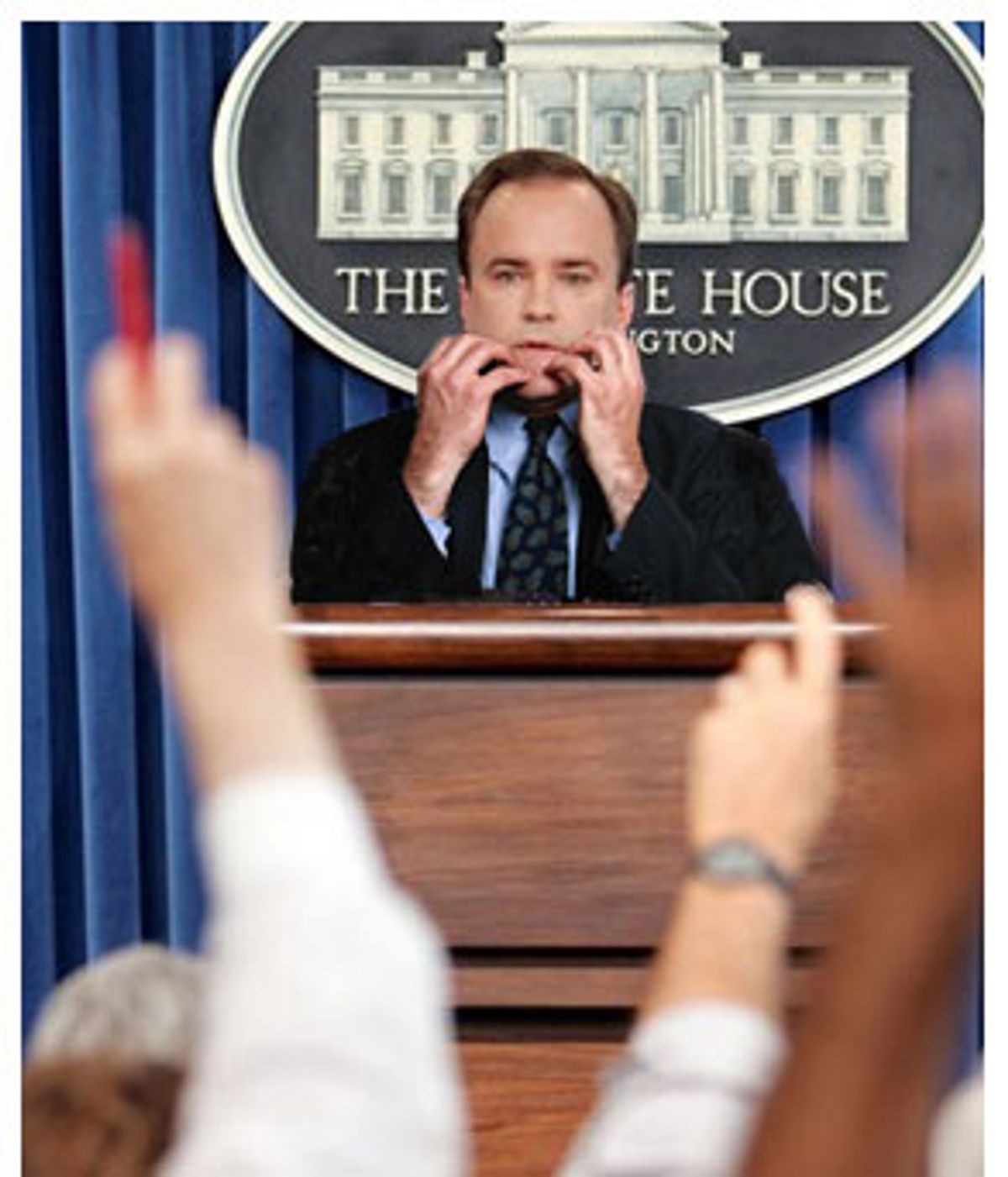
On July 11, the story of Karl Rove's involvement in the Valerie Plame case broke, and the hounds got loose in the James S. Brady Press Briefing Room at the White House and whomped on the press secretary. It was the Great McClellan Mauling of '05: Thirty-five questions about Karl Rove by a suddenly unified and frothy White House press corps that had quickened into a minor mutiny.
July 11, the Day the Press Corps Attacked, was just the kickoff. I spent the next two weeks in the James S. Brady Briefing Room at the White House, witnessing the molten Rove-a-thon. By the end I felt like I'd spent a couple of weeks on one of those indoor thrill rides where seats are bolted to a moving floor while a film is shown, creating a vague sensation of G-force when nothing actually goes anywhere. Still, the mini-revolt offered hope that despite its previously persistent vegetative state, the press might not be entirely dead yet. For the first time since 9/11, the reporters got nakedly hostile and went for the throat. Pandora's box opened -- just a hairline crack, but enough bats flew out to suggest that it might not close all the way again.
In the last few years, the press has lost all sense of its own mojo. Things bottomed out after the terrorist attacks of 9/11, when any aggressive grilling of the administration branded reporters as unpatriotic, which potentially alienated their audiences. The high emotion surrounding 9/11 and the War on Terror (or the new, improved Global Struggle Against Violent Extremism, which the Beltway kids snarkily refer to as G-SAVE) have made them very useful hostage babies for the administration cowboys to shield themselves with during shootouts with the press. Somehow, aggressive questioning of the White House got spun as a heretical insult to slaughtered American innocents. It was so demoralizing that after a while the press succumbed en masse to what I call the Potomac dinge: passive cooperation in one's own degradation -- the deranged, unconscious complicity that is found in victims of ritual abuse.
"This is the most complacent and complicit media I've ever seen," Helen Thomas, the most senior member of the White House press corps, told me in an interview at her office at Hearst.
The Rove affair, however, and the artless info-block by Scott McClellan that followed, was one twist too many in the press corps' shorts. The long-simmering scandal about the leaking of the identity of CIA agent Valerie Plame, wife of Bush critic Joe Wilson, became a full-on plumbing emergency when it was revealed that the black stuff all over the faucet was the fingerprints of Karl Rove, President Bush's right-hand man, realpolitik guru and pet genius. Despite White House denials of any administrative vendetta, Washington smelled Rove's funk in the air. The stakes were raised by the president's assertion that anyone found to be involved in the Plame leak would be fired. When the humble folk of Press Town got word that Rove was, indeed, involved in the outing of Wilson's wife, they finally got morally indignant enough to go after McClellan and his boss lynch-mob style, with rolling pins and pitchforks.
As Helen Thomas observed, "They're beginning to come out of the coma a little bit."
As fans of Talon News reporter Jim "Jeff" Guckert "Gannon" know, it is surprisingly easy to get into the briefing room -- any no-account hosebag (myself obviously included) can mock up enough credentials to have their questions unanswered by Scott McClellan. (I met a lawyer in one of the back seats who manufactured his own press card at Kinko's.) With a laminated press pass and a little tenacious badgering of the White House Office of Media Affairs, I was cleared to take my seat in the amphitheater and watch lions chew an unlucky Christian.
JULY 13, 2005
The James S. Brady Press Briefing Room is rich with carpet stains, too many aluminum ladders, $2 theater seats and elaborate networks of duct tape all over the floor for the phalanx of TV cameras. The vibe is congenial, casual and sassy, particularly among the cameramen, who have the unkempt, insomniac charm of rock roadies. There is a comfortingly down-on-its-luck utilitarian funk around the blue velvet proscenium, which looks passably gentrified and official on C-SPAN, but is as cramped, low-ceilinged, unclean and half-assedly glue-jobbed as the stage at a Perth Amboy comedy open mic.
Scott McClellan is difficult to hate when you are in the room with him. He's robotic, but somehow also warm and disarming, in the way that TV newscasters can be. He often pronounces "nuclear" correctly (at least until he says "denukularization"); he is astonishingly good at his job and too genuinely nice to be detestable. The people of the corps unequivocally like McClellan personally. It is the usual game of Washington grab-ass that happens in the off hours; the "We're a big special club doing our crazy jobs all together here, in the nation's capital" attitude that is very seductive when you're half-drunk, like everyone is after 6 p.m., except for the pristine Mormons of the CIA. I think, however, that such fraternity between naturally opposing professional roles has given many journalists an ill-placed sense of inclusion and gratitude.
On the 13th of July, the work-a-day friction between the press secretary and the corps was, by all accounts, still a lot more aggressive than usual. The reporters were openly jeering at McClellan over his refusal to discuss anything remotely connected to the Rove/Plame mess, and it was exciting -- there was a palpable sense that abusing McClellan was worth something, and that a constant hail of Refusing to Swallow His Absurd Line of Bilge might earn results, eventually. To me, it had a thrilling college sit-in feel. If we join hands and sing this protest song together, the administration might cave in from the weight of its own moral shame!
Scott walked into the room, preceded by his usual gaggle of young "Gattaca"-style GOP-bots who sit in seats off to the left and handsomely say nothing. There is always a zircon gleam in McClellan's eye, a tight little smile pressed into his face, and a cloisonné flag on his lapel.
McClellan kicked off the day with a batch of statements that were such an absurdly Orwellian valentine to the administration, I thought he was delivering a blatant "up yours" to his bloodthirsty audience. However, I was assured by veteran corps members that this was business as usual; even when the president is being led away in handcuffs, you can count on the press secretary to stand tall, show clean teeth, and deliver good news about how the administration is Doing Great Things for the American People. I was assured that even under more liberal White Houses, press secretary-speak has always been this poufy and unrealistically cheerful.
McCLELLAN: We are well on our way to cut the deficit in half by 2009 ...The president's tax cuts and pro-growth economic policies are fueling growth and job creation ... The economic growth that is fueled by the president's tax cuts are leading to significant increases in revenues...
The president [also talked about] our strategy for prevailing in the war on terrorism and defeating the ideology that the terrorists espouse.
Since this was my first exposure, in real time, to the administration's spin jingo, straight from the larynx of a living person, I was so stunned I emitted an involuntarily, hysterical gasp and one of McClellan's frozen über-blondes tried to turn me into a pillar of salt with a penetrating fish-eye.
The corps is inured to this ideological Esperanto, but it is vertiginous and risible when you first hear it live -- compared to human conversation, it sounds absurd. I discussed the "defeating ideology" statement later with defense analyst "Dr. Suave," who clarified: "It's postmodern language. It's abstract. It means absolutely nothing. There's no content there."
My first revelation: Nobody in the room asks questions like "How does one militarily defeat an ideology, short of killing everyone who feels that way and their families, then destroying all writings ever produced about that ideology, and disappearing any scholars who've ever had a passing interest in it?" And/or "Has the president noticed that historically, ideologies usually persist, despite genocide and other disincentives?"
That's not how questions are asked in the briefing room. How it's done is far more complicated, Byzantine and ineffectual.
The Biggest Boy with the Cleanest Game, when I was there, was usually Terry Hunt of the AP, who has the kind of small, wiry gravity that should be played by Bob Balaban in the fantasy biopic. Hunt's game style in the room seems to be a daily practice of publicly outclassing McClellan -- but it's easy to sound smarter and more worthy of love than your adversary when you are using the spontaneous, active language centers of your brain to communicate, as opposed to being limited to doling out cold sound bites from an undersize professional memory thermos. On the 13th, Hunt asked McClellan why the president hadn't given a "warm endorsement" to Karl Rove when asked about him earlier that day. McClellan responded that the president "wasn't asked about his support or confidence for Karl."
HUNT: Well, the president has never been restrained at staying right in the lines of a question, as you know. [Laughter.] He kind of -- he says whatever he wants. And if he had wanted to express confidence in Karl Rove, he could have. Why didn't he?
McCLELLAN: He expressed it yesterday through me, and I just expressed it again.
Q. Well, why doesn't he? [Hunt said this in almost a whine.]
<mcclellan: He was not asked that specific question, Terry. You know that very well. The questions ... he was asked about were relating to an ongoing investigation.
Q. But, Scott, he defended Al Gonzales without even being asked --
(And there was a laugh there, which isn't in the official transcript. I also didn't hear the word "defended" -- I heard "befriended." This was a reference to Bush's comment regarding Attorney General Alberto Gonzales, of whom he said, "I'm loyal to my friends.")
The dynamic felt vacuous, frustrated and unhealthy. McClellan infantalizes the press corps -- apart from token gestures of professional camaraderie and assertions of respect (he tells them he respects them a lot, he returns their phone calls after 7 p.m., and is friendly to everyone at the annual Christmas parties), the corps are not trusted or treated like adults, and they passively accept this. McClellan's operative personality is a patronizing hybrid of nursery school teacher and Hal the supercomputer from "2001: A Space Odyssey"; his tone suggests your persistence in asking these awful questions means that you are crabby and need a nap. If somebody gets too excited and badgers McClellan for clarity, they are shut down with a withering blast of Daddy/Authority-speak, the subtext of which is always the same: Your question is so appalling and immature that I cannot possibly dignify it with a response. You should be very ashamed of yourself. I suggest you lie down and forget about this Dave. Beep. Dave. Beep.
There is another powerful disincentive to ask too many uncomfortable questions: Security passes to the briefing room have been known to become elusive at times, as Maureen Dowd discovered at the beginning of the Bush administration. Reporters are also frozen out by never getting called on. Staying an Insider in Good Standing is a much more demanding gig than getting in. There have been many bodies buried outside the security gate. Banishment from the corps means exile, and unless the reporter wants to give up and sell Amway products, it's a slow, painful crawl back to the inside. The function of the press may be to harass McClellan for information, but everyone is tensely aware that you can pull the Big Dog's ears only so long and keep the seat of your pants intact.
The seat to Hunt's left, the weeks I was there, was usually filled by NBC's David Gregory, whose big soft face belies his real exasperation with the status quo and a lust for confrontation. He was, by far, the most aggressive man in front, who got the most blood on the walls in the scraps with McClellan. Unlike any other journalist in the room, Gregory and McClellan seem to have a personal grudge match that would make them capable of storming out to the parking lot and taking swings at each other. Gregory is a good nemesis for McClellan -- they seem to be the same weight class, on many levels.
GREGORY: Scott ... to make a general observation here, in a previous administration, if a press secretary had given the sort of answers you've just given ... Republicans would have hammered them as having a kind of legalistic and sleazy defense. I mean, the reality is that you're parsing words, and you've been doing it for a few days now. So does the president think Karl Rove did something wrong, or doesn't he?
McCLELLAN: No, David, I'm not at all. I told you and the president told you earlier today that we don't want to prejudge the outcome of an ongoing investigation. And I think we've been round and round on this for two days now...
GREGORY: ... When you're dealing with a covert operative ... a senior official of the government should be darn well sure that that person is not undercover, is not covert, before speaking about them in any way, shape or form. Does the president agree with that or not?
McCLELLAN: Again, we've been round and round on this for a couple of days now. I don't have anything to add to what I've said the previous two days.
GREGORY: That's a different question, and it's not round and round --
McCLELLAN: You heard from the president earlier.
GREGORY: It has nothing to do with the investigation, Scott, and you know it.
McCLELLAN: You heard from the president earlier today, and the president said he's not --
[Pitch, volume and tempo are rising...]
GREGORY: That's a dodge to my question. It has nothing to do with the investigation. Is it appropriate for a senior official to speak about a covert agent in any way, shape or form without first finding out whether that person is working as a covert officer?
McCLELLAN: Well, first of all, you're wrong. This is all relating to questions about an ongoing investigation, and I've been through this.
GREGORY: If I wanted to ask you about an ongoing investigation, I would ask you about the statute, and I'm not doing that. [Very exasperated.]
McCLELLAN: I think we've exhausted discussion on this the last couple of days.
GREGORY: You haven't even scratched the surface.
Q. It hasn't started.
It was ugly, but a lot like a Wimbledon match. There was sweat and grunting -- everyone was playing as hard and aggressively as they could, but overall, it was awfully sportsmanly and polite. None of it was ever personal -- a dysfunctional family that argues in public, but is conspicuously all in there together -- the room shook hands with Scott over the net afterward.
It is hard to tell, from rows further back, who is saying what, but I believe that the last question, "It hasn't started," was asked by Edwin Chen of the L.A. Times. Chen has a deep, shiny kindness, serenity and grace about him that suggests decades of meditation. When Chen jumps on the dogpile, it creates a kind of animist earthquake -- a psychic, something-is-deeply-wrong vertigo that one would get if the sun suddenly eclipsed and all the trees on the White House lawn abruptly shuddered all their leaves off.
Mr. Chen was thoughtful and sympathetic after the brief, about McClellan s revelation, that day, that he'd been hurt:
McCLELLAN: It may not look like it, but there's a little bit of flesh that's been taken out of me the past few days.
The official transcript says this statement was followed by laughter, but it was really one of those "Awww" sitcom moments where everyone felt sorry for Scott, for a minute.
Ed Chen's compassionate Buddha nature notwithstanding, I had a hard time sharing his sympathy. It seemed clear that McClellan had ultimately won the day -- there was no new information being circulated, and he had successfully survived another day of the rebellion, which was starting to unravel due to a lack of unity, solidarity and focus. The press had gotten their foot in the door as a team, but Scott was keeping them out one at a time.
I asked USA Today's stylish Richard Benedetto, walking down Pennsylvania Avenue, if he felt in any way demoralized by the day's briefing. Benedetto said, "People get frustrated with Scott because they're looking for a scoop, but you're not going to get a scoop at a White House press briefing. That's not the function of them."
"He said that?" Helen Thomas asked me, later, when I repeated Benedetto's opinion. "Some reporters have better ins -- they can talk to the officials after the briefings and get more, but the credibility in this administration is so low. Those who are getting the so-called exclusives should really find out if they're being used as a ploy or not."
JULY 18, 2005
There's a hierarchy in room that is immediately apparent. The front row players, TV and major wire service reporters, are a discrete breed from the journalists in rows further back, and there is some grumbling and resentment that the network guys, "like a high school in-crowd" as one of the lowlier scribes kvetched, "have a tendency to throw their weight around." The front row swans into the room at the same time as McClellan. At briefing's end, they evaporate and reappear in their docks directly behind the TV cameras, while all lesser journalists shuffle downstairs to file in the creepy little brown catacombs known as The Basement.
After the weekend, there was still a blistering feeling that the Rove story should be pounced on. In a move that seemed to be a painfully obvious ploy to cover Rove's ass, Bush had reneged on his promise to fire anyone involved in the Plame leak. Now the president was saying the culprit would be fired if they were found to have "committed a crime." Since it was far from clear that outing Plame was technically illegal, and given the proliferation of fabulous lawyers in Washington D.C., this was tantamount to saying, "We'll burn the witch if she assumes the form of a sturgeon when we hose her down."
Helen Thomas sits in front because of her seniority, but has less mojo now that she is now a scribe of opinion, rather than a straight news journalist. Still, she plays a mythical function in the room. She is the Great Liminal Crone, custodian of Truth, Warning and Prophecy.
Helen frontally attacked and bludgeoned Scott's hard line. It created a small, energetic jump-start:
THOMAS: What is [the president's] problem? Two years, and he can't call Rove in and find out what the hell is going on? I mean, why is it so difficult to find out the facts? It costs thousands, millions of dollars, two years, it tied up how many lawyers? All he's got to do is call him in.
McCLELLAN: You just heard from the president. He said he doesn't know all the facts. I don't know all the facts.
THOMAS: Why?
McCLELLAN: We want to know what the facts are. Because --
THOMAS: Why doesn't he ask him?
McCLELLAN: I'll tell you why, because there's an investigation that is continuing at this point...
And with that, Ms. Thomas was ignored.
Ed Chen, on July 12, was the first one on the record to ask the sound bite that became a community broadsword the corps passed around and smote Scott with that week.
CHEN: Does the White House have a credibility problem?
I believe it was ABC's Jessica Yellin who picked it up on the 18th. Ms. Yellin has the compact, athletic vibe of the Only Chick on the Men's Water Polo Team, and gets a lot of shots in -- this one, where she reintroduced Ed Chen's Credibility Mallet, not the least of them:
YELLIN: ...Given the fact that you have previously stood at that podium and said [Karl Rove and Lewis "Scooter" Libby, Vice President Dick Cheney's chief of staff] did not discuss Valerie Plame or a CIA agent's identity in any way, does the White House have a credibility problem?
McCLELLAN: No. You just answered your own question. You said we don't know all the facts. And I would encourage everyone not to prejudge the outcome of the investigation.
The press corps collectively tried to browbeat and coerce McClellan about Rove throughout most of the briefing, but McClellan kept them at bay by invoking the "ongoing investigation." Whenever he brought it up, Scott's little blue eyes took on a sheeny, abandoned quality, as if he had just propped up a set of decoy eyes on toothpicks while his brain retreated eight clicks back into an underground bunker.
Connie Lawn, a conservative reporter for Audio Visual News who has been covering the White House since 1968, maternally intervened when Scott was beginning to look especially bruised.
LAWN: Scott, I just wonder ... on a personal, human note, how are you holding out? Are you enjoying this? [Laughter.] Seriously. And are you consulting with any of your predecessors who have also gone through crises, Mike McCurry --
McCLELLAN: There are so few things I enjoy more. [Laughter.] Connie, this is nothing personal. Everybody is doing their job here, and I respect the job that you all are doing in this room. And I look forward to having a continuing constructive relationship with everybody in this room.
It was a warm exchange, but I watched that thing come out of his mouth -- "There are so few things I enjoy more" -- and it looked like he really meant it. I thought I saw a surge of essential humanity in McClellan, like he was finally plugged in to something besides the chill of the cryonic spin vault -- a microsecond of human honesty. McClellan may whine that he suffers from chunks being taken out of him, but it seemed, in that moment, that he really liked this fight. D.C. is a power and secrecy game, and Scott's imperturbable blind eye to the corps' desire for information is his glory and satisfaction -- proof that underneath the serene whipping-boy routine, Daddy knows he wears the biggest pants in the room and gets to drive the car.
JULY 19, 2005
It was getting all hot and sexy in the James S. Brady Press Briefing Room, and everybody wanted in to see the showdown. It was unusually difficult getting my security pass. The White House Media Affairs Office told me that there were too many journalists that needed to be processed; it was a madhouse. The gang was juiced for a swarming, and that might be why the briefing was abruptly canceled the minute it was supposed to take place. Instead, we were told that at 9 p.m. that evening the president would announce his Supreme Court nominee.
There was a whole lot of eye-rolling. "Well, that was the quickest way to change the conversation," more than one correspondent groaned.
JULY 20, 2005
The 20th was a weird, hot day on campus.
It seemed somehow related to the Roberts nomination that there was an extra helping of snappy young Republicans humming around the White House on the 20th -- prematurely wide and matronly young women with obsolete cheerleader features dressed like Lady Bird Johnson, with tightly twisted hair and $2,000 handbags, and 20-something guys with that roundheaded military eunuch look: plastic wraparound sunglasses and boxy, off-the-rack navy-blue suits with the periwinkle-blue shirts that have become the uniform of the GOP Youth. The guys have a restless, jacked-up machismo that probably comes of venting the frustrations of abstinence in Krav Maga class, and a thumping sense of the authority and entitlement that comes with belonging to the winning team, which they call "The Party." Superclean motherfuckers -- an abrasive, stinging kind of clean, like they all just got shaken out of an icy tumbler full of Pine Sol, pumice and the New Testament.
The members of the press corps were exhausted that morning: they had to stand around waiting for the president for three hours the night before, then stay up typing until 3 or 4 a.m. I thought the corps was being directly bitch-slapped; the grind was too punishing and the timing too perverse to resemble anything but deliberate venality on the part of an annoyed Caesar. But such abuse is apparently normal.
When one atrocity draws too much fire, it is good to change the subject -- in this case, to the beliefs of John Roberts, the president's Supreme Court nominee. It was a classic slick Bush move, wholly momentum-puncturing. The press corps now had another job to do, and they could no longer pester McClellan about Rove without appearing obsessive, unprofessional and "unfair." Rove had officially become Old News. In order to stay with the Rove story, the press corps would have had to have broken with precedent, and cross a professional ethics red line: They would have had to consciously become the news themselves. The revolt of 7/11 was an accident, a fluke; any further persistence could have been read as a grab for the limelight, which most reporters would sooner jump into a volcano than be accused of -- it's a huge, icky protocol no-no. But only by this uncharacteristic grandstanding could they have truly done their job.
And nobody, save the marginalized journalists, was willing to do it. On July 20, professional decorum defeated journalism. The press corps lost 90 percent of the headway they'd gained since the 11th. The rebellion was clearly punctured and deflating, and there was no way to protest this, short of total anarchy.
Les Kinsolving is a charming old guy in a baseball hat with a big quaky voice; he prints out his questions every day on a legal pad in big block capital letters with a felt-tip pen. Kinsolving feels he gets the cold shoulder from some corps members. This could be due to his habit of killing momentum when everyone is getting unified and excited by asking off-track questions; Les disperses the smell of chum in the water by throwing Nerf balls in it.
I was fascinated by his weird politics. A Baltimore talk radio host and ex-Episcopal priest, Kinsolving has been haunting the press corps since the Nixon administration. He calls himself a conservative, but (and this is a measure of how meaningless the words "Democrat" and "Republican" are in Washington these days) he is pro-choice, anti-death penalty, and pro-euthanasia. As far as I could tell, the only thing separating him from Bill Moyers was his spouting of the right-wing line that Valerie Plame "had a desk job in 1997" and therefore was not really covert, and the fact that he thought that Bill Clinton should be in jail for "what he did to that girl, in the Oval Office."
When Les Kinsolving asked this question I had another revelation: McClellan would be providing no information about Rove following the investigation. In fact, Scott McClellan would be providing no information ever, about anything. It wasn't his function.
KINSOLVING: Nineteen members of Congress from seven states have written a letter to the president saying that they are still waiting for an answer to a May 26th question: Is the president opposed to contraception? And my question is, could they now have an answer to my question? Or do you regard them, too, as not to be dignified with a response?
McCLELLAN: No, I think we've talked about these issues before and these issues when it comes to the federal government and programs aimed at promoting abstinence and how those ought to be funded on at least equal footing with other programs, so I think we've addressed the president's views in that context.
"You get frustrated, and you think it's like nailing mercury to a wall, and then you realize that it's not because Scott is so masterfully evasive, but because the White House declines to provide any mercury, or a wall, " a reporter who insisted on anonymity told me after the briefing. And this was a guy from a major conservative news outlet, one person who I thought would have some mechanism for making sense of it all, however delusional.
I overheard two young box-suited GOP Blueshirt boys talking as I was exiting the White House security gate:
"He's a good guy."
"Good guy."
I assumed they were talking about John Roberts, the topic du jour.
They shook hands. One guy tipped his head slightly sideways, to lay on a more unctuous sincerity:
"Good Christian."
Over the next week, it began to look like the Free Press insurgency had been pretty much quashed. The placement of John Roberts as Rove's anti-scandal-Kevlar vest worked like a charm: by the 21st, there were political cartoons showing the press corps -- a mass of arms and microphones -- dashing collectively away from Rove to besiege Roberts, leaving Rove smiling like he'd flash-fried and eaten Big Bird.
JULY 26, 2005
I began to feel, in a very visceral way, that that the James Brady Briefing room is way too small. There is such a constant storm of news, and all the reporters try to catch all the raindrops simultaneously; it's very difficult to follow any storyline diligently through to its conclusion. An atrocity is born every 10 seconds -- the landscape of what is considered pertinent information shifts constantly. To slow the metabolism of information would be unnatural and constipating. No scandal, no matter how tragic or venal, can generate enough weight or momentum in the Age of Fleeting Information to register as more than a speed bump. The wily administration knows this, and takes advantage.
Occasionally the large and sonorous CBS correspondent -- whose name, coincidentally, is also John Roberts -- would park like a yacht to Terry Hunt's right, in the front-center seat. The day's big story was NASA's impending Discovery launch; there was also an ill-fated Boy Scout Jamboree to discuss.
Roberts annoyed McClellan by asking if the president was still gung-ho on going to Mars. Just before Bush's State of the Union address, he gave a much-ridiculed speech in which he made it a top national priority for the U.S. to journey to the Red Planet.
ROBERTS: So the president supports a Mars mission?
McCLELLAN: Well, this is a long-term mission that the president outlined, John, so I think you have to look at the overall perspective in what the president said...
ROBERTS: And how is the Mars program going?
McCLELLAN: NASA can probably update you on the effort. Again, this is a long-term program, and you can sit there and smirk about it, but the president felt it was important.
The official transcript says "(laughter)" after this exchange, but it was hard laughing, like people do in bars when somebody says something particularly nasty to someone else.
I chalked the edgy vibes up to the corps' having tasted something like freedom for a split second; now they were back in their cages, and feeling de-clawed.
JULY 27, 2005
I remember falling in love with April Ryan, soul sister of American Urban Radio Networks, after seeing her bite into McClellan like a turkey leg on C-SPAN a year or so ago. April has both great admirers and detractors -- she is, like Helen Thomas, a tenacious and loud truth alarm, even if she rarely makes any headway.
When the rest of the White House was evacuated because a misguided Cessna flew into its airspace a while back, there had been no alarm in the Basement to evacuate the journalists. It was April Ryan who ran through the halls yelling for everyone to get out. It left several members of the press corps with a hinky feeling that the White House would not grieve overmuch if they were blown up.
April Ryan has an uncanny talent for finding the only substantial word in McClellan's otherwise calorie-free statements. I saw her zero in on the word "young," which she felt was being set up, in advance, as a wedge against upcoming information on John Roberts:
RYAN: Scott, why is it that you continue to cushion John Roberts' work during the Reagan administration ... You continue to say, he was "young." You've used those words consecutively for a couple of days. Are you aware of something that is getting ready to come out in the 65,000 documents from the Reagan era that will make this administration say, well, that was when he was young and he has now changed his mind, because there's a major --
McCLELLAN: OK, let me address that -- let me address that very quickly: No. [Laughter.]
RYAN: Well, why do you continue to preface, he was young, then? Why do you continue to say that, because you lead us to believe that --
McCLELLAN: Because I'm stating a fact.
RYAN: Don't be smart about it. I'm looking for a serious answer.
McCLELLAN: Ken, go ahead.
I overheard another journalist joking with Ryan after this particular spat, giving her some good-natured advice. "You got the question right, but you can't just attack it like that. I mean, come on, you can't just come out and say, So Scott, when did you stop beating your wife?"
This was one of various independent confirmations of an impression I'd had about the way questions are asked in the Briefing Room. There is a tiny pinhole of opportunity, which is the holy grail for the press corps. There is a wild, pervasive hope if a question can be built stealthily enough, there is a sliver of a chance that Scott will say something unexpected. It has become the operative carnival dart-game ... hit the microscopic nerve, win a prize. It seems that most of the corps regulars have won this jackpot once or twice and have been chasing that elusive high ever since, at the expense of asking harder and/or more bluntly direct questions, or asking them in a more aggressively unified way.
JULY 28, 2005
On the 28th, the room felt surly and resentful.
Ken Herman of Cox News serves as a kind of token hipster class clown. He's an over-tan, charismatic swinging-dick sort, partial to seersucker, with a high, reedy voice and a propensity for quotable wisecracks. He is the only guy in the corps you could imagine working for National Lampoon, or writing things in bleach on a golf course in the dead of night. His sass is indiscernible in his straight reportage, but in the room, he delivers the occasional futile, self-sacrificial joke-question that pokes at the collective boil of frustration and dismay forming over the room.
Herman offered this gem of insouciance, on my penultimate day:
HERMAN: Scott, last night on the "Tonight Show," Jay Leno, who apparently is subbing for Johnny, displayed a video of the president at the Capitol yesterday. In that video, the president walking away from the press lifts his hand and raises a finger. Mr. Leno interpreted it as, shall we say, a finger of hostility. Each of our fingers has a special purpose and meaning in life. [Laughter.] Can you tell us what finger it was he held up?
McCLELLAN: Ken, I'm not even going to dignify that with much of a response...
HERMAN: Well, it was not a finger of hostility?
McCLELLAN: Ken, I was there with him, and I'm just not going to -- I'm not going to dignify that with a response....
It seemed to me that Herman's unconscious role in the dysfunctional family of the White House press corps was to restore morale, like the youngest son whose unspoken duty is to take emotional responsibility for Mom at the expense of his own progress. Say what you like about the relevance of Herman's question, it loosened the Darth Vader stranglehold from the collective neck for a minute.
The one reporter who seems immune to that stranglehold is Helen Thomas. Because of her outspokenness, she is often referred to as a "gadfly" these days. "I'm in the deep freeze," she said in reference to her current credibility status. "It doesn't matter. I've been in the freeze before."
A working journalist for 62 years, Ms. Thomas has sat in front of every president since John F. Kennedy. She is the only member of the press corps who has the power and freedom to say what she believes about the bigger picture, on the record. Years have not diminished her laser sharpness. Thomas is so candid, direct and honest that listening to her is as jarringly refreshing as sitting under a cold waterfall, after a few days in the corps.
"Reporters have not done their job," Thomas said. "They've given [Bush] a free pass and they've let the people down. They haven't been watchdogs, but lapdogs.
"The press officer has to wear two hats. True, he speaks for the president ... [But] he also, through the press, has to give the truth back to the American people. [The press] is the transmission.
"You have to pile on these people," Thomas said. It had to be the whole press corps, she said, or questions would be dismissed as coming from "an isolated enfant terrible."
"McClellan was on the ropes. [July 11] was the one time finally, finally, the press corps came alive ... If the reporters stick to the subject ... that will worry the White House that they're not getting their message across and they have to go and change it in some way, and maybe even tell the truth sometimes.
"If [reporters] don't ask the questions, no one else can, or will. We are the last line of defense. We're the only forum, the only institution in our democratic society that can question the president. We have that privilege ... The press has a duty to find out the truth. No one else can question him ... If we fall down on the job, the people suffer. [The Bush administration] doesn't think the people have a right to know, but we know they do. You can't have a democracy without an informed people.
"How will we know all the things that are done secretly in our name if we don't try to find out? The American people cannot fly blind, as they have now in this war ... We went to war under extremely false pretenses, and nothing can justify that.
"Every American is responsible for what this president does."
Thomas, on one of the more cacophonous days in the briefing room, was the only reporter who brought up Karl Rove. Her question was immediately slapped away by McClellan.
"Why'd you do that?" I asked her on the way out, because it was obvious at that point that Scott was a tomb on the subject, and it was futile.
"To let him know the question wasn't going away," she said.
JULY 29, 2005
The 29th was the feistiest day of hot and cold-running hostilities I'd seen since I got in there.
David Gregory dug into McClellan over Sen. Bill Frist's departure from the president's position on stem cells, and the number of federally funded stem cell lines the president would make available for research.
The party line, delivered by McClellan, was that while the president was "strongly committed to advancing medical research," "taxpayer money should not be used to create life for the sole purpose of destroying life."
Gregory dived into the deep with a knife in his teeth:
GREGORY: The Republican Party appears to be moving away from this president on this issue. How does he react to that?
McCLELLAN: I think that there are many Americans that share the president's view that we need to continue to explore and advance science, but we need to make sure that we maintain ethical standards. As I said, these are decisions that have far-reaching consequences. And that's why the president worked to find common ground on this difficult issue.
GREGORY: OK, let me just interrupt. Most Americans --
McCLELLAN: Hang on, hang on.
GREGORY: Most Americans don't support the president's decision, according to polls.
McCLELLAN: Hang on. This is a difficult issue ... The president has always worked to try to find common ground on difficult issues...
[Mud began slinging.]
GREGORY: ...The fact is that the Republican Party is moving away from this president, and there is a feeling that Senator Frist articulated today that, in effect, the president is stuck in a 2001 decision when the science is passing him by.
[McClellan became visibly upset and defensive.]
McCLELLAN: OK, I'm going to disagree with you right now on saying the Republican Party is moving away. The Republican Party is united and moving forward to implement important priorities for the American people. This week has been one of the most successful weeks --
GREGORY: On stem cell -- I'm talking about this issue.
McCLELLAN: No, no, you made a general statement that they're moving away.
GREGORY: No, no, I meant on this issue. I meant on this issue.
McCLELLAN: Well, but let me talk about this issue, because some of you in this room, and some of your colleagues, two months ago, were saying that this president is facing lame-duck status, that we can't get things done that --
GREGORY: Let's not divert off of that, Scott. I was specific to this issue. Let's not get off on that.
McCLELLAN: Of course, you don't want to talk about it.
GREGORY: That was your opening statement, you had time about that. No, the Republicans support you on any number of things, I can list them --
McCLELLAN: You don't want to talk about it.
GREGORY: I'd love to talk about it, let's lengthen the briefing, but one question about --
McCLELLAN: I'm not going anywhere.
Gregory managed to momentarily swing the conversation back around to the amount of available stem cell lines, but Scott wasn't having it. His dander was up, and the briefing escalated into what, in any other room, in any other century, with the addition of even the smallest amount of ale, would have resulted in cheeks slapped with gloves, fisticuffs and armed Satisfaction at dawn.
McCLELLAN: Now I want to back up, because I do think it's important to talk about the accomplishments. Maybe you don't want to talk about it, because a number of people in the media were saying just two months ago --
GREGORY: Don't start with that.
McCLELLAN: No, let's start with that.
GREGORY: Don't take me on like I don't want to talk about it. That's ridiculous. You want to make your statement, make your statement. I was asking you a specific question on a specific issue, and don't try to turn this into a screed about the media.
McCLELLAN: Then don't make a broad statement, like you did.
GREGORY: I corrected myself. I meant on this issue.
McCLELLAN: Of course you don't want to talk about it, because you don't want the American people to hear about the great progress that we're making on the legislative front.
GREGORY: I thought I heard your opening statement pretty clearly.
McCLELLAN: I'm sure you'll be reporting on it later tonight.
GREGORY: Watch the broadcast tomorrow.
Booyah! This was fucked-up ... this was adrenal. It was the best pit fight yet, and it was absolutely necessary, because it showed, after a week of dribbling the ball, that there was muscle in the corps that was still livid and ready to rumble.
Jessica Yellin fearlessly strode into the fray, needling McClellan about the 400,000-plus frozen embryos sitting in fertility banks, which will be discarded if they are not used:
McCLELLAN: Well, in fact, [Bush] just had an event a short time ago, talking about how there are embryo adoption families, people that can adopt these embryos and --
YELLIN: But that's a nominal -- nominal -- number compared to the hundreds of thousands of embryos --
McCLELLAN: Well, no, no, go back and look at what I said at the time, because I gave out some statistics. I think that you need to look at the statistics I gave out at the time. But this --
YELLIN: But you never came up with a policy on what should be done. Do they all have to be given up for adoption?
McCLELLAN: Are you going to let me respond?
YELLIN: Sure.
McCLELLAN: OK, thank you. No one seems to want to talk about the great progress this week in Congress, but -- (laughter).
This was a man in retreat.
The next man on the dog pile was Fox's Carl Cameron. If he had a British accent, Cameron could make an archetypal, central-casting Jeeves the Butler -- rigid posture, preternatural cleanliness, and a gentleman's ascetic devotion to the grace of the verbal bullfight. Cameron thinks beautifully on his chair; he is one of the few players able to receive the blast of Ivory soap flakes emitted each day by McClellan, and with a bit of spit and panache, mold seamless, articulate snowballs to chuck back at Scott's head. Cameron's look involves a lot of super-grooming and contraptions -- there is a level of clipped, germ-free, ultra-professional influence to his appearance that I can only liken to looking at an astronaut, or a baby in an intensive care unit.
CAMERON: ...One gets the sense that you think that there's an "I told you so" coming here for the administration, because the press, in the past four months, has been writing the president off as a lame duck. Is that what you're doing? And, if so, why?
McCLELLAN: No, I wouldn't say that. But I remember being in this room, I remember all the coverage at the time, just two months ago, and, frankly, there hasn't been a whole lot of focus in the media this week on the significant accomplishments that are being achieved for the American people...
CAMERON: So, if I may -- pardon the interruption -- are you suggesting then that the absence of coverage to your standard is because the media is deliberately trying to suppress that information on behalf of the administration?
McCLELLAN: All I know is that there was a lot of coverage saying, two months ago, that the president wasn't going to get anything done on the domestic agenda, that he was maybe entering lame-duck status, and the facts say otherwise. We are getting things done for the American people, and the ones who are benefiting are the American people. Thank you.
Perhaps the biggest surprise that day was when ol' Les Kinsolving picked up Ken Herman's undignified question from the previous day:
KINSOLVING: Scott, the Washington Post this morning reports that, "Many days, no doubt, he" -- that's you, Scott -- "he harbors his own desires to finger his feelings about reporters." (Laughter.) ... And my question is, since the Post also reports that "The president suddenly thrust his right hand into the air and extended a finger." White House officials yesterday said it was his thumb. Could this be interpreted as the traditional thumbs-up signal, or is it a mistake to confuse the president's thumb with his middle finger?
I have a follow up.
McCLELLAN: Les, OK, I found all this kind of preposterous --
KINSOLVING: It was in the Washington Post.
Even Kinsolving was throwing his gas on the fire. Hands raised all over the room. McClellan was on the ropes again, and the blood tasted like chocolate on everyone's teeth.
And then, there was a very strange, Dr. Seuss-y moment, where the Dust Speck spoke, proving unequivocally that there was a whole, inconceivably tiny, foreign world sitting in full view of the American White House. A visiting Japanese journalist was called on. He stood up with his hands folded, formally, respectfully. His English was pretty rough, but his point was clear:
JAPANESE JOURNALIST: Thank you. I was born and raised in Hiroshima, Japan. (Inaudible). And August 6th (the anniversary of the bombing of Hiroshima) is coming again ...I believe the use of automatic weapons during World War II was cruel and (inaudible), against international law ... So in the history of human beings, losers cannot say anything, winners make history as they like.
McCLELLAN: Is there a question?
Yes. Sixty years have passed ... I would not necessarily ask, recommend President Bush or someone say someone should apologize, but I believe some statement or comment is needed...
McCLELLAN: I understand. I think I'll leave the history to historians. I mean, we're all well aware of the history. But the president is focused on the future, and we do have a great relationship with Japan. The president has a good friend in Prime Minister Koizumi.
This is an example of how freedom leads to peace, because 60 years ago, as you pointed out, and the president often points out, we were enemies. Today we're working together to advance freedom in places like the broader Middle East, and what we're doing is laying the foundation of peace for our grandchildren and our -- for our children and our grandchildren. And I think that's important, to remember the past, but to look to the future and how we can continue to build upon the great relationship that we have. And the president is pleased to have a good friend like Prime Minister Koizumi, who understands the importance of that.
It was such a singularly dissatisfying response to what was a very moving question that one corps regular felt horrified enough to have a real, live emotional meltdown outside, ranting, "Talking out the side of his neck! God! I feel unclean!" Others looked on numbly, saying nothing.
I was told that everybody freaks out like this occasionally -- it's an occurrence not unlike acne or parking tickets. The mendacity and disgust hits a fever point and somebody loses it, as quietly and anonymously as possible, and everyone collectively pretends it didn't happen, out of politeness, because, after all, everybody has those days, and they all have to come back tomorrow.
Scott McClellan is the Undertaker of Information. With the gentle sterility of a mortician, McClellan puts a dark suit on every day and tells us, in a soothing voice, how comfortable our beloved information will be now that it is dead and resting in an attractive coffin. The press -- outraged family members of the strangled Truth -- wail, "But Scott, it wasn't dead before you guys got your hands on it!" And the Undertaker, unruffled, sympathetic and appropriately somber, politely informs you that it is part of an ongoing investigation, and he believes he has already told you what the president's comments were on that.
After a while, it is sickeningly passive-aggressive.
But the bottom line is, Scott is telling the truth: The truth is dead. And you're never going to see it again. It's in heaven now, with Chandra Levy and JonBenet Ramsey and Nicole Brown Simpson. He understands your grief, but getting angry won't bring it back.
Worst of all, where to put the blame in Washington is never entirely clear -- all the alleys are big and dark, and everyone knows that if blame is ever placed anywhere higher than the collective navel, it will only get deflected.
"This president cannot get up at this stage and explain this war," said Helen Thomas. "If he did, and if reporters asked at his very few press conferences -- his rare press conferences, How can you defend all the untruths that were said in the run up to the war? How can you stand there, when thousands of people are dead when we went to war under false premises?"
"Have you asked this question?" I asked.
"No. I don't have a chance, but somebody should. I want everybody to wake up, and say, Is this us?"
Thomas is right. The White House press corps needs serious help -- a rallying point, a Charlemagne, someone who could take its beaten peoples and convince them of how much they could achieve together. But seriously, there is nothing more the corps could have done, those weeks in the James S. Brady Press Briefing Room. I was there. They could have ganged up and pistol-whipped Scott's molars into glue and punctured his eardrums with his own American flag lapel pin, and they would have gotten the same sunny, bleating drivel until he was unconscious or dead. He's a damn good soldier, that McClellan. If any major player in this administration is ever kidnapped by al-Qaida and tortured for national secrets, we can only hope that it is he. Like a quality linoleum, Scott will never crack.
Shares